Learning Phrase Boundaries
for Hierarchical Phrase-based Translation
Zhongjun HE Yao MENG Hao YU
Fujitsu R&D Center CO., LTD.
{hezhongjun, mengyao, yu}@cn.fujitsu.com
Abstract
Hierarchical phrase-based models pro-vide a powerful mechanism to capture non-local phrase reorderings for statis-tical machine translation (SMT). How-ever, many phrase reorderings are arbi-trary because the models are weak on de-termining phrase boundaries for pattern-matching. This paper presents a novel approach to learn phrase boundaries di-rectly from word-aligned corpus without using any syntactical information. We use phrase boundaries, which indicate the be-ginning/ending of phrase reordering, as soft constraints for decoding. Experi-mental results and analysis show that the approach yields significant improvements over the baseline on large-scale Chinese-to-English translation.
1 Introduction
The hierarchial phrase-based (HPB) model (Chi-ang, 2005) outperformed previous phrase-based models (Koehn et al., 2003; Och and Ney, 2004) by utilizing hierarchical phrases consisting of both words and variables. Thus the HPB model has generalization ability: a translation rule learned from a phrase pair can be used for other phrase pairs with the same pattern, e.g. reordering infor-mation of a short span can be applied for a large span during decoding. Therefore, the model cap-tures both short and long distance phrase reorder-ings.
However, one shortcoming of the HPB model is that it is difficult to determine phrase boundaries for pattern-matching. Therefore, during decod-ing, a rule may be applied for all possible source phrases with the same pattern. However, incorrect pattern-matching will cause wrong translation.
Consider the following rule that is used to trans-late the Chinese sentence in Figure 1 into English:
X→ hXLdeXR, XRinXLi (1)
The rule translates the Chinese word “de” into English word “in”, and swaps the left sub-phrase covered byXL and the right sub-phrase covered by XR on the target side. However, XL may pattern-match5spans on the left side of “de” and
XR may pattern-match3spans on the right side. Therefore, the rule produces 15 different deriva-tions. However,14of them are incorrect.
The correct derivationScis shown in Figure 2, while one of the wrong derivationsSiis shown in Figure 3. We observe that the basic difference be-tweenSc andSi is the phrase boundary matched by “XR”. InSc, XR matches the span[7,9]and moves it as a whole unit. While inSi,XRmatches the span[7,8]and left the last word[9,9]be trans-lated separately. Similarly, other incorrect deriva-tions are caused by inadequate pattern-matching ofXLand/orXR.
1
ta
2
jiang
3
chengwei
4
yindu
5
youshiyilai
6
de
7
shouwei
8
n
9
zongtong
She1 will2 become3 the4first5 female6 president7 in8 India’s9 history10
X[5,5]
X[4,5]
X[3,5]
X[2,5]
X[1,5]
X[7,7]
X[7,8]
X[7,9]
Figure 1: An example of Chinese-English translation. The ruleX → hXLdeXR, XRinXLi pattern-matches5and3spans on the left and right of the Chinese word “de”, respectively.
Sc ⇒ h X, She will becomeXi
⇒ h X[4,5] X[7,9], She will becomeX[7,9]inX[4,5]i
⇒ h k k k ,
She will become the first female president in India’s historyi
Figure 2: The correct derivation with adequate pattern-matching ofXR.
Si ⇒ h X , She will becomeXpresidenti
⇒ h X[4,5] X[7,8] , She will becomeX[7,8]inX[4,5]presidenti
⇒ h k k k k ,
She will become the first female in India’s history presidenti
Figure 3: A wrong derivation with inadequate pattern-matching ofXR.
system. Xiong et al. (2009) presented a syntax-driven bracketing model to predict whether two phrases are translated together or not, using syn-tactic features learned from training corpus. Al-though these approaches differ from each other, the main basic idea is the utilization of syntactic information.
In this paper, we present a novel approach to learn phrase boundaries for hierarchical phrase-based translation. A phrase boundary indicates the beginning or ending of a phrase reordering. Moti-vated by Ng and Low (2004) that built a classifier to predict word boundaries for word segmenta-tion, we build a classifier to predict phrase bound-aries. We classify each source word into one of the 4 boundary tags: “b” indicates the beginning of a phrase, “m” indicates a word appears in the
mid-dle of a phrase, “e” indicates the end of a phrase, “s” indicates a single-word phrase.
We use phrase boundaries as soft constraints for decoding. To do this, we incorporate our classifier as a feature into the HPB model and propose an efficient decoding algorithm.
Compared to the previous work, out approach has the following advantages:
• Our approach maintains the strength of the phrase-based models since it does not re-quire any syntactical information. There-fore, phrases do not need to respect syntactic boundaries.
• The decoder outputs phrase segmentation in-formation as a byproduct, in addition to translation result.
We evaluate our approach on large-scale Chinese-to-English translation. Experimental re-sults and analysis show that using phrase bound-aries as soft constraints achieves significant im-provements over the baseline system.
2 Previous Work
2.1 Learning Word Boundaries
In some languages, such as Chinese, words are not demarcated. Therefore, it is a preliminary task to determine word boundaries for a sentence, which is the so-called word segmentation.
Ng and Low (2004) regarded word segmen-tation as a classification problem. They labelled each Chinese character with one of 4 possible boundary tags: “b”, “m”, “e” respectively indi-cates the begin, the middle and the end of a word, and “s” indicates a single-character word. Their segmenter was built within a maximum entropy framework and trained on manually segmented sentences.
Learning phrase boundaries is analogous to word boundaries. The basic difference is that the unit for learning word boundaries is charac-ter while the unit for learning phrase boundaries is word. In this paper, we adopt the boundary tags presented by Ng and Low (2004) and build a classifier to predict phrase boundaries within max-imum entropy framework. We train it directly on a word-aligned bilingual corpus, without any man-ually annotation and syntactical information.
2.2 The Hierarchical Phrase-based Model
We built a hierarchical phrase-based MT system (Chiang, 2007) based on weighted SCFG. The translation knowledge is represented by rewriting rules:
X→ hα, γ,∼i (2)
where X is a non-terminal,αandγare source and target strings, respectively. Both of them contain words and possibly co-indexed non-terminals. ∼
describes a one-to-one correspondence between non-terminals inαandγ.
Chiang (2007) used the standard log-linear framework (Och and Ney, 2002) to combine var-ious features:
P r(e|f)∝X
i
λihi(α, γ) (3)
where hi(α, γ) is a feature function and λi is the weight of hi. Analogous to the previous phrase-based model, Chiang defined the follow-ing features: translation probabilitiesp(γ|α)and
p(α|γ), lexical weights pw(γ|α) and pw(α|γ), word penalty, rule penalty, and a target n-gram language model.
In this paper, we integrate a phrase boundary classifier as an additional feature into the log-linear model to provide soft constraint for pattern-matching during decoding. The feature weights are optimized by MERT algorithm (Och, 2003).
3 Learning Phrase Boundaries
We build a phrase boundary classifier (PBC) within a maximum entropy framework. The PBC predicts a boundary tag for each source word, con-sidering contextual features:
Ptag(t|fj, F1J) =
exp(Piλihi(t, fj, F1J))
P
texp(
P
iλihi(t, fj, F1J)
(4)
where, t ∈ {b,m,e,s}, fj is the jth word in source sentenceFJ
1, hi is a feature function and
λiis the weight ofhi.
To build PBC, we first present a method to rec-ognize phrase boundaries and extract training ex-amples from word-aligned bilingual corpus, then we define contextual feature functions.
3.1 Phrase Boundary
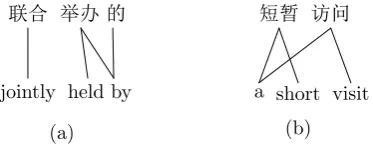
jointly held by
(a)
a short visit (b)
Figure 4: Illustration for monotone span (a) and PM span (b).
tags to each word in the source span, according to their position.
To do this, we first introduce some notations. Given a bilingual sentence(FJ
1, E1I)together with
word alignment matrix A, we use L(Aj) and
H(Aj) to represent the lowest and highest tar-get word position which links to the source word
fj, respectively. Since the word alignment forfj maybe “one-to-many”, all the corresponding tar-get words will appear in the span[L(Aj), H(Aj)]. we define a source span[j1, j2] (1≤j1 ≤j2 ≤ J)a monotone span, iff:
1. ∀(j, i) ∈ A, j1 ≤ j ≤ j2 ↔ L(Aj1) ≤i ≤ H(Aj2)
2. ∀k1, k2 ∈ [j1, j2], k1 ≤ k2 → H(Ak1) ≤ L(Ak2)
The first condition indicates that (Fj2
j1, E
H(Aj2)
L(Aj1)) is a phrase pair as described
previously in phrase-based SMT models. While the second condition indicates that the lower target bound linked to a source word cannot be lower than any target word position linked to the previous source word. Therefore, a monotone span does not contain crossed links or internal reorderings.
Considering that word alignments could be very noisy and complex in real-world data, we de-fine pseudo-monotone (PM) span by loosening the second condition:
∀k1, k2 ∈[j1, j2], k1≤k2 →L(Ak1)≤L(Ak2)
(5) This condition allows crossed links to some ex-tent by loosening the bound of Ak1 from upper
to lower. Figure 4 (a) shows an example of monotone span, in which the translation is mono-tone. While Figure 4 (b) is not a monotone span
because there is a cross link between the upper bound of “ ” and the lower bound of “ ” on the target side. However, it is a PM span ac-cording to the definition. Note that in some cases, a source word may not be contained in any phrase pair, therefore we consider a single word span as a PM span, specificly.
An interesting feature of PM span is that if two PM spans are consecutive on both source side and their corresponding target side, the two PM spans can be combined as a larger PM span. Formally,
(Fjj1, Eii1)M(Fj2
j+1, Eii+12 ) = (F
j2
j1, E
i2
i1) (6)
where[j1, j]and[j+ 1, j2]are PM spans,[i1, i]
and[i+ 1, i2]are the target spans corresponding
to[j1, j]and[j+1, j2], respectively. For example,
Figure 4 (a) shows a PM phrase pair that consists of two small PM pairs “ , jointly” and “
, held by”.
In this paper, we are interested in phrase re-ordering boundaries for a source sentence. We de-fine translation span (TS) the largest possible PM span. A TS may consist of one or more PM spans. According to our definition, cross links may ap-pear within PM spans but do not apap-pear between PM spans within a TS. Therefore, TS is the largest possible span that will be translated as a unit and phrase reorderings may occur between TSs during decoding.
To obtain phrase boundary examples from word-aligned bilingual sentences, we first find all possible TSs and then assign boundary tags to each word. For a TS[j1, j2] (j1 < j2)that contain
more than two words, we assign “b” to the first wordfj1 and “e” to the last wordfj2, and “m” to
the middle wordsfj (j1 < j < j2). For a single
word span TS[j, j], we assign “s” to the wordfj.
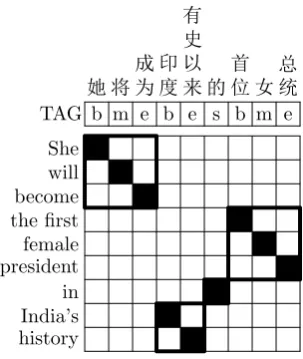
TAG b m e b e s b m e
She will become the first female president in India’s history
Figure 5: Illustration for labelling the source words with boundary tags. The solid boxes present word alignments. The bordered boxes are TSs.
3.2 Feature Definition
The features we used for the PS model are anal-ogous to (Ng and Low, 2004). For a word W0,
we define the following contextual features with a window of “n”:
• The word featureWn, which denotes the left (right)nwords of the current wordW0;
• The part-of-speech (POS) featurePn, which denotes the POS tag of the wordWn.
For example, the tag of the word “ (be-come)” in Figure 5 is “e”, indicating that it is the end of a phrase. If we set the context window
n= 2, the features of the word “ (become)” are:
• W−2= W−1= W0= W1=
W2=
• P−2=rP−1=dP0=vP1=nsP2=l
We collect TSs from bilingual sentences to-gether with the contextual features and used a MaxEnt toolkit (Zhang, 2004) to train a PBC.
b 0.78 0.10 1.2e-5 m 6.4e-8 0.75 5.4e-5 e 2.1e-8 0.11 0.87 s 0.22 0.04 0.13
Table 1: The TPM for a source sentence. The highest probability of each word is in bold.
4 Phrase Boundary Constrained Decoding
Give a source sentence, we can assign boundary tags to each word by running the PBC. During decoding, a rule is prohibited to pattern-match across phrase boundaries. By doing this, the PBC is integrated as a hard constraint. However, this method will invalidate a large number of rules and the decoder suffers from a risk that there are not enough rules to cover the source sentence.
Alternatively, inspired by previous approaches, we integrate the phrase boundary classifier as a soft constraint by incorporating it as a feature into the HPB model:
hpbc(F1J) =log(
J
Y
j=1
Ptag(t|fj, F1J)) (7)
To perform translation, for each word fj in a source sentence F1J, we first compute all tag probabilities Ptag(t|fj), where t ∈ (b, m, e, s),
j∈[1, J], according to Equation 4. Therefore, we build a4×J tag-word probability matrix (TPM).
T P M[i, j] indicates the probability of the word
fj labelled with the tag ti. Table 1 shows the TPM for a source text “ ”.
Then we select rule options from the rule ta-ble that can be used for translating the source text. Since each rule option(f ,eee, a)1 can be regarded
as a bilingual sentence with word alignments, thus we find all TS infeand assign an initial tag (IT) for each source word. This procedure is analogous to label phrase boundary tags for a word-aligned bilingual sentence. For example, the following rules are used for translating the Chinese sentence in Table 1:
1
X→ h bX1∗, SheX1i (8)
X1 → h b e, will becomei (9)
Since both the source sides of these two rules are PM spans according to the word alignments, the IT sequences for rule (8) and (9) are “b *”2 and “b e”, respectively. According to Table 1, the initial hpbc score for these two rules can be computed as follows:
h(7)pbc =log(Ptag(b| )) =log(T P M[1,1])(10)
h(8)pbc =log(Ptag(b| )) +log(Ptag(e| )) =log(T P M[1,2]) +log(T P M[3,3])(11)
Note that to keep the tag sequence valid, e.g. “m” follows “b” rather than “s”, the ITs maybe updated during decoding. The tag-updating should be consistent with the definition of TS as described in Section 3.1. Specifically, when the non-terminal symbol X is derived from its cov-ered spanf(X), the boundary tags should be up-dated.
When a tag of word fj is updated from tk1 to tk2, the PBC score should also be updated
accord-ing to TPM:
∆P BC=log(T P M[k2, j])−log(T P M[k1, j])
(12) The following is a derivation of the source sen-tence in Table 1:
S ⇒ h bX1∗, SheX1i
⇒ h b b→m e, She will becomei
WhenX1is derived, the tag of its left boundary
word “ ” is updated from “b” to “m”. The reason is that after derivation, the combined span forms a larger PM span and the left boundary off(X1)
should be updated.
As a result, thehpbcscore is recomputed:
hpbc(F13) =h (7)
pbc+h
(8)
pbc+ ∆P BC (13) where,
∆P BC=log(T P M[2,2])−log(T P M[1,2]) (14)
2
We use “*” as a tag of the non-terminal symbol “X1” since it has not been derived.
The decoding algorithm is efficient since the computing of the PBC score is a procedure of table-lookup.
5 Experiments
5.1 Experimental Setup
Our experiments were on Chinese-to-English translation. The training corpus (77M+81M) we used are from LDC 3. The evaluation metric is BLEU (Papineni et al., 2002), as calculated by mteval-v11b.pl with case-insensitive matching of
n-grams, wheren= 4.
To obtain word alignments, we first ran GIZA++ (Och and Ney, 2002) in both translation directions and then refined it by “grow-diag-final” method (Koehn et al., 2003).
For the language model, we used the SRI Lan-guage Modeling Toolkit (Stolcke, 2002) to train two 4-gram models on xinhua portion of Giga-Word corpus and the English side of the training corpus.
The NIST MT03 test set is used to tune the fea-ture weights of the log-linear model by MERT (Och, 2003). We tested our system on the NIST MT06 and MT08 test sets.
5.2 Results
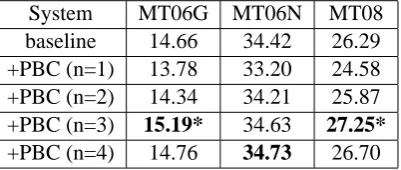
The results are shown in Table 2. We tested vari-ous settings of the context window. It is observed that the small values of n (n = 1,2) drop the BLEU score, suggesting that perhaps there are not enough contextual information. With more con-textual information is used, the BLEU scores are improved over all test sets. Whenn= 3, the most significant improvements are obtained on MT06G and MT08. The improvements over the baseline are statistically significant atp < 0.01 by using the significant test method described in (Koehn, 2004). While for MT06N, the optimized context window size is n = 4 but the improvement is not statistically significant. In most cases, with
nlarger than 3, we do not obtain further improve-ments because of the data sparseness for training
3
LDC2002E18, LDC2002L27, LDC2002T01,
System MT06G MT06N MT08 baseline 14.66 34.42 26.29 +PBC (n=1) 13.78 33.20 24.58 +PBC (n=2) 14.34 34.21 25.87 +PBC (n=3) 15.19* 34.63 27.25* +PBC (n=4) 14.76 34.73 26.70
Table 2: Results on the test sets with different con-text window (n) of the phrase boundary classifier. The largest BLEU score on each test set is in bold. MT06G: MT06 GALE set. MT06N: MT06 NIST set. *: significantly better than the baseline at
p <0.01.
the classifier.
6 Discussion
The experimental results show that the phrase boundary constrained method improves the BLEU score over the baseline system. Furthermore, we are interested in how the PBC affects the transla-tion results? We compared the outputs generated by the baseline and “+PBC (n = 3)” system and found some interesting translations. For example, the translations of a source sentence of NIST08 are as follows 4:
• Src: b1 m2 m3 m4 e5 k b6
m
7 e8k b9 m10 e11
• Ref: US1 Treasury-Secretary2 Arrives-in3
China4 for-a-Visit-with5 Environment6 and7
Exchange-Rate8as9Focus10,11
• HPB: US1 Treasury2
in-environmental-protection6 and7 visit5 China4 is9 key11
to-the-concern-of10the-exchange-rate8
• +PBC: US1 Treasury2 arrived-in3 China4
for-a-visit5 environmental-protection6 and7
exchange-rate8 is9 concerned-about10
the-key11
In the example, both “ ” and “ ” in the source sentence are the concern of the “visit”. Therefore, the source span [6,8] indicates a co-hesive phrase, which should be translated as a
4
The co-indexes of the words on the source and target sentence indicate word alignments.
whole unit. However, the baseline translates the spans [6,7]and [8,8] separately. It moves[6,7] before “visit China” and [8,8] after “concern”. This makes an mistake on phrase reordering. We observe that the “+PBC” system produces a bet-ter translation. Afbet-ter incorporating the PBC as a soft constraint, the system assigns a boundary tag to each source word and segments the source sentence into three TSs. According to our defi-nition, TSs are encouraged as pseudo-monotone translation unit during decoding. As a result, the “+PBC” system discourages some arbitrary re-ordering rules and produces more fluent transla-tion.
7 Conclusion and Future Work
This paper presented a phrase boundary con-strained method for hierarchical phrase-based translation. A phrase boundary indicates begin or end of a phrase reordering. We built a phrase boundary classifier within a maximum entropy framework and learned phrase boundary exam-ples directly from word-aligned bilingual corpus. We proposed an efficient decoding method to in-tegrate the PBC into the decoder as a soft con-straint. Experiments and analysis show that the phrase boundary constrained method achieves sig-nificant improvements over the baseline system.
The most advantage of the PBC is that it han-dles both syntactic and non-syntactic phrases. In the future, We would like to try different meth-ods to determine more informative phrase bound-aries, e.g. Xiong et al. (2010) proposed a method to learn translation boundaries from a hierarchical tree that decomposed from word alignments using a shift-reduce algorithm. In addition, we will try more features as described in (Chiang et al., 2008; Chiang et al., 2009), e.g. the length of the phrases that covered by non-terminals.
References
Cherry, Colin. 2008. Cohesive phrase-based decoding for statistical machine translation. In Proceedings
of the 46rd Annual Meeting of the Association for Computational Linguistics: Human Language Tech-nologies, page 72 80.
2008. Online large-margin training of syntactic and structural translation features. In Proceedings of the
Conference on Empirical Methods in Natural Lan-guage Processing, page 224 233.
Chiang, David, Wei Wang, and Kevin Knight. 2009. 11,001 new features for statistical machine trans-lation. In Proceedings of Human Language
Tech-nologies: the 2009 Annual Conference of the North American Chapter of the Association for Computa-tional Linguistics, page 218 226.
Chiang, David. 2005. A hierarchical phrase-based model for statistical machine translation. In
Pro-ceedings of the 43rd Annual Meeting of the Associa-tion for ComputaAssocia-tional Linguistics, pages 263–270.
Chiang, David. 2007. Hierarchical phrase-based translation. Computational Linguistics, pages
33(2):201–228.
Gimpel, Kevin and Noah A. Smith. 2008. Rich source-side context for statistical machine transla-tion. In In Proceedings of the ACL-2008 Workshop
on Statistical Machine Translation (WMT-2008),
pages 9–17.
Koehn, Philipp, Franz J. Och, and Daniel Marcu. 2003. Statistical phrase-based translation. In
Pro-ceedings of HLT-NAACL 2003, pages 127–133.
Koehn, Philipp. 2004. Statistical significance tests for machine translation evaluation. In Proceedings of
the 2004 Conference on Empirical Methods in Nat-ural Language Processing (EMNLP), pages 388–
395.
Marton, Yuval and Philip Resnik. 2008. Soft syntac-tic constraints for hierarchical phrased-based trans-lation. In Proceedings of the 46rd Annual Meeting
of the Association for Computational Linguistics: Human Language Technologies, pages 1003–1011.
Ng, Hweetou and Jinkiat Low. 2004. Chinese part-of-speech tagging: One-at-a-time or all-at-once? word-based or character-based? In Proceedings of
the 2004 Conference on Empirical Methods in Nat-ural Language Processing (EMNLP 2004), pages
277–284.
Och, Franz Josef and Hermann Ney. 2002. Dis-criminative training and maximum entropy models for statistical machine translation. In Proceedings
of the 40th Annual Meeting of the Association for Computational Linguistics, pages 295–302.
Och, Franz Josef and Hermann Ney. 2004. The align-ment template approach to statistical machine trans-lation. 30:417–449.
Och, Franz Josef. 2003. Minimum error rate training in statistical machine translation. In Proceedings of
the 41st Annual Meeting of the Association for Com-putational Linguistics, pages 160–167.
Papineni, K., S. Roukos, T. Ward, and W.-J. Zhu. 2002. Bleu: a method for automatic evaluation of machine translation. In Proceedings of the 40th
An-nual Meeting of the Association for Computational Linguistics, pages 311–318.
Stolcke, Andreas. 2002. SRILM – An extensible lan-guage modeling toolkit. In Proceedings of the
Inter-national Conference on Spoken language Process-ing, volume 2, pages 901–904.
Xiong, Deyi, Min Zhang, Aiti Aw, and Haizhou Li. 2009. A syntax-driven bracketing model for phrase-based translation. In ACL-IJCNLP 2009, page 315 323.
Xiong, Deyi, Min Zhang, and Haizhou Li. 2010. Learning translation boundaries for phrase-based decoding. In Human Language Technologies: The
2010 Annual Conference of the North American Chapter of the ACL, page 136 144.