Unsupervised Induction of Labeled Parse Trees
by Clustering with Syntactic Features
Roi Reichart
ICNC
Hebrew University of Jerusalem
Ari Rappoport
Institute of computer science Hebrew University of Jerusalem
Abstract
We present an algorithm for unsupervised induction of labeled parse trees. The al-gorithm has three stages: bracketing, ini-tial labeling, and label clustering. Brack-eting is done from raw text using an un-supervised incremental parser. Initial la-beling is done using a merging model that aims at minimizing the grammar descrip-tion length. Finally, labels are clustered to a desired number of labels using syn-tactic features extracted from the initially labeled trees. The algorithm obtains 59% labeled f-score on the WSJ10 corpus, as compared to 35% in previous work, and substantial error reduction over a random baseline. We report results for English, German and Chinese corpora, using two label mapping methods and two label set sizes.
1 Introduction
Unsupervised learning of grammar from text (‘grammar induction’) is of great theoretical and practical importance. It can shed light on language acquisition by humans and on the general structure of language, and it can potentially assist NLP ap-plications that utilize parser output. The problem has attracted researchers for decades, and interest has greatly increased recently, in part due to the availability of huge corpora, computation power, and new learning algorithms (see Section 2).
A fundamental issue in this research direction is the representation of the resulting induced
gram-c
2008. Licensed under the Creative Commons
Attribution-Noncommercial-Share Alike 3.0 Unported
li-cense (http://creativecommons.org/licenses/by-nc-sa/3.0/). Some rights reserved.
mar. Most recent work (e.g., (Klein and Manning, 2004; Dennis, 2005; Bod, 2006a; Smith and Eis-ner, 2006; SegiEis-ner, 2007)) annotates text sentences using a hierarchical bracketing (constituents) or a dependency structure, and thus represents the in-duced grammar through its behavior in a parsing task. Solan et al. (2005) uses a graph representa-tion, while (Nakamura, 2006) simply uses a gram-mar formalism such as PCFG. When the bracket-ing approach is taken, some algorithms label the resulting constituents, while most do not.
Each of these approaches can be justified or crit-icized; a detailed discussion of this issue is be-yond the scope of this paper. The algorithm pre-sented here belongs to the first group, annotating given sentences with labeled bracketing structures. The main theoretical justification for this approach is that many linguistic and psycho-linguistic theo-ries posit some kind of a hierarchical labeled con-stituent (or constructional) structure, arguing that it has a measurable psychological (cognitive) reality (e.g., (Goldberg, 2006)). The main practical argu-ments in favor of this approach are that it enables a detailed and large-scale evaluation using anno-tated corpora, as is done in this paper, and that the output format is suitable for many applications.
When an algorithm generates labeled structures, the number of labels is an important issue. From a theoretical point of view, the algorithm should also discover the appropriate number of labels. How-ever, for evaluation and application purposes it is useful to base the number of labels on a specific
target grammar. In previous work, the number was
set to be equal to that in the target grammar. This is a reasonable approach that we experiment with in this paper. In addition, to reduce the possible arbitrariness in this approach, we also experiment with the number of prominent labels in the target
grammar, determined according to their coverage of corpus constituents.
Another issue relates to the nature of the in-put. In most cases (e.g., in the Klein, Smith, Den-nis and Bod papers above), the input consists of part-of-speech (POS) sequences, derived from text corpora by manual or automatic POS tagging. In some cases (e.g., in the Seginer and Solan papers above) it can consist of plain text. Again, each approach has its pros and cons. The algorithm we present here requires POS tags for its labeling stages. Parts-of-speech are widely considered to have a psychological reality (at least in English, including when they are viewed as low-level con-structions as in (Croft, 2001)), so this kind of input is reasonable for theoretical research. Moreover, as POS induction is of medium quality (Clark, 2003), using a manually POS tagged corpus enables us to measure the performance of other induction stages in a controlled manner. Since supervised POS tag-ging is of very high quality and very efficient com-putationally (Brants, 2000), this requirement does not seriously limit the practical applicability of a grammar induction algorithm.
Our labeled bracketings induction algorithm consists of three stages. We first induce unla-beled bracketing trees using the algorithm given in (Seginer, 2007)1. We then induce initial labels us-ing a Bayesian Model Mergus-ing (BMM) labelus-ing al-gorithm (Borensztajn and Zuidema, 2007), which aims at minimizing the description length of the input data and the induced grammar. Finally, the initial labels are clustered to a desired number of labels using syntactic features extracted from the initially labeled trees. Previous work on labeled brackets induction (Section 2) did not differentiate the unlabeled structure induction phase from the labeling phase, applying a single phase approach.
To evaluate labeled bracketings, we need a map-ping between the label symbols of the induced and target grammars. Previous work used a ‘greedy’, many to one, mapping. We used both the greedy mapping and a label-to-label (LL) mapping, since greedy mapping is highly forgiving to structural problems in the induced labeling. We report results for two cases: one in which the number of labels in the induced and target grammars is the same, and one in which the former is the number of promi-nent labels in the target grammar. We discuss how this number can be defined and determined. We
1
The algorithm uses raw (not POS tagged) sentences.
experimented with English (WSJ10, Brown10), German (NEGRA10) and Chinese (CTB10) cor-pora.
When comparing to previous work that used manually annotated corpora in its evaluation (Haghighi and Klein, 2006)2, we obtained 59.5% labeled f-score on the WSJ10 setup vs. their 35.3% (Section 5). We also show substantial improve-ment over a random baseline, and that the cluster-ing stage of our algorithm improves the results of the second merging stage.
Section 2 discusses previous work. In Section 3 we detail our algorithm. The experimental setup and results are presented in Sections 4 and 5.
2 Previous Work
Unsupervised parsing has attracted researchers for decades (see (Clark, 2001; Klein, 2005) for recent reviews). Many types of input, syntax formalisms, search procedures, and success criteria were used. Among the theoretical and practical motivations to this problem are the study of human language ac-quisition (in particular, an empirical study of the poverty of stimulus hypothesis), preprocessing for constructing large treebanks (Van Zaanen, 2001), and improving language models (Chen, 1995).
In recent years efforts have been made to eval-uate the algorithms on manually annotated cor-pora such as the WSJ PennTreebank. Recently, works along this line have for the first time out-performed the right branching heuristic baseline for English. These include the constituent–context model (CCM) (Klein and Manning, 2002), its extension using a dependency model (Klein and Manning, 2004), (U)DOP based models (Bod, 2006a; Bod, 2006b; Bod, 2007), an exemplar– based approach (Dennis, 2005), guiding EM using contrastive estimation (Smith and Eisner, 2006), and the incremental parser of (Seginer, 2007). All of these use as input POS tag sequences, except of Seginer’s algorithm, which uses plain text. All of these papers induce unlabeled bracketing or de-pendencies.
There are other algorithmic approaches to the problem (e.g., (Adriaans, 1992; Daelemans, 1995; Van Zaanen, 2001)). None of these had evaluated labeled bracketing on annotated corpora.
In this paper we focus on the induction of
labeled bracketing. Bayesian Model Merging
2
(BMM) (Stolcke, 1994; Stolcke and Omohundro, 1994) is a framework for inducing PCFG contain-ing both a bracketcontain-ing and a labelcontain-ing. The charac-teristics of this framework (separating prior prob-ability, data likelihood and heuristic search proce-dures) can also be found in the grammar induction models of (Wolf, 1982; Langley and Stromsten, 2000; Petasis et al., 2004; Solan et al., 2005). The BMM model used here (Borensztajn and Zuidema, 2007) combines features of (Petasis et al., 2004) and Stolcke’s algorithm, applying the minimum description length (MDL) principle. We use it here only for initial labeling of existing bracketings. The MDL principle was also used in (Grunwald, 1994; de Marcken, 1995; Clark, 2001).
There are only two previous papers we are aware of that induce labeled bracketing and eval-uate on corpora annotated with a similar repre-sentation (Haghighi and Klein, 2006; Borensztajn and Zuidema, 2007). We utilize and extend the latter’s labeling algorithm. However, the evalu-ation done by the latter dealt only with labeling, using gold-standard (manually annotated) bracket-ings. Thus, we can directly compare our results only to (Haghighi and Klein, 2006), where two models (PCFG×NONEandPCFG×CCM) are fully
un-supervised. These models use the inside-outside and EM algorithms to induce bracketing and label-ing simultaneously, as opposed to our three step method3.
3 Algorithm
Our model consists of three stages: bracketing, ini-tial labeling, and label clustering.
3.1 Induction of Unlabeled Bracketing
In this step, we apply the algorithm of (Seginer, 2007) to induce bracketing from plain text4. We
have chosen that algorithm because it is very fast (both learning and parsing) and its code is publicly available. We could have chosen any of the algo-rithms mentioned above producing a similar output format.
3.2 Initial Constituent Labeling
Our label clustering stage uses syntactic fea-tures. To obtain these, we need an initial label-ing on the bracketlabel-ings computed in the previous
3
Their other models, which were the core of their paper, are semi-supervised.
4
http://www.seggu.net/ccl
stage. To do that we modify the Bayesian Model Merging (BMM) algorithm of (Borensztajn and Zuidema, 2007), which induces context-free gram-mars (bracketing and labeling) from POS tags, combining features of the models of (Stolcke and Omohundro, 1994) and (Petasis et al., 2004).
The BMM algorithm (Borensztajn and Zuidema, 2007) uses an iterative heuristic greedy search for an optimal PCFG according to the Bayesian criterion of maximum posterior prob-ability. Two operators define possible transitions between grammars: MERGE creates generaliza-tions by replacing two existing non-terminals X1 and X2 that occur in the same contexts by a
single new non-terminalY; CHUNK concatenates repeating patterns by taking a sequence of two non-terminals X1 and X2 and creating a new non-terminal Y that expands toX1X2.
We have used the algorithm to deal only with labeling. It reads the initial rules of the grammar from all productions implicit in the bracketed cor-pus induced in the previous step. Every constituent (except of the start symbol) is given a unique label. Since only labeling is required, onlyMERGE oper-ations are performed.
The objective function the algorithm tries to op-timize at each step is the posterior probability cal-culated according to Bayes’ Law:
MMAP=argmaxMP(M|X) =argmaxMP(X|M)·P(M) (1)
where P(X|M) is the likelihood of the data X given the grammarM andP(M)is the prior prob-ability of the grammar. This is equivalent to mini-mizing the function
−log(P(X|M))−logP(m) :=DDL+GDL:=DL. (2)
is iterated until no additional merge operation im-proves the objective function. Full details are given in (Borensztajn and Zuidema, 2007).
3.3 Label Clustering
Label set size. BMM produces quite a large
num-ber of labels (4944 for WSJ105). In the third step of our algorithm we reduce that number. We first discuss the issue of the number of labels in induced grammars, which is an important issue.
In many situations, it is reasonable to use a num-berT identical to the number of labels in a given target grammar, for example when that grammar is used for applications or evaluation. This is the approach in (Haghighi and Klein, 2006) for their unsupervised models6, and we use it in part of our evaluation. However, it is also reasonable to argue that the granularity of syntactic categories (labels) in the gold standard annotation of the corpora we experiment with is somewhat arbitrary. For exam-ple, in the WSJ Penn Treebank noun phrases are annotated with the symbol NP, but there is no dis-tinction between subject and object NPs. Incorpo-rating such a distinction into the WSJ10 grammar would result in a 27 labels grammar instead of 26. To examine this issue, consider Figure 1, which shows the amount of constituent coverage obtained by a certain number of labels in the four corpora we use (see Section 4). In all of them, about 95% of the constituents are covered by 23% – 37% of the labels, and the curve rises very sharply until that 95% value. Motivated by this observation, given a corpus annotated using a certain hierarchi-cal labeled grammar, we refer to the set ofP labels that cover at least 95% of the constituents in the corpus as the grammar’s prominent labels.
The prominent labels are not only the most frequent in the corpus; each of them substan-tially contributes to constituent labeling, while the saliency of other labels is much smaller. It is thus reasonable to assume that by addressing only prominent labels, we address a level of granularity that is uniform and basic (to the annotation scheme used). As a result, by asking the induced grammar to produce P labels, we reduce arbitrariness and enable our testing to focus on our success in iden-tifying the basic phenomena in the target grammar.
5
For completeness, in Section 5 we provide results for this grammar using greedy mapping evaluation. LL mapping eval-uation cannot be performed when the numbers of induced and target labels differ.
6
Personal communication with the authors.
0 5 10 15 20 25 30
20 30 40 50 60 70 80 90 100
K most frequent labels
% of constituents
NEGRA10 BROWN10 WSJ10 CTB10
Figure 1: For each k, the fraction of constituents labeled with thekmost frequent labels, for WSJ10 (solid), Brown10 (triangles), NEGRA10 (dashed) and CTB10 (dotted). In all corpora, more than 95% of the constituents are labeled using less than 10 prominent labels.
As a result, we generated two grammars for each corpus we experimented with, one havingTlabels and the other havingP labels.
Clustering. we stop BMM when no improvement
to its objective function is possible, and cluster the labels to conform to the size constraint. 7
Denote the number of labels in the induced grammar withM, the set of Dmost frequent in-duced labels withA, and the set consisting of the other induced labels withB (|B| = M −D). If M 6> D, there is nothing to do since the con-straint holds. Otherwise, we map each label in B to the label in A that exhibits the most simi-lar syntactic behavior, as follows. We construct a feature vector representation of each of the la-bels, using3M +|K|features, whereKis the set of POS tags in the corpus. The first M features correspond to parent-child relationships between each of the induced labels and the represented la-bel. Thei-th feature(i∈[1, M])is the number of times thei-th label is the parent of the represented label. Similarly, the next M features correspond to child-parent relationships, the next M features correspond to sibling relationships and the last|K| features correspond to the number of times each POS tag is the leftmost POS tag in a constituent labeled by the represented label. Note that in order to compute the values of the first3M features, we needed an initial labeling on the induced bracket-ings; this is the main reason for using the BMM stage.
For each label bi ∈ B, we compute the cosine
7
metric between its vectorbvi and that of everyaj ∈ A, mappingbito the labelaj with which it obtains the highest score:
Map(bi) =argmaxj bv
i·avj |bv
i||avj|
(3)
The cosine metric grows when the same coordi-nates (features) in both vectors have higher values. As a result, vectors with high values of the same features (corresponding to similar syntactic behav-ior) get high scores.
4 Experimental Setup
We evaluated our algorithm on English, German and Chinese corpora: the WSJ Penn Treebank, containing economic English newspaper articles, the Brown corpus, containing various English gen-res, the Negra corpus (Brants, 1997) of German newspaper text, and version 5.0 of the Chinese Penn Treebank (Xue et al., 2002). In each cor-pus, we used the sentences of length at most 108, numbering 7422 (WSJ10), 9117 (Brown10), 7542 (NEGRA10) and 4626 (CTB10).
For each corpus the following T and P values were used: WSJ10: 26,8; Brown10: 28,7; NE-GRA10: 22,6; CTB10: 24,9. Each number pro-duces a different grammar.
For labeled f-score evaluation, the induced la-bels should be mapped to the target lala-bels9. We evaluated with two different mapping schemes. For each pair(Xi, Yj)of induced and target labels, letCXi,Yj be the number of times they label a con-stituent having the same span in the same sentence. Following (Haghighi and Klein, 2006) we applied a greedy (many to one) mapping where the map-ping is given byMap(Xi) = argmaxYj CXi,Yj. This greedy mapping tends to map many induced labels to the same target label, and is therefore highly forgiving of large mismatches between the structures of the induced and target grammars. Hence, we also applied a label-to-label (LL) map-ping, computed by reducing this problem to op-timal assignment in a weighted complete bipar-tite graph, formally defined as follows. Given a weighted complete bipartite graph G = (X ∪ Y;X×Y) where edge (Xi, Yj) has weight wij,
8
Excluding punctuation and null elements, according to the scheme of (Klein, 2005).
9There are many possible methods for evaluating
cluster-ing quality (Rosenberg and Hirschberg, 2007). For our task, overall f-score is a very natural one. We will address other methods in future papers.
find a (one-to-one) matchingM fromXtoY hav-ing a maximal weight. In our case,X is the set of model symbols, Y is the set of T orP most fre-quent target symbols (depending on the desired la-bel set size used), andwij :=CXi,Yj, computed as in greedy mapping (the number of timesxiandyj share a constituent). To make the graph complete, we add zero weight edges between induced and target labels that do not share any constituent. The Kuhn-Munkres algorithm (Kuhn, 1955; Munkres, 1957) solves this problem, and we used it to per-form the LL mapping (see also (Luo, 2005)).
We assessed the overall quality of our algorithm, the quality of its labeling stage and the quality of the syntactic clustering (SC) stage. For the over-all quality of the induced grammar (both brack-eting and labeling) we compare our results with (Haghighi and Klein, 2006), using their setup10. That setup was used for all numbers reported in this paper. Note that a random baseline would yield very poor results, so there is nothing to be gained from comparing to it.
We assessed the quality of the labeling (MDL and SC) stages alone, using only the correct brack-etings produced by the first stage of the algorithm. We compare to a random baseline on these correct constituents that randomly selects (using a uniform distribution) a label for each constituent among the set of labels allowed to the algorithm.
To asses the quality of the third stage (SC) we compare the f-score performance of our three stages labeled trees induction algorithm (bracket-ing, MDL, SC) to an algorithm consisting of the first two stages only (bracketing and MDL) and the accuracy of the two stages labeling algorithm (MDL, SC) to an algorithm where the syntactic clustering stage is replaced by a simpler method (MDL, random clustering).
5 Results
We start with comparing our algorithm with (Haghighi and Klein, 2006), the only previous work that produces labeled bracketing and was tested on large manually annotated corpora. Their relevant models arePCFG×NONEandPCFG×CCM11.
10
Brackets covering a single word are not counted, multi-ple labels and the sentence level constituent are counted. Two sentence level constituents are usually used: one for the root symbol at the top (which was not counted), and one real sym-bol (in WSJ10 it is usually, but not always, S), which was counted. We had verified the setup with the authors.
11
This Paper PCFG×CCM PCFG×NONE
WSJ10 59.5 35.3 26.3
Table 1: F-scores of our algorithm and of the unsu-pervised models in (Haghighi and Klein, 2006) on WSJ10 (they did not test these models on the other corpora we experimented with).
The number of labels in their induced grammar equals the number of labels in the target grammar (26 for WSJ10), and they had used a greedy map-ping. Table 1 shows that our algorithm achieves a superior f-score of 59.5% over their 35.3%. Haghighi and Klein (2006) did not experiment with the NEGRA10 and Brown10 corpora, and had used version 3.0 of CTB10 while we have used the substantially different version 5.0, so we can only compare our results on WSJ10.
Table 2 shows the labeled recall, precision and f-score of our algorithm on the various corpora and mappings we use. On Brown10, NEGRA10 and CTB10 (version 5.0) these are the first reported results for this task. For reference, the table also shows the unlabeled f-score results of Seginer’s bracketing algorithm (our first stage)12.
We can see that greedy mapping is indeed more forgiving than LL mapping, for both T labels and P labels. WSJ results are generally higher than for the other corpora, probably because WSJ bracket-ing results are higher than for the other corpora.
Comparing the left and right columns in each of the table sections reveals that for greedy map-ping, mapping to a higher number of labels results in higher scores than mapping to a lower number. LL mapping behaves in exactly the opposite way. The explanation for this is that when we force the mapping to cover all of the target labels (as done by LL mapping for T labels), we move probabil-ity mass from the correct, heavy labels to smaller ones, thereby magnifying errors.
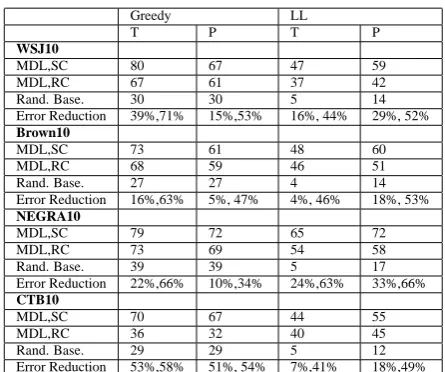
Table 4 addresses the quality of the whole la-beling stage (MDL and SC) and of the SC stage. We report the quality of our labels (top line for each corpus in the table) the random baseline la-bels (third line) and the lala-bels of an algorithm where MDL is performed and the syntactic clus-tering is replaced by a random clusclus-tering (RC) al-gorithm that, given a labelLthat is not one of the T orP most frequent labels, randomly selects one of the most frequent labels and adds Lto its
clus-12
The numbers slightly differ from those in Seginer’s paper, since we use the (Haghighi and Klein, 2006) setup.
Greedy LL
T P T P
WSJ10
MDL,SC 80 67 47 59
MDL,RC 67 61 37 42
Rand. Base. 30 30 5 14
Error Reduction 39%,71% 15%,53% 16%, 44% 29%, 52%
Brown10
MDL,SC 73 61 48 60
MDL,RC 68 59 46 51
Rand. Base. 27 27 4 14
Error Reduction 16%,63% 5%, 47% 4%, 46% 18%, 53%
NEGRA10
MDL,SC 79 72 65 72
MDL,RC 73 69 54 58
Rand. Base. 39 39 5 17
Error Reduction 22%,66% 10%,34% 24%,63% 33%,66%
CTB10
MDL,SC 70 67 44 55
MDL,RC 36 32 40 45
Rand. Base. 29 29 5 12
Error Reduction 53%,58% 51%, 54% 7%,41% 18%,49%
Table 4: Pure labeling results (taking into account only the correct bracketings produced at stage 1), compared to the random and (MDL,RC) baselines. The left number in the Error Reduction lines slots compares (MDL,SC) to (MDL,RC) and the right number compares (MDL,SC) to random labeling. (MDL,SC) algorithm is substantially superior.
ter (second line).13 All three labeling algorithms used Seginer’s bracketing and results are reported only for labels of correctly bracketed constituents. Reported are the algorithm and baselines accuracy (percentage of correctly labeled constituents after the mapping has been performed) and the error re-duction of the algorithm over the baselines (bottom line). (MDL,SC) substantially outperforms both the random baseline, demonstrating the power of the whole labeling stage, and the (MDL,RC) algo-rithm, demonstrating the power of the SC stage.
We compared our grammars to the grammars in-duced by the first two stages (bracketing and then MDL that stops when no DL improvement is pos-sible) alone. Since the number of labels in these grammars is much larger than in the target gram-mar, only the evaluation with the greedy, many to one, mapping is performed. Using greedy map-ping, the F-score of these grammars constitutes an upper bound on the F-score after the subsequent SC stage. For WSJ10 (4944 labels), NEGRA10 (5557 labels), CTB10 (2298 labels) and Brown10 (3314 labels) F-score values are 64.6, 49.9, 38.7 and 52.5 compared to F-score values of 59.5(50.2), 45.6(42), 36.4(34.7) and 49.4(41.3) after mapping all induced labels to the T (P) most frequent la-bels with SC (Table 2, ‘greedy’ section). The
frac-13
Greedy Mapping LL Mapping Seginer
Tlabels Plabels Tlabels Plabels (unlabeled)
Corpus R P F R P F R P F R P F F
WSJ10 58 61 59.5 48.9 51.5 50.2 34.2 36.1 35.2 42.7 44.9 43.8 74.6 NEGRA10 54.2 39.3 45.6 50 36.2 42 44.7 32.4 37.6 49.5 35.9 41.7 58.1 CTB10 35.1 37.8 36.4 33.4 36 34.7 21.9 23.6 22.7 27.4 29.5 28.4 51.8 Brown10 47.6 51.3 49.4 39.9 43 41.3 31.3 33.7 32.4 38.9 41.9 40.3 67.8
Table 2: Labeled recall, precision and f-score of our algorithm, mapping model labels into target labels greedily (left) and using LL mapping (right). The number of induced labels was set to be the total numberT of target labels or the number P of prominent labels in the target grammar (WSJ10: 26, 8; Brown10: 28, 7; NEGRA10: 22, 6; CTB10: 24, 9). Also shown are Seginer’s unlabeled bracketing results (rightmost column), which constitute an upper bound on the quality of subsequent labeling steps.
WSJ10 Brown10
Label Tlabels Plabels Tlabels Plabels
R P F R P F R P F R P F
S 77.1 77.6 77.3 75.4 67.9 71.5 72.3 60.9 66.1 69.3 63.2 66.1 NP 8.5 79.5 15.4 19.8 61.6 30 10.7 79.3 18.9 15.6 78 26 VP 20.4 67.6 31.3 64.2 36.7 46.7 9.8 72.5 17.3 14.1 59 22.8 PP 40.8 63.5 49.7 8 8.9 8.4 17.4 59.2 26.9 75.5 14.4 24.2
Table 3: Recall, Precision and F-score for constituents labeled with the 4 most frequent labels in the WSJ10 and Brown10 test sets. LL mapping is used for evaluation.
tion of constituents covered by theT(P) most fre-quent labels before mapping with SC is 0.42(0.29), 0.33(0.23), 0.58(0.45) and 0.66(0.42), emphasiz-ing the effect of SC on the final result.
MDL finds the best merge at each iteration. In-stead of stopping it when no DL gains are possi-ble, we can keep merging after the deltas become worse than the total DL, stopping only when the desired number of labels (T orP) is achieved. We tried this version of a (bracketing and MDL) algo-rithm and obtained grammars of very low quality. This further demonstrates the importance of the SC stage.
Table 3 shows results for the four most frequent labels of WSJ10 and Brown10 .
6 Conclusion
Unsupervised grammar induction is a central re-search problem, possessing both theoretical and practical significance. There is great value in pro-ducing an output format consistent with and evalu-ated against formats used in large human annotevalu-ated corpora. Most previous work of that kind produces unlabeled bracketing or dependencies. In this pa-per we presented an algorithm that induces labeled bracketing. The labeling stages of the algorithm use the MDL principle to induce an initial, rela-tively large, set of labels, which are then clustered using syntactic features. We discussed the issue of the desired number of labels, and introduced the
concept of prominent labels, which allows us cov-erage of the basic and most salient level of a target grammar. Labels are clearly an important aspect of grammar induction. Future work will explore their significance for applications.
Evaluating induced labels is a complex issue. We applied greedy mapping as in previous work, and showed that our algorithm significantly out-performs it. In addition, we introduced LL map-ping, which overcomes some of the shortcomings of greedy mapping. There are several other possi-ble methods for evaluating labeled induced gram-mars, and we plan to explore them in future work. We evaluated on large human annotated corpora of different English domains and three languages, and showed that our labeling stages, and specif-ically the SC stage, outperform several baselines for all corpora and mapping methods.
Acknowledgments. We thank Gideon
Borensz-tajn and Yoav Seginer for their help.
References
Pieter Adriaans, 1992. Learning Language from a
Categorical Perspective. Ph.D. thesis, University of
Amsterdam.
Rens Bod, 2006a. An All-Subtrees Approach to Un-supervised Parsing. Proc. of the 44th Meeting of the
ACL.
Rens Bod, 2006b. Unsupervised Parsing with U-DOP.
Rens Bod, 2007. Is the End of Supervised Parsing in Sight? Proc. of the 45th Meeting of the ACL.
Gideon Borensztajn and Willem Zuidema, 2007.
Bayesian Model Merging for Unsupervised Con-stituent Labeling and Grammar Induction. Technical
Report, ILLC . http: //staff.science.uva.nl/∼gideon/
Thorsten Brants, 1997. The NEGRA Export Format.
CLAUS Report, Saarland University.
Thorsten Brants, 2000. TnT: A Statistical
Part-Of-Speech Tagger. Proc. of the 6th Applied Natural
Language Processing Conference.
Stanley F. Chen, 1995. Bayesian grammar induction for language modeling. Proc. of the 33th Meeting of
the ACL.
Alexander Clark, 2001. Unsupervised Language
Ac-quisition: Theory and Practice. Ph.D. thesis,
Uni-versity of Sussex.
Alexander Clark, 2003. Combining Distributional and Morphological Information for Part of Speech In-duction. Proc. of the 10th Meeting of the European
Chapter of the ACL.
Willliam A. Croft, 2001. Radical Construction
Gram-mar. Cambridge University Press.
Carl G. de Marcken, 1995. Unsupervised Language
Acquisition. Ph.D. thesis, MIT.
Walter Daelemans, 1995. Memory-based lexical ac-quisition and processing. Lecture Notes In Artificial
Intelligence, 898:85–98.
Simon Dennis, 2005. An exemplar-based approach to unsupervised parsing. Proceedings of the 27th
Con-ference of the Cognitive Science Society.
Adele E. Goldberg, 2006. Constructions at Work. Ox-ford University Press.
Peter Grunwald, 1994. A minimum description length approach to grammar inference. Lecture Notes In
Artificial Intelligence, 1004 : 203-216.
Aria Haghighi and Dan Klein, 2006. Prototype-driven grammar induction. Proc. of the 44th Meeting of the
ACL.
Jin–Dong Kim, Tomoko Ohta, Yuka Teteisi and Jun’ichi Tsujii, 2003. GENIA corpus – a seman-tically annotated corpus for bio-textmining.
Bioin-formatics, 19:i180–i182, Oxford University Press,
2003.
Dan Klein and Christopher Manning, 2002. A gener-ative constituent-context model for improved gram-mar induction. Proc. of the 40th Meeting of the ACL.
Dan Klein and Christopher Manning, 2004. Corpus-based induction of syntactic structure: Models of de-pendency and constituency. Proc. of the 42nd
Meet-ing of the ACL.
Dan Klein, 2005. The unsupervised learning of
natu-ral language structure. Ph.D. thesis, Stanford
Uni-versity.
Harold W. Kuhn, 1955. The Hungarian method for the assignment problem. Naval Research Logistics
Quarterly, 2:83-97.
Pat Langley and Sean Stromsten, 2000. Learning
context-free grammars with a simplicity bias. Proc.
of the 11th European Conference on Machine Learn-ing.
Xiaoqiang Luo, 2005. On coreference resolution per-formance metrics. Proc. of the 2005 Conference on
Empirical Methods in Natural Language Processing.
James Munkres, 1957. Algorithms for the Assignment and Transportation Problems. Journal of the SIAM, 5(1):32–38.
Katsuhiko Nakamura, 2006. Incremental learning of context free grammars by bridging rule generation and search for semi-optimum rule sets. Proc. of the
8th ICGI.
Georgios Petasis, Georgios Paliouras and Vangelis Karkaletsis, 2004. E-grids: Computationally effi-cient grammatical inference from positive examples.
Grammars, 7:69–110.
Andrew Rosenberg and Julia Hirschberg, 2007.
Entropy-based external cluster evaluation measure.
Proc. of the 2007 Conference on Empirical Methods in Natural Language Processing.
Yoav Seginer, 2007. Fast Unsupervised Incremental Parsing. Proc. of the 45th Meeting of the ACL.
Noah A. Smith and Jason Eisner, 2006. Annealing Structural Bias in Multilingual Weighted Grammar Induction . Proc. of the 44th Meeting of the ACL.
Zach Solan, David Horn, Eytan Ruppin, and Shimon Edelman, 2005. Unsupervised learning of natural languages. Proceedings of the National Academy of
Sciences, 102 : 11629–11634.
Andreas Stolcke. 1994. Bayesian Learning of
Proba-bilistic Language Models. Ph.D. thesis, University
of of California at Berkeley.
Andreas Stolcke and Stephen M. Omohundro, 1994. Inducing probabilistic grammars by Bayesian model merging . Proc. of the 2nd ICGI.
Menno van Zaanen, 2001. Bootstrapping Structure
into Language: Alignment-Based Learning. Ph.D.
thesis, University of Leeds.
J. Gerard Wolff, 1982. Language acquisition, data
compression and generalization. Language and
Communication, 2(1): 57–89.