A Framework for Identifying Textual Redundancy
Kapil Thadani and Kathleen McKeown Department of Computer Science,
Columbia University, New York, NY USA
{kapil,kathy}@cs.columbia.edu
Abstract
The task of identifying redundant infor-mation in documents that are generated from multiple sources provides a signifi-cant challenge for summarization and QA systems. Traditional clustering techniques detect redundancy at the sentential level and do not guarantee the preservation of all information within the document. We discuss an algorithm that generates a novel graph-based representation for a document and then utilizes a set cover approximation algorithm to remove redundant text from it. Our experiments show that this approach offers a significant performance advantage over clustering when evaluated over an an-notated dataset.
1 Introduction
This paper approaches the problem of identifying and reducing redundant information in documents that are generated from multiple sources. This task is closely related to many well-studied problems in the field of natural language processing such as summarization and paraphrase recognition. Sys-tems that utilize data from multiple sources, such as question-answering and extractive summariza-tion systems that operate on news data, usually in-clude a component to remove redundant informa-tion from appearing in their generated output.
However, practical attempts at reducing redun-dancy in the output of these types of systems usu-ally involve clustering the sentences of the gener-ated output, picking a representative sentence from each cluster and discarding the rest. Although this strategy would remove some redundant in-formation, clustering approaches tuned for coarse
c
2008. Licensed under the Creative Commons Attribution-Noncommercial-Share Alike 3.0 Unported li-cense (http://creativecommons.org/licenses/by-nc-sa/3.0/). Some rights reserved.
matches could also remove non-redundant infor-mation whereas clustering approaches tuned for near-exact matches could end up removing very little repeated information. This is simply a con-sequence of the fact that information can, and usu-ally does, exist at the sub-sentential level and that clusters of sentences don’t necessarily correspond to clusters ofinformation.
In this paper, we discuss a framework for build-ing a novel graph-based representation to detect re-dundancy within documents. We identify redun-dancy at the sub-sentential level through pairwise alignment between the sentences of a document and use this to build a bipartite graph which en-ables us to keep track of redundant information across all sentences. Common information be-tween pairs of sentences, detected with the align-ment algorithm, can be extrapolated to docualign-ment- document-wide units of information using the graph struc-ture. Individual sentences that are encompassed by the information in the rest of the document can then be identified and removed efficiently by us-ing a well-known greedy algorithm adapted for this representation.
2 Related Work
The challenge of minimizing redundant informa-tion is commonly faced by IR engines and extrac-tive summarization systems when generating their responses. A well-known diversity-based rerank-ing technique for these types of systems is MMR (Carbonell and Goldstein, 1998), which attempts to reduce redundancy by preferring sentences that differ from the sentences already selected for the summary. However, this approach does not at-tempt to identify sub-sentential redundancy.
Alternative approaches to identifying redun-dancy use clustering at the sentence level (Lin and Hovy, 2001) to remove sentences that are largely repetitive; however, as noted earlier, this is not well-suited to the redundancy task. The use of
tence simplification in conjunction with clustering (Siddharthan et al., 2004) could help alleviate this problem by effectively clustering smaller units, but this issue cannot be avoided unless sentences are simplified to atomic elements of information.
Other research has introduced the notion of identifying concepts in the input text (Filatova and Hatzivassiloglou, 2004), using a set cover algo-rithm to attempt to include as many concepts as possible. However, this approach uses tf-idf to approximate concepts and thus doesn’t explicitly identify redundant text. Our work draws on this approach but extends it to identify all detectable redundancies within a document set.
Another approach does identify small sub-sentential units of information within text called “Basic Elements” and uses these for evaluating summarizations (Hovy et al., 2006). Our approach, in contrast, does not make assumptions about the size or structure of redundant information since this is uncovered through alignments.
We thus require the use of an alignment algo-rithm to extract the common information between two pieces of text. This is related to the well-studied problem of identifying paraphrases (Barzi-lay and Lee, 2003; Pang et al., 2003) and the more general variant of recognizing textual entailment, which explores whether information expressed in a hypothesis can be inferred from a given premise. Entailment problems have also been approached with a wide variety of techniques, one of which is dependency tree alignment (Marsi et al., 2006), which we utilize as well to align segments of text while respecting syntax. However, our definition of redundancy does not extend to include unidi-rectional entailment, and the alignment process is simply required to identify equivalent information.
3 Levels of Information
In describing the redundancy task, we deal with multiple levels of semantic abstraction from the basic lexical form. This section describes the ter-minology used in this paper and the graph-based representation that is central to our approach.
3.1 Terminology
The following terms are used throughout this paper to refer to different aspects of a document.
Snippet: This is any span of text in the doc-ument and is a lexical realization of information. While a snippet generally refers to a single
sen-tence within a document, it can apply to multiple sentences or phrases within sentences. Since re-dundancy will be reduced by removing whole snip-pets, a snippet can be defined as the smallest unit of text that can be dropped from a document for the purpose of reducing redundancy.
To illustrate the levels of information that we consider, consider the following set of short sen-tences as snippets. Although this is a synthe-sized example to simplify presentation, sentences with this type of overlapping information occur frequently in the question-answering scenario over news in which our approach has been used.
x1: Whittington is an attorney.
x2: Cheney shot Whittington, a lawyer.
x3: Whittington, an attorney, was shot in Texas.
x4: Whittington was shot by Cheney while hunting quail.
x5: This happened during a quail hunt in Texas.
We can see that all the information inx1 is con-tained in both x2 and x3. While no other snip-pet is completely subsumed by any single snipsnip-pet, they can be made redundant given combinations of other snippets; for example,x4 is redundant given
x2,x3andx5. In order to identify these combina-tions, we need to identify the elements of informa-tion within each snippet.
Concept:This refers to a basic unit of informa-tion within a document. Concepts may be facts, opinions or details. These are not necessarily se-memes, which are atomic units of meaning, but simply units of information that are seen as atomic within the document. We further restrict the defi-nition of a concept to a unit of information seen in
more than one snippet, since we are only interested in concepts which help in identifying redundancy.
Formally, a document can be defined as a set of S snippets X = {x1, . . . ,xS}, which is a literal representation of the document. However, it can also be defined in terms of itsinformation content. We useZ={z1, . . . ,zC}to represent the set ofC concepts that cover all information appearing more than once in the document. In the example above, we can identify five non-overlapping concepts:
zA: Whittington was shot
zB: Whittington is an attorney
zC: The shooting occurred in Texas
zD: It happened during a hunt for quail
zE: Cheney was the shooter
Nugget: This is a textual representation of a concept in a snippet and therefore expresses some information which is also expressed elsewhere in the document. Different nuggets for a given con-cept may have unique lexico-syntactic realizations, as long as they all embody the same semantics. With regard to the notation used above, nuggets can be represented by anS ×C matrixY where eachyc
sdenotes the fragment of text (if any) from the snippetxsthat represents conceptzc.
Since a concept itself has no unique textual re-alization, it can be simply represented by the com-bination of all its nuggets. For instance, in the ex-ample shown above, conceptzDis seen in bothx4 andx5 in the form of two nuggets yD4 (“... while hunting quail”) andyD5 (“... during a quail hunt”), which are paraphrases. The degree to which we can consider this and other types of lexical or syn-tactic differences between nuggets that have the same semantic identity depends on the alignment algorithm used.
Intersection: This is the common information between two snippets that can be obtained through their alignment. For example, the intersection from the alignment between x2 and x4 consists of two fragments of text that express that Cheney shot Whittington (an active-voiced fragment from
x2and a passive-voiced fragment fromx4). In general, aligning xi andxj produces an in-tersection vi,j which is simply a pair of aligned text fragments covering the set of concepts thatxi and xj have in common. However, these undi-vided segments of text may actually contain mul-tiple nuggets from a document-wide perspective. We assume that intersections can be decomposed
into smaller intersections through further align-ments with snippets or other intersections; this pro-cess is explained in Subsection 4.3.
3.2 Concept graph representation
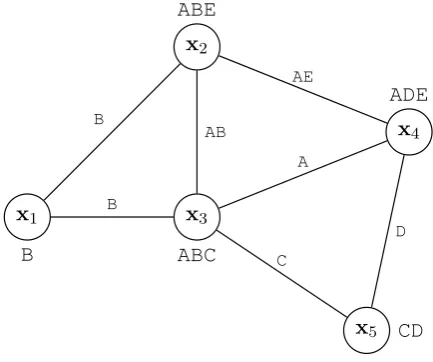
Figure 1 illustrates the example introduced in Sub-section 3.1 as a network with interSub-sections repre-sented as edges between snippets. This is the type of graph that would be built using pairwise align-ments between all snippets. Note that although some intersections such as v1,2 (between x1 and
x2) andv3,5express concepts directly, other inter-sections such asv2,3 andv2,4 are undivided com-binations of concepts. Since we cannot directly identify concepts and their nuggets, this graph is not immediately useful for reducing redundancy.
x1 B
x2 ABE
x3 ABC
x4 ADE
x5 CD B
B
AB
AE
A
C
D
Figure 1: Graph representing pairwise alignments between the example snippets from Section 3. For clarity, alphabetic labels likeArepresent concepts
zA. Node labels show concepts within snippets and edge labels indicate concepts seen in intersections.
x1 B
x2 ABE
x3 ABC
x4 ADE
x5 CD
zA zB
zC
zD zE
yB1
yA 2
yB2
yE2
yA3
yB 3
yC3
yA4
yD4
yE 4
yC5
yD5
Figure 2: Structure of the equivalent concept graph for the example document illustrated in Figure 1. Circular nodesxsrepresent snippets, large squares
zcrepresent concepts and small squaresyc sdepict nuggets for each concept within a snippet.
Figure 2 illustrates the structure of the equiva-lent concept graph for the previous example. This is simply the bipartite graph with the two types of nodes, namely snippets and concepts, represented using different symbols. For clarity, nuggets are also depicted as nodes in the graph, thereby reduc-ing edges to simple links indicatreduc-ing membership. This representation identifies the redundancy be-tween snippets in terms of non-overlapping con-cepts and is therefore more useful than the graph from Figure 1 for reducing redundancy.
4 Constructing the Concept Graph
We now describe how a concept graph can be con-structed from a document by using dependency tree alignment and leveraging the existing struc-ture of the graph during construction.
4.1 Alignment of snippets
In order to obtain the concept graph representation, the common information between each pair of snippets in the document must first be discovered by aligning all pairs of snippets with each other. We make use of dependency parsing and alignment of dependency parse trees to obtain intersections between each pair of snippets, where each inter-section may be a discontiguous span of text corre-sponding to an aligned subtree within each snip-pet. In our experiments, dependency parsing is accomplished with Minipar (Lin, 1998) and align-ment is done using a bottom-up tree alignalign-ment al-gorithm (Barzilay and McKeown, 2005) modified to account for the shallow semantic role labels pro-duced by the parser. The alignment implementa-tion is not the focus of this work, however, and the framework described here could by applied using any alignment technique between segments of text in potentially any language.
As seen in Figure 1, the intersections that can be extracted solely by pairwise comparisons are not unique and may contain multiple concepts. A truly information-preserving approach requires the ex-plicit identification of concepts as in the concept graph from Figure 2, but efficiently converting the former into the latter poses a non-trivial challenge.
4.2 Extraction of irreducible concepts
Our approach attempts to obtain a set of irre-ducible conceptssuch that each concept in this set cannot wholly or partially contain any other con-cept in the set (thereby conforming to the
defini-tion of a concept in Subsecdefini-tion 3.1).
We attempt to build the concept graph and main-tain irreducible concepts alongside each of the S(S −1)/2 pairwise alignment steps. Every in-tersection found by aligning a pair of snippets is assumed to represent some concept that these snip-pets share; it is then compared with existing con-cepts and is decomposed into smaller intersections if it overlaps partially with any one of them. This implies a worst-case of C comparisons at each pairwise alignment step (2C if both fragments of an intersection are compared separately). How-ever, this can be made more efficient by exploiting the structure of the graph. A new intersection only has to be compared with concepts which might be affected by it and only affects the other snippets containing these concepts. We can show that this leads to an algorithm that requires fewer thanC comparisons, and additionally, that these compar-isons can be performed efficiently.
Consider the definition of alignment along the lines of a mathematical relation. We require snip-pet alignment to be anequivalence relationand it therefore must have the following properties.
Symmetry: If an intersection vi,j contains a concept z0, then vj,i will also contain z0. This
property allows only S(S −1)/2 alignments to suffice instead of the full S(S −1). Therefore, without loss of generality, we can specify that all alignments betweenxiandxj should havei < j.
Transitivity: If intersectionsvi,j andvj,k both contain some conceptz0, thenv
i,k will also con-tainz0. This property leads to an interesting
con-sequence. Assuming we perform alignments in order (initially aligning x1 and x2 and iterating forj within each i), we observe that xi has been aligned with snippets{x1, . . . ,xj−1}and, for any i > 1, snippets{x1, . . . ,xi−1}were aligned with all snippets{x1, . . . ,xS}. Since i < j, this im-plies that xi was directly aligned with snippets
{x1, . . . ,xi−1} which in turn were each aligned with all S snippets. Therefore, due to the prop-erty of transitivity, all concepts contained in a new intersectionvi,j thatalso exist in the partly-constructed graph would already be directly asso-ciated with xi. Note that this does not hold for
xj as well, since xj has not been aligned with
{xi+1, . . . ,xj−1}; therefore, it may not have en-countered all relevant concepts.
have already been uncovered in xi and thus vi,j only needs to be compared to these concepts.
4.3 Comparisons after alignment
For every new intersection vi,j produced by an alignment betweenxi andxj, the algorithm com-pares it (specifically, the fragment from xi) with each existing nugget yk
i for each concept zk al-ready seen inxi. Checking for the following cases ensures that the graph structure contains only irre-ducible concepts for all the alignments seen:
1. If vi,j doesn’t overlap with any current nugget fromxi, it becomes a new concept that links toxi andxj. In our example, the first intersection v1,2 contains “Whittington ... an attorney” from x1 and “... Whittington, a lawyer” fromx2; this becomes a new concept
zBsincex1has no other nuggets.
2. Ifvi,j overlaps completely with a nuggetyik, thenxjmust also be linked to conceptzk. For example, x1’s fragment in the second inter-section v1,3 is also “Whittington ... an attor-ney”, sox3must also link tozB.
3. Ifvi,j subsumesyki, it is split up and the non-overlapping portion is rechecked against ex-isting nuggets recursively. For example,x2’s fragment in the intersection v2,3 is “... shot Whittington, a lawyer”, part of which over-laps with yB
2, so this intersection is divided up and the part representing “... shot Whit-tington ...” becomes a new conceptzA. 4. If, on the other hand, yk
i subsumesvi,j, the concept zk is itself split up along with all nuggets that it links to, utilizing the present structure of the graph.
When comparing intersections, we can restrict the decomposition of nuggets to prevent the creation of overly-granular concepts. For instance, we can filter out intersections containing only isolated named-entities or syntactic artifacts like determin-ers since they contain no information by them-selves. We can also prevent verbs and their ar-guments from being split apart using information from a snippet’s dependency parse, if available.
4.4 Efficiency of the algorithm
Instead of C additional comparisons in the worst case after each pairwise snippet alignment, we need no more comparisons in the worst case than the maximum number of concepts that can exist in
a single snippet. Since this value grows no faster thanCasSincreases, this is a significant improve-ment. Other factors, such as the overhead required to split up concepts, remain unchanged.
Furthermore, since all the additional compar-isons are carried out between nuggets of thesame
snippet, we don’t need to perform any further alignment among nuggets or concepts. Alignments are expensive; each isO(n1n2) wheren1 andn2 are the number of words in the two segments of text being aligned (if dependency tree alignment is used) along with an overhead for checking word similarity. However, since we now only need to compare text from the same snippet, the com-parison can be performed in linear time by sim-ply comparing spans of word indices, thereby also eliminating the overhead for comparing words.
5 Decreasing redundancy
The concept graph can now be applied to the task of reducing redundancy in the document by drop-ping snippets which contain no information that is not already present in the rest of the document.
5.1 Reduction to set cover
Every snippetxsin a document can be represented as a set of concepts{zc:yc
s∈Y}. Since concepts are defined as information that is seen in more than one snippet as per the definition in Subsection 3.1, representing snippets as sets of concepts will over-look any unique information present in a snippet. Without loss of generality, we can add any such unique information in the form of anartificial con-ceptfor each snippet to Zso that snippets can be completely represented as sets of concepts fromZ. Note that the union of snippetsSSs=1xsequalsZ.
Reducing redundancy in the document while preserving all information requires us to identify themostsnippets whose entire informational con-tent is covered by the rest of the snippets in the document, thereby targeting them for removal. Since we express informational content in con-cepts, this problem reduces to the task of finding the smallest group of snippets that together cover all the concepts in the document, i.e. we need to find thesmallestsubsetX0 ⊆ X such that, ifX0
containsRsnippetsx0r, the union of these snippets
SR
r=1x0r also equalsZ. Therefore, every concept in a snippet fromX−X0also exists in at least one
snippet fromX0 and no concept fromZis lost.
set coverproblem, which seeks to find the smallest possible group of subsets of a universe that cov-ers all the other subsets. A more general variant of this problem isweighted set coverin which the subsets have weights to be maximized or costs to be minimized. While this problem is known to be NP-hard, there exists a straightforward local maximization approach (Hochbaum, 1997) which runs in polynomial time and is proven to give so-lutions within a known bound of the optimal solu-tion. This greedy approximation algorithm can be adapted to our representation.
5.2 Selecting non-redundant snippets
The algorithm selects a snippetxrto the subsetX0 such that information content ofX∪xr is max-imized. In general, this implies that the snippet with the highest degree over uncovered concepts must be selected at each iteration. Other measures such as snippet length, fluency, or rank in an or-dered list can be included in a weight measure in order to break ties and introduce a preference for shorter, more fluent, or higher-ranked snippets.
Consider the example from Section 3. The can-didates for selection arex2,x3 andx4 since they contain the mostuncovered concepts. Ifx2 is se-lected, its concepts zA, zB and zE are covered. At this stage,x5contains two uncovered concepts while x3 andx4 contain just one each. Thus,x5 is selected next and its concepts zC and zD are covered. Since no uncovered concepts remain, all snippets which haven’t been selected are redun-dant. This solution, which is shown in Figure 3, selects the following text to cover all the snippets:
x2: Cheney shot Whittington, a lawyer.
x5: This happened during a quail hunt in Texas.
Other solutions are also possible depending on the factors involved in choosing the snippet to be selected at each iteration. For example, the algo-rithm might choose to selectx3 first instead ofx2, thereby yielding the following solution:
x3: Whittington, an attorney, was shot in Texas.
x4: Whittington was shot by Cheney while hunting quail.
6 Experiments
To evaluate the effectiveness of this framework empirically, we ran experiments over documents containing annotations corresponding to concepts within the document. We also defined a metric
x1
B
x2 ABE
x3
ABC
x4
ADE
x5 CD
zA zB
zC
zD zE
yB1
yA2
yB2
yE2
yA3
yB3
yC3
yA4
yD4
yE4
yC5
yD5
Figure 3: Pruned version of the concept graph ex-ample shown in Figure 2, illustrating the outcome of removing redundant snippets.
for comparing any concept graph over a document to a gold-standard concept graph. This was used to compare the concept graphs created by our ap-proach to perturbed versions of the gold-standard graphs and graphs created by clustering.
6.1 Dataset
Due to the scarcity of available annotated datasets suitable for evaluating redundancy, we utilized the pyramid dataset from DUC 2005 (Nenkova et al., 2007) which was created from 20 articles for the purpose of summarization evaluation. Each pyra-mid document is a hierarchical representation of 7 summaries of the orginal news article. These sum-maries have been annotated to identify the indi-vidualsemantic content unitsor SCUs where each SCU represents a certain fact, observation or piece of information in the summary. A sentence frag-ment representing an occurrence of an SCU in a summary is acontributorto the SCU.
The pyramid construction for a group of sum-maries of the same article mirrors the concept graph representation described in Subsection 3.2. SCUs with more than two contributors are simi-lar in definition to concepts while their contribu-tors fill the role of nuggets. Using this analogy, each dataset consists of a combination of the seven summaries in a single pyramid document; the 20 pyramid documents therefore yield 20 datasets.
6.2 Evaluation metrics
x1
x2
x3
x4
x1
x2
x3
x4 Concepts SCUs
(merge)
(split) Lalg
Lpyr
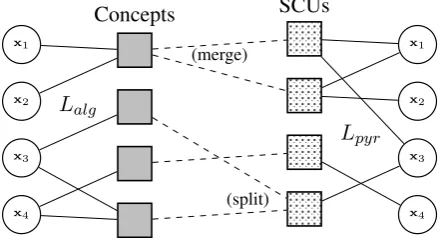
Figure 4: The bipartite graph on the left shows snippetsxslinked to concepts produced automati-cally; the one on the right shows the same snippets linked to SCUs from annotated data. Dashed lines indicate mappings between concepts and SCUs.
concept graph extracted from the pyramid docu-ment annotations. Standard metrics do not ap-ply easily to the problem of comparing bipartite graphs, so we define a novel metric modeled on the well-known IR measures of precision, recall and F-measure. Figure 4 illustrates the elements involved in the evaluation task.
We define the metrics of precision, recall and F-measure over thelinksbetween snippets and con-cepts. Assuming we have a mapping between gen-erated concepts and gold-standard SCUs, we can judge whether each link is correct. Let each single link between a snippet and a concept have an asso-ciated weight of 1 by default and letLindicate a set of such links. We useLalg andLpyr to distin-guish between the sets of links generated by the al-gorithm and retrieved from the annotations respec-tively. Precision and recall are defined as follows while F-measure retains its traditional definition as their harmonic mean.
Precision = Sum of weights inSum of weights inLalgL∩Lpyr
alg
Recall = Sum of weights inSum of weights inLalgL∩Lpyr
pyr
To determine a mapping between concepts and SCUs, we identify every concept and SCU pair, sayzc andzs, which has one or more snippets in common and, for each snippet xi that they have in common, we find the longest common subse-quence between their nuggetsyc
i andysi to obtain the following score which ranges from 0 to 1.
LCS score= min (lengthlength(yc(LCS)
i), length(ysi))
Measure Random Clustering Concepts Precision 0.0510 0.2961 0.4496
Recall 0.0515 0.1162 0.3266
F1score 0.0512 0.1669 0.3783
Table 1: Summary of the evaluation metrics aver-aged over all 20 pyramid documents whenm=0.5
This score is compared with a user-defined map-ping thresholdm to determine if the concept and SCU are sufficiently similar. In order to avoid bi-asing the metric by permitting multiple mappings per concept, we adjust for merges or1 :N map-pings by cloning the concept and creatingN 1 : 1
mappings in its place. We then adjust forsplitsor N: 1mappings by dividing the weight of each of the links connected to a participating concept by N. Due to this normalization, the metrics are ob-served to be stable over variations inm.
6.3 Baselines
We compare the performance of the algorithm against two baselines. The first approach involves a random concept assignment scheme to build arti-ficial concept graphs using the distributional prop-erties of the gold-standard concept graphs. The number of conceptsCand the number of snippets that each concept links to is determined by sam-pling from distributions over these properties de-rived from the statistics of the actual SCU graph for that document. For evaluation, these artificial concepts are randomly mapped to SCUs usingm to control the likelihood of mapping. The best scores from 100 evaluation runs were considered.
6.4 Results
Table 1 shows the F1 scores over evaluation runs using the random concept assignment, clustering and concept graph techniques. These results are obtained at a mapping threshold of m = 0.5, which implies that we consider a mapping between a concept and an SCU if their nuggets over com-mon sentences share more than 50% of their words on average. The results do not vary significantly at different settings ofm.
We observe that the concepts extracted by our graph-based approach perform significantly better than the best-performing clustering configuration. Despite a fairly limited alignment approach that doesn’t use synonyms or semantic analysis, the concept graph outperforms the baselines by nearly an order of magnitude on each document. This validates our initial hypothesis that clustering ap-proaches are not suitable for tackling the redun-dancy problem at the sub-sentential level.
7 Conclusions and Future Work
We have described a graph-based algorithm for identifying redundancy at the sub-snippet level and shown that it outperforms clustering methods that are traditionally applied to the redundancy task.
Though the algorithm identifies redundancy at the sub-snippet level, redundancy can be decreased by dropping only entirely redundant snippets. We hope to be able to overcome this limitation by extending this information-preserving approach to the synthesis of new non-redundant snippets which minimize redundant content in the document.
In addition, this work currently assumes that re-dundancy is bidirectional; however, we intend to also address the case of unidirectional redundancy by considering entailment recognition approaches.
Acknowledgements
We are grateful to Andrew Rosenberg, David El-son, Mayank Lahiri and the anonymous review-ers for their useful feedback. This material is based upon work supported by the Defense Ad-vanced Research Projects Agency under Contract No. HR0011-06-C-0023.
References
Barzilay, Regina and Lillian Lee. 2003. Learn-ing to paraphrase: an unsupervised approach
us-ing multiple-sequence alignment. InProceedings of HLT-NAACL, pages 16–23.
Barzilay, Regina and Kathleen R. McKeown. 2005. Sentence fusion for multidocument news summa-rization. Computational Linguistics, 31(3):297–328. Carbonell, Jaime G. and Jade Goldstein. 1998. The use of MMR, diversity-based reranking for reorder-ing documents and producreorder-ing summaries. In Pro-ceedings of ACM-SIGIR, pages 335–336.
Filatova, Elena and Vasileios Hatzivassiloglou. 2004. A formal model for information selection in multi-sentence text extraction. In Proceedings of COL-ING, page 397.
Hochbaum, Dorit S. 1997. Approximating covering and packing problems: set cover, vertex cover, in-dependent set, and related problems. In Approxi-mation algorithms for NP-hard problems, pages 94– 143. PWS Publishing Co., Boston, MA, USA. Hovy, Eduard, Chin-Yew Lin, Liang Zhou, and Junichi
Fukumoto. 2006. Automated summarization evalu-ation with basic elements. InProceedings of LREC. Lin, Chin-Yew and Eduard Hovy. 2001. From single
to multi-document summarization: a prototype sys-tem and its evaluation. InProceedings of ACL, pages 457–464.
Lin, Dekang. 1998. Dependency-based evaluation of MINIPAR. InProceedings of the Workshop on the Evaluation of Parsing Systems, LREC.
Marsi, Erwin, Emiel Krahmer, Wauter Bosma, and Ma-riet Theune. 2006. Normalized alignment of depen-dency trees for detecting textual entailment. In Sec-ond PASCAL Recognising Textual Entailment Chal-lenge, pages 56–61.
Nenkova, Ani, Rebecca Passonneau, and Kathleen McKeown. 2007. The pyramid method: Incorporat-ing human content selection variation in summariza-tion evaluasummariza-tion. ACM Transactions on Speech and Language Processing, 4(2):4.
Pang, Bo, Kevin Knight, and Daniel Marcu. 2003. Syntax-based alignment of multiple translations: ex-tracting paraphrases and generating new sentences. InProceedings of HLT-NAACL, pages 102–109. Rosenberg, Andrew and Julia Hirschberg. 2007.
V-measure: A conditional entropy-based external clus-ter evaluation measure. InProceedings of EMNLP, pages 410–420.
Shi, Jianbo and Jitendra Malik. 2000. Normalized cuts and image segmentation. IEEE Transactions on Pat-tern Analysis and Machine Intelligence, 22(8):888– 905.