M e t h o d s and Practical Issues in Evaluating Alignment Techniques
P h i l i p p e L a n g l a i s CTT/KTH SE-10044 Stockholm CERI-LIA, ACROPARC BP 1228
F-84911 Avignon Cedex 9 [email protected]
M i c h e l S i m a r d RALI-DIRO Univ. de Montr6al Qudbec, Canada H3C 3J7 [email protected] real.CA
J e a n V 6 r o n i s LPL, Univ. de Provence
29, Av. R. Schuman F-13621 Aix-en-Provence Cedex 1
veronis@ univ-aix.fr
A b s t r a c t
This paper describes the work achieved in the first half of a 4-year cooperative research project (ARCADE), financed by A U P E L F - U R E F . The project is devoted to the evaluation of paral- lel text alignment techniques. In its first period A R C A D E ran a competition between six sys- tems on a sentence-to-sentence alignment task which yielded two main types of results. First, a large reference bilingual corpus comprising of texts of different genres was created, each pre- senting various degrees of difficulty with respect to the aligmnent task.
Second, significant methodological progress was made both on the evaluation protocols and metrics, and the algorithms used by the dif- ferent systems. For the second phase, which is now underway, A R C A D E has been opened to a larger number of teams who will tackle the problem of word-level alignment.
1 I n t r o d u c t i o n
In the last few years, there has been a growing interest in parallel text alignment techniques. These techniques a t t e m p t to map various tex- tual units to their translation and have proven useful for a wide range of applications and tools. A simple example of such a tool is probably the TrunsSearch bilingual concordancing system (Isabelle et al., 1993), which allows a user to query a large archive of existing translations in order to find ready-made solutions to specific translation problems. Such a tool has proved ex- tremely useful not only for translators, but also fbr bilingual lexicographers (Langlois, 1996) and terminologists (Dagan and Church, 1994). More sophisticated applications based on alignment technology have also been the object of recent work, such as the automatic building of bilin- gual lexical resources (Melamed, 1996; Klavans
azld Tzoukermann, 1995), the automatic verifi- cation of translations (Macklovitch, 1995), the automatic dictation of translations (Brousseau et al., 1995) and even interactive machine trans- lation (Foster et al., 1997).
Enthusiasm for this relatively new field was sparked early on by the apparent demonstra- tion that very simple techniques could yield al- most perfect results. For instance, to produce sentence alignments, Brown et al. (1991) and Gale and Church (1991) both proposed meth- ods that completely ignored the lexical content of the texts and both reported accuracy lev- els exceeding 98%. Unfortunately performance tends to deteriorate significantly when aligners are applied to corpora which are widely differ- ent fi'om the training corpus, a n d / o r where the alignments are not straightforward. For instance graphics, tables, "floating" notes and missing segments, which are very common in real texts, all result in a dramatic loss of efficiency.
The truth is that, while text alignment is mostly an easy problem, especially when consid- ered at the sentence level, there are situations where even humans have a hard time making the right decision. In fact, it could be argued that, ultimately, text alignment is no easier tha~l the more general problem of natural laalguage understanding.
In addition, most research efforts were directed towards the easiest problem, that of sentence-to-sentence alignment (Brown et al., 1991; Gale and Church, 1991; Debili, 1992; Kay and RSscheisen, 1993; Simard et al., 1992; Simard and Plamondon, 1996). Alignment at the word and term level, which is extremely useful for applications such as lexical resource extraction, is still a largely unexplored research area(Melamed, 1997).
various application fields, alignment technology will therefore have to improve substantially. As was the case with several other language processing techniques (such as information retrieval, document understanding or speech recognition), it is likely that a systematic evalu- ation will enable such improvements. However, before the A R C A D E project started, no for- mal evaluation exercise was underway; and worse still, there was no multilingual aligned reference corpus to serve as a "gold standard" (as the Brown corpus did, for example, for part of speech tagging), nor any established methodology for the evaluation of alignment systems.
2 O r g a n i z a t i o n
A R C A D E is an evaluation exercise financed by A U P E L F - U R E F , a network of (at least partially) French-speaking universities. It was launched in 1995 to promote research in the field of multilingual alignment. T h e first 2-year period (96-97) was dedicated to two main tasks: 1) producing a reference bilingual corpus (French-English) aligned at sentence level; 2) evaluating several sentence alignment systems through an ARIA-like competition.
In the first phase of ARCADE, two types of teams were involved in the project: the corpus providers (LPL and RALI) and the (RALI, LO- RIA, ISSCO, IRMC and LIA). General coor- dination was handled by J. Vdronis (LPL); a discussion group was set up and moderated by Ph. Langlais (LIA & KTH).
3 R e f e r e n c e c o r p u s
One of the main results of A R C A D E has been to produce an aligned French-English corpus, combining texts of different genres and various degrees of difficulty for the alignment task. It is i m p o r t a n t to mention that until ARCADE, most alignment systems had been tested on ju- dicial and technical texts which present rela- tively few difficulties for a sentence-level align- ment. Therefore, diversity in the nature of the texts was preferred to the collection of a large quantity of similar data.
3.1 F o r m a t
A R C A D E contributed to the development and testing of the Corpus Encoding Standard
(CES), which was initiated during the MUL- T E X T project (Ide et al., 1995). The CES is based on SGML and it is an extension of the now internationally-accepted recommendations of the Text Encoding Initiative (Ide and Vdronis, 1995). Both the JOC and BAF parts of the A R C A D E corpus (described below) are encoded in CES format.
3:2 JOC
The JOC corpus contains texts which were pub- fished in 1993 as a section of the C Series of the Official Journal of the European Community in all of its official languages. This corpus, which was collected and prepared during the MLCC and M U L T E X T projects, contains, in 9 parallel versions, questions asked by members of the Eu- ropean Parliament on a variety of topics and the corresponding answers from the European Com- mission. JOC contains approximately 10 million words (ca. 1.1 million words per language). The part used for JOC was composed of one fifth of the French and English sections (ca. 200 000 words per language).
3.3 B A F
The BAF corpus is also a set of parallel French- English texts of about 400000 words per lan- guage. It includes four text genres: 1) I N S T , four institutional texts (including transcription of speech from the Hansard corpus) for a total- ing close to 300 000 words per language, 2) S C I - E N C E , five scientific articles of about 50000 words per language, 3) T E C H , technical doc- umentation of about 40 000 words per language and 4) V E R N E , the Jules Verne novel: "De
la terre d la lune" (ca. 50000 words per lan-
guage). This last text is very interesting because the translation of literary texts is much freer than that of other types of tests. Furthermore, the English version is slightly abridged, which adds the problem of detecting missing segments. T h e BAF corpus is described in greater detail in (Simard, 1998).
4 E v a l u a t i o n m e a s u r e s
respect to a reference. However, recall and preci- sion can be c o m p u t e d for various levels of gran- ularity: an a h g n m e n t at a given level (e.g. sen- tences) can be m e a s u r e d in terms of units of a lower level (e.g. words, characters). Such a fine~ grained measure is less sensitive to segmenta- tion problems, a n d can be used to weight errors according to the n u m b e r of sub-units they span.
4 . 1 F o r m a l d e f i n i t i o n
If we consider a text S a n d its translation T as two sets of segments S = {sl, s2, .., Sn} and T =
{ t l , t 2 , . . . , t m } , an alignment A between S and
T can be defined as a subset of the Cartesian p r o d u c t p ( S ) x p ( T ) , where g~(S) and ~o(T) are respectively the set of all subsets of S and T. T h e triple (S, T, A) will be called a bitext. Each of the elements (ordered pairs) of the aligmnent will be called a bisegment.
This definition is fairly general. However, in the evaluation exereice described here, segments were sentences and were supposed to be contigu- ous, yielding monotonic alignments.
For instance, let us consider tile fol- lowing alignment, which will serve as tile
reference alignment in the subsequent ex-
aznples. Tile formal representation of it is: A~ = {({sl}, {tl}), ({s2}, {t2, ta})}.
81 Phrase numdro un. s2 Phrase numdro deux qui ressemble h la l~re.
tl The first sentence.
t2 The 2nd sentence. ta It looks like the first.
4 . 2 R e c a l l a n d p r e c i s i o n
Let us consider a bitext ( S , T , A ~ ) and a
proposed alignment A. T h e alignment recall
with respect to the reference
Ar
is definedas: recall = IA fq A~I/IA~ I. It represents the
proportion of bisegments in A t h a t are correct with respect to the reference
At.
The silencecorresponds to 1 - recall. T h e alignment
precision with respect to the reference Ar
is defined as: p r e c i s i o n = [A fq ArI/[AI. It represents the proportion of bisegnmnts in A that are right with respect to the n u m b e r of bisegment proposed. T h e noise corresponds to
1 - precision.
We will also use the F-measure (Pdjsbergen, 1979) which combines recall and precision in a single efficiency measure (harmonic m e a n of precision and recall):
2 (recall x precision) F = "(recall + precision)"
Let us assume the following proposed align- ment:
s ! Phrase numdro un. tl Tile first sentence. t2 "The 2nd "sentence. s2 Phrase numdro deux ta It looks like tile first. qui ressemble/~ la l~re.
T h e formal representation of this alignment is: A = { ( { s l } , { t l } ) , ( { } , { t ~ } ) , ( { s ~ } , { t a } ) } . We note that: A N Ar = {({sl}, {tl})}. Align- ment recall and precision with respect to Ar are 1/2 = 0.50 and 1/3 = 0.33 respectively. The F- measure is 0.40.
hnproving both recall and precision are an- tagonistic goals : efforts to improve one often result in degrading the other. Depending on the applications, different trade-offs can be sought. For example, if the bisegments are used to auto- matically generate a bilingual dictionary, maxi- nfizing precision (i.e. omitting doubtful couples) is likely to be the preferred option.
Recall and precision as defined above are rather unforgiving. T h e y do not take into ac- count the fact that some bisegments could be partially correct. In the previous examl)le, the bisegment ({se}, {ta}) does not belong to the reference, but can be considered as partially cor- rect: t3 does m a t c h a part of s2. To take partial correctness into account, we need to compute re- call and precision at tile sentence level instead of the alignment level.
Assuming the alignment A = {al, a s , . . . ,
am}
and the reference Ar = {arl, a t 2 , . . . , arn}, with
ai = (asi,ati) and arj = ( a r s j , a r t j ) , we can
derive the following sentence-to-sentence align- ments:
A ' = U i ( a s i X ati) A' r = U j ( a r s j x artj)
Sentence-level recall and precision can thus be defined in tile following way:
recall = IA' n A" I/IA" I
precision = IA' n A'rl/IA' I
therefore 2/3 = 0.66 and 1 respectively, as com- pared to the aLignment-level recall and preci- sion, 0.50 and 0.33 respectively. The F-measure
becomes 0.80 instead of 0.40.
4.3 G r a n u l a r i t y
In the definitions above, the sentence is the unit of granularity used for the computation of recall and precision at both levels. This results in two difficulties. First, the measures are very sensi- tive to sentence segmentation errors. Secondly, they do not reflect the seriousness of misaiign- ments. It seems reasonable that errors involving short sentences should be less penalized t h a n errors involving longer ones, at least from the perspective of some applications.
These problems can be avoided by taking ad- vantage of the fact that a unit of a given gran- ularity (e.g. sentence) can always be seen as a (possibly discontinuous) sequence of units of finer granularity (e.g. character).
Thus, when an alignment A is compared to a reference alignment
Ar
using the recall and precision measures c o m p u t e d at the chax-level, the values obtained are inversely proportional to the quantity of text (i.e. number of characters) in the misaiigned sentences, instead of the num- ber of these misaligned sentences. For instance, in the example used above, we would have at sentence level:• using word granularity (punctuation marks are considered as words) :
IA'I = 4 * 4 + 0 * 4 + 9 * 6 = 1 0 6 L h r ' l = 4 * 4 + 9 . 1 0 = 7 0
I h r ' " A ' I = 4 * 4 + 9 * 6 = 7 0
r e c a l l = 7 0 / 1 0 6 = 0 . 6 6
precision = 1
F = 0 . 8 0
• using character granularity (excluding spaces):
I h ' l = 1 5 . 1 7 + 0 . 1 5 + 3 6 * 2 0 = 9 7 5 I h r ' l = 1 5 . 1 7 + 3 6 * 3 5 = 1 5 1 5
I h r ~ ~ h ' l = 1 5 . 1 7 + 3 6 * 2 0 = 9 7 5
r e c a l l = 9 7 5 / 1 5 1 5 = 0 . 6 4
p r e c i s i o n = 1 F = 0.78
5 S y s t e m s t e s t e d
Six systems were tested, two of which having been s u b m i t t e d by the RALI.
l : t A L I / J a c a l This system uses as a first step a program that reduces the search space only to those sentence pairs that axe potentially inter- esting (Simard and Plamondon, 1996). The un- derlying principle is the automatic detection of isolated cognates (i.e. for which no other similar word exists in a window of given size). Once the search space is reduced, the system aligns the sentences using the well-known sentence-length model described in (Gale and Church, 1991). R A L I / S a l i g n The second m e t h o d proposed by RALI is based on a dynamic programming scheme which uses a score function derived from a translation model similar to that of (Brown et ai., 1990). T h e search space is reduced to a beam of fixed width around the diagonal (which would represent the alignment if the two texts were perfectly synchronized).
L O R I A The strategy a d o p t e d in this system differs from that of the other systems since sen- tence alignment is performed after the prelim- inaxy alignment of larger units (whenever pos- sible, using maxk-up), such as paragraphs and divisions, on the basis of the SGML structure. A dynamic programming scheme is applied to all alignment levels in successive steps.
I R M C This system involves a preliminary, rough word alignment step which uses a trans- fer dictionary and a measure of the proximity of words (Ddbili et al., 1994). Sentence alignment is then achieved by an algorithm which opti- mizes several criteria such as word-order con- servation and synchronization between the two texts.
L I A Like Jacal, the LIA system uses a pre-processing step involving cognate recog- nition which restricts the search space, but in a less restrictive way. Sentence alignment is then achieved through dynamic program- ming, using a score function which combines sentence length, cognates, transfer dictionary and frequency of translation schemes (1-1, 1-2, etc.).
by depth, then by breath, while aligning sen- tences using a method resembling that of Gale & Church.
6 Results
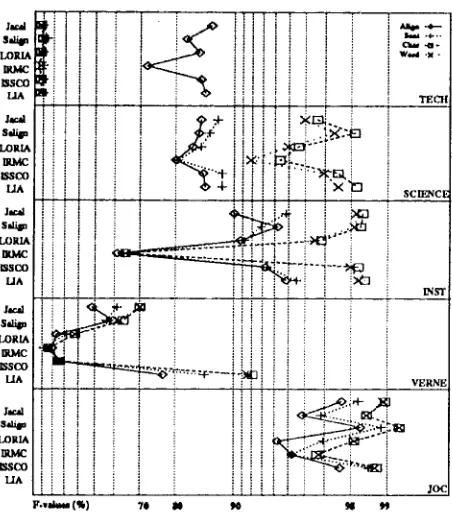
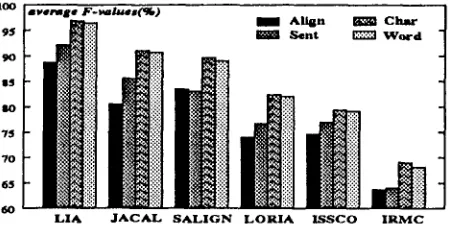
Four sets of recall/precision measures were com- puted for the alignments achieved by the six systems for each text type previously described above: A l i g n , alignment-level, S e n t sentence- level, W o r d , word-level and C h a r character- level. The global efficiency of the different sys- tems (average F-values) for each text type is given in Figure 1.
s a i ~
L O R / ~
ii
il
L O R b ~ , t
i . . . .
~ 5 C 0 ~
L I A I : : I ! i
i i i i i i i i l i i i i i
~ ( ' . . l i x . ' , . ~ L , i : i r o M E t
i ' % ' " + , ~ , i ~ : ' ~ i i ~ ' + ! ~ I ~ ~ ~ ~ x l ~
! ! ! ! ! " , b ~ ! : ::~t]
i I . . . : : : : : : :
J ! i i i i ! i
i
i
i i i i i i !
i i
: : : : : : : : :
i l l , i !
iiii i i ~ ! '..'..~i~
i I 1 !
! 1 • "
1 i i i : ~ : : : W * . d . ~ -
I I 1 1 1 ~ :
! i111 ; i i I i ~c~
i
$ C I ] E ~ C
I N S ' r
V E R / ~
Figure 1: Global efficiency (average F-values for A l i g n , S e n t , W o r d and C h a r measures) of the different systems (Jacal, Salign, LORIA, IRMC, ISSCO, LIA) , by text type (logarithmic scale).
First, note than the Char measures are higher that the Align measures. This seems to con- firm that systems tend to fail when dealing with shorter sentences. In addition, the refer- ence alignment for the BAF corpus combines several 1-1 alignments in a single n-n align- ment, for practical reasons owing to the sen- tence segmentation process. This results in de- creased Align measures.
The corpus on which all systems scored high- est was the JOC. This corpus is relatively sim- ple to align, since it contains 94% of 1-1 align- ments, reflecting a translation strategy based on speed and absolute fidelity. In addition, this corpus contains a large amount of data that remains unchanged during the translation pro- cess (proper names, dates, etc.) and which can serve as anchor points by some systems. Note that the LORIA system achieves a slightly bet- ter performance than the others on this cor- pus, mainly because it is able to carry out a structure-alignment since paragraphs and divi- sions are explicitly marked.
The worst results were achieved on the VERNE corpus. This is also the corpus for which the results showed the most scattering across systems (22% to 90% chax-prccision). These poor results are linked to the literary nature of the corpus, where translation is freer and more interpretative. In addition, since the English version is slightly abridged, the occa- sional omissions result in de-synchronization in most systems. Nevertheless, the LIA sys- tem still achieves a satisfactory performance (90% char-recall a ~ l d 94% char-precision), which can be explained by the efficiency of its word-based pre-alignment step, as well as the scoring function used to rank the candidate bisegments.
Significant discrepancy are also noted be- tween the Align and Char recalls on the TECH corpus. This document contained a large glossary as an appendix, and since the terms are sorted in alphabetic order, they are ordered differently in each language. This portion of text was not manually aligned in the reference. The size of this bisegment (250-250) drastically lowers the Char-recall. Aligning two glossaries can be seen as a doculnent-structure alignment task rather than a sentence-alignment task. Since the goal of the evaluation was sentence alignment, the TECH corpus results were not taken into account in the final grading of the systems.
[image:5.612.77.303.218.475.2]100
|vGra#.
F - m l u * . ( ~ ) s m A l t l l n ~ C h a r9 5 ~ I ~ S e n t ~ W o r d
7S
7O
6 0
L I & J A C A L S A L I G N L O R I A I S S C O I R , ~ I C
Figure 2: Final ranking on the systems (average F-values).
important criterion for many applications.
7 C o n c l u s i o n a n d f u t u r e w o r k
The ARCADE evaluation exercise has allowed for significant methodological progress on paral- lel text alignment. The discussions among par- ticipants on the question of a testing proto- col resulted in the definition of several evalu- ation measures and an assessment of their rela- tive merits. The comparative study of the sys- tems performance also yielded a better under- standing of the various techniques involved. As a significant spin-off, the project has produced a large aligned bilingual corpus, composed of several types of texts, which can be used as a gold standard for future evaluation. Grounded on the experience gained in the first test cam- paign, the second (1998-1999) has been opened to more teams and plans to tackle more difficult problems, such as word-level alignment. 1
A c k n o w l e d g m e n t s
This work has been partially funded by AUPELF-UREF. We are indebted to Lucie Langlois and Elliott Macklovitch for their fruitful comments on this paper.
R e f e r e n c e s
J. Brousseau, C. Drouin, G. Foster, P. Isabelle, R. Kuhn, Y. Normandin, and P. Platoon- don. 1995. French Speech Recognition in an Automatic Dictation System for Translators: the TransTa/k Project. In
Proceedings o] Eu-
rospeech 95,
Madrid, Spain.1For more information check the Web site at http: / / www'lpl'univ-alx'fr / pr° jects / arcade
P. F. Brown, J. Cocke, S. A. Della Pietra, V. J. Della Pietra, F. Jelinek, J. D. Lafferty, 1%. L. Mercer, and P. S. Roosin. 1990. A Sta~ tistica/Approach to Machine Translation. In
Computational Linguistics,
volume 16, pages 79-85, June.P.F. Brown, J.C. La/, and R.L. Mercer. 1991. Aligning Sentences in Parallel Corpora. In
29th Annual Meeting of the Association ,for
Computational Linguistics,
pages 169-176, Berkeley, CA,USA.Ido Dagan and Kenneth W. Church. 1994. Ter- might: Identifying and Translating Techni- ca/Terminology. In
Proceedings of ANLP-9$,
Stuttgart, Germany.F. D4bili, E. Sammouda, and A. Zribi. 1994. De l'appariement des mots ~. la compara/son de phrases. In
9~me Congr~s de Reconnaissance
des Formes et Intelligence Artificielle,
Paris, Janvier.F. Debili. 1992. Aligning Sentences in Bilingual Texts French - English and French - Arabic. In
COLING,
pages 517-525, Nantes, 23-28 Aout.George Foster, Pierre Isabelle, and Pierre Pla- mondon. 1997. Target-Text Mediated Inter- active Machine Translation.
Machine Trans-
lation,
21(1-2).W. A. Gale and Kenneth W. Church. 1991. A Program for Aligning Sentences in Bilin- gual Corpora. In
29th Annual Meeting of
the Association ]or Computational Linguis-
tics,
Berkeley, CA.N. Ide and J. V4ronis, 1995.
The Text Encod-
ing Initiative: background and context,
chap- ter 342p. Kluwer Academic Publishers, Dor- drecht.N. Ide, G. Priest-Dorman, and J. V6ronis.
1995. Corpus encoding standard.
Report. Accessible on the World
Wide Web: http://www.lpl, univ-
a/x.fr/projects/multext/CES/CES 1.html.
Pierre Isabelle and Michel Simard.
1996. Propositions pour la
repr4sentation et l'~va/uation des
a/ignements de textes para/l~les.
h t t p ://www-rali. iro. umontreal, ca/arc-a2/-
PropEval.
Simaxd. 1993. Translation Analysis and Translation Automation. In Proceedings of
TMI-93, Kyoto, Japan.
M. Kay and M. RSscheisen. 1993. Text- translation alignment. Computational Lin- guistics, 19(1):121-142.
Judith Klavans and Evelyne Tzoukermann. 1995. Combining Corpus and Machine- readable Dictionary Data for Building Bilin- gum Lexicons. Machine Translation, 10(3). Lucie Langlois. 1996. Bilingual Concordances:
A New Tool for Bilingual Lexicographers. In Proceedings of AMTA-96, Montrdal, Canada. Elhott Macklovitch. 1995. TransCheck - - or the Automatic Validation of Human Trans- lations. In P~vceedings of the M T Summit V, Luxembourg.
I. Dan Melamed. 1996. Automatic Con- struction of Clean Broad-coverage Transla- tion Lexicons. In Proceedings of AMTA-96, Montrdal, Canada.
I. Dan Melamed. 1997. A portable algorithm for mapping bitext correspondence. In 35th Conference of the Association for Computa- tional Linguistics, Madrid, Spain.
C.J. Van Rijsbergen. 1979. Information Re- trieval,2nd edition, London, Butterworths. M. Simard and P. Plamondon. 1996. Bilingual
.,~ntence alignment: Balancing robustness and accuracy. In Proceedings of the Second Con- ference of the Association for Machine Trans- lation in the Americas (AMTA), Montrdal, Qudbec.
M. Simard, G.F. Foster, and P. Isabelle. 1992. Using Cognates to Align Sentences in Bilin- gual Corpora. In Fourth International Con- ference on TheoT,etical and Methodological Is- sues in Machine Translation (TMI), pages 67-81, Montrdal, Canada.