H e a d - D r i v e n G e n e r a t i o n w i t h H P S G
G r a h a m
W i l c o c k *C e n t r e for C o m p u t a t i o n a l L i n g u i s t i c s U n i v e r s i t y of M a n c h e s t e r I n s t i t u t e
of S c i e n c e a n d T e c h n o l o g y P O B o x 88, M a n c h e s t e r M60 1QD
U n i t e d K i n g d o m g r a h a m © e e l , umi s t . a c . u k
Y u j i M a t s u m o t o
G r a d u a t e School of I n f o r m a t i o n S c i e n c e N a r a I n s t i t u t e of Science a n d T e c h n o l o g y
8916~5 T a k a y a m a , I k o m a , N a r a 630-01 J a p a n
m a t s u ~ i s , a i s t - n a r a , a c . j p
A b s t r a c t
As
HPSG is head-driven, with clear semantic heads, semantic head-driven generation should be simple. We adapt van Noord's Prolog generator for use with an IIPSG grammar in ProFIT. tlowever, quantifiers and context factors are difficult to include in head- driven generation. We must adopt recent theoretical proposals lbr lexicalized scoping and context. With these revisions, head-driven generation with ItPSG is not so simple, bnt it is possible.1 Introduction
A natural approach to generation with tlead-driven Phrase Structure Grammar (Pollard and Sag, 1994) is to use a head-driven algorithm. IIPSG is head- driven not only syntactically, but also semantically. While the Itead Feature Principle requires identity of major syntactic features between a phr~e and its syntactic head daughter, the Semantics Principle (in various formulations) requires identity of major semantic features between a phrase and its seman- tic head daughter. Since the semantic head is very clearly defined in HPSG, semantic head-driven gen- eration should be easy to implement.
Efficient head-driven generation algorithms, such as BUG, SlID and CSItD, have been presented as Prolog algorithms for use with DCG grammars. In Section 2 we brietly describe how an IIPSG grammar call be implemented as a PSG with typed feature structures, which can be compiled into a DCG by the ProFIT system. In this way, HPSG grammars can be used with the existing Prolog algorithms.
Such a combination of head-driven grammar
and
head-driven generator works well if the semantics is strictly head-driven. However, in Section 3 we show that if we implement the HPSG textbook semantics, with quantifier storage and contextual background conditions, the notion of semantic head becomes un- clear and this approach no longer works. In fact, head-driwm generation of even simple phr~es such
* Visiting researcher of S h a r p Corporation, Japan.
as "Kim walks" (Chapter 1 of the IIPS(] textbook) raises fundamental difficulties.
rio use a semantic bead-driven algorithm, we must adopt recent IIPSG proposals to put quantifier store and contextual background inside semantic heads. We summarize these proposals in Section 4, and show how they can be implemented in the ProFIT llPSG grammar. We conclude that head-driven gen- eration with HPSG is possible, but there are some difficulties in implementing this approach.
2
H e a d - D r i v e n G e n e r a t i o n
We assmne that generation starts from logical forms, which may be represented for IIPSG as typed feature structures. Logical form is not a separate linguistic level in IIPSG, but is equated with semantic content. In this section, we take the starting logical form for generation to be a semantic %ature structure which will be identical to the CONTENT feature of the top-level HPSG sign to be generated.
2.1 S e m a n t i c h e a d s
llead-driven generation algorithms are based on the idea that most grammar rules have a semantic head (laughter whose logical form is identical to the logi- cal form of the mother. Tile bottom-up generation (BUG) algorithm of van Noord (1990) requires every rule to have such a head (except lexical entries). The semantic head-driven (SHD) algorithm of Shieber et al. (1.990) relaxes this, dividing rules into chain rules with such a head (processed bottom-up), and non- chain rules (processed top-down). The chart-based semantic head-driven (CSItD) algorithm 1 of Haruno et al. (1996) increases efficiency by using a chart to eliminate recomputation of partial results.
llead-driven bottom-up generation is efficient as it is geared both to the input logical form (head- driven) and to lexical information (bottom-up). It is good for HPSG, which is highly lexiealist and ha.s
'HFP' := synsem!loc!cat!head!HF & hd_dtr!synsem!loc!cat!head!HF. 'SemP' := synsem!loc!cont!Cont &
hd_dtr!synsem!loc!cont!Cont.
'SemP'(adjunct) := synsem!loc!cont!Cont & adj_dtr!synsem!ioc!cont!Cont.
hd_ph := <hd ph & @'HFP' & synsem!loc!cat!val!comps![].
hd_nexus_ph := <hd_nexus_ph ~ @hd_ph & @'SemP'. hd_subj_ph := <hd_subj_ph & @hd_nexus ph &
@'VALP'(spr) & @'VALP'(comps) & synsem!loc!cat!val!subj![].
hd_comp_ph := <hd_comp_ph ~ C h d _ n e x u s p h & @'VALP'(subj) & @'VALP'(spr).
@hd_subj_ph & phon!PO-PN & hd dtr!(Head &
synsem!loc!cat!val!subj![S]) subj_dtr!(Subj & synsem!S)
---> [Head & <phrase a phon!Pl-PN, Subj & <phrase & phon!P0-Pl]°
@hd_comp_ph & phon!PO-PN hd dtr!(Head
synsem!ioc!cat!val!comps![C]) comp_dtrs![Comp a synsem!C]
---> [Head a <word ~ phon!P0-Pl, Comp & <phrase & phon!Pl-PN].
Figure 1: Principles, Phrase Types, Schemata
a clear definition of semantic head: in head-adjunct phrases, the adjunct daughter is the semantic head; in other headed phrases, the syntactic head daughter is the semantic head. In both cases, the Semantics Principle basically requires the content of the seman- tic head to be identical to the content of the mother. If we ignore coordinate structures, and if we equate logical form with semantic content for now, then all HPSG grammar rules are StID chain rules, meeting the requirement of the BUG algorithm.
2.2 H P S G i n P r o F I T
ProFIT: Prolog with Features, Inheritance and Tem- plates (Erbaeh, 1995) is an extension of Prolog which supports inheritance-based typed feature structures. The type hierarchy is declared in a signature, which defines subtypes and appropriate features of every type. Terms with typed feature structures can then be used alongside normal terms. Using the signature declarations, the ProFIT system compiles the typed feature structures into normal Prolog terms, which can be compiled by the Prolog system.
Figure 1 shows some implementation details. We use ProFIT templates (defined by ':=') for princi-
pies such as the Head Feature Principle ('HFP') and Semantics Principle ('SemP'). Templates are expanded where they are invoked (by @'HFP' or @'SetuP'). The type hierarchy includes the phrase type hierarchy of Sag (1997). As ProFIT does not support dynamic constraints, we use templates to specify phrasal constraints. For example, for hea& nexus phrases, the hd_nexus_ph template specifies the <hd_nexus_ph type, invokes general constraints on headed phrases (such as HFP) by @hd_ph, and invokes the Semantics Principle by @'SetuP'.
Immediate dominance schemata are implemented as PSG rules, using schematic categories
word
andphrase,
not traditional categories (NP, VP etc). 'lb simplify the generator, the semantic head is first in the list of daughters. Linear precedence is speci- fied by tile PHON strings, implemented as Prolog difference lists. Example rules for IIead-Subject and Head-Complements Schemata are shown in Figure 1.2.3 H P S G I n t e r f a c e for B U G 1
van Noord (1990) implements the BUG algorithm as BUG1 in Prolog. For IIPSG, we add the ProFIT interface in Figure 2. Templates identify the head features (ItF) and logical form (LF), and keep the algorithm independent from IfPSG internal details. Note that link, used by van Noord (1990) to im- prove the efficiency of the algorithm, is replaced by the ttPSG Head Feature Principle.
hf(HF) := synsem!loc!cat!head!HF. II(LF) := synsem!loc!cont!LF.
predict_word(@If(LF) & ~hf(HF), Word ) :- lex( Word a @If(LF) ~ ~hf(HF) ).
predict_rule(Head,Mother,Others,@hf(HF)) :- ( Mother ~ @hf(HF) ---> [Head[Others] ).
generate(LF, Sign, String) :-
bugl( Sign & phon!String-[] & @If(LF) ).
/ * BUGI: van Noord 1990 * / bugl(Node) : -
p r e d i c t _ w o r d ( N o d e , S m a l l ) , cormect(Small, Node). connect(Node, Node). connect(Small, Big) :-
predict_rule(Small,Middle,Others,Big), gen_ds(Others),
connect(Middle, Big). gen_ds([]).
gen ds([NodeINodes]) :- bugl(Node),
gen_ds(Nodes).
S "PHON (she, saw, Elm)
8eC-FC~
CONT [] SEER SEEN
{
BACKGR [] LINST []J'
H(IHIC-I'CI
[] BEAREll. [] NAMF Kim
NP
CONT]INDEX [] BACKOII~ {[]}
VP
-PIION (scow, Kim)l
CONT [] /
BACKGIt~ {Ell j
v NP
CONT []
|
/ CONTIINDEx[] I
BACKGR {}J
LBACKaR {E~}J
Figure 3: Contextual Background (Phrasal Amalgamation)
3 Q u a n t i f i e r s a n d C o n t e x t
llcad-driven generation as in Section 2 works fine if tile semantics is strictly head-driven. All semantic information must be inside the C O N T E N T feature, and cannot be distributed in other features such as
QSTORE
or B A C K G R . When an NP is assigned to the semantic role of a verb, the whole of the NP's C O N T E N T must be assigned, not only its INI)EX. This (lifters siglfiiicantly from ItPSG theory. 3.1 Q u a n t i f i e r S t o r a g e a n d R e t r i e v a lT h e r e is a complication in Pollard and Sag (1994) caused by the use of Cooper storage to handle scope ambiguities. While scoped quantifiers are included in the Q U A N T S list within C O N T E N T , unscoped quantifiers are stored in the Q S T O R E set outside C O N T E N T . So logical form for generation needs to include Q S T O R E as well ms C O N T E N T .
In this approach, a quantifier may be retrieved at any suitable syntactic node. A quantifier retrieved at a particular node is a member of the Q S T O R E set (but not the Q U A N T S list) of some daughter of that node. l)ue to the retrieval it is a member of the Q U A N T S list (but not the Q S T O R E set) of the m o t h e r node. Pollard and Sag (1994) define a mod- ified Semantics Principle to cater for this, but the effect of retrieval on Q S T O R E and QUANTS means that the m o t h e r and the semantic head daughter must have different logical forms. The daughter is
tile semantic head by the t l P S G definition, but not as required by the generation algorithm.
3.2 C o n t e x t u a l B a ( : k g r o u n d
In addition to semantic content, natural language generation requires presuppositions and other prag- matic and discourse factors. In t l P S G , such factors are part of CON'FI';XT. To specify these factors for generation, the usual approach is to include them in the logical form. So logical form needs to include CONTF, X T as well ms C O N T E N T and Q S T O R E . This extended logical form is defined for BUG1 by replacing the P r o F I T template for 'If(LF)' shown in Figure 2 with the new template in Figure 4.
l f ( c t ! C T & qs!OS & cx!CX) :=
synsem!].oc!(cont!CT ~ qstore!OS ~ conx!eX).
Figure 4: Extending the Logical Form Ilowever, head-driven generation does not work with this inclusive logical form, given the theory of Pollard and Sag (1994). Even if we ignore quantifier retrieval and look at a very simple sentence, there is a flmdamental difficulty with C O N T E X T .
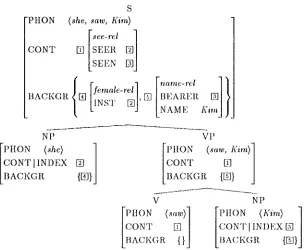
[image:3.612.153.458.54.304.2]This background condition is part of C O N T E X T , and is passed up from NP to S by the Principle of Contextual Consistency. Similarly, Kim has a back- ground condition (shown by tag [N) that the referent bears this name. This is also passed from NP to VP, and from V P to S.
S, VP and V share the same C O N T E N T (shown by tag H1). If logical form is restricted to seman- tic content as ill Figure 2, then V is the semantic head of VP and VP is the semantic head of S, not only in terms of the HPSG definition but also in terms of the BUG algorithm. In this case, saw can be found immediately by p r e d i c t _ w o r d in BUG1. But if we extend logical form as in Figure 4, to in- elude the context factors required for adequate re- alization, it is clear from Figure 3 that S does not have the same logical form as VP, and VP does not have the same logical form as V, as their B A C K G R sets differ. Therefore, although V is still the seman- tic head of VP according to the ItPSG definition, it is not the semantic head according to the BUG algorithm. Similarly, VP is still the semantic head of S for HPSG, but it is not the semantic head for BUG. In this case, p r e d i c t _ w o r d cannot find any se- mantic head word in the lexicon, and BUG1 cannot generate the sentence.
4 R e v i s i n g t h e G r a m m a r
If we include unscoped quantifiers and contextual background in logical form, we see that there arc two different definitions of "semantic head": the IIPSG definition based on adjunct daughter or syntactic head daughter, and the BUG algorithm definition based on identity of logical forms, tIowever, recent proposals for changes in HPSG theory suggest that the two notions of semantic head can be brought back together.
4.1 L e x l c a l a m a l g a m a t i o n in H P S G
In Pollard and Sag (1994), Q S T O R E and B A C K G R sets are phrasally amalgamated. The Quantifier In- heritance Principle requires a phrase's Q S T O R E to be the set union of the Q S T O R E s of all daughters, minus any quantifiers in the phrase's R E T R I E V E D list. T h e Principle of Contextual Consistency re- quires a phrase's B A C K G R to be the set union of the B A C K G R sets of all the daughters.
It has recently been proposed that these sets should be lexically amalgamated. A syntactic head word's arguments are now lexically specified in its A R G U M E N T - S T R U C T U R E list. The word's set- valued features can therefore be defined in terms of the a m a l g a m a t i o n of the set-valued features of its arguments.
Lexical amalgamation of quantifier storage was proposed by Pollard and Yoo (1995). T h e y change Q S T O R E into a local feature which can be included in the features subcategorized for by a lexical head, and can therefore be lexically a m a l g a m a t e d in the head. A phrase no longer inherits unscoped quan- tifiers directly from all daughters, instead they are inherited indirectly via the semantic head daughter. Lexical amalgamation of C O N T E X T , proposed by Wilcock (1997), follows the same approach. As C O N T E X T is a local feature, it can be subcatego- rized for by a head word and lexically amalgamated in the head by means of a B A C K G R amalgamation constraint. Instead of a phrase inheriting B A C K G R conditions directly from all daughters by the Prin- ciple of Contextual Consistency, they are inherited indirectly via the "contextual head" daughter which is the same as the semantic head daughter.
4.2 L e x i e a l a m a l g a m a t i o n in P r o F I T
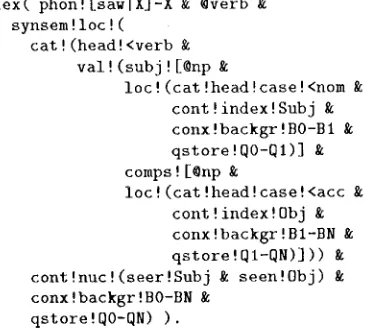
In the P r o F I T implementation, Q S T O R E sets and BACKGI{ sets are Prolog difference lists. Lexical amalgamation of both sets is shown in Figure 5, the lexical entry for the verb "saw". T h e subject's B A C K G R set B0-B1 and the object's B A C K G R set B1-BN are amalgamated in the verb's B A C K G R set B0-BN. The subject and object Q S T O R E sets, Q0- Q1 and Q1-QN, are similarly a m a l g a m a t e d in the verb's Q S T O R E QO-QN.
lex( phon![sawlX]-X ~ @verb synsem!loc!(
cat!(head!<verb val!(subj![@np
loc!(cat!head!case!<nom cont!index!Subj conx!backgr!BO-Bl & qstore!QO-Ql)] comps![@np
loc!(cat!head!ease!<acc cont!index!Obj & conx!backgr!BI-BN qstore!Qi-QN)])) cont!nuc!(seer!Subj ~ seen!Obj) & conx!backgr!BO-BN
qstore!~O-~N) ).
Figure 5: Lexical amalgamation
[image:4.612.317.501.414.580.2]semantic head, the Semantics Principle is replaced and extended. As proposed by Wilco& (1997), we need three principles: Semantic Head Inheritance Principle (SItlP), Quantifier Inheritance Principle (QUIP), and Contextual tlead Inheritance Princi- ple (CHIP). These are implemented by templates as shown in Figure 6 (only the non-adjunct forms are shown). To include the three principles in the gram- mar, the template for hd_nexus_ph in Figure 1 is extended as shown in Figure 6.
'SHIP' := synsem!loc!cont!Cont
hd_dtr!synsem!loc!cont!Cont.
'QUIP' := synsem!loc!qstore!QS
hd dtr!synsem!loc!qstore!QS.
'CHIP' : = synsem!loc!eonx!Conx
hd dtr!synsem!loc!conx!Conx.
h d n e x u s p h : = <hd_nexus_ph & @hd_ph
@'SHIP' & ~'QUIP' ~ @'CHIP'.
Figure 6: Inheritance of l,ogical l"orm
With these revisions, it is possible to include unscoped quantifiers and background conditions in the starting logical form, and perform head-driven generation suecessfiflly using the BUG1 generator. llowever, there remain various technical difficulties in this implementation. The t)roFIT system does not support either dynamic constraint checking or set-valued features. The methods shown (template expansion and difference lists) are only partial sub- stitutes for the required facilities.
5 C o n c l u s i o n
T h e combination of a head-driven tIPSG grammar with a head-driven generation algorithna is a natu- ral approach to surface realization. We showed how van Noord's BUG1 generator can easily be adapted for use with an I1PSG g r a m m a r implemented in P r o F I T , and that this works well if the semantics is strictly head-driven, llowever, while the apparently clear definition of semantic head in tIPSG should make semantic head-driven generation easy to imple- nlent, we found that if we implement the fifll I1PSG t e x t b o o k semantics, with quantitler storage and con- textual I)ackground conditions, the notion of seman- tic head becomes unclear. Surprisingly, this natural approach does not work, even for simple examples.
In order to use semantic head-driven generation algorithms with HI SG, we must adopt recent pro- posals to include quantifier storage and contextual background inside semantic heads by means of lex- ical amalgamation. We showed how the grammar
in P r o F I T can be extended with these proposals. We therefore conclude that head-driven generation with IIPSG is indeed a feasible approach to surface realization, although tiler(', are some technical ditti- culties.
A c k n o w l e d g e m e n t s
We. are gratelhl to Mr Yoshikazu Nakagawa of Sharp Corporation for making our collaboration possible.
R e f e r e n c e s
Gregor Erbach. 1995. P r o F I T : Prolog with Fea- tures, hihel'itance, and Templates. In Seventh Co@fence of the European Ch, apler of lhe Asso- cialiou for Computalio~al Linguistics, pages 180--- 187, l)ublin.
Masahiko llaruno, Yasuharn l)en, and Ynji Matsu- moto. 1996. A chart-based semantic head driven generation algorithm. In G. Adorni and M. Zock, editors, Trends in Natural Lauguage Generation: An Artificial Intelligence Perspective, pages 300 3113. Springer.
Carl Pollard and Ivan A. Sag. 1994. Head-driven Phrase Structure Grammar. CSLI Publications and University of Chicago Press.
Carl Pollard and F, un Jung Yoo. 1995. Quantifiers, wh-phrases and a theory of argument selection. Tiibingen IIPSG workshop.
Ivan A. Sag. 1997. English relatiw~' clause construc- tions. Jour~al of Linguistics, 33(2):431l 484. Stuart M. Shieber, (~ertjan wm Noord, Fer-
nando C.N. Pereira, and Robert C. Moore. 1990. Semantic head-driven generation. Compulational LiT~guistics, 16(1):30 42.
Gertjan van Noord. 1990. An overview of head- driven bottom-up generation. In R. Dale, C. Me.l- lish, and M. Zock, editors, Currenl Research in Natural l, aT~guagc GeTteralion, pages 141-165. Academic Press.
(2;raham Wilcock and Yuji Matsmnoto. 1996. l{e- versible delayed lexical choice in a bidirectional framework. In 16th International Conference on Compulalional Linguistics (COLING-96), pages 758 763, Copenhagen.