A Method for Abstracting Newspaper Articles by Using Surface Clues
Hideo Watanabe
IBM Research, Tokyo Research Laboratory
1623-14, Shimotsuruma, Yamato-shi, Kanagawa-ken 242, JAPAN
[email protected] p
A b s t r a c t
This paper describes a system which automatically creates an a b s t r a c t of a newspaper article by selecting important sentences of a given text. To determine the importance of a sentence, several superficial features are considered, and weights for features are determined by multiple-regression analysis of a hand processed cor-
pus.
1
I n t r o d u c t i o n
T h e rapid expansion of the Internet enables us to easily access a lot of information sources in the world. T h e ability to browse information quickly is therefore a very i m p o r t a n t feature of an information retrieval and navigation system. Abstraction of a d o c u m e n t is one useful tool for quick browsing of textual information.
Generally, an abstract can be considered to be a con- cise text giving an outline of the original text. Creat- ing an abstract requires deep semantic processing with broad knowledge, and the strategy for generating an abstract depends on the t y p e of target text. Abstracts created by humans tend to differ according to their creators' background knowledge and interests. Fur- thermore, as stated in [6], the same person is likely to create different abstracts of the same text at dif- ferent times. Simulating this human process is clearly outside the area that can be dealt with by current com- putational linguistics. There are, however, some cases in which an abstract can be created by using surface clues to make conjectures as to which portions are the most important without using deep semantic process-
ing.
T h e most practical way to create an abstract is thus to determine the most i m p o r t a n t portions by using sur- face clues. There are two lines of research based on this approach: one analyzes some aspects of a text's struc- ture, such as the rhetorical structure [7], and selects
some sentences according to this s t r u c t u r e [5, 3]; the other analyzes surface features for each sentence in a given text and selects the most i m p o r t a n t sentences according to some heuristics [6, 1, 9]. In methods of former type, the rhetorical structure is a p p r o p r i a t e for a relatively small set of sentences such as a paragraph, but it does not give enough information to create an a b s t r a c t for a large set of sentences. In methods of the latter type, the validity of the heuristics is uncertain when the target text is changed. Therefore, this p a p e r proposes a method for selecting i m p o r t a n t sentences by using an equation based on surface features and their weights, and a m e t h o d for determining these weights by multiple-regression analysis of abstracts created by humans. T h e target texts of this method are J a p a n e s e newspaper articles.
2
S u r f a c e
F e a t u r e s
o f a S e n -
t e n c e
T h e proposed method is to create an abstract by determining i m p o r t a n t sentences according to features extracted from each sentence. For each sentence in a given J a p a n e s e newspaper article, the following fea- tures 1 are analyzed:
• I m p o r t a n t Keywords:
An i m p o r t a n t keyword is defined as a keyword that appears in another sentence or in a title. T h e number of points for this feature is tile total num- ber of occurrences of impot'tant keywords.
• Tense:
T h e tense of a sentence is analyzed as
past
orpresent.
This feature gives 1 point forpresent,
and 0 forpast.
l b l e s t of these features were proposed in t h e previous studies. K e y w o r d s were p r o p o s e d in [6], sentence location was proposed in [1], s e n t e n c e type was p r o p o s e d in
[1, 9],
etc., and rhetori- ca] relations were proposed in s t u d i e s using rhetorical s t r u c t u r e s• T y p e of a Sentence:
Sentence types are fact, conjecture, or insistence.
This feature gives 0 points for fact, 1 for conjec-
ture, and 2 for insistence.
• Rhetorical Relation:
The rhetorical relations to the preceding context is analyzed as example, adverse, parallel, compar- ison, or connection. This feature gives 1 point for
reason, 2 for example, and 0 for others. • Distance from the beginning of a text:
In general, sentences located near the beginning of a text tend to be important. Therefore, sentences in the first paragraph are given 5 points for this feature, sentences in the next paragraph 4, and so
o n .
• Distance from the end of a text:
Sentences located near the ending of a text also tend to be important. Therefore, sentences in the last paragraph are given 5 points for this feature, sentences in the previous paragraph 4, and so on.
T h e tense of a sentence is simply determined to be
past if it has "ta" (an inflection for the past tense) in the last p h r ~ e 3 The reason why tense is used is that sentences stating about the current fact seem to be more important than ones about the past fact in the context of editorial articles.
The sentence type is determined by checking special expressions in the last phrase, a For instance, if the fi- nal phrase contains "bekida" ("should") or "nakereba- naranai" ("must"), then its sentence type is insistence;
if it contains "darou" ("probably ..."), then its type is
conjecture; otherwise, its type is fact. Examples of spe- cial expressions used to determine sentence type are as
follows:
• Conjecture: kamosirenal (may), kanenai (be capa- ble of), souda (likely to), youda (likely to), darou (probably), etc.
• Insistence: tai (want to do), hosii (want someone to do), bekida (should), nakereba-naranai (must), taisetu-dearu (important), hituyouda (necessary), etc.
2 In this m e t h o d , past does n o t imply t h e p a s t t e n s e lit a s t r i c t s e n s e b u t r a t h e r ;the s e n t e n c e is n o t in t h e p r e s e n t tense. In J a p a n e s e , "ta" implies t h e p a s t tense, c o m p l e t i o n , a n d so on. M o s t c a s e s are a c t u a l i n s t a n c e s of t h e p a s t tense.
n i t is sufficient to check in fire l a s t p h r a s e for J a p a n e s e s e n - tences, b e c a u s e a p r e d i c a t i v e p h r a s e is always l o c a t e d at t h e e n d of a J a p a n e s e senteltce. T h e r e f o r e , a n o t h e r s t r a t e g y is n e e d e d for l a n g u a g e s in which a p r e d i c a t i v e p h r a s e m a y b e l o c a t e d in t h e middle of a s e n t e n c e .
T h e rhetorical relation is determined by checking special expressions both in the first phrase and in the last phrase of a sentence. For instance, if "sitakarada" 4 is found in the last phrase, then the rhetorical relation is reason, and if the conjunction "sikasi" ( " b u t " ) is found, then the rhetorical relation is adverse. 5 Exam- ples of special expressions used to determine rhetorical relations are listed below:
• Example: t a t o e b a (for instance), nado (etc.), etc.
• Adverse: sikasi (but), tokoroga (however), etc.
• Comparison: koreni-taisi (while), etc.
• Parallel: mata (further), sarani (in addition), etc.
• Reason: karada (because), tameda (because), etc.
3
P r o c e s s o f C r e a t i n g a n A b -
s t r a c t
T h e basic method for creating an abstract in most previous studies has been to analyze the sentences of a text in terms of some surface features, and a heuristic to determine the most important sentences on the basis of these features.
T h e method proposed in this paper formalizes the above approach so that the importance of each sentence is calculated as the sum of feature points multiplied by their feature weights. The most important sentences are then extracted as an abstract. T h e importance S of a sentence is calculated as follows:
r~
i = t
where a is a constant, P/ is the number of points as- signed to the i-th feature, which is normalized to be between 0 and 1, and Wi is the weight assigned to the i-th feature.
T h e steps in creating an abstract are as follows:
1. For each sentence, calculate the importance.
2. Select the sentence that has the highest impor- tance value among the unselected sentences.
3. If the selected sentence sl has another sentence s2 in the previous context that is related to st by any rhetorical structure, then s2 is also selected and marked.
41n English, this expression corresponds to "because" in the first p h r a s e .
5 T h e s e checking of s e n t e n c e t y p e s a n d rhetorical relations a r e b a s e d on [10].
4. If the ratio of the number of selected sentences to the number of sentences in the text exceeds the specified one, then terminate this process; other- wise, goto 2.
These steps select sentences on the basis of their importance value, but they also respect the rhetori- cal structure to some extent (step 3), because if the rhetorical structure is totally ignored, the o u t p u t text will be awkward to read.
4
A M e t h o d for D e t e r m i n i n g
t h e W e i g h t s of F e a t u r e s
Most previous systems can be considered to deter- mine the weights of features according to human intu- ition. On the other hand, this paper proposes a method for determining the wieghts of features by multiple- regression analysis of correct examples, which are ab- stracts created by testers. A tester selects important sentences that should be included in an abstract. T h e importance value of a sentence is defined as the number of supporters (testers who selected it as an important one) divided by the total number of testers. Let this importance value be S; we then get the following equa- tion for each sentence:
S=a+LWI*Pi
imlwhere, a is a constant, Pi is the number of points as- signed to the i-th featnre which is normalized to be between 0 to l, and Wi is the weight assigned to the i-th feature.
In this equation, Wi is the only variable. There- fore, the feature weight Wi is calculated by multiple- regression analysis.
5
E x p e r i m e n t
We conducted an experiment to check the validity of the proposed method.
T h e testers were divided into two groups, A and B, each consisting 10 people. Those in group A selected important sentences (about 1/3 of the article) in 5 ed- itorials and 3 general articles from the Nikkei News- paper. Those in group B selected important sentences (about 1/3 of the article) in 3 editorials and 3 general articles, which were different from those used for group A. One of the editorials and one of the general articles
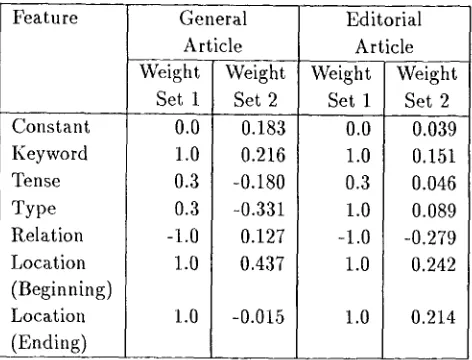
Feature
Constant Keyword Tense T y p e Relation Location (Beginning) Location (Ending)
General Article
Weight Weight
Set 1 Set 2
0.0 0.183
1.0 0.216
0.3 -0.180
0.3 -0.331
-1.0 0.127
1.0 O.437
1.0 -0.015
Editorial Article Weight
Set 1
0.0 1.0 0.3 1.0 -1.0 1.0
1.0
Weight Set 2
0.039 0.151 0.046 0.089 -0.279 0.242
0.214
Table h Weight Set of Features (General and Editorial Articles)
used for group B are shown in Figures 1 (a) and 2 (a), respectively. In each of these figures, the first number is a sentence number, the second number is the number of supporters in group B, and the last part is a rough English translation. G
Table 1 shows two weight sets; weight set 1 was cre- ated by the author in such a way that sentences located near the beginning and end are regarded as important, sentence importance is not proportional to points for rhetorical relation, and the importance of
insistence-
type sentences is higher in editorials than in general articles] Weight set 2, on the other hand, was calcu- lated from the results obtained from group A by the method described in the previous section. Weight set 2 for general articles implies that sentences near the beginning are more important than ones near the end, andinsistence-type
sentences are less important, and so on. On the other hand, weight set 2 for editori- als implies that sentences both near the beginning and near the end are important, and thatinsistence-type
sentences are important, sTo check the validity of these weight sets, we com- pared the abstracts created by the system, using weight set 1 and 2, from the articles supplied to group B, with
6This translation was made by the author, and is not autho- rized by Nikkei Newspaper K.K.
7This weight set 1 corresponds to the way used in previ- ous studies, where weights are determined according to human
intuition.
[image:3.596.317.553.94.274.2]the abstracts created by group B. For the general arti- cle in Figure 1 (a), the three most important sentences
(roughly 1/3
of the article) determined by using the weight sets 1 and 2 are listed in Figures 1 (b) and (c), respectively. In this case, the three most important sentences selected by grou t) B were 0, 2, and 3. Like- wise, for the editorial in Figure 2 (a), the eight most iml)ortant sentences (roughly1/a
of the article) deter- mined by using weight sets l attd 2 are listed in Figures 2 (b) and (c), respectively, in this case, the eight most important sentences selected by grou I) 11 are 0, 2, 3, 12, 15, 20, 21, 22. Here, we introduce the following metric of estrangement to check which abstract is most similar to the result of group B:Estrangement = ~ . , , ( t h e number of supporters of a sentence si) - ~_~.</(the number of Sul)porters of a
sentence s j)
where s{ is a sentence that is included in an abstract by group B but not in an abstract created by the system, and s./ is a sentence that is not included in an abstract by group B but is included in an abstract created by
the system.
The estrangements of the articles in Figures 1 and 2 are as follows: From this result, the weight set 2 calcu-
14 13
Weight Set 1 Weight Set 2
6 12
to adjust these heuristics for the given text. This pa- per proposed a method for this adjustment; that is, a method for determining weights of surface features by multiple-regression analysis of abstracts created by human. By using this method, a system can have an ability to be applied to a variety of texts.
7
C o n c l u s i o n
This paper has proposed a method for creating an abstract by using surface features and their weights to select important sentences, and a method for de- termining these [eature weights by multiple-regression analysis of abstracts created by humans. By using the proposed method to calculate feature weight, this sys- tem can be applied to other types of texts, and gives results ntore similar to those of a human process than a set of weights based on human intuition.
This abstract creation system is currently used in an informatioll navigation assistance system [8] as a tool for quickly viewing the contents of newspaper articles.
R e f e r e n c e s
[1]
[2]
[,3]
luted by multiple-regression analysis is more similar to the human selection than the weight set 1 created ac- cording to the author's intuition. For the other general [4] articles used with group B, the estrangement values of weight set 2 are also better than those of weight set [q 1. In the other editorials, the estrangement values arc comparable. This implies that the weight set I is not
such a bad estimate for editorials. [~]
6
D i s c u s s i o n
[71
Edmmtdson, lI. I'., ':New Methods in Automatic Extracting, " Journal of the Association for Computing Machiuery, Vol. 16, No. 2, pp. 264-285, April 1969.
Kita, S., "A System for Summarization of au Explanatory Text" (itl Japanese), Report 63-6 of NLWG of hlformation Processing Society of J a p a n (IPSJ), 1987.
Ono, K., Sumita, K., and bliike, S., ':Abstract Generation based on Rhetorical S t r u c t u r e Extraction," Proc. of Col- ing'94, Vo[.1, pp. 344-348, 1994.
Tamura, '17., and Tamura, N., "A Summary Generation based ou The Form of Text" (in Jap~.aese), Report 92-t of NI,WG of IPSJ, 1992.
So far, most systems for creating an abstract of a text has been selected important sentences by some heuristics on the basis of surface features. I[owever, [8] most of these heuristics were derived from human in- tuition, and the validity of them are uncertain if the target text is changed. As mentioned in the introduc- [9] tion, the strategy of an abstraction should be changed accordhlg to the given text. Therefore, it is needed
Schank, 1{. and Abelsoll, A., "Script Plans Goals and Um derstandlng," Lawrextce F, rlba.um Associates, IIillside, New Jersey, 1977.
Luhn, H. P., ';The Automatic Creation of Literature AI> stracts," IIIM Journal of Research and Development, Vol. 2, No. 2, pp. 159-165, 1958.
Mann, W. C., '"Rhetorical Structure Theory: Description
and Construction of Text Structure," In G. Kempen, edi- tor, Natural Lauguage Generation, pp. 279-300, Martiuus Nihjhoff Publishers, 1987.
Morohashi, M., Takedx, K., and et. al., '~[nformation Outlin- ing - Filling tile Gap between Visualization and Navigation
in Digital Libraries," Proc. of lilt. Symposium o0. Digital Libraries 1995, pp. 151-158, 1995.
Yanmmoto, K., blasuyama, S., and Naitou, S., "GREEN: All Experimental System Generating Sutllltlary of Japanese Editorials by Combining blultiple Discourse Characteristics" (in Japanese), Report 99-3 of NLWG of IPSJ, 1994.
[101 Watanabe, H., Tsujii, J., and Nagao, M., "A Method for Analyzing Text Structure by Using Surface Clues of Sentence " (in Japanese), Proc. of 32nd Convention of IPSJ, pp.1633- 163-t, 1986.
Title: ~%~]~MP U ~ ' , ' n : , . I B M , ~ : ~ - - - ~ . ? ~ ~ t m ~ : J ~ o (IBM to release PC equipped with the latest MPU, featuring low cost and fast processing)
0 (10) [ - - : ~ - ~ - # 1 0 H = ~ 2 g ~ f 6 ] ~ I B M t ~ J - H , ~ . ~ ' w 4
poration announced on the 10th of this month that a personal computer equipped with the latest "PowerPC" microprocessor will be released next summer.)
(First, a notebook PC will go on sale; this will be followed by two types of desktop PC.)
kN~avl,7o =/>" 1::*=- ~ -~,l~,~n-I~nno (The PowerPC" is used as
a centrM part of a computer. It is cheap aud has high processing power, and is said to be a key to IBM's recovery.)
Y£o (Since IBM announced its plan to sell personal computers equipped PowerPCs, other PC makers in the world are likely to take countermeasures.)
4 (3) ~ - ~ T ~ - - - _ . ~ , ~ I I C D - - R o m . " ~ 4 ~'. ~ f f - P J ' J - ~ - ' 4
(The above three types of PC will provide additional multimedia functions by including CD-ROM, microphone, stereo audio, and voice recognition functions as standard features.)
5 ( 0 ) O S ( ~ g ' 2 7 b) l i I BM69 [ O S / 2 J a ) t t g , . ~ ' 7 4 ¢, t ~ ' , ' 7 b o re] 4 > ' F e 2 X N T J , 4]-:,. v 4 ~ m - > X ~ A X ' © [']
9 ') x J %: ~'l.= ~o)bj'l~,-e-~ 7o 3:-5 l:.~Ya o (IBM's OS/2, Microsoft's Windows NT, and Sun Microsystems' Solaris will be installed as operating systems.)
6 (O) ; ¢ ~ - P C I I I B M , 7.~7"Jt,=~ y ~ * : ~ - P , ~ b ~ - 9 © ~ _
Uo ("PowerPC" is a RISC-type MPU developed by IBM, Apple, and Motorola.)
7 (2) e~'] ~ Y ~ M P U ~ f f ~ T ~ h © } ~ . ~ R I : *; o ~:~'~ 4 >T-)t, ~ M P U~:~}E~To]tgg¢)~@n~2, ] t ~ } ~ • ]~&}~/~Trj~fSo (It is intended to compete with Intel CPUs, which are de-facto stan- dards in the PC microprocessor market. Its main advantages are low price and fast processing.)
" ~ T a ~ ] ' ~ ' ~ o (The second largest PC maker, Apple, has announced a plan to release a "PowerPC"-based PC next year.)
9 ~ ' o h o (The largest P C maker. IBM. has already released a
PowerPC-based workstation, but has not announced an3' corre- sponding plan for PCs.)
10(1) I B M I i ~ ¢ 7 - P C @9~J-$fdP]'"O*; <, ¢ ~ ] ¢'7 -~ :, a-)¢~ ~) ~e~.~g)To~:{'~o (IBM plans to sell PowerPCs to other vendors, license the ~ technology, ahd create a family of PowerPC-based PC.)
(Together with Apple and others, IBbl aims to gain at least a 20% share in the PC market for PowerPC-based PC.)
(a) Origi~,al Article
2 (5) t ~ f ~ ' U ~ P ~ N _ ~ © ~ j ~ ' z e r T - P C I $ , I B M ~ © 2 - ' F ' ~
11 (3) 7 ' ~ 7 " ~ P * 3 ~ ' ~ b - ~ f ~ Z l T - - P C ~ i ~ ' ] ~ : , ~ : ~ k ' ~ , ~:
(b) Abstract by Weight Set 1
o (~o) [ - : : ~ - ~ - - ~ ' 1 0 H = ~ ] ) ~ I B M I ~ T H , ~ J ~
~ o
(c) Abstract by Weight Set 2
F i g . h A n E x a m p l e o f A b s t r a c t o f G e n e r a l A r t i c l e ( N i k k e i N e w s p a p e r , 1 N o v . 1993)
Title: [{~i~[{l~:J ~i~F)~ L ~;sl%g)f,: F 4 'Y (~J:~) (Germany de- termined to shut out economic refugees.)
V- 3 : 7 o g ] q ~ A , © ~ ¢ k ~ 6 ~ ; ~ C ~ ~:/., L:~ (The German Diet has revised the constitution to prohibit immigration for economic reasons such as poverty.)
.5 ~b~J'/',~o (The aim of this move is to shut out economic refugees and accept only political refugees.)
:~di¢3 ~':6~f9~,-(, . ~ ¢ 2 , ~ : ~ 1 " . ¢ b ~ , 4 , _ 3 : - 5 0 (This retreat from idealism is disappointing, but in view of the current situation of Germany, it is an inevitable measure.)
©f~o (The restriction, which will come into effect in July, will
prohibit refugees from "countries without persecution" (e.g. Ro- mania, Bulgaria, and Hungary) from being granted entry except in special cases, and will repatriate political refugees through "safe countries" (e.g. western European countries, Poland, and Czechoslovakia) which permit pohtical refugees.)
4 (i) ~ . 9 *~ ~ ' ~ J ~ l I : ~ b t:~ ~ ~, c~ ~ C ~
~7o~'{'~{<¢t,,A~, " 5 ~ ' ~ 7 o o (The logic behind this is that there cannot be political refugees from countries that have been converted into democratic nations by the East European Revo- lution, and so on.)
l~@.*~:-'~;tqfzof:.o (Clause 2, Article 16 of the Basic Law es- tablished after WWlI, in 1949, was generous to refugees stating that people persecuted politically had a right to be protected.)
was based on the reflection that anti-foreign policies in the 'Nazi' era had hurt foreign nations and produced many refugees from Germany.)
< o f.: ~ ~o I,~.5 ~ (It is also said that this clause was created out of strong consideration for socialist states.}
f.:o (However, Germany's situation has been totally changed by the unification of Germany and the end of the cold war.)
n u m b e r arriving in Germany, which has loose restrictions, was 440,000, over 60% of the total for Europe.)
10 (0) U.a)m]:JI21$Z]7:]~.-T-)k.7)¢V 4 'Y}21~.@"~l~a~b, [ ~ - - + ] <
people applied to Germany for refugee s t a t u s this April; of these, 410,000 were interviewed but only 700 were accepted.)
~gE~7)'g69Xa'~d~&G~l-Zoo (73% of applicants are from Eastern Europe or ex-soviet-bloc countries such as Romania, and former Yugoslavia.)
12 (0) --%Z*, >[<i~.i.~[ ~a ~:~d~/-.: %: ~ 'o ( a t the same tinle, titere is a constant flow of entrants.)
13 (5) g 4 "9lJ:~'£, i~l{f~.~.~.& g~,~7~74<iS{,TIza~7~o (Germany is now said to be suffering the worst recession since WWII.) 14 (0) I H ~ F 4 "~f.~a)9£~!{~11~[~lH -c-{~ • --%/27) ¢, {(}:i/]~][~.£7)¢~ ~cv,7olH~/{ F -1' '2~.~-~li--~ • g % ~ ' o (Tim unemployment rate in April was 7.1% in former West Germany, and 14.7% in former East G e r m a n y . )
~, ~ -} 74<~7)~ ~ 7o 7), #o/'.50 (There is a growing anti-forelgn tendency
manifested in attacks on foreigners by ultra-rightist groups, re- suiting from anxiety t h a t masses of immigrants will take native people's jobs.)
(Refugees enter government-provided accommodation and live there until ttleir inverviews are completed, with their expenses borne by states and cities.)
(For this reason, many regional governments have appealed for the numbers of refugees to be restricted.)
18 (0 u ) i ~ l , ~ _ g , a)DJ~i~J Ca~.~f 3:5 ~ t,, ~ ~ag~£©i~>-l=ll, ,~.-~g.~o~aT),, ~ % . ¢ i ~ A ~ a ) ~ a ) ~ < g ~ 2 bf:o (Most
Diet members in coalition government parties and social liberal- ist party approved the revision of rite Basic Law, which intposes restrictions on refugees similar to those of other m a j o r Western European countries.)
Z ' U ' L " 0 © ~ / : ~ 7 ) ~ . : ~ o k ~ b'")t~l]~l~.¢'~fTao (Tile move is also iutended to be a post-war process and the settlemeut after the Cold War, aud gives tire impression of the end of an era in Ger- many.)
-9"("u"7o o ( O t h e r major Western E u r o p e a n countries such as France have also decided to impose more restrictions on eco- nonfic refugees.)
21 (4) t~tt,,l$1©A4 r) {-a T) , &- I~J -"-.~ ~:a -) & -¢.5 ¢)lat g ~Sa)~ b {?~
?.9)< 7 k ~ a ) ~ $ ! ~ j l a t ? ~ a L ~ b o (It is n a t u r a l for poor people to try to go to rich countries, but the movenmnt of many people produces confusion and friction.)
tant to Mleviate the conditions that produce econonfic refugees through world-wide cooperation, and it may be inevitable for
European countries to impose some level of restricts.)
g ) - C ~ 7 o a ) t ~ , ~ 7 ) { a ~ 7 ~ ")o (However, it is not appropriate to apply these examples to Japan, because Japan's circumstances are different from those in Europe.)
(a) OrigiuM Article
u,Sa~ft~o
2 (8) ~_~,$~a)i{i~_Iz~tZT){, A~,II4~*~_~, V 4 "77k.#,~)10~
a (6) -b~17),gZ~~cTo~lJ{~l£, Fi~a)gu,[~] (;b-7--7,
f~o
"CW6o
<'~ b, #A#l~7)¢--,~e)~llA,$'~.lf,5© g.,eb,k{~.:~ v,o
(b) A b s t r a c t by Weight Set 1
3 (6) -{5~JT)"6~)~iTTa~bj~lJ.{~'n~{~, [~=m©exv,V,l] (m--~'m7,
(a) A b s t r a c t by Weight Set 2
Fig. 2: An Example of Abstract of Editorial (Nikkei Newspaper, 1 Jun. 1993)