Applying Lexical Rules Under Subsumption
E r h a r d W . H i n r i c h s
Dept. o[ Linguistics
University of T~bingcn
Wilhelmstr. ] ]3
D- 72074 Tiibingen
G e r m a n y
eh~sf s. nphil, uni-tuebingen, de
T s u n e k o N a k a z a w a
NTT Laboratories
1-2356 Take, Yokosuka 238-03
,Japan
t suneko©nttnly, nit. j p
A b s t r a c t
Lexical rules are used in constraint- based g r a m m a r formalisms such as llead-Driven l)hrase Structure G r a m m a r ( I I P S G ) (Pollard and Sag 1994) to ex- press generalizations atnong lexical en- tries. '['his paper discusses a number of lexical rules from recent I[PSG analy- ses of G e r m a n (tlinri<;hs and Nakazawa 1994) and shows t h a t the g r a m m a r in some cases vastly overgenerates and in other cases introduces massive spurious structural ambiguity, if lexical rules ap: ply under unification. Such l)rot)lems of overgeneration or spurious ambiguity do not arise, if a lexical rule al)plies to a given lexical ent;ry iff the lexical entry is subsumed by the left:hand side of the lexical rule. I,'inally, the paper discusses c o m p u t a t i o n a l consequcnce~s of at)plying lexical rules under subsuml)tion.
1
I n t r o d u c t i o n
Current linguistic theories place an increasing a m o u n t of g r a m m a t i c a l information in the lexicon and employ a variety of mechanisms to express generalizations across lexical entries: templates (Flickinger 1987, Shieber 1986), inheritance hier- archies (Flickinger 1987, Pollard and Sag 11994), and lexical rules (Bresnan 1982, I)owty 1982, Gaz- d a r e t al. 1985, Pollard and Sag 1994). Lexical rules (henceibrth: LRs) have been subjected to particularly close s<:rutiny. 'Fhis research has tb- cused on two i m p o r t a n t issues: 1. how the use of LRs affects the generative power of g r a m m a r formalisms and the c o m p u t a t i o n a l complexity of parsing algorithms (Uszkoreit and Peters 1986, Carpenter 1991), and 2. how to provide a de- notational semantics for LRs (Calcagno and PoP lard 1995, Meurers 1995). In this paper we ad- dress neither of these two issues. Instead we will concentrate on a question t h a t we c<msider to be of equal importance, but t h a t has received sur- prisingly little attention: Under what conditions
should an I,R be applicable to a given lexical entry (henceforth: LE)? For g r a m r n a r formalisms t h a t employ the notion of unitication of attribute-value structures, two criteria for applicability naturally suggest themselves:
1. llypolhcsis A: A lexical rule applies to a lexi- cal entry ifr the lexi<:al entry unifies with the left-hand side of t;he lexical rule.
2. Hypothesis B: A lexical rule applies to a lex- ical entry iff the lexical entry is subsumed by the left-hand side of the lexical r u l e )
W i t h o u t much argument, it is cotnmonly as- sume<t that llypothesis A is correct (el. Pollard and Sag 1994, (]alcagno and Pollar<t :1995, and Meurers 1995). This paper argues t h a t 11ypoth- esis A should be rejected on empirical grounds. We discuss a number of Ll{s t h a t have been used in IIPSG analyses of G e r m a n (tlinri<:hs and Nakazawa 1994) and show t h a t the g r a m m a r will either vastly overgenerate and accept u n g r a m m a t - ical sentences or introduce spurious structural am- biguity for g r a m m a t i c a l sentences, if ltypothesis A is adopted. Itowever, no such problems ofovergeu- eration or spurious ambiguity arise, if one adopts llypothesis B, instead.
It would go beyond tim scope of this paper to present a flJly worked-out proposal on how to i>ro - cess LRs in a coml)utational system for I I P S G . Itowever, as discussed in section 6, it is worth not- ing t h a t the s u b s u m p t i o n test for I,l{ application <'.an be integrated straightforwardly into two re- cent proposals by van Noord and B o u m a (:1994) and by Meurers and Minnen (1995) of how to im- plement l a b in a processing system for HPSG.
l'Fhis paper will not provide a formal definition of subsumption or nnificiation for typed feature struc- tures. Instead, we refer the reader to the standard definitions of Kasper and Rounds (1986) and Carpen- tel: (1992), among many <)tilers. Informally speaking, two feature structures are unifiable itf they do not con- t a b incompatible information. One feature structure subsumes another iff the intormation contained in the former is less specific than in the latter.
P P L R :
IPLR:
SUIIJ COMPS
S U B J C O M P S
[IIF, ADIVI'~ORM pass ]
s P
>
-*/val, [SUB
[CAS, no,,,]
>]
[ [CAS acc] I [] >
h
[COMPS
[]
] [-HEAI)IVFORM pass
] ]
NP >
+ hal, [SUI{J < >
E~[CAS]~ geil
V dat] I [] >
k
t C ° M P s ( []][C,'ASlC gen v dat] I [ ] )
lqgure 1: Passive Lcxical l{ules for German Kiss 1992
2
Passive by Lexical Rule
It has been assumed in a variety of syntactic fi'ameworks t h a t the active/passive alternation should be treated as a lexical process: Bresnan (1982) in LFG, Dowty (1982) in Categorial G r a m - mar, and Pollard and Sag (1987) for I I P S G . Ger- m a n exhibits two types of passNes: personal pas- sives, as in (lb), and impersonal passives, as in (2b,3b).
(l) 3. Peter sah den Mann. 'Peter saw the m a n . '
b.
1)er Mann wurde gesehen. ' T h e m a n was seen.' (2) a. Peter half dem Mann.'Peter helped the m a n . ' b. Dem Mann wurde geholfen.
'The m a n was helped.'
(3) a. Die Veteranen gedachten der 'l~)ten. ' T h e veterans c o m m e m o r a t e d the dead.' b. Der 'Poten wurde gedaeht.
'The dead were c o m m e m o r a t e d . '
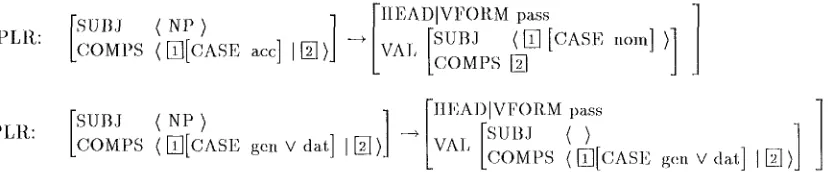
For personal passives the accusative object NP of a transitive verb, e.g. den M a n n in (la), in its active form corresponds to an NP with nomina- tive case, e.g. der M a n n in (11)). In impersonal passives a datiw; or genitive NP complement of a transitive verb, e.g. the dative NP dem M a n n in (2), exhibits the same case assignment in the ac- tive and passive forms. 'IS formMly capture the relationship between the l, Es for active and pas- sive forms of G e r m a n verbs in I l P S G , Kiss (1992) formulates the LRs in Fig. 1 (henceforth referred to as the PPLt{ and the IPLR, respectively), u
The LRs in b'ig. I employ the H P S G feature geometry of Pollard and Sag (1994). a ']'he spec- illcation of a syntactic category (CNI') in tlPSO
>However, see Kathol (1994) and Pollard (1994) for an account of German passive without LRs.
aIn order to reduce the size of the feature struc- tures, prefixes of paths that begin with the SYNSEM attribute have been omitted as much as possible in
Fig. 1 and all other feature structures that are shown
in this paper.
According to Kiss, specifying two different case wtl- ues under one reentrancy (cf. tags [~ in the PPLR) is a shorthand notation for identity of the two categories in all respects, except for the case value. ']'he original
includes the feature V A L E N C E (abbreviated as VAL in lqg. 1), which in turn specifies for verbs under the features SUILI and C O M P S the sub- ject and non-subject complements. C O M P S takes a list of categories, (:ailed s y n s e m objects, as its vahn;. If the list is n o m e m p t y , the h:ftmost cate gory in the list represents the direct object. T h e intended effect of the PPI, I{ is to p r o m o t e the di- rect object of a. transitive verb in the l,l,] for the actiw~' form to the subject of the passive form. l,'ol: impersonal passives the C O M P S list of any transi- tive verb whose leftmost complement is marked by genitive or dative case remains unchanged, while the singleton list of the subject value of the active form becomes the e m p t y list in the I,E for the passive form. Note t h a t the case specifications on the left-hand side of the rules m:e crucial since they condition which classes of transitive verbs appear in personal and impersonal passives.
[image:2.596.95.511.53.139.2]Viewed procedurally, the PPI,I{, is m e a n t to ap-- ply to [,Es for transitiw; verbs such as kau,[en as shown in |+'ig. 2. 4 For transitive verbs it makes no ditthrence whether we use unitication or sub s u m p t i o n as the test of ;,pplicability tbr the PP l, lC '['he LE for any transitive verb is more specific than the feature stru<-ture
of
the input descrip- tion of the PPI,I{, since the P H O N wdue and the C O M P S and SOl+;1 wJues will be further instan- d a t e d t h a n in the input description of the PPM~. In particular, the C O M P S list of the P P L R is entirely schematic R)r any non-empty list of cat- egories whose tlrst element is an accusative N P, while the C O M P S vahle for kaufi'.n is a list with exactly one element that has the same category and case spc'cification as the NP in the P I q , R. Therefore, {;he LE will b o t h unify with and be subsumed by the input Datnre structure of the IJPLI{. However, as we will see in the next section, the choice of s u b s u m p t i o n or unification makes a crucial dilDrence when [,Es are themselves highly schematic and underspecitled.tbrmulation of the I,Rs by Kiss (1992) differs from the version presented here in minor definitionM details. ttowever, these differences are entirely orthogonal to the theoretical issues discussed in this paper.
~ll)()?'d
I)I]ON ( k~tul'en )
(.A~ "~ /w,"
"',,
su~.~ ( N P[.o.,]m~
)
...
L
COMPS ( N,,[;,,~:,:]GI )
P"
:j
"WO i'd
PlION ( gcka, u[t )
F
[ II I!:AI)IvI''O:t{MP~'~
]
/
F""'"'
]
]
| L L (2oM pS ( )
J
"
/
F
]
/
/
L
Ll~ou(',lrr E~]J
I:'igm:c 2: A p l d Y i n g IJ,c I>PI,I{ to the al)t,'~wia.tc'd 1,1'; For l, hc v¢~'~'l~ ka*tflen, ( ' l m y ' )
3
Argument Composition in the
Lexicon
Tim notion of nrgulnent composil;ion wa.s Iirsl; i n
/,roduccd inl;o tJm I/I)SG lil.crt~tm:c l)y Ilinrichs nnd Nttka,znwa (1989) to account for the topica.l- ization of w, rhM c(mstituents aml ff)r the a u x i l i a r y
( ) C I ' l l l UI.
flip ('onsl;ruction in a
]11 (~ornHtll VE]I, BAI, (?()MI'I,EXLS~ i,c. lllai,l vcA'bs t.ogethcr with non-linitc auxiliaries, such as /e.~e~ k(';m~en c~m bc toldca.lize.d, ;ts s h o w . iu (4).
(4) l:'s('n kiinncn wird <'r cs. rca.d (:;m will h c i t 'lie will be able rca.d il;.'
In addition, the verbM complex serves as the, do- main over which auxilim:ics c;u, t><', I'ronl,ed. T h i s so-called AUXII,IAII.Y I,'1,11' c(ms(.rucl.ion i)osil.k)ns
finite auxilia, rics such as ",:ird in (5) to the M't in {,he vcrl)a.l COml>h',x , insl.~nd of 1,h<~ customa.ry scntencc-lina.I posit,ion for suhordim:d;c cla.uses.
(5) lch ghmlm m(:ht, da.13 cr ~'s wird lose., kSnncl,. l b d i e w , [,ot t i m * h o l t will read (:a.n '1 don'l; 1)clicvc th{:d; hc will 1)c a.I)lc 1;o I'e~M it.
'tbpica.lization {rod auxilia.ry-tlip, I, hus, t)rovidc cru(:ia] evidence for i;re;~l;ing Ina, in verbs a.ud aux- iliaries as constil,ucnLs. T h e prol)oscd consl;itueiH; sLrllcl;urc l'cquircs that, sul)ca.tcgorizal.io,l in for,w>
lion M>out n o n - w M ) a l COml)h;m0,nts is l>rOl/agal;ed from the m a i n verb to the l,op of the vcrlml com- f>lcx. In IIPS(~ l,his can he achieved by structure shnring the complements of the ina.in vcrt) with the subcal;egorization in form;d;ion of each ~mxiliary in I;hc scnl;ence. '['his lends to I,Es for auxiliaries such
:'II:PS(~ pra.cticioucrs h~tve a,doptcd the notion of arg*tmcnt compositio*t to ~tcc:ou nt for a, wu:icty of syn-.
L~t(:ti<:
coimtrncl, ions in <lift>rent ]~ulgua,gcs, including citric-climbing in /t~di~m (Mona.chest :199;I), the syn-- t~(:l;i(: properl, ies of ~tuxilia, rics in /g'cnch (Alto*lid a, nd (',oda, rd 1994), nnd (:ross-scriM dcpc'ndcncics in Dutch(ll.entier 1994).
as k S n n c n '<:~m' s h o w . in Fig. 3.
l l/) 0 i'd
PIION ( k 6 n . c n }
[IIEA I)1VI"O I{.M hsc ]
' [VAI,I(:OMPS ( [ ~ + ( V [( o m l ' s [~ )
where [ ] - list(-, [>'YNSI:M I ...IIIEAI) .... "b])
I:igurc 3: A l)brcvintcd I,E I'or auxiliary kSnue~l
k&m, en requires a lmsc infinilJw~' coml)h;t~mnt~ a.s imli<'atcd in tl," (;OMITS vMuc in Fig. 3. T h e
(JOMI>S value of kSnnc.n also conta, ins ~ (possibly
cinl)t,y ) list o[' non-w~rl)a.l categories (idcnl, ilicd by
tim ta.g 1) that I, he gow~'rned w'xt) sul>ca.tc.goriz~s for. c; In other words, the COMICS vMuc of the
governed vcrh is merged with the (7OMI'S list of
t'gnncn itsclr. Formally this merging is nchic;vcd t)y al)l)en<ling the C O M I ' S list of' the governed v(;rh with l.h(~ olm-ch~mcnt list 1;hal. collsisl;s o[' l.h(; govern('d v(;rh its('lF. Sin(:(' auxilia.rics Im.vc I.() bc able Ix) c(md)inc w i t h dill'crcnl~ types of vcrl)s (%g. intra.nsitives, I, ra.nsitivcs, ditra.nsil.ivcs, etc.), the (',()M I'S lis~ oF I, hc governed w',rh has l,o r<,: main uudcrslmcilicd. It. is this undcrspccilication in the I,i!3 for a.uxilia.rics l.hat, m~kcs n crucial (li[: I'crcncc in tlm nl)l)lic;d)ility oF l,l{s.
4
S u b s u m p t i o n
a n d U n i f i c a t i o n
R e v i s i t e d
l:'or interactions hctwcett tim I,Es f'or mJxiliarics
such as k g n n c n and the ims,~ivc: I,I{ for (;erman, it mal¢cs ~ <'.ruciM difforcncc whc(,hm' the I,l{ appli<'~s under unifica.|;ion or m M c r s u b s u m p t i o n . Firs/,
consi<h;r mliIical;ion as the tcsl, for nl, lJicability
of' l,l{s. Since the M.] for k5n'nc~z does not; c,o,tain ~my infornm.tion t h a t is inconsistent w i t h the in. t>ul; s/~ccilication o[" the I>PI,I{ in Fig. l, bhc rule is a.I)plic, al)h~' a.nd will produce the derived LI:, for
c; For lurthcr dc(,a.ils a.s to wily Lh(" list of ra.isc'd clc.
,mints h~m to be restricted to (xmta.in only non-verba]
(:~m~gorics sec ]linrichs and N~tkaza.wa. (1994).
k 6 n n e n in Fig. 4.
word
PHON { k6nnen )
'ItEADJVFORM bse ]
SUBS
[]
'" VAL COMPS < [ ~ ( ~ [ C A S E a c c ] } l [ ~ ] ) [ ~ )
. +
<
V [COMPS_ _ +
word
|PITON ( gekonnt )
| [HEAD[VFORM p a s s ]
/"" /VA] [SUBJ {[~] [CASE nom] ) ]
J
L [' [COMPS <~]+ <
V [COMPS[~))
]
Figure 4: Applying the P P L R to k d n n e n under unification
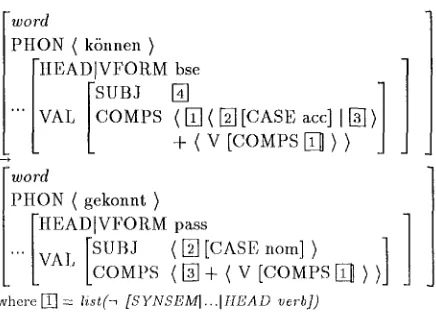
When the LE for k 6 n n e n is unified with the left- hand side of the P P L R , the C O M P S list of kb'nnen
- and, via structure sharing, the C O M P S value
of the governed verb - becomes further instanti- ate& This C O M P S list now contains as its left- most element a category with accusative case. In accordance with the P P L R , this leftmost element is p r o m o t e d to the SUBJ value of kdnnen, while the remainder of the C O M P S list of the verb gov- erned by k6nnen, identified by tag 3, is retained. Ilowever, this derived LE would have the unde- sirable consequence t h a t it admits ill-formed sen- tences such as (6).
(6) * Das Auto wurde kaufen gekonnt. the car was bought can
In (6) the auxiliary k 6 n n e n has been passivized and the direct object of the transitive verb has been p r o m o t e d as the subject of k6nnen. |low- ever, since in G e r m a n only main verbs can be pas- sivized, the sentence is u n g r a m m a t i c a l . 7
U n g r a m m a t i c a l sentences such as (6) can be successfiflly ruled out if the PPLR, is applied to an I,E only if the input specification of the LR sub- sumes the LE (Hypothesis B). T h e s u b s u m p t i o n requirement for LR application is based on the in- sight that LRs should apply only to LEs t h a t are instantiated at least to the extent t h a t the input description of the LR minimally requires. In the case at hand, the list of raised arguments in the LE for k d n n e n in Fig. 3 is totally unspecified - it can be any list of non-verbal s y n s e m objects, in- chiding the e m p t y list. T h e C O M P S list of the left-hand side of the P P L R , on the other hand} requires the leftmost element to carry accusative
>rhere are some cases of "long distance" passives, i.e. passives which involve the complelnent of an em- bedded verb, that at least some German speakers ac- cept, e.g. Der Hund wurde vergesscn zu f£ttcrn ('It was forgotten to feed the dog'): However, we are not aware of any German speakers that would allow pas- sives with raising verbs such as k6nnen.
case. Therefore the C O M P S list of k S n n e n does not subsume the C O M P S list on the left-hand side of the P P L R , or vice versa. Accordingly, no subsutnption relationship exists between the input specification of the P P M { as a whole and the LE for kb'nnen, tIence if tIypothesis B is assumed, the Lt{ can be successfiflly blocked, s However, even under s u b s u m p t i o n nothing blocks the P P L R from applying to the transitive verb kaufen, as discussed in section 2. Therefore the g r a m m a t i c a l sentence in (7) can be derived successfully.
(7) Das Anto wnrde gekauft. 'The car was b o u g h t . '
5 Avoiding Spurious Ambiguity
This section will consider the interaction of highly schematic LEs with another LR com- monly used in IIPSG: the C o m p l e m e n t Ex- traction LR, formulated for English by Pol- lard and Sag (1994). Fig. 5 shows the ver- sion of the C o m p l e m e n t Extraction LexicM Rule for G e r m a n (henceforth: C E L R G ) t h a t has been proposed by Hinrichs and Nakazawa (1994).
[LOCALI...ICOMP ~ ( ... , [ ] [phrase] . . . . )
]
NONLOCAI, IINII ER[SLAStI [ ] j
[
LOCALICATIVALICOMPSFigure 5: C o m p l e m e n t Extraction Lexical Rule for G e r m a n - Hinrichs and Nakazawa 1994
T h e C E L R G moves an element from the C O M P S list of a verb to its SI,ASH set. T h e value of the feature SLASH contains those items t h a t are realized in left dislocated position, e.g. as a topicalized constituent in sentenceqnitiM posi- tion. Analogous to the applicability of tile P P L R , the CELt{G is applicable to LEs of transitive verbs such as kaufcn shown in Fig. 2, under b o t h uni- fication and subsumption. [File result of such an application is the same as shown in Fig. 2, except t h a t the direct object is placed on the SLASH set instead of the SUB3 list. For the analysis of sen-
[image:4.596.75.293.77.233.2][I]
NPI
1)as Buch V* NP
I I
wird Peter
v [SLAS| {}]
V [SLASH {[]]} ]
v c
[SLAS.
]
VC [SI, ASIf {[1]} ] V*
V [SLASH {[1]}] V* k6nnen
I I
gekauft haben
1,'igure 6: Analysis Tre.e for Sentence (8)
tence (8), the tree in Fig. 6 illustrates the perco- lation of the relevant SLASH value t h a t is intro- duced via the CEIA{G in the LE for kaufcn. 9 (8) l)as Buch wird Peter gekauft haben kgnnen.
the book will Peter bought have can 'Peter will have been able to buy the book.' The SLASII wdue in Fig. 6 is percolated h'om the non-terminal node for the verb ka'ufl:n, by the Nonlocal I,'eaturc Principle to the sister node of the topicalized constitueut des B u c k 'Fhe top lo- cal tree is licensed by the llead-Filler II) Schema which binds oil' the SLASII wdue so t h a t the sen- tence node has an e m p t y SI,ASH set;./°
T h e CEI, I{G restricts topicalized constituents to phrasal categories. This restriction is neces- sary to rule out sentences such as (9) in which a single lexicM item, i.e. a word in terms of the type hierarchy of HPSG, is t, opiealized.
(9) * K6nnen wird Peter des Auto gekauft haben. can will 1)eter the car bought have As in the ease of the PPLR, the difference be- tween Hypotheses A and B comes into play when we consider the interaction of the (21!'LtLG with highly schematic entries such as the ones Ilin- richs and Nakazawa (1994) assume for attxiliaries in G e r m a n . If Hypothesis A is assumed, then the CEI,I{G will be applicable to the type of I,E shown for kSnnen in Fig. 3, since such an I,l'] will unify with the input descrit)tion of the LI{,. One of the possible outputs of the I3{ to such an auxiliary entry wouht look identical to l;he putative, out- put of the P P L I t shown in Fig. 4, expect that one of the elements from the COMPS list of the auxiliary is assigned to the SLASH set instead of the SUBJ list;. However, this would have the un- desirable consequence t h a t the SLASII wdne in
9The tree in Fig. 6 ~Lssumcs the tlat constituent structure for Germ~tn cbutse structure proposed by tIinrichs and Nakazttwa (1994). However, the issue raised with respc'ct to the CEI,RG in this p~tper is orthogonal to overall assumptions of German obtuse structure.
1°See Pollard and Sag (1994) and ltinrichs and Nakazawa (1.994) for further details on the Nonlocal Feature Principle and the Head-Filler ID Schema.
the analysis of topicalized sentences t h a t contain auxiliaries could originate in the LE for the main verb, but also in the LE for each auxiliary present in the sentence. Hence, in addition to the. tree in Fig. 6, three additionM trees are a d m i t t e d for sen- tence (81) in which the SLASII value originates in one of the pre-terminal nodes for the anxiliaries. These nodes are marked lbr emphasis by an aster- isk in Fig. 6. This a m b i g u i t y is, of course, totally spurious since it does not correlate with a differ- ence in semantics or any other relevant linguistic property of the sentence. I!'rom a c o m p u t a t i o n a l perspective, such spurious ambiguities are highly undesirable since they force the parser into con- sidering multiple analyses where a single analysis suflbes. T h e spurious ambiguity t h a t we have just identified is particularly pernicious, since it; would aiD.el a wide range of sentences in any g r a m m a r of G e r m a n that employs a r g u m e n t composition and the (JEI~I{G: all assertion main clauses t h a t con- tMn auxiliaries would be affected since in assertion clauses the initiM constituent is the result of top- icalization.
Once again undesirable consequences of over- applying an Lit under unification can be avoided if applicability of LRs instead requires subsump- tion (llypothesis B). Since the CEM{G limits extracted constituents to phr~ses and since the C O M P S list; of an auxiliary does not restrict, its elements in the same w~ty, the LI,] for auxiliaries ~md the input description of the CEI,I{G do not stand in a s u b s u m p t i o n relation, llenee under lly- pothesis B the CI,3,RG applies only to main verbs, and the tree in Fig. 6 is the only tree admitted.
6 C o m p u t a t i o n a l C o n s e q u e n c e s
Finally, we will consider the c o m p u t a t i o n a l impli- cations t h a t the adoption of lfypothesis B has for the processing of LRs in a computational system. Since consensus on how to provide an adequate denote|tonal semantics for I,Rs has not yet been reached, it would go well beyond the scope of this paper to develop a fully worked-out proposal on how to process lJ{s. n A very promising approach
USee CMcagno and Pollard (1995) ~tt(l Menrers (11995) for further discussion.
on how to integrate LRs into processing systems for H P S G has been developed independently by wm Noord and B o u m a (1994) and by Meurers and Minnen (1995). It turns out t h a t the conclusions reached in this paper can be easily integrated in the general framework t h a t these authors provide. C o m m o n to these two proposals is the idea of treating LRs as (ltorn clause) constraints on LF, s of the kind shown schematically in Fig. 7.
derive-lexical-entry (X0 , X n ) : - base-lexical-entry(X0),
lo×-rule (Xo,X,), ..., lex-rule, (X,_
Figure 7: l,exical rules as Horn Clause constraints on relations between lexical entries
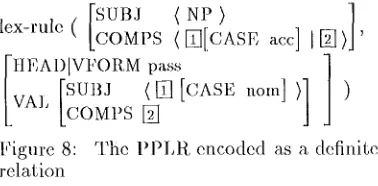
l)efinite clause s c h e m a t a as in Fig. 7 (for n 0) define relations between base LEs listed in the lexicon and derived l, Es that are obtained via the application of a sequence of LRs. Each I,R is then viewed as a two-place definite relation as illns- [rated in Fi R. 8 for the l'Pl,t{ of Fig. l.
[SUBJ { NP )
]
lex-rule( [COMPS {[~[CASE acc] [ [ ~ ) '
[ HF'A1)IVFORM pass ~ ]
Fs< J (@[CASE
no,n]
>] )
VA], [COMPS [ ]
.J
l,'igure 8: T h e PPI, R encoded as a definite relation
It is i m p o r t a n t to distinguish two tasks that need to be performed in computing with lexical rules: 12
1. the algorithm t h a t decides for a given lexicaI entry whether a lexical rule is applicable to it, and
2. the algorithm that; computes for a given lex- ical entry the o u t p u t specification of the lex~ ical rule, i.e. the derived lexical entry. T h e subsumption test for lexical rule applica- tion t h a t we have argued for in this paper pertains to the first task. T h e execution of the definite clauses of the kind shown schematically in Fig. 7, which encode the possible relations between base mid derived lexical entries, pertains to the second task.
Regarding the first task, in van Noord and B o u m a ' s approach the sequences of lexical rules that are applicable to a given base lexical entry have to be specified by the g r a m m a r developer along with delay statements, which allow goal freezing at run riffle of not sufficiently ins[an[f- ated relations. In Meurers and Minnen's approach such sequences are automatically generated from
12This distinctkm is rightly emphasized by Cab cagno and Pollard (1995).
the set of base lexical entries and the set of lexi- cal rules specified by the g r a m m a r . T h e allowable sequences of lexi('al rules are compiled into finite state a u t o m a t a which are in turn encoded as de[: inite clause a t t a c h m e n t s to base lexical entries.
Note thai; both approaches are general enough to a c c o m m o d a t e different assumptions about the applicability of lexicat rules to lexical entries, i.e. they are compatible with b o t h Itypotheses A and B. Whether or not at given lexical rule ap- plies to a. lexical entry in van Noord and l{ouma's al)proach needs to be stipulated by the g r a r n m a r writer who is in theory fl:ee to use either a unifi- cation or s u b s u m p t i o n test. In Meurers and Min- hen's approach the deduction rules for a u t o m a t - ically generating a finite-state encoding of lexi- cal rules can likewise be based on a subsumption check or a unification clieck. In this paper we have argued on empirical grollnds that subsumption should be the relevant operatiw-, criterion. The theoretical results of tit(', present p a p e r c~m there- fore be straightforwardly integrated into a lexical rule compiler of the sort described by Meurers and Minneu in which applicability of lexieal rules is checked automatically under subsumption.
7
C o n c l u s i o n'['his paper has discussed a number of lexical rules from recent IIPSG analyses of G e r m a n (llin- richs and Nakazawa 1994) and has shown that the g r a m m a r ill some eases vastly ow~rgenerates and in other cases introduces massive spurious structural ambiguity, if lexical rules apply under unificationY ~ l[owew'.r, no such problems of over- generation or spurious ambiguity arise, if a lexical rule applies to a giwm lexieM entry iff the lexi- cal entry is subsumed by the. left-hand side of the lexica[ rule. Finally we have shown t h a t tile sub- s u m p t i o n test for the applicability of lexical rules (;an be. integrated straightforwardly into the pro- posals by wm Noord and l k ) m n a (1994) and by Meurers and Minnen (11!)95) of how to implemeut lexical rules in a processing system for IIPSG.
13[t is worth pointing out that the importauce of
[image:6.596.78.267.322.415.2]R e f e r e n c e s
Ann<; Abcill6 and I)aniblc G o d a r d . 19!FI. T h e Coniplcmentation o[' l,'ren<:h Auxiliaries. Pro: ceedin.qs of the 7'hirlcenth West Coast Conlkr- cncc o'n l"o'rmal Li'agaislics. CSI,I ]>ublic~-~- tions/SI,A, S6an['ord U nivcrsil, y.
Sa.ill Bayer ?riid Marl( ,]ohlis()li. ]99,~. ["eaJ, lircs O.I1<[ Agrc<;nl<ml,. lJrocc<'dings o.f IDc <'7,~h'd An- n'aal Mccling of ID.c Associalion. oJ" (;'omq).ltla- lional Li'ngwistics. MIT, Calnbridgc, Mass.
,loan I}resiia.n. 1982. Passive. lbeslian, ,I. ed.
The Menial l~epresenlation of (;rammalical ILc- lalions. Canlbridge, MA: The' M I T Press.
Michael C'alcagilo a,[i<] (]a.r] PollaM. 1995. l,cxical
I{ulcs in lIPS(;: Wlial, arc they. Procecdin<ls o]
the ACQIHLIqX It Workshop on Le,ical ILales. (Talnbridgc, U K.
Hob Carl>ciJter. 1991. '['hc Ch',m;ral,iw; Power o[' (Tal,<;goria.l (~ra.lnrila, i;s and llead-l)riwm [~]ll;a.sc. ~trticl, lllX; (]raJiHl-la.rs wilih I,cxical t{,ulcs. (/om-
tntlalional Lin.g'uisli(s. Vol. 17.3, pp. "~01-',114.
Bob Carpetlt,<~r. 71992. 7'he I,.ogic of "l}lpcd l,'ea-
luT'c ,~/tFacl'ltrcs. (]a.nil>ri<lgc Tracts iu 'l'h<~ol'CJ; h:al (]oitlput;cr ,qch;n<:<< (Ja.inl>i:i</g<; Uuivlwsil,y
Press.
])avid I{. I)owty. {)82. (arainin;tl, ica.I rciatiolis &lid Motll;3,glI0 gjF&IIIII]IHL ,1 ~-t(;obSOll~ I>. ~tIl(l (]. R. lhllhlnl cds. The Nal'a're of Synlactic ILcpr<',- sentation I)ordrc('ht: I). Rcido].
I)au l'~lickiug(;r. 1!)87. I, ca:ical Ibalc.s i,. the IlL erarchical Lczico'a.. Ph.l). dmsis, .ql,anford Uni. vcrsity, Sta.nford, (JA.
(lerald (;a.z(lar, I']wali Kh;hi, (h~ofl'rcy I~uihuu and [win ~ag. t985. (Tcnc'ralTz(d Fh.rasc Slruclurc
Grammar. Oxford: Basil lllaclcvvcAI.
Erha.rd W , Hinric.hs all([ Tsuneko Na.kazawa. 1989. Sil]ica, I;cgorizaLion alid VI > ~tiql(;tllrO in (.ICl:llla.ll. Pal)or prcscnl, cf] at the 7'Mrd ,5';qm/>0- siu'm, on Germanic I, ing'uislics, Purdue Ilniver- nity: I,al'a.y<;t;t<~, Indiana. I>ul)lishc<l in E. llin- riclis &lid '['. Nakaza, wa,. Aspccls o] (]cl'Tlta'll V] )
,qlr'uclure. S['S 'l'cclini<'al Rcpor(. 01={)3, i)cpl, of I,inguisi,ics: [Jniversil,y (51' Tiibilig<m,
I']l'll;-tt'(] W. Ilinl'ichs nu(I Tsutt<J(o Na,]~a.zawa. i994. l>artial-VI > a.nd ~ql>lit-NI > TopicaAizat, ion in (Joriiiaji Au IIILqG AnaJysis. E. Ilin- richs, I). Mellrcrs ;-i.1/<1 T. Na]¢azawa c<ls. Ar- bc.ilsbcric[tlc dcs 5'o'adcr]brsch.ungsb~rcichs 3/~0. S~ul;l;ga.rl; a, lld Tiibingcn, pp. I.-/16.
R o b e r t Kasper and Willianl I{ounds. 198(i. A l,ogi<'al S e m a u t i c s / o r F<',aLurc Sl;ru(-l;ures. Pro= cc('dings o] lhc 2~tD. Ann'aM Mcelin,q o]" Ihe As- .so~ialion. of Comlrutatio'aal Linguistics. New York, N.Y.
Andrcas Kathol. 19!)4. I~n.ssiw~s W i t h o u t I,cxical ILulcs. In Ncrbonne ct M. cds. Cerman in l/ead- Driven, Phrase Struchu'c (]ram.ma'r. ( ] S [ J I,cc- ture Notes No. 46, University of (Thicago Press and CSI,I, (]hicago.
Paul John King. 1989. A logical form.ali.sm ]br head-driveT~ phrase slruclurc grammar. Ph.I). thesis, Iluiversity <>f Ma.nchester.
T i b o r Kiss. l!)!)2. Variable Subkalx%oiqsicrui,g l,]i,e Thcoric dcr u,qmrsSnlicl,<;n Kons/.ruktio n<'n im l)cuts<-h<'n. Lin.guislisclw Bcrichtc Vol. 140, pp. 256 293.
W. I)ctniar Meurcrs. 1995. Towa.Ms a Scnia.iltics for Lcxical Ruh;s as Used ill IIt'S(~. l'roccc& ings of the A CQ UILI'/X It Workshop on. Lezical lhtlcs. Cambridge, U K.
W. l)ctmar Mere:ors mM ( l u i d o Minncn. I!)!i)5. A (]ol,q)utational Trcatm<mt of [l PS(~ I,c,×ica, I I¢,uh'~s as (',c>wu'ia, l,i¢m in Lcxical I~;ntri<',s. Pro- cccdin(ls of the I"ifth l'nternatio'nal Workshop oa Nahtral Lang'aagc I/nderslanding wad Logic
I>rogram.m.ing. I,isbon, I~(>rtuga.I.
l%ola Mo~mcllcsi. 1!)93. Obj(~(:t (;liti<;s and (;lil, ic (3ilubiilg ill Ita.li;m lIPS(; ( I r a a m m r s . Fro- cccdin.qs of lhc ,q'i:,:lh (/o~dcrc'a.ce o] the Euro= pean Chapter o] the Assocation of Co'mpula- lional Li'ag'uislics. Utrecht, Tim Netherlands. Carl I%llar(I. 1994. TowaM a, l.]nificd A<'counl, (51'
Passive in Ch~rman. lu Ncrl>onne ct al. e<ls. (;or= man in. llcad-l)rivcn Phrase ,~'trucl'ure (/ram- HI, aT. (]S[,] [AX:I, Ilr(~ Notes No. 46, Univcl:sity (51" Chicago I'rcss aud (~SI,I, (~hicago.
(~arl I'olla.rd mid Iwm Sag. 1987. ht/brm.abion- l)ased ,~'T/nta.:r and /cm.a'n, lics: Volume I - l'~,'n- damcnlals (]SI,I I,c<:lmr(~ Nol,cs, VoluiJi<; 13. Si,anfoM: (',cnt<',r for the S t u d y of I,auguagc a.ml
Inl'oru,ation.
(Tarl l'o]la.rd mM l w m A. Sag. :I!)9/I. llead-l)'rivcn
Phrase ,5'tr'ucl'urc Cram.mar. (]hi<:ago: Univcr- sit, y of (Thicago Press aud Stanford: C'Si,I Pub- lica.dons.
(;e, rricl; M. ICmti<;r. 1994. A I,exicMist Al)l>ro~Lch to I)ulch (]ross-Serial l)cI>cndcncies. Pa.pcrs fi'om the 30th Regional M<;<q, ing of tlm Chicago biuguisl, ics So<:icty. (',[,icago, Illinois.
Si, uarl, Shicl)cr. 198(i. An htlr(Ma(:tio'n. to I/'ni, lication-lmscd Apl/roach(:s lo (h'ammar. csl,l Lecturc Notes No. 4. (31icago: IJNivcrsil,y of (3tica.go lq'<'.ss and Sta.nford: (~SLI lh,I)li<'a- l;ioils.
llans Uszkorcit and .<'gl, anl(;y ]>cl, ers. 1,98(]. Oil some l%riual i~rolmrti(',s of Meta.rulcs. Lii~.yluis- lies a'n.d Philosophy Vol. 9.4, 1>1). 477-494. (]erl;ja.ll V&II Noord aAl(] (~OSSC il()llHl~l. ]9,<)4. ']'[ic
S<:ope of Adjunci,s aJl<[ l;h(; ]:lr(lc(?,qsilig o[' I,exi cal I{,ulcs. lJr'ocec<linqs of COL[NU 9~ K/fit<i, ,1 a i m . .