A Multi-task Learning Approach to Adapting Bilingual Word
Embeddings for Cross-lingual Named Entity Recognition
Dingquan Wang1 Nanyun Peng3∗ Kevin Duh12
1Center for Language and Speech Processing, Johns Hopkins University 2Human Language Technology Center of Excellence, Johns Hopkins University
3Information Sciences Institute, University of Southern California [email protected], [email protected], [email protected]
Abstract
We show how to adapt bilingual word em-beddings (BWE’s) to bootstrap a cross-lingual name-entity recognition (NER) system in a language with no labeled data. We assume a setting where we are given a comparable corpus with NER labels for the source language only; our goal is to build a NER model for the target lan-guage. The proposed multi-task model jointly trains bilingual word embeddings while optimizing a NER objective. This creates word embeddings that are both shared between languages and fine-tuned for the NER task. As a proof of concept, we demonstrate this model on English-to-Chinese transfer using Wikipedia.
1 Introduction
Cross-lingual transfer is an important technique for building natural language processing (NLP)
systems for low-resource languages, where
la-beled examples are scarce. The main idea is to transfer labels or models fromhigh-resource lan-guages. Representative techniques include (a) pro-jecting labels (or information derived from labels) across parallel corpora (Yarowsky et al., 2011;
Das and Petrov, 2011; Che et al., 2013; Zhang et al.,2016), and (b) training universal models us-ing unlexicalized features (McDonald et al.,2011;
T¨ackstr¨om et al., 2012; Zirikly and Hagiwara,
2015) or bilingual word embeddings (Xiao and
Guo,2014;Gouws and Søgaard,2015).
Here, we focus on the bilingual word embed-ding (BWE) approach. In particular, we are in-terested in leveraging recent advances in
learn-ing BWE from comparable corpora (Hermann and
∗This research was majorly conducted when the author was at Johns Hopkins University.
…
Model for BWEs Unigram Modelfor NER
ct
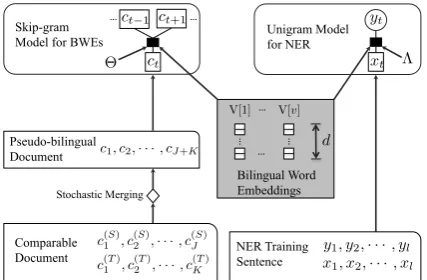
Figure 1: Our multi-task framework, which trains bilingual word embeddings from comparable cor-pora while optimizing an NER objective on the high-resource language. The NER part of the model is then tested on a low-resource language.
Blunsom, 2014;Vulic and Moens, 2015; Gouws and Søgaard,2015). A comparable corpus is a col-lection of document pairs written in different lan-guages but talking about the same topic (e.g. in-terconnected Wikipedia articles). The advantage of comparable corpora is that they may be more easily acquired in the language and domain of in-terest. However, cross-lingual transfer on compa-rable corpora is more difficult than on parallel cor-pora, due to the difficulty in finding high-quality word translation equivalences.
Our contributions are two-fold: First, we inves-tigate cross-lingual transfer on an NER task, and found that pre-trained BWE’s do not necessarily help out-of-the-box. This corroborates results in the monolingual setting, where it is widely rec-ognized that training task-specific embeddings is helpful for the downstream tasks like NER (Peng and Dredze,2015;Ma and Hovy,2016).
Second, we propose a multi-task learning framework that utilizes comparable corpora to jointly train BWE’s and the downstream NER task
(Figure 1). We experimented with a Wikipedia
corpus, training a NER model from labeled En-glish articles (high-resource) and testing it on Chi-nese articles (low-resource)1. The challenge with training task-specific embeddings in cross-lingual transfer is that the task in which we have labels (English NER) is not equivalent to the task we care about (Chinese NER). Despite this, we demon-strate improvements on NER F-scores with our multi-task model.
2 The Multi-task Framework
Assumptions : We assume two resources: First is a comparable corpus whereS(”source”) refers
to the high-resource language and T (”target”)
refers to the low-resource language. The compa-rable corpus is denoted asC={(c(S)i ,c(Ti ))|i∈ [1, M]}, where each(c(S)i ,c(Ti ))is a tuple of com-parable documents written inS andT, and M is the size (total number of tuples) ofC.
We also assume a labeled NER corpus on the high-resource language, which may be disjoint fromC. LetX(S) = {x(S)
i | i ∈ [1, N(S)]} and
Y(S) = {y(S)
i | i∈ [1, N(S)]}together form the
NER training examples ofS, where each y(S)i is the gold tag sequence of sentencex(S)i , andN(S)
is the number of training examples.
Training : GivenX(S)andY(S)and
Cthe training objective (loss)Lis:
α Ln
X(S),Y(S)(V,Λ) + (1−α)LmC (V,Θ) (1)
Ln is the loss for training the NER tagger in
S, Lm is the loss for training the BWE’s, and
α ∈ [0,1] is coefficient for balancing these two
losses. Λ, V and Θ are the model parameters,
where Λ is Ln-specific parameter, Θ is the Lm -specific parameter andVis thed×v-shape BWE’s that shared are by bothLn andLm. v is the size of the joint vocabularyV andVis formed by con-catenating2 the vocabulary of S and T, dis the dimension of the word embedding. Figure1gives a visualization of the framework.
Evaluation : At test time, givenX(T)– the raw
sentences ofT, we evaluate the F1 score ofY¯(T)
predicted by the trained model {V∗,Λ∗} against
the true labelY(T). Note that this model is trained
1Chinese can be considered a high-resource language for
NER, but we use it as a proof-of-concept and do not use any existing Chinese resources.
2Same word in different languages is treated separately.
on NER labels inSonly, so it is imperative for the
learned BWE’s to map S and T words with the
same NER label into nearby spaces.
Our framework (Equation1) is flexible to differ-ent definitions ofLn andLm objectives. Below, we describe a specific instantiation that fits well with cross-lingual NER.
2.1 Design ofLn
Given the labeled training data X(S), Y(S) ofS,
we optimize the conditional log-likelihood asLn (superscriptsSare suppressed for readability):
Ln
givenxparameterized byVandΛsuch that
pV,Λ(y|x) = P exp(sV,Λ(x,y))
y0∈Yexp(sV,Λ(x,y0)) (3)
. sV,Λ(. . .) is a score function of a sentence and
its possible NER-tag sequence. Y is the set of all possible NER-tag sequences.
Unigram Model : Given a sentencex∈Xwith lengthland its labely∈Y, the score function of unigram model is simply:
sV,Λ(x,y) =
X
t∈[1,l]
V[xt]>·W[yt] +b[yt] (4)
where Λ =def {W, b}, W is a d×n-shape matrix that maps the word vectorV[xt]into the NER-tag
space,nis the number of NER-tag types, which is 7 as will be explained in§3.1. bis the bias vector with size n. The reason why we call this model unigram is it only looks at the word itself without its context.3
2.2 Design ofLm
Here we adopt the method of Vulic and Moens
(2015), which is the only mechanism for training on comparable documents as far as we know: First we transformCinto apseudo-bilingualcorporaC0
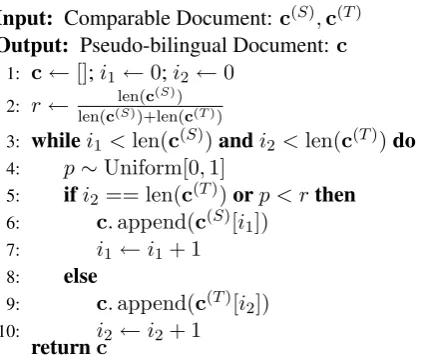
by a stochastic merging process of two documents as shown in Alg. 1. The idea is to mix together the two documents in different languages into a single document (whereSandT words are inter-spersed), then apply a standard monolingual word embedding algorithm.
Algorithm 1 Stochastic merging of two docu-ments, wherelen(c)returns the number of tokens of documentc,c[i]is theith token of documentc.
Input: Comparable Document:c(S),c(T)
Output: Pseudo-bilingual Document:c
1: c←[];i1 ←0;i2 ←0 2: r← len(c(S)len()+len(c(S))c(T))
3: whilei1<len(c(S))andi2 <len(c(T))do
4: p∼Uniform[0,1]
5: ifi2 == len(c(T))orp < rthen 6: c.append(c(S)[i1])
7: i1←i1+ 1 8: else
9: c.append(c(T)[i2]) 10: returnic2←i2+ 1
We use the standard skip-gram objective (Mikolov et al., 2013) by considering each pseudo-bilingual document as a single sentence. Lm
C (V,Θ)is given by:
mean
c∈C0 t∈[1,len(meanc)] X
−w≤j≤w j6=0
logpV,Θ(ct+j|ct) (5)
, wherew is the word window,ctis thetth token
ofc.pV,Θ(. . .)is the standard context probability
parameterized byVandΘsuch that
pV,Θ(cO|cI) = V[cI]
>·V0[cO]
P
c0
O∈VV[cI]>·V 0[c0
O] (6)
Θ def= {V0}, where V0 is the context embedding with size d×v. In the implementation, we use negative sampling to save the computation, since we desire using a large vocabulary to handle as many words as possible for cross-lingual transfer. 2.3 Optimization
Full Joint (FJ) Training : First optimizeLnby updatingVandΛ. Then optimizeLmby updating V,Θ. Repeat.
Half-fixed Joint (HFJ) Training : Same as FJ Training, except in theLmoptimization step, the English word embeddings are fixed and only the Chinese word embeddings are updated. The mo-tivation is to anchor the English embeddings to fit the NER objectiveLn, and encourage the Chinese embedding (of comparable documents) to move towards this anchor.
Inspired by Lample et al. (2016), for both ap-proaches, words with frequency 1 in the NER data are replaced by OOV with probability 0.5 to so that embedding OOV could be optimized.
3 Experiments
3.1 Data
We use the EN-ZH portion of the Wikipedia Com-parable Corpora4. For experiment purposes, we
sampled 19K document pairs5 as our comparable
corporaC. The NER labeled data on English (S) is obtained by collecting the first paragraph of each English document inCasX(S), and labeling
it with Stanford NER tagger (Finkel et al.,2005) to generateY(S).6
For the NER test data in Chinese (T), we sep-arately sampled 1K documents and collected the first sentence as X(T). We ran automatic word
segmentation7and manually labeledX(T)to
gen-erate Y(T). The English side of these 1K tuple
is treated as held-out data for tuning NER hyper-parameters, and is labeled with the same Stanford NER tagger. We use the BIO tagging scheme for 3 basic named-entity types (“LOC” for location, “ORG” for organization and “PER” for person), so the output space is 7 tags. The data statistics are shown in Table1. The size of BWE’s is about 1M with 514K being Chinese words.
C X(S) X(T)
#Document Tuple 19K -
-#Sentence 1.8M 45K 1K
#Token 24M 994K 20K
Table 1: Data statistics.
3.2 Results
We compare our multi-task model with FJ and HFJ alternate training8against a baseline where BWE’s
4http://linguatools.org/tools/corpora/
wikipedia-comparable-corpora/
5We started from 20K pairs in totall, then we first sampled
out 1K from the Chinese side for the final evaluation and left 19K for training. We consider it as a reasonable number com-pared toVulic and Moens(2015), which used 14K pairs for Spanish-English and 19K for Italian-English.
6We treat these automatic NER tags as ”gold” labels to
simulate a scenario where we want cross-lingual transfer on
Tto do at least as well as onS. But naturally our model can also use human annotations if available.
7https://github.com/fxsjy/jieba
8For training the BWE’s, we borrow the same
d Baseline HFJ FJ
64 6.54 13.5 7.01
128 14.95 20.27 17.14
256 13.69 24.29 16.53
512 21.23 17.7 20.14
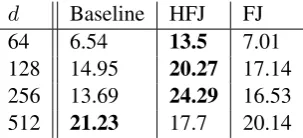
Table 2: The F1 scores on the Chinese held-out data averaged over multiple restarts. dis the di-mension of the BWE’s. All the BWE’s are ini-tialized by the output ofVulic and Moens (2015) trained onC. “Baseline” fixes the BWE’s and only trainsΛ, “HFJ” and “FJ” are proposed joint train-ing methods described in§2.3
are pre-trained onC, then held fixed when train-ing a NER tagger. This baseline corresponds to a two-step procedure where word embeddings pre-trained on comparable corpora is used as features when training an NER.9
Table 2 shows the F1 scores. We observe the
joint training methods (HFJ & FJ) outperform the baseline method with embedding size 64, 128, and
256. For example, for d = 256, HFJ achieves
an F1 score of 24%, compared to the baseline of 13%, implying that jointly tuning the embedding on both comparable corpora and NER objectives (HFJ) is better than fine-tuning only NER objec-tive after training on comparable corpora (base-line). Further, HFJ results are better than FJ, im-plying when optimizingLm, it is better to tune the Chinese embedding toward an anchored English embedding, rather than allow both to be updated.
We note that the trend is different ford= 512: it might be that as the NER model grows larger, there is a risk of overfitting10 the English NER data and losing generality on Chinese NER. We observe similar trends when we replaced the
uni-negative sampling with25samples and subsampling rate of value1e-4. The dropout rate of0.3is decided by the best F1 score of the language-specific NER tagger on the English held-out data. The coefficientαfor balancing twoLnand
Lmshould presumably be chosen by tuning on the labelled data for Chinese, which is not available in our setting. So we heuristically set it to0.5by assuming they are equally help-ful. Our fully unsupervised setting has no NER training data available on the Chinese side for tuning. To prevent the train-ing from overfitttrain-ing to the English data, we heuristically early stop after10000pairs of alternating updates ofLmandLn.
9Another possible baseline is using onlyLnfor training,
this will not work becauseLnonly consists of English data, so the Chinese embeddings will stay random when English embedding are optimized, resulting random outputs on the Chinese side.
10When training withd= 512, the F1 on training data is
consistently>60for the last epochs, which is about50with
d= 256.
gram model with a LSTM+CRF (see§2.1) inLn. This degraded results for all systems, e.g. with d = 256, “Baseline” F1 dropped from 13.69 to 6.07, and “FJ” dropped from 16.53 to 8.62.
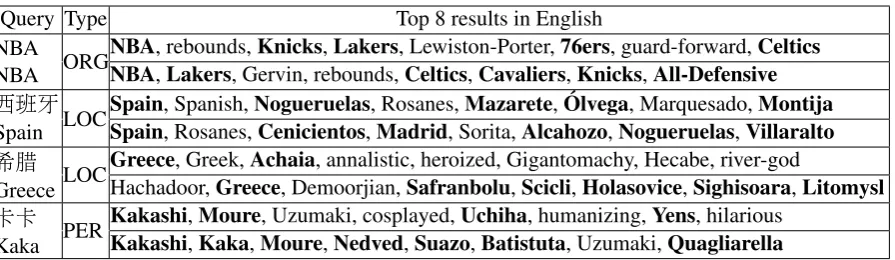
It is interesting to see the impact of joint train-ing on BWE’s. In Table3, given a Chinese query, we show the most similar words in English re-turned by computing the Euclidean distance be-tween BWE’s (d= 256). While both pre-trained and jointly-trained BWE’s retrieve correct English translations, jointly-trained BWE’s retrieves more words with the same NER type. For example, “Spanish”, and “Greek” – the adjective forms of “Spain” and “Greece”, rank highly with the pre-trained BWE’s due to semantic similarity. But these may degrade NER since these adjectives are not labeled ”LOC”. Our multi-task model miti-gates this confusion.
4 Conclusion & Future Work
We show how a multi-task learning approach can help adapt bilingual word embeddings (BWE’s) to improve cross-lingual transfer. Joint train-ing of BWE’s encourages the BWE’s to be task-specific, and outperforms the baseline of using ptrained BWE’s. We showed promising re-sults on the challenging task of cross-lingual NER on comparable corpora, where the target language has no labels. Future work will aim to improve the absolute F1 scores by combining limited la-bels in the low-resource languages, via exploiting
document structure in Wikipedia (Richman and
Schone,2008;Steinberger et al.,2011;Tsai et al.,
2016; Ni and Florian, 2016; Pan et al., 2017). While we only focus on the most difficult case where the source language and target languages are not in the same family, and a bilingual dictio-nary is not available in this paper, it is interesting to study how this technique could be applied when the different levels of supervision are available on various language pairs in the future.
Acknowledgment
Query Type Top 8 results in English NBA
NBA ORG
NBA, rebounds,Knicks,Lakers, Lewiston-Porter,76ers, guard-forward,Celtics NBA,Lakers, Gervin, rebounds,Celtics,Cavaliers,Knicks,All-Defensive
西班牙
Spain LOC
Spain, Spanish,Nogueruelas, Rosanes,Mazarete, ´Olvega, Marquesado,Montija Spain, Rosanes,Cenicientos,Madrid, Sorita,Alcahozo,Nogueruelas,Villaralto
希腊
Greece LOC
Greece, Greek,Achaia, annalistic, heroized, Gigantomachy, Hecabe, river-god
Hachadoor,Greece, Demoorjian,Safranbolu,Scicli,Holasovice,Sighisoara,Litomysl
卡卡
Kaka PER
Kakashi,Moure, Uzumaki, cosplayed,Uchiha, humanizing,Yens, hilarious Kakashi,Kaka,Moure,Nedved,Suazo,Batistuta, Uzumaki,Quagliarella
Table 3: Top similar words in the English given a Chinese query. “Type” is the gold named-entity type of the query. For each query, the upper row is calculated with the baseline BWE’s, and the lower row is calculated with HFJ BWE’s. The words with the same type as the query are bold-faced, and we observe more of these cases with HFJ.
References
Wanxiang Che, Mengqiu Wang, Christopher D. Man-ning, and Ting Liu. 2013. Named entity recogni-tion with bilingual constraints. InProceedings of the 2013 Conference of the North American Chapter of the Association for Computational Linguistics: Hu-man Language Technologies, pages 52–62, Atlanta, Georgia. Association for Computational Linguistics. Dipanjan Das and Slav Petrov. 2011. Unsupervised part-of-speech tagging with bilingual graph-based
projections. In Proceedings of the 49th Annual
Meeting of the Association for Computational Lin-guistics: Human Language Technologies - Volume 1, HLT ’11, pages 600–609, Stroudsburg, PA, USA. Association for Computational Linguistics.
Rose Jenny Finkel, Trond Grenager, and Christopher Manning. 2005. Incorporating non-local informa-tion into informainforma-tion extracinforma-tion systems by gibbs
sampling. InProceedings of the 43rd Annual
Meet-ing of the Association for Computational LMeet-inguistics (ACL’05), pages 363–370. Association for Compu-tational Linguistics.
Stephan Gouws and Anders Søgaard. 2015. Sim-ple task-specific bilingual word embeddings. In Proceedings of the 2015 Conference of the North American Chapter of the Association for Computa-tional Linguistics: Human Language Technologies, pages 1386–1390, Denver, Colorado. Association for Computational Linguistics.
Karl Moritz Hermann and Phil Blunsom. 2014. Mul-tilingual Distributed Representations without Word
Alignment. InProceedings of ICLR.
Guillaume Lample, Miguel Ballesteros, Sandeep Sub-ramanian, Kazuya Kawakami, and Chris Dyer. 2016.
Neural architectures for named entity recognition. InProceedings of the 2016 Conference of the North American Chapter of the Association for Computa-tional Linguistics: Human Language Technologies, pages 260–270. Association for Computational Lin-guistics.
Xuezhe Ma and Eduard H. Hovy. 2016. End-to-end sequence labeling via bi-directional lstm-cnns-crf. CoRR, abs/1603.01354.
Ryan McDonald, Slav Petrov, and Keith Hall. 2011. Multi-source transfer of delexicalized dependency
parsers. InProceedings of the 2011 Conference on
Empirical Methods in Natural Language Process-ing, pages 62–72, Edinburgh, Scotland, UK. Asso-ciation for Computational Linguistics.
Tomas Mikolov, Ilya Sutskever, Kai Chen, Greg S Cor-rado, and Jeff Dean. 2013. Distributed representa-tions of words and phrases and their composition-ality. In C. J. C. Burges, L. Bottou, M. Welling,
Z. Ghahramani, and K. Q. Weinberger, editors,
Ad-vances in Neural Information Processing Systems 26, pages 3111–3119. Curran Associates, Inc. Jian Ni and Radu Florian. 2016. Improving
multilin-gual named entity recognition with wikipedia entity type mapping. pages 1275––1284.
Xiaoman Pan, Boliang Zhang, Jonathan May, Joel Nothman, Kevin Knight, and Heng Ji. 2017. Cross-lingual name tagging and linking for 282 languages. InProceedings of the 55th Annual Meeting of the As-sociation for Computational Linguistics (Volume 1: Long Papers). Association for Computational Lin-guistics.
Nanyun Peng and Mark Dredze. 2015. Named en-tity recognition for chinese social media with jointly
trained embeddings. In Proceedings of the
Con-ference on Empirical Methods in Natural Language Processing (EMNLP).
Alexander E Richman and Patrick Schone. 2008. Min-ing wiki resources for multilMin-ingual named entity
recognition. InACL, pages 1–9.
Ralf Steinberger, Bruno Pouliquen, Mijail Kabadjov, Jenya Belyaeva, and Erik van der Goot. 2011. Jrc-names: A freely available, highly multilingual
named entity resource. RECENT ADVANCES IN,
Oscar T¨ackstr¨om, Ryan McDonald, and Jakob Uszko-reit. 2012. Cross-lingual word clusters for direct transfer of linguistic structure. In Proceedings of the 2012 conference of the North American chap-ter of the association for computational linguistics: Human language technologies, pages 477–487. As-sociation for Computational Linguistics.
Chen-Tse Tsai, Stephen Mayhew, and Dan Roth. 2016. Cross-lingual named entity recognition via
wikifi-cation. In Proceedings of The 20th SIGNLL
Con-ference on Computational Natural Language Learn-ing, pages 219–228, Berlin, Germany. Association for Computational Linguistics.
Ivan Vulic and Marie-Francine Moens. 2015. Bilin-gual word embeddings from non-parallel document-aligned data applied to bilingual lexicon
induc-tion. InProceedings of the 53rd Annual Meeting of
the Association for Computational Linguistics (ACL 2015). ACL.
Min Xiao and Yuhong Guo. 2014. Distributed word representation learning for cross-lingual dependency
parsing. In Proceedings of the Eighteenth
Confer-ence on Computational Natural Language Learning, pages 119–129, Ann Arbor, Michigan. Association for Computational Linguistics.
D. Yarowsky, G. Ngai, and R. Wicentowski. 2011. In-ducing multilingual text analysis tools via robust projection across aligned corpora. InProceedings of the First International Conference on Human Lan-guage Technology Research.
Dongxu Zhang, Boliang Zhang, Xiaoman Pan, Xi-aocheng Feng, Heng Ji, and Weiran Xu. 2016. Bi-text name tagging for cross-lingual entity annotation projection. page 461–470.