An Algorithm for Determining Talker
Location using a Linear Microphone
Array and Optimal Hyperbolic Fit
Harvey F. Silverman
Laboratory for Engineering Man/Machine Systems (LEMS) Division of Engineering
Brown University Providence, RI 02912
Abstract
One of the problems for all speech input is the necessity for the talker to be encumbered by a head. mounted, hand-held, or fixed position microphone. An intelfigent, electronically-aimed unidirectional micro- phone would overcome this problem. Array tech- niques hold the best promise to bring such a system to practicality. The development of a robust algorithm to determine the location of a talker is a fundamental is- sue for a microphone-array system. Here, a two-step talker-location algorithm is introduced. Step 1 is a rather conventional filtered cross-correlation method; the cross-correlation between some pair of micro- phones is determined to high accuracy using a some- what novel, fast interpolation on the sampled data. Then, using the fact that the delays for a point source should fit a hyperbola, a best hyperbolic fit is obtained using nonlinear optimization. A method which fits the hyperbola directly to peak-picked delays is shown to be far less robust than an algorithm which fits the hy- perbola in the cross-correlation space. An efficient, global nonlinear optimization technique, Stochastic re- gion Contraction (SRC) is shown to yield highly accu- rate (>90%), and computationally efficient, results for a normal ambient.
Introduction
One of the problems for all speech input is the necessity for the talker to be encumbered by a hcad- mounted, hand-held, or fixed position microphone, or, perhaps, a technician-conlxolled mechanical unidirectional microphone. Whether for teleconferencing [I], speech recognition [2], or large-room recording or conferencing [3], an intelligent, eleclronically-aimed unidirectional mi- crophone would overcome this problem. Array tech- niques hold the best promise to bring such a system to practicality.
Algorithms for passive tracking -- the determina- tion of range, bearing, speed, and signature as a function of time for a moving object -- have been studied for near- ly 100 years partiomLqrly for radar and sonar systems. While there is currently much activity involved with the wacking of multiple sources using variants of the eigenvalue-hased decomposition MUSIC algorithm, [4], [5], [6], [7], [8], most systems still use correlational tech- niques
[9], [10], [11].
The method presented here is also based on correla- tion. First, a coarse, normalized cross-correlation func- tion is computed over the delay range of interest. It turns out that, even for the relatively high sampfing rate of 20kHz, the 5Olas resolution of the time-delay estimates causes derived locations to be unsatisfactory. However, the latter may be refined by nearly two orders of magni- tude through accurate interpolation techniques which can be attained for a relatively small computational using multirate filtering[12].
For M microphones, one can estimate M-1 in- dependent relative delays. As, theoretically, only two re- lative delays are needed to triangulate a source, for M >3, the system is overspecified. However, since noise is al- ways present in a real system, this extra information can be profitably used to overcome some of the effects of the noise. In fact, the geometry of the array constrains the vector of relative delays. For example, a simple linear array, with all the microphones on the axis, y=0, has de- lays constrained to be on a particular hyperbola with a focus on the target. Therefore, errors in the estimation of the delays may be corrected by fitting the best hyperbola. Two methods for doing so are presented here.
often "dumb" errors.
TDEHF
is introduced in Section 4. The second (and more robust) method InterpolatedCross-eorrelation Hyperbolic Fit (ICHF), fits the best
hyperbola to the actual output of the interpolated cross-
correlations. As reasonable crosscorrelations
are
alwayspositive, the sum of the crosscorrelations across all the
microphones for
a
given hyperbola is usedas
a functionalto maximize. As
the
functional surface is multimodal,results for a hierarchical grid search and for application of
Stochastic Region Contraction (SRC), [14]
,
[IS], a newmethod for efficient global nonlinear optimization,
are
presented.
Coarse Cross-Correlation
Consider
a
linear microphone array having M mi-crophones, each located on the line y = O at a distinct
point (z,,O) in the x y plane. A simple case is to be
considered in this paper in which a single some (talker) is located at some point (x,y) in frdnt of the array. although there will be ambient noise. Without loss of
generality, microphone 1 is selected
as
the reference. Itis assumed that the signal at each microphone is appropri-
ately sampled at some reasonable rate, R and that each
microphone thus receives a signal of time (indexed by j).
p:~). As sources might be separable in
the
frequencydomain, one
can,
in general, filter each received signalusing a zero-phase FIR filter, this is
the
only reasonablechoice
as
delay estimation is yet to be performed. Thisimplies,
where
f , G )
is a 2J+1 element symmetric FIR filter. Itis advantageous, as will be seen later, to define
rectangularly-windowed data, referenced to time index k',
for the correlations
as,
O I I I L - 1
otherwise (2.2)
Each of
the
M-1 independent cross-correlations fora
delay of k samples each of duration 1IR may bedefined,
A,(k') L-1
C:[k,k'I
7
x r : (k '+l )$(k'+l +k), (2.3)L
-
lklwhere A,(k') is a normalizing factor. A reasonable nor-
malization is to make the autocorrelation of
the
unshiftedreference signal have a value of unity for any particular
time reference k
',
Combining (2.3) and (2.4) gives,
which generalizes to,
Computational Considerations for the Cross-
Correlations
An important consideration is the selection of L.
the number of points in the crosscorrelation. When auto-
correlations are taken for
LPC
analysis, the length is lim-ited by the assumption that the vocal tract is essentially
stationary over the interval. As one is not doing this pseudo-stationary modeling of the vocal tract, this fact
does not limit L here. Rather, the tradeoff
between
infor-mation
content-
tending to make one increase L-
and
computational load
--
tending to make one decrease L--
governs this decision. For the typical human talker, com-
puting a position about five times per second is sufficient.
With no redundancy, selecting L to correspond to 100-
200ms of data is reasonable,
as
the experimental datashow.
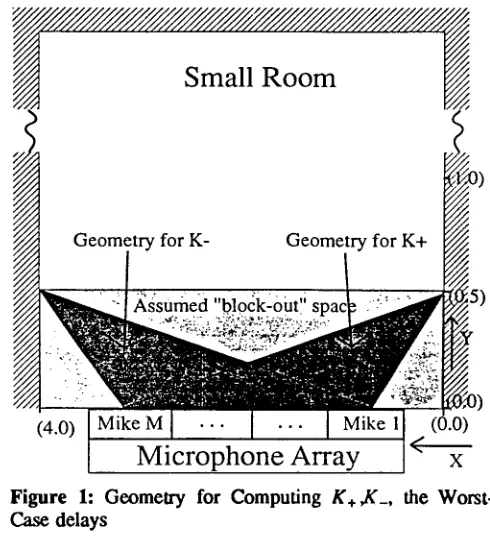
The range of the correlations, [-K-, K+], may be
determined from
the
sample rateand
the geometry shownin Figure 1 for a onedimensional array. For a symmetric
arrangement in a room. K- =
K +
andR
K- = K+ = r k n g t h -cos(O)-1.
C (2.7)
where c is the speed of sound with value about 342M/s.
Small Room
Geometry for K+
[image:2.612.318.563.366.634.2]I
Figure 1: Geometry for Computing K+&-, the Worst-
Case delays
(4.0)
As an example, consider a one-dimensional array of
length one meter, a room four meters wide, one-half me-
ter of "block-out space" and a sampling rate of 20,000 samples-per-second. For this case, correlations will re- quire 2000 multiplication-addition operations for lOOmsec of data. As the maximum relative delay may be seen to
be 1'C0S140 = 2.84m.s. Equation (2.7) yields
C
K- = K+ = 57. Thus, the correlation phase requires
Mike M
I
. . .
I
. . .
I
Mike 1Microphone
Array
(0.0)
L
L R"
B= (k ")
= OR OR230,000 multiplication-additions per microphone pair if done directly or just under 20ms of computation time us- ing the Analog Devices ADSP-2100A digital signal pro- cessor at 12.5MHz clock rate [16]. For eight micro- phones, about 160 ms would be required, and the location could be computed in real-dine for the required five up- dates per second.
The relative delay between each microphone and its reference could be estimated by selecting the highest po- sitive point in the correlation outputs, i.e.,
k=* -= argmin C~[k,k'], (2.8) -.K_ ~l ~K+
k:, (2.9)
d, tk q
-"T'
where d,~ [k'] is defined to be the delay, relative to micro- phone 1, for microphone m. Note that the accuracy is only to that of the sample rate, and that this simple peak- picking algorithm is subject to serious errors when real data are used!
Interpolation for Higher Accuracy
Even for the relatively high (for speech) sampling rate of 20kHz, estimation accuracy of the tracking posi- tion is inadequate; a variation of more than one meter in the y dimension is the norm for talkers two meters direct- ly in front of the microphone. Experience has shown that an acceptable region of uncertainty may be achieved for a sampling inteerval of about llas.
The most straightforward way to achieve the need- ed high resolution would be to sample at a much higher rate, R" -- around 1MHz - and perform the correlations on the data, i.e.,
C,~'[k,kq= B.(k3 LR'-~
E r~'(k'+l).r~'(k'+k+l)(3.1)LtC--lk l I=o
where B , ( k ' ) is a normalizing factor and L R' is the number of high-resolution samples in L. Relative to 20kHz sampling, this would force the computation to in- crease by a factor of 502 = 2500, making the procedure absurd. For an appropriately anti-aliased speech signal, one would be dealing with greatly oversampled signals. Thus, with no loss in accuracy, one could generate the signal at sampling rate R ' from the signal sampled at rate R by the simplest standard multirate method if
R" -= Z'R, (3.2)
where 2~ is an integer greater than 1.
The proof for computationally efficient interpola- tion is given in [17]. The results for computation are:
B m (k ') QR QR
=
~
E (3.3)
C~'[~offk+Vt, k'] L l ' - I~Jfftt +Vk I at=._QR~2=._QR
• [a,, a2. vk ]-C,~ [k + a~-a2 ,kq
~ ~[~i, OZ 0]'CUR [ ~ t - O2 ,k'~ 3"4) at= ..QRa2= ..QR
"7
}
• [al,a2vi] n ~
(7~l+vi)'f(~2+vk+vl)
(3.5)Vl= 0
C,~ [ k "t.ff l--o2 k "] m L-Ik-c-qfft--ff21
A . ( k 3 (3.6)
C~[k+Gl-Cr 2, k•
Computational Considerations for the Inter-
polation
One important aspect of the computation of Equa- tion (3.3) is the storage requirement for O. Appropriate resolution is achieved for Z=64, R=20k.Hz and a filter length of 641, implying QR =5. Then the range of oi and 02 is only 11. Thus (11)(11)(64) = 7744 storage lo- cations are required.
The number of multiplication-additions is (11)2= 121 to compute the cross-correlation for each in- terpolated point. One should note that this number is a far cry from the "direct" method in which, for L = 2000, (621)(64)(2000) = 80,000,000 operations had to be done to get each interpolated signal and (64)(2000) = 128,000 operations had to be done for each interpolated cross- correlation!
Best Hyperbolic Fit Algorithms
Triangulation
In binaural hearing, both amplitude and phase infor- marion is fed to the ~ and is used -- expertly -- to determine the location of a sound source. If the phase in- formation -- the delay estimates - alone were to be used to determine location of a source, a minimum of three microphones is required for this "triangulation" procedure. If microphone 1 is considered to be the reference, and d2 and d3 the time delays for microphones 2 and 3 respec- tively, relative to the arrival at microphone 1, then the es- timation of the source location xo, Yo may be determined from,
¢ 2d 22 (d2 - d 3)-d 2(z 32-z 12 ) + d 3(z 22-z 12 ) x0 = 2[d2(z 1 -z 3) - d3(z 1-z 2)] (4.1)
12
YO = t~
~
j
-(Xo-Zl)2J . ( 4 . 2 )(One should note that these triangulation formulae are normally listed for polar coordinates.) These relatively ugly, nonlinear expressions tend to be very sensitive to variations due to noise in the estimates of d2 and d3.
T i m e - D e l a y E s t i m a t i o n , H y p e r b o l i c Fit
( T D E H F )
For the case of the linear array, where the micro- phones are all considered to be on y=0, the locus of the relative delays for points along this line forms a hyperbo- la. This is clear from Figure 2 in which the relative de- lay loci are plotted for various point-source locations (x,y). At (zm,0), the absolute delay d= may be comput- ed from the Pythagorean Theorem as
d m - " ~ ] ( X - z 2 ) + y 2 (4.3)
C ,
and, relative to microphone 1,
d,~ = ~l(x-zm)2+y2
dr.
(4.4)C
Some algebra yields,
(d,~+dl) 2 -
(Zm-X)2
= ~ (4.5) C 2 C 2 "The points ( z = , d . ) lie on a hyperbola parameterized by the speed of sound, c, and the location of the source, ( x , y ) . Thus, there is a one-to-one relationship between a specific hyperbola and a source-point
(x,y)
located in front of the array -- there is a mirror in back of the array. The task, then, is to fit the best member of this class, the best hyperbola, to the set of relative delay estimateszmd,~'[l~'],
where m e [2,M]. "~ it. ~-E
o-i
u 1
t_ [D CO
0.5
C
o
ua 1:3 .,..4
t_ -6.5
q3
E C3 t_ -1
> . r13
oJ -1.5
~ l0 28 30 48 50 60 70 80 90 (0.44m,0.0.) / Nicroohone Placement (cm)
Figure 2: Delay Hyperbolae for Several Source Locations In TDEHF an estimate of the relative delay for each microphone is obtained by peak-picking as indicated by Equations (2.10) and (2.11). Interpolation is done lo- cally to get a higher resolution estimate,
d,~'(k').
While many criteria are possible, a typical squared-error meas- ure is defined asM
E (k') = 2~ (d,~ "(k 3 - d,,))2
(4.6)m=2
Substituting (4.4) into (4.6), one gets,
Source Location
" - - - 7
-o- 10.25m, l . ~ m )
"-+- (0.65ml 1.Sin) ]
-o-(l.8m,2.0m) [
-~-" (1.35m, 1.5m) I
M[ d
. ~ ( X _ Z m ) 2 + y 2 ] 2E(k 3 = E
,~'(k')
- d t
(4.7)m=2 C
and the esrtimate (x0,yd minimizes
E(k'). As
this sur- face is normally unimodal, a gradient method [18] has been used.I n t e r p o l a t e d C r o s s - c o r r e l a t i o n H y p e r b o l i c Fit
( I C H F )
When real data are used, it is often the case that the cross-correlation peak which must be determined in
TDEHF is inappropriate. This is due to 1) periodicity in the signal, 2) room reverberations, and 3) noise. A more robust algorithm would clearly resdt ff the specific deter- mination of the delays did not have to be explicitly done. In ICHF, one tries to determine the "optimal:fit" hyperbo- la in the cross.correlation space itself; thus, no pattern recognition errors are made prior to the optimization.
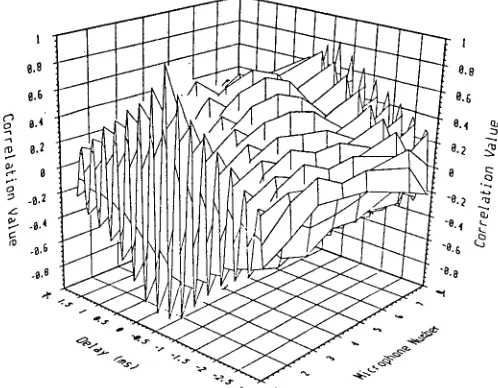
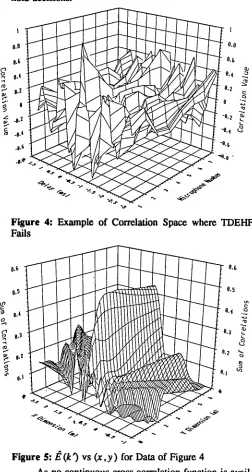
Plots for real data are presented in Figures 3 and 4. In each case, the d at~ are produced by a loud talker si- tuated at (1M,2M) with low ambient noise. In Figure 3, TDEHF worked well, as the peaks are relatively easy to pick correctly. In Figure 4, however, TDEHF yielded poor results, although it is evident that a hyperbolic fit in the cross-correlation space itself could give the right loca- tion.
6.8 8.8
8.6
~ o.2
.~,2
Figure 3: Example of Correlation Space where TDEHF Succeeds
In nonlinear optimization, one must develop a func- tional that measures "goodness (badness)" as a function of the set of variables over which one wants to optimize. In this case, one wants to develop a measure of the average "goodness" of a particular hyperbola parametefized by ( x , y ) over the space shown in Figures 3, 4 having in- dependent variables of x , the x spatial variable, and i f , the relative delay. Points for the microphones
(z,,,,d,,)
[image:4.612.319.568.366.560.2]M
I .
--- . - ,
/~(k') represents a measure of the average height of the cross-correlation function measured over the points on the hyperbola taken by the set of microphones. One should note that it would be expected that the value should be positive for reasonable situations, and approaching unity for ideal ones, and thus/~ (k') could also be used to thres- hold decisions.
@.8 8.8
8.6 8.6
~.~ ~.e •
Figure 4: Example of Correlation Space where TDEI-IF Fails
@.6
~
8.~
° H4 k qgggE'H i
@.3
8'3
[image:5.612.53.305.155.627.2] [image:5.612.56.301.164.367.2] [image:5.612.331.562.387.569.2],.' t I _ ~ # L t ~ I ~ / I I U J _ . L , H ] ~ I J , I I . , ~ I ! " °
Figure 5:/~(k3 vs (x,y) for Data of Figure 4
As no continuous cross-correlation function is avail- able, one must approximate it. It is assumed that interpo- lation may be used to achieve an accurate estimate, i. e., one determines Om and v . from d,~ using,
* ,LJ _>o
=- M * , L - L o J ,L <0" (4.9)
v . .
ta.,R'- o . * + 0.sj.
Then, C . ( z . . din) may be accurately approximated by
Cm(zm.dm)
= C~'[~m +vm,k'], (4.11)which is exactly as derived previously. A three dimen- sional plot of the surface for E (k 3 is given in Figure 5. Notice the strong peaking due to the hyperbolic-fit transformation.
R e s u l t s
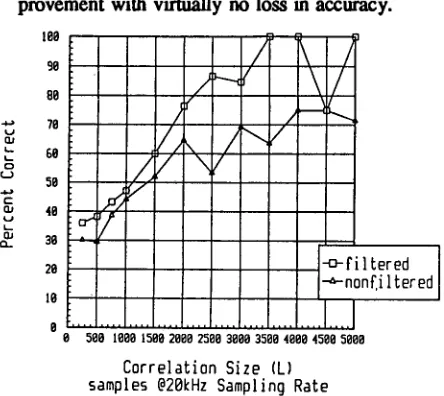
Some preliminary results for one loud talker stand- ing at (1M,2M) with a low ambient are shown in Figures 6 and 7. A linear array of eight microphones was used for all cases. For these Figures, an algorithm was as- sumed to have c(rrecfly located the talker ff it indicated a location within the rectangular region from 1.9M to 2.1M in x and 1.5M to 2.5M in y. As algorithms have im- proved, the measure of "correctness" is also to be refined in further work. In both TDEHF and ICHF, the tendency is for better p e r f o r m a n c e when larger-size cross- correlations are used, although there seems to be no rea- son to go beyond 3500 samples (175ms). It is also clear that ICHF is far more robust than is TDEHF. Further- more, as might be expected, one gets improved perfor- mance using bandpass-filtered data. (The filter used is a 61-tap, symmetric FIR filter having transition bands (400Hz -900Hz) and (3300HZ-3800)Hz; stopbands are 50dB down.)
u t _ o
5@
c
48
m 3@
I@@
I"
9@
- o - f i ] feted
88 -~-n0n f i ] t e r e d
78
/ [ \ %6"I I I \
Correlation Size (L) samples @2@kHz Sampling Rate
Figure 6: Performance of TDEHF
There is high correlation between "correctness" and the resultant value of/~ [k q for ICHF. Therefore, it is ex- pected that, in regions where the algorithm fails -- perhaps in silence or a high-ambient interval -- the value of
E[k']
would be low and the incorrect location would not be accepted. Given this thresholding, one would ex- pect to almost always get an accurate prediction of a talker's location, providing no other talkers are competing acoustically, a case not yet studied.Computationally, ICHF is implementable in real- time due to the use of Stochastic Region Contraction [14] for the nonlinear optimization. Relative to a coarse-fine full search, SRC has provided an order-of-magnitude im-
pmvement with virtl,aUy no loss in accuracy.
Q~
Q~
0_ 188
g8
88
78
5 8
58
48
38
28
16
8
/
/
/
\ /
• i i
!
,-°-filtered ]
J-~-
non
Ci
I
tered
. . . ... I ....
I
8 500 I~08 158~ 2 8 0 8 2500 3888 3588 4 8 8 8 4588 5888
Correlation
Size (L)
samples @20kHz Sampling
Rate
Figure 7: Performance of ICHF
Conclusion
A very promising algorithm for determining the lo- cation of a talker in a real acoustic environment has been introduced. In an uncontested acoustic environment, prel- iminary results from real data indicate that highly accu- rate performance is achievable. In addition, the SRC method for nonlinear optimization has provided a mechanism for making the algorithm practical in real time. In follow-on work, more data have to be tested, multiple talker and various noise environments need to be explored, and extensions to tracking need to be developed. However, the current level of performance tends to predict that these aspects will go smoothly.
References
[1] Flanagan, J. L., Bandwidth Design for Speech-seeking Microphone Arrays, Proc. 1985 ICASSP, Tampa, FL, 3/85, pp. 732-735.
[2] Martin, T. B., Practical Applications of Voice Input to Machines, Proceedings IEEE, Vol. 64, 4/'76 pp. 487-501.
[3] Flanagan, J. L., Johnston, J. D., Zahn, R., and Elko,
G. W., Computer-steered Microphone Arrays for Source Transduction fll Large Rooms, Journal of the Acoustical Society of America, Vol. 78, No. 5, 11/85, pp. 1508- 1518.
[4] Schmidt, R. 0., A Signal Subspace Approach to Multi- ple Emitter Location and Spectral Estimation, PhD.
Dissertation, Stanford University, Nov. 1981.
[5] Schmidt, R. O., Multiple Emitter Location and Signal Parameter Estimation, IEEE Trans. on Antennas and Pro- pagation, Vol. AP-34, No. 3, 3/86, pp. 276-280.
[6] Schmidt, R. O., and Franks, R. E., Multiple Source DF Signal Processing: An Experimental System, IEEE Trans. on Antennas and Propagation, Vol. AP-34, No. 3, 3/86, pp. 281-290.
[7] Wax, M. and Kailath, T., Optimum Localization of
Multiple Sources by Passive Arrays, IEEE Trans. on Acoustics, Speech and Signal Processing, Vol. ASSP-31, No. 5, 10/83, pp. 1210-1218.
[8] Kesler, S. B., and Shahmirian, V., Bias Resolution of the MUSIC and Modified FBLP Algorithms in the Pres- ence of Coherent Plane Waves, IEEE Trans. on Acous- tics, Speech and signal Processing, Vol ASSP-36, No. 8, 8/88, pp. 1351-1352.
[9] Knapp, C. H., and Carter, G. C., The Generalized Correlation Method for Estimation of Time delay, IEEE
Transactions on Acoustics, Speech and Signal Processing, Vol. ASSP-24, No. 4, 8/76, pp. 320-327.
[10] Carter, G. C., Coherence and Time-Delay Estimation,
Proc. IEEE, Vol. 75, No. 2, 2/87, pp. 236-255.
[11] Bendat, J. S., and Piersol, A. G., Engineering Appli- cations of Correlation and Spectral Analysis, John Wiley and Sons, Inc. 1980.
[12] Crochiere, R. E., and Rabiner, L. R., Multirate Digi- tal Signal Processing, Prentice-Hall, Englewood Cliffs, NJ 07632, 1983.
[13] Press, W. H., Flannery, B. P., Teukolsky, S. A., and Vettering, W. T., Numerical Recipes in C, Cambridge University Press, New York, 1988.
[14] Bergex, M., and Silverman, H. F., Microphone Array Optimization by Stochastic Region Contraction, Technical Report LEMS-62, Division of Engineering, Brown University, August 1989.
[15] Alvarado, V. M., Talker Localization and Optimal Placement of Microphones for a Linear Microphone Ar- ray using StochasticRegion Contraction, PhD Thesis, LEMS, Division of Engineering, Brown University, May
1990.
[16] Analog Devices, Inc. ADSP-2100 User's Manual,
Analog Devices, Inc., Norwood, MA, 1989.
[17] Silverman, H. F., and Doerr, K. J., Talker Location using a Linear Microphone Array and Hyperbolic Fitting
Brown University, Division of Engineering, LEMS Technical Report #73, July 1990.
[image:6.612.54.276.50.248.2]