Natural Language Query Refinement for Problem Resolution from
Crowd-Sourced Semi-Structured Data
Rashmi Gangadharaiah and Balakrishnan Narayanaswamy
IBM Research, India Research Lab
{rashgang,murali.balakrishnan}@in.ibm.com
Abstract
We study the problem of natural language query generation for decision support sys-tems (DSS) in the problem resolution do-main. In this domain, a user has a task he is unable to accomplish (eg.bluetooth head-phone not playing music), which we cap-ture using language struccap-tures. We show how important units that define a prob-lem can robustly and automatically be ex-tracted from large noisy online forum data, with no labeled data or query logs. We also show how these units can be selected to re-duce the number of interactions and how they can be used to generate natural lan-guage interactions for query refinement.
1 Introduction
Decision Support Systems (DSSs) that help deci-sion makers extract useful knowledge from large amounts of data have found widespread applica-tion in areas ranging from clinical and medical di-agnosis (Musen et al., 2006) to banking and credit verification (Palma-dos Reis et al., 1999). IBM’s Watson Deep Question Answering system (Fer-rucci et al., 2010), can be applied to DSSs to di-agnose and recommend treatments for lung cancer and to help manage health insurance decisions and claims1. Motivated by the rapid explosion of con-tact centres, we focus on the application of DSSs to assist technical contact center agents.
Contact center DSSs should be designed to as-sist an agent in the problem resolution domain. This domain is characterized by a user calling in to a contact center with the problem of being un-able to perform an action with their product (e.g.I am unable to connect to youtube). Currently con-tact center DSSs are essentially search engines for
1
http://www.ihealthbeat.org/articles/2013/2/11/ibm- offering-two-new-decision-support-tools-based-on-watson.aspx
technical manuals. However, this has two short-comings : (i) in most cutting edge consumer tech-nology, like software and smart devices, the range of possible applications and use cases makes it im-possible to list all of them in the manuals- lim-iting their usefulness under the heavy tailed na-ture of customer problems, (ii) contact centers are known to suffer from high churn due to pressures and difficulties of the jobs, particularly the need for rapid resolution, making ease of use essential since users of these DSSs are somewhere between experts (in using the system) and novices (in the actual technology customers need help with).
With the birth and growth of the Web 2.0 and in particular, large and active online product fo-rums, such as, Yahoo! Answers2, Ubuntu Forums
3 and Apple Support Communities4, there is the
hope that other technology savvy users will find and resolve large number of problems within days of the release of a product. However, these fo-rums arenoisy, i.e. they contain many throw-away comments and erroneous solutions. The first im-portant question we address in this paper is, how can we mine relevant information from online fo-rums and, in essence,crowdsourcethe creation of contact center DSSs? In particular, we show how many problems faced by consumers can be cap-tured byactions on attributes(e.g.bluetooth head-phone not playing music).
In order to address the second shortcoming, we study the problem of automaticinteractivequery refinement in DSSs. When DSSs are used by non-computer scientists, natural language understand-ing and interaction problems take center-stage (Al-ter, 1977). Since both customers and agents are not experts in a technical area, mis-understandings are common. As agents are evaluated based on the number of problems resolved, it is often the case
2http://answers.yahoo.com/
3
http://ubuntuforums.org/
4https://discussions.apple.com/
that queries entered by an agent are underspeci-fied. In response to such a query, a search engine may return a large number of documents. For com-plicated technical queries, the time taken by an agent to read the long list of returned information and possibly reformulate the query could be sig-nificant. The second question we address in this paper is how can a DSS make natural language suggestions that assist the agent in acquiring ad-ditional information from a caller to resolve her problem in the shortest amount of time? Finally, for rapid prototyping and deployment, we develop a system and architecture that does not use any form of labeled data or query logs, a big differ-entiator from prior work. Query Logs are not al-ways available for enterprise systems that are not on the web and/or have a smaller user base (Bhatia et al., 2011). When software and hardware change rapidly over time, it is infeasible to quickly collect large query logs. Also, logs may not always be ac-cessible due to privacy and legal constraints.
To the best of our knowledge, this paper presents the first interactive system (and detailed evaluation thereof) for natural language problem resolution in the absence of manually labeled logs or pre-determined dialog state sequences. Con-cretely, our primary contributions are:
•Problem Representation and Unit Extraction:
We define and automatically extract units that best represent a problem. We show how to do this ro-bustly from noisy forum threads, allowing us to use abundant online user generated content.
•Unit selection for Interaction:We propose and
evaluate a complete interactive system for users to quickly find a resolution based on semi-structured online forum data. Follow up questions are gen-erated automatically from the retrieved results to minimize the number of interactions.
• Natural Language Question Generation:We
demonstrate that, in a dialog system it is possi-ble and useful to automatically generate fluent in-teractions based on the units we defineusing ap-propriate templates. We use these to create follow up questions to the user, which have much needed context, and show that this improves precision.
2 Proposed System
In online forums, people facing issues with their product (thread initiators) post their problems and other users write subsequent posts discussing so-lutions. These threads form a rich data source that
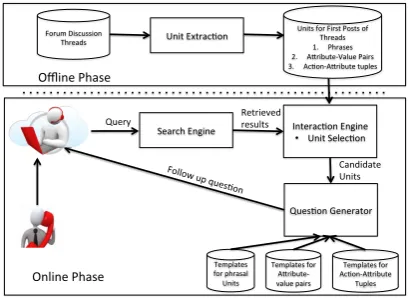
could contain problems similar to what a user who calls in to the contact center faces, and can be used to find an appropriate solution. Our system (Figure 1) has two phases. In the offline phase, the system extracts units that describe the problem being discussed. In the online phase, the interac-tion engine selects the most appropriate units that best divide the space of search results obtained, to minimize the number of interactions. The system then generates follow up interactions by inserting the units into appropriate unit type dependent tem-plates. The answers to these follow up questions are used to improve the search results.
Search Engine
Online Phase Forum Discussion
Threads Unit Extrac:on
Units for First Posts of Threads 1. Phrases 2. A@ribute-‐Value Pairs 3. Ac:on-‐A@ribute tuples
Query Interac:on Engine
• Unit Selec:on
Ques:on Generator Candidate Units
Follow up que
s:on
Templates for phrasal Units
Templates for A@ribute-‐ value pairs
Templates for Ac:on-‐A@ribute
Tuples Retrieved
results Offline Phase
Figure 1: System Description
2.1 Representational Units
It is important to select representational units that capture the signature, or the most important char-acteristics of the information that users search for. This signature should be sufficient to find relevant results. In order to understand the right units for the problem resolution domain, we conducted the following user study. Five annotators analyzed the first posts from50threads from the Apple Discus-sion Forum, and were asked to mark the most rele-vant short segments of the post that best described the problem (an example in Table 1).
I cannot hear the notifications on my bluetooth now. it’s at normal
volume when i send a message, if i receive an email or text volume is very low yet I have all volumes up all the way. Is there a new bluetooth volume i have to turn up? or did another update screw the bluetooth .
Was working just great before i updated to ios - 4 . please help me.
Table 1: Relevant short segments for a forum post.
Phrases as query suggestions have been shown to improve user experience when compared to just showing terms (Kelly et al., 2009) since longer phrases tend to provide more context informa-tion. One shortcoming of these contiguous phrasal units is that they are sensitive to typography, i.e. small changes in phrasing (e.g. ios - 4 and ios 4 ) lead to different phrases and the occurrence counts are divided among these variations. This causes difficulties both in the problem representa-tion as well as in the search for problem resolurepresenta-tion which are exacerbated by the noisy, casual syn-tax in forums. Motivated by Probst et al. (2007), we extractattribute-value pairs. These units pro-vide both robustness as well as more configura-tional context to the problem. Another observa-tion from the segments marked was that many of them involved a user wanting to perform an action (I cannot hear notifications on bluetooth) or the problems caused by a user’s action (working great before I updated). We capture them using
action-attribute tuples(details in Section 3.1.1).
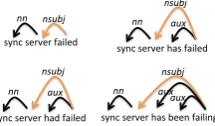
Thread initiators describe the same problem in different ways leading to multiple threads dis-cussing the same problem. Ideally, we want the representation of the problem to be the same for all these threads to build robust statistics. Consider the following examples, sync server has failed, sync server failed, sync server had failed, sync server has been failing. While the phrasing is dif-ferent, we see that their dependency parse trees (Figure 2) show a common relation between the verb or action, fail, and the attribute sync server (the base form of the verbs are obtained from their corresponding lemmas with TreeTagger (Schmid, 1994)). Motivated by this, we use dependency parse trees for extracting action-attribute tuples.
!"#$%!&'(&'%)*!%+*,-&.%% !"#$%!&'(&'%+*,-&.%%
!"#$%!&'(&'%)*.%+*,-&.%% !"#$%!&'(&'%)*!%/&&#%+*,-,#0%%
!"#$%& !!&
!"#$%& '#(& !!&
!"#$%& !!& '#(&
!"#$%&
!!& '#(&'#(&
Figure 2: Dependency Parse Trees for various forms of the same problem.
3 Detailed System Description
We now give a detailed description, showing how the three types of units can be robustly extracted and used from noisy online forums.
3.1 Offline Component
In the offline phase we first extract candidate units that describe a problem (and its solution) from the forum threads. We then filter this description, us-ing the thread itself, to retain the important units.
3.1.1 Candidates for Problem Description
Sentences are tagged and parsed using the Stan-ford dependency parser (de Marneffe et al., 2006). The following units are then obtained from the first post of the discussion thread.
Phrasal units:defined to be Noun Phrases
satis-fying the regular expression, (Adjective)* (Num-ber/Noun/Proper Noun)+, (eg., interactive web sites, osx widgets, 2007 outlook calendar). These are extracted from the discussion thread along with their frequencies of occurrence.
Attribute-Value pairs:The dependency relations
amod (adjectival modifier of a noun phrase) and num (numeric modifier of a noun) in the parsed output are used for this purpose. In the case of amod, the attribute is the noun that the adjective modifies and its value is the adjective. For exam-ple, withamod(signal,strong), the attribute is sig-naland its value isstrong. In the case ofnum, the attribute is the noun and its value is the numeric modifier. For example, withnum(digits,10), the at-tribute isdigits and its value is10. As mentioned in Section 2.1, these pairs capture more context of the problem being discussed. Additional attribute-value pairs are extracted by expanding the at-tributes with the adjacent nouns and adjectives that occur with it. For the example in Figure 3, the at-tributesignalis modified tocell phone signaland added to the list of attribute-value pairs along with their frequencies of occurrence.
Action-Attribute tuples: The dependency
rela-tions used for these units are given in Table 3 with examples. Many of these units help describe the user’s problem while others provide contextual information behind the problem being discussed. These units are described with 4-tuples (Arg1
-verb-Arg2-Arg3), three of which are the
First Post I cannot hear the notifications on my bluetooth now. it’s at normal volume when i send a message but if i receive an email or text the volume is very low yet I have all volumes up all the way. Is there a new bluetooth volume i have to turn up with ios - 4? or is it that another update screwed with the bluetooth again. Was working just great before i updated ios - 4. please help me. thanks! Phrases volume, bluetooth volume, bluetooth, notifications, update, ios, normal volume, work, text, way, email, message, new bluetooth volume, Phrases + volume, bluetooth volume, bluetooth, notifications, update, ios, normal volume, work, text, way, email, message, new bluetooth volume, Att-Val pairs ios 4
Phrases + volume, bluetooth volume, bluetooth, notifications, update, ios, normal volume, work, text, way, email, message, new bluetooth volume, Att-Val pairs + ios 4, low volume, I hear notifications on bluetooth, update screwed bluetooth, I send message,
Act-Att tuples I receive email, it is at normal volume, working great before updated, I missed emails, *I volumes way.
Table 2: Problem representations for a forum post.
hence, the verb is now modified to turned off. Sinceenteredin this example takes only a subject and an object as arguments, the third argument is null. Consider another example,I removed the wep password in the router settings, the tuple is now I-removed-password-in the settings. The last row in Table 3 gives an example of the usage of thexcomp relation. As done with Attribute-Value pairs, the attributes in these units are also expanded with the adjacent nouns and adjectives and added to the list of Action-Attribute tuples along with their fre-quencies of occurrence in the entire thread.
3.1.2 Scoring and Filtering
Since the problem is defined by the thread initia-tor in the first post of the thread, units in the first post are scored and ranked based on tf-idf (Man-ning et al., 2008). We treat each thread as a doc-ument and the top 50 highest scoring candidates form the problem description for the thread. Units are extracted from the rest of the thread in order to obtain frequency statistics for the units in the first post. Pronouns, prepositions and determiners are dropped from the units while obtaining the counts. In addition, verbs in the action-attribute tuples are converted to their base form using the lemma information obtained from TreeTagger (Schmid, 1994), to obtain counts. This makes the scores ro-bust to small variations in the units.
Examples of extracted units are shown in Ta-ble 2. We see that errors in the parse (volumes was tagged as a verb) cause erroneous units (*I volumes up). For this reason, we use frequency statistics from the rest of the discussion thread, to determine if a unit is valid or not. The tf-idf based scheme also removes commonly used phrases such as,please help me,thank you, etc.
3.2 Online Phase
The system searches for a set of initial documents based on the user’s initial query. Next, the follow-up candidate units are selected (Section 3.2.1) from the units extracted in the offline phase for the
!""#$%#&#'"%(#"'$)"*#+,-)#"!"'."$.%"(,/#",")%&.$0"+#11"2(.$#")30$,1" !"#$%& '($%&
')*& +',-.&
/+01& !"#$%&+#2&!)3&
')*&
+/('&
!!& !!& '($%&
Figure 3: Dependency parse:I entered the dns be-cause I do not have a strong cell phone signal.
retrieved documents and natural language interac-tions are further generated by filling the templates (Section 3.2.2) with the selected units.
3.2.1 Selection of candidate units for
Question Generation
Interactions should be selected to (i) understand the user’s requirements better by making the query more specific and reduce the number of results returned by the search engine, and (ii) reduce the number of interactions required. We use in-formation gain to find the best unit that reduces the search space, motivated by its near optimality (Golovin et al., 2010). IfSis the set of all retrieved documents,S1 ⊆ S containinguniti andS2 is a subset ofSthat do not containuniti, the gain from branching (or interacting) onunitiis,
Gain(S, uniti) = E(S)−
|S1| |S|E(S1)−
|S2|
|S|E(S2) (1)
E(S) = X
k=1,...|S|
−p(dock)log2p(dock) (2)
Where, each document is assigned a probability based on its rank in the search results:
p(docj) =
1
rank(docj) P
k=1,...|S|
1
rank(dock)
(3)
Relation Example Attributes(Arg1/Arg2/Arg3) Action(Verb)
nsubj nsubj(entered,I) I (Arg1) entered
dobj dobj(entered,dns) dns (Arg2) entered
iobj iobj(give, address) address (Arg3) address
pobj prep(connect,to), pobj(to,wifi) wifi(Arg2) connect
prep (to,into, etc) prep in(removed,settings) in the settings (Arg3if Arg2not present, else Arg2) removed
xcomp xcomp(prompt, connect), prep to(connect,wifi), password(Arg1), to wifi (Arg2) prompt to connect
nsubj (prompt, password)
Table 3: Dependency relations used to extract Action-Attribute tuples
no. The goal in decision trees is to quickly exhaust the space of examples with fewer steps, resulting in shorter trees. The goal in this paper is to tra-verse the space of results obtained with the initial query to reach the most relevant document with the fewest interactions. Since the dialog problem can be easily mapped to decision trees, the choice of information gain allows the user to arrive at the most relevant document with the smallest number of interactions in the online phase.
3.2.2 Question Generation
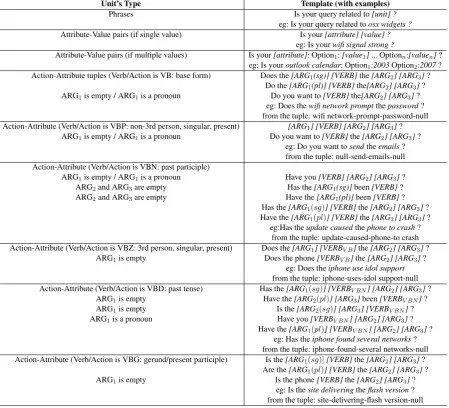
Questions are generated based on the type, number and tense information present in the units. The list of templates used for question generation is given in Table 4. Once a candidate unit is selected, a template is chosen based on its type. Phrasal units have a single template. If an attribute has two val-ues with very similar information gains, the tem-plate for Attribute-Value pairs accommodates the different values. For example, if the pairs, Out-look:2003 and Outlook:2007 have very similar gains, the question would then beIs your outlook: Option1:2003 Option2:2007 ?and the user has the
option to click on the one that is relevant to his query. For Action-Attribute tuples, the templates are chosen based on the the person, number and tense information from the verbs (Table 4). null in the table (for example, null-send-emails-null) indicates that a particular argument does not ex-ist or was not found and hence the argument will not be added to the appropriate template. Certain templates require converting the verb to a different form (e.g.,VBDtoVBN). This mapping is stored as a dictionary obtained by running the TreeTag-ger on the entire dataset and various forms are au-tomatically obtained by linking them to the lem-mas of the verbs (for example, give(VB/lemma) gave(VBD) given(VBN) gives(VBZ)).
4 Results and Discussion
To evaluate our system, we built and simulated a contact center DSS for iPhone problem resolution.
4.1 Description of Dataset
We crawled threads created during the period 2007-2011 from the Apple Discussion Forum re-sulting in about147,000discussion threads. In or-der to create a test data set, threads were clustered treating each discussion thread as a data point us-ing a tf-idf representation. The thread nearest the centroid from the60largest clusters were marked as the ‘most common’ problems.
Underspecified Query 1: “cannot sync calendar” Forms6specific queries
1. because iphone disconnected 2. because the sync server failed to sync 3. because the sync session could not be started 4. because the phone freezes
5. error occurred while mingling data 6. error occurred while merging data
Table 5: Specific and under-specified queries
To generate specific and under-specified queries on this data set, in our experiments, we use the first post as a proxy for the problem description. An annotator created one short query (underspec-ified) from the first post of each of the60selected threads. These queries were given to the Lemur search engine (Strohman et al., 2005) to retrieve the 50 most similar threads from an index built on the entire set of147,000threads. He manually analyzed the first posts of the retrieved threads to create contexts, resulting in 217specific queries. To understand this process we give an example from our data creation in Table 5. Starting from an under-specified query cannot sync calendar, the annotator found6specific queries. Two other an-notators, were given these specific queries along with the search engine’s results from the corre-sponding under-specified query. They were asked to choose the most relevant results for the specific queries. The intersection of the choices of the an-notators formed our ‘gold standard’.
4.2 User based analysis of the problem
representation and unit extraction
Unit’s Type Template (with examples)
Phrases Is your query related to[unit] ?
eg: Is your query related toosx widgets ?
Attribute-Value pairs (if single value) Is your[attribute] [value] ?
eg: Is yourwifi signal strong ?
Attribute-Value pairs (if multiple values) Is your[attribute]: Option1:[value1]... Optionn:[valuen]?
eg: Is youroutlook calendar: Option1:2003Option2:2007?
Action-Attribute tuples (Verb/Action is VB: base form) Does the[ARG1(sg)] [VERB]the[ARG2] [ARG3]?
Do the[ARG1(pl)] [VERB]the[ARG2] [ARG3]?
ARG1is empty / ARG1is a pronoun Do you want to[VERB]the[ARG2] [ARG3]?
eg: Does thewifi network promptthepassword?
from the tuple: wifi network-prompt-password-null
Action-Attribute (Verb/Action is VBP: non-3rd person, singular, present) [ARG1] [VERB] [ARG2] [ARG3]?
ARG1is empty / ARG1is a pronoun Do you want to[VERB]the[ARG2] [ARG3]?
eg: Do you want tosendtheemails?
from the tuple: null-send-emails-null Action-Attribute (Verb/Action is VBN: past participle)
ARG1is empty / ARG1is a pronoun Have you[VERB] [ARG2] [ARG3]?
ARG2and ARG3are empty Has the[ARG1(sg)]been[VERB]?
ARG2and ARG3are empty Have the[ARG1(pl)]been[VERB]?
Has the[ARG1(sg)] [VERB]the[ARG2] [ARG3]?
Have the[ARG1(pl)] [VERB]the[ARG2] [ARG3]?
eg:Has theupdate causedthephone to crash?
from the tuple: update-caused-phone-to crash
Action-Attribute (Verb/Action is VBZ: 3rd person, singular, present) Does the[ARG1] [VERBV B]the[ARG2] [ARG3]?
ARG1is empty Does the phone[VERBV B]the[ARG2] [ARG3]?
eg: Does theiphone use idol support
from the tuple: iphone-uses-idol support-null
Action-Attribute (Verb/Action is VBD: past tense) Has the[ARG1(sg)] [VERBV BN] [ARG2] [ARG3]?
ARG1is empty Have the[ARG2(pl)] [ARG3]been[VERBV BN]?
ARG1is empty Is the[ARG2(sg)] [ARG3] [VERBV BN]?
ARG1is a pronoun Have you[VERBV BN] [ARG2] [ARG3]?
Have the[ARG1(pl)] [VERBV BN] [ARG2] [ARG3]?
eg: Has theiphone found several networks?
from the tuple: iphone-found-several networks-null
Action-Attribute (Verb/Action is VBG: gerund/present participle) Is the[ARG1(sg)][VERB]the[ARG2] [ARG3]?
Are the[ARG1(pl)] [VERB]the[ARG2] [ARG3]?
ARG1is empty Is the phone[VERB]the[ARG2] [ARG3]?
eg: Is thesite deliveringtheflash version?
from the tuple: site-delivering-flash version-null
Table 4: Templates for the follow up Question Generation .
focusing on action-attribute tuples. In the first user study, 5 users were given the first post of
20threads with three problem representations for the first post, (1) phrasal units only, (2) phrasal units and attribute-value (Att-Val) pairs and (3) phrasal units, attribute-value pairs and action-attribute (Act-Att) tuples. They were asked to in-dicate which representation best represented the problem. All users preferred the third representa-tion on all the first posts. An example first post and units are in Table 2.
In the second study, the same5users were asked to indicate how many units in Representation 3
were not relevant to the problem discussed in the first post, for a subset of 10 threads. We defined ‘not relevant’ as noisy components which do not aid in the problem representation e.g.oh boyand thanks!(see Table 2). All users marked2examples
(sortandway) as not relevant, out of110units that the algorithm generated for these threads.
These two user studies taken together show that the combined set of units, is able to capture the problem description well and that our algorithm is able to filter out noise in the thread to create a ro-bust and useful representation of the problem. The results in Section 4.3 (Tables 6 and 7), show the value of our problem representation, in a complete end-to-end system, with objective metrics.
4.3 Unit selection for interaction
1 1.5 2 2.5 3 3.5 4 4.5 5 0.2
0.3 0.4 0.5 0.6 0.7 0.8 0.9 1
Success at N
N
Baseline Random
Pairs+Tuples+Phrases with Top=1 Pairs+Tuples+Phrases with Top=3 Pairs+Tuples+Phrases with Top=5
Figure 4: Success at N.
1 1.5 2 2.5 3 3.5 4 4.5 5
0.2 0.4 0.6 0.8 1 1.2 1.4 1.6 1.8
MAP at N
N
Baseline Random
Pairs+Tuples+Phrases with Top=1 Pairs+Tuples+Phrases with Top=3 Pairs+Tuples+Phrases with Top=5
Figure 5: MAP at N.
(as created in Section 4.1) along with the results obtained when the underspecified query was input to the search engine. They were presented with the
T op= 1,3or5scoring follow up questions. E.g., for the underspecified query in Table 5 and specific query2, the generated question was (see Table 4), Has the sync server failed to sync?. The user then selected the most appropriate follow up question, reducing the number of results. We then measured the relevance of the reduced result, with respect to the gold standard (see Section 4.1) for that spe-cific query, using metrics commonly used in Infor-mation Retrieval - MRR, Mean Average Precision (MAP) and Success at rankN (Baeza-Yates et al., 1999). We restrict N = 5(small) since the rapid resolution time required of contact center agents does not allow them to look at many results.
In Figures 4, 5 and Table 6, we compare our system against a baseline system, which is the set of results obtained with the underspecified query, and a system where5interaction units are selected at random from the initial search results. Note that, as the number of follow up questions presented in-creases, the scores will improve since it is more likely that the ‘correct’ choice is presented. How-ever, there is a trade-off here since the agent has to again peruse more questions, which increases
time spent, and so we limit this value to5as well. In terms of all three measures, our system is able
Unit’s Type MRR
Baseline 0.3997
Random 0.4021
Phrases (with Top=5) 0.6548 Phrases, Pairs (with Top=5) 0.6745 Phrases, Pairs, Tuples (with Top=5) 0.7362
Table 6: MRR for different unit types.
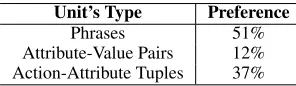
to give a substantial improvement in performance. E.g., one intelligently chosen interaction performs better than 5 randomly chosen ones. These re-sults show the value of the units we select and the choice of information gain as a metric. To measure the importance of each unit type, we analyzed the selected follow up questions (T op = 5) for each underspecified query. Table 7 lists the fraction of queries whose origin was a specific unit type.
Unit’s Type Preference
Phrases 51%
Attribute-Value Pairs 12% Action-Attribute Tuples 37%
Table 7: Fraction of follow up questions selected that originated from a specific unit type
4.4 Evaluating Templates for Question
Generation
Finally, an annotator was given100generated fol-low up questions from the previous experiment and asked to label them as understandable or not. The annotator marked13%as not understandable. Examples were, does the phone connect, has the touchscreen stopped, does the message connect (which were due to errors in parsing) anddo you want to leave the car(due to a filtering error).
5 Related Work
Many speech dialog systems exist today for tasks including, obtaining train information (RAILTEL) (Bennacef et al., 1996), airline mation (Rudnicky et al., 2000) and weather infor-mation (Zue et al., 2000). These systems perform simple database retrieval tasks, where, the key-words and their possible values are known apriori.
In general document retrieval tasks, when a user’s query is under-specified and a large num-ber of documents are retrieved, interactive search engines have been designed to assist the user in narrowing down the search results (Bruza et al., 2000). Much research has concentrated on query reformulation or query suggestions tasks. Sugges-tions are often limited to terms or phrases ei-ther extracted from query logs (Guo et al., 2008; Baeza-Yates et al., 2004) or from the documents obtained in the initial search results (Kelly et al., 2009). Bhogal et al. (2007) require rich ontolo-gies for query expansion, which may be difficult and expensive to obtain for new domains. Leung et al. (2008) identify related queries from the web snippets of search results. Cucerzan and White (2007) use users’ post-query navigation patterns along with the query logs to provide query sug-gestions. Mei et al. (2008) rank query suggestions using the click-through (query-url) graph. Boldi et al. (2009) provide query suggestions based on short random walk on the query flow graph. The main drawback behind these approaches is the de-pendence on query logs and labeled data to train query selection classifiers. We show how certain units are robust representations of documents in the problem resolution domain which can auto-matically be extracted from semi-structured data.
Feuer et al. (2007) use a proximity search-based system that suggests sub and super phrases. Cut-ting et al. (1993; Hearst and Pedersen (1996; Kelly et al. (2009) cluster retrieved documents and make suggestions based on the centroids of the clusters. Kraft and Zien (2004) and Bhatia et al. (2011) use
n-grams extracted from the text corpus to suggest query refinement. Although these techniques do not rely on query logs for providing suggestions, the suggestions are limited tocontiguousphrases. They also do not generate follow up questions, but instead provide a list of suggestions and require the user to select one among them or use them manually to reformulate the initial queries.
Automatically framing natural language ques-tions as follow up quesques-tions to the user is still a
challenging task since, (1) Diriye et al. (2009) and Kelly et al. (2009) showed that interactive query expansion terms are poorly used, and tend to lack information meaningful to the user, thus empha-sizing the need for larger context to best capture the actual query/problem intent (2) finding a few question/suggestions that would narrow the search results will lead to fewer interactions as opposed to displaying the single best result (3) particularly for non-technical users, interactions and clarifications need to be fluent enough for the user to understand and continue his interaction with the system (Al-ter, 1977). In this paper, we show how to extract important representative contextual units (which do not necessarily contain contiguous words) and use these to generate contextual interactions.
Sajjad et al. (2012) consider a data set where objects belong to a known category, with textual descriptions of objects and categories collected from human labelers, using whichn-gram based attributes of objects are defined. Subsets of these attributes are filtered, again using labeled data. Kotov and Zhai (2010) frame questions with the help of handmade templates for the problem of factoid search from a subset of Wikipedia. How-ever, they do not select queries with the goal of minimizing the number of interactions. To extend these approaches to problem-resolution finding, (as opposed to factoids or item descriptions) sim-ple most common noun phrases (as used in Sajjad et al. (2012) and Kotov and Zhai (2010)) are in-sufficient, since they do not capture the problem or intent of the user. As motivated in Section 1, this requires a better representation of candidate phrases. Our paper also suggests an approach that does not need any human labelled or annotated data. Suggestions are selected using units such that the problem intent is well captured and also ensure that fewer interactions take place between the user and the system. Follow-up questions are framed using templates designed for these units, allowing us to move beyond simple terms and phrases.
6 Conclusion and Future Work
References
Steven Alter. 1977. Why is man-computer interaction
important for decision support systems? Interfaces,
7(2):109–115.
Ricardo Baeza-Yates, Berthier Ribeiro-Neto, et al.
1999.Modern information retrieval. ACM press.
Ricardo Baeza-Yates, Carlos Hurtado, and Marcelo
Mendoza. 2004. Query recommendation using
query logs in search engines. InEDBT.
S. Bennacef, L. Devillers, S. Rosset, and L. Lamel. 1996. Dialog in the RAILTEL telephone-based
sys-tem. InICSLP.
Sumit Bhatia, Debapriyo Majumdar, and Prasenjit
Mi-tra. 2011. Query suggestions in the absence of
query logs. InSIGIR.
J. Bhogal, A. Macfarlane, and P. Smith. 2007. A
re-view of ontology based query expansion. Inf.
Pro-cess. Manage.
Paolo Boldi, Francesco Bonchi, Carlos Castillo, Deb-ora Donato, and Sebastiano Vigna. 2009. Query suggestions using query-flow graphs. WSCD.
Peter Bruza, Robert McArthur, and Simon Dennis.
2000. Interactive internet search: keyword,
di-rectory and query reformulation mechanisms
com-pared. InSIGIR.
Silviu Cucerzan and Ryen W. White. 2007. Query
suggestion based on user landing pages. InSIGIR.
Douglass R. Cutting, David R. Karger, and Jan O.
Pedersen. 1993. Constant interaction-time
scat-ter/gather browsing of very large document
collec-tions. InSIGIR.
Marie-Catherine de Marneffe, Bill MacCartney, and Christopher D. Manning. 2006. Generating typed dependency parses from phrase structure parses. LREC.
Abdigani Diriye, Ann Blandford, and Anastasios Tombros. 2009. A polyrepresentational approach
to interactive query expansion. InACM/IEEE-CS.
David Ferrucci, Eric Brown, Jennifer Chu-Carroll, James Fan, David Gondek, Aditya A Kalyanpur, Adam Lally, J William Murdock, Eric Nyberg, John Prager, et al. 2010. Building Watson: An overview
of the DeepQA project. AI Magazine, 31(3).
Alan Feuer, Stefan Savev, and Javed A Aslam. 2007.
Evaluation of phrasal query suggestions. InCIKM.
Daniel Golovin, Andreas Krause, and Debajyoti Ray. 2010. Near-optimal bayesian active learning with
noisy observations. InNIPS.
Jiafeng Guo, Gu Xu, Hang Li, and Xueqi Cheng. 2008. A unified and discriminative model for query
refine-ment. InSIGIR.
Marti A. Hearst and Jan O. Pedersen. 1996. Reex-amining the cluster hypothesis: scatter/gather on
re-trieval results. InSIGIR.
Diane Kelly, Karl Gyllstrom, and Earl W. Bailey. 2009. A comparison of query and term suggestion features
for interactive searching. InSIGIR.
Alexander Kotov and ChengXiang Zhai. 2010.
To-wards natural question guided search. InWWW.
Reiner Kraft and Jason Zien. 2004. Mining anchor text
for query refinement. InWWW.
Kenneth Wai-Ting Leung, Wilfred Ng, and Dik Lun Lee. 2008. Personalized concept-based clustering
of search engine queries. IEEE Trans. on Knowl.
and Data Eng.
Christopher D Manning, Prabhakar Raghavan, and
Hinrich Sch¨utze. 2008. Introduction to information
retrieval. Cambridge University Press.
Qiaozhu Mei, Dengyong Zhou, and Kenneth Church.
2008. Query suggestion using hitting time. In
CIKM.
Tom M Mitchell. 1997. Machine learning. Burr
Ridge, IL: McGraw Hill.
Mark A Musen, Yuval Shahar, and Edward H
Short-liffe. 2006. Clinical decision-support systems.
Biomedical informatics.
Ant´onio Palma-dos Reis, Fatemeh Zahedi, et al. 1999. Designing personalized intelligent financial decision
support systems.Decision Support Systems, 26(1).
Katharina Probst, Rayid Ghani, Marko Krema, Andy
Fano, and Yan Liu. 2007. Extracting and using
attribute-value pairs from product descriptions on
the web. From Web to Social Web: Discovering and
Deploying User and Content Profiles.
Alexander I. Rudnicky, Christina L. Bennett, Alan W. Black, Ananlada Chotimongkol, Kevin A. Lenzo, Alice Oh, and Rita Singh. 2000. Task and domain specific modelling in the carnegie mellon
communi-cator system. InINTERSPEECH.
Hassan Sajjad, Patrick Pantel, and Micheal Gamon. 2012. Underspecified query refinement via natural
language question generation. InCOLING.
Helmut Schmid. 1994. Probabilistic part-of-speech
tagging using decision trees. InNEMLP.
Trevor Strohman, Donald Metzler, Howard Turtle, and W Bruce Croft. 2005. Indri: A language
model-based search engine for complex queries. InICIA.
Victor Zue, Stephanie Seneff, James Glass, Joseph Po-lifroni, Christine Pao, Timothy J. Hazen, and Lee
Hetherington. 2000. Jupiter: A telephone-based