Impact of Corpus Diversity and Complexity on NER Performance
Tatyana Shmanina1,2, Ingrid Zukerman1,2, Antonio Jimeno Yepes1,3,Lawrence Cavedon1,3, Karin Verspoor1,3
1NICTA Victoria Research Laboratory, Melbourne, Australia 2Clayton School of Information Technology, Monash University, Australia
3Department of Computing and Information Systems, University of Melbourne, Australia
[email protected], [email protected],
[email protected],{Lawrence.Cavedon,Karin.Verspoor}@nicta.com.au
Abstract
We describe a cross-corpora evaluation of disease mention recognition for two an-notated biomedical corpora: the Human Variome Project Corpus and the Arizona Disease Corpus. Our analysis of the per-formance of a state-of-the-art NER tool in terms of the characteristics and annotation schema of these corpora shows that these factors significantly affect performance.
1 Introduction
The recent growth of on-line biomedical literature has spawned an increasing number of NLP tools for content analysis that help researchers and prac-titioners access the latest developments in their fields. Examples of these tools include:BANNER–
aNamed Entity Recognizer(NER) for the biomed-ical domain (Leaman and Gonzalez, 2008);ABNER
– a NER for molecular biology (Settles, 2004); andWhatizit– a Web service which provides func-tionality to perform text-mining tasks (Rebholz-Schuhmann et al., 2008). These tools in turn re-quire the development of annotated training cor-pora, e.g., (Kim et al., 2003; Rosario and Hearst, 2004; Kulick et al., 2004; Pestian et al., 2007; Jimeno-Yepes et al., 2008; Bada et al., 2012).
Studies have been conducted to examine the performance of different NLP tools on a single corpus, e.g., (Jacob et al., 2013; Verspoor et al., 2012). However, experience shows that the char-acteristics of a corpus influence performance, e.g., (Cao and Zukerman, 2012) for sentiment analy-sis and (Pyysalo et al., 2008) in the biomedical space. In this paper, we analyze how the char-acteristics and annotation schemas of two corpora influence BANNER’s performance on the recogni-tion of diseases (note thatBANNERoutperforms AB-NER in the recognition of diseases (Leaman and Gonzalez, 2008)). The corpora in question are theHuman Variome Project Corpus(HVPC) devel-oped at NICTA (Verspoor et al., 2013), and the
Arizona Disease Corpus(AZDC) – a popular med-ical resource developed at the University of Ari-zona (Leaman et al., 2009).1
Our results show that BANNER’s performance
on HVPC significantly exceeds its performance on AZDC. This is (at least partly) explained by differences in corpus characteristics, such as re-duced disease mention diversity resulting from
HVPC’s specific focus, and by some requirements ofHVPC’s annotation schema. These observations suggest that corpus analysis should be conducted along with performance evaluation in order to ap-propriately assess the obtained results and the suit-ability of a corpus for training general NER tools.
2 Biomedical Corpora
AZDCis a biomedical textual resource focusing on disease annotation (Leaman et al., 2009). It was extracted from a corpus created by Craven and Kumlien (1999), which consists of sentences se-lected from MEDLINER abstracts via queries for
six proteins. All disease mentions inAZDCare an-notated, with each disease annotation containing a Unified Medical Language SystemR (UMLSR)
concept unique identifier (where possible).
HVPC is an annotated biomedical textual re-source pertaining to human genetic variation and its relation to diseases (Verspoor et al., 2013). At present, the corpus comprises ten double-annotated plain-text full journal publications on inherited colorectal cancer, which were selected on the basis of their relevance to the genetics of the Lynch Syndrome. The annotation schema, which is tailored to the focus of the corpus, covers thirteen relations, such as “gene-has-mutation”, “mutation-has-size” and “disease-related-to-body-part”; and elevenentity types, such as genomic egories (e.g., “gene”, “mutation”), phenotypic cat-egories (e.g., “disease”, “body-part”), catcat-egories
1Of the above corpora, only Kulicket al.’s focuses on
related to the occurrence of mutations in a dis-ease (e.g., “age”, “ethnicity”), and a “character-istic” category as a catch-all for information of in-terest that is otherwise uncategorized.
2.1 Comparison of Annotation Schemas
Both HVPC and AZDC annotate duplicate disease mentions in the same sentence, and abbreviations specific to the analyzed article (e.g., “Huntington disease (HD)”). In addition, they do not annotate stand-alone generic words (e.g., “disease”, “syn-drome”), and disease names embedded into enti-ties of other types (e.g., “Peter MacCallum Can-cer Centre”). However, there are significant dif-ferences between these annotation schemas:
• HVPC’s annotation guidelines define the “dis-ease” entity type as “an abnormal condition affecting the body of an organism”, and an-notates modifiers such “healthy”, “unaffected” and “normal” as diseases of healthy individ-uals. In contrast, AZDC requires that dis-ease mentions correspond to one of the sev-eral semantic types of the UMLSR
Seman-tic Group “disorders” (e.g., “disease or syn-drome”, “injury or poisoning”, “mental dys-function”, “sign or symptom”). As a result, dis-ease effects are annotated as disdis-eases inAZDC, but not inHVPC.
• AZDC requires mention boundaries to be set to a minimum span of text necessary to describe the most specific form of a disease. In contrast,
HVPCseems to be more restrictive with respect to disease mention boundaries. Specifically, many of the modifiers describing the type of a disease (which are included in disease men-tions inAZDC) are attributed to the “characteris-tic” entity type (Section 1). For example, “clas-sical galactosemia” and “unilateral retinoblas-toma” are disease mentions according toAZDC, while only the head noun is a disease mention according toHVPC.
• HVPC annotates only the last and most com-plete part of a disease coordination2 (e.g., in “breast andovarian cancer”, “breast” is anno-tated as a body part3), whileAZDCannotates a coordination as separate but overlapping men-tions of a disease (e.g., “breast and ovarian cancer” and “ovarian cancer”).
2This was originally done in response to the BRAT
anno-tation tool (Stenetorp et al., 2012) not allowing annoanno-tation of discontinuous entities (since rectified).
3A refinement is to consider(body-part, disease)related
pairs as multi-word disease names, which would boost the mention-length counts forHVPCin Figure 2.
These aspects account for the simplicity, brevity and higher structural regularity of HVPC disease mentions compared to those inAZDC(Section 2.2).
2.2 Comparison of Corpora Parameters
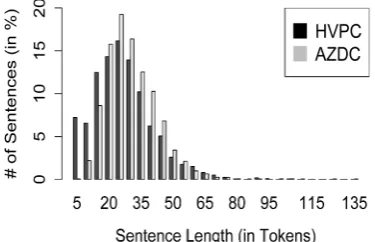
We have analyzedHVPCandAZDCwith respect to the following parameters: size of the corpora in terms of number of sentences and tokens; number of disease mentions and unique disease mentions; and distribution of sentence length, disease men-tion length and disease menmen-tion frequency. The results, which appear in Tables 1 and 2, and Fig-ures 1 and 2, reveal the following differences be-tweenHVPCandAZDC, which explain whyAZDCis more difficult to analyze automatically thanHVPC: • Unique disease mentions – The ratio of uniquedisease mentions tototaldisease men-tions in HVPC (8.4%) is much lower than in
AZDC (37.2%) (Table 1). In addition, inHVPC
a small set of unique mentions has very high frequency compared toAZDC(Table 2). These properties ofHVPCmay be attributed to its
nar-row focus on the Lynch Syndrome.
• Sentence length and complexity – In gen-eral, sentence length is significantly higher in
AZDC (Figure 1). This may be attributed in part to the way in whichHVPCandAZDC were constructed: AZDC contains only sentences
ex-tracted from biomedical paper abstracts, while
HVPCconsists of full papers, which in addition to sentences, contain section headings and ta-ble and figure captions.
• Disease mention length – Most disease men-tions in HVPC consist of 1 or 2 terms, while AZDC contains a large number of multi-word complex disease mentions (Figure 2).
3 NER Performance
In this section, we describe the experiments we performed to evaluate the performance achieved forHVPCandAZDCby a state-of-the-art NER tool, viz BANNER (Leaman and Gonzalez, 2008) (Sec-tion 1). We also analyze the types of errors made byBANNERon each corpus, and discuss their con-nection to the annotation guidelines.
Parameter HVPC AZDC
# of sentences 2116 2783
# of tokens 52454 79950
[image:3.595.307.533.63.173.2]Total # of disease mentions 1552 3228 # of unique disease mentions 130 1202
Table 1: Various quantitative parameters ofHVPC
and AZDC. Unique mentions refer to all (case-sensitive) textually identical disease mentions.
Figure 1: Distribution of sentence lengths (binned with step 5) inHVPCandAZDC.
3.1 Experimental Set-Up
BANNER configuration: We used the 19th SVN revision of BANNER (sourceforge.net/p/
banner/code/HEAD/tree/) with the following
parameters: (1) parenthesis post-processing, post processing of abbreviations specific to an arti-cle, and numeric normalization switched “on”; (2) IOB (Inside, Outside, Begin) label model with second order CRF model; and (3) no dictionary.
Matching schemes: BANNER’s performance was assessed using the following matching schemes: (1) exact, (2) left border, (3) right border, (4) left or right border, (5) entity inclusion (one entity is a subset of another), and (6) entity overlap. The first scheme provides the most stringent measure of performance, while the other schemes provide different types of fuzzy matches.
Dataset preparation: BANNER contains a dataset loader specifically created forAZDC, while
HVPC had to be segmented into sentences. This was done by training the OpenNLP sentence splitter (opennlp.apache.org/) on 70% ofHVPC, and manually fixing the nine errors that remained after automatic sentence splitting.
3.2 Performance Evaluation
We performed 10-fold cross validation over both corpora, and employed the standard performance
Parameter HVPC AZDC
Frequency mean 11.94 2.73
Frequency standard deviation 22.39 5.65 Ratio of topN frequent mentions
to all mentions
N = 10 0.51 0.14
N = 20 0.73 0.22
[image:3.595.72.292.63.133.2]N = 30 0.85 0.28
Table 2: Frequencies of disease mentions.
Figure 2: Distribution of disease mention lengths inHVPCandAZDC.
metrics ofPrecision,RecallandF-score.
The results in Table 3 show that BANNER
achieves excellent performance (F-score=0.9164) for HVPC on exact matches, which cannot be substantially improved by relaxing the matching scheme. In contrast, AZDC’s F-score=0.7365 for the exact matching scheme increases by up to 15% with matching-scheme relaxation.4
The good performance of BANNER on HVPC
may be attributed to the single-disease focus of the corpus, its sentence brevity, and its disease-mention properties, which in turn are influenced by the annotation schema (Section 2). The lat-ter may also explain the relative insensitivity of
BANNER to the matching scheme relaxation: BAN-NER tends to have NE boundary detection prob-lems mostly for long disease mentions, which are under-represented inHVPC.
With regard toAZDC, the results in Table 3 indi-cate that the main cause of the relatively low per-formance ofBANNERis its inaccurate left boundary detection, which affects performance for both the exact and left-border schemes.
4
[image:3.595.79.267.202.323.2] [image:3.595.315.502.216.339.2]Scheme Corpus Precision Recall F-score
Exact AZDC 0.7772 0.7003 0.7365 HVPC 0.9322 0.9026 0.9164 Left AZDC 0.8009 0.7217 0.7590 Border HVPC 0.9372 0.9076 0.9214 Right AZDC 0.8706 0.7844 0.8250 Border HVPC 0.9512 0.9215 0.9353 Left or Right AZDC 0.8870 0.7992 0.8406 Border HVPC 0.9555 0.9258 0.9396 Inclusion AZDC 0.8897 0.8016 0.8431 HVPC 0.9593 0.9293 0.9433 Overlap AZDC 0.8931 0.8046 0.8463 HVPC 0.9599 0.9299 0.9439
Table 3: 10-fold X-validation forAZDCandHVPC.
3.3 NER Errors
Below we consider the errors identified in (Lea-man et al., 2009) for AZDC (items 1-3), and add another type of error (item 4):
1. Improper handling of coordinations (AZDC), which occurs quite often, despite the addition of a coordination-handling post-processing step. BANNER tends to combine separate men-tions of the form “disease1 and disease2” (false positives), while sometimes missing annotated coordinations (false negatives).
2. Inability to correctly detect boundaries of dis-ease mentions (AZDCandHVPC). This problem is exacerbated in AZDC when diseases are re-ferred to by their effects rather than their names (e.g., “premature periodontal destruction”), or disease names contain attributes (e.g., “high myopia”).
3. Incorrect identification of acronyms and abbre-viations specific to the analyzed article (AZDC
andHVPC).
4. Overlooking (false negatives) or mistaken an-notation (false positives) of disease names (AZDC and HVPC). In particular, this happens
for words characterizing a health condition, e.g., “affected”, “normal” or “healthy” (HVPC
only), and diseases referred to by their effects (AZDConly).
This analysis confirms that the difference in
BANNER’s performance onHVPCandAZDCis partly caused by differences in the annotation guidelines for these two corpora:
• AZDC contains many coordinations, while
HVPC’s annotation guidelines circumvent the “coordination problem” (Section 2).
• Disease effects and characteristics are not an-notated as disease names inHVPC. In contrast, the number of such mentions inAZDC is high,
and its disease mentions in general are usually longer and more diverse than disease mentions inHVPC.
These factors explain the increased difficulty of disease-mention identification and mention-boundary detection inAZDCcompared toHVPC.
3.4 Baseline Performance onHVPC
The simplicity ofHVPCis further demonstrated by evaluating the performance of a very simple base-line algorithm that extracts disease mentions from
HVPC. This algorithm applies the Unix string-matching utility grep to each word in a small (42 word) dictionary that was quickly constructed. The dictionary was created by collecting all the disease mentions and their morphological varia-tions from the Wikipedia article about the Lynch Syndrome, and adding six terms (“healthy”, “nor-mal”, “unaffected”, “polyp”, “polyps” and “poly-posis”). The results obtained by this baseline for the exact matching scheme (Precision = 0.8777, Recall= 0.7352 and F-score=0.8001) are signifi-cantly better than theBANNERscores forAZDC.
4 Conclusion
In this paper, we presented a case study of two cor-pora with disease annotations. Our results show that the domain and construction method of a cor-pus, the restrictions imposed on disease defini-tions, and other annotation schema requirements are likely to have a high impact on NER perfor-mance. In particular, HVPC is an easy corpus for NER in comparison withAZDCdue to its low lexi-cal variability, the brevity and high regularity of its disease names, and the requirements of theHVPC
annotation schema.
We conclude that corpus features identified in this paper are predictive of NER performance, and possibly of performance in other tasks, and should be taken into account during corpus selection. In particular, we note that HVPC is not very
suit-able for the development of NER tools for disease name recognition in general. However, this cor-pus may be useful for the development and assess-ment of (disease) relation extraction (RE) tools, as it minimizes the noise introduced by incorrect NER. In addition, it may be suitable for training NER and RE tools for applications focused on par-ticular diseases.
Acknowledgements
NICTA is funded by the Australian Government through the Department of Communications and by the Australian Research Council through the ICT Centre of Excellence Program.
References
M. Bada, M. Eckert, D. Evans, K. Garcia, K. Shipley, D. Sitnikov, W.A. Baumgartner, K. Bretonnel Co-hen, K.M. Verspoor, J.A. Blake, and L.E. Hunter. 2012. Concept annotation in the CRAFT corpus. BMC Bioinformatics, 13(161).
M.D. Cao and I. Zukerman. 2012. Experimental eval-uation of a lexicon- and corpus-based ensemble for multi-way sentiment analysis. InALTA-2012 – Pro-ceedings of the Australasian Language Technology Workshop, pages 52–60, Dunedin, New Zealand.
M. Craven and J. Kumlien. 1999. Constructing biolog-ical knowledge bases by extracting information from text sources. In ISMB 1999 – Proceedings of the International Conference on Intelligent Systems in Molecular Biology, pages 77–86, Heidelberg, Ger-many.
C. Jacob, P. Thomas, and U. Leser. 2013. Comprehen-sive benchmark of Gene Ontology concept recogni-tion tools. In Proceedings of BioLINK SIG 2013, pages 20–26, Berlin, Germany.
A. Jimeno-Yepes, E. Jimenez-Ruiz, V. Lee, S. Gaudan, R. Berlanga, and D. Rebholz-Schuhmann. 2008. Assessment of disease named entity recognition on a corpus of annotated sentences. BMC Bioinformat-ics, 9(S-3).
J.-D. Kim, T. Ohta, Y. Tateisi, and J. Tsujii. 2003. Ge-nia corpus – a semantically annotated corpus for bio-textmining. Bioinformatics, 19(suppl. 1):i180–i182.
S. Kulick, A. Bies, M. Liberman, M. Mandel, R. Mc-Donald, M. Palmer, A. Schein, L. Ungar, S. Win-ters, and P. White. 2004. Integrated annotation for biomedical information extraction. In HLT/NAACL-2004 – Proceedings of the Human Language Tech-nology Conference and the Annual Meeting of the North American Chapter of the Association for Computational Linguistics, pages 61–68, Boston, Massachusetts.
J.D. Lafferty, A. McCallum, and F.C.N. Pereira. 2001. Conditional Random Fields: Probabilistic models for segmenting and labeling sequence data. In ICML’2001 – Proceedings of the 18th International Conference on Machine Learning, pages 282–289, Williamstown, Massachusetts.
R. Leaman and G. Gonzalez. 2008. BANNER: an ex-ecutable survey of advances in biomedical named entity recognition. In R.B. Altman, A.K. Dunker,
L. Hunter, T. Murray, and T.E. Klein, editors, Pa-cific Symposium on Biocomputing, pages 652–663. World Scientific.
R. Leaman, C. Miller, and G. Gonzalez. 2009. En-abling recognition of diseases in biomedical text with machine learning: corpus and benchmark. In LBM2009 – Proceedings of the 3rd International Symposium on Languages in Biology and Medicine, pages 82–89, Jeju Island, South Korea.
J.P. Pestian, C. Brew, P. Matykiewicz, D.J. Hovermale, N. Johnson, K. Bretonnel Cohen, and W. Duch. 2007. A shared task involving multi-label classifica-tion of clinical free text. InBioNLP’07 – Proceed-ings of the Workshop on Biological, Translational, and Clinical Language Processing, pages 97–104, Prague, Czech Republic.
S. Pyysalo, A. Airola, J. Heimonen, J. Bj¨orne, F. Gin-ter, and T. Salakoski. 2008. Comparative analysis of five protein-protein interaction corpora.BMC Bioin-formatics, 9(Suppl. 3):S6.
D. Rebholz-Schuhmann, M. Arregui, S. Gaudan, H. Kirsch, and A. Jimeno-Yepes. 2008. Text processing through Web services: calling Whatizit. Bioinformatics, 24(2):296–298.
B. Rosario and M.A. Hearst. 2004. Classifying se-mantic relations in bioscience texts. InACL’2004 – Proceedings of the 42nd Annual Meeting of the As-sociation for Computational Linguistics, pages 431– 438, Barcelona, Spain.
B. Settles. 2004. Biomedical named entity recog-nition using Conditional Random Fields and rich feature sets. In Proceedings of the International Joint Workshop on Natural Language Processing in Biomedicine and its Applications, pages 104–107, Geneva, Switzerland.
P. Stenetorp, S. Pyysalo, G. Topic, T. Ohta, S. Anani-adou, and J Tsujii. 2012. BRAT: A Web-based tool for NLP-assisted text annotation. InEACL’2012 – Proceedings of the 13th Conference of the European Chapter of the Association for Computational Lin-guistics, pages 102–107, Avignon, France.
K.M. Verspoor, K.B. Cohen, A. Lanfranchi, C. Warner, H.L. Johnson, C. Roeder, J.D. Choi, C. Funk, Y. Malenkiy, M. Eckert, N. Xue, W.A. Baumgart-ner, M. Bada, M. Palmer, and L.E. Hunter. 2012. A corpus of full-text journal articles is a robust evalua-tion tool for revealing differences in performance of biomedical natural language processing tools. BMC Bioinformatics, 13(107).