A string-to-graph constructive alignment algorithm for discrete and
probabilistic language modeling
Andrei Shcherbakov Ekaterina Vylomova The University of Melbourne
Parkville, Victoria 3010, Australia
[email protected] [email protected]
Abstract
We propose a novel algorithm of graph-to-string alignment that constructs automata from a sample of string sequences. While being a variant of global edit distance, the algorithm also employs graph construction operations in
order to form an optimal alignment. It
al-lows dynamic insertion of edges and nodes driven by optimization of the best string-to-graph alignment score. The algorithm may be used both to derive discrete non-deterministic acceptor (or a regular expression) and to build a probabilistic generative model of an input language. An outstanding ability to produce accurate approximate models from extremely sparse training sets constitutes the main advan-tage of the technique.
1 Introduction
Tasks such as text generation or language mod-elling might require approximate string matching. Often the models are trained on a set of match-ing samples (sometimes augmented with mis-matching, or negative, samples). In most cases, they rely on extrinsic metrics (n-gram similarity (Kondrak,2005), perplexity (Jelinek et al.,1977), Kolmogorov (Li and Vit´anyi, 2013) or cognitive (Rogers et al., 2013) complexities, Levenshtein distance (Levenshtein,1966)). An objective func-tion may not directly correspond to any formally proven or intuitively observable reasonable goal. In current paper, we attempt to combine struc-ture awareness of graph-based models with sim-plicity of similarity-based approaches. We train a graph-based model that minimizes modified re-current edit distance1 between each training sam-ple and the path in the graph closest to it. As a graph-based model we propose to use a weighted non-deterministic finite state acceptor (WFSA) to
1Here “recurrent” means that a path may contain loops.
enable a compact representation of learned se-quences as well as to allow alternations and rep-etitions of substrings. The approach we consider in the paper is essentially based on the hypoth-esis that sequences that are likely to appear in a language normally form dense clusters around some basic patterns. In other words, the sequences are characterized by relatively low edit distance to some cluster centroid. The proposed tech-nique handles both branching and looping of sub-sequences in a consistent way. As a result, pattern generalization may be carried out without any ex-tra pre- or post-processing.2
2 Architecture
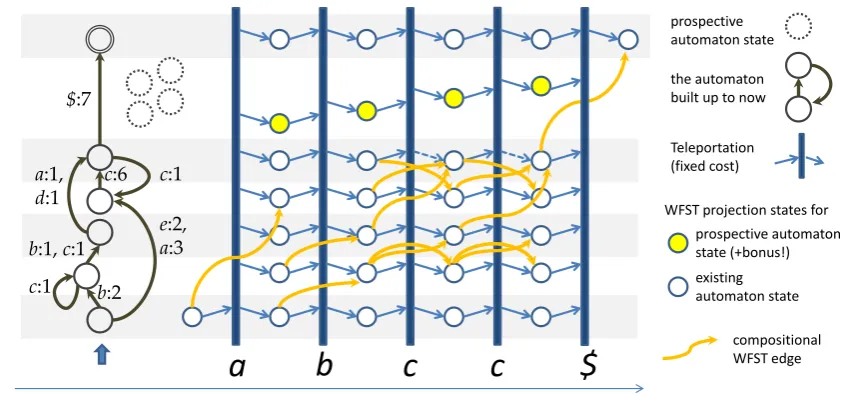
We first provide a set of positive (and, option-ally, negative) string samples in order to build a weighted acceptor (WFSA). The training pro-cedure runs as follows. Initially, the acceptor only contains unconnected start and finish (accept-ing) nodes. At each training iteration we com-pute the best possible alignments between the ac-ceptor and a given sample string using Smith– Waterman (Smith et al., 1981) alignment search procedure with the following major differences. First, it allows virtually any automaton edge (even non-existent ones) to be considered for alignment paths.3 In such a way, it enables new candidate edges that should be built in order to improve fit to a given sample. Second, it speculates on prospec-tive new states of acceptor, one per sample string character. Each string sampleyis processed in the following two phases during training.
Phase 1 - counting alignment scores and build-ing a temporary transducer.We construct a
ma-2The code is available at http://regexus.com/jumpalign , https://github.com/andreas-softwareengineer-pro/jumpalign
compositional WFST edge
a
b
c
c
WFST projection states for prospective automaton state (+bonus!) existing automaton state Teleportation (fixed cost) the automaton built up to now prospective automaton state
e:2, a:3 c:1 c:6
b:2 c:1
b:1, c:1 a:1, d:1
$:7
[image:2.595.79.501.51.248.2]$
Figure 1: A single acceptor-to-string alignment step.
trix of best partial alignment scoresSi,j, wheren is number of existing WFSA states,i ∈ {0..n+ |y|} is existing or prospective state of accep-tor, and j ∈ {1..|y|} is sample string position. For each j we consider all n existing automaton states augmented with one new (prospective) state “number” n + j. In order to assign candidate scores forSi,jcell, we transfer scores fromS∗,j−1
cells in two ways: (1) using existing WFSA edges that match the yj character,4 applying respective edge weights as increments; or (2) using virtual “teleport” edges that might be added between any pair of states, with a fixed teleport penaltyT:5
Si,j = max
( max
k Sk,j−1−T
max
k:∃k−→yj i
(Sk,j−1+w(k
yj −→i))
(1) whereyj is thejthcharacter of the sample string y;k−→yj iis WFSA edge from statekto statei la-belled withyj character;w(k
yj
−→i)is its weight. Indeed, we build a transient weighted finite-state transducer (WFST) which translates the ac-ceptor into the sample string. Each transducer state si,j maps into the respective Si,j score. In order to reduce complexity, we upper bound the number of incoming edges to each WFST state by a constant hyperparameter K, only creating WFST edges that yield best candidate scores to a givenSi,j according to Eq.1. Other potential
in-4We track a modifiablecharacter 7→ weightmap for every edge
5Technically, for the sake of efficiency, one may handle the matrix as a sparse one, assuming the default score of any missing(i, j)element to bemaxkSk,j−1−T.
coming edges are ignored, if any. In Fig.1, WFST edges that would be built at infinitely greatK but rejected at K = 2 as not yielding competitive scores, are given in dashed line.
For eachjwe create a new candidate transducer state sn+j,j that is only “accessible” froms∗,j−1
by teleportation and apply a fixed bonusB to its score: Sn+j,j = maxkSk,j−1 +B. Such a state
(shown in yellow color in Fig.1) may further be either mapped to a newly created state of the ac-ceptor or deleted if it fails to improve the result-ing alignment score. The bonus encourages initial endorsement of newly hypothesized states, which otherwise wouldn’t have competitive scores.
Phase 2 - endorsement. After calculation of all Si,j scores, we trace paths of alignment from Saccepting,|y| back to Sstart,0. We endorse all
WFSA edges laying at WFST-to-WFSA projec-tions of those optimal and near-optimal paths. En-dorsementhere means increasing weight of an ex-isting or prospective WFSA edge k −→yj i by an amount ofφ(k −→yj i), which isendorsement flow trough the WFST edge sk,j 7→ si,j−1 that maps
which is then distributed to all states using a dy-namic programming procedure. R plays part of learning rate. Choosing a reasonably low value for it (0.1B) helps one to alleviate bias caused by a particular order of sample learning.
The distribution of flow over incoming edges of a given statesis determined by the softmax:6
φ(e) = Pexp (−L(e))
v∈Vs
exp (−L(v)) X
u∈Us
φ(u) (2)
where {Vs} and {Us} are sets of incoming and outgoing edges, respectively, for some state s; e ∈ Vs; L(e) isedge losswhich is calculated as difference between the respectiveSi,j score fors and a candidate score brought to it byeedge.
For negative training samples, we apply a similar procedure (disendorsement) with negative amounts of flow. The endorsement/disendorse-ment procedure described above keeps the sum of incoming edge weights and the sum of outgo-ing edge weights equal for any given WFSA state. Besides other benefits, that fact enables simple re-alization of unbiased sampling procedure, just as easy as random weighed selection of an edge to proceed with.
3 Experiments
3.1 Learning a WFSA from positive samples
The approach demonstrates ability to recognize basic branching and recurrent patterns in string sample sets that can be used to construct regular expressions. Fig. 2(a) illustrates an acceptor for the following set:
12345 , 1232345 , 123232345 , abfg , abcdefg , abcdecdecdefg , 123456, 123232323232323456
3.2 Contrastive learning of WFSA
We experimented with training acceptors on both positive and negative examples. At every epoch, for each sample, we applied a respective positive or negative endorsement to the edges. Although we started with a symmetrical approach by en-dorsing proportionally to the score differences, it made any graph prone to any reshaping neces-sary for better fitting to a training set. Therefore,
6Minor terms below a threshold are ignored in the imple-mentation in order to avoid excessive growth of the WFSA and performance loss.
we found asymmetrical approach to be signifi-cantly more efficient. For false positive matches we randomly set a negative score to some of edges constituting the best path of acceptor-to-sample alignment. This leads to a permanent denial of those edges, and alternative edges will be con-sidered in further learning process to achieve a high enough score for positive samples. Our ex-periments showed that the acceptor easily learns combinatorial rules like one that requires it to ac-cept “aaabbb, aaaccc,dddccc” but to reject
dddbbb”. For most cases, it achieves a 100% ac-curacy in less than 20 epochs.
3.3 Probabilistic language modeling
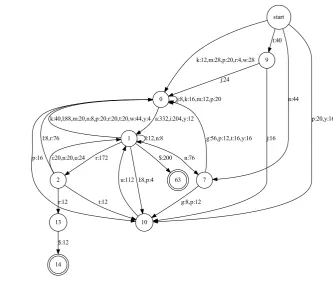
We created WFSAs on the basis of small samples of vocabularies of the English (Germanic, IE) and the Kukatja (Pama-Nyungan, Australian Aborigi-nal) languages.7 For the latter, we reused the lin-guistic resources introduced inShcherbakov et al. (2016). We generated “novel” possible words us-ing the acceptors and measured precision of the outputs, i.e. percentage of predicted strings that were observed in the corresponding language dic-tionaries. To generate a word, we traversed a path in the weighted acceptor from its accepting state back to the initial state, choosing an incoming edge and a character to generate at each state. In our experiments, the likelihood of test vocabulary word production was comparable with the one ob-tained in modified Kneser-Ney approach (Heafield et al., 2013) if the training corpus size is large enough. However, for very low-resource settings (10. . .500 training words) the alignment-based approach outperforms n-gram approaches (at the best fixed n) in ∼ 1.2+ times. Fig. 2(b) shows a graph trained for a random 300 words sampled from Kukatja dictionary. Although the automaton is quite simple, as many as 10% of its output words hit the remaining known Kukatja vocabulary that contains ∼ 9,000 words.8 A larger automaton may be built if we increaseLhyperparameter, but this choice does not lead to precision increase. In-terestingly, a model trained on the English poem “Humpty Dumpty” (only 18 words!) predicts real English words with a precision above 18% which is 1.5x greater than the best result achieved by
7Kukatja is an Australian Aboriginal language spoken by about 300 people in Western Desert, Australia.
start
0 1:20
7 a:12
1 2:56 3:36
2 3:20
3 4:20
4 5:20
6:8
5 $:32
8 b:12
9 f:12
11 c:16
g:12 12 d:16
e:16
(a) Example in Subsection3.1
start
0
k:12,m:28,p:20,r:4,w:28
7
n:44 9
t:40
10
p:20,y:16 j:8,k:16,m:12,p:20
1
a:332,i:204,y:12
p:16
k:40,l:88,m:20,n:8,p:20,r:20,t:20,w:44,y:4
l:12,n:8
2
r:172 n:76
l:8,p:4 63 $:200 l:8,r:76
i:20,n:20,u:24
t:12
13 r:12
g:56,p:12,t:16,y:16
g:8,p:12 j:24
j:16
u:112
14 $:12
[image:4.595.189.523.87.369.2](b) 90 words of Kukatja (paths with low weight edges were pruned)
Figure 2: Examples of the learned WFSA.
the modified Kneser-Ney model. Finally, since finite state machines are well-known in the do-main of morphology modeling, we additionally explored this direction. We used short (100..1000 words) samples of CELEX English morphology database (Baayen et al., 1995) to train an accep-tor. We observed that common prefixed and suf-fixes got aligned and represented compactly in a resulting automaton structure. However, overfit-ting to stems significantly affects its overall gen-eralization potential that results is perplexity val-ues comparable to ones achieved by n-gram mod-els (Table1).
Resource Test set Train set (language) K=1 K=2 2gr. K=1 2gr.
[image:4.595.73.290.623.698.2]Kukatja 1.79 1.77 1.66 1.9 1.63 English 2.54 2.46 2.32 2.4 2.13 CELEX 2.69 2.66 2.55 2.28 2.18
Table 1: Per-character perplexity (natural logarithms) for acceptors trained on 300-word random subsamples at different settings ofKhyperparameter. Figures for a bi-gram model (“2gr.”) are given for comparison.
3.4 Learning software control flow graphs
Reverse engineering of a software control flow graph (CFG) based on samples of execution traces is another area where the proposed constructive alignment algorithm performs well. Experiments with sample programs demonstrated its ability to produce accurate estimations of CFG suitable for analysis and verification purposes.
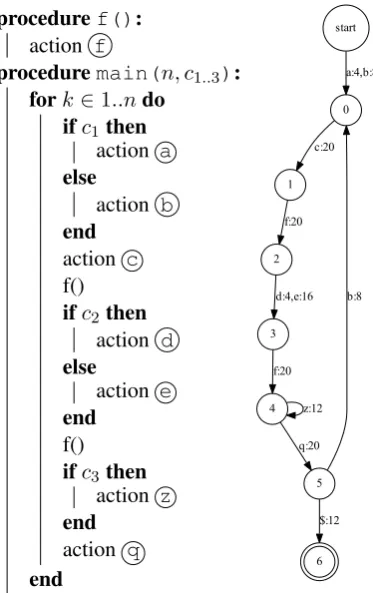
Consider a simple abstract program example given in Figure3. Suppose that each abstract ac-tion writes a respective character to a log upon execution. In such a way, every program run produces an execution trace string. For instance, givennum = 1, c1 = c2 = c3 = f alseit will
produce a bcfefq trace. An automaton learnt from a collection of traces obtained at different in-puts is shown in Fig.3. The result correctly back engineers the program control flow graph. It may be noted that procedure call context was properly preserved. Indeed, two different edges labelled ‘f’ were produced for procedure f calls originating from different points of code.
dis-proceduref():
action f
proceduremain(n, c1..3):
fork∈1..ndo ifc1then
action a
else
action b
end
action c
f()
ifc2then
action d
else
action e
end
f()
ifc3then
action z
end
action q
end
start
0 a:4,b:8
1 c:20
2 f:20
3 d:4,e:16
4 f:20
z:12
5 q:20
b:8
[image:5.595.85.272.67.364.2]6 $:12
Figure 3: A control flow graph inferred from a code sample execution traces.
covering latent states of transition graph for vari-ous natural and artificial processes (process min-ing).
4 Discussion
The constructive alignment algorithm demon-strated its ability to efficiently solve various kinds of tasks when training sets are too small to employ other options. This fact supports the hypothesis that most of the acceptable sequences are likely to congest within low edit distances from a relatively sparse variety of alterable common patterns.
The method also demonstrated its advantages over n-gram language modeling for “dense” train-ing resources, still its higher complexity may chal-lenge the advantages as a kind of “light” learn-ing algorithms. The approach seem to be promis-ing for regular expression construction since it ad-dresses repetitions and branching in an intuitive, uniform way of alignment alternative trade-off.
5 Related work
Tomita (1982) made an early successful attempt to address automaton construction from sets of
positive and negative samples. Their approach employs a global optimization over edge muta-tions. Dupont (1994) proposed a further adap-tation of genetic algorithms to the task of au-tomata creation. Formalization of a regular gram-matical inference task was also a major contri-bution. Brauer et al.(2011) employed a feature-based approach which constructed a query answer that had the shortest possible description length. Bui and Zeng-Treitler(2014) applied the Smith– Waterman algorithm (Smith et al.,1981) over se-quences of keys to align input positive samples. A dedicated “primary” sample string was aligned to all other strings and then a branching graph was produced. The authors proposed to use a ma-chine learning classifier to derive optimally per-forming sequences of keys from given samples. Recently Shcherbakov (2016) proposed to build a regular expression acceptor by incrementally aligning input samples to a topologically sorted representation of the automaton. It essentially did fuzzy alignment of characters dynamically reduc-ing character sets to character classes at corre-sponding score penalties.
Finally,Fernau (2009) used a simplified block-wise alignment procedure and a dedicated gener-alization for the loop creation. The construction process combinesgeneratingprospective patterns withinferringthem from input samples.
6 Conclusion
We proposed an approach to language modeling that constructs an acceptor driven by optimization of minimum edit distance between a learning sam-ple and a path in the automaton. We carried out a series of preliminary experiments demonstrating its effectiveness in four major areas of the algo-rithm’s potential application, particularly, for low-resource task settings.
References
R Harald Baayen, Richard Piepenbrock, and Leon Gu-likers. 1995. The celex lexical database (release 2).
Distributed by the Linguistic Data Consortium, Uni-versity of Pennsylvania.
Falk Brauer, Robert Rieger, Adrian Mocan, and Wo-jciech M Barczynski. 2011. Enabling information extraction by inference of regular expressions from
sample entities. In Proceedings of the 20th ACM
Duy Duc An Bui and Qing Zeng-Treitler. 2014. Learn-ing regular expressions for clinical text
classifica-tion. Journal of the American Medical Informatics
Association, 21(5):850–857.
Pierre Dupont. 1994. Regular grammatical
infer-ence from positive and negative samples by genetic
search: the gig method. In International
Collo-quium on Grammatical Inference, pages 236–245. Springer.
Henning Fernau. 2009. Algorithms for learning
regu-lar expressions from positive data. Information and
Computation, 207(4):521–541.
Kenneth Heafield, Ivan Pouzyrevsky, Jonathan H Clark, and Philipp Koehn. 2013. Scalable modified
kneser-ney language model estimation. In
Proceed-ings of the 51st Annual Meeting of the Association for Computational Linguistics (Volume 2: Short Pa-pers), volume 2, pages 690–696.
Fred Jelinek, Robert L Mercer, Lalit R Bahl, and James K Baker. 1977. Perplexitya measure of the
difficulty of speech recognition tasks. The Journal
of the Acoustical Society of America, 62(S1):S63– S63.
Grzegorz Kondrak. 2005. N-gram similarity and
dis-tance. In International symposium on string
pro-cessing and information retrieval, pages 115–126. Springer.
Vladimir I Levenshtein. 1966. Binary codes capable of correcting deletions, insertions, and reversals. In
Soviet physics doklady, volume 10, pages 707–710.
Ming Li and Paul Vit´anyi. 2013. An
introduc-tion to Kolmogorov complexity and its applicaintroduc-tions. Springer Science & Business Media.
James Rogers, Jeffrey Heinz, Margaret Fero, Jeremy Hurst, Dakotah Lambert, and Sean Wibel. 2013.
Cognitive and sub-regular complexity. In Formal
grammar, pages 90–108. Springer.
Andrei Shcherbakov. 2016. A branching
alignment-based synthesis of regular expressions. In AIST
(Supplement), pages 315–328.
Andrei Shcherbakov, Ekaterina Vylomova, and Nick
Thieberger. 2016. Phonotactic modeling of
ex-tremely low resource languages. InProceedings of
the Australasian Language Technology Association Workshop 2016, pages 84–93.
Temple F Smith, Michael S Waterman, et al. 1981. Identification of common molecular subsequences.
Journal of molecular biology, 147(1):195–197.