Improved Neural Machine Translation using Side Information
Cong Duy Vu Hoang† and Gholamreza Haffari‡ and Trevor Cohn†
†University of Melbourne, Melbourne, VIC, Australia
‡Monash University, Clayton, VIC, Australia
[email protected], [email protected], [email protected]
Abstract
In this work, we investigate whether side information is helpful in the context of neural machine translation (NMT). We study various kinds of side information, including topical information and personal traits, and then propose different ways of incorporating these information sources into existing NMT models. Our experi-mental results show the benefits of side in-formation in improving the NMT models.
1 Introduction
Neural machine translation is the task of gener-ating a target language sequence given a source language sequence, framed as a neural network (Sutskever et al.,2014;Bahdanau et al.,2015, in-ter alia). Most research efforts focus on inducing more prior knowledge (Cohn et al., 2016; Zhang et al., 2017; Mi et al., 2016, inter alia), incor-porating linguistics factors (Hoang et al., 2016b;
Sennrich and Haddow, 2016; Garc´ıa-Mart´ınez et al.,2017) or changing the network architecture (Gehring et al.,2017b,a;Vaswani et al.,2017; El-bayad et al., 2018) in order to better exploit the source representation. Consider a different direc-tion, situations in which there exists other modal-ity other than the text of the source sentence. For instance, the WMT 2017 campaign1 proposed to use additional information obtained fromimages to enrich the neural MT models, as in (Calixto et al., 2017; Matusov et al., 2017; Calixto and Liu,2017). This task, also known as multi-modal translation, seeks to leverage images which can contain cues representing the perception of the image in source text, and potentially can con-tribute to resolve ambiguity (e.g., lexical, gender),
1http://www.statmt.org/wmt17/ multimodal-task.html
vagueness, out-of-vocabulary terms, and topic rel-evancy.
Inspired from the idea of multi-modal transla-tion, in our work, we propose the use of another modality, namely metadata or side information. Previously, Hoang et al.(2016a) have shown the usefulness of side information for neural language models. This work will investigate the potential usefulness of side information for NMT models. In our work, we target towardsunstructured and heterogeneousside information which potentially can be found in practical applications. Specifi-cally, we investigate different kinds of side infor-mation, including topic keywords, personality in-formation and topic classification. Then we study different methods with minimal efforts for incor-porating such side information into existing NMT models.
2 Machine Translation Data with Side Information
First, let’s explore some realistic scenarios in which the side information is potentially useful for NMT.
TED Talks The TED Talks website2hosts
tech-nical videos from influential speakers around the world on various topics or domains, such as: ed-ucation, business, science, technology, creativity, etc. Thanks to users’ contributions, most of such videos are subtitled in multiple languages. Based on this website, Cettolo et al. (2012) created a parallel corpus for the MT research community. Inspired by this, Chen et al. (2016) further cus-tomised this dataset and included an additional sentence-level topic information.3 We consider such topic information as side information.
Fig-2
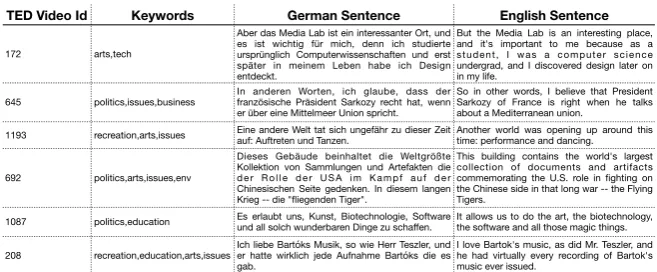
ure1illustrates some examples of this dataset. As can be seen, the keywords (second column, treated as side information) contain additional contextual information that can provide complementary cues so as to better guide the translation process. Let’s take an example in Figure1(TED Video Id 172), the keyword “art” provides cues for words and phrases in target sequence such as: “place, de-sign”; whereas the keyword “tech” refers to “Me-dia Lab, computer science”.
Personalised Europarl For the second dataset,
we evaluate our proposed idea in the context of personality-aware MT. Mirkin et al. (2015) ex-plored whether translation preserves personality information (e.g., demographic and psychometric traits) in statistical MT (SMT); and further Rabi-novich et al. (2017) found that personality infor-mation like author’s gender is an obvious signal in source text, but it is less clear in human and ma-chine translated texts. As a result, they created a new dataset for personalised MT4 partially based on the original Europarl. The personality such as author’s gender will be regarded as side informa-tion in our setup. An excerpt of this dataset is shown in Figure2. As can be seen from the figure, there exist many kinds of side information pertain-ing to authors’ traits, includpertain-ing identification (ID, name), native language, gender, date of birth/age, and plenary session date. Here, we will focus on the “gender” trait and evaluate whether it can have any benefits in the context of NMT complement-ing the work ofRabinovich et al.(2017) attempted a similar idea as part of a SMT, rather than NMT, system.
Patent MT Collection Another interesting data
is patent translation which includes rich side in-formation. PatTR5 is a sentence-parallel corpus which is a subset of the MAREC Patent Cor-pus (W¨aschle and Riezler, 2012a). In general, PatTR contains millions of parallel sentences col-lected from all patent text sections (e.g., title, ab-stract, claims, description) in multiple languages (English, French, German) (W¨aschle and Riezler,
2012b;Simianer and Riezler, 2013). An appeal-ing feature of this corpus is that it provides a la-belling at a sentence level, in the form of IPC (In-ternational Patent Classification) codes. The IPC
4
http://cl.haifa.ac.il/projects/pmt/ index.shtml
5http://www.cl.uni-heidelberg.de/ statnlpgroup/pattr/
codes explicitly provide a hierarchical classifica-tion of patents according to various different ar-eas of technology to which they pertain. This kind of side information can provide a useful signal for MT task – which has not yet been fully exploited. Figure3gives us an illustrating excerpt of this cor-pus. We can see that each of sentence pair in this corpus is associated with any number of IPC la-bel(s) as well as other metadata, e.g., patent ID, patent family ID, publication date. In this work, we consider only the IPC labels. The full mean-ing of all IPC labels can be found on the official IPC website,6however we provide in Figure3the glossess for each referenced label. Note that those IPC labels form a WordNet style hierarchy ( Fell-baum, 1998), and accordingly may be useful in many other deep models of NLP.
3 NMT with Side Information
We investigate different ways of incorporating side information into the NMT model(s).
3.1 Encoding of Side Information
In this work, we propose the use of unstructured heterogeneous side information, which is often available in practical datasets. Due the hetero-geneity of side information, our techniques are based on a bag-of-words (BOW) representation of the side information, an approach which was shown to be effective in our prior work (Hoang et al.,2016a). Each element of the side informa-tion (a label, or word) is embedded using a matrix
Wse ∈ RHs×|Vs|, where|V
s|is the vocabulary of
side information andHsthe dimensionality of the
hidden space. These embedding vectors are used for the input to several different neural architec-tures, which we now outline.
3.2 NMT Model Formulation
Recall the general formulation of NMT (Sutskever et al.,2014;Bahdanau et al., 2015, inter alia) as a conditional language model in which the gen-eration of target sequence is conditioned on the source sequence (Sutskever et al.,2014;Bahdanau et al.,2015,inter alia), formulated as:
yt+1 ∼pΘ(yt+1|y<t,x)
= softmax (fΘ(y<t,x)) ; (1)
TED Video Id Keywords German Sentence English Sentence
172 arts,tech
Aber das Media Lab ist ein interessanter Ort, und es ist wichtig für mich, denn ich studierte ursprünglich Computerwissenschaften und erst später in meinem Leben habe ich Design entdeckt.
But the Media Lab is an interesting place, and it's important to me because as a student, I was a computer science undergrad, and I discovered design later on in my life.
645 politics,issues,business In anderen Worten, ich glaube, dass der französische Präsident Sarkozy recht hat, wenn er über eine Mittelmeer Union spricht.
So in other words, I believe that President Sarkozy of France is right when he talks about a Mediterranean union.
1193 recreation,arts,issues Eine andere Welt tat sich ungefähr zu dieser Zeit auf: Auftreten und Tanzen.
Another world was opening up around this time: performance and dancing.
692 politics,arts,issues,env
Dieses Gebäude beinhaltet die Weltgrößte Kollektion von Sammlungen und Artefakten die d e r R o l l e d e r U S A i m K a m p f a u f d e r Chinesischen Seite gedenken. In diesem langen Krieg -- die "fliegenden Tiger".
This building contains the world's largest collection of documents and artifacts commemorating the U.S. role in fighting on the Chinese side in that long war -- the Flying Tigers.
1087 politics,education Es erlaubt uns, Kunst, Biotechnologie, Software und all solch wunderbaren Dinge zu schaffen. It allows us to do the art, the biotechnology, the software and all those magic things.
208 recreation,education,arts,issuesIch liebe Bartóks Musik, so wie Herr Teszler, und er hatte wirklich jede Aufnahme Bartóks die es gab.
I love Bartok's music, as did Mr. Teszler, and he had virtually every recording of Bartok's music ever issued.
Fig. 1 An example with side information (e.g., keywords) for MT with TED Talks dataset.
English Sentence: Accordingly , I consider it essential that both the identification of cattle and the labelling of beef be introduced as quickly as possible on a compulsory basis .
German Sentence: Entsprechend halte ich es auch für notwendig , daß die Kennzeichnung möglichst schnell und verpflichtend eingeführt wird , und zwar für Rinder und für Rindfleisch .
Meta Info: EUROID="2209" NAME="Schierhuber" LANGUAGE="DE" GENDER="FEMALE" DATE_OF_BIRTH="31 May 1946" SESSION_DATE="97-02-19" AGE="50"
English Sentence: Can the Commission say that it will seek to have sugar declared a sensitive product ?
German Sentence: Kann die Kommission sagen , dass sie danach streben wird , Zucker zu einem sensiblen Produkt erklären zu lassen ?
Meta Info: EUROID="22861" NAME="Ó Neachtain (UEN)." LANGUAGE="EN" GENDER="MALE"
DATE_OF_BIRTH="22 May 1947" SESSION_DATE="03-09-02" AGE="56"
English Sentence: For example , Brazil has huge concerns about the proposals because the poor and landless there will suffer if sugar production expands massively , as is predicted .
German Sentence: So hegt beispielsweise Brasilien bezüglich der Vorschläge enorme Bedenken , denn wenn die Zuckerproduktion , wie vorhergesagt , massiv expandiert , wird das die Not der Armen und Landlosen dort noch verstärken .
Meta Info: EUROID="28115" NAME="McGuinness (PPE-DE )." LANGUAGE="EN" GENDER="FEMALE"
DATE_OF_BIRTH="13 June 1959" SESSION_DATE="05-02-22" AGE="45"
English Sentence: The European citizens ' initiative should be seen as an opportunity to involve people more closely in the EU 's decision-making process .
German Sentence: Die Europäische Bürgerinitiative ist als Chance zu werten , um die Menschen stärker in den Entscheidungsprozess der EU miteinzubeziehen .
Meta Info: EUROID="96766" NAME="Ernst Strasser" LANGUAGE="DE" GENDER="MALE" DATE_OF_BIRTH="29 April 1956" SESSION_DATE="10-12-15-010" AGE=“54"
Fig. 2 An example with side information (e.g., author’s gender highlighted in red) for MT with person-alised Europarl dataset.
where the probabilitypΘ(.)of generating the next target wordyt+1 is conditioned on the previously generated target words y<t and the source se-quence x; f is a neural network which can be framed as an encoder-decoder model (Sutskever et al.,2014) and can use an attention mechanism (Bahdanau et al., 2015; Luong et al., 2015). In this model, the encoder encodes the information of the source sequence; whereas, the decoder de-codes the target sequence sequentially from left-to-right. The attention mechanism controls which parts of the source sequence where the decoder should attend to in generating each symbol of tar-get sequence. Later, advanced models have been proposed with modifications of the encoder and decoder architectures, e.g., using the 1D (Gehring et al., 2017b,a) and 2D (Elbayad et al., 2018) convolutions; or a transformer network (Vaswani et al., 2017). These advanced models have led to significantly better results in terms of both per-formance and efficiency via different benchmarks (Gehring et al.,2017b,a;Vaswani et al.,2017; El-bayad et al.,2018).
Regardless of the NMT architecture, we aim to explore in which case side information can be use-ful, as well as the effective and efficient way of in-corporating them with minimal modification of the NMT architecture. Mathematically, we formulate the NMT problem given the availability of side in-formationeas follows:
yt+1 ∼pΘ(yt+1|y<t,x,e)
= softmax (fΘ(y<t,x,e)) ; (2)
whereeis the representation of additional side in-formation we would like to incorporate into NMT model.
3.3 Conditioning on Side Information
Keeping in mind that we would like a generic in-corporation method so that only minimal modifi-cation of NMT model is required, we propose and evaluate different approaches.
Side Information as Source Prefix/Suffix The
most simple way to include side information is to add the side information as a string prefix or suf-fix to the source sequence, and letting the NMT model learn from this modified data. This method requires no modification of the NMT model. This method was firstly proposed by Sennrich et al.
(2016a) who added the side constraints (e.g.,
hon-orifics) as suffix of the source sequence for con-trolling the politeness in translated outputs.
Side Information as Target Prefix
Alterna-tively, we can add the bag of words as a target prefix, inspired from Johnson et al. (2017) who introduces an artificial token as a prefix for spec-ifying the required target language in a multilin-gual NMT system. Note that this method leads to additional benefits in the following situations: a) when the side information exists, the model takes them as inputs and then does its translation task as normal; b) when the side information is miss-ing, so the model first generates the side informa-tion itself and subsequently uses it to proceed with translation.
Output Layer Similar toHoang et al.(2016a) – who considers side information in the model fo-cusing on the output side which worked well in LM, this method involves in two phases. First, it transforms the representation of the side infor-mation into asummedvector representation,e =
P
m∈[1,M]ews
m. We also tried the average oper-ator in our preliminary experiments but observed no difference in end performance.
Next, the side representation vector,e, is added to theoutput layerbefore thesoftmax transforma-tion of the NMT model, e.g.,
yt+1∼softmax
Wo·fdect (. . .) +be+bo
be=We·e;
(3) where We ∈ R|VT|×Hs is an additional weight
matrix (learnable model parameters) for linear projection of side information representation onto the target output space (Hsis a predefined
dimen-sion for embedding side information). The ratio-nale behind this method is to let the model learn to control the importance of the existing side infor-mation contributed to the generation. The function
fdect (. . .) is specific to our chosen network repa-rameterisation, based on RNN (Sutskever et al.,
2014;Bahdanau et al.,2015;Luong et al.,2015), or convolution (Gehring et al., 2017b,a; Elbayad et al.,2018), or transformer (Vaswani et al.,2017). Although we make an effort for modification of the NMT model, we believe that it is minimally simple, and generic to suit many different styles of NMT model.
Multi-task Learning Consider the case where
improve the main NMT task. We can define a gen-tioned on the side information as explained earlier;
p (e|x)can be regarded as a classification model – which predicts the side information given the source sentence. Note that side information can often be represented as individual words – which can be treated as labels, making the classification model feasible.
Importantly, the above formulation of a gener-ative model would require summing over “e” at test/decode time, which might be done by decod-ing for all possible label combinations, then re-porting the sentence with the highest model score. This may be computationally infeasible in prac-tice. We resort this by approximating the NMT model asp (y|x,e)≈p (y|x), resulting in
p (y,e|x)≈p (y|x)·p (e|x) ; (5)
and thus force the model to encode the shared in-formation in the encoder states.
Our formulation in Equation 5 gives rise to multi-task learning (MTL). Here, we propose the joint learning of two different but related tasks: NMT and multi-label classification (MLC). Here, the MLC task refers to predicting the labels that possibly represent words of the given side infor-mation. This is interesting in the sense that the model is capable of not only generating the trans-lated outputs, but also explicitly predicting what the side information is. Here, we adopt a simple instance of MTL for our case, called soft param-eter sharing similar to (Duong et al., 2015;Yang and Hospedales, 2016). In our MTL version, the NMT and MLC tasks share the parameters of the encoders. The difference between the two is at the decoder part. In the NMT task, the decoder is kept unchanged. For the MLC task, we define its ob-jective function (or loss), formulated as:
LM LC :=−
wherepsis the probability of predicting the
pres-ence or abspres-ence of each element in the side
infor-mation, formulated as: where x is the source sequence, comprising of
x1, . . . , xi, . . . , x|x| words. Here, we denote a generic function termg0(.)which refers to a vec-torised representation of a specific word depend-ing on designdepend-ing the network architecture, e.g., stacked bidirectional (forward and backward) net-works over the source sequence (Bahdanau et al.,
2015;Luong et al.,2015); or a convolutional en-coder (Gehring et al., 2017b,a) or a transformer encoder (Vaswani et al.,2017).7 Further,Ws ∈
R|Vs|×Hxandb
s∈ R|Vs|are two additional model
parameters for linear transformation of the source sequence representation (whereHxis a dimension
of the output of the g0(.) function, it will differ from network architectures as discussed earlier).
Now, we have two objective functions at the trainingstage, including the NMT lossLN M T and the MLC lossLM LC. The total objective function
of our joint learning will be:
L:=LN M T +λLM LC; (8)
where: λis the coefficient balancing the two task objectives, whose value is fine-tuned based on the development data to optimise for NMT accuracy measured using BLEU (Papineni et al.,2002).
The idea of MTL applied for NLP was firstly explored by (Collobert and Weston, 2008), later attracts increasing attentions from the NLP com-munity (Ruder, 2017). Specifically, the idea be-hind MTL is to leverage related tasks which can be learned jointly — potentially introducing an in-ductive bias (Feinman and Lake,2018). An alter-native explanation of the benefits of MTL is that joint training with multiple tasks acts as an addi-tional regulariser to the model, reducing the risk of overfitting (Collobert and Weston,2008;Ruder,
2017,inter alia).
4 Experiments
4.1 Datasets
As discussed earlier, we conducted our experi-ments using three different datasets including TED Talks (Chen et al., 2016), Personalised Europarl
7Here, to avoid repeating the materials, we will not
No. of labels Examples
TED Talks 11 tech business arts issues education health env recre-ation politics others
Personalised Europarl 2 male female
PatTR-1 (deep) 651 G01G G01L G01N A47F F25D C01B . . . PatTR-2 (shallow) 8 G A F C H B E D
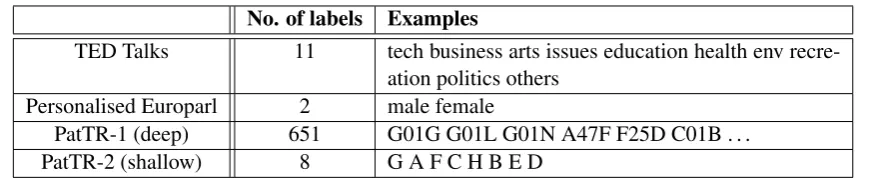
Table 1 Side information statistics for the three datasets, showing the number of types of the side infor-mation label, and the set of tokens (display truncated for PatTR-1 (deep)).
(Rabinovich et al., 2017), and PatTR (W¨aschle and Riezler,2012b;Simianer and Riezler,2013), translating from German (de) to English (en). The statistics of the training and evaluation sets can be shown in Table 2. For the TED Talks and Per-sonalised Europarl datasets, we followed the same sizes of data splits since they are made available on the authors’ github repository and website. For the PatTR dataset, we use the Abstract sections for patents from 2008 or later, and the develop-ment and test sets are constructed to have 2000 sentences each, similar to (W¨aschle and Riezler,
2012b;Simianer and Riezler,2013).
It is important to note the labeling information for side information. We extracted all kinds of side information from three aforementioned datasets in the form of individual words or labels. This makes the label embeddings much easier. Their relevant statistics and examples can be found in Table1.
We preprocessed all the data using Moses’s training scripts8 with standard steps: punctuation normalisation, tokenisation, truecasing. For train-ing sets, we set word-based length thresholds for filtering long sentences since they will not be use-ful when training the seq2seq models as suggested in the NMT literature (Sutskever et al.,2014; Bah-danau et al.,2015;Luong et al.,2015,inter alia). We chose 80, 80, 150 length thresholds for TED Talks, Personalized Europarl, and PatTR datasets, respectively. Note that the 150 threshold indi-cates that the sentences in the PatTR dataset is in average much longer than in the others. For better handling the OOV problem, we segmented all the preprocessed data with subword units us-ing byte-pair-encodus-ing (BPE) method proposed by
Sennrich et al. (2016b). We already know that languages such English and German share an al-phabet (Sennrich et al., 2016b), hence learning BPE on the concatenation of source and target
8https://github.com/moses-smt/ mosesdecoder/tree/master/scripts
languages (hence called shared BPE) increases the consistency of the segmentation. We applied 32000 operations for learning the shared BPE by using the open-source toolkit.9 Also, we used dev sets for tuning model parameters and early stop-ping of the NMT models based on the perplexity. Table2shows the resulting vocabulary sizes after subword segmentation for all datasets.
4.2 Baselines and Setups
Recall that our method for incorporating the ad-ditional side information into the NMT models is generic; hence, it is applicable to any NMT ar-chitecture. We chose the transformer architecture (Vaswani et al.,2017) for all our experiments since it arguably is currently the most robust NMT mod-els compared to RNN and convolution based architectures. We reimplemented the transformer -based NMT system using the C++ Neural Network Library - DyNet10 as our deep learning backend toolkit. Our re-implementation results in the open source toolkit.11
In our experiments, we use the same configura-tions for all transformer models and datasets, in-cluding: 2 encoder and decoder layers; 512 input embedding and hidden layer dimensions; sinusoid positional encoding; dropout with 0.1 probability for source and target embeddings, sub-layers (at-tention + feedforward), attentive dropout; and la-bel smoothing with weight 0.1. For training our neural models, we used early stopping based on development perplexity, which usually occurs af-ter 20-30 epochs.12
We conducted our experiments with various in-corporation methods as discussed in Section3. We
9https://github.com/rsennrich/ subword-nmt
10
https://github.com/clab/dynet/
11
https://github.com/duyvuleo/Transformer-DyNet/
12The training process of transformer models is much
dataset # tokens (M) # types (K) # sents # length limit TED Talks de→en
train 3.73 3.75 19.78 14.23 163653 80
dev 0.02 0.02 4.03 3.15 567 n.a.
test 0.03 0.03 6.07 4.68 1100 n.a.
Personalised Europarl de→en
train 8.46 8.39 21.15 14.04 278629 80
dev 0.16 0.16 14.67 9.83 5000 n.a.
test 0.16 0.16 14.76 9.88 5000 n.a.
PatTR de→en
train 33.07 32.52 24.97 13.28 656352 150
dev 0.13 0.13 13.50 6.88 2000 n.a.
test 0.13 0.12 13.35 6.89 2000 n.a.
Table 2 Statistics of the training & evaluation sets from datasets including TED Talks, Personalised Europarl, and PatTR; showing in each cell the count for the source language (left) and target language (right); “#types” refers to subword-segmented vocabulary sizes; “n.a.” is not applicable, for development and test sets. Note that all the “#tokens”’ and “#types”’ are approximated.
Method TED Talks Personalised Europarl PatTR-1 PatTR-2
base 29.48 31.12 45.86
si−src−prefix 29.28 30.87 45.99 45.97
si−src−suffix 29.36 31.03 46.01 45.83
si−trg−prefix−p 29.06 30.89 45.97 45.85
si−trg−prefix−h 29.28 30.93 46.03 45.92
output−layer 29.99† 31.22 46.32† 46.09
w/oside info 29.62 31.10 46.14 45.99
mtl 29.86† 31.12 46.14 46.01
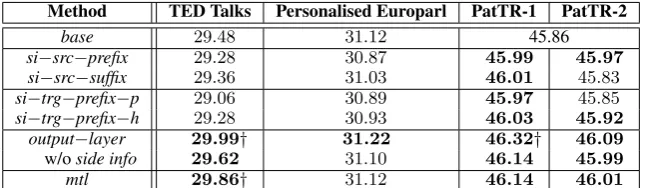
Table 3 Evaluation results with BLEU scores of various incorporation variants against the baseline;bold: better than the baseline,†: statistically significantly better than the baseline.
denote the system variants as follows:
baserefers to the baseline NMT system using the transformer without using any side informa-tion.
si-src-prefix and si-src-suffix refer to the NMT system using the side information as respec-tive prefix or suffix of the source sequence (Jehl and Riezler, 2018), applied to both training and decoder/inference.
si-trg-prefix refers to the NMT system using the side information as prefix of the target se-quence. There are two variants, including “si-trg-prefix-p” means the side information is generated by the model itself and is then used for decoding/inference; “si-trg-prefix-h” means the side information is given at decod-ing/inference runtime.
output-layer refers to the method of incorporat-ing side information in the final output layer.
mtlrefers to the multi-task learning method.
It’s worth noting that the dimensional value for the output-layer method was fine-tuned over
the development set, using the value range of
{64,128,256,512}. Similarly, the balancing weight in the mtl method is fine-tuned using the value range of{0.001,0.01,0.1,1.0}. For evalua-tion, we measured the end translation quality with case-sensitive BLEU (Papineni et al.,2002). We averaged 2 runs for each of the method variants.
4.3 Results and Analysis
The experimental results can be seen in Ta-ble 3. Overall, we obtained limited success for the method of adding side information as prefix or suffix for TED Talks and Personalised Europarl datasets. On the PatTR dataset, small improve-ments (0.1-0.2 BLEU) are observed. We experi-mented two sets of side information in the PatTR dataset, including PatTR-1 (651 deep labels) and PatTR (8 shallow labels).13 The possible reason for this phenomenon is that the multi-head atten-tion mechanism in the transformer may have some confusion given the existing side information,
ei-13
The shallow setting takes the first character of each label code, which denotes the highest level concept in the type
hi-erarchy, e.g., G01P (measuring speed)→G (physics), with
ther in source or target sequences. In some am-biguous cases, the multi-head attention may not know where it should pay more attention. Another possible reason is that the implicit ambiguity of side information that may exist in the data.
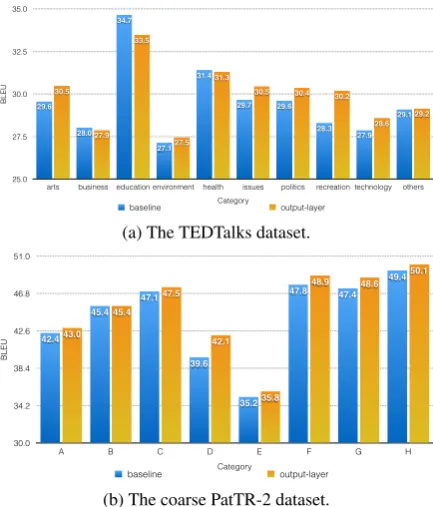
Contrary to these variants, theoutput-layer vari-ant was more consistently successful, obtaining the best results across datasets. In the TED Talks and PatTR datasets, this method also provides the statistically significant results compared to the baselines. Additionally, we conducted another ex-periment by splitting the TED Talks and coarse PatTR-2 datasets by the meta categories, then ob-served the individual effects when incorporating the side information withoutput-layervariant, as shown in Figure 4a and 4b. In the TED Talks dataset, we observed improvements for most cat-egories, except for “business, education”. In the coarse PatTR-2 dataset, the improvements are ob-tained across all categories. The key behind this success of theoutput-layervariant is that the rep-resentation of existing side information is added in the final output layer and controlled by addi-tional learnable model parameters. In that sense, it results in a more direct effect on lexical choice of the NMT model. This resembles the success in the context of language modelling as presented in
Hoang et al. (2016a). Further, we also obtained the promising results for themtlvariant although we did implement a very simple instance of MTL with a sharing mechanism and no side information given at a test time. For a fair comparison with the output-layer method, we added an additional ex-periment in which the output-layer method does not have the access of side information. As ex-pected, its performance has been dropped, as can be seen in the second last row in Table3. In this case, themtlmethod without the side information at a test time performs better. We believe that more careful design of themtlvariant can lead to even better results. We also think that the hybrid method combining theoutput-layer andmtl vari-ants is also an interesting direction for future re-search, e.g., relaxing the approximation as shown in Equation5.
Given the above results, we can find that the characteristics of side information plays an impor-tant role in improving the NMT models. Our em-pirical experiments show that topical information (as in the TED Talks and PatTR datasets) is more useful than the personal traits (as in the
Person-BLEU
arts businesseducation environment health issues politics recreation technology others 29.2
(a) The TEDTalks dataset.
BLEU
(b) The coarse PatTR-2 dataset.
Fig. 4 Effects on individual BLEU scores for each of categories in the TEDTalks and coarse PatTR-2 datasets, with the NMT model enhanced with the output-layervariant.
alised Europarl dataset). However, sometimes it is still good to reserve the personal traits in the tar-get translations (Rabinovich et al.,2017) although their BLEU scores are not necessarily better.
5 Related Work
Our work is mainly inspired from Hoang et al.
(2016a) who proposed the use of side informa-tion for boosting the performance of recurrent neu-ral network language models. We further apply this idea for a downstream task in neural machine translation.
We’ve adapted different methods in the litera-ture for this specific problem and evaluated using different datasets with different kinds of side in-formation.
Our methods for incorporating side informa-tion assuffix,prefixfor either source or target se-quences have been adapted from (Sennrich et al.,
they observe are larger, of about 1 BLEU point, albeit from a lower baseline.
Also, Michel and Neubig (2018) proposed to personalise neural MT systems by taking the vari-ance that each speaker speaks/writes on his own into consideration. They proposed the adaptation process which takes place in the “output” layer, similar to ouroutput layerincorporation method.
The benefit of the proposed MTL approach is not surprising, resembling from existing works, e.g., jointly training translation models from/to multiple languages (Dong et al., 2015); jointly training the encoders (Zoph and Knight,2016) or both encoders and decoders (Johnson et al.,2017).
6 Conclusion
In this work, we have presented various situations to which extent the side information can boost the performance of the NMT models. We have stud-ied different kinds of side information (e.g. topic information, personal trait) as well as present dif-ferent ways of incorporating them into the existing NMT models. Though being simple, the idea of utilising the side information for NMT is indeed feasible and we have proved it via our empirical experiments. Our findings will encourage practi-tioners to pay more attention to the side informa-tion if exists. Such side informainforma-tion can provide valuable external knowledge that compensates for the learning models. Further, we believe that this idea is not limited to the context of neural LM or NMT, but it may be applicable to other NLP tasks such as summarisation, parsing, reading compre-hension, and so on.
Acknowledgments
We thank the reviewers for valuable feedbacks and discussions. Cong Duy Vu Hoang is supported by Australian Government Research Training Pro-gram Scholarships at the University of Melbourne, Australia.
References
Dzmitry Bahdanau, Kyunghyun Cho, and Yoshua Ben-gio. 2015. Neural Machine Translation by Jointly Learning to Align and Translate. In Proc. of 3rd International Conference on Learning Representa-tions (ICLR2015).
Iacer Calixto and Qun Liu. 2017. Incorporating global visual features into attention-based neu-ral machine translation. In Proceedings of the
2017 Conference on Empirical Methods in Natu-ral Language Processing, EMNLP 2017, Copen-hagen, Denmark, September 9-11, 2017. pages 992–1003. https://aclanthology.info/papers/D17-1105/d17-1105.
Iacer Calixto, Qun Liu, and Nick Campbell. 2017.
Doubly-attentive decoder for multi-modal neural machine translation. InProceedings of the 55th An-nual Meeting of the Association for Computational Linguistics, ACL 2017, Vancouver, Canada, July 30 - August 4, Volume 1: Long Papers. pages 1913– 1924.https://doi.org/10.18653/v1/P17-1175.
Mauro Cettolo, Christian Girardi, and Marcello Fed-erico. 2012. WIT3: Web Inventory of Transcribed
and Translated Talks. In Proceedings of the 16th Conference of the European Association for Ma-chine Translation (EAMT). Trento, Italy, pages 261– 268.
Wenhu Chen, Evgeny Matusov, Shahram Khadivi, and Jan-Thorsten Peter. 2016. Guided align-ment training for topic-aware neural ma-chine translation. CoRR abs/1607.01628.
http://arxiv.org/abs/1607.01628.
Trevor Cohn, Cong Duy Vu Hoang, Ekaterina Vy-molova, Kaisheng Yao, Chris Dyer, and Gholam-reza Haffari. 2016. Incorporating Structural Align-ment Biases into an Attentional Neural Transla-tion Model. In Proceedings of the 2016 Confer-ence of the North American Chapter of the Associ-ation for ComputAssoci-ational Linguistics: Human Lan-guage Technologies. Association for Computational Linguistics, San Diego, California, pages 876–885.
http://www.aclweb.org/anthology/N16-1102.
Ronan Collobert and Jason Weston. 2008. A uni-fied architecture for natural language process-ing: Deep neural networks with multitask learn-ing. In Proceedings of the 25th International Conference on Machine Learning. ACM, New York, NY, USA, ICML ’08, pages 160–167.
https://doi.org/10.1145/1390156.1390177.
Daxiang Dong, Hua Wu, Wei He, Dianhai Yu, and Haifeng Wang. 2015. Multi-task learning for mul-tiple language translation. InACL (1). The Associa-tion for Computer Linguistics, pages 1723–1732.
Long Duong, Trevor Cohn, Steven Bird, and Paul Cook. 2015. Low resource dependency parsing: Cross-lingual parameter sharing in a neural network parser. In Proceedings of the 53rd Annual Meet-ing of the Association for Computational LMeet-inguistics and the 7th International Joint Conference on Natu-ral Language Processing (Volume 2: Short Papers). Association for Computational Linguistics, pages 845–850. https://doi.org/10.3115/v1/P15-2139.
Maha Elbayad, Laurent Besacier, and Jakob Ver-beek. 2018. Pervasive attention: 2d con-volutional neural networks for sequence-to-sequence prediction. CoRR abs/1808.03867.
Reuben Feinman and Brenden M. Lake. 2018. Learning inductive biases with sim-ple neural networks. CoRR abs/1802.02745.
http://arxiv.org/abs/1802.02745.
Christiane Fellbaum, editor. 1998. WordNet: An Elec-tronic Lexical Database. Language, Speech, and Communication. MIT Press, Cambridge, MA.
Mercedes Garc´ıa-Mart´ınez, Lo¨ıc Barrault, and Fethi Bougares. 2017. Neural machine translation by generating multiple linguistic factors. CoRR
abs/1712.01821. http://arxiv.org/abs/1712.01821.
Jonas Gehring, Michael Auli, David Grangier, and Yann Dauphin. 2017a. A convolutional en-coder model for neural machine translation. In
Proceedings of the 55th Annual Meeting of the Association for Computational Linguistics, ACL 2017, Vancouver, Canada, July 30 - August 4, Volume 1: Long Papers. pages 123–135.
https://doi.org/10.18653/v1/P17-1012.
Jonas Gehring, Michael Auli, David Grangier, De-nis Yarats, and Yann N. Dauphin. 2017b. Con-volutional sequence to sequence learning. In
Proceedings of the 34th International Conference on Machine Learning, ICML 2017, Sydney, NSW, Australia, 6-11 August 2017. pages 1243–1252.
http://proceedings.mlr.press/v70/gehring17a.html.
Cong Duy Vu Hoang, Trevor Cohn, and Gholam-reza Haffari. 2016a. Incorporating Side Informa-tion into Recurrent Neural Network Language Mod-els. In Proceedings of the 2016 Conference of the North American Chapter of the Association for Computational Linguistics: Human Language Technologies. Association for Computational Lin-guistics, San Diego, California, pages 1250–1255.
http://www.aclweb.org/anthology/N16-1149.
Cong Duy Vu Hoang, Reza Haffari, and Trevor Cohn. 2016b. Improving Neural Translation Mod-els with Linguistic Factors. In Proceedings of the Australasian Language Technology Association Workshop 2016. Melbourne, Australia, pages 7–14.
http://www.aclweb.org/anthology/U16-1001.
Laura Jehl and Stefan Riezler. 2018. Document-level information as side constraints for improved neural patent translation. InProceedings of the 13th Con-ference of the Association for Machine Translation in the Americas, AMTA 2018, Boston, MA, USA, March 17-21, 2018 - Volume 1: Research Papers. pages 1–12. https://aclanthology.info/papers/W18-1802/w18-1802.
Melvin Johnson, Mike Schuster, Quoc Le, Maxim Krikun, Yonghui Wu, Zhifeng Chen, Nikhil Thorat, Fernand a Vigas, Martin Wattenberg, Greg Corrado, Macduff Hughes, and Jeffrey Dean. 2017. Google’s multilingual neural machine translation system: En-abling zero-shot translation.Transactions of the As-sociation for Computational Linguistics5:339–351.
https://transacl.org/ojs/index.php/tacl/article/view/1081.
Thang Luong, Hieu Pham, and Christopher D. Man-ning. 2015. Effective Approaches to Attention-based Neural Machine Translation. In Proceed-ings of the 2015 Conference on Empirical Methods in Natural Language Processing. Association for Computational Linguistics, Lisbon, Portugal, pages 1412–1421. http://aclweb.org/anthology/D15-1166.
Evgeny Matusov, Andy Way, Iacer Calixto, Daniel Stein, Pintu Lohar, and Sheila Castilho. 2017.
Using images to improve machintranslating e-commerce product listings. In Proceedings of the 15th Conference of the European Chap-ter of the Association for Computational Lin-guistics, EACL 2017, Valencia, Spain, April 3-7, 2017, Volume 2: Short Papers. pages 637–643. https://aclanthology.info/papers/E17-2101/e17-2101.
Haitao Mi, Baskaran Sankaran, Zhiguo Wang, and Abe Ittycheriah. 2016. Coverage Embedding Models for Neural Machine Translation. InProceedings of the 2016 Conference on Empirical Methods in Natu-ral Language Processing. Association for Compu-tational Linguistics, Austin, Texas, pages 955–960.
Paul Michel and Graham Neubig. 2018. Extreme adaptation for personalized neural machine trans-lation. In Proceedings of the 56th Annual Meet-ing of the Association for Computational Lin-guistics (Volume 2: Short Papers). Association for Computational Linguistics, pages 312–318.
http://aclweb.org/anthology/P18-2050.
Shachar Mirkin, Scott Nowson, Caroline Brun, and Julien Perez. 2015. Motivating personality-aware machine translation. In Proceedings of the 2015 Conference on Empirical Meth-ods in Natural Language Processing. Association for Computational Linguistics, pages 1102–1108.
https://doi.org/10.18653/v1/D15-1130.
Kishore Papineni, Salim Roukos, Todd Ward, and Wei-Jing Zhu. 2002. BLEU: A Method for Au-tomatic Evaluation of Machine Translation. In
Proceedings of the 40th Annual Meeting on As-sociation for Computational Linguistics. Asso-ciation for Computational Linguistics, Strouds-burg, PA, USA, ACL ’02, pages 311–318.
https://doi.org/10.3115/1073083.1073135.
Ella Rabinovich, Raj Nath Patel, Shachar Mirkin, Lu-cia SpeLu-cia, and Shuly Wintner. 2017. Personal-ized machine translation: Preserving original author traits. InProceedings of the 15th Conference of the European Chapter of the Association for Computa-tional Linguistics: Volume 1, Long Papers. Asso-ciation for Computational Linguistics, pages 1074– 1084.http://aclweb.org/anthology/E17-1101.
Sebastian Ruder. 2017. An overview of multi-task learning in deep neural networks. CoRR
abs/1706.05098.http://arxiv.org/abs/1706.05098.
InProceedings of the First Conference on Machine Translation: Volume 1, Research Papers. Associ-ation for ComputAssoci-ational Linguistics, pages 83–91.
https://doi.org/10.18653/v1/W16-2209.
Rico Sennrich, Barry Haddow, and Alexandra Birch. 2016a. Controlling politeness in neural machine translation via side constraints. In Proceedings of the 2016 Conference of the North American Chapter of the Association for Computational Lin-guistics: Human Language Technologies. Associ-ation for ComputAssoci-ational Linguistics, pages 35–40.
https://doi.org/10.18653/v1/N16-1005.
Rico Sennrich, Barry Haddow, and Alexandra Birch. 2016b. Neural machine translation of rare words with subword units. In Proceed-ings of the 54th Annual Meeting of the As-sociation for Computational Linguistics (Volume 1: Long Papers). Association for Computational Linguistics, Berlin, Germany, pages 1715–1725.
http://www.aclweb.org/anthology/P16-1162.
Patrick Simianer and Stefan Riezler. 2013. Multi-task learning for improved discriminative training in SMT. In Proceedings of the Eighth Workshop on Statistical Machine Translation. Association for Computational Linguistics, Sofia, Bulgaria, pages 292–300. http://www.aclweb.org/anthology/W13-2236.
Ilya Sutskever, Oriol Vinyals, and Quoc V. Le. 2014. Sequence to Sequence Learning with Neural Net-works. In Proceedings of the 27th International Conference on Neural Information Processing Sys-tems. MIT Press, Cambridge, MA, USA, NIPS’14, pages 3104–3112.
Ashish Vaswani, Noam Shazeer, Niki Parmar, Jakob Uszkoreit, Llion Jones, Aidan N Gomez, Ł ukasz Kaiser, and Illia Polosukhin. 2017. Attention is all you need. In I. Guyon, U. V. Luxburg, S. Ben-gio, H. Wallach, R. Fergus, S. Vishwanathan, and R. Garnett, editors, Advances in Neural Informa-tion Processing Systems 30, Curran Associates, Inc., pages 5998–6008. http://papers.nips.cc/paper/7181-attention-is-all-you-need.pdf.
Katharina W¨aschle and Stefan Riezler. 2012a.
Analyzing Parallelism and Domain Similar-ities in the MAREC Patent Corpus. Mul-tidisciplinary Information Retrieval pages 12–27. http://www.cl.uni-heidelberg.de/ rie-zler/publications/papers/IRF2012.pdf.
Katharina W¨aschle and Stefan Riezler. 2012b. Struc-tural and Topical Dimensions in Multi-Task Patent Translation. In Proceedings of the 13th Confer-ence of the European Chapter of the Association for Computational Linguistics (EACL 2012), Avi-gnon, France. http://www.aclweb.org/anthology-new/E/E12/E12-1083.pdf.
Yongxin Yang and Timothy M. Hospedales. 2016. Trace norm regularised deep
multi-task learning. CoRR abs/1606.04038.
http://arxiv.org/abs/1606.04038.
Jiacheng Zhang, Yang Liu, Huanbo Luan, Jingfang Xu, and Maosong Sun. 2017. Prior knowledge inte-gration for neural machine translation using poste-rior regularization. InProceedings of the 55th An-nual Meeting of the Association for Computational Linguistics (Volume 1: Long Papers). Association for Computational Linguistics, pages 1514–1523.
https://doi.org/10.18653/v1/P17-1139.
B. Zoph and K. Knight. 2016. Multi-source neural translation. In Proc. NAACL.