Experiments with Sentence Classification
Anthony Khoo, Yuval Marom and David Albrecht
Faculty of Information Technology, Monash University
Clayton, VICTORIA 3800, AUSTRALIA
nthony [email protected],
{
yuvalm,dwa
}
@csse.monash.edu.au
Abstract
We present a set of experiments involving sentence classification, addressing issues of representation and feature selection, and we compare our findings with simi-lar results from work on the more general text classification task. The domain of our investigation is an email-based help-desk corpus. Our investigations compare the use of various popular classification algo-rithms with various popular feature selec-tion methods. The results highlight simi-larities between sentence and text classifi-cation, such as the superiority of Support Vector Machines, as well as differences, such as a lesser extent of the usefulness of features selection on sentence classifi-cation, and a detrimental effect of com-mon preprocessing techniques (stop-word removal and lemmatization).
1
Introduction
Classification tasks applied to textual data have been receiving increasing attention due to the ex-plosion in digital presentation and storage of tex-tual information, such as web pages, emails, publi-cations, and discussion forums. The bulk of the re-search concerns the classification of complete doc-uments, such as spam detection in emails (Drucker et al., 1999), and the classification of news arti-cles (Yang and Pedersen, 1997; Joachims, 1998). These kinds of tasks are widely known as text clas-sification (TC). A text document is best character-ized by the words and terms it contains, and conse-quently the representation of textual data is often of a very high dimensionality. Thus, an important
aspect of TC is feature selection (Yang and Peder-sen, 1997; Forman, 2003).
There are numerous examples of textual docu-ments whose content conveys communication be-tween multiple parties. In such documents, it may be useful to classify individual sentences that ex-press communicative acts, either to obtain a more meaningful description of the documents, or sim-ply to extract meaningful components, such as ac-tion items or opinions. The computational lin-guistics community devotes considerable research into speech and dialogue acts, and has developed a markup convention for coding both spoken and written language (Core and Allen, 1997, for exam-ple). The classifications we use for sentences are inspired by such conventions.
Although there are existing implementations of sentence classification (SC) (Zhou et al., 2004; Wang et al., 2005; McKnight and Srinivasan, 2003), including ones where sentences convey communicative acts (Cohen et al., 2004; Corston-Oliver et al., 2004; Ivanovic, 2005), comparatively little attention has been given to SC in general. In particular, there are no empirical demonstrations of the effect of feature selection in SC tasks, to the best of our knowledge.
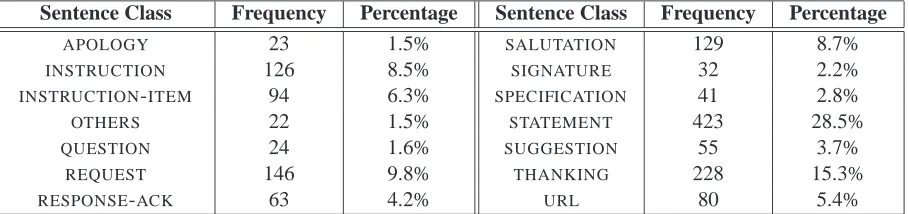
sen-Sentence Class Frequency Percentage Sentence Class Frequency Percentage
APOLOGY 23 1.5% SALUTATION 129 8.7%
INSTRUCTION 126 8.5% SIGNATURE 32 2.2%
INSTRUCTION-ITEM 94 6.3% SPECIFICATION 41 2.8%
OTHERS 22 1.5% STATEMENT 423 28.5%
QUESTION 24 1.6% SUGGESTION 55 3.7%
REQUEST 146 9.8% THANKING 228 15.3%
[image:2.612.91.545.52.159.2]RESPONSE-ACK 63 4.2% URL 80 5.4%
Table 1: Sentence class distribution.
tence classification is emerging as an important task to investigate, due to the increasing interest in detecting intentional units at a sub-document level.
The rest of the paper is organized as follows. In the next section we present our domain of inves-tigation. In Section 3 we discuss the experiments that we carried out, and we conclude the paper in Section 4.
2
Domain
Our corpus consists of 160 email dialogues between customers and operators at Hewlett-Packard’s help-desk. These deal with a variety of issues, including requests for technical assis-tance, inquiries about products, and queries about how to return faulty products or parts. As an ini-tial step in our study, we decided to focus only on the response emails, as they contain well-formed grammatical sentences, as opposed to the cus-tomers’ emails. In future work we intend to ex-tend our study to include both types of emails. The response emails contain 1486 sentences over-all, which we have divided into the classes shown in Table 1. The classes are inspired by the SWBD-DAMSL tag set (Jurafsky et al., 1997), an adap-tation of the Dialog Act Markup in Several Lay-ers (DAMSL) annotation scheme (Core and Allen, 1997) for switchboard conversations. For exam-ple, RESPONSE-ACK refers to an acknowledge-ment by the operator of receiving the customer’s request: Your email was submitted to the HP
eSer-vices Commercial Support group; INSTRUCTION-ITEM is similar to INSTRUCTION but appears as part of a list of instructions.
We can see from Table 1 that there is a high dis-tribution skew, where some classes are very small. This means that many of the classes have very few positive examples to learn from. We will see var-ious implications of this high skew in our investi-gation (Section 3).
When annotating the sentences, problems arose when a sentence was of compound form, which consisted of multiple independent clauses con-nected by conjunctions, like “and”, “but”, and
“or”. For example, the sentence “Please send us the error message and we will be able to help.”.
The two clauses could be labeled asREQUESTand STATEMENT respectively. As our study consid-ered only one tag per sentence, the annotators were asked to consider the most dominant clause to tag the sentence as a whole. Another tricky problem when tagging the sentences dealt with the com-plex sentences, which contained one independent clause and one or more dependent clauses, for ex-ample “If you see any error message, please
for-ward it to us”. The first clause is a dependent
clause, while the second one is an independent clause. To solve this problem, the annotators were asked to consider only the independent clause to determine which tag to use. Despite these dif-ficulties, we obtained a high inter-tagger agree-ment, measured with the widely used Kappa statis-tic (Carletta, 1996) as 0.85. We had three anno-tators, and we considered only the sentences on which at least two of the annotators agreed. This was the case in all but 21 of the sentences.
3
Experiments
Our experiments involve three classification algo-rithms, Naive Bayes (NB), Decision Tree (DT), and Support Vector Machine (SVM). The evalu-ation platform is the machine learning software toolkit WEKA (Witten and Frank, 2005). For the SVM, the multi-class task is implemented as a se-ries of binary classification tasks. We employ a stratified 10-fold validation procedure, where the labelled sentences are randomly allocated to train-ing and testtrain-ing data splits.
datasets with skewed distribution this measure can be misleading, and so instead we have used the F1 measure, derived from precision and recall (Salton and McGill, 1983), as follows. The precision of a classiis defined as
Precision= # sentences correctly classified into class i
# of sentences classified into class i
and the recall of classiis defined as
Recall= # sentences correctly classified into class i
# of sentences that are truly in class i
and thenF1, the harmonic mean between precision and recall, is defined as
F1= 2×Precision×Recall
Precision+Recall
Once the F1 measure is calculated for all the classes, we average it to get an overall indication of performance, and also look at the standard de-viation as an indication of consistency. The aver-age can be computed in two different methods to reflect the importance of small classes. The first method, called macro averaging, gives an equal weight to each class. The second, called micro
averaging, gives proportional weight according to
the proportion of the classes in the dataset. For classes with only a few positive training data, it is generally more difficult to achieve good classi-fication, and their poor performance will have a larger effect on the overall performance when the macro average is used. The choice between the two measures depends on the relative preference that an experimenter places on the smaller classes. Since the classes in our corpus have unbalanced distributions (Table 1) we consider both alterna-tives and discuss their differences.
3.1 Experiments with representation
Before looking at feature selection, we investigate different techniques for extracting features from sentences. Finding a useful representation for tex-tual data can be very challenging, and the success of classification hinges on this crucial step. Many different techniques have been suggested for text classification, and we have investigated the most common ones.
3.1.1 Representation techniques
Bag-of-words (BoW). Each distinct word in the text corresponds to a feature, and the text is trans-formed to a vector ofN weights (< w1,w2, . . . ,
wN >), where N is the total number of distinct
words in the entire corpus, and wk is the weight
of the kth
word in the vector. Information about sentence order, word order and the structure of the text and sentence are discarded. The BoW representation is widely used due to its simplicity and computational efficiency (Cardoso-Cachopo and Oliveira, 2003). There are various methods for setting the weights, for example, solely tak-ing into account the presence of the word, or also considering the frequency of the word. Since we are dealing with sentences that are usually quite short, we do not believe that the frequency of each word conveys any meaning. This is in contrast to typical text classification tasks. We use a binary word-presence representation, indicating whether a word is present or absent from the sentence.1
Stop-word removal. Generally, the first step to reduce the feature space is to remove the stop-words (connective stop-words, such as “of”, “the”,
“in”). These words are very common words and
are conjectured in TC to provide no information to the classifier. Stop-word removal is said to be used in almost all text classification experiments (Scott and Matwin, 1999).
Tokenization. This involves separating any symbols from the numbers or alphabets. For ex-ample, the word “(manual12.txt)” is separated into five tokens, “(”, “manual12”, “.”, “txt” and
“)”, all considered as features. Without
tokeniza-tion, a word that is coupled with different sym-bols may lose its discriminative power because the BoW treats each coupling as a distinct fea-ture. Similarly, the symbols lose any discrimina-tive power.
Lemmatization. The process of mapping words into their base form. For example, the words
“in-stalled”, “installs” and “installing” are mapped
to “install”. This mapping makes the bag-of-words approach treat bag-of-words of different forms as a single feature, hence reducing the total number of features. This mapping can increase the discrim-inative power of a word if that word appears in a particular sentence class but in different forms.
Grouping. This involves grouping certain types of words into a single feature. For instance, all words that are valid numbers, like “1”, “444” and
1
Representation Num Features Measure NB DT SVM
[image:4.612.111.504.51.119.2]Basic 2710 micro-F1ave 0.481 0.791 0.853 macro-F1ave 0.246 0.693 0.790 Best 1622 micro-F1ave 0.666 0.829 0.883 macro-F1ave 0.435 0.803 0.866
Table 2: Classification performance using different representations.
“9834”, are grouped to represent a single feature.
Grouping was also applied to email addresses, phone numbers, URLs, and serial numbers. As opposed to the other techniques mentioned above, grouping is a domain-specific preprocessing step.
3.1.2 Results.
We begin our investigation by looking at the most basic representation, involving a binary BoW without any further processing. The first row in Table 2 shows the results obtained with this ba-sic setup. The second column shows the num-ber of features resulting from this representation, the third column shows the performance measure, and the last three columns show the results for the three classifiers. We see that SVM outperforms the other classifiers on both measures. We also inspected the standard deviations of the macro av-erages and observed that SVM is the most con-sistent (0.037 compared to 0.084 and 0.117 for DT and NB, respectively). This means the SVM’s performance is most consistent across the differ-ent classes. These results are in line with obser-vations reported in the literature on the superior-ity of SVMs in classification tasks involving text, where the dimensionality is high. We will return to this issue in the next sub-section when we dis-cuss feature selection. We can also see from Ta-ble 2 that the micro F1 average consistently re-ports a better performance than the macro F1 av-erage. This is expected due to the existence of very small classes: their performance tends to be poorer, but their influence on the micro average is proportional to their size, as opposed to the macro average which takes equal weights.
We have experimented with different combi-nations of the various representation techniques mentioned above (Anthony, 2006). The best one turned out to be one that uses tokenization and grouping, and its results are shown in the second row of Table 2. We can see that it results in a sig-nificant reduction in the number of features (ap-proximately 40%). Further, it provides a consis-tent improvement in all performance measures for
all classifiers, with the exception of NB, for which the standard deviation is slightly increased. We see that the more significant improvements are re-ported by the macro F1 average, which suggests that the smaller classes are particularly benefit-ing from this representation. For example, serial numbers occur often in SPECIFICATION class. If grouping was not used, serial numbers often ap-pear in different variation, making them distinct from each other. Grouping makes them appear as a single more predictive feature. To test this further, theSPECIFICATION class was examined with and without grouping. Its classification performance improved from 0.64 (no grouping) to 0.8 (with grouping) with SVM as the classifier. An example of the effect of tokenization can be observed for the QUESTION class, which improved largely be-cause of the question mark symbol ‘?’ being de-tected as a feature after the tokenization process. Notice that there is a similar increase in perfor-mance for NB when considering either the micro or macro average. That is, NB has a more gen-eral preference to the second representation, and we conjecture that this is due to the fact that it does not deal well with many features, because of the strong assumption it makes about the indepen-dence of features.
words produced by the feature selection methods. We conclude that unlike text classification tasks, where each item to be classified is rich with tex-tual information, sentence classification involves small textual units that contain valuable cues that are often lost when techniques such as lemmatiza-tion and stop-word removal are employed.
3.2 Experiments with feature selection
Since there can be thousands or even tens of thou-sands of distinct words in the entire email corpus, the feature space can be very large, as we have seen in our baseline experiments (Table 2). This means that the computational load on a classifi-cation algorithm can be very high. Thus feature selection (FS) is desirable for reducing this load. However, it has been demonstrated in text fication tasks that FS can in fact improve classi-fication performance as well (Yang and Pedersen, 1997).
We investigate four FS methods that have been shown to be competitive in text classifica-tion (Yang and Pedersen, 1997; Forman, 2003; Gabrilovich and Markovitch, 2004), but have not been investigated in sentence classification.
3.2.1 Feature selection algorithms
Chi-squared (χ2). Measures the lack of
statis-tical independence between a feature and a class (Seki and Mostafa, 2005). If the independence is high, then the feature is considered not predictive for the class. For each word, χ2 is computed for each class, and the maximum score is taken as the χ2statistic for that word.
Information Gain (IG). Measures the entropy when the feature is present versus the entropy when the feature is absent (Forman, 2003). It is quite similar to χ2 in a sense that it considers the
usefulness of a feature not only from its presence, but also from its absence in each class.
Bi-Normal Separation (BNS). This is a rela-tively new FS method (Forman, 2003). It mea-sures the separation along a Standard Normal Dis-tribution of two thresholds that specify the preva-lence rate of the feature in the positive class versus the negative class. It has been shown to be as com-petitive asχ2and IG (Forman, 2003; Gabrilovich
and Markovitch, 2004), and superior when there is a large class skew, as there is in our corpus.
Sentence Frequency (SF). This is a baseline FS method, which simply removes features that are infrequent. The sentence frequency of a word is the number of sentences in which the word ap-pears. Thus this method is much cheaper compu-tationally than the others, but has been shown to be as competitive when at least 10% of the words are kept (Yang and Pedersen, 1997).
3.2.2 Results.
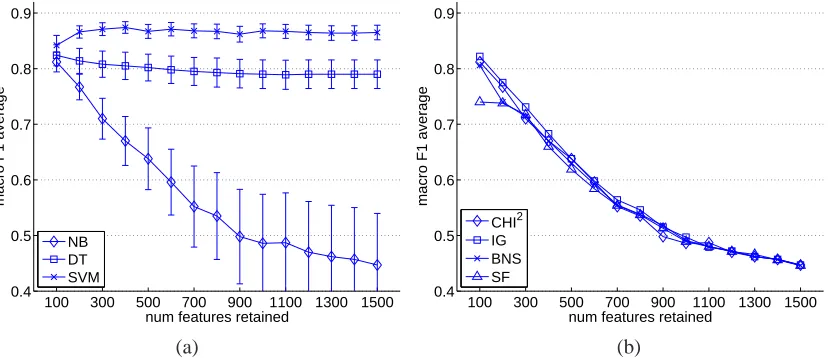
We evaluate the various FS methods by inspect-ing the performance of the classifiers when trained with increasing number of features, where we re-tain the top features as determined by each FS method. Figure 1(a) shows the results obtained with theχ2method, reported using the macro F1 average, where the error bars correspond to the 95% confidence intervals of these averages. We can see from the figure that SVM and DT are far less sensitive to feature selection than NB. As con-jectured in the previous sub-section, NB does not deal well with many features, and indeed we can see here that it performs poorly and inconsistently when many of the features are retained. As we filter out more features, its performance starts to improve and become more consistent. In contrast, the SVM seems to prefer more features: its perfor-mance degrades slightly if less than 300 features are retained (although it still outperforms the other classifiers), and levels out when at least 300 fea-tures are used. As well as having an overall bet-ter performance than the other two classifiers, it also has the smallest variability, indicating a more consistent and robust behaviour. SVMs have been shown in text classification to be more robust to many features (Joachims, 1998).
When comparing the FS methods against each other, it seems their performance is not signifi-cantly distinguishable. Figure 1(b) shows the per-formance of the four methods for the NB classi-fier. We see that when at least 300 features are re-tained, the performances of the FS methods are in-distinguishable, with IG andχ2 slightly superior.
100 300 500 700 900 1100 1300 1500 0.4
0.5 0.6 0.7 0.8 0.9
num features retained
macro F1 average
NB DT SVM
100 300 500 700 900 1100 1300 1500 0.4
0.5 0.6 0.7 0.8 0.9
num features retained
macro F1 average
CHI2 IG BNS SF
[image:6.612.103.518.56.235.2](a) (b)
Figure 1: Results from feature selection: (a) the effect of theχ2method on different classifiers, (b) the effect of different feature selection methods on the Naive Bayes classifier.
simple method is adequate. We have observed the pattern seen in Figure 1(b) also with the other clas-sifiers, and with the micro F1 average (Anthony, 2006).
Our observations are in line with those from text classification experiments: the four FS methods perform similarly, except when only a small pro-portion is retained, when the simple frequency-based method performs worse. However, we ex-pected the BNS method to outperform the oth-ers given that we are dealing with classes with a high distributional skew. We offer two explana-tions for this result. First, the size of our corpus is smaller than the one used in the text classification experiments involving skewed datasets (Forman, 2003) (these experiments use established bench-mark datasets consisting of large sets of labelled text documents, but there are no such datasets with labelled sentences). Our smaller corpus therefore results in a substantially fewer number of features (1622 using the our “best” representation in Ta-ble 2 compared with approximately 5000 in the text classification experiments). Thus, it is pos-sible that the effect of BNS can only be observed when a more substantial number of features is pre-sented to the selection algorithm. The second ex-planation is that sentences are less textually rich than documents, with fewer irrelevant and noisy features. They might not rely on feature selection to the extent that text classification tasks do. In-deed, our results show that as long as we retain a small proportion of the features, a simple FS method suffices. Therefore, the effect of BNS can-not be observed.
3.3 Class-by-class analysis
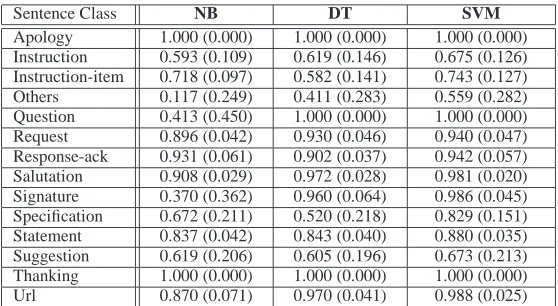
So far we have presented average performances of the classifiers and FS methods. It is also inter-esting to look at the performance individually for each class. Table 3 shows how well each class was predicted by each classifier, using the macro F1 average and standard deviation in brackets. The standard deviation was calculated over 10 cross-validation folds. These results are obtained with the “best” representation in Table 2, and with the χ2feature selection method retaining the top 300
features.
We can see that a few classes have F1of above 0.9, indicating that they were highly predictable. Some of these classes have obvious cue words to distinguish them from other classes. For in-stance, “inconvenience”, “sorry”, “apologize” and “apology” to discriminate APOLOGY class,
“?” to discriminate QUESTION, “please” to dis-criminate REQUEST and “thank” to discriminate THANKING.
Sentence Class NB DT SVM
[image:7.612.168.447.50.203.2]Apology 1.000 (0.000) 1.000 (0.000) 1.000 (0.000) Instruction 0.593 (0.109) 0.619 (0.146) 0.675 (0.126) Instruction-item 0.718 (0.097) 0.582 (0.141) 0.743 (0.127) Others 0.117 (0.249) 0.411 (0.283) 0.559 (0.282) Question 0.413 (0.450) 1.000 (0.000) 1.000 (0.000) Request 0.896 (0.042) 0.930 (0.046) 0.940 (0.047) Response-ack 0.931 (0.061) 0.902 (0.037) 0.942 (0.057) Salutation 0.908 (0.029) 0.972 (0.028) 0.981 (0.020) Signature 0.370 (0.362) 0.960 (0.064) 0.986 (0.045) Specification 0.672 (0.211) 0.520 (0.218) 0.829 (0.151) Statement 0.837 (0.042) 0.843 (0.040) 0.880 (0.035) Suggestion 0.619 (0.206) 0.605 (0.196) 0.673 (0.213) Thanking 1.000 (0.000) 1.000 (0.000) 1.000 (0.000) Url 0.870 (0.071) 0.970 (0.041) 0.988 (0.025)
Table 3: Class-by-class performance
SUGGESTION and STATEMENT were often mis-classified as one another. This means that there were not enough distinguishing features to clearly separate these classes. The highest confusion was between INSTRUCTION and STATEMENT, and indeed, sentences of the form “the driver must
be installed before the device will work” can be
interpreted as both an instruction and a general statement. This suggests that the usage of some of these sentence classes may need to be revised.
4
Conclusions
We have presented a set of experiments involv-ing sentence classification. While the successful deployment of classification algorithms for sen-tences has been demonstrated previously, this kind of classification has received far less attention than the one involving complete documents. In particu-lar, the usefulness of feature selection for sentence classification has not been investigated, to the best of our knowledge.
There are many types of documents where in-dividual sentences carry important information re-garding communicative acts between parties. In our experiments this corresponds to email re-sponses to technical help-desk inquiries. However, there are many more examples of such documents, including different kinds of emails (both personal and professional), newsgroup and forum discus-sions, on-line chat, and instant messaging. There-fore, sentence classification is a useful task that deserves more investigation. In particular, such investigations need to relate results to the more well established ones from text classification ex-periments, and thus highlight the significant dif-ferences between these two tasks.
Our results confirm some observations made
from text classification. The SVM classification algorithm generally outperforms other common ones, and is largely insensitive to feature selec-tion. Further, the effect of non-trivial feature se-lection algorithms is mainly observed when an gressive selection is required. When a less ag-gressive selection is acceptable (that is, retain-ing more features), a simple and computationally cheap frequency-based selection is adequate. Our results also show some important differences be-tween text and sentence classification. Sentences are much smaller than documents, and less rich with textual information. This means that in prun-ing the feature space one needs to be very care-ful not to eliminate strong discriminative features, especially when there is a large class distribu-tion skew. We saw that lemmatizadistribu-tion and stop-word removal proved detrimental, whereas they have been demonstrated to provide a useful di-mensionality reduction in text classification. This difference between sentences and documents may also be responsible for obscuring the effect of a particular feature selection method (BNS), which has been demonstrated to outperform others when there is a large distribution skew. We conclude from these observations that while feature selec-tion is useful for reducing the dimensionality of the classification task and even improving the per-formance of some classifiers, the extent of its use-fulness is not as large as in text classification.
Acknowledgments
Tischer and anonymous reviewers for their valu-able feedback, and Edward Ivanovic for providing a prototype for our tagging software.
References
Anthony. 2006. Sentence classifier for helpdesk
emails. Honours Thesis, Clayton School of Infor-mation Technology, Monash University.
Ana Cardoso-Cachopo and Arlindo Limede Oliveira. 2003. An empirical comparison of text categoriza-tion methods. In String Processing and Informa-tion Retrieval, 10th InternaInforma-tional Symposium, pages 183–196, Brazil, October.
Jean Carletta. 1996. Assessing agreement on classi-fication tasks: The Kappa statistic. Computational Linguistics, 22(2):249–254.
William W. Cohen, Vitor R. Carvalho, and Tom M.
Mitchell. 2004. Learning to classify email into
“Speech Acts”. In Proceedings of Empirical Meth-ods in Natural Language Processing, pages 309– 316, Barcelona, Spain, July. Association for Com-putational Linguistics.
Mark G. Core and James F. Allen. 1997. Coding di-alogues with the DAMSL annotation scheme. In David Traum, editor, Working Notes: AAAI Fall Symposium on Communicative Action in Humans and Machines, pages 28–35, Menlo Park, California. American Association for Artificial Intelligence. Simon Corston-Oliver, Eric Ringger, Michael
Ga-mon, and Richard Campbell. 2004. Task-focused
summarization of email. In Text Summarization
Branches Out: Proceedings of the ACL-04 Work-shop, pages 43–50, Barcelona, Spain, July.
Harris Drucker, Donghui Wu, and Vladimir N. Vap-nik. 1999. Support Vector Machines for spam cat-egorization. IEEE Transactions on Neural Network, 10(5):1048–1054.
George Forman. 2003. An extensive empirical
study of feature selection metrics for text classifica-tion. Journal of Machine Learning Research, 3(7– 8):1289–1305. Cambridge, MA, MIT Press.
Evgeniy Gabrilovich and Shaul Markovitch. 2004.
Text categorization with many redundant features: Using aggressive feature selection to make SVMs
competitive with C4.5. In Proceedings of the
21st International Conference on Machine Learn-ing, pages 321–328, Alberta, Canada.
Edward Ivanovic. 2005. Dialogue act tagging for in-stant messaging chat sessions. In Proceedings of the ACL Student Research Workshop, pages 79–84, Ann Arbor, Michigan.
Thorsten Joachims. 1998. Text categorization with Support Vector Machines: Learning with many rele-vant features. In European Conference on Machine Learning (ECML), pages 137–142.
Daniel Jurafsky, Rebecca Bates, Noah Coccaro, Rachel Martin, Marie Meteer, Klaus Ries, Eliza-beth Shriberg, Andreas Stolcke, Paul Taylor, and
Carol Van Ess-Dykema. 1997. Automatic detection of discourse structure for speech recognition and un-derstanding. In Proceedings of the IEEE Workshop on Speech Recognition and Understanding, pages 88–95, Santa Barbara, CA, December.
Larry McKnight and Padmini Srinivasan. 2003. Cat-egorization of sentence types in medical abstracts. In Proceedings of the American Medical Informat-ics Association Annual Symposium, pages 440–444, Washington D.C.
Gerard Salton and Michael J. McGill. 1983. An Intro-duction to Modern Information Retrieval. McGraw-Hill.
Sam Scott and Stan Matwin. 1999. Feature engineer-ing for text classification. In Proceedengineer-ings of ICML-99: The 16th International Conference on Machine Learning, pages 379–388, Slovenia.
Kazuhiro Seki and Javed Mostafa. 2005. An applica-tion of text categorizaapplica-tion methods to gene ontology annotation. In Proceedings of the 28th annual inter-national ACM SIGIR conference on Research and development in information retrieval, pages 138– 145, Salvador, Brazil.
Chao Wang, Jie Lu, and Guangquan Zhang. 2005.
A semantic classification approach for online
product reviews. In Proceedings of the 2005
IEEE/WIC/ACM International Conference on Web Intelligence, pages 276–279, Compiegne, France. Ian H. Witten and Eibe Frank. 2005. Data Mining:
Practical Machine Learning Tools and Techniques. Morgan Kaufmann, San Fransisco, 2nd edition. Yiming Yang and Jan O. Pedersen. 1997. A
compara-tive study on feature selection in text categorization. In Douglas H. Fisher, editor, Proceedings of ICML-97: The 14th International Conference on Machine Learning, pages 412–420, Nashville, US.