Multi-label Text Categorization with Model Combination
based on
F
1-score Maximization
Akinori Fujino, Hideki Isozaki, and Jun Suzuki NTT Communication Science Laboratories
NTT Corporation
2-4, Hikaridai, Seika-cho, Soraku-gun, Kyoto, Japan 619-0237
{a.fujino,isozaki,jun}@cslab.kecl.ntt.co.jp
Abstract
Text categorization is a fundamental task in natural language processing, and is gener-ally defined as a multi-label categorization problem, where each text document is as-signed to one or more categories. We fo-cus on providing good statistical classifiers with a generalization ability for multi-label categorization and present a classifier de-sign method based on model combination andF1-score maximization. In our formu-lation, we first design multiple models for binary classification per category. Then, we combine these models to maximize the F1-score of a training dataset. Our experi-mental results confirmed that our proposed method was useful especially for datasets where there were many combinations of cat-egory labels.
1 Introduction
Text categorization is a fundamental task in such aspects of natural language processing as informa-tion retrieval, informainforma-tion extracinforma-tion, and text min-ing. Since a text document often belongs to multiple categories in real tasks such as web pages and in-ternational patent categorization, text categorization is generally defined as assigning one or more pre-defined category labels to each data sample. There-fore, developing better classifiers with a generaliza-tion ability for such multi-label categorizageneraliza-tion tasks is an important issue in the field of machine learning. A major and conventional machine learning ap-proach to multi-label categorization is based on
bi-nary classification. With this approach, we assume the independence of categories and design a binary classifier for each category that determines whether or not to assign a category label to data samples. Statistical classifiers such as the logistic regression model (LRM), the support vector machine (SVM), and naive Bayes are employed as binary classi-fiers (Joachims, 1998).
In text categorization, theF1-score is often used to evaluate classifier performance. Recently, meth-ods for training binary classifiers to maximize the F1-score have been proposed for SVM (Joachims, 2005) and LRM (Jansche, 2005). It was con-firmed experimentally that these training methods were more effective for obtaining binary classifiers with betterF1-score performance than the minimum error rate and maximum likelihood used for train-ing conventional classifiers, especially when there was a large imbalance between positive and nega-tive samples. In multi-label categorization, macro-and micro-averagedF1-scores are often used to eval-uate classification performance. Therefore, we can expect to improve multi-label classification perfor-mance by using binary classifiers trained to maxi-mize theF1-score.
We present a classifier design method based on the combination of multiple binary classifiers to im-prove multi-label classification performance. In our framework, we first train multiple binary classifiers for each category. Then, we combine these bi-nary classifiers with weights estimated to maximize micro- or macro-averaged F1-scores, which are of-ten used for evaluating multi-label classifiers. To es-timate combination weights, we extend theF1-score maximization training algorithm for LRM described in (Jansche, 2005). Using three real text datasets, we show experimentally that our classifier design method is more effective than the conventional bi-nary classification approaches to multi-label catego-rization.
Our method is based on a binary classification ap-proach. However, Kazawa et al. (2005) proposed a method for modeling a map directly from data samples to the combination of assigned category la-bels, and confirmed experimentally that the method outperformed conventional binary classification ap-proaches. Therefore, we also compare our method with the direct mapping method experimentally.
2 F1-score Maximization Training of LRM
We first review theF1-score maximization training method for linear models using a logistic function described in (Jansche, 2005). The method was pro-posed in binary classification settings, where classi-fiers determine a class label assignment y ∈ {1,0} for a data sample represented by a feature vectorx. Here,y(n)= 1 (= 0)indicates that the class label is assigned (unassigned) to thenth feature vectorx(n). The discriminative function of a binary classifier based on a linear model is often defined as
f(x;θ) =θt
1x+θ0, (1)
where θ = (θ0,θt1)t is a model parameter vector, andθt1ximplies the inner product ofθ1 andx. A binary classifier using f(x;θ) outputs a predicted class label assignment yˆfor x asyˆ(n) = 1 (= 0) whenf(x(n);θ)≥0 (<0).
An LRM is a binary classifier that uses the dis-criminative function f(x;θ). In this model, the class posterior probability distribution is defined by using a logistic function:
g(z) ={1 + exp(−z)}−1. (2)
That is, P(y = 1|x;θ) = g(f(x;θ))and P(y =
0|x;θ) = 1 − P(y = 1|x;θ) = g(−f(x;θ)). The LRM determines that y(n) = 1 (= 0) when P(y = 1|x(n);θ) ≥0.5 (<0.5), sinceg(0) = 0.5.
The model parameter vector θ is usually estimated to maximize the likelihood ofP(y|x;θ)for training datasetD ={x(m), y(m)}Mm=1 and the prior proba-bility density ofθ:
JR(θ) = M
m=1
logP(y(m)|x(m);θ) + logp(θ). (3)
In this paper, the classifier design approach that em-ploys this training method is called LRM-L.
By contrast, in the training method proposed by (Jansche, 2005), the discriminative function f(x;w) is estimated to maximize the F1-score of training datasetD. This training method employs an approximate form of theF1-score obtained by using a logistic function.
The F1-score is defined as F1 = 2(1/P R +
1/RE)−1, where P R and RE represent precision and recall defined asP R=C/AandRE =C/B, respectively. Here,Crepresents the number of data samples whose true and predicted class label assign-ments,y(n) andyˆ(n), respectively, correspond to1. Arepresents the number of data samples for which
ˆ
y(n) = 1. B represents the number of data samples
for which y(n) = 1. C, A, and B are computed for training dataset D as C = M
m=1y(m)yˆ(m),
A=M
m=1yˆ(m), andB =
M
m=1y(m).
In (Jansche, 2005),yˆ(m)was approximated by us-ing the discriminative and logistic functions shown in Eqs. (1) and (2) as
ˆ
y(m) ≈g(γf(x(m);θ)), γ >0, (4)
becauselimγ→∞g(γf(x(m);θ)) = ˆy(m). Then, an
approximate distribution of theF1-score for training datasetDwas provided as
˜
F1(θ) = 2
M
m=1g(γf(x;θ))y(m)
M
m=1y(m)+
M
m=1g(γf(x;θ))
. (5)
The θ estimate for the discriminative function f(x;θ) can be computed to maximize JF(θ) =
3 Proposed Method
We propose a framework for designing a multi-label classifier based on the combination of multiple mod-els. In our formulation, multiple models are com-bined with weights estimated to maximize the F1 -scores of the training dataset. In this section, we show our formulation for model combination and training methods for combination weights.
3.1 Combination of Multiple Models for Multi-label Categorization
Multi-label categorization is the task of selecting multiple category labels from K pre-defined cat-egory labels for each data sample. Multi-label classifiers provide a map from a feature vector
x to a category label assignment vector y =
(y1, . . . , yk, . . . , yK)t, where y( n)
k = 1 (= 0)
indi-cates that the kth category label is assigned (unas-signed) tox(n).
In our formulation, we first design multiple mod-els for binary classification per category and ob-tainJ×Kdiscriminative functions, whereJ is the number of models. The discriminative function of the jth model for the kth category is denoted by fjk(x;θjk), whereθjkrepresents the model
param-eter vector. LetΘ ={θjk}j,k be a model parameter
set. We train model parameter vectors individually with each model training algorithm and obtain the estimate Θ =ˆ {θˆjk}jk. Then, we define the
dis-criminative function of our multi-label classifier by combining multiple models such as
fk(x; ˆΘ,w) = J
j=1
wjfjk(x; ˆθjk) +w0, ∀k, (6)
where w = (w0, w1, . . . , wj, . . . , wJ)t is a weight
parameter vector and is independent of k. wj
pro-vides the combination weight of thejth model, and w0 is the bias factor for adjusting the threshold of the category label assignment.
We estimate the w value to maximize the micro-averaged F1-score (Fμ), which is often used
for evaluating multi-label categorization perfor-mance. The Fμ-score of training dataset D =
{x(m),y(m)}M
m=1is calculated as
Fμ=
2M
m=1
K
k=1y( m) k yˆ(
m) k
M
m=1
K
k=1y( m) k +
M
m=1
K
k=1yˆ( m) k
,(7)
We provide an approximate form of theFμ-score of
the training dataset,F˜μ( ˆΘ,w), by using the
approx-imation:
ˆ
y(m)
k ≈g(γfk(x(m); ˆΘ,w)), γ >0, (8)
as shown in Eq. (4). In our proposed method,wis estimated to maximizeF˜μ( ˆΘ,w).
However, training dataset D is also used to es-timate Θ. Using the same training data samples for bothΘandwmay lead to a bias estimation of
w. Thus, we used ann-fold cross-validation of the training data samples to estimatew as in (Wolpert, 1992). LetΘˆ(−m) be the model parameter set esti-mated by usingn−1training data subsets not con-taining{x(m),y(m)}. Then, using
˜
Fμ=
2
m,ky( m)
k g(γfk(x; ˆΘ(−m),w))
m,ky( m) k +
m,kg(γfk(x; ˆΘ(−m),w))
, (9)
we provide the objective function ofwsuch that
Jμ(w) = log ˜Fμ+ logp(w), (10)
where p(w) is a prior probability density of w. We use a Gaussian prior (Chen and Rosenfeld, 1999) with the form asp(w)∝J
j=0exp{−(wj−
ρj)2/2σj2}, whereσj, andρjare hyperparameters in
the Gaussian prior. We compute an estimate ofwto maximizeJμ(w)around the initialwvalue by using
a quasi-Newton method. In this paper, this formula-tion is called model combinaformula-tion by micro-averaged F1-score maximization (MC-Fμ).
3.2 Other Training Methods
In multi-label categorization problems, the macro-averaged F1-score (FM) is also used to evaluate
classifiers. Moreover, the average labelingF1-score (FL) has been used to evaluate the average labeling
performance of classifiers for data samples (Kazawa et al., 2005). These F1-scores are computed for training datasetDas
FM =
1
K
K
k=1
2M
m=1y( m) k yˆ(
m) k
M
m=1y( m) k +
M
m=1yˆ( m) k
, (11)
FL=
1
M
M
m=1
2K
k=1y( m) k yˆ
(m) k
K
k=1y( m) k +
K
k=1yˆ( m) k
. (12)
-and FL-scores, and then present similar objective
functions to that for the Fμ-score. Therefore, in
the next section, we examine experimentally the per-formance of classifiers obtained by estimatingwto maximizeF˜M( ˆΘ,w)andF˜L( ˆΘ,w). In this paper,
these model combination methods based on FM
-andFL-scores are called MC-FM and MC-FL,
re-spectively.
4 Experiments
4.1 Test Collections
To evaluate our proposed method empirically, we used three test collections: Reuters-21578 (Reuters), WIPO-alpha (WIPO), and Japanese Patent (JPAT) datasets. Reuters and WIPO are English document datasets and have often been employed for bench-mark tests of multi-label classifiers.
The Reuters dataset contains news articles from the Reuters newswire and consists of 135 topic cate-gories. Following the setup in (Yang and Liu, 1999), we extracted 7770 and 3019 articles as training and test samples, respectively. A subset consisting of the training and test samples contained 90 topic cate-gories. We removed vocabulary words included ei-ther in the stoplist or in only one article. There were 16365 vocabulary words in the dataset.
The WIPO dataset consists of patent documents categorized using the International Patent Classifica-tion (IPC) taxonomy (Fall et al., 2003). The IPC tax-onomy has four hierarchical layers: Section, Class,
Subclass, and Group. Using patent documents
be-longing to Section D (textiles; paper), we evalu-ated classifiers in a task that consisted of selecting assigned category labels from 160 groups for each patent document. Following the setting provided in the dataset, we extracted 1352 and 358 patent docu-ments as training and test samples, respectively. We removed vocabulary words in the same way as for Reuters. There were 45895 vocabulary words in the dataset.
The JPAT dataset (Iwayama et al., 2007) con-sists of Japanese patent documents published be-tween 1993 and 1999 by the Japanese Patent Office. These documents are categorized using a taxonomy consisting of Themes and F-terms. The themes are top-label categories, and the patent documents be-longing to each theme are categorized by using
F-Reuters WIPO JPAT
Nav 1.17 1.28 10.5
Nmax 15 6 40
K 90 160 268
Nds 10789 1710 2464
NLC 468 378 2430
[image:4.612.355.498.68.144.2]Nds/NLC 23.1 4.52 1.01
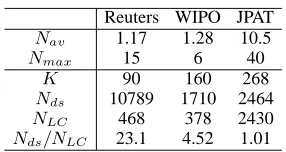
Table 1: Statistical information of three datasets: NavandNmaxare the average and maximum
num-ber of assigned category labels per data sample, re-spectively. K andNds are the number of category
labels and data samples, respectively. NLC is the
number of category label combinations appearing in each dataset.
terms. Using patent documents belonging to Theme
5J104, we evaluated classifiers in a task that
con-sisted of selecting assigned category labels from 268 F-terms for each patent document. 1920 patent doc-uments published between 1993 and 1997 were used as training samples, and 544 patent documents pub-lished between 1998 and 1999 were used test sam-ples. We extracted Japanese nouns, verbs, and adjec-tives from patent documents by using a morpholog-ical analyzer named MeCab1, and removed vocab-ulary words included in only one patent document. There were 21135 vocabulary words in the dataset.
Table 1 shows statistical information about the category label assignment of the data samples for the three datasets. The average numbers of assigned cat-egory labels per data sample,Nav, for Reuters and
WIPO were close to 1 and much smaller than that for JPAT. The number of category label combina-tions,NLC, included in JPAT was larger than those
for Reuters and WIPO. These statistical information results show that JPAT is a more complex multi-label dataset than Reuters or WIPO.
4.2 Experimental Settings
For text categorization tasks, we employed word-frequency vectors of documents as feature vectors input into classifiers, using the independent word-based representation, known as the Bag-of-Words (BOW) representation. We normalized the L1-norms of the word-frequency vectors to 1, to miti-gate the effect of vector size on computation. We did not employ any word weighting methods such as inverse document frequency (IDF).
1
We constructed three multi-label text classifiers based on our proposed model combination methods, MC-Fμ, MC-FM, and MC-FL, where LRM and
SVM (J = 2) were employed as binary classifica-tion models combined with each method. We trained the LRM by using LRM-L described in Section 2, where a Gaussian prior was used as the prior proba-bility density of the parameter vectors. We provided the SVM by usingSVMlight2 (SVM-L), where we employed a linear kernel function and tuned the C (penalty cost) parameter as a hyperparameter.
To evaluate our proposed method, we examined the micro- and macro-averaged, and average label-ingF1-scores (Fμ,FM, andFL), of test samples
ob-tained with the three classifiers based on MC-Fμ,
MC-FM, and MC-FL. We compared the
perfor-mance of the three classifiers with that of two binary classification approaches, where LRM-L or SVM-L was used for binary classification.
We also examined two binary classification ap-proaches using LRM-F and SVM-F. For LRM-F, we used a Gaussian prior and provided the initial pa-rameter vector with a papa-rameter estimate obtained with LRM-L. SVM-F is a binary classifier design approach that employsSVMperf 3. For SVM-F, we used a linear kernel function, set the L (loss parame-ter) parameter to maximize theF1-score, and tuned the C (penalty cost) parameter as a hyperparameter. Moreover, we examined the performance of the
Maximal Margin Labeling (MML) method (Kazawa
et al., 2005), which models the map from feature vectors to category label assignment vectors, be-cause it was reported that MML provides better per-formance than binary classification approaches.
We tuned the hyperparameter of SVM-F for JPAT to provide good performance for test samples, be-cause the computational cost for training was high. We tuned the other hyperparameters by using a 10-fold cross-validation of training samples.
4.3 Results and Discussion
In Table 2, we show the classification performance obtained for three datasets with our proposed and other methods described in Section 4.2. We ex-amined nine evaluation scores: the micro-averaged F1-score (Fμ), precision (Pμ), and recall (Rμ), the
2
http://svmlight.joachims.org/
3
http://svmlight.joachims.org/svm perf.html
Method Fµ(Pµ/Rµ) FM(PM/RM) FL(PL/RM) MC-Fµ 87.0 (87.4/86.7) 51.3 (60.0/48.4) 90.0 (90.1/92.3) MC-FM 85.0 (80.8/89.5) 53.9 (54.9/58.4) 89.7 (88.5/94.1) MC-FL 86.3 (84.3/88.3) 53.4 (59.6/52.6) 90.0 (89.3/93.6) LRM-L 85.2 (87.3/83.2) 46.1 (55.0/43.1) 86.9 (87.6/88.6) LRM-F 85.2 (87.2/83.2) 47.4 (58.5/42.7) 87.0 (87.6/88.7) SVM-L 87.1 (92.9/82.0) 48.9 (58.9/45.8) 88.1 (89.3/88.8) SVM-F 82.4 (78.9/86.2) 51.4 (49.4/60.1) 87.4 (86.9/91.4) MML 87.8 (92.6/83.4) 59.3 (62.6/60.0) 91.2 (91.7/93.2)
(a) Reuters
Method Fµ(Pµ/Rµ) FM(PM/RM) FL(PL/RM) MC-Fµ 51.4 (57.3/46.6) 30.4 (35.8/30.3) 46.9 (48.3/51.5)
MC-FM 48.1 (46.1/50.4) 32.2 (33.8/36.0) 46.8 (46.3/56.0) MC-FL 48.6 (45.8/51.9) 32.5 (33.4/36.5) 47.1 (46.4/56.8) LRM-L 40.5 (68.0/28.9) 22.1 (33.7/17.9) 32.7 (36.5/32.0) LRM-F 41.0 (68.6/29.2) 22.3 (34.0/18.1) 33.2 (37.0/32.4) SVM-L 41.8 (61.9/31.5) 24.4 (34.2/21.0) 35.1 (38.8/35.3) SVM-F 48.3 (53.8/43.8) 32.3 (37.4/31.8) 45.6 (47.9/49.6) MML 48.6 (54.9/43.6) 30.8 (36.5/29.7) 49.4 (56.2/48.4)
(b) WIPO
Method Fµ(Pµ/Rµ) FM(PM/RM) FL(PL/RM) MC-Fµ 41.8 (42.6/41.1) 17.5 (21.4/17.4) 40.2 (43.5/44.4) MC-FM 40.6 (35.8/46.7) 20.2 (20.4/23.1) 39.4 (37.7/50.6) MC-FL 42.1 (42.3/41.9) 17.6 (21.1/17.8) 40.5 (43.2/45.2)
LRM-L 33.9 (44.4/27.4) 15.8 (20.9/14.0) 32.2 (46.5/29.9) LRM-F 36.9 (44.6/31.5) 16.9 (22.9/14.7) 35.1 (47.3/34.1) SVM-L 33.3 (39.6/28.7) 16.3 (20.9/14.6) 31.9 (42.4/31.6) SVM-F 32.2 (28.6/36.8) 19.7 (15.0/38.4) 31.0 (30.7/40.0) MML 32.7 (42.1/26.8) 14.7 (19.4/12.9) 32.2 (51.8/30.5)
[image:5.612.314.537.68.437.2](c) JPAT
Table 2: Micro- and macro-averaged, and average labelingF1-scores (%) with our proposed and con-ventional methods.
macro-averaged F1-score (FM), precision (PM),
and recall (RM), and the average labelingF1-score
(FL), precision (PL), and recall (RL) of the test
sam-ples.FM andPM were calculated by regarding both
theF1-score and precision as zero for the categories where there were no data samples predicted as posi-tive samples.
LRM-F and SVM-F outperformed LRM-L and SVM-L in terms ofFM-score for the three datasets,
respectively. The training methods of LRM-F and SVM-F were useful to improve the FM-scores of
LRM and SVM, as reported in (Jansche, 2005; Joachims, 2005). TheFμ- andFL-scores of LRM-F
were similar or better than those of L. LRM-F was effective in improving not only theFM-score
but also theFμ- andFL-scores obtained with LRM.
MC-Fμ provided betterFμ-scores than LRM-F and
SVM-F. TheFM-scores of MC-FM were similar or
better than those of LRM-F and SVM-F. Moreover, MC-FLoutperformed LRM-F and SVM-F in terms
ofFL-scores. The binary classifiers designed by
us-ing LRM-F and SVM-F were trained to maximize theF1-score for each category. On the other hand, MC-Fμ, MC-FM, and MC-FLclassifiers were
con-structed by combining LRM and SVM with weights estimated to maximize theFμ-,FM-, andFL-scores,
respectively. The experimental results show that our training methods for combination weights were use-ful for obtaining better multi-label classifiers.
MC-Fμ, MC-FM, and MC-FL outperformed
MML as regards the threeF1-scores for JPAT. How-ever, MML performed better for Reuters than MC-Fμ, MC-FM, and MC-FL, and provided a betterFL
-score for WIPO. As shown in Table 1, there were more category label combinations for JPAT than for Reuters or WIPO. As a result, there were fewer data samples for the same category label assignment for JPAT. Therefore, MML, which learns the map di-rectly from the feature vectors to the category label assignment vectors, would have been overfitted to the training dataset for JPAT. By contrast, our model combination methods employ binary classifiers for each category, which mitigates such an overfitting problem. Our model combination methods will be useful for complex datasets where there are many category label combinations.
5 Conclusion
We proposed a multi-label classifier design method based on model combination. The main idea be-hind our proposed method is to combine multiple models with weights estimated to maximize evalua-tion scores such as the micro- and macro-averaged, and average labeling F1-scores. Using three real text datasets, we confirmed experimentally that our proposed method provided similar or better perfor-mance than conventional binary classification ap-proaches to multi-label categorization. We also con-firmed that our proposed method was useful for datasets where there were many combinations of category labels. Future work will involve training our multi-label classifier by using labeled and un-labeled samples, which are data samples with and without category label assignment.
References
David A. Bell, J. W. Guan, and Yaxin Bi. 2005. On combining classifier mass functions for text categorization.
IEEE Transactions on Knowledge and Data Engineering,
17(10):1307–1319.
Stanley F. Chen and Ronald Rosenfeld. 1999. A Gaussian prior for smoothing maximum entropy models. Technical report, Carnegie Mellon University.
C. J. Fall, A. T¨orcsv´ari, K. Benzineb, and G. Karetka. 2003. Automated categorization in the international patent classifi-cation. ACM SIGIR Forum, 37(1):10–25.
Giorgio Fumera and Fabio Roli. 2005. A theoretical and exper-imental analysis of linear combiners for multiple classifier systems. IEEE Transactions on Pattern Analysis and
Ma-chine Intelligence, 27(6):942–956.
Zoubin Ghahramani and Hyun-Chul Kim. 2003. Bayesian classifier combination. Technical report, Gatsby Computa-tional Neuroscience Unit, University College London.
Makoto Iwayama, Atsushi Fujii, and Noriko Kando. 2007. Overview of classification subtask at NTCIR-6 patent re-trieval task. In Proceedings of the 6th NTCIR Workshop
Meeting on Evaluation of Information Access Technologies (NTCIR-6), pages 366–372.
Martin Jansche. 2005. Maximum expected F-measure train-ing of logistic regression models. In Proceedings of
Human Language Technology Conference and Conference on Empirical Methods in Natural Language Processing (HLT/EMNLP2005), pages 692–699.
Thorsten Joachims. 1998. Text categorization with support vector machines: Learning with many relevant features. In
Proceedings of the 10th European Conference on Machine Learning (ECML ’98), pages 137–142.
Thorsten Joachims. 2005. A support vector method for multi-variate performance measures. In Proceedings of the 22nd
International Conference on Machine Learning (ICML’05),
pages 377–384.
Hideto Kazawa, Tomonori Izumitani, Hirotoshi Taira, and Eisaku Maeda. 2005. Maximal margin labeling for multi-topic text categorization. In Advances in Neural Information
Processing Systems 17, pages 649–656. MIT Press,
Cam-bridge, MA.
Leah S. Larkey and W. Bruce Croft. 1996. Combining classi-fiers in text categorization. In Proceedings of the 19th ACM
International Conference on Research and Development in Information Retrieval (SIGIR-96), pages 289–297.
Kai Ming Ting and Ian H. Witten. 1999. Issues in stacked generalization. Journal of Artificial Intelligence Research, 10:271–289.
David H. Wolpert. 1992. Stacked generalization. Newral
Net-works, 5(2):241–259.
Yiming Yang and Xin Liu. 1999. A re-examination of text categorization methods. In Proceedings of the 22nd ACM