Designing an Electronic System for the Study of Simple Pendulum at Large Angles
Abdulghefar Kamil Faiq (University of Salahaddin – Erbil. Erbil Iraqi Kurdistan RegionIraq)
Muhammad Hamza Abdullah (Fenk Basic Private School. Erbil Iraqi Kurdistan RegionIraq)
281 Author(s)
Abdulghefar Kamil Faiq University of Salahaddin - Erbil Erbil Iraqi Kurdistan Region Iraq
E-mail:[email protected] [email protected]
Muhammad Hamza Abdullah
Fenk Basic Private School. Erbil. Iraqi Kurdistan Region Iraq
E-mail:[email protected]
Designing an Electronic System for the Study of Simple Pendulum at Large Angles
Abstract
An electronic system based on a photo gate and an electronic switching circuit is designed for studying simple pendulum at large angles. The detailed of the system operation is studied, the pulse measurements performed on a CRO screen for five displacement amplitude angles of 5, 10, 15, 20, and 25 degrees, and the technical problems associated with the measurement process is treated. Results show that calculated acceleration of gravity with acceptable magnitudes can be obtained for small displacement angle of 5o compared with the real value of the local acceleration of gravity; the relative error is 0.01617 %. Instantaneous time period, amplitude decay, and maximum velocities are measured and used for error handling in the calculation of the acceleration of gravity. In order to overcome the problem of the operating time of the relays which are used in the electronic circuit switch, taking 80 periods for manual measurements have been proved to be useful in decreasing errors in the calculation of acceleration of gravity.
Key words: Simple Pendulum at Large Angles, Photo Gate, Non Linear Differential Equation, Electronic Measuring Circuit
Introduction
The study of simple pendulum at large displacement angles gets great interest in physics both for undergraduate and graduate levels, because it is a popular example of treating non-linear effect at such levels. At undergraduate level, simple pendulum is used for measuring the acceleration of gravity (g), however, the differential equation which governs the pendulum's motion has no-analytical solution, hence, either numerical method is used or a special case of small angle vibration is taken (Belendez et. al, 2009; Amore et. al., 2007; Carvalhaes, and Suppes , 2008).
(Aggarwal et. al, 2005) designed an electronic system for studying simple pendulum which consists of a microprocessor program controlling system. In this work, we designed a simpler electronic circuit, feeds a sophisticated CRO, to measure the instantaneous time period of pendulum's oscillatory motion at high level of accuracy. This work aims at the study of the amplitude of vibration's effect on the time period, damping of the pendulum, and the technical
factors that affect the measuring system. All these are to further investigate the pendulum's problem at large displacement angles.
Method
Simple pendulum consists of a small bob with a mass (m) suspended to a certain position by a light inextensible thread. When we shift the bob with an angle (), and release it, the oscillatory motion which takes place in a vertical motion represents the simple pendulum's motion, it is governed by the following differential equation
0
sin
2 2 2
odt
d
(1) WhereL
g
o
(2)Where L is the length of the pendulum.
282
0
2 2 2
odt
d
(3)This is the differential equation of simple harmonic motion of angular frequency o. The solution of eq. (3) gives time period (To) of:
g
L
T
o
2
(4)
Taking into account the large displacement angles (when the approximation as cannot be used), the solution of eq. (1) will be (Amrani et. al, 2008):
....
3072
11
16
1
1
2
o2 o4g
L
T
(5)
The second order approximation of Bernoulli can be used (Lima, and Arun, 2006)
216
1
1
2
og
L
T
(6)Eq. (6) can be used to calculate g. As a result of oscillation damping, o must be substituted for each period, i.e., the calculation of o for each period is necessary.
The kinetic energy of the pendulum
2
2
1
mv
E
K
(7)v is the linear velocity of the pendulum. The pendulum's potential energy is:
))
cos(
1
(
mgL
E
p (8) According to the principle of conservation ofenergy, the maximum kinetic energy (at =0) is equal to the maximum potential energy
(=
o),
the result can be written as:
gL
v
o2
1
cos
max 2 1
(9)Where vmax is the maximum velocity of the bob at =0.
Oscillation damping follows the following equation (Nelson, and Olsson, 1986):
o
me
t
me
n (10) Where m is the initial displacement angle, isthe damping factor. Its assumed that the instantaneous time period (t) is slightly changed
with number of period (n), then we can define as another damping parameter with respect to (n). Substituting eq.(10) into eq. (6) gives:
2)
(
16
1
1
2
me
ng
L
T
(11)The Procedure
A novel electronic system is designed for the time period measurements shown in figure (1). The circuit description is necessary as other researcher did in their novel circuit designs (Alsadi et. al, 2012). The photo gate consists of a Light Emitting Diode (LED), and a Light Dependent Resistor (LDR). The former produces a red light beam which is detected by the latter. When the bob intersect the light beam, the LDR resistance increases rapidly thus it controls the electronic switch circuit shown in figure (2).
When the bob is shifted with a certain angle, then
release it, simultaneously the LED power switch turned on. In the light case; when there is no barrier between the LED and LDR, the LDR resistance will be very small about 400Ω. In the dark case, when the bob intersect the light, the LDR resistance increases to about 1 MΩ, the timer starts automatically. The voltage divider circuit, consisting of R1 and the LDR, will derive
the base of T1 and T2 as follows:
LDR LDR LDR
R
R
R
Vs
V
1 (12)For the light case, we can approximate eq. (12) to:
V
LDR
0
(13)The above voltage cannot force T1 and T2 to saturation, while for dark case, eq.(12) can be approximated to:
2 1E B LDR
V
V
V
(14) Thus IB=I1, that assures T1 and T2 are both in283 with (f1) to start the counting of the voltage
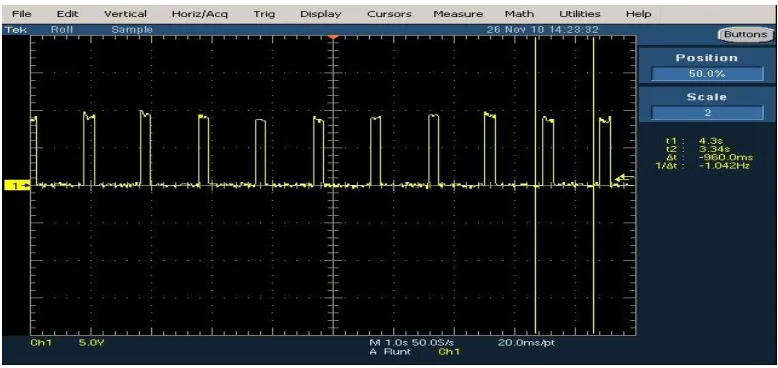
pulses, while (O0) will be connected with (O1) to gain pulse amplitude about 9 volts equal to the source voltage V. This voltage is fed into a digital phosphorous oscilloscope (1 GHz Tektronix TDS5104), which has the capability to measure signal's parameters; maximum pulse voltage, time duration, and positive time, as its snapshot is shown in figure(3). The purpose of using Diode D1 is to prevent Id1 from returning back to point (d2). With the arrival of the later pulse while S2 is at stop state, i. e. (c) is connected with (e), REL1 will be turned on, this means that (a) will be disconnected from (h), at the same time REL2 and REL3 will be turned off. Finally the timer and the counter are stopped. D2 and D3 are designed to separate the current passing through REL1 from that passing through REL2.
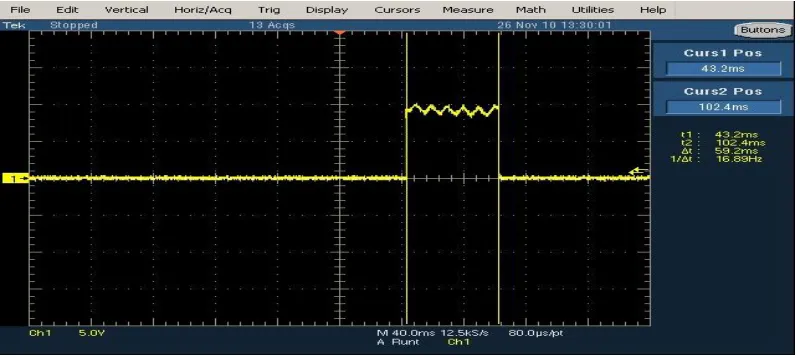
Five initial displacement angles o; 5o, 10o, 15o, 20o, and 25o have been chosen, and four different pendulum lengths 60, 70, 80, and 95 cm were taken. The larger is the number of oscillation the less is the error in measuring time period, since the error is divided by the number of oscillation (Madrid, 1983). Eighty oscillations have been taken. The data were taken manually by the timer and the counter, meanwhile for the case of L=95 cm data were also taken by the CRO. We could able to measure the time period of each oscillation with the aid of the snapshot specification of the CRO, including the measurement of positive pulse width, time period, and other pulse parameters. Since the positive pulse widths is belonging to the dark case, i.e. time spent by the bob in traversing the LED light, we could able to measure the maximum velocity of the bob at the center of the oscillation with the use of the following equation:
p
T
D
V
max
(15)Where D is the diameter of the bob = 2.45 cm, and Tp is the positive pulse width time. Vmax is calculated for each period, substituting them in eq.(9) to find o for each period and using eq.(6) we could able to make the second order approximation. Figure (4) show how individual positive pulse time is measured on the CRO screen.
Results and Discussion
The Manual Method
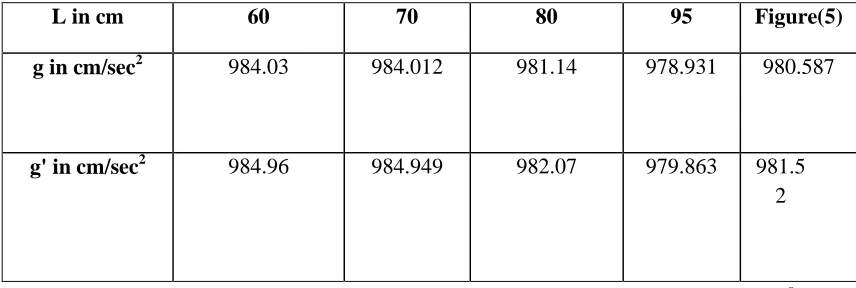
A matlab software algorithm is used for the whole results. Figure (5) shows the time periods of four different lengths and five different initial displacement angles that are taken manually. Table (1) summarizes the results which are deduced from the slopes, g is the acceleration of gravity calculated by eq. (4), g' is the corrected acceleration of gravity calculated by eq.(6). While table (2) summarized g and g' for the case of o=5o and different lengths L. R2 is the correlation factor of the fitted curve. The results show that by increasing L, more accurate g' is obtained; at L=95 g'=979.863 cm/sec2 is obtained. The theoretical value of g in Erbil city at College of science (414 m, Latitude 36o 09' 10'') can be calculated by using the following equation (Li, and Gotze, 2001):
(16)
Where:
g= acceleration in cm/sec2, is the latitude, and h is the high above sea level in meter
The above equation is called the international gravity formula (1980) with first correction for high above sea level; the result is 979.705 cm/sec2. If the two results are compared, an acceptable relative error of 0.01617 % is obtained. It is clear from figure (6) that the calculated g' at L=95 cm approaches the exact value for all other initial displacement angles. On the basis of the above results, the pendulum length of 95 cm for all displacement angles (5o, 10o, 15o, 20o, and 25o) gives adequate g' value, hence the L=95 cm is chosen for the remainder of this work.
The CRO Method
284 friction forces between the thread and the
suspended point, and other damping effects as studied by (Nelson, and Olsson, 1986). Figures (7), (8), and (9) show the results of CRO measurements performed for L=95 cm, and 80 periods for the five different displacement angles as mentioned above.
Instantaneous change of the time period with the period number (n) is shown in Figure (7). Time periods decrease with n for all o
cases except the
case of o
=5
o, and larger time periods belongs tolarger o As oscillation takes place, the amplitude
of oscillation damped with time, the amount of the damping depends on the initial displacement angle, as a result of the vibration path decreases with the time and less time is required to complete a period. Damping of
o is shown inFigure(8), in all cases
decrease with period number (n). A curve fitting of figure (8) is performed using eq. (10) for calculation. Table (3) summarizes the results.It is obvious that
increases with increasing
ofor all o
>10
o.
For small othe friction force is alinear function of the velocity. However, at larger
o, i.e. larger Vmax, the linearity may not validbecause of the turbulence of motion. (Aggarwal et. al, 2005) states that for o
beyond 11-12
o, thependulum encounter a larger damping force.
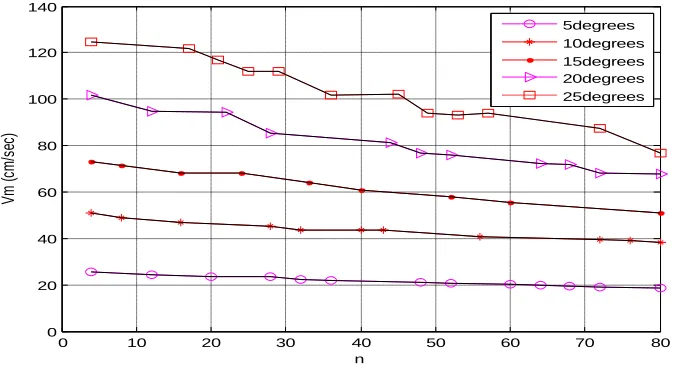
In figure (9), maximum velocity Vm, is drawn as a function of n. The graph shows a decrease of Vm with n for all o
cases, and larger Vm belongs
to larger o
. Decrease of
o. and Vm with n have
reverse effects on the instantaneous time period, when
o.
decreases, the vibration path will beshortened, then the time period will also be decreased, as it is mentioned above, however, the decrease of Vm slow down the vibration which suppose to increase the time period, the former predominates the latter as it is shown in figure (7).
Error Analysis
The manual method gives better results for g than the results of the CRO, since taking average of 80 periods will reduce the error in the evaluation of g. The uncertainty in g is given by the following equation: 2 2
2
T
T
L
L
g
g
(17)
Hence, T will be reduced by a factor (1/80) and this affects the uncertainty in g twice according to eq.(17). The error source may be related to the operating time of the relays.
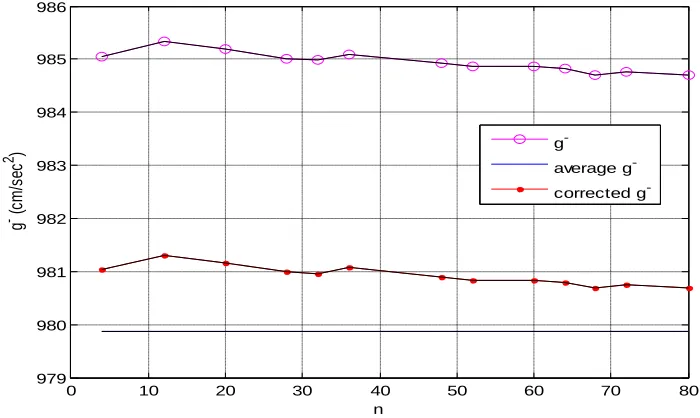
In figure (10), the averaged g' for 80 periods, at o=5o, and L=95 cm, the instantaneous g' calculated from figure (7) with the aid of eq.(11), and a corrected g' by adding 4 msec (the maximum operating time of the relays) to each To are shown. It is obvious that the error of a single period measurement with CRO can be well treated by taking into account the effect of the operating time of the relays.
Conclusion
The problem of simple pendulum at large angles is studied by the above presented technique. The results of the local g' at Erbil city for o=5o, L=95 cm and the average time is taken for 80 periods gives a relative error of 0.01617%. The instantaneous measurements of To, Vmax, and o can be performed with this system, the results are comparable with the theory. Error sources of the instantaneous To measurements can be related to the operating time of the three used relays, its found out that by adding the maximum operating time of these relays to the instantaneous time period To for o=5o , results of g' approaches that of the g' averaged for 80 periods
References
Aggarwal, N., Verma, N. and Arun, P. (2005) "Simple pendulum revisited" Eur. J. Phys. Vol. 26, pp.517–523
Alsadi, S., Khatib, T., Malloh, S.,(2012) "Development of a Novel Solar Radiation Measuring Device" Journal of Asian Scientific Research Vol. 2, No.2, pp. 40-44.
Amore, P., Cervantes Valdovinos, M., Omelas, G. and Zamudio Barajas, S. (2007) "The nonlinear pendulum: formulas for the large amplitude period" Revista Mexicana de Fi'sica Vol. E 53, No. 1, pp.106–111
285 Revista Mexicana de Fi'sica, Vol. E 54, No. 1, pp.
59–64
Belendez, A. , Rodes J. J., Belendez, T. and Hernandez, A. (2009) "Approximation for a large-angle simple pendulum period" Eur. J. Phys. Vol. 30, pp. L25–L28
Carvalhaes, C. G. and Suppes, P. (2008) "Approximations for the period of the simple pendulum based on the arithmetic-geometric mean" Am. J. Phys. Vol. 76, No. 12, pp. 1150-1154.
Li, X. and Gotze, H. J(2001) "Correctly Understanding Gravity" Geophysics, Vol. 66, No. 6, pp. 1660-1668
Lima, F. M. S. and Arun, P. (2006) "An accurate formula for the period of a simple pendulum oscillating beyond the small angle regime" Am. J. Phys., Vol. 74 , No.10, pp. 892-895
Madrid, A. C. (1983) "The Period of a Pendulum" Phys. Educ., Vol.18, pp. 271-272 Nelson, R. A. and Olsson, M. G. (1986) "The Pendulum –Rich Physics from a Simple Pendulum" Am. J. Phys., Vol. 54, No.2, pp. 112-121
oin degrees
5
10
15
20
25
g in cm/sec
2980.587
977.915
974.535
969.986
965.243
g' in cm/sec
2981.52
981.642
982.902
984.816
988.35
R
20.999
0.999
0.999
0.999
0.999
Table1:
Presents g and g' as calculated from the slopes of figure (5).
L in cm
60
70
80
95
Figure(5)
g in cm/sec
2984.03
984.012
981.14
978.931
980.587
g' in cm/sec
2984.96
984.949
982.07
979.863
981.5
2
Table 2:
Presents g and g' for different pendulum's lengths for the case:
o= 5
286
o5
o
10
o15
o20
o25
o
0.00424
0.0035
0.00481
0.00554
0.0062
R
20.99
0.968
0.991
0.975
0.963
Table 3:
Results of the curve fitting of figure (8)
a- Protractor
b- Stand
c- Photo gate
d- The designed electronic switch
circuit
e- A thread and a bob
287
Figure 2:
The designed electronic switch circuit
288
Figure4:
The process of measuring of the positive pulse time shown on the CRO screen
60 65 70 75 80 85 90 95
2.5 3 3.5 4
L (cm)
T
2 (s
ec
)
5degrees 10degrees 15degrees 20degrees 25degrees
289
60 65 70 75 80 85 90 95
978 980 982 984 986 988 990 992 994
L (cm)
g
- (c
m
/s
ec
2 )
5degrees 10degrees 15degrees 20degrees 25degrees
Figure 6:
g' as a function of pendulum length for five initial amplitudes 5
o, 10
o, 15
o, 20
o, and
25
0 10 20 30 40 50 60 70 80
1.95 1.955 1.96 1.965 1.97 1.975
n
T
o
(s
ec
)
5degrees 10degrees 15degrees 20degrees 25degrees
Figure 7:
Time period T
ochange with period number (n) for five initial amplitudes 5
o290
0 10 20 30 40 50 60 70 80
0 5 10 15 20 25
n
th
et
a
(d
eg
re
es
)
5degrees 10degrees 15degrees 20degrees 25degrees
Figure 8:
The displacement angle as a function of period number (n) for five initial amplitudes
5
o, 10
o, 15
o, 20
o, and 25
o.
0 10 20 30 40 50 60 70 80
0 20 40 60 80 100 120 140
n
V
m
(c
m
/s
ec
)
5degrees 10degrees 15degrees 20degrees 25degrees
Figure 9:
The maximum velocity V
mas a function of period's number (n) for five initial
291
0 10 20 30 40 50 60 70 80
979 980 981 982 983 984 985 986
n
g
- (cm
/s
ec
2 )
g
-average g
-corrected g