Real-Time Multipoint Temperature Data Acquisition System
Using Zigbee
Abdul Rahman , Dr. G Kanaka Durga , Jaideep Kumar Naag
[email protected] , [email protected] , [email protected] ABSTRACT
In this work, a low cost three- multipoint temperature data logger was developed. It was designed using LM35 as the sensor, and Arduino Uno as the data processing element. The comparative evaluation of the system with other established thermometers show that no two temperature meters gave the same values. However the most important thing is that all the systems recorded the same temperature flow pattern. This indicates that the systems actually senses change in the surrounding effectively. The system gives effective and adjustable temperature data logging procedure. Hence, the system is recommended for use in monitoring low temperature systems.
It consists of a temperature sensor for constantly monitoring temperature and Zigbee module for wireless data transfer. The measured temperature parameter will be sent to microcontroller. And with the help of Zigbee module temperature is sent to computer from Monitoring area.
.
Key words: Zigbee, LM35, Arduino uno
I. INTRODUCTION
Nowadays, the number of factories is increasing as a result of industrial development. However, issues of safety additionally increased, and work is less economical for example instrumentality malfunction, human error and natural disaster. This will cause the error in measuring and storing information. The damage and injury caused by these factors are usually increasing, therefore lack of safety and potency has become an enormous issue of today.
On this downside, the observation management won't unendingly owe to manually measure on industrial currents. Apart from that, the Standard measuring system is a high cost of the system as a result of the abundant
files of paper and if it uses wired system, the high price and consumption are occurring with their installation.
From that, the protection and work efficiency can less on some Factories. By victimization the WSN, the system can operate easily with real time observation and unendingly. From that, it has rather more efficient on this technique like low price installation and maintenance, low energy usage, long lasting equipment, measure and monitor in real time, ease to storing data acquisition, and straight forward implementation and installment comparable to ancient new wired network.
II. LITERATURE REVIEW
[1] Wei Jia; Physics and electronics engineering college, Xiang fan, China; Peng Zia; Guo-Qin Feng This design takes the 16-bit ultra-low power MSP430F149 microcontroller produced by TI Company as the control core .Using a high-precision single-bus device DS18B20as the temperature sensor, keyboard as temperature input setting, and temperature value displayed by the 1602LCD, temperature measurement and controlling are realized within the closed environment. And the nRF401 wireless transmission module could transfer temperature value to the PC. [2] Patvardhan.A; Renuka Devi.V; Aishwarya.R.
“Embedded Temperature Monitoring and Control Unit
“In this paper a low cost embedded temperature Monitor with controller is built using AVR ATmega8 Microcontroller. A thermistor, a thermocouple and an LM35transistor are the temperature sensors used in the model.
III. METHODOLOGY
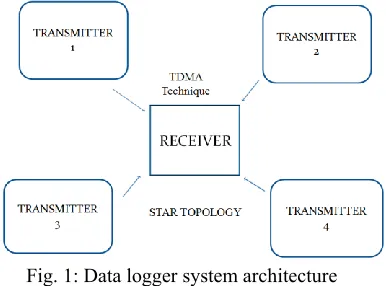
to the receiver by using star topology as shown in below figure1.
Fig. 1: Data logger system architecture
The System Architecture has two sections. They are 1. Data collection section, 2. Monitor Section
Data Collection Section: In this section we are
performing Data Acquisition. It is performed by multiple temperature sensors, measures temperature of the particular node. And that data will be transfer to monitoring Section by using Zigbee Wireless Communication System.
Fig. 2: Data Collection Section
Monitoring Section
In this Monitoring section we are using Zigbee receiver for data receiving and PC for data monitoring. In this we are using PC to enter the commands to change the Transmitting nodes.
Fig. 3: Monitoring Section
Working Model:
The idea behind this paper is to develop a smart real time embedded Arduino based Multi point data acquisition system. Presents data collection system available in market are too costly. Here the operation involves two steps data Collection as well as data transferring. This concept is implemented using Arduino microcontroller and sensor circuits which are developed and are custom designed as per the physical data to be captured. The data acquisition system is developed with additional features such as data base storage with real time plotting of collected data. Initially simulation of the circuit is done using proteus simulation software to check whether the circuit designed for project will work out or not. After observing the simulation result in proteus, PCB design is made with it. Here we have used Arduino Uno tool for programming ATmega328. Then ATmega328 chip is removed and placed it on a PCB with required components.
The Arduino microcontroller board is used which has inbuilt ADC and other peripheral circuitry necessary for operation. Three LM35 sensors are used. The LM35 temperature sensor which shows temperature in degree Celsius and it is connected to the ATmega328. The physical parameter is sensed by sensors and is converted into analog signal. This analog signal is fed to the Arduino board ADC pins which is then converted into an equivalent digital quantity and is further processed in the Arduino microcontroller. The sensor signal out of the microcontroller is displayed on 16*2 LCD display. At the same time this data is sent to the computer through ZIGBEE Protocol. In the receiver section Zigbee receives the data and send to the PC by using UART Protocol. In the PC we are observing the data by using TMFT Terminal. And also switching the collection of data from different nodes by using Zigbee commands.
IV. MODULES USED IN THIS PROJECT
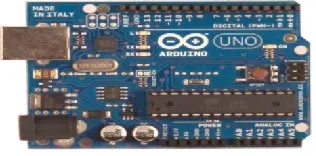
Arduino UNO
beginners who do not have the experience of using this tool for implementing low cost embedded projects. The objects built with Arduino respond to sound, control light, touch, and movement etc. The developed Arduino is used to produce an amazing variety of things such as games, musical instruments, robots, interactive furniture and also interactive clothing. It is best suited for its hardware but its software that is set of instructions is also required to program hardware. The hardware and the software both include “Arduino.” The physical world can be sensed and controlled by the combination of both hardware and software of Arduino that enable the user to create interactive projects. The Arduino software is freely available, cross-platform and also hardware is reasonable to buy.
Fig. 4: Arduino Uno board
LM35 SENSOR:
LM35 converts temperature value into electrical signals. LM35 series sensors are precision integrated-circuit temperature sensors whose output voltage is linearly proportional to the Celsius temperature. The LM35 requires no external calibration since it is internally calibrated. . The LM35 does not require any external calibration or trimming to provide typical accuracies of ±1⁄4°C at room temperature and ±3⁄4°C over a full −55 to +150°C temperature range. Sensor provides output in analog form. Its provide 10mV/C, it means that for 30°C will provide 300mV output.
Fig. 5: LM35 Temperature sensor
Zigbee
For configuration of Zigbee XCTU software is used which is provided from DIGI international company. The XBee and XBee-PRO RF Modules were engineered to meet IEEE 802.15.4 standards and support the unique needs of low-cost, low-power wireless sensor networks. The modules require minimal power and provide reliable delivery of data between devices. The modules operate within the ISM 2.4 GHz frequency band and pin-for-pin compatible with each other. 802.15.4 defines the physical and MAC layers, and ZigBee defines the network and application layers. For sensor network applications, key design requirements revolve around long battery life, low cost, small footprint, and mesh networking to support communication between large numbers of devices in an interoperable and multi-application environment.
Fig. 6: Zigbee module
V. PROTEUS SIMULATION:
Before actually implementing the hardware modules, it was simulated in Proteus software. The Proteus Design Suite is an Electronic Design automation (EDA) tool including schematic capture, simulation and PCB Layout modules.
Fig. 7: Transmitter Section
The above figure shows the Proteus model of transmitting section in this I am taking LM35, Atmega328, and LCD as components.
Fig. 8: Data Displaying Section
The above figure indicates the how temperature values displayed in the LCD.
VI. RESULTS
This project is developed for remote monitoring system with switching commands. Therefore user does not need to go remote area to know the temperature of device .The device developed can work efficiently upto a 30m distance depending upon surrounding environmental and 100m for open air, which can be used as a modern technique as per requirement.
Fig. 9: Monitoring Section
Above figure shows the Hardware model of the application. In this we are creating two transmitting nodes and one receiver.
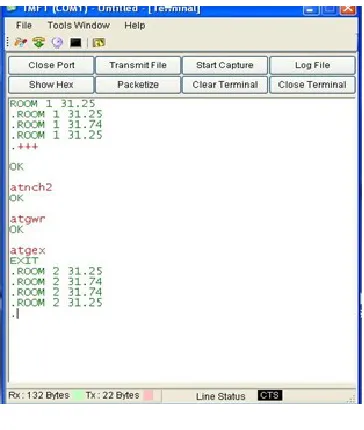
Fig. 10: PC output
The above figure shows the output observed in PC. It contains different room temperature values, and these are change by using commands.
Fig. 11: Flow chart for Transmitting Section
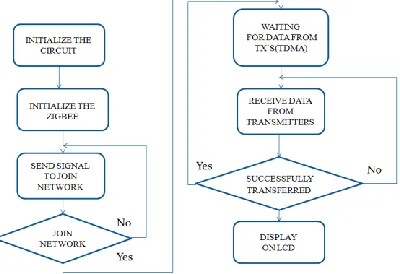
Fig. 12: Flow chart for Monitoring Section
VIII. CONCLUSION
In this paper, we present a new temperature control system, by using wireless communication module of ZigBee protocol it is not only realizing wireless transmission in more simple, but also low cost, high reliability, easy maintenance and less interference in transmission. Sensor nodes are designed for temperature monitoring.
IX. FUTURE ENHANCEMENT
In the present paper we are monitoring temperature values only, in future it will be extended by controlling the temperature with the help of controlling devices. This system can be altered marginally to log and record other physical signals rather than temperature. In requisite
application, data acquired can be imported further into computational software like MATLAB, Python for mathematical computations.
Extensions of my current work include a switching from a star network to a mesh network, which will be useful for deploying sensor networks in large areas like in buildings with multiple rooms and multiple floors.
X. REFERENCES
[1] Wei Jia; Physics and electronics engineering college, Xiangfan, China; Peng Zia; Guo-Qin Feng. “Wireless Temperature Measurement andControl System based on MSP430F149”, Genetic and Evolutionary Computing (ICGEC), 2010 Fourth international conference, 13-15December 2010.
[2] Balraj.A; School of interdisciplinary science and technology; International institute of Information technology, Pune, India; Patvardhan.A; Renuka Devi.V; Aishwarya.R. “Embedded TemperatureMonitoring and Control Unit”, 12-13 March 2010.
[3] Sehgal V.K; Department of ECE Jaypee University of Information and technology, Waknaghat; Nitin; Chauhan D.S; Sharma. R. “SmartWireless Temperature Data Logger using IEEE 802.15.4/ Zigbee protocol”,
TENCON 2008 IEEE region 10 conference, 19-21 November 2008.
[4] Sardini.E; Department of Information engineering, University of Brescia, Italy; Serpelloni.M. “Wireless Measurement Electronics forPassive Temperature Sensor”, Instrumentation and Measurement, IEEE transactions (volume: 61, Issue: 9), September 2012.
[5] Veerasingam.S; Department of Instrumentation and Control Engineering, National Institute of Technology, Tiruchirapally, India; Karodi.S; Shukla.S; Yeleti M.S. “Design of Wireless Sensor Network Nodeon Zigbee for Temperature Monitoring”, Advances in Computing, Control
and Telecommunication technologies, 2009, ACT’09, International Conference, 28-29 December 2009.
Zigbee technology”. Electronics Computer Technology (ICECT), 2011, 3rd International Conference (Volume: 6).
[7] PSoC CY8C27443, datasheet http://www.cypress.com/psoc/
[8] LM35 Precision Centigrade Temperature Sensors, 1-2 datasheet, www.national.com.
AUTHOR’S PROFILE:
ABDUL RAHMAN, pursuing ME in
Embedded system and VLSI design from MVSR Engineering College He received his Bachelor’s degree in Electronic & communication engineering from Muffakham Jah college of Engineering and Technology, Hyderabad and Diploma in Electronic & communication engineering from Quli Qutub shah government polytechnic College. His current research interests include embedded systems, test automation fault-tolerant computing and VLSI Physical Design.
DR. G KANAKA DURGA is currently
working as a professor in ECE department in M.V.S.R College of Engineering. She received P.hD in Low Power VLSI Design. She is 23 years of experience in Teaching Profession.
Mr. JAIDEEP KUMAR NAAG is