SECURITY SECTOR REFORMS AND THEIR IMPLICATION IN FIGHTING AGAINST TERRORISM IN KENYA (1998-2015)
ALBERT OCHIENG’ OKINDA, BA REG NO: C50/23402/2012
A THESIS SUBMITTED TO THE SCHOOL OF HUMANITIES AND SOCIAL SCIENCES IN PARTIAL FULLFILMENT OF THE REQUIREMENT FOR THE
AWARD OF THE DEGREE OF MASTER OF ARTS (INTERNATIONAL RELATIONS AND DIPLOMACY), KENYATTA UNIVERSITY
ii
DECLARATION
I declare that this thesis is my own unaided work and has not been submitted for any other degree award in any other university.
Signature……… Date………
Name: Ochieng’ Albert Okinda C50/23402/2012
University Supervisors: We confirm that the work reported in this thesis was carried out by the student under our supervision.
Signature……….Date………
Dr. Susan Mwangi Owino
Department of History, Archaeology and Political Studies Signature………..Date………..
Dr. Joseph Wasonga
iii
iv
ACKNOWLEDGEMENT
I am indebted to many people who in one way or the other gave their priceless support toward the realization of this thesis. I am grateful to Kenyatta University for granting me an opportunity to pursue my Masters studies and use university facilities.
I express my gratitude to my supervisors: Dr. Susan Owino Mwangi and Dr. Joseph Wasonga for their reflective support, encouragement and selfless dedication in reading my work and providing valuable comments. To you my supervisors, I can only say continue with the spirit.
I am equally indebted to the Department of History, Archaeology and Political Studies teaching staff, led by Dr. Washington Ndiiri, Dr. Kakai Pius, Dr. Kisiangani, Dr. David Okello, Dr. Lazarus Ngari, Dr. Peter Wekesa, Dr. Edith Miguda, Dr. Joel Imbisi, Mr. Julius Nabende, Mr. Isaiah Odour, Mr Kennedy Gitu and Mr. Lemoosa for your advices and positive criticism. My appreciation also goes to the secretarial staff in the Department led by Carol Runyenje, Miriam Wangui, Margret Odongo, Margret Wambui, Janise Kaburu and Yvonne Mutua.
I owe special thanks to the staff of the Post Modern Library (Kenyatta University), Jomo Kenyatta Memorial Library (University of Nairobi) and Kenya National Archives for all the support given in the course of the research.
I am also thankful to my classmates and friends Nyakundi Enock, Nyarieko Geoffrey, Kipngeno Hillary, Nyabwengi Catheline, Bernice Akinyi, Maina David, and Kennedy Onyango. Thank you for your encouragements and relentlessly reminding me of our joint resolve to complete the course when time was challenging.
My gratitude goes to my parents, Boaz Okinda, Beatrice Okinda, and Pesila Okinda for taking me to school and instilling in me the culture of hard work. Special thanks also go to my brothers and sisters for their support. Equal gratitude goes to the entire family of Richard Monye for their prayers and assistance. I would also like to thank my uncle Philip Monye (Mwalimu) for ensuring steady supply of pocket money for me.
v
TABLE OF CONTENTS
DECLARATION………. ii
DEDICATION ………iii
ACKNOWLEDGEMENT ………..iv
LIST OF FIGURES ……….viii
OPERATIONAL DEFINITION OF TERMS ………...x
ABBREVIATIONS AND ACRONYMS ………..xi
GLOSSARY ………...xiii
ABSTRACT ………...xiv
CHAPTER ONE………. 1
1.0 INTRODUCTION……….. 1
1.1 BACKGROUND ……….1
1.2 Statement of the problem ………7
1.3 Research Questions ………..8
1.4 Objectives of the study…… ………9
1.5 Research premises ………..9
1.6 Justification and significance of the study ………9
1.7 Scope and limitation of the study ………..10
1.8 Literature review and theoretical framework ………11
1.8.1 Global terrorism ……….12
1.8.2 The conceptualization of Security Sector reforms… ………18
1.8.3 Theoretical framework…. ………...20
1.9 Research methodology………...24
1.9.1 Research design ……….25
1.9.2 Research location… ………..25
1.9.3 Targeted population ….……….25
1.9.4 Sampling technique ….………26
1.9.5 Data generation… ………26
1.9.6 Data analysis….………..………27
1.9.7 Ethical considerations ………..27
CHAPTER TWO ………..28
2.0 CONCEPTUAL ISSUES AND ORIGIN OF GLOBAL TERRORISM ……28
2.1 INTRODUCTION ………28
vi
2.3 Characteristics of terrorism. ……….30
2.4 Origin of global terrorism ……….34
2.5 Terrorism in Africa ………..42
2.6 Conclusion ………44
CHAPTER THREE………44
3.0 TRENDS OF TERRORISM IN KENYA ………44
3.1 Introduction ………..44
3.2 Terrorist attacks in Kenya ……….44
3.3 Historical development of global terrorism in Kenya ………..49
3.3.1 The emergence of Al-Shabaab ……….………60
3.3.2 Al-Hijra: Al- Shabaab's affiliate in Kenya……. ….……….69
3.4 Why is Kenya a target of terrorism? ………73
3.5 Conclusion ………85
CHAPTER FOUR ………87
4.0 REFORMING THE SECURITY SECTOR IN KENYA; 1998-2015 ………87
4.1 Introduction………87
4.2 Contextualizing security sector reforms (SSR) in Kenya ……….87
4.3 Security sector reforms in Kenya ………..93
I. The National Intelligence Service (NIS) ….……….95
II. Anti-Terrorism Police Unit (ATPU)………100
III. The National Counter-Terrorism Center (NCTC) …..………102
IV. Legislations…. ….……….104
V. The Constitution ………108
VI. The Security Law (Amendment) Bill, 2014. …..…….………113
VII. Community based policing (now nyumba kumi) ………114
4.4 The role of international and regional bodies in the fight against terrorism…123 I. East African Counterterrorism Initiative (EACTI)…. ……….123
II. Terrorists Interdiction Program (TIP)…. ……….125
III. Anti-Terrorism Assistance (ATA) by United States of America ....………126
IV. Combined Joint Task Force-Horn of Africa (CJTF-HOA) ….……….126
V. Intergovernmental Authority on Development (IGAD) ….……….127
vii
VII. United Nations (UN)...……….130
4.5 Conclusion ………...131
CHAPTER FIVE ………..133
5.0 ASSESING THE EFFECTIVENESS AND IMPLICATIONS OF SECURITY SECTOR REFORMS ……….133
5.1 Introduction………..133
5.2 Legislations ………..134
5.2.1 The Suppression of Terrorism Bill 2003 ………..………..134
5.2.2 The Security Laws (Amendment) Bill 2014 ………..140
5.3 ‘Usalama Watch’ ……….148
5.4 Anti-Terrorism Police Unit (ATPU) ………151
5.5 Information sharing with other countries ………..155
5.6 Conclusion…. ………..167
CHAPTER SIX ……….169
6.0 SUMMARY, CONCLUSION AND RECCOMENDATIONS ……….169
REFERENCE ………...181
APPENDICES ………..196
A1: INTERVIEW SCHEDULE ….………196
A2: LIST OF KEY INFORMANTS ………..198
A3: MAP OF NAIROBI ………199
viii
LIST OF FIGURES
ix
LIST OF TABLE
x
OPERATIONAL DEFINITION OF TERMS
Terrorism: This is a premeditated, politically motivated violence perpetrated against non-combatant targets by sub-national groups or clandestine agents usually intended to influence an audience.
Global/International terrorism: it occurs when the act of terrorism occurs in more than one country and has clear international consequences.
Domestic Terrorism: It occurs when the act of terrorism is, confined to national boundaries and does not include targets or agents from abroad.
Anti-terrorism: refers to the defensive efforts to reduce vulnerabilities of targets to terrorist attacks and to lessen the effects of terrorist attacks that do occur.
Counterterrorism: refers to offensive and military measures against terrorists to prevent, deter and respond to terrorist acts.
Cells: A small unit of terrorist group serving as part of a larger terrorist movement. Homeland security: this is the government efforts to protect the country from terrorist attacks.
Horn of Africa: The region in focus here includes the following countries: Kenya, Uganda, Tanzania, Somalia, Ethiopia, Djibouti, Eritrea, and Sudan.
Security sector reforms: this is the restructuring, professionalizing and increasing the accountability of the security actors in order to improve the delivery of security and justice services in the fight against international terrorism.
xi
LIST OF ABBREVIATIONS AND ACRONYMS
ACRST -African Center for Study and Research on Terrorism AFRICOM -United States, Africa Command
AIAI -al Ittihad al Islamiya
AMISOM -African Union Mission in Somalia
AMYC -Ansar Muslim Youth Center
ATPU -Anti-Terrorism Police Unit
ATSA -Aviation and Transportation Security Act
AQIM -Al-Qaeda in Maghreb
AU -African Union
CBP -Community Based Policing
CCTV -Closed-Circuit Television
CIA -Central Intelligence Agency
CID -Criminal Investigation Department
DG -Director General
DRA -Department of Refugee Affairs
CJTF-HOA -Combined Joint Task Force-Horn of Africa
EA -East Africa
EACTI -East Africa Counterterrorism Initiative EARSI -East African Regional Strategic Initiative FBI -Federal Bureau of Investigation
GSU -General Service Unit
HOA -Horn of Africa
ICC -International Criminal Court ICG -International Crisis Group
IG -Inspector General
IGAD -Intergovernmental Authority on Development ICG -International Crisis Group
ICPAT -IGAD’s Capacity Building Program Against Terrorism
ICU -Islamic Court Union
IPOA -Independent Police Oversight Authority ISI -Pakistan’s Inter-Service Intelligence Agency ISIL -Islamic State of Iraq and the Levant
ISSP -IGAD Security Sector Program
KDF -Kenya Defense Forces
KHRC -Kenya Human Rights Commission
KNHCR -Kenya National Commission on Human Rights
KTN -Kenya Television Network
MRC -Mombasa Republican Council
MYC -Muslim Youth Center
NCBDA -Nairobi Central Business District Association NCTC -National Counter-Terrorism Center
xii
NPSC -National Police Service Commission NSIS -National Security and Intelligence Service OAU -Organization of African Unity
OECD-DAC Organization for Economic Cooperation and Development -Assistant Committees
O.I -Oral Interview
ONLF -Ogaden National Liberation Front OPEC -Oil and Petroleum Exporting Countries
PFLP -Palestinian Front for the Liberation of Palestine PLO -Palestinian Liberation Organization
POCAMLA -Proceeds of Crime and Anti-Money Laundering Act PREACT -Partnership for Regional East African Counterterrorism TFG -Transitional Federal Government
TIP -Terrorism Interdiction Program
UK -United Kingdom
UN -United Nations
UNDP -United Nations Development Program UNEP -United Nations Environment Program
UNHCR -United Nations High Commission for Refugees UNODC -United Nations Office on Drugs and Crime
US -United States
PISCES -Personal Identification Secure Comparison and Evaluation System.
PMY -Pumwani Muslim Youth
PRMC -Pumwani Riyadha Mosque Committee
SSR -Security Sector Reforms
TFG -Transitional Federal Government
xiii GLOSSARY Al-Hijra - meaning New Year
Al-Qaeda -literally means the ‘base’
Al-Shabaab - Harakat Al-Shabaab al-Mujahedeen (Mujahidin Youth Movement), better known as Al-Shabaab
Boko Haram -literally it means the “western education is sinful”
Fatwa - declaration of war
Jihad -is an Islamic term referring religious duty to defend spread religion of Islam
xiv ABSTRACT
The growing threat of global terrorism to various countries’ national security prompted most governments such as Kenya to make reforms in the security sector to mitigate the vice. The study explored security sector reforms and their implication in the fight against terrorism in Kenya between 1998 and 2015. The study sought to realize the following objectives: examine the conceptual issues and origin of global terrorism; explore the trends of terrorism in Kenya (1998-2015); analyse the relevance of the reforms in the security sector in fighting terrorism in Kenya since 1998-2015; and to assess the effectiveness and implications of reforms in the security sector in mitigating terrorism. To achieve these objectives the study used both primary and secondary data. Primary data was obtained using in depth interview guides while secondary data was subjected to critical textual analysis and interpretation to test the relevance and accuracy of the document for the purpose of the study. The obtained qualitative data was analysed thematically. The study found out that global terrorism has been in existence since human civilization. However, it has been changing in terms of the target audience,
1
CHAPTER ONE
1.0 INTRODUCTION
This chapter discussed the background of the study, statement of the study, research questions, objectives of the study, research premises, justification and significance of the study and lastly the scope and limitation of the study.
1.1 BACKGROUND
Terrorism is not a new phenomenon, but a new phenomenon in the field of international relations (Jenkins 1974). Cronin (2003) considers terrorism as old as humankind; however, she is keen to note that the current trend of terrorism has its roots in the French revolution, when terror was used to crash enemies of the revolution. Hoffman (2004) and Shughart (2006) on their part concur that the word terrorism was popularized during the French revolution. They argue that terrorism at that time was adopted to restore order in the wake of revolutions.
However, the current wave of terrorism experienced globally emerged in the late 1970s. The emergence of this kind of terrorism is marked by two events; the Iranian revolution and the Afghan-Soviet conflict of 1978 (Botha, 2013; Rapoport, 2004). This kind of terrorism is characterized by fundamentalism and fanaticism and often perceived to be emanating from Muslim countries (Cronin, 2003; Rapoport, 2004). Rapoport (2004) refers to this of kind terrorism as the 'religious wave' of terrorism.
2
challenges faced in conceptualizing terrorism partly to its changing nature and its association with subjective activities. According to Stern (2000) and Otiso (2009), there exist many definitions because some focus on the perpetrators, others on their purposes and others on their techniques.
Hoffman (2004, p. 821) on his part comprehends terrorism as the systematic use of violence to create a general atmosphere of fear in a population with the objective of achieving a particular political objective. One key feature of terrorism is that the acts are often considered illegal and result in massive loss of lives and destruction of property. Snow (2006) considers the aim of these acts as the disruption of normalcy of life either through killing or injuring people or of destruction of infrastructures.
However, the current wave of global terrorism is often directed towards the United States and other Western countries and their allies (Botha, 2013). Scholars argue that the reason behind terrorism activities is the presence of US military troops in Saudi Arabia; the economic and military support to Israelis; and their policies towards Middle East countries (Zinn, 2002; Botha, 2013). It is in light of this that various terrorist groups targeting Western interests have carried out terrorist attacks in various regions of the world.
3
product of the use of sophisticated weapons, religious motivation and the ability to operate globally. The global news networks such as twenty-four hour news have enhanced this and internet based news.
Therefore, with globalization, the nature of terrorism makes it not a preserve of one country (Nzau, 2010). Drawing from other countries’ experiences, it is clear that terrorism is catastrophic and can occur anytime anywhere. Scholars and policy makers have argued that it is the greatest threat to our life today globally. The responses to terrorists’ attacks are varied and have changed tremendously, especially with the al-Qaeda 11th September 2001attack on World Trade Centre and the Pentagon.
This has demanded rethinking of national security of different countries. In the US, the response contained a range of reforms in the security sector. The US passed the USA Patriotic Act 2001 (Uniting and Strengthening America by Providing Appropriate Tools Required to Intercept and Obstruct Terrorism). It also created the Department of Homeland Security in 2002 to facilitate easy sharing of information between different government security agencies and placing them under one authority (US Homeland Security Act of 2002). Moreover, the US government federalized airport security by passing the Aviation and Transportation Security Act (ATSA) in 2001, which created the transport administration that provided tight screening of passengers and scanning of any weapons to enhance airport security (del Carmen, 2003). However, is this, the case with other continents and specifically Africa?
4
havoc in the continent, from the Eastern part, the Somali based Harakat Al-Shabaab
al-Mujahedeen (Mujahidin Youth Movement), better known as Al-Shabaab, in West Africa;
Boko Haram has been abducting school children, and the al-Qaeda activities and attacks in the Maghreb and Sahel countries (pp. 1).
The al-Qaeda in Maghreb (AQIM) in Algeria has been fighting to overthrow the government (Cilliers, 2003). Based on this, African states have responded differently in an attempt to address the ever-growing terrorist phenomenon. For example, in West Africa, Sahelian states have welcomed the American help in getting control of their ungoverned spaces by adopting new security legislation (Lyman, 2009).
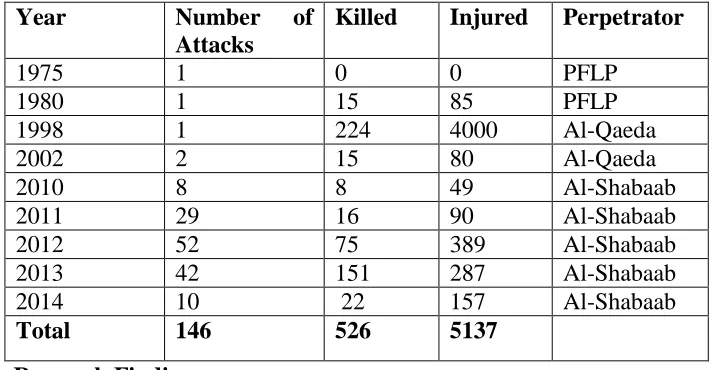
The East African region has also had its share of terrorism attacks. The 1998 attack on US embassies in Kenya and Tanzania and the foiled attack in Uganda confirmed the presence of international terrorism (in this case al-Qaeda) in the region (Shinn, 2004).Accordingly, in 2002, Kenya witnessed a major attack on the Paradise Hotel along the Kenyan coast town of Mombasa. The attack killed 12 people and injured 80 people (Botha, 2013; Kagwanja, 2006).
5
(Blanchard, 2013) across the country. Some of these attacks have been a counter attack to Kenya’s military intervention in Somalia in an attempt to restore peace.
In Kenya, the attacks have proliferated due to a combination of international and domestic factors. These factors range from: the porosity of Kenya’s borders; the Dadaab refugee complex; presence of urban refugees; corruption; the perceived close ties with the West; unstable neighbours; the relatively advanced economy of the country and the perceived laxity of laws (Otenyo, 2004; Shinn, 2004; Adan, 2005; Combating Terrorism Center at West Point, 2006; and Aronson, 2013).
Terrorist attacks in Kenya have exposed fundamental shortcomings in the country's national security vulnerabilities to terror activities, thus demanding a reorganization of the country's security apparatus. This led to the revision of security sectors in order to prepare the country to meet the new and existing threat of terrorism. On their part, Uganda and Tanzania adopted the Anti-terrorism Act that criminalized funding of terrorism in 2002 as a response to terrorism. Kenya’s approach that attempted to adopt Suppression of Terrorism Act in 2003 faced a lot of criticism from civil society. This is because it was violating human rights and targeting certain religious groups mainly Muslim (Kamau, 2006; Whitaker, 2008). The three East African countries have also worked together to improve airport security and regional aviation security regulations (Combating Terrorism Center at West Point, 2006).
6
(2007), security sector reforms calls for change in regulations, department, procedures and bureaucratic reorganization.
To redress these existing flaws with national security in regard to terrorism; the Kenyan government took measures to reorganize security institutions and to rewrite laws strengthening these institutions in the fight against international terrorism. For example, the government established the National Counterterrorism Center (NCTC) in 2003 to coordinate regional counterterrorism efforts and Anti-Terrorism Police Unit (Adan, 2005; Mogire & Mkutu, 2011; Whitaker, 2008; Wycloff, 2004). There has also been increased security in and around the airports whereby passengers are subjected to screening and construction of perimeter walls around them (Whitaker, 2008).
7
The security sectors reforms have received consensus among the public in Kenya, but the change entailed in this reforms remain disputed. The reforms took the form of legislations, restructuring, professionalizing and increasing accountability of the security agencies. Despite all this, there have been continued terrorist attacks with each attack exposing fundamental shortcomings in in the security sector.
Most of the security reforms’ shortcomings relate to collection of intelligence by the
national security and coordination among security agencies, border security and prosecution of terrorist suspects. The identified shortcomings make the sufficiency of these reforms to be questionable. Nevertheless, reforms in the security sector often have implications regarding the manner in which they are instituted and implemented by government in an effort to mitigate terrorism in Kenya. It is against this background that the study sought to interrogate the efficiency of security sector reforms in curbing terrorism in Kenya.
1.2 Statement of the problem
8
government in 2011 sent its military forces to Somalia as a way of curbing terrorist activities at its roots.
Nevertheless, despite Kenya’s intervention in Somalia, terror attacks have continued to occur. Regardless of the existing comprehensive security sector reforms, Kenya has remained vulnerable to terrorist attacks and activities. This demonstrated that there was need to carry out this research to interrogate the implications of security sector reforms on Kenya’s security. This was carried out through examination of the conceptual issues and origin of global terrorism, an interrogation of trends of global terrorism in the country; the existing security sector reforms that are specifically initiated to fight terrorism in Kenya since 1998-2015; and the effectiveness and implications of these reforms on Kenya’s security.
1.3 Research Questions
The study was guided by the following research questions:
i. What are the conceptual issues and origins of global terrorism? ii. What has been the trend of global terrorism in Kenya?
iii. Which security sector reform initiatives has Kenya undertaken in the fight against terrorism from 1998 to 2015?
9 1.4 Objectives of the study
The study was guided by the following objectives:
i. To explore the conceptual issues and origin of global terrorism; ii. To examine terrorism trends in Kenya, 1998 to 2015);
iii. To analyse the reforms in the security sector relevant to fighting terrorism in Kenya from 1998 to 2015; and
iv. To assess the effectiveness and implications of the security sector reforms in mitigating terrorism.
1.5 Research premises
The study was premised on the following:
i. Global terrorism is surrounded by many conceptual issues;
ii. The emergence and growth of global terrorism in Kenya owe much to her ties with the Western countries;
iii. A number of reforms have taken place in the security sector since 1998, in reaction to global terrorism; and
iv. Reforms in the security sector relating to global terrorism have had a number of effectiveness and implications.
1.6Justification and significance of the study
10
such as Botha, 2013; Shinn, 2006; Rosenau, 2005; Rabasa, 2007 have focused on regional level in the fight against terrorism and radicalization.
These studies having a broader context of the fight against terrorism do not provide an in-depth critical analysis of security sector reforms undertaken by Kenyan government as a response to emerging threats of terrorism. The study examined the various security sector reforms and their implication in the fight against terrorism in Kenya. The nexus between security sector reform and terrorism is important for a number of reasons: to begin with, with the ever-increasing global threat and apparent tenacity of terrorists to morph and successfully kill and create fear globally, it becomes imperative that more research is carried out in order to counter terrorism.
The scholarly literature about the country’s security sector reforms and their implications in the fight against terrorism, are fragmentary and often indirectly relates to the country. Thus, the study will add to the existing literature and ongoing studies on terrorism and security studies. The rationale of the study will be to create an understanding of the reforms in the security sector and their subsequent implications in curbing terrorism in Kenya. At a time the world, and in particular Kenya, is grappling with terror threats, this study would help the government, especially intelligence to decipher the trends and influence policy formulation in counter terrorism response.
1.7 Scope and limitation of the study
11
relevant or facilitating the fight against terrorism was considered to advance the argument. The study was also restricted to Nairobi, Kenya. Nairobi was given much focus because it is cosmopolitan; the headquarters for different state security agencies; centre for policy formulation and it is constantly the target of terrorist attacks and activities as witnessed in its history.
The study considered 1998 to 2015 periods as appropriate in providing relevant information. This period is significant because it marks the major shift in the security sector reforms to deal with terrorism. However, in examining the trend of terrorism in the country, the study referred to other instances of terrorist attacks before the 1998 USA Embassy bombing.
One of the major challenges experienced by the researcher was the secretive nature of information dealing with security. In most case, the participants (state security agency personnel and the public) of the research were not willing to openly give information. However, the researcher addressed this by assuring participants of their anonymity and that the research was to be used for academic purposes. In some cases, due to terror activities, the respondents that the researcher had intended to interview cancelled the interview; however, this was delimited through by interviewing the next available member of the institution.
1.8 Literature review and theoretical framework
12
how the literature material available on the topic would help in advancing the argument by providing support for claims arrived at by the researcher.
The literature review will be organized around the following thematic issues: the conceptualization of terrorism and the concept of security sector reforms. The chapter also identified the theories used in the study and demonstrated how the different concepts in the theories were applied. As such, the study employed Securitization theory and game theory as tools in developing the discussion.
1.8.1 Global terrorism
Rapoport (2004) analyses different waves of terrorism such as the ‘anarchist wave’, which he considers to be the first international terrorism. This was followed by ‘anti-colonial wave’, which began in the 1920s and lasted for about forty years, which was followed by the ‘new left wave’, which diminished when the twentieth century closed. The final wave is the ‘religious wave’ that emerged in 1979 driven by religious fundamentalism emanating from Islam. This study takes a general look to the emergence and growth of terrorism by highlighting the amorphous nature of terrorism. The present study approached terrorism from a wider perspective based on the changing nature of terrorism in Kenya.
13
Afghan-Soviet conflict, and the collapse of the Cold war. In discussing this, he highlights the various terrorist activities attributed to Islamist ideals from 1979. Shughart’s study focused on terrorism in the western countries and Middle East countries thus glossing African countries. Therefore, the present study was a worthwhile undertaking to address this gap in the scholarship.
Shinn (2006) argues that there exist three different types of terrorism in Horn of Africa (HOA) and East Africa (EA). These are terrorist attacks perpetrated by organizations based outside the region such as al-Qaeda; those of organizations within the region, but directed to the neighbour; and lastly domestic terrorism such as the attacks by the Lord Resistance Army against the government of Uganda. However, Shinn’s study does not provide a comprehensive analysis of terrorism in Kenya given the fact that it is one of the countries in the region that has served terrorism brunt. It is within such research paucity on Kenya that my study proceeds.
14 study addressed.
Rosenau (2005) gives the same reason as Adan (2005) as to why the country is always a target of terrorist activities. He points out that the country has been a venue for international terrorism since 1980 when the Palestinian Liberation Organization (PLO) sympathizers bombed Norfolk hotel in Nairobi as retribution for Kenya’s assistance to Israel during rescue operations in Uganda. This was retaliation against Kenya for allowing Israel military planes to refuel in Nairobi during their raid to free Israel hostages at Uganda’s Entebbe Airport, in 1976. However, he rejects the notion that there exists radical Islam in EA, and in his opinion, some US government officials have exaggerated the case. This argument, however, fails to capture the current presence of radicalization of the youth in Kenya and its implication on security reforms. Therefore, my study grappled with this in an attempt to provide appropriate solutions to terror attacks.
15
various security reforms put in place by the government therefore my study addresses this gap.
Shinn (2004) in his article Fighting Terrorism in East Africa and the Horn outlines the increasing importance Africa in the battle against terrorism after the September 11th, 2001 attack in the U.S. He argues that charities sponsored by Saudi Arabia and other Persian Gulf states have probably financed terrorism in the region including Kenya. These charities are closely linked to the effort to promote fundamentalist Sunni Islamic creed popularly known as Wahhabism (p. 39). He also discusses the cooperation between the Kenyan government and the US government in an effort to fight against terrorism in the region. The study, however, does not provide the changing trend of terrorisms in the country, which my study pursued.
Mwazighe (2012) discusses the legal responses that the Kenyan government has taken in order to provide legal mechanisms in dealing with terrorism. The author takes a critical look at the Suppression of Terrorism Bill 2003, which was shelved due to criticism by civil society and religious leaders, and the Prevention of Terrorism Act 2012 which was enacted in 2012. He also evaluates the sufficiency of the Kenyan criminal-justice system, the British legal response to counterterrorism as a basis for comparison, and current counterterrorism legislation. However, the study failed to provide trends and changing nature of terrorism in Kenya. Nonetheless, it does not provide a comprehensive study of other counterterrorism measures; therefore, my study filled these gaps.
16
recent anti-terror laws, including the involvement of the USA and others in that process. After 9/1, most developing countries adopted various antiterrorism legislations, which were not clear on the definition of terrorism. Some adopted legislations due to international pressure to attract more funding in the fight against terrorism. Nonetheless, Kenya’s attempt received opposition from civil society due to perceived American influence in drafting the bill. The bill created tension between freedom and security; thus, had implications on the ongoing processes of democratization. Despite, this analysis the author only focussed on the legislation aspect, but my study looks at both legislation and institutional reforms in the fight against terrorism.
Mogire and Mkutu (2011) critically examine the counterterrorism measures that have been taken in Kenya in response to the attacks and threats made in the country. They describe the measures, the rationale and motivations behind them and assess their effectiveness. They argue that while these measures are aimed at addressing the perceived main causes of terrorism in Kenya, the assumptions upon which they are based are often flawed, do not have domestic support and are externally imposed, primarily by the US, and hence are often criticized as a tool of US imperialism (pp. 473). They point out that the price of these measures has been high in terms of the negation of the civil and human rights and freedoms. However, in their study, they do not analyse the changing nature of terrorism in Kenya, which my study does.
17
in Kenya, he considers the country to be a target of global terrorism because of a combination of geographic, regional, historical, political, economic and socio-cultural factors. The author also analyses terrorist attacks and activities in the country, drawing conclusion that these attacks have impacted on the country’s economy, created tension between Muslim and Christians, and have led to the erosion of citizens‘ rights and the country‘s sovereignty. Because of this, the Kenyan government has tightened security
through various security reforms and trying to find solutions to the unstable neighbours used as a safe haven by terrorists. However, he does not provide a comprehensive study of terrorism in the country and the changing dynamics due to new actors as perpetrators of terrorism, which this study, did.
Gatsiounis (2012) discusses the anatomy of al-Shabaab- an al-Qaeda affiliate. He traces the history to the al Ittihad al Islamia a terrorist group that operated in Somalia in the 1980s and 1990s. However, he places the emergence of al-Shabaab to the defeat of the Islamic Court, and the Union by Ethiopian troops backed by US government in 2006. The group has carried out various attacks in Somalia and currently poses security threat to Kenya’s national security. This prompted the Kenyan government to intervene in
18
1.8.2 The conceptualization of Security Sector reforms
Sedra (2010) conceptualizes the emergence of security sector reforms and the changing nature of what security concept demands. With the waning of the Cold War, there was a shift in the concept of security from state-centric notion to human security. This placed the security of individuals at the forefront rather than the state. This model of security is the mainstay in state-building policy and practice, as it is widely perceived as a precondition for stability and sustainable development in countries recovering from conflict or making transitions from authoritarianism, fragility or collapse (Sedra, 2010: 16). Sedra (2010) provides the general outlook of security sector reform; however, my study looked at security sector reforms in the context of fighting terrorism and how the Kenyan government has enacted various reforms to fight the vice.
19
Sherman (2010) examines the implication of “global war on terrorism” on security
sector reforms in the post September 11th, 2001 attack in the US. This resulted in revision of US national security architecture and policy, which expanded executive authority and erosion of civil liberties. Nonetheless, it led to the militarization of US foreign aid and lastly, it provided a platform for some countries to repress political dissidents under the auspice of counterterrorism. Because of this, it has become hard to reconcile the principles of transparency and democratic oversight, which guide SSR, both domestically and abroad due to the continued demands of defending the US from terrorism (Sherman, 2010, p. 60). The study only emphasizes on the case of US Despite the study focussing on the implication of the fight against terrorism on security sector reforms
20
Hanggi (2004) places the period of emergence of security sector reform to 1990s with the aim to providing efficient and effective state and human security. He attributes the emergence of the concept to non-military security issues, which posed more threat to individuals and social groups than the state. However, he notes that security sector reforms vary with reform context, depending with the country and experiences. However, like Sedra (2010) and Ball (2010) he contends that security sector reform is a precondition for countries recovering from conflict or making transitions from authoritarianism. The study largely focuses on security sector reforms in former Soviet satellite states, but my study conceptualized security sector reforms in Kenya in relation to mitigation of terrorism.
The literature reviewed above demonstrates that some studies have been undertaken on terrorism and security sector reforms in Kenya. Nonetheless, there exists a gap in the reviewed study, which requires further study. Therefore, this study addressed some of the gaps by examining the trends of terrorism in Kenya, reforms in the security sector relevant to fighting terrorism in Kenya, and the implications of these reforms. In pursuit of this, the study employed different sources of data in order to fill the gap.
1.8.3 Theoretical framework
21
the actors must always make choices that potentially affect the interest of the other player and in this case the government of Kenya counterterrorism policies and the terrorists’ choices of target and modus operandi.
Securitization theory emerged in 1990s and from then on, it has become the principal critical approach to the study of security. Securitization, as a concept, originated from the writings of Ole Wæver. Security: A New Framework for Analysis (Buzan, Waever and Wilde, 1998) which is identified as the key foundational text in securitization studies.
According to Buzan et al., (1998), securitization is an inter-subjective establishment of an existential threat, which demands urgent and immediate attention, as well as the use of extraordinary measures to counter the threat. Security, in this sense, is considered a political issue in which political actors use even extraordinary mechanisms to protect from what is perceived as a threat. The political actors in this case can be the state, the executive, and legislature. Not leaving the media aside, which also plays a crucial by securitizing the existential threat through carrying out public opinion and independent investigations, discussions, news and bulletins. Media does this through the provision of information and analysing them to extend that the political actors become convinced of the need to protect the referent object.
22
thus making security a social and inter-subjective construction. Securitized issue is always given more priority than other issues because of its importance and in this case terrorism. Terrorism is always considered as a threat to the national security and the government has always taken measures to curb it by giving it more priority despite the existence of other crimes such as corruption in the country (Kenya).
The priority that is often given to terrorism is reflected in security sector reforms that the government carries out and the frequency by which terrorism has been referred to as a threat to national security by government and national leaders. The public accepting securitization as such also boosts this. In this case, the securitization has been characterized by intervention in Somalia under the operations ‘Linda Nchi’ and the recent ‘Usalama Watch’, the increased regional and international cooperation.
In the securitization of terrorism, there exist loopholes that can be used to justify infringement on human rights, justification for security reform measures deemed inappropriate and lastly it allows the use of extraordinary means in the name of security. Thus, state as people can be paranoid, constructing threats where none exists and in doing so they ignore the actual threats. A case in point is the increasing equation of refugees to insecurity in the country.
23
and why outcomes in the political world look as they do. Hence, game-theoretic models are used to provide insight into outcomes (Conflict, and cooperation) that are jointly produced by choices made by distinct actors (States, groups, or individuals). Those choices result from a decision process based on assumptions about the goals, actors have, about the knowledge those actors have about the goals of other actors, and about what those other actors may know in turn. According to Sandler and Arce (2003), terrorists’
choices will be influenced by those of government and vice versa.
Sandler et al., (2003) argues that game theory is suitable for analysing terrorism since it captures the strategic interaction between the terrorists and the governments that they target. In sequential interdependence, the players and in this case the terrorists and the government move in sequence and each knows each other’s previous actions. In
sequential interdependence (in this case the terrorists and the government) each player should figure out how the other players will respond to his current move, how he will respond in turn, and so on. In this case, the government in pursuit of security reforms to curb terrorism often anticipate the reaction of terrorists similarly by terrorists in carrying out their attacks. The terrorists will always calculate the cost and benefits of their various moves, but the state should always counter these by reducing the benefits or increasing the cost of terrorism, or even both.
24
kidnappings, which have remained pronounced in the current attacks. Nonetheless, improved security in Nairobi County has raised the cost of attacks targeting the county forcing the terrorists to shift to vulnerable targets in other regions.
The rationality requirement of game theory is viewed as simply the requirement that individuals’ actions are consistent with their preferences and beliefs. However, these limits the theory as in certain scenario the government cannot always stick to its preferences in fighting terrorism as some actors such as human rights activists and civil society will always intervene making the government to reconsider its policies. This will always work against the government giving an upper advantage to the terrorists, since for them it would mean reduced governments’ heavy handedness in dealing with them. This makes game theory unsuitable in explaining security reforms aimed at curbing terrorism.
Even though securitization have shortcomings, it remains the key theory for explaining the security reforms in curbing international terrorism, since the government will always secure the country against terrorism. This is because terrorism is the single most national threat to sustainable development, therefore, security sector reforms and Kenya’s intervention in Somalia should be seen in this light.
1.9 Research methodology
25
1.9.1 Research design
The study adopted a descriptive design to analyse security reforms and their implication in fighting international terrorism in Kenya. This design was significant because it provided an in-depth examination of the phenomena of the study through ascertaining attitudes, values and opinions.
1.9.2 Research location
The study was carried out in Nairobi City (see appendix A5). Nairobi is the capital city of Kenya founded in 1899 by the colonial authorities and is located within Nairobi City County at 1°17′S 36°49′E and occupies 696 square kilometres. It is considered the economic beacon of the East Africa and Horn of Africa with an estimated population of 3.1 million as per the 2009 population census. It is host to many international organisations, foreign embassies and consulates and the headquarters of Kenya security agencies.
1.9.3 Targeted population
26
knowledge and to a limited extent organizational representation.
1.9.4 Sampling technique
The study used both purposive sampling and snowballing sampling techniques. Purposive sampling was used, because the participants were considered by the researcher to be having the vital information for the research such as security experts, civic groups that deal with security matters. Snowballing sampling was used because the sensitive nature of the study, thus the knowledge of the insiders is required in order to locate participants of the study. However, in some cases the researcher used convenient sampling whenever some of respondents (specifically security officers) that were to be interviewed were not available on the day of the interview. Therefore, the researcher interviewed respondents who were available but from the same institution.
1.9.5 Data generation
27
explained, therefore strengthening the analysis. Nonetheless, the secondary data were subjected to critical analysis.
1.9.6 Data analysis
The Data processing and analysis was carried out in accordance with the objectives of the study. This was important because it provided an insight for ensuring that all relevant data for each objective was available. The qualitative data analysis was conducted by coding the collected data and then analysing them thematically. The secondary data were subjected to critical textual analysis and interpretation to examine the relevance and accuracy of the document for the purpose of the study. The analysed data were reported in the form of narrative with first hand quotation from the primary data.
1.9.7 Ethical considerations
28
CHAPTER TWO
2.0 CONCEPTUAL ISSUES AND ORIGIN OF GLOBAL TERRORISM 2.1 INTRODUCTION
The September 11, 2001 attacks in the United States provided a surge for research in international terrorism and placed it at the top of the international agenda. The discourses focused on the understanding of the phenomena in terms of modus operandi, trend, causes, facilitating factors and finding ways of prevention of future attacks. Therefore, the study addressed the following questions: why is it that there is no comprehensive definition of terrorism? What does the history of terrorism look like? What are some characteristics of terrorism? Is terrorism morphological in nature? This chapter discusses the general debates about terrorism globally in an attempt to answer the above questions.
2.2Conceptual issues and definition of terrorism
Terrorism has been used since the beginning of recorded history. Despite this, its definition has remained elusive and this has presented a problem of coming to a common understanding of what it entails and what it does not. This also presents a possibility of condemning one form of terrorism and accepting the other. Cronin (2003) attributes, challenges faced in the definition of terrorism partly to its changing nature and its association with activity that is subjective. It is a matter of perception thus different individuals have different perception of what it is (Cronin, 2003) therefore making it subjective.
29
definition of terrorism often find cliché with the maxima 'one man's terrorist is another man's freedom fighter'. According to Stern (2000), there exist many definitions because some focuses on the perpetrators, others on their purposes and others on their techniques. The problem of definition is also because some focus on the terrorist organizations mode of operation while others emphasize the motivations and characteristics of terrorism (Nzau, 2010, p. 166).
The subjective nature of terrorism has been manipulated by certain governments for their own benefits by referring to the actions of their opponents as terrorism. These are used to justify their totalitarian actions against the opponents. In Uganda, president Museveni invoked the Anti-terrorism Act against the opposition leader Kizza Besigye (Kagwanja, 2006, p. 78). Furthermore, radio stations in Uganda were banned from airing interviews with Besigye and anyone considered in aiding him in his propaganda was perceived to be promoting terrorism (Mazrui, 2007, p. 69).
non-30
combatants, calculated to instil fear in the audience beyond the victims” (p. 243).
Stern (2000) defines terrorism as ‘an act or threat of violence against non-combatants with the objective of revenge, intimidating, or influencing an audience’ (p. 11). Kegley and Witkopf (1995) refer to terrorism as ‘criminal acts and threats against the targeted actor for the purpose of arousing fear in order to get the target accept the terrorist demands’ (p, 222). According to Snow (2007) terrorism is “the commission of atrocious acts against a target population normally to gain compliance with some demands the terrorists insist upon” (p, 276).
The above sampled definitions demonstrate that terrorist acts are aimed at generating fear or intimidating the targeted audience. However, the definition of terrorism remains a problem depending on who is defining and identifying it, and the circumstances in which the definition is made. It is in light of the above that the basis of the proceeding debate on the origin of terrorism is grounded. However, in this study terrorism was conceptualized as violence perpetrated by non-state actors against soft targets with the sheer purpose to influence responsive government to accept their demands. Nonetheless, under this study terrorism is treated as a criminal act.
2.3 Characteristics of terrorism.
31
infrastructures. This, according to Wardlaw (1989) demoralizes citizens by causing loss of faith in the ability of the government to guarantee their safety. However, behind these acts are motivating factors, which often vary from one terrorist group to another.
In attempting to unearth the motives of terrorism, Duiker and Spielogel (2001) articulate that the motivations for terrorist acts vary considerably. For instance, the Baader-Meinhof gang (Red Army Faction) in Germany and the Red Brigades in Italy used revolutionary terrorism to bring down the capitalist system with the motivation being ideological. The salient issue discussed by most scholars is that terrorist acts are not mainly directed at the victims who are either killed or maimed in the attacks but to those who are watching. In this regard, the aim to inculcate fear, intimidate and frighten the target audience (Snow, 2006; Hoffman, 2004; Rourke & Boyer, 2004; Jenkins, 1974). Jenkins (1974) builds upon this by concluding that terrorism is a theatre because the audience targeted is composed of those who are watching.
Hughes (1991) concurs with Jenkins (2004) adding that the media attention and the global spotlight are greatly needed for this to be realized (p, 212). The importance of media in all these has created symbiotic relations between the media and the perpetrators of terrorist incidences (Wardlaw, 1989). However, Kegley & Blanton (2011) argue that terrorism is no longer a theatre, since terrorists want to kill more people. This is driven by searing hatred, annihilating the enemies rather than winning sympathy for their cause (Kegley & Blanton, 2011, p. 247).
32
Secondly, it is non-state based. Thirdly it often targets innocent non-combatants and finally the act itself is illegal (Jenkins, 1974; Stern, 2000; Cronin, 2003; Hoffman, 2004; Snow, 2006). The illegality of terrorism thus makes it a criminal act. However, Hoffman (2004) notes that for an act to qualify as terrorism, the violence must be perpetrated by an organizational entity with some clear cut structure and identifiable chain of command beyond a single individual acting on his or her own (p. 840). Jenkins (1974) reiterates this in International Terrorism: A New Kind of Warfare in which he distinguishes terrorism from other forms of crime that may have terrific outcomes, but not terrorism in nature.
Another key feature of terrorism lies in their goals. Jenkins (2004, as quoted in Snow, 2006) and Wardlaw (1989) discuss some of the six goals: such as exacting special concession for example the release of prisoners. It is also a way to gain publicity, and to create disorder in the society. In certain cases, it is aimed to provoke overreaction by the government by either repressive laws or counter-terrorism policies.
33
Nonetheless, terrorism is an asymmetric form of conflict. This is because the terrorists cannot compete with their targets through accepted conventional methods of the target society (Snow, 2006). Kegley and Wittkopf (1995) consider acts of terrorism as acts of the powerless against the powerful and could be the reason why small clandestine groups have adopted it.
Terrorism does not recognize the rules and conventions of war making the continuous use of the dictum ‘Global War on Terrorism’ adopted after the 9/11 misguided due to the stateless and faceless nature of terrorism (Shane, 2009). With the destruction of terrorist sanctuaries in Afghanistan, terrorism has morphed becoming stateless and decentralized (Snow, 2007). The transformation of terrorism is indicative that the perpetrators are rational therefore; they change tactics in face of government or global counterterrorism measures. Their actions are dependent of counterterrorism, hence reinforcing game theory. In this regard, the sustained use of the term implies that the enemy (terrorism) can be defeated, which is not the case (Snow, 2007).
34
physical ones, undefined chain of command, operates globally and ability to spread their message (p. 103). An idea, according to Snow (2007) cannot be defeated, but one can oppose and subdue those people who act on the idea by discrediting it (p. 274).
These analyses of characteristics of terrorism provide a foundation for understanding what terrorism is and what it is not. It is upon this that the origin of terrorism is grounded in order to demonstrate the morphological nature of terrorism globally. Therefore, what is the origin of global terrorism and when did it emerge?
2.4Origin of global terrorism
However, terrorism has been in existence for many centuries as noted earlier, there is need to highlight various instances instrumental in the development of terrorism. This helps in limiting the extend to understand the problem
35
As noted earlier terrorism as a phenomenon has continued to morph itself over a period. During each stage, it reflects different characteristics; however, in certain cases the characteristics overlap into other periods, thus presenting no clear-cut differences. Nonetheless, in examining how terrorism has morphed itself, the discourse is organized around four overlapping waves of terrorism as discussed by Rapoport (2004) in his work:
The four Waves of Modern Terrorism. These four waves include: first ‘the anarchist wave’; second ‘the colonial wave’; third ‘the new left wave’; and fourth is ‘the religious wave’ (Rapoport, 2004, p. 47). The growth of the four waves of terrorism is important in understanding how terrorism has morphed itself, thus; in the analysis of origins of terrorism, the four stages will form centrepiece of analysis of terrorism.
The period 1881-1914, terrorists advanced their cause by assassinating prominent figures, for example, the assassination of the United States president, William McKinley in 1901, and the assassination of Archduke Franz Ferdinand of Austria 1914, among others (Rapoport, 1990). During this period, international terrorism was marked by anarchical activities even though most were revolutionary.
36
In 1930s, the term terrorism acquired a different meaning (Hoffman, 2004). It became less associated with revolutionaries, but was associated with state sponsored terrorism: where the totalitarian government conducted acts of terrorism to intimidate and frighten their own population into submission and also in the building of empires (Rapoport, 2004; Cronin, 2003). Like the Fascist Italy, Nazi Germany and Stalinist Russia and also Saddam Hussein’s government atrocities against the Iraqi Kurds (Stern, 2000). This is
supported by Snow (2006) who contends that states have always been the leading terrorists and these are often manifested using government organizations such as secret police. This trend later emerged in 1980s when states begun again to 'sponsor' terrorism to control their destiny (Rapoport, 2004).
During the periods of the 1940s and 1950s, it was used to refer to nationalist movements in the Third World countries, which were fighting the colonial governments to obtain their independence. These movements applied terrorist activities against the colonial governments through kidnappings and killing of colonial government officials, attacking colonial infrastructures. According to Cronin (2003), the aim of these activities was to fight against the colonial powers.
37 2003; Rapoport, 2004).
From colonialist standpoint, the fighters were terrorists, but on the contrary the alleged ‘terrorists’ were freedom fighters for Africans and their sympathizers. However, the difference should be drawn between anti-colonial insurgents and the modern terrorists. As much as the attacks of the former sought international attention, they were within the colonies unlike the latter's case which is worldwide (Jenkins, 1974).
The period 1960-1970 saw the concept expanded to include ethno-nationalists, ideologically motivated organizations and exiled nationalists such as the Palestinian Liberation Organization (PLO) (Hoffman 2004). These new groups adopted terrorism as a way of drawing attention to their course and international support. The PLO believed that it was only through terror that Israel’s would be removed from the Palestinian occupied lands (Rapoport, 2004).
38
This set the precedence of the current wave of terrorism. The ‘religious wave’ kind of terrorism emerged in 1979 and was characterized by fundamentalism and fanaticism often emanating from Muslim countries (Cronin, 2004; Rapoport, 2004). According to Cronin (2003), besides religion, such kind of terrorism reflects the sentiments of anti-globalization and struggle between the developed and developing countries. The developing nations perceive the spread of Western nations’ cultures as a threat to their
own culture therefore creating tensions. As Rapoport (2004) puts it, during this period terrorism equally acquired notable political hope from Islam and its success thus, acting as a motivational factor for other zealous religious terror groups in different regions.
The target group from 1979 to date remains the United States and other Western countries and their allies. This form of terrorism resulted from the frustration among the population in the Arab and Muslim world, which are against the US- led globalization campaign rather than technological advancement of the US as some scholars have put it (Cronin, 2003).
39
It is within such a discourse that the 9/11 attack should be understood because much of the terrorists have been targeting US citizens and structures across the globe. It is alleged that the bombing of American Twin Towers was because of contemporary US foreign policies, which is the root of al-Qaeda’s animosity for the United States (Shane, 2009, p. 99). However, the growth of this kind of terrorism is alleged to be rooted in the Muslim world.
Botha (2013) and Rapoport (2004) outline some events that happened in the Islamic world that propelled the emergence of the current wave of terrorism. The Iranian revolution in Rapoport’s view disintegrated the Shahs secular state and demonstrated that religion had appeal that is more political. This provided enthusiasm for the Iranians to assist terror groups outside Iran such as the Shiite movements in Iraq, Kuwait, Saudi Arabia and Lebanon. According to Mamdani (2004), the revolution produced a nationalist’s regime that acted independently of all foreign influences, with the specification of the United States.
40
The withdrawal of the Soviet troop from Afghanistan in 1989 marked the end of the confrontation. This Afghan-Soviet confrontation led to the rise of Osama bin Laden and al-Qaeda and its influence in the broader region (Botha, 2013). Osama, according to Shane (2009), was not against the American culture, but was against its political and military policy in the Muslim world. Nevertheless, he exploited the US foreign policy supporting Israel over Palestine. This, according to bin Laden was a Christian-Jewish conspiracy with the intention of destroying Islam and allowing oppressive Arab regimes to remain in power (Shane, 2009, p. 102).
The Israeli-Palestinian conflict, though beyond this study, stems from competing Jewish and Arab claims to the land in Palestine. Jewish claims to this land are based on the Biblical promise to Abraham and his descendants, while Palestinian Arab claims to the land are based on their continuous residence in the country for hundreds of years and the fact that they represented the demographic majority until 1948 (Benin & Hajjar, 2000, p. 1). To address this, the United Nation General Assembly of November 29, 1947, partitioned the land of Palestine into two, one Jewish and the other Arab of which Jewish state got the largest share (Beinin & Hajjar, 2000).
41
who perceived this assistance as US support for persecution of Palestinian Arabs by the Israelis (Rowley & Taylor, 2006).
The third motive for bin Laden’s animosity against the US was the presence of US forces in Saudi Arabia following the1991US-led Gulf War and the incursion of US troops in Somalia in 1992, after the fall of Siad Barre’s government (Shane, 2009). Thus, in 1996, he called for a holy war against the United States and her allies and this was later followed by religious ruling called Fatwa (declaration of war) on February 23, 1998 (White, 2003: 55; The September 11 Commission Report, 2004: 69). Part of the fatwa reads:
On that basis, and in compliance with God’s order, we issue the following fatwa to all Muslims: The ruling to kill the Americans and their allies-civilians and military-is an individual duty for every Muslim who can do it in any country in which it is possible to do it, in order to liberate the al-Aqsa Mosque and the holy mosque [Mecca] from their grip, and in order for their armies to move out of all the lands of Islam, defeated and unable to threaten any Muslim. (Shane, 2009, pp. 104-105)
42
influence in the Middle East (Botha, 2013). This opposition spilled over into Africa, which has seen increased terrorism activities across the continent.
2.5 Terrorism in Africa
Since 1990’s, the African continent has witnessed an escalation of international terrorism, which has led to loss of lives and destruction of property. The major terrorist groups operating in the continent include, but are not limited to Boko Haram that forbids Western education in Nigeria, al-Shabab in the horn of Africa and al-Qaeda in the Islamic Maghreb (AQIM), which operates in Algeria, Morocco and areas along the Sahara (Ankomah, 2014). In the recent Global Terrorism Index report (2014), Nigeria bares the highest number of attacks in Africa and is position four globally. Somalia follows Nigeria closely at position seven and Kenya at position twelve (Institute for Economics and Peace, 2014)
Though terrorism is not a new threat or concept for communities and governments in Africa, what is perturbing is that Africans often use Western models to categorize terrorism, the tactics used and its impact (Botha, 2008). However, the use of Western concept should not repudiate the existence of terrorist activities in Africa from 1990s, when al-Qaeda and Osama bin Laden operated in Sudan (Kagwanja, 2006; Rabasa, 2010). This saw Al-Qaeda playing a role in the attacks on American and United Nations forces in Somalia during the humanitarian intervention that began late 1992 (Shinn, 2007).