Implementation of Multi-Step Differential Transformation Method
for Hyperchaotic Rossler System
Chaluvaadi Vamshikrishna
M.SC(Maths)Department of Mathematics, Osmania University
Abstract: - In this work, the multi-step differential transformation method (MSDTM) is applied to approximate a solution of the hyperchaotic Rossler system. MSDTM is adapted from the differential transformation method (DTM). In this method, DTM is implemented in each subinterval. Results are compared with a fourth-order Runge Kutta method and a standard DTM. The results show that the MSDTM is an efficient and powerful technique for solving hyperchaotic Rossler systems and this method is more accurate than DTM.
Keywords: Hyperchaotic Rossler system;
Differential transformation method; Forth-order
Runge Kutta method; Multi-step differential
transformation method.
1. Introduction
The behavior of dynamical systems such as circuits, mechanical devices, population growth, fluid dynamics, and weather are studied in a field of mathematics known as chaos theory. A chaotic system shows sensitivity to any tiny change in the initial conditions, so it has unpredictable behavior. In
other words, it is impossible to predict the future behavior of a chaos system unless the initial conditions are entirely known and accurate. The first chaotic system, known as the Lorenz system, was discovered in 1963 by Lorenz for solving equations describing atmospheric flows [1]. Inspiring from Lorenz, Otto Rossler proposed a chaos system, known as Rossler system or Rossler attractor, resulted from studying a chemical reaction system[2]. This system contains three prototype first-order diferential equations with three dynamical variables in defining the phase space and three parameters. This system has been thoroughly studied by many researchers; (see [3, 4, 5] for more details). Continuing his work, In 1979 Rossler proposed another dynamical system which was made of four first order differential equations as following (see [6]).
Hyperchaotic Rossler system is the first four dimensional hyperchaotic system. This system
contains four prototype ordinary differential
equations as the following
Where x, y, z, and w are state variables and a, b, c, and d are positive parameters. It is well-known that this system exhibits hyperbolic behaviour when a = 0:25, b = 3, c = �0:5, and d = 0:05. Here, with respect to these values of constants a, b, c, and d,
Rossler system is studied by differential
transformation method and multi-step differential transformation method in order to find its approximate solutions. see [7, 8, 9] for more details. This paper is organized as follows: Section 2 presents some basic concepts of differential transformation method, facilitating the understanding of the ideas presented in this work. The multi-step differential transformation method and some important details
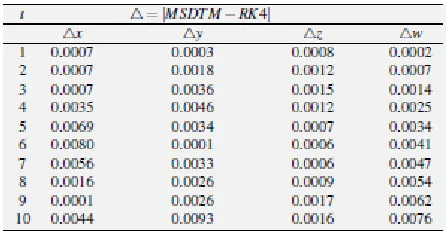
pertaining to MSDTM will be addressed in section 3. Section 4 is devoted to showing the efficiency and the accuracy of the proposed method by applying MSDTM, R.K. and traditional DTM on the Rossler system and the results are presented in some tables. So, the results can be compared. Some conclusions are drawn in section 5.
Therefore, by combining (2) and (3), the following equation will be obtained.
In fact, the concept of differential transformation is gaind from the Tylor series expansion. In order to understand how this method is implemented in Rossler system, it’s enough to know some essential properties of DTM [9].
3. Multistep Differential Transform Method
According to the knowledge one learns from section 2, DTM determines a series solution,by a recurrence relationship, over the whole domain. This approximate solution is valid in the neightborhood of a fixed point t0. Therefore, the series solution always converges in a small region and this is a drawback of DTM. In order to
enhance the efficiency of DTM,the idea of MSDTM is introduced. see [7] for more details and examples. Consider
the following system of differential equations
subject to the following initial conditions
Where D is the first order differentiation operator. Let [0;T] be the whole interval in which the solution of considered initial value problem (5)-(6) is going to be find. In the multi-step differential transform method (DTM), the initial interval [0;T] is divided into M subintervals [tm�1; tm] , of equal step size h= T M , by using the nodes tm =mh, m = 1;2; _ _ _ ;M. After that, the DTM will be applied in each subinterval.
4. Application
Applying the differential transformation method to the hyperchaotic Rossler system (1) gives
where X(k), Y(k), Z(k), and W(k) are the differential transformations of the corresponding functions x(t), y(t), z(t), and w(t), respectively. The initial conditions are given by
Table 1: Table 1. Differences between 10-term DTM and RK4 solutions
5. Conclutions
In this paper, both differential transformation method (DTM) and multi-step differential transformation method (MSDTM) have been succesfully applied to compute an approximated solution of hyperchaotic Rossler system. In spite of requiring more computations in MSDTM, because DTM is applied on a thousand subintervals,but more accurate results are obtained. These results also show that the approximate solutions obtained by MSDTM are valid for a long time interval, while DTM fails to achieve this accuracy.
References
[1] E. N. Lorenz, “Deterministic non-periodic flow”, Journal Of the Atmospheric Sciences, Vol.20, (1963), p.p 130-141.
[2] O. E. R¨ossler, “An equation for continuous chaos”, Physics Letters A,Vol. 57, (1976), p.p 397-398.
[3] Dimitris T. Maris, Dimitris A. Goussis, “The ”hidden” dynamics of the Rossler attractor”, Physica D: Nonlinear Phenomena, Vol. 295–296, (2015), p.p 66-90.
[4] R. Barrio, F. Blesa, A. Dena, S. Serrano, “Qualitative and numerical analysis of the Rossler model: Bifurcations of equilibria”, Computers Mathematics with Applications, Vol. 62, Issue 11, (2011), p.p 4140- 4150.
[5] R. Barrio, F. Blesa, S. Serrano, “Qualitative analysis of the R¨ossler equations: Bifurcations of
Nonlinear Phenomena, Vol. 238, Issue 13, (2009) p.p 1087–1100.
[6] O. R¨ossler, “An equation for hyper chaoti”, Phys Lett A, Vol. 71, (1979), p.p 155-7.
[7] E. Abuteen, S. Momani, A. Alawneh, “Solving the fractional nonlinear Bloch system multi-step generalized differential transform”, Computers Mathematics with Applications, Vol. 68, Issue 12, Part A, (2014), p.p 2124-2132.
[8] A. Arikoglu, I. Ozkol, “Solution of fractional dierential equations by using dierential transform method”, Chaos, Solitons and Fractals, Vol. 34, (2007), p.p 1473-1481.