Western University Western University
Scholarship@Western
Scholarship@Western
Electronic Thesis and Dissertation Repository
4-24-2017 12:00 AM
Practical Attacks on Cryptographically End-to-end Verifiable
Practical Attacks on Cryptographically End-to-end Verifiable
Internet Voting Systems
Internet Voting Systems
Nicholas Chang-Fong
The University of Western Ontario
Supervisor
Dr. Aleksander Essex
The University of Western Ontario
Graduate Program in Electrical and Computer Engineering
A thesis submitted in partial fulfillment of the requirements for the degree in Master of Engineering Science
© Nicholas Chang-Fong 2017
Follow this and additional works at: https://ir.lib.uwo.ca/etd
Part of the Information Security Commons, and the Software Engineering Commons
Recommended Citation Recommended Citation
Chang-Fong, Nicholas, "Practical Attacks on Cryptographically End-to-end Verifiable Internet Voting Systems" (2017). Electronic Thesis and Dissertation Repository. 4533.
https://ir.lib.uwo.ca/etd/4533
This Dissertation/Thesis is brought to you for free and open access by Scholarship@Western. It has been accepted for inclusion in Electronic Thesis and Dissertation Repository by an authorized administrator of
Cryptographic end-to-end verifiable voting technologies concern themselves with the provision
of a more trustworthy, transparent, and robust elections. To provide voting systems with more
transparency and accountability throughout the process while preserving privacy which allows
voters to express their true intent.
Helios Voting is one of these systems—an online platform where anyone can easily host
their own cryptographically end-to-end verifiable election, aiming to bring verifiable voting to
the masses. Helios does this by providing explicit cryptographic checks that an election was
counted correctly, checks that any member of the public can independently verify. All of this
while still protecting one of the essential properties of open democracy, voter privacy.
In spite of these cryptographic checks and the strong mathematical assertions of correctness
they provide, this thesis discusses the discovery and exploit of three vulnerabilities. The first
is the insufficient validation of cryptographic elements in Helios ballots uploaded by users.
This allows a disgruntled voter to cast a carefully crafted ballot which will prevent an election
from being tallied. The second vulnerability is the insufficient validation of cryptographic
parameters used in ElGamal by an election official. This leads to an attack where the election
official can upload weak parameters allowing the official to cast arbitrary votes in a single
ballot. The final attack is a cross-site scripting attack that would allow anyone to steal or
re-cast ballots on behalf of victims.
We coordinated disclosure with the Helios developers and provided fixes for all the
vulnera-bilities outlined in the thesis. Additionally, this thesis adds to the body of work highlighting the
fragility of internet voting applications and discusses the unique challenges faced by internet
voting applications.
Keywords: Internet voting, end-to-end verifiable voting, cryptography, hacking, elections
Acknowlegements
First, I’d like to thank my supervisor, Dr. Aleksander Essex, for all of his support and guidance
throughout my time at Western. Beginning in undergrad, Dr. Essex helped me truly realize my
interest in the field large by giving me the freedom to explore all I found interesting while still
helping me find my way. It is with certainty I can say I would not be here if it were not for Dr.
Essex’s guidance.
To my dear friend, Vanessa, for being truly exceptional in all that she does and inspiring me
to do the same. An endless source of personal and academic inspiration, Vanessa reminded me
of the magic in music and dance when I needed it the most. I could not have done this without
her.
To my parents at home, whose endless support really make all of this possible. For taking
care of things before they could even cross my mind and for always being understanding no
matter the situation.
Finally, thanks to Ben Adida and the Helios team for their excellent work and for handling
this situation in the most gracious manner.
Abstract i
Acknowledgments ii
List of Figures v
1 Introduction 1
1.1 Motivation . . . 1
1.2 Contributions . . . 2
1.3 Organization of Thesis . . . 2
2 Background 4 2.1 Electronic Voting . . . 4
2.2 Security Properties of Elections . . . 4
2.3 Software Independence . . . 7
2.4 End-to-end Verifiable Elections . . . 8
2.5 Categories of Internet Voting Systems . . . 11
2.6 Cryptographic Voting Systems . . . 12
2.7 Hybrid End-to-End Verifiable Voting Systems . . . 12
2.7.1 Scantegrity II . . . 12
2.7.2 Prˆet-´a-Voter . . . 13
2.8 Internet Voting in the Real World . . . 14
2.8.1 Norway . . . 14
2.8.2 Washington D.C. . . 15
2.8.3 New South Wales . . . 16
3 Helios Voting 18 3.1 Introduction . . . 18
3.2 Helios Overview . . . 19
3.3 Threat Model and Assumptions . . . 19
3.4 System Components . . . 20
3.4.1 Process Details. . . 23
3.5 Cryptography in Helios . . . 27
3.6 Related Work . . . 33
4 Cryptographic Attacks 35 4.1 Overview . . . 35
4.2 Poison Ballot Attack . . . 35
4.2.1 Implementation . . . 37
4.2.2 Detection and Mitigation . . . 38
4.3 Vote Stealing . . . 38
4.3.1 Attack Overview . . . 38
4.3.2 Vulnerability . . . 39
4.3.3 Exploit . . . 39
4.3.4 Implementation . . . 40
4.3.5 Detection and Mitigation . . . 42
5 Web Attacks 43 5.1 Overview . . . 43
5.2 XSS Attacks . . . 43
5.2.1 Vulnerability . . . 44
5.2.2 Exploit . . . 45
5.2.3 Impact and Mitigation . . . 46
5.2.4 Related Attacks . . . 46
6 Conclusion and Future Work 47
Bibliography 49
Curriculum Vitae 53
2.1 A sample ballot for elections in Canada [79]. . . 9
3.1 A screenshot of the Helios Voting Booth during the review stage. . . 21
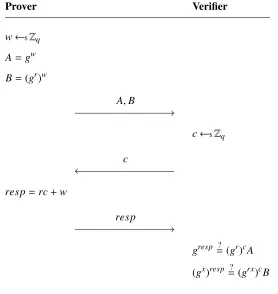
3.2 Interactive Chaum-Pedersen proof of DDH tuple . . . 31
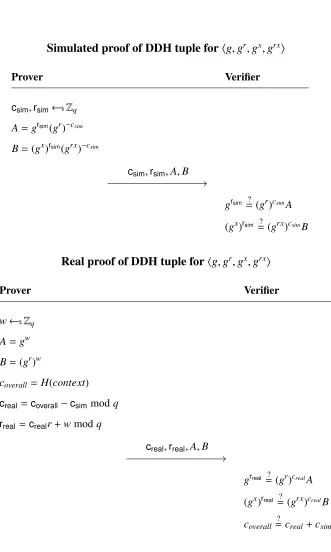
3.3 Non-interactive Chaum-Pedersen proof of DDH tuple. . . 32
3.4 Disjunctive non-interactive proofs of DDH tuple. . . 34
4.1 Screen capture of the Helios verifier in a rigged election. . . 42
Chapter 1
Introduction
Internet voting seems to be one of the few remaining dreams of the digital age yet to be realized
and for good reason. Unlike other activities that have moved online, such as banking or retail,
the security considerations that have to be made for in-person voting do not have an easy
implementation in the online world. Looking at the cities and countries that have deployed
internet voting such as Switzerland [62], Estonia [91], New South Wales [101], and Washington
D.C. [106], there are frequently more tales of woe than success.
Even in the broader field of electronic voting, researchers are frequently skeptical about
the readiness of the technology for large-scale deployment [96]. This skepticism is not driven
by pessimism but by a well-informed understanding of the complex challenges involved in
handling electronic or internet voting.
At a high level, these challenges relate to how any voting system has to protect voter privacy
while simultaneously be open and transparent all of this on top of a robust system ensuring
correctness (with indications of incorrectness) arguably above all else. Some systems attempt
to provide these services and for the most part do but as this thesis demonstrates, even
well-reviewed systems trusted by people in the research community, have oversights that cause a
system to fail to deliver a fair, end-to-end verifiable election
1.1
Motivation
Helios voting is one of the most popular internet voting systems, claiming to have tallied over
one-hundred thousand ballots, having been used by major organizations, and the subject of
many research papers [86, 88, 70, 90]. When looking for an cryptographically end-to-end
verifiable internet voting system to investigate, Helios seemed to be the perfect choice.
The overarching goal of this thesis is to help make internet voting more secure by (1)
discovering, demonstrating, and fixing vulnerabilities; and (2) adding to the body of knowledge
to help advance further development of such systems.
1.2
Contributions
This thesis makes three specific contributions to the Helios voting platform; the discovery,
exploit, and repair of three vulnerabilities that would allow:
1. A dishonest election official to convincingly rig an election by arbitrarily adding or even
subtracting votes while, perhaps most concerning, still providing a valid cryptographic
zero knowledge proof that the election tally and thus election proceeded without error.
2. A dishonest voter could cast a “poison ballot” which would prevent an entire election
from being tallied. Similar to the previous attack, the ballot had an accompanying
zero-knowledge proof of correctness. Had this not been discovered and actually used in a real
election, it is unclear whether the election officials would attribute the error to malice or
glitch.
3. Any member of the public to create a false election containing a cross-site scripting
attack that could be leveraged to steal ballots, or prevent them from being cast at all.
The discovery of the cryptographic vulnerabilities highlights a systemic failure to check
the cryptographic assumptions of the underlying mathematical structure. A problem not only
experienced in Helios but also in many widely implemented online protocols such as the Diffi
e-Hellman key exchange in Transport Layer Security (TLS) [75, 103] among others highlighting
an ongoing need for better requirements in cryptographic protocols.
The discovery of the cross-site scripting (XSS) bug highlights the fragility of the web
ecosystem and adds to the list of examples where small platform-based flaws can ruin an
elec-tion.
These results also resulted in a publication [66] which appeared at the Annual Computer
Security Applications Conference (ACSAC) in 2016.
1.3
Organization of Thesis
1.3. Organization ofThesis 3
Chapter 2contains an introduction to the broader field of verifiable electronic voting, what
security considerations need to be made, and what the current state of the technology is. To
do this, it examines the successes and failures of various verifiable voting systems used in
real-world elections.
Chapter 3 covers the cryptography that makes Helios a cryptographically end-to-end
ver-ifiable system. Topics include finite field cryptography, the ElGamal cryptosystem, underlying
security assumptions, and zero-knowledge proofs of knowledge and how all of them are used
in Helios. Additionally, this section contains information related to the system components,
architecture, and use cases of the system.
Chapter 4 demonstrates attacks against Helios’s cryptographic implementation and thus
some of its cryptographic properties. This chapter contains two attacks; the poison ballot attack
and the vote stealing attack by explaining their vulnerabilities, exploits, implementations, and
fixes.
Chapter 5discusses the existence of a cross-site scripting vulnerability and how even this
seemingly small bug can be leveraged to mislead voters and steal their ballots.
Chapter 6discusses the implications of the work, and what considerations need to be made
Background
2.1
Electronic Voting
Electronic voting is a broad collection of technologies used to assist with the various challenges
of conducting an election. For each of the many tasks involved with conducting an election,
there likely is an electronic method available to automate it. These tasks can be on the periphery
of the election process such as voter registration; directly in the voter booth such as casting and
tallying ballots; or responsible for the whole process from start to finish. However, simply
automating any or all of these steps is not enough; any election body must ensure security
measures present in a physical implementation transfer to an electronic one which is not trivial.
The design and security of electronic voting systems is the ongoing focus for many security
researchers as countries look to introduce electronic voting systems into their voting processes.
In this section, we provide an overview of various topics related to the security of electronic
and internet voting systems.
2.2
Security Properties of Elections
The conveniences afforded to us by internet-connected technologies are nearly uncountable.
For example, although it may be difficult, remember (or imagine) having to convert every
e-mail into a letter or phone call and any online bank transfer to a visit to the actual branch. These
things are rarely required now and it is not surprising that many wonder when the conveniences
afforded to other activities will find their way to voting. Unfortunately, and possibly surprising
to many, securing voting is not as easy as securing these other activities and the reason lies
in the complex security requirements for voting systems. This section proceeds by examining
2.2. SecurityProperties ofElections 5
the security properties of an ideal voting system before discussing how they interact with each
other.
Voter Privacy. Voter privacy, frequently provided through thesecret ballot, is one of the most
identifiable properties of free and open democracies dating back to ancient Greece [76] and
rep-resented in Article 21.3 of the United Nation’s Universal Declaration of Human Rights [102].
The protection of voter privacy, primarily prevents abuse by coercing agents and by voters
themselves. To guarantee this privacy, a voting system should not provide any mechanism
which allows a voter to reveal their intent beyond their word.
Voter coercion is the application of force or use of intimidation by one party to influence the
voting choices of another. Without any mechanism to prove voting intent, the only assurance
a coercer has is what the potential victim reports. Without evidence, the perpetrator assumes
all of the legal risk associated with voter coercion but has no assurance of the outcome. This
imbalance is thought to have drastically reduced the prevalence of voter coercion [100].
What if the voter does not wish to exercise their right to vote but sells it instead? Although
not as clearly defined legally, opponents of the practice argue it provides an unfair economic
influence on the outcome by purchasing votes of the disenfranchised or poor. What the secret
ballot does here is similar to the case of coercion except through increased financial risk
in-stead of legal: by making it impossible to prove how one voted, the value of a purchased vote
decreases, collapsing any vote market [59].
Voter Verifiability. In current voting systems, after the ballot is placed in the box, it is then
beyond the voter’s ability to ensure the rest of the process is correctly carried out. For example,
if a ballot box were replaced, how would any voter be able to file a legitimate claim that such
an action had taken place? The answer is she cannot in the current voting paradigm. In order
to protect voter privacy, voters must give up the ability to ensure their ballot was counted.
Voting verifiability, focuses on this concern by aiming to include voters in all steps of the
election. From the casting of their ballot to the counting of all ballots. By doing this, trust is
shifted away from a relatively small number of people and put in the correctness of the process.
The field of end-to-end verifiable voting concerns itself with development of these systems and
formally defines notions of verifiability as discussed in Section 2.4.
Usability. In their seminal paper, ”Why Johnny Can’t Encrypt”, Whitten and Tygar [105]
explained the threats poor user interfaces can have on secure software. As a result of theirs
system security. It has been demonstrated time and time again [85, 97, 98] that when users are
asked to complete secure tasks on poorly designed systems, the usability will undermine the
best-intentioned security efforts. Additionally, voting is not like sending an encrypted e-mail.
Each voter usually gets one chance to perform the desired action, should it go incorrectly, it
may not be until the results are released that they realize they used the system incorrectly. We
can look to Palm Beach County, Florida where, during the 2000 U.S. Presidential Election
between George W. Bush and Al Gore, a new ballot design caused an estimated 2000 voters to
mistakenly vote for Pat Buchanan instead of Al Gore [104]. This estimate is nearly four times
larger than the margin of 537 votes [71] Bush won the state by resulting in Bush winning the
U.S. Presidency. This highlights the sensitivity of the electoral process to poor design.
As we have discussed, an ideal system would provide voters mechanisms allowing them to
participate beyond the voting process. This increased set of interactions requires the
introduc-tion of new interfaces, each with the potential to be gravely misunderstood. This is why any
voter-facing components of a secure voting system have to be designed with strong usability
considerations concerning the tasks to be performed.
Dispute Resolution. The ability to verify the correctness of election results is great but how
can a voter report an error in the process without revealing their vote? Additionally, how can
election officials be sure that any claim of error is valid while still protecting voter privacy? This
demonstrates the need for systems that are able to resolve complaints by voters, determining
the validity of the claim while also preserving ballot secrecy.
Correctness. Perhaps above all else and what the rest of these properties contribute to is
that, when the result is released, not only is it correct but the voters are convinced as such.
These properties all align with the goal of providing an election whose result the voters can be
confident in. Not only on faith in people and systems but by having evidence that the result is
correct or otherwise.
Conflicting Requirements. The biggest challenge to overcome in secure electronic voting
is the conflicting nature of these requirements. Voter secrecy involves no user being able to
prove how they voted, but voter verification should allow voters to confirm that their vote
was correctly recorded. The fulfillment of this property is only as good as the voter’s ability
to act on it. This introduces a conflict between privacy and dispute resolution. Affecting
all of these requirements, is the actual interface through which voters and officials interact
2.3. SoftwareIndependence 7
the resolution of their intersection is one of the things that makes secure electronic voting so
difficult.
2.3
Software Independence
The concept of software independence as it relates to the security electronic voting systems
was introduced by Rivest and Wack [95] and later refined by Rivest [94]. Explicitly defined as:
A voting system is software-independent if an (undetected) change or error in its
software cannot cause an undetectable change or error in an election outcome.
The main principle suggests that errors, undetected or intentional, in the software of an
electronic voting system should not be able to produce an undetectable error that can affect an
election outcome. This does not mean that voting machine software must be guaranteed to be
error free; in fact, it is likely impossible to prove such a thing or so prohibitively expensive that
it may as well be considered impossible. What this notion suggests, is that systems should be
designed with fail safes that themselves do not explicitly rely on the correctness of the system.
One need for systems to consider this a design goal is the high complexity of voting
soft-ware and the near impossibility of having zero bugs. Additionally, unlike paper ballots where a
local error may go undetected and affect only a few ballots, with software distribution, a small
error can exist in an entire county or state and while the error may be benign, it may also be
leveraged by attackers to influence elections at a larger scale than previously possible.
Since this is more of a design philosophy than a hard fact, the roads to software
indepen-dence vary greatly from application to application, but the destination is easily identifiable and
there are some recurring trends in voting systems believed to be software independent.
On the identifiability of software independent systems, Rivest suggests a thought
exper-iment such as the following: consider a malicious adversary with the ability to arbitrarily
modify or replace the voting system’s software. Even with this ability, could they produce an
undetected change in the results? If not, this system is likely to be software-independent.
There are common design elements in software-independent systems that lend toward this
property. Unsurprisingly, they all have some kind of external reference or record which is an
integral part of the security the system provides. For example, the implementation of a
voter-verifiable paper audit trail could be a way to add robustness to the otherwise highly software
dependent direct-record electronic voting machine. In this case, a receipt is printed out that
However, not all techniques need to be physical. The use of a public bulletin board on which
ballot trackers can be printed is one way of externalizing some record or knowledge about the
votes thus far which may highlight discrepancies with what voters see on a machine versus
what appears on the bulletin board.
2.4
End-to-end Verifiable Elections
End-to-end verifiable voting (E2EVV) systems, referred to as verifiable voting systems, aim
to provide strong software independence by providing mechanisms which allow any voter to
verify the ballot casting process from his or her vote throughout the counting of all votes.
To explain this, we’ll cover some of the verifiability goals (i.e., what is to be verified), the
mechanisms used to achieve them, and look at current state of verifiable voting.
Generally speaking, there are three main verification objectives of E2E verifiable voting
systems:
1. Any voter may verify his or her own ballot wascast as intended,
2. Any voter may verify any ballot wascollected as cast, and,
3. Any voter may verify that all ballots weretallied as collected.
An additional component of all verifiable voting systems is the introduction of apublic ledger
(also referred to as apublic bulletin board) on which all cast ballots are posted for the public
inspection. In order to protect ballot secrecy, these systems have some mechanism through
which voter intent is decoupled from ballot representation on the public ledger. However, this
introduces a problem; if a ballot’s public representation is obfuscated from its original intent,
how can a voter be convinced that the representation of his or her vote is actually included in the
final tally? This problem is the motivation behind the first verification objective of end-to-end
verifiable systems; cast as intended verification.
Cast as Intended. In the voting booth, a voter must first have the ability to verify that the
ballot accurately represents his or her intent before submitting the ballot. In a traditional voting
system, such as the paper-based system used in Canadian federal elections, this is
straight-forward; before submitting the ballot, a voter can visually review their ballot to make sure
the circles next to their selections are correctly marked. However, if this ballot were to be
2.4. End-to-endVerifiableElections 9
less than ideal. Knowing that ballots have to be made public for review, verifiable voting
systems separate voter intent from the ballot and one of the ways this is done through the use
of encryption.
Figure 2.1: A sample ballot for elections in Canada [79].
Consider a voter named Alice. Alice wishes to cast vote vviaballot b whereb is the
en-cryptionE() of votevunder the election’s public key,kpubexpressed byb = Ekpub(v). Without
knowing kpub, how can Alice be sure, or verify, that Dec(Ekpub(v)) = b? This is the cast as
intended verification requirement and how the requirement is satisfied depends on the voting
system. In cryptographic systems, this requirement can be fulfilled with a ballot casting
as-suranceprotocol such as the one developed by Josh Benaloh (sometimes called the “Benaloh
challenge”) which proceeds as follows [60]:
• A voter at a voting machine indicates their voting preferences by marking the ballot,
• The user chooses to encrypt their ballot,
• The machine displays the encryption of their ballot and possibly the plaintext it encrypts,
• The voter is then asked if she would like to submit or audit this ballot:
– If she chooses to submit, the ballot is digitally signed and submitted to election
officials for inclusion in the election tally and the voter is provided with a receipt
allowing them to look up their ballot on the bulletin board.
– If she chooses to audit, the ballot is printed along with random factors used to
With the plaintext, ciphertext, random factors, and knowledge of the public key, any voter
can determine whether the audited ballot was encrypted properly. The voter can audit any
number of ballots before choosing to cast the actual ballot preventing a malicious machine
from “knowing” a challenge was coming. Additionally, only a relatively low number of voters
would have to audit their ballots to provide a high level of confidence that the machines were
operating correctly although more work remains to be done in quantifying the success rate of
a malicious adversary against the Benaloh challenge.
Collected as Cast. After the voter is content with their audited ballot(s), she then chooses to
cast her ballot and is given a receipt containing a identification number unique to the ballot. A
voter can then take their receipt and compare the identification number to the public ledger to
verify that their ballot has been recorded as they cast it. For this to be most effective, the public
ledger needs to have a few properties mostly related to its accessibility or “how public” it is.
At this point, the voter has been assured that the ballot they submitted is a true
representa-tion of their intent, and that ballot was collected/recorded as it had been cast. All that remains
is to ensure that the ballots are counted correctly.
Counted as Cast. While the nature of the previous verification steps require participation
from actual voters—since they verify the correct representation of a marked plaintext ballot as
it travels from the booth to the tally—counted as cast verification can be performed by anyone
with access to the public ledger. With access to the ledger, anyone can validate two things:
1. All the recorded ballots have been tallied, and,
2. The finally tally is the correct summation of the encrypted ballot values.
Despite the large differences between E2EVV systems, the steps of verifying that an
elec-tion was counted as cast can be generalized into a few steps. First, all the ballots need to be
collected; a process not only made easier by the availability of a public bulletin board but more
trustworthy as well. The easier or more public the record of votes, the more confidence voters
or potential auditors can have that they are all verifying the actual tally. After collecting all the
ballots, an auditing body can then begin the verification process. Unsurprisingly, this process
varies from system to system but some properties to be verified include; the correctness of each
ballot, the inclusion of each ballot in the tally, and the correctness of the tally itself.
Crypto-graphic E2EVV systems such as Helios, [others], use extensive zero-knowledge proofs, and
2.5. Categories ofInternetVotingSystems 11
instead requiring larger amounts of computing resources. Physical systems are also subject to
this kind of verification but since some of them have physical elements, more work-hours and
personnel would be involved.
2.5
Categories of Internet Voting Systems
When considering the ways internet voting systems can be integrated into the larger voting
process, there are three properties which determine the system’s potential security as put forth
by Epstein in 2011 [80]; These properties are:
1. Ballot type,
2. Type of system, and,
3. Supervision.
Each of these properties can take on two values with one lending itself to being “more” secure,
creating 8 categories in total.
The first property, ballot type, refers to whether the system is one used for blank ballot
delivery ormarked ballot return. In the first case, users may receive an e-mail with a blank
ballot they are expected to print offand return via a secondary channel. Marked ballot return
(henceforth, ballot return), indicates some capability of the user to mark the ballot on the
computer and submit it online.
The second property,type of system, relates to what other functions the system is expected
to perform and can take on two values: dedicated ornon-dedicated. Dedicated machines are
only used for voting and typically are what some people see on election day and have a more
localized threat model. Non-dedicated systems can include voters’ mobile phones, laptops, etc.
Finally,supervisionrelates to whether or not the voting process issupervisedby an election
official orunsupervised. Supervised elections obviously not have less opportunity for malicious
error but also accidental error in the case the voter does not correctly follow instructions.
Epstein uses these three properties to broadly categorize the security risks of any
elec-tronic voting system. With three properties and two options, we see that this ranking has eight
positions with the least risky being blank ballot deliver, on dedicated system, in supervised
environments. From this it follow that the riskiest configuration is a marked ballot return
sys-tem on non-dedicated hardware, being used in an unsupervised environment and this is where
2.6
Cryptographic Voting Systems
2.7
Hybrid End-to-End Verifiable Voting Systems
As previously mentioned, convincing the electorate that the result of an election is correct is
essential to the stability of a free society and in order to truly be convinced, one must understand
the argument being made. Although verifiable voting can be a complex topic, a category of
systems exists that attempt to integrate well within the current voting framework. This is not
only to appeal to voters but, in some cases, also leverages the benefits of the current system.
These systems, which will be referred to as hybrid end-to-end verifiable voting systems (or
hybrid systems) for their combination of cryptographic verifiability and paper ballots.
2.7.1
Scantegrity II
The Scantegrity II [67] (Scantegrity hereafter) voting system was designed to bring E2E
verifi-able voting assurances to the conventional optical-scan paper ballot used in American elections.
First appearing at EVT 2008, Scantegrity aimed to provide the E2E verifiable properties
previ-ously mentioned with an addition; dispute resolution. Scantegrity was also the first end-to-end
verifiable voting system to be used in a legally binding government election in the United
States [65].
A lot of Scantegrity’s security properties are provided through its unique paper ballot
con-sisting of the ballot itself and a detachable receipt. The ballot portion appears similar to what
one imagines when considering a ballot; a list of candidates with empty regions or “bubbles”
next to their names where voters indicate their preference by filling in the empty region
corre-sponding to their candidate. However, in Scantegrity, within each of these bubbles, printed in
invisible ink, is a pseudorandomly selected alphanumeric code (also calledconfirmation codes
not visible until marked with the special markers available in the voting booth. In addition to
the confirmation codes, the Scantegrity ballot also contains three serial numbers designed to
allow voters to identify their ballots for verification or auditing purposes.
To vote, the voter marks the bubble corresponding to her choice using the special marker
in the booth. By using the marker with special ink, the area around the confirmation code turns
dark first, revealing the code to the voter. Eventually, the code itself turns dark too but at a
slower rate to provide the voter time to complete and submit the ballot. With the confirmation
codes visible, the voter can choose to record them on the receipt or take no action. The ballot is
2.7. HybridEnd-to-EndVerifiableVotingSystems 13
with a receipt.
After polls close, voters can check audit their ballot by logging on to the election website
and providing their ballot serial numbers. The website will then display the confirmation codes
it understands were marked on the ballot without revealing the corresponding candidate. The
voter can then compare the confirmation codes they recorded in the booth against the record.
To make verification and tallying possible, Scantegrity keeps a record of the ballot IDs, the
confirmation codes, and which bubbles were selected. Through the use of various masking
techniques the relationship between confirmation codes, marked bubbles, and ballot IDs is
hidden to preserve voter privacy.
2.7.2
Prˆet-´a-Voter
Originally developed by Chaumet al. in 2004, Prˆet-´a-Voter has been improved on over time.
For this section, we’ll be discussing the iteration described by Ryanet al. in 2009. Prˆet-´a-Voter
is a verifiable voting system that brings verifiability to the familiar paper ballot while also being
accommodating to different voting systems such as Single Transferable Vote (STV).
Prˆet-´a-Voter’s ballot is perforated down the middle into a left and right section, the left side
contains a pseudorandomly permuted list of candidates and the right side contains an empty set
of rows where the voter indicates their preference, by selecting the row corresponding to the
candidate on the left. To vote, a voter simply marks the row corresponding to her preference,
detaches the two halves, destroys the left half with the permutation, and submits the remaining
half to the official for scanning. After scanning, the voter can keep her marked portion which
serves as her receipt. At the bottom of the marked portion exists what Prˆet-´a-Voter calls a ballot
cipher which is a key part in verifying the vote and voting process.
This ballot cipher serves two purposes: it provides voters with a reference to their ballot
on the bulletin board allowing a voter to verify their ballot was included in the tally and it also
contains (either directly or a pointer to) cryptographic information related to the permutation.
Since cryptographic effort for the ballot is done before it is printed or marked, any ballot can
be audited before being marked it in contrast to Benaloh’s ballot casting assurance protocol
preserving ballot privacy.
When looking behind the scenes of Prˆet-´a-Voter, we find an election authority responsible
for ballot generation and mix network handling the decryption of votes. On receipt of an
encrypted ballot, each node in the mix network permutes the ballot one step closer to its original
representation. This prevents any group of n-1 nodes from reconstructing a ballot so long as
Chaum in 1981 [69]. After sufficient mixing, the ballots are decrypted and tallied.
2.8
Internet Voting in the Real World
Despite all of the challenges associated with internet voting, the perceived benefits are too
tempting for some governments. This section covers a few examples of elections conducted
over the internet and what lessons were learned.
2.8.1
Norway
In 2011, Norway piloted the use of a verifiable remote voting system that allowed for marked
ballot return as part of its local government elections and again in 2013 for its parliamentary
elections.
Two companies were awarded the task of delivering an internet voting system. Ergo, a
Nor-wegian company which had previously provided electronic voting systems to the NorNor-wegian
government; and Scytl, a Spanish company specializing in electronic voting systems.
Using a cryptographic system leveraging the homomorphic properties of ElGamal
cipher-texts to provide ballot secrecy and non-interactive zero-knowledge proofs of knowledge (NIZKs)
to give voters ballots were cast as intended, the companies were able to deliver a system they
believed to fulfill the main requirements of correctness, secrecy, and limited coercion resistance
as set out in the proposal.
The 2011 pilot included ten municipalities with approximately 160000 eligible voters
be-tween them and allowed for remote voting over the 30-day advance voting period. Of the
eligible voters, approximately 28000 voters submitted their ballots electronically without any
large-scale errors.
The 2013 pilot was more complicated. As technological trends moved away from Java
applets, the system had to be re-written to run in voters browsers using JavaScript. While
JavaScript cryptographic implementations were better developed, Scytl made an error in the
pseudo-random number generator (PRNG). Namely, the reuse of a seed value for subsequent
calls to the PRNG causing the first call to be sufficiently random but additional calls to be
similar to previous. This resulted in approximately 60% of all ballots cast using the same
ran-dom value in the encryption before the bug was patched. Fortunately, thanks to other security
2.8. InternetVoting in theRealWorld 15
2.8.2
Washington D.C.
In preparation for the 2010 midterm elections in the United States, Washington D.C.’s Board of
Elections and Ethics (BOEE) piloted an internet voting system it named the D.C. Digital
Vote-by-Mail Service. The system would allow overseas and military voters to cast their absentee
ballots online.
Ahead of voting, voters were to receive a letter with instructions and a sixteen-character
PIN that would allow them to log onto the website. The ballots were represented as PDF files
that voters would download, mark using an appropriate PDF editor, and upload them to the
voting server where they were to be encrypted upon receipt. After voting was complete, these
ballots were to be collected on a single machine, printed, and counted among the rest of the
ballots.
In a refreshing act of transparency, BOEE decided to host a mock election and invited the
public to test the system’s stability and security [78]. This trial started September 28, 2010 and
was scheduled to end three days before the system would be made available for actual voters.
Unfortunately, it only took a couple of days before a team of researchers from the University
of Michigan completely compromised the voting system; gaining unlimited access not only to
the system, but to the infrastructure it ran on [106]. This was made possible by poorly sanitized
string handling—particularly, the use of double quotes instead of single quotes—allowing the
researchers to run arbitrary commands on the server.
With this access, the researchers were able to change all of the previous votes in addition
to writing software that would allow the modification of all future votes yet to be received. In
addition to modifying the ballots, the team was able to read any ballot as it was received,
break-ing the secrecy of the vote. In addition to compromisbreak-ing the election, they also compromised
the data center hosting the election by gaining access to the data centers surveillance cameras.
It took election officials two days to realize that the intrusion had taken place even though the
researchers modified the system so that a song would play after the voter submitted their ballot.
Unsurprisingly, BOEE decided not to proceed with internet voting for the 2010 midterm
elections in November as the letters containing PINs could not be corrected in time and,
al-though the vulnerability may have been small, the research team could not guarantee there
were not other vulnerabilities. This case really highlights the impact seemingly small
2.8.3
New South Wales
New South Wales, a state on the East coast of Australia, conducted the largest internet voting
deployment during its 2015 state election. Through the use of its iVote internet voting system,
it was designed to accommodate the return of up to 280000 ballots.
Before voting, voters had to register in person, over the phone, or online. After registering,
the user received an 8-digit ID and selected a 6-digit PIN. To vote online, the voter logged on
to the service, authenticated themselves with their credentials, cast their ballot, and received a
receipt with a 12-digit ballot tracking number. Votes were encrypted client-side, uploaded to
the iVote servers, and verified by a third-party.
Until polling closed, voters could phone a verification service, provide their credentials
and ballot tracking number to then have their vote read back to them. Additionally, beyond the
close of polls, voters could use the ballot tracking number to verify that an associated ballot was
included in the final tally although they would not receive any information about the contents
of the ballot.
Shortly after the polls opened and iVote was made available to voters, a pair of researchers,
J. Alex Halderman and Vanessa Teague, performed an unofficial security audit of the system.
Without source code or voting credentials, they used a practice voting site set up by iVote to
allow users to cast mock ballots. Although the practice site was not provided under the same
pretense as it was in D.C., the researchers determined it was nearly identical to the live site and
sufficient for investigation.
One of the challenges concerning the security of web applications is a common distributed
architecture with many application components being delivered to the client from their
re-spective providers. This architecture increases attack surface because not only is the main
application server a vector to the client, all of the component providers are as well and that is
one of the ways Halderman and Teague were able to compromise the iVote system. During
their investigation, the researchers looked at the TLS configuration of the iVote server using
Qualys SSL Labs’s SSL Server Test:1 an online application that provides users with a TLS
“report card” for a given URL. While iVote’s results came back as an effective TLS
configu-ration, one of the providers of a third-party analytics tool, Piwik, did not do as well. Tasked
with delivering JavaScript code to perform analytics, Piwik’s TLS configuration scored an “F”.
Notably, that the server allowed 512-bit export-grade cipher suites making it vulnerable to both
the FREAK [63] and Logjam [58] attacks. These downgrade attacks allowed the researchers to
man-in-the-middle (MITM) the connection and replace or add code of their own desire. Being
2.8. InternetVoting in theRealWorld 17
able to run arbitrary JavaScript on client machines, the researchers essentially had their choice
of what to do with voters’ votes; they could modify ballots, steal votes, or just break ballot
secrecy. The researchers provide techniques for circumventing the verification procedures for
which we refer you to the paper.
To make matters more complicated, these vulnerabilities were discovered while the polls
were open making for a challenging vulnerability disclosure and need for imminent action.
The vulnerability was disclosed to the Australian CERT on March 20, 2015, four days after
polls opened on March 16 and was patched on March 21, 2015 after an estimate 66000 votes
had been cast.
Although not as devastating a result as Washington D.C.’s Digital Vote by Mail, this case
further highlights that the seemingly inherent complexity of web based applications makes
Helios Voting
3.1
Introduction
First proposed by Adida in 2008 [56], Helios is a cryptographically end-to-end verifiable
in-ternet voting system. It is designed to give anyone with a modern web browser the ability host
their own election where voters can cast secret ballots, tally the votes, and verify the election
every step of the way. Public facing, Helios is also designed to be easy to use and attempts to
make the process of hosting or voting in a verifiable election as easy as possible.
Since its creation, Helios claims to have been used to tally over one-hundred thousand
votes and has been used in various organizational elections. The Universit´e catholique de
Louvain (UCL) in Louvain-la-Neuve, Belgium, used Helios to host its presidential election
in 2009 where it received ballots from nearly 4000 voters. As one of Helios’s first
“high-profile” elections, new considerations had to be made and large changes were made to the
Helios protocol by Adida et al. [57] Notably, the introduction of distributed decryption and
a move from mixnet-based tallying to homomorphic tallying leveraging the homomorphisms
provided by the ElGamal ciphertexts already used. The cryptographic elements used in Helios
are explained in further sections. Beyond its use at UCL, Helios has been used to conduct
Princeton University’s Undergraduate Student Government (USG) elections since 2013,1 and
the International Association for Cryptologic Research (IACR) since 2010 [82].
1https://princeton.heliosvoting.org
3.2. HeliosOverview 19
3.2
Helios Overview
Helios providers users and administrators with an easy-to-use interface accessed via the user’s
web browser. Behind this interface exists a combination of various cryptographic protocols,
each of which works together to deliver a private, end-to-end verifiable election.
In line with the properties of verifiable voting systems as outlined in Section 2.4, Helios
fulfills the following verifiability requirements:
Cast-as-intended verification. Helios uses a ballot verifier page implementing Benaloh’s
ballot casting assurance protocol [60] where voters can choose to cast or audit their ballot to
determine if their ballots were correctly encrypted and whether the fingerprint was correctly
generated.
Recorded-as-cast verification. After choosing to cast a ballot, the voter is then given a ballot
fingerprint (essentially a receipt number) that is posted in theballot tracking centerwhich acts
as a bulletin board containing all voter identifiers (or pseudonyms) and their corresponding
ballot fingerprint.
Tallied-as-recorded verification. Helios elections are universally verifiable meaning that
anyone, voter or otherwise, can access the information required to verify the correctness of
the tally. To make this easier, Helios provides an Election Verifier page that will download
the ballots, recompute the encrypted tally, and check the correctness of all the associated zero
knowledge proofs in the browser. However, depending on the number of voters and contests,
verification of the election tally can be computationally expensive and may be beyond the scope
of what can be computed in-browser. In the case of complex ballots or large elections such as
the UCL election in 2009, Helios makes the required data available for download so that it can
be independently verified offline using more efficient methods.
3.3
Threat Model and Assumptions
Being a truly remote internet voting system, there are some threats that Helios cannot protect
against and does not claim to such as coercion resistance or malware on the voter’s computer.
Semantic security. Bernhard et al. [61] demonstrated that Helios is non-malleable under
plain-text attack (IND-CPA). It should therefore be computationally infeasible for an adversary to
guess a voter’s intent with advantage based solely on the public audit trail.
Semi-trusted election authority. This thesis does not consider attacks in which a malicious
election authority attempts to recover voting preferences from encrypted ballots—this
capabil-ity is assumed. Although Helios does support multiple trustees with distributed decryption, the
default and most common configuration is the single-trustee setting where the Helios server
has a copy of the election private key.
Completeness and soundness. Helios produces various non-interactive zero-knowledge proofs
(NIZKs) to prove that (a) a ballot is correctly formed, e.g., does not contain multiple votes,
negative votes, etc., and (b) the election trustees decrypted the homomorphic tally correctly. A
proof is acceptingif a verification algorithm returns True, and non-acceptingotherwise. We
assume the Helios proofs are both complete, meaning (informally) that a verifier will accept
valid proofs, andsoundmeaning a verifier will reject invalid proofs.
3.4
System Components
Helios itself is split into the following main components:
Election home page. On the election home page, an administrator has the ability to modify
the ballot, specify the eligible voters, manage trustees, and open or close the polls. After polls
are closed, the home page provides administrators with the ability to contact trustees, perform
decryption, and release the election result. In addition to these functions, administrators have
all the functionality of voters as well. For other users, the election home page allows registered
voters to vote, non-registered voters to view the question, and allows everyone to view the
Voters and Ballot Tracking Center where some verification capabilities are available.
Trustee home page. A link to this page is sent to the trustee when an administrator decides
to add a trustee beyond the default Helios Server. From this page, the trustee is able to generate
a key pair (or reuse one previously generated), and it is through this page that the trustee will
3.4. SystemComponents 21
Figure 3.1: A screenshot of the Helios Voting Booth during the review stage.
Helios voting booth. The booth is responsible for nearly all ballot operations. It is where
ballots are delivered, marked, and encrypted. After encryption it provides the option to audit
which opens the Single Ballot Verifier.
Single ballot verifier. Accessed from the voting booth or the election home page, this
veri-fier takes as input a JSON structure containing: a plaintext ballot, its corresponding ciphertext,
random values used in the encryption, and the election ID. Using the election ID, the verifier
downloads the election parameters from the server, and re-encrypts the plaintext. It then
com-pares these values to those that were supplied for equality. Additionally, it calculates the ballot
tracking ID (a hash of the ciphertext) and displays it so that a voter can independently verify it
if he or she recorded it previously.
Voters and ballot tracking center. Essentially the public bulletin board for Helios, the
Vot-ers and Ballot Tracking Center contains a list of user IDs, or randomly-generated pseudonyms
if the officials decide, and the corresponding Ballot Tracker ID. This is an essential part of
counted as cast verification because it allows voters who recorded their ballot tracking IDs
to verify their inclusion in the tally. Also available from this page is a list of audited ballots
allowing non-voters to verify the encryptions as well.
Election verifier. The Election Verifier operates similarly to the Single Ballot Verifier except
election parameters and all the encrypted ballots. It then recomputes the homomorphic tally,
verifying the proofs along the way and outputs whether each vote and its associated proofs are
3.4. SystemComponents 23
{
"answers": [
{
"choices": [
{"alpha": "","beta": ""},
{"alpha": "","beta": ""}
],
"individual_proofs": [
[{"challenge": "","commitment": {"A": "","B": ""},"response": ""},
{"challenge": "","commitment": {"A": "","B": ""},"response": ""}],
[{"challenge": "","commitment": {"A": "","B": ""},"response": ""},
{"challenge": "","commitment": {"A": "","B": ""},"response": ""}]
],
"overall_proof":
[{"challenge": "","commitment": {"A": "","B": ""},"response": ""},
{"challenge": "","commitment": {"A": "","B": ""},"response": ""}
]
}
],
"election_hash": "",
"election_uuid": ""
}
Listing 3.1: An example of the Helios ballot for a one contest, two candidate election.
Helios ballot. The Helios ballot is represented as a JSON structure containing a list of
en-crypted answers, an election hash, and the election UUID. Each enen-crypted answer corresponds
to an election question and contains an ElGamal ciphertext ⟨α,β⟩ for each choice, the
cor-responding zero-knowledge proofs that the ciphertext encrypts a value in [0. . .max], and an
overall proof that the collection of ciphertexts is well-formed.
An example ballot for a one contest, two candidate election can be seen in Listing 3.1.
3.4.1
Process Details.
In this section we will go through the various aspects of participating in a Helios election.
Starting with election setup, moving onto voting, then tallying, and finally onto verification by
Election Setup. Helios does an excellent job of reducing the barrier to hosting online
elec-tions. The steps to hosting an election are relatively simple:
1. Log in with Facebook or Google account,
2. Provide an election name and description,
3. Add ballot questions and answers,
4. Provide a list of approved voters, or allow any registered user to vote,
5. Freeze the ballot (i.e., prevent future changes) thereby opening voting phase.
This creates an election that is publicly accessible by URL where voters are authenticated upon
voting.
Setting up a key. In the event that the election administrators do not wish to trust election
privacy to Helios, they can replace Helios as the default trustee. Upon doing so, the trustee
receives a link to the trustee dashboard where they have to upload either their key or their
key share. Either way, a trustee key also specifies domain parameters for which cryptographic
operations take place and takes the form:
⟨g,p,q,y,x⟩
defining the cyclic groupGqgenerated bygof prime orderqwhich is a cyclic subgroup ofZ∗p,
i.e., the multiplicative group of integers modulo p. The election secret key is x and thus the
election public key isy=gx mod p. More information regarding these parameters is found in
Section 3.5.
Casting a ballot. This paragraph covers the actions a voter must perform in order to cast a
ballot using Helios. These steps are as follows:
1. Access the election using modern browser and the election URL,
2. Click “Vote in this Election” to be taken to the Helios Voting Booth,
3. Indicate preferences (or lack of) for each question by clicking on the checkbox next to
the candidate’s name. After sufficiently completing the question, the voter clicks ”Next.”
If there are no remaining questions, the voter is displayed the vote review screen where
3.4. SystemComponents 25
4. After choosing to submit the ballot, the user then has to authenticate (if they have not
already) with one of the acceptable methods determined by Helios and the election
ad-ministrators.
5. The user is then shown their “smart ballot tracker” which is the base64 representation of
aSHA256 hash of the ballot’s JSON representation. The voter should to record this so
they can check their ballot was recorded as cast by using the public bulletin board.
This sends the JSON representation of the ballot containing the ciphertexts for each
possi-ble choice and the associated zero-knowledge proofs to the Helios server. This representation
can be recalled at any time from the ballot tracking center using their own ID.
Auditing a ballot. There are two opportunities to audit a ballot in Helios the first of which is
in the voting booth where, while reviewing their ballot, the voter can choose to audit instead of
submit it as per Benaloh’s ballot casting assurance protocol; the second option is by viewing
the “Audited Ballots” page accessible from the election homepage. The audited ballots page
displays a collection of audited ballots that voters explicitly requested be posted on the publicly
visible, audited ballots section. Ballots to be audited contain a standard Helios ballot that
would be submitted, but also contain additional information required to conduct the audit such
as the randomness used in the encryption and the actual plaintext answer. This allows anyone,
registered voter or not, to be able to verify the encryption of ballots.
Either way, the process after having access to the audit tool is similar; copy the JSON
from either the booth or the ballot tracking center and paste it in the single ballot verifier. The
verifier begins by verifying all of the proofs of knowledge. Next, it goes through each of the
plaintexts and, using its knowledge of the randomness, recomputes the ciphertexts to check
if the computed ciphertext is the same as the ciphertext in the ballot. Finally, it hashes the
whole ballot (without the plaintexts) and compares it to the smart ballot tracker. If any of these
equalities fail, the verification fails; otherwise, the ballot verifies success.
Tallying an election. After polls close, the tallying can begin. This is the computationally
intense part of the Helios process; this computation is best done outside of the browser. As a
result, decryption generally occurs on the server but if an election official wished to tally the
election fingerprint = b64 sha(election.toJSON())
# keep track of voter fingerprints
vote fingerprints = []
# initialize tallies to zero
tallies = [[0forainquestion.answers]forquestioninelection.questions]
forvoterinvoters:
if notverify vote(voter.vote):
returnFalse
# compute fingerprint
vote fingerprints.append(Base64(SHA256(voter.vote.toJSON())))
# update tallies, looping through questions and answers within them
forquestioninelection.questions:
forchoiceinquestion.answers:
tally[question][choice] += voter.vote.answers[question].choices[choice]
# after tallying ciphertexts, verify proofs
forquestioninelection.questions:
forchoiceinquestion.answers:
decryption factor combination = 1
fortrusteeinelection.trustees:
trustee = election.trustees[trustee]
# verify the tally for that choice within that question
# check that it decrypts to the claimed result with the claimed proof
if notverify partial decryption proof(tallies[question][choice],
trustee.decryption factors[question][choice],
trustee.decryption proof[question][choice],
trustee.public key):
returnFalse
# combine the decryption factors progressively
decryption factor combination∗= trustee.decryption factors[question][choice]
if(decryption factor combination∗election.result[question][choice]) % election.public key.p
!= tallies[question][choice].beta % election.public key.p:
returnFalse
3.5. Cryptography inHelios 27
To tally the votes, Helios loops through all the voters and begins by verifying their overall
ballot proof. If the proof verifies correctly, Helios loops through each question and option,
adding the ciphertext to the tally. Modified pseudocode from the Helios documentation2 for
this process can be seen in Listing 3.2.
Auditing the election tally. Auditing the election tally is essentially the same process as
tallying it again except there’s now a reference against which to compare it.
3.5
Cryptography in Helios
ElGamal cryptosystem
Multiplicative group of integers modulo n An abelian group is an algebraic structure
de-fined by a set of elementsGand a mathematic operation◦represented together as (G,◦) which
observes the following properties:
• Closure under the group operation ◦ meaning that for all a,b ∈ G it is the case that
a◦b=c∈G,
• Associative under the group operation◦ meaning that for all a,b,c ∈ G, (a◦b)◦c = a◦(b◦c),
• Commutative under the group operation◦ meaning that for all a,b ∈ G it is the case
thata◦b=b◦a
• There exists anidentityelement 1 such that, for everya∈Git is the case thata◦1=a
• The existence of aninverseelementa−1meaning for everya∈G, there is a correspond-inga−1 ∈Gsuch thata◦a−1= 1 where 1 is the identity element.
We can implement this definition to create the type of group related to the cryptography in
Helios known as afinite cyclic group, specifically,the group of multiplicative integers modulo
n.
A finite cyclic group contains a finite number of elements all of which which can be
ex-pressed as a repeatedly application of the group operation to a member of this group known as
2
thegenerator, denoted asgorαand still possess all of the generic group properties previously
mentioned. Finite cyclic groups have many applications in cryptography but the particular
group Helios’s cryptography is based on is the multiplicative group of integers modulo n.
We can define the multiplicative group of integers modulo n beginning with the earlier
generic group definition and definition of a finite cyclic group. From the generic definition
(G,◦), our set G will be a subgroup of the set of integers relatively prime to prime p, Z∗p =
{1,. . .,p−1}, Gq of prime orderqwhere q = p−21 in the case pis a safe prime. This means
that the subgroup containsq elements which can be produced by a special element known as
the primitive root orgenerator. The generator of a group is an element that when repeatedly
subjected to the group operation (such as in exponentiation), will generate all of the elements
in the subgroupGq. The order or period of the generator is the smallest positive integerksuch
that
gk ≡1 mod p
where 1 is both the number and the identity element of the group.
The group generatorgwill be ofmultiplicative order orperiod q. In the case of the
gener-ator, order refers to
To properly define the group it stands that we need a prime pfor Z∗p and a generator gof prime orderq to generate a subgroup Gq. From here on, we can now express a finite cyclic
group as a triplet of the group parameters,⟨p,q,g⟩.
Discrete logarithm problem A discrete logarithm of an elementafrom a finite cyclic group
defined by⟨p,q,g⟩is the positive integerksatisfyinga= gk mod p. Theproblemcan be de-fined as: given an elementa∈Gqand a generatorgof orderqfindksuch thata =gk mod p.
Currently, there is no efficient algorithm to solve the discrete logarithm problem and this
dif-ficulty is what makes it the basis for many cryptosystems. The best algorithms implemented
on conventional hardware solve the DLP inO(√2n2) wheren = log
2q(i.e., exponential in the
bit-length of the group order). However, a quantum algorithm by Shor [99] would solve the
DLP in polynomial time should quantum computers come to fruition.
However, in order for the DLP to be hard, parameter selection is essential. Current NIST
recommendations require |p| ≥ 2048 bits and |q| ≥ 224 bits, corresponding to the 112-bit
security level [93].
Decisional Diffie-Hellman assumption Working in a finite cyclic group defined by⟨p,q,g⟩,
3.5. Cryptography inHelios 29
without knowledge of a or b one cannot determinec=? abwith non-negligible advantage [64].
This is thought to be a greater security notion than the relatedcomputational Diffie-Hellman
assumptionwhich states that for a cyclic groupGof orderq, given⟨g,ga,gb⟩, whereggenerates
Gqit is computationally infeasible to producegab.
As it relates to ElGamal and Helios, the secret information is the private key x and the
ephemeral keyrand thus we have
⟨g,gr,gx,grx⟩= ⟨g,α,y,β/gm⟩
This four-tuple is referred to as a Decisional Diffie-Hellman or DDH-tuple. It will be useful in
proving correctness of a ciphertext in the following sections.
ElGamal cryptosystem A public-key cryptosystem based on the Diffie-Hellman key
ex-change [74], the ElGamal cryptosystem [77] can be defined as a triplet of functions⟨Gen,Enc,Dec⟩
respectively representing parameter generation, encryption, and decryption. For the rest of this
section, we will consider users Alice and Bob who wish to secure their communication channel
with ElGamal encryption.
In the parameter generation phase (Gen) Alice begins by generating domain parameters
⟨p,q,g⟩defining a cyclic group of orderq,Gqwith primitive element or generator,gwhere the
DDH is assumed to hold. She then randomly selects her private key,x∈rZq and computes her
public keyy= gx mod pand publishes it.
Bob now wishes to encrypt (Enc()) and send a message to Alice. Ciphertexts in ElGamal
are a pair of group elements⟨α,β⟩. First, he obtains the domain parameters, randomly selects
an ephemeral key from the groupr ∈r Zqand computesα= gr mod p. Bob then takes Alice’s
public key yand uses his ephemeral key to compute the masking key yr = (gx)r = gxr. Bob then needs to encode his messagem into a group element M ∈ Gq and combines it with the
masking key to createβ=(gxr)·M. Now Bob can send the ciphertext⟨α,β⟩=⟨gr,gxr·M⟩. For decryption (Dec), Alice computes the inverse of the masking key (gxr)−1 = α−x = g−xr
and multiplies it withβto recover the message
M= β·g−xr = M·gxr·g−xr.
Notice that message recovery depends on the difficulty of calculating xthe hardness of which
is reducible to the hardness of the DLP.
In Helios, a variant of traditional ElGamal is used calledexponential ElGamal. In it, instead
![Figure 2.1: A sample ballot for elections in Canada [79].](https://thumb-us.123doks.com/thumbv2/123dok_us/1953792.1257264/15.612.200.428.137.325/figure-a-sample-ballot-elections-in-canada.webp)