Electronic Thesis and Dissertation Repository
10-30-2017 1:30 PM
Does Reflection Mitigate Negative Emotions Following Work
Does Reflection Mitigate Negative Emotions Following Work
Performance Feedback?
Performance Feedback?
Rebecca J. Factor
The University of Western Ontario Supervisor
Goffin, Richard D.
The University of Western Ontario
Graduate Program in Psychology
A thesis submitted in partial fulfillment of the requirements for the degree in Master of Science © Rebecca J. Factor 2017
Follow this and additional works at: https://ir.lib.uwo.ca/etd Part of the Industrial and Organizational Psychology Commons
Recommended Citation Recommended Citation
Factor, Rebecca J., "Does Reflection Mitigate Negative Emotions Following Work Performance Feedback?" (2017). Electronic Thesis and Dissertation Repository. 5068.
https://ir.lib.uwo.ca/etd/5068
This Dissertation/Thesis is brought to you for free and open access by Scholarship@Western. It has been accepted for inclusion in Electronic Thesis and Dissertation Repository by an authorized administrator of
ii Abstract
This study examined if reflection could mitigate negative emotion following
negative work performance feedback. Initial research has found that reflection is
beneficial for learning, but it has seldom been tested if reflection can mitigate negative
emotion associated with negative feedback. Participants were tasked with completing
open-ended questions based on a workplace training manual, and then received negative
work performance feedback. Feedback was presented in either absolute terms, or relative
to others’ performance. Afterwards, in one condition, participants completed a reflection
activity, while in another condition, participants simply completed a time filler task.
Participants’ emotions were then measured. Results indicated that reflection did not lead
to lower scores of negative emotion. In fact, there was evidence that it resulted in higher
scores of negative emotion, which held when feedback was presented in absolute terms or
relative to others. Reasons for this are discussed, as well as potential future research.
Keywords: Feedback; Reflection; Performance Appraisal; Performance Management;
iii
Acknowledgements
I would like to thank my supervisor, Dr. Richard Goffin, for his support and
guidance throughout this thesis project, and for many other projects we have worked on
together. I’ve very much appreciated your advice and learned from your expertise. Thank
you to Dr. Paul Tremblay for assisting me with my analyses in this project. I would also
like to thank my colleagues in the I/O Psychology program, who have continually
answered my questions and helped me throughout the past two years. I also want to say
thank you to my family, Diane Boyes, John Dodds, David Factor, and Sherri Wolfish, for
iv
TABLE OF CONTENTS
Abstract ii
Acknowledgments iii
Table of Contents iv
List of Tables v
List of Figures vi
List of Appendices vii
Introduction 1
Method 10
Results 15
Discussion 24
References 31
Appendices 35
v
LIST OF TABLES
Table 1: Means and Standard Deviations of Mean NA Scores 19
Table 2: Means and Standard Deviations of Subset NA Scores 21
Table 3: Means and Standard Deviations of Feedback Acceptance Subscales 23 Table 4: Overall Means and Standard Deviations of Feedback Acceptance
vi
LIST OF FIGURES
vii
LIST OF APPENDICES
Appendix A: Cover Story 35
Appendix B: Letter of Information/Consent 36
Appendix C: Participant Information Form 39
Appendix D: Feelings Scale (PANAS) Time 1 41
Appendix E: Conflict Diamonds Training Manual 42
Appendix F: Self-Evaluation of Your Answers to Questions 45
Appendix G: Computer-Scored Evaluation (Absolute Condition) 46
Appendix H: Computer-Scored Evaluation (Relative Condition) 47
Appendix I: Reflection Activity (Follow-up Activity) 48
Appendix J: Time Filler Activity 49
Appendix K: Feelings Scale (PANAS) Time 2 50
Appendix L: Feedback Questionnaire (Feedback Acceptance Scale) 51
Appendix M: Response Check 52
Appendix N: Debriefing Form 53
Does Facilitated Reflection Mitigate Negative Emotions Following Work Performance
Feedback?
Feedback is imperative for both individuals and teams to develop at work (Kluger
& DeNisi, 1998). Employees, however, are not always receptive to feedback, affecting
the understanding and acceptance of feedback, as well as later performance.
In other words, if employees do not accept the feedback process, the effectiveness
of said process is compromised (Dipboye & Pontbriand, 1981). Feedback often has little
or no effect on future performance, a possible reason being that individuals receiving
feedback tend to spend very little time thinking about the feedback after receiving it
(Anseel, Lievens, & Schollaert, 2009). Additionally, affective reactions can interfere with
an employee’s reception of the feedback and later performance. This is especially
probable when the feedback incorporates criticism (Belshack & Den Hartog, 2009;
Kluger & DeNisi, 1998).
It is likely that feedback could actually have negative effects on work
performance due to issues with reception. For example, negative feedback could produce
a host of negative emotions, and a defensive response, which could subsequently interfere
with improvement on the job. Recent literature suggests that certain cognitive reframing
techniques, such as reflection – defined as “…the intellectual and affective activities
individuals engage in to explore their experiences to reach new understandings and
appreciations of those experiences” (Boud, Keogh, & Walker, 1985, p. 19) – can have
certain benefits, including learning, gaining new perspective, and decreasing emotional
reactions. Ultimately, this could improve the understanding and reception of feedback
Kluger and DeNisi (1996) proposed a model in which employees understand
workplace feedback as being on the ‘self level,’ which changes focus of the feedback
from being aboutthe task to aboutoneself. Employees interpreting feedback at the ‘self
level,’ which usually occurs when negative feedback is given, will experience negative
emotions (Sargeant, Mann, Sinclair, Van der Vleuten, & Metsemakers, 2008; Kluger &
DeNisi, 1996). Certain cognitive processes, such as specific types of reflection, can result
in learning new perspectives and understandings, which could aid in combatting
employees’ negative emotions resulting from feedback (Sargeant et al., 2008). As Boud
et al. (1985) explained, people can be exposed to a vast amount of input and have trouble
assessing the information, or feel overwhelmed. When reflecting, an individual will recall
an event, attempt to work through it, and set aside emotions associated with said
experience in order to incorporate new perspectives. Thus, in setting emotions aside,
reflection could mitigate negative reactions to feedback, ensuring feedback is both
received and understood. Additionally, because an individual can gain new perspectives
through reflection, they may be able to better understand feedback. This demonstrates
how emotions and learning are embedded in the reflection process, and how engaging in
reflection can mitigate negative emotion and enhance feedback reception.
Theoretical Frameworks Relevant to Reflection
Kolb’s (2001) experiential learning theory holds that there are four stages of
learning: concrete experience, reflective observation, abstract conceptualization, and
active experimentation (Kolb, Boyatzis, & Mainemelis, 2001). This theory could be
applied to the events associated with the feedback process. Concrete experience occurs
abstract conceptualization encourages learning, and applying the presented feedback
would be a part of active experimentation. Overall, these four stages offer an explanation
for learning from the point of a first experience, all the way to incorporating learned
concepts into future behaviour. This theory presents reflection as a vital aspect of the
learning and behaviour process, and provides one reason that reflection plays a role in
feedback reception and later performance.
However, in order to maximize learning, reflection should be practiced in a way
that results in deep level processing (Xie, Ke & Sharma, 2008). According to cognitive
models, material processed at the surface does not require much thought; as such, it may
not be remembered or lead to change. In contrast, deep processing is a longer process – a
result of elaboration and evaluation of material (Anseelet al., 2009). Deep processing
will be longer lasting, and is more likely to result in behavioural changes.
Facilitated reflection is vital for people to engage in critical thinking (Loo &
Thorpe, 2002) and can encourage deep reflection; to prevent information from being
processed merely at surface level. Facilitated reflection is designed to prevent individuals
from reflecting freely. In order to guide the reflection and provoke a different way of
thinking, they are asked to complete structured activities, i.e. reflective questions (Anseel
et al., 2009). This is type of reflection is advantageous because, as Boud et al. (1985)
pointed out, people often reflect on many different matters; yet, the matters they reflect
on may not provoke deeper processing. In turn, what was being reflected upon may not
be remembered or affect behaviour. However, if reflection is leveraged to encourage
deeper processing (such as in a facilitated reflection activity), it can be more impactful
reflection could improve the understanding of feedback and influence subsequent work
behaviour and performance.
In fact, Scanlan and Chernomas (1997) described a three-step model of reflection
that emphasizes the importance of deep processing. The model consists of awareness,
critical analysis, and learning. First, one will experience awareness, when positive or
negative thoughts about an event surface. Next, critical analysis occurs. The individual
will reflect on their ability to handle adversity or doubt, resulting in self-awareness and
learning. The last stage, learning, should result in a realization or understanding of a new
perspective (Scanlan & Chernomas, 1997). This model can be compared to the feedback
process, as follows: an employee will feel either negative or positive feelings about the
feedback; the employee will reflect on feedback leading to awareness; he or she will learn
from the feedback and understand a new perspective. To mitigate negativity and bolster
learning, the individual must experience all steps. Therefore, without deep reflection,
employees simply remain ‘aware’ of their feelings and move forward without having
gained new perspectives or realizations. This affects feedback reception and workplace
behavioural change.
While it is clear that reflection plays a role in learning, less is known about its role
in mitigating emotional responses. When deeply reflecting on a task or event, Boud
(1985) stated that people ‘set aside’ emotional responses to think about the event. Yet,
not all reflection theories incorporate emotion, nor do they state the benefits of reflection
in terms of managing negative emotion. Furthermore, many of the current studies tend to
investigate reflection and learning, but do not investigate the effects on emotion. The
ensuring the effectiveness of facilitated refection. As well, emotional reactivity plays an
important role related to the effectiveness of work performance feedback. Negative
feedback could elicit an emotional response, which then affects learning and
performance. Literature integrating emotion and reflection is scarce, especially in the
field of industrial/organizational (I/O) psychology and work performance assessment.
Current literature stems from the clinical and educational fields, among others. This
further emphasizes the importance of examining the outcomes of reflection in the context
of work performance feedback.
Research on the Benefits of Feedback and Facilitated Reflection
An experimental study in the field of computer science investigated both feedback
and reflection in teams (Phielix, Prins, Kirschner, Erkens, & Jaspers, 2011). Participants
were 108 high school students, randomly assigned in groups of 2, 3, or 4. Students used
Radar, an online peer feedback forum, to provide team members with information
pertaining to cognitive and social behaviours. Team members rated each other, from 0-4,
on influence, friendliness, cooperation, reliability, productivity, and quality of
contribution. Participants completed a self-evaluation, as well as an evaluation on all
other group members, on Radar. Participants also used Reflektor, an online reflection tool
with 4 items. An example item would be, “What is your opinion on how the group is
functioning? Give arguments to support this,” (Phielix et al., 2011, p. 1094). Each group
member individually answered the reflection questions in Reflektor. Once completed, the
answers were sent to the other group members. Two additional reflection items were
answered in an online form called Co-writer, which is similar to Reflektor. This program,
“What does the group think about its functioning in general? Discuss and formulate a
conclusion shared by all the group members,” and the other item focused on goal setting,
“Set specific goals (who, what, when) to improve group performance,” (Phielix et al.,
2011, p. 1094). To investigate the effectiveness of the reflection tools (Reflektor and
Co-writer) as well as the feedback tool (Radar), researchers manipulated when they were
introduced. These tools were introduced either in the beginning – Time 1 – halfway –
Time 2 – or end – Time 3. If the tools were introduced at Time 1, they were also used at
Time 2 and 3. If the tools were introduced in Time 2, they were also used at Time 3. If
the tools were introduced at Time 3, then they were only used at Time 3. Those
participants who used the tools (either beginning or halfway) had more convergent
evaluations (self versus other) at Time 3. They also had higher satisfaction, team
development, positive attitudes when facing a problem, and less group conflict at Time 3.
The tools did not lead to higher cognitive performance, as measured through group and
individual ratings of productivity and quality of contribution. This could be due to the
short period of time using the tools, or to the subjective nature of the measure. Overall,
there is some evidence that receiving feedback and participating in reflection activities
could be beneficial for being receptive to feedback. When the tools were used throughout
the task, self-evaluation scores were similar to peer evaluation scores once the task was
completed, perhaps indicating that people gained an understanding of new perspectives
through reflection. Using the tools also resulted in positive benefits for the teams, further
demonstrating the learning of new perspectives.
There are, however, limitations to these results. It is unknown whether the
conjunction, making the results difficult to interpret. Notably, Phielix, Prins, & Kirschner
(2010) developed an original tool for Reflektor that did not have a goal setting item. Due
to the null results in that study, they revised the reflection tool to include an item about
future performance. Therefore, it remains somewhat unknown if the conclusion of the
Phielix et al. (2011) study was due to the goal setting item, or other changes (such as
sample size) between the two studies. According to the aforementioned definition of
reflection, a reflection instrument should focus on the current experience, but Reflektor
encourages thought on past, present, and future behaviour. There is no mention of
forward planning in the definition of reflection; as such, the goal setting item should not
be included in a reflection tool. This inconsistency in the results demonstrates the need to
consider additional research that is focused on feedback and reflection.
Another study more directly related to the field of I/O psychology examined
reflection following feedback on a task (Anseel et al., 2009). Participants were recruited
through a government job training website that advertises a variety of tests people can
complete to learn more about their work skills. As such, many of the participants were
employees or applicants. If people volunteered to participate, they were asked to rate the
effectiveness of different responses to 20 e-mails: 10 at Time 1, and 10 at Time 2. Using
a computer program, participants’ problem awareness, coordination, information
management, and decisiveness were immediately graded. After completing the first 10
e-mails, participants were placed in a condition where they would: a) receive no feedback
on their performance (they would merely be told that they are halfway done); b) only
receive feedback on their performance; c) receive feedback on their performance and be
activity. Then, participants would respond to 10 new e-mails, which made up an alternate
form of e-mails to those in Time 1. Performance in the alternate form would be compared
to participants’ ability in the first 10 e-mails. The reflection activity asked participants to
explain (in writing) what they thought they had done well, and done poorly, on 4
different performance items. This reflection activity fits the definition of reflection
because it is a guided reflection of a current experience, encouraging new thought and
perspectives. Feedback was presented on the four dimensions with a rating from 1-20,
alongside a short narrative explaining the results.
Participants improved their performance most if they were in the feedback and
reflection condition. In the no feedback and no reflection condition, performance did not
improve; in the reflection only condition, performance improved very little. In the
feedback only condition, improvements were made from Time 1 to Time 2, but not to the
same extent when both feedback and a reflection tool were presented. This was
convincing evidence that reflection with feedback could enhance later performance.
However, this was a simulation and was based on a very simple task in the workplace:
writing emails. Also, participants would have been very motivated to do well, as they
voluntarily participated in the task. Even so, this is an indication that reflecting after
receiving feedback in the workplace could produce significant improvements in
performance.
Therefore, reflection activities could enhance feedback reception through eliciting
learning, but few tests exist demonstrating if reflection could deter negative emotion. In
addition, there is not enough research on reflection in relation to feedback to make clear
study in which goal setting could have been the reason for changes in group outcomes.
Having said this, the theoretical evidence and proposed benefits indicate that reflection
could be valuable in mitigating negative emotion (which could assist in the learning
process). Further exploration of this topic would make both a research and theoretical
contribution.
Present Study
We examined the effects of reflection on emotion after receiving negative
feedback. We were interested in whether reflection could mitigate negative affect (NA)
over and above a “time filler” control condition. We also examined whether the effects of
reflection hold when two different methods are used to present the rating: an absolute
feedback method, with conventional descriptive anchors, and a relative method where
performance was described in comparison to others. There was no hypothesis for this
aspect of the study, as previous research has not examined this. However, evaluations that
use comparative language usually impact someone more negatively, as the feedback is
directed to the ‘self level’ (Kluger & DeNisi, 1998). We wanted to investigate if
reflection could still combat the NA resulting from this condition. Despite anticipating
that participants who complete the reflection activity would result in lower NA scores
(than those that complete the time filler task), we tested the difference in both directions,
(i.e. using a two-tailed test), given that this is a new area of research and it is impossible
to predict any unintended side-effects.
H1: Participants who have completed a time filler task will have significantly
different mean scores of NA than those participants who completed the reflection
Brett and Atwater (2001) found that a discrepancy between self-ratings and
others’ ratings of performance predicted negative reactions to feedback. Consequently,
we also assessed whether controlling for one’s self-rating of performance influenced the
effect of the reflection manipulation on NA. We expected that one’s self-rating would be
a significant covariate:
H2: After negative work performance feedback, participants who have completed
the reflection activity will have significantly different NA than will those in the control
(time filler) condition, and participants’ self-ratings will be a significant co-variate in this
analysis.
Whether or not an employee accepts performance feedback influences the
effectiveness of the feedback process (Ashford, 1986), and in turn, if employees make
behavioural changes. As such, four subscales from The Feedback Acceptance Scale
(Kedharnath, Garrison, & Gibbons, 2010) were included in this study: self-awareness,
fairness, clarity, and intent to use. It was predicted that reflection would have an impact
on the self-awareness and intent to use subscales. This is because these items are most
related to outcomes of reflection; that is, gaining a new perspective and learning. Because
this is a nascent area of research, we tested for differences in both directions.
H3a: Self-awareness scores will be significantly different for those in the
reflection condition than for those in the control (time filler) condition.
H3b: Intent to use scores will be significantly for those in the reflection condition
than for those in the control (time filler) condition.
Method
Demographics Questionnaire. Participants completed a short demographic
questionnaire containing questions on gender, age, education history, and if they have
received feedback in a past job. Some of these questions were based on items asked in
Derue et al.’s (2012) study. All questions are included in Appendix A.
PANAS (Watson, Lee & Tellegen, 1988).Participants completed this 20-item
scale that measures both positive and negative affect to analyze emotional reactions to the
feedback. The PANAS was filled out at the beginning and end of the study to see if a
change in affect occurred (manipulation check), the end-of-study PANAS score served as
a dependent variable. This questionnaire has high validity, as items have convergent
validity with similar items, and divergent validity with items measuring a different type
of affect (Watson et al., 1988). The scale was referred to as a “Feelings Scale,” as it
sounded less academic. The negative items used in the analysis were scared, afraid, upset,
distressed, jittery, nervous, ashamed, guilty, irritable, and hostile (items #2, #4, #6, #7,
#8, #11, #13, #15, #18, and #20, respectively, in Appendix D and K). Using a scale from
1-5 – from very slightly or not at all, to extremely – participants indicated how they were
feeling at the present moment.
Training Manual. Participants read a “Conflict Diamonds Training Manual” in
which they were asked to imagine themselves as a sales associate selling diamonds to
customers. The manual provided instructions on dealing with inquiries about conflict
diamonds. It was based on a manual from the World Diamond Council in Alliance with
Jewellers Vigilance Committee, Jewellers of America, Diamond Dealers Club, Diamond
Manufacturers and Importers Association of America, and Jewellery Information Center.
Most items were scenario based and open-ended so that participants were somewhat
unsure of how they did. All items are included in Appendix C.
Self-Evaluation of Your Answers to the Questions. Participants self-evaluated
their overall performance on the above task using a 1 (poor) to 5 (excellent) scale.
Participants were asked to rate themselves based on how accurately they answered the
questions while using their own words. They were shown a scale and asked to select their
score underneath the scale, as shown in Appendix D.A 5-point scale was chosen because
this is what is most widely used in the workplace (3D Group, 2009).
Bogus “Computer-Scored” Evaluation of Your Answers to the Questions.
Participants received a numerical rating on their task performance after completing their
self-evaluation. They were told that this rating was produced by a machine learning
algorithm. In fact, all participants received 2/5, which constituted negative feedback. This
score was chosen because 1/5 was thought to be either extremely upsetting for
participants or seem implausible. A score of 3/5 and up did not seem negative. Therefore,
2/5 seemed like the most fitting rating for this study. In one condition, a sentence
explained that 2/5 was, “better than poor but less than satisfactory” (absolute condition).
In another condition, a sentence accompanying the 2/5 was, “64% of participants
performed better than you” (relative condition). The percentage, 64%, was chosen for
similar reasons as the 2/5 rating: because any percentage lower than 64% may seem
implausible, or seriously upset participants, causing them to drop out of the study. The
percentage was also low enough to be a negative score, thus corresponding to 2/5. These
Reflection Activity. Two open-ended items were created to encourage
participants to reach new conclusions by reflecting upon the experience of completing the
activity and receiving feedback. Participants were asked to reflect about why there was a
difference between their self-rating and the computer-scored rating. These items were
influenced by the reflection activities usedin previous research, such as focusing on what
someone has done well or poorly (Anseel et al., 2009), and the items used in Phielix et
al.’s (2011) study. From these instruments, our items were developed to create an
impactful reflection activity. The reflection activity is included in Appendix H.
Time Filler Task (HEXACO-PI-R, Lee & Ashton, 2016). “Neutral” items
chosen from the HEXACO-PI-R (Lee & Ashton, 2016) by four graduate students and
were filled out by participants who were randomly assigned to the control condition.
Items were chosen with the goal of not eliciting an emotional response. Most items were
taken from the Openness to Experience and Extraversion facets. One item each from
Agreeableness and Conscientiousness was also used. Potential neutral items were initially
chosen from the 100-item HEXACO PI-R and looked over by four graduate students.
Items repeatedly believed not to be neutral were cut from the item list. Having
participants complete neutral HEXACO items was chosen as the time filler task as it
would not change participants’ emotional reaction. Also, it is believable that these items
would be included in a research study, so participants would not be confused about the
task they were completing.
Feedback Acceptance Scale (Kedharnath, Garrison, & Gibbons, 2010).
Participants completed select items from 4 (out of 7) Feedback Acceptance Subscales.
disagree to strongly agree). The subscales in this study were self-awareness, fairness,
clarity, and intent to use. The other subscales were not included because they were not
applicable to the feedback presented in this study. Some of the items were adapted for the
study, while others were deleted. All items included are in Appendix G.
Response Check. There were 10 items included in the response check. Based on
the recommendations by Meade and Craig (2013), three items were instruction response
items, and one item pertained to the quality of responses. Three items asked participants
about the content of the training manual. In order to assess how real participants believed
both the cover story and the negative feedback to be, two manipulation check items were
included. The last question asked participants if they would like to comment on the study.
This created an opportunity for participants to share their thoughts on the study, thus
enhancing our understanding of the results. All items are shown in Appendix H.
Procedure
The entire study was completed online using Amazon’s Mechanical Turk
(MTurk) with a $2.00 USD participation incentive. Upon seeing the advertisement for
this study, participants read the cover story (see Appendix A), which explained that the
study was being carried out to test the effectiveness of a workplace training manual for a
retail company selling diamonds.
Participants read the letter of information and the consent form (Appendix B),
which also emphasized that the study was investigating the effectiveness of a workplace
manual. Participants then completed the demographic questionnaire (Appendix C), as
well as the PANAS (Appendix D). The PANAS measured an individual’s feelings, and
manual and answered open-ended questions about the manual’s suggestions for dealing
with customers (Appendix E). Answering these questions was the task participants based
their self-evaluations (described above) on. Participants were asked to rate themselves on
answering the questions, and to think about if they communicated ideas accurately and
explained ideas in their own words (Appendix F). After, participants received the bogus
“computer-scored” negative feedback -- a score of 2/5. As described above, the 2/5 score
was accompanied by the randomly-assigned absolute (Appendix G) or the relative
(Appendix H) description of the score. Next, also through random assignment, one group
of participants completed the reflection activity (Appendix I), while the other group
completed the time filler task (Appendix J). After, participants completed the PANAS a
second time (Appendix K) in order to determine if reflection could mitigate negative
emotion. Participants also completed The Feedback Acceptance Scale (Appendix L).
Lastly, participants completed the Response Check (Appendix M) and received the
Debriefing Form (Appendix N). In addition to the cover story, inclusions of seemingly
unrelated measures of testing a workplace manual were justified for other reasons related
to the research. Deception was used in this study because if participants knew that we
were investigating the effects of reflection, it may have interfered with the results.
Results
Participants
Participants had a mean age of 34.84 (range 18 to 67; SD = 9.72), 108 were
women. All participants were employed either part-time or full-time.
A power analysis indicated a sample size of approximately 210 would be needed
and uneven sample sizes (that could alter the effect size), 300 participants, approximately
75 participants in each condition, were initially tested. After data cleaning, the number of
participants was below what was adequate for sufficient power. As a result, another batch
of 200 participants was collected. Every participant who took-part in the first batch of the
study was precluded from participating in the second batch. All participants were over 18
so that they could give consent. The total N was 250participants. There were 66
participants in the relative condition and time filler condition, 61 participants in the
relative condition and reflection condition, 60 participants in the absolute condition and
time filler condition, and 63 participants in the absolute condition and reflection
condition.
Participants were not included in the analyses if they failed any question in the
careless responding questions. If manipulation check questions were answered “strongly
disagree,” “disagree,” or “neutral,” the participant’s data was deleted from the analyses.
This was to ensure participants believed the manipulation. However, for the manipulation
check item “My computer-scored rating came from an algorithm developed over the
course of 5 years,” the answer “neutral” did not result in a deleted item. This is because
some participants explained that they did not remember exactly how many years it took
to develop the algorithm. Perhaps, some participants thought of it as a knowledge check
rather than a manipulation. As such, the “neutral” responders were kept in the analyses.
The open-ended questions following the workplace manual reading, as well as the
reflection questions, were read before the hypotheses were tested. Cases were deleted if
participants did not answer the question, i.e. if they wrote down something irrelevant to
computer-scored rating was merely an error. In addition, answers to the final question, “Is
there anything you would like to say about this MTurk study?” were read to determine if
anyone stated they did not believe the manipulation. All open-ended questions were read
twice to confirm the cases that were deleted should have been deleted, and if any
additional cases should have been deleted.
Preliminary Analyses
A mean negative affect (NA) score was calculated using all 10 negative items
from the PANAS, distressed, upset, guilty, scared, hostile, irritable, ashamed, nervous,
jittery, and afraid (items #2, #4, #6, #7, #8, #11, #13, #15, #18, and #20, respectively, in
Appendix D and K). It was specified that at least 80 percent of the NA items had
responses to create a mean for each participant. No mean NA scores were missing. There
was a significant difference between the mean NA scores before the manipulation (M
=1.34, SD = 0.49) and after the manipulation (M =1.40, SD = 0.61), although the actual
mean difference values were small, t(249) = -6.49, p < .001, d = -0.29. Due to the
non-normal distribution, this was also confirmed using a Wilcoxon Signed Ranks test, Z =
-6.87, p < .001.
The NA items were skewed because the task was not extremely negative, and
most participants rated themselves on the lower end of the scale. However, ANOVA’s
are still robust despite violating this assumption.
Test of Hypotheses
A 2X2 Analysis of Variance (ANOVA) was carried out on two independent
variables (reflection activity, feedback presentation method) on the level of NA.
presentation method also had two levels, the absolute and relative condition. The main
effect of the reflection activity was investigated. This was used to determine if H1 was
rejected or confirmed: when individuals received negative feedback, did the level of NA
they feel depend on if they participated in the reflection activity or not? It was also
investigated if there was a main effect of the feedback presentation method or if there
was an interaction effect between the conditions. This is because when evaluations use
comparative language, they usually impact someone more negatively, as the feedback is
directed at the ‘self level’ (Kluger & DeNisi, 1998).
In addition, self-evaluation scores were tested as a co-variate to determine if these
ratings would affect the relationship between the independent and dependent variables.
Previous research has found that a higher discrepancy between a given rating and
rating predicts a negative reaction. ANCOVA was used to analyze this, with the
self-rating used as a covariate, because the computer-scored self-rating of 2/5 was kept constant
for all participants. This analysis was carried out to test H2: that the self-rating was a
significant covariate.
H3 was tested using ANOVA to see if reflection would result in higher scores on
the self-awareness and intent to use subscales. All subscales were used as a dependent
variable in the ANOVA for exploratory purposes. This analysis would also allow us to
investigate if the feedback presentation method had an effect on the feedback acceptance
subscales, and if there was an interaction between the conditions.
Test of H1
The ANOVA revealed that there was no main effect of the reflection activity, F(1,
difference between the reflection condition (M = 1.45, SD = 0.61) and time filler
condition (M = 1.35, SD = 0.53). There was also no main effect of the feedback
presentation method, F(1, 246), = 1.17, p = .28, h2 = .005, indicating no significant
difference between the absolute condition (M = 1.36,SD = 0.56) and the relative
condition (M = 1.45, SE = 0.66). There was also no significant interaction, F(1, 246) =
0.19, p = .66, h2 = .001. Therefore, H
1 was rejected. The means and standard deviations
are displayed in Table 1.
Table 1.
Means and Standard Deviations of Mean NA Scores
M = Mean, SD = Standard Deviation
Follow-Up Analyses for H1
We surmised that some of the NA items in the PANAS correspond to emotions
that could not reasonably be affected because of the nature of this study. For example,
“ashamed” seemed unlikely to apply because participants knew that their responses
would be completely confidential. Thus, as a follow-up, five graduate students rated how
“amenable to change” the NA items were given the study’s tasks, that is, which emotions
would be susceptible to change pre-post the tasks in the study. The subset of NA items
chosen were based both of the graduate students’ ratings as well as considering the
realities and relevance in the study context. All items had high “amenable to change”
ratings as judged by the graduate students, and were further justified due to conceptual
grounds. Upset was chosen because it was logical to assume participants would feel upset
Condition Reflection Time Filler
M SD M SD
Absolute 1.40 0.56 1.33 0.54
when receiving negative feedback, as this may cause one to be unhappy. Irritable and
distressed were chosen, as they may be associated with anxiousness – which could have
been felt after receiving negative feedback – and agitation – which could have also
resulted from the negative feedback. Hostile was chosen because participants may have
felt bitter or opposed to the feedback, and this emotion may have captured that. The
subset of NA items was judged purely conceptual (not empirical) grounds, and were
grouped together and used as the dependent variable: distressed, upset, hostile, and
irritable (#2, 4, #8 and, #11 respectively, in Appendix D and K).
The mean score of the subset of NA items before and after the manipulation was
significantly different, t(249) = -7.703, p < .001, d = -0.43. This was confirmed with the
Wilcoxon Signed Ranks test, Z = -7.42, p< .001, due to the skewed distribution.
The ANOVA revealed that there was a main effect of the reflection activity, F(1,
246) = 5.20, p = .023, h2 = .021, indicating a significant difference between the reflection
(M = 1.63, SD = 0.77) and the time filler condition (M = 1.43, SD = 0.60), on the subset
of NA items. The mean differences between the two groups before and after the
Figure 1.
Means of NA Subset in Reflection and Time Filler Conditions Before and After Manipulation
There was no main effect of the feedback presentation method, F(1, 246) = 1.61,
p = .21, h2 = .006, indicating no significant difference between the absolute (M = 1.48,
SD = 0.65) and relative condition (M = 1.58, SD = 0.74). There was no interaction effect,
F(1, 246) = 0.21, p = .64, h2 = .001. Means and standard deviations are displayed in
Table 2.
Table 2.
Means and Standard Deviations of Subset NA scores by Condition
Condition Reflection Time Filler
M SD M SD
Absolute 1.55 0.71 1.40 0.57
Relative 1.70 0.83 1.47 0.62
M = Mean, SD = Standard Deviation
Test of H2
1 1.1 1.2 1.3 1.4 1.5 1.6 1.7 1.8
Before Manipulation After Manipulation
Subs et N A M ea n Reflection Condition
ANCOVA was also used to test if the self-evaluation rating was a covariate in
predicting mean NA scores, but was not significant, F(1, 245) = 0.31, p = .58, h2 = .001.
This was also tested with the subset of NA items (distressed, upset, irritable, and hostile)
and it was not significant, F(1, 245) = 2.13, p = .15, h2 = .009. Therefore, H 2 was
rejected, meaning that participants self-evaluations did not significantly influence the
effect of the manipulations.
Test of H3
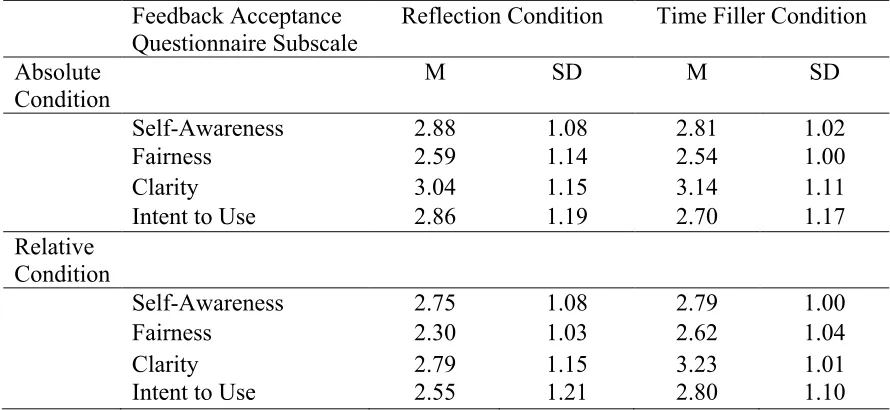
ANOVA was carried out with the Feedback Acceptance Subscales as the
dependent variables. All means and standard deviations are displayed in Table 3. First,
self-awareness was analyzed. There was no main effect of the reflection activity, F(1,
246) = 0.02, p = .90, h2 < .001, no main effect of feedback presentation method
(relative/absolute), F(1, 246) = 0.312, p = .58, h2 = .001, and no interaction effects, F(1,
246) = 0.21, p = .64, h2 = .001. Thus, H
3awas rejected, as there were no higher ratings of
self-awareness for participants in the reflection condition.
Intent to use was then tested. There were no main effects of the reflection activity,
as well as feedback presentation method (absolute/relative), F(1, 246) = 0.08, p = .78, h2
< .001; F(1, 246) = 0.46, p = .50, h2 = .002, respectively. There was also no interaction,
F(1, 246) =1.97, p = .16, h2 = .008. Therefore, H
3bwas also rejected, as those participants
in the reflection condition did not rate intent to use higher.
For exploratory purposes, fairness and clarity were also used as dependent
variables. There was no main effect of the reflection activity on fairness, F(1, 246) =
0.99, p = .32, h2 = .004, no main effect of feedback presentation method
1.83, p = .18, h2 = .007. Interestingly, there was a main effect of the reflection activity on
clarity, F(1, 246) = 3.71, p = .055, h2 = .015, such that those participants in the reflection
condition rated the clarity of the feedback as lower; i.e. they found the computer-scored
rating less clear. However, this finding was marginally significant and had a small effect
size, so must be interpreted with caution. There was no main effect of feedback
presentation method (absolute/relative), F(1, 246) = .30, p = .58, h2 = .001, nor was there
an interaction, F(1, 246) = 1.53, p = .22, h2 = .006.
Table 3.
Means and Standard Deviations of Feedback Acceptance Subscales by Condition
Feedback Acceptance
Questionnaire Subscale Reflection Condition Time Filler Condition
Absolute
Condition M SD M SD
Self-Awareness 2.88 1.08 2.81 1.02
Fairness 2.59 1.14 2.54 1.00
Clarity 3.04 1.15 3.14 1.11
Intent to Use 2.86 1.19 2.70 1.17
Relative Condition
Self-Awareness 2.75 1.08 2.79 1.00
Fairness 2.30 1.03 2.62 1.04
Clarity 2.79 1.15 3.23 1.01
Intent to Use 2.55 1.21 2.80 1.10
M = Mean, SD = Standard Deviation
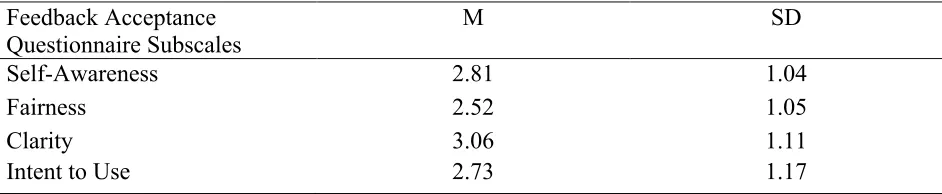
As seen in Table 4, the means of these items indicated that most participants did
not find that the feedback promoted self-awareness, i.e. that it allowed them to learn more
about themselves; that the feedback was fair or clear; and that the feedback would be
thought about or useful for the future. This may have occurred given that there was little
qualitative feedback presented to participants. Notably, the fairness subscale had the
This indicated that many participants either disagreed or felt neutral when answering the
fairness items.
Table 4.
Overall Means and Standard Deviations of Feedback Acceptance Subscales
Feedback Acceptance
Questionnaire Subscales M SD
Self-Awareness 2.81 1.04
Fairness 2.52 1.05
Clarity 3.06 1.11
Intent to Use 2.73 1.17
M = Mean, SD = Standard Deviation
Discussion
Unexpectedly, reflection did not result in lower negative affect (NA) after
negative feedback. There was no significant difference between the mean NA in the
reflection and time filler conditions. Moreover, when a subset of NA items more likely to
be affected by our manipulation was analyzed, reflection resulted in higher scores of NA.
One reason for these results could be that providing the numeric rating with
limited qualitative feedback stifled the effects of reflection. When asked, “Is there
anything else you would like to say about this MTurk study?” a few of the participants
stated it was difficult to understand why they got the rating they did when there was a
lack of feedback comments were provided. Perhaps reflection without detailed qualitative
feedback is ineffective, and may actually produce a negative reaction. It is possible that
the benefits of reflection are only evident when thorough comments and suggestions
accompany feedback. Previous studies investigating feedback and reflection (Anseel et
al., 2009; Phielix et al., 2011) provided more detailed qualitative feedback, which may
Perceived justice may have been a confounding variable, as numeric feedback
was provided by a “computer-scored algorithm” instead of a “real person,” and feedback
lacked a qualitative detail. The mean of the fairness subscale, a construct similar to
justice, was such that most participants rated between disagree and neutral, suggesting
that participants felt a low level of justice. Previous literature has found that justice
correlates with feedback acceptance and attitudinal response (Leung, Su & Morris, 2001),
demonstrating that justice could have interfered with the results.
Previous qualitative research may support this study’s overall findings. One study
by Hobbs (2007) examined the effects of journaling in short teaching courses. Students
were asked to write in a journal and were required to include information outlined by the
course. Researchers found that participants could have a negative response to reflection
due to feeling that they had to please the individual reading the reflection. Another study
found that people do not know the why reflection is meaningful (Roberts, 1998), which
could also result in negative reactions.
The reflection activity in this study may have induced a similar effect to that of
rumination. Self-focused rumination is defined as “…thoughts and behaviors that focus
the individual's attention on the negative mood, the causes and consequences of this
mood, and self-evaluations related to the mood,” (Rusting & Nolen Hoeksema, 1998, p.
790). Rusting and Nolen Hoeksema (1998) found that rumination increased feelings of
anger when compared to a distractor group. In the rumination group, participants were
asked to respond to either self-focused items or emotion-focused items, that is, items
pertaining to anger and related thoughts, while the distractor group was asked to think
previous research that found rumination had increased sadness and anxiety (Rusting &
Nolen Hoeksema, 1998). The reason rumination increased these negative emotions was
justified through spreading activation theory: when an emotion is felt, previous thoughts
linked to that feeling are also recalled and experienced as they are all intertwined in a
neural network, which causes the emotion to last longer. The same effect may have
occurred in our reflection condition: the reflection may have activated a neural network,
resulting in a higher score on pertinent NA items.
Goal setting may thus be the most effective way for employees to accept negative
feedback. By setting goals, employees can focus on developing specific skills (Locke &
Latham, 2002), which may increase feedback acceptance by refocusing attention from
criticism to improvement of future performance. In Phielix et al.’s study (2011),
reflection incorporated aspects of goal setting, a possible explanation as to why it was
effective.
There was no significant difference between the absolute and relative conditions
on NA. This may have occurred because the comparison was not salient; participants may
have been unaware of the abilities and identities of the individuals they were being
compared to. The results may have been different if this were carried out in a workplace
setting, where people have a relationship with their coworkers and know their abilities. In
fact, according to the Self-Evaluation Maintenance (SEM) model of social behaviour,
people feel inclined to improve or uphold their current self-evaluation, which is strongly
affected by: a) performance feedback on a task that is relevant (versus irrelevant) to one’s
self-definition; and b) when ability on a task is compared to people “close” to that
strangers (Tesser, Millar & Moore, 1987). Research by Salovey and Rodin (1984)
investigated this phenomenon, and discovered that anxiety and depression was higher
among those participants who received negative feedback on relevant tasks, and when
feedback was compared to close others. This is because negative emotions result from
one’s self-evaluation being threatened. These findings demonstrate that participants may
have been less affected by the relative condition than predicted because the comparison
was made to “distant” others.
The second hypothesis, that the self-evaluation rating would be a significant
co-variate in the study was rejected. Participants may have been less defiant about their
self-rating because it was based on one circumscribed task and not on overalljob
performance. Thus, they were not afforded time to develop a sense of their abilities. This
relates to the SEM model in that participants may have been less affected by the
feedback, as the task was not pertinent to participants’ self-definition. In addition, the
feedback provided in this study came from a “computer-scored algorithm,” which may
have affected how negatively participants felt from the score. They may have felt that the
score was less “real,” and justified that the result was from a computer which cannot
analyze their actual performance. Therefore, the score may have had less of an effect on
participants regardless of their self-rating; in turn, the self-rating would not have been a
significant co-variate.
In the exploratory analyses, one subscale of the Feedback Acceptance Scale,
clarity, had a marginally significant negative main effect of the reflection activity.
Participants in the reflection condition were required to write about their performance and
Perhaps, participants then realized the feedback lacked clarity, as there was a numeric
score but little qualitative feedback to further guide the reflection. As a result, these
participants may have rated lower on clarity.
Self-awareness and intent to use did not significantly differ based on condition.
This may have occurred for the same reason clarity was significant: because feedback
was numeric with little qualitative content.
Limitations & Future Research
Previous research (Phielix et al., 2011; Anseel et al., 2009) contained varying
numbers of reflection items in the reflection activity. In future, researchers should
examine how many items to include in a facilitated reflection, as well as the optimal
duration for a reflection activity.
Only four subscales from the Feedback Acceptance Scale were used because they
were the only scales relevant to this study. Other studies could use the entire Feedback
Acceptance Scale to investigate how reflection influences all subscales.
A limitation to this study is generalizability. This study took place over a
relatively short period of time and participants were aware that it was not a real job. This
study was a lab study, and the feedback and reflection activity were based on a question
and answer exercise, not overall work performance. This was necessary in order to gain
the kind of control that the experimental method allows. However, participants may have
been less affected by the feedback, as well as the reflection, since it was based on a task
they may have not felt was as important as much as a job performance. Because this
study was not carried out in the workplace, it also made the absolute and relative
who they are being compared to, and have ideas about both their own and others’
abilities. According to the SEM model, having the tasks be more relevant to one’s
self-definition and being compared to people “closer” to oneself, may yield different results.
Future research in field settings would also be advisable.
In future, it would be interesting to test the impact of motivation on the
effectiveness of reflection. To my knowledge, this has not been examined in the
workplace setting. Additionally, research should be conducted to determine if reflection
is effective in a coaching setting. This is a setting in which both the employee and
employer are focused on performance improvement. As such, reflection may be helpful
in learning.
As mentioned, previous research (Hobbs, 2007) found that when reflection
activities were forced, participants felt their responses should please the reader, and that
participants did not have a favourable opinion of reflection, as it appeared to have little
value (Roberts, 1998). This could be addressed in future research. Perhaps after a
reflection activity, participants can be asked if the activity was helpful or not. The groups
could then be compared. Hobbs (2007) also suggested gradually introducing reflection
activities to prevent feelings of resentment. This could also be investigated in future.
Lastly, future research could examine both the role of emotion and learning to get
a full understanding of how each lead to performance changes after reflection in the
workplace. Perhaps emotion does not manifest as expected, as reflection may not result in
immediate decreases in negative emotion, yet still have benefits to learning.
Alternatively, reflection could simply increase negative emotions and have detrimental
follow-up studies on emotion, feedback, and reflection to understand how emotion manifests
itself, and make a theoretical contribution about both the effects of reflection and the
benefits of the feedback process.
Conclusion
Although there are theoretical claims that reflection has the potential to result in
the ability to manage emotions, understand new perspectives, and result in performance
change, we found evidence that reflection may not be all it is cracked up to be in the case
of performance feedback. The reflection activity did not result in less negative emotion;
in fact, there was evidence it actually increased negative emotion. Factors such as how
feedback was delivered (without little qualitative content), worries about pleasing the
researcher, the belief that reflection was not helpful, and experiencing effects similar to
that of rumination, may have caused participants to feel slightly more negative after
completing the reflection activity. Future research on reflection in different contexts, as
well as the effect reflection has on both emotion and learning from feedback should be
examined. This would contribute to the theoretical underpinnings of reflection and further
References
Anseel, F., Lievens, F., & Schollaert, E. (2009). Reflection as a strategy to enhance task
performance after feedback. Organizational Behavior and Human Decision
Processes, 110(1), 23-35.
Ashford, S. J. (1986). Feedback-seeking in individual adaptation: A resource
perspective. Academy of Management Journal, 29(3), 465-487.
doi:http://dx.doi.org/10.2307/256219
Belschak, F. D., & Den Hartog, D. N. (2009). Consequences of positive and negative
feedback: The impact on emotions and extra-role behaviors. Applied
Psychology, 58(2), 274-303.
Boud, D., Keogh, R., & Walker, D. (1985). Promoting reflection in learning: A model.
Reflection: Turning Experience into Learning, 18-40.
Boud, D. (2001). Using journal writing to enhance reflective practice. New directions for
adult and continuing education, 2001(90), 9-18.
Brett, J. F., & Atwater, L. E. (2001). 360° feedback: Accuracy, reactions, and perceptions
of usefulness. Journal of Applied Psychology, 86(5), 930-942.
doi:10.1037/0021-9010.86.5.930
DeRue, D. S., Nahrgang, J. D., Hollenbeck, J. R., & Workman, K. (2012). A quasi
experimental study of after-event reviews and leadership development. Journal of
Applied Psychology, 97(5), 997.
Dipboye, R. L., & De Pontbriand, R. (1981). Correlates of employee reactions to
performance appraisals and appraisal systems. Journal of Applied
Hobbs, V. (2007). Faking it or hating it: can reflective practice be forced?. Reflective
practice, 8(3), 405-417.
Kedharnath, U., Garrison, L., & Gibbons, A. M. (2010). A multidimensional measure of
feedback acceptance. Presented at the 25th Annual Meeting of the Society for
Industrial Organizational Psychology in Atlanta, GA.
Kluger, A. N., & DeNisi, A. (1996). The effects of feedback interventions on
performance: a historical review, a meta-analysis, and a preliminary feedback
intervention theory. Psychological bulletin, 119(2), 254.
Kluger, A. N., & DeNisi, A. (1998). Feedback interventions: Toward the understanding
of a double-edged sword. Current directions in psychological science, 7(3),
67-72.
Kolb, D. A., Boyatzis, R. E., & Mainemelis, C. (2001). Experiential learning theory:
Previous research and new directions. Perspectives on thinking, learning, and
cognitive styles, 1, 227-247.
Lee, K., & Ashton, M. C. (2016). Psychometric properties of the HEXACO-
100. Assessment, 1073191116659134.
Leung, K., Su, S., & Morris, M. W. (2001). When is criticism not constructive? The roles
of fairness perceptions and dispositional attributions in employee acceptance of
critical supervisory feedback. Human Relations, 54(9), 1155-1187.
Locke, E. A., & Latham, G. P. (2002). Building a practically useful theory of goal setting
and task motivation: A 35-year odyssey. American psychologist, 57(9), 705.
and team performance. Team Performance Management: An International
Journal, 8(5/6), 134-139.
Phielix, C., Prins, F. J., & Kirschner, P. A. (2010). Awareness of group performance in a
CSCL-environment: Effects of peer feedback and reflection. Computers in
Human Behavior, 26(2), 151-161.
Phielix, C., Prins, F. J., Kirschner, P. A., Erkens, G., & Jaspers, J. (2011). Group
awareness of social and cognitive performance in a CSCL environment: Effects of
a peer feedback and reflection tool. Computers in Human Behavior, 27(3),
1087-1102.
Roberts, J. (1998). Language teacher education. Routledge.
Rusting, C. L., & Nolen-Hoeksema, S. (1998). Regulating responses to anger: effects of
rumination and distraction on angry mood. Journal of personality and social
psychology, 74(3), 790.
Salovey, P., & Rodin, J. (1984). Some antecedents and consequences of social-
comparison jealousy. Journal of Personality and Social Psychology, 47(4), 780.
Sargeant, J., Mann, K., Sinclair, D., Van der Vleuten, C., & Metsemakers, J. (2008).
Understanding the influence of emotions and reflection upon multi-source
feedback acceptance and use. Advances in Health Sciences Education, 13(3),
275-288.
Scanlan, J. M., & Chernomas, W. M. (1997). Developing the reflective teacher. Journal
of advanced nursing, 25(6), 1138-1143.
comparison and reflection processes: the pain and pleasure of being close. Journal
of personality and social psychology, 54(1), 49.
Watson, D., Clark, L. A., & Tellegen, A. (1988). Development and validation of brief
measures of positive and negative affect: the PANAS scales. Journal of
personality and social psychology, 54(6), 1063.
World Diamond Council in Alliance with Jewelers Vigilance Committee, Jewellers of
America, Diamond Dealers Club, Diamond Manufacturers and Importers
Association of America, and Jewelry Information Center. Employee Training
Manual: How to Train Your Employees about Conflict Diamonds. Retrieved from
http://www.diamondfacts.org/pdfs/industry/TrainingGuide_v5.pdf
Xie, Y., Ke, F., & Sharma, P. (2008). The effect of peer feedback for blogging on college
students' reflective learning processes. The Internet and Higher Education, 11(1),
Appendix A
Cover Story
Pay: $2 We are looking for employed participants. We are testing the effectiveness of a
workplace manual for a retail company that sells diamonds. This workplace manual is a
training manual to prepare employees for customers’ questions regarding conflict
diamonds. Many measures included are to test the different aspects of the training manual
and the activities associated with it. In addition, you will be asked to fill out several
measures that we need to include as the responses may affect the results. The measures
Appendix B
Letter of Information and Consent Form
Project Title: Investigating the Effectiveness of a Workplace Manual
Principal Investigator: Richard Goffin, Professor, The University of Western Ontario
1. Invitation to Participate
You are being invited to participate in this research study investigating the effectiveness of a workplace manual and activities associated with the workplace manual.
2. Purpose of the Letter
The purpose of this letter is to provide you with information required to make an informed decision regarding participation in this research.
3. Purpose of this Study
The purpose of this study is to allow researchers to learn more about the
effectiveness of a workplace manual and activities associated with the workplace manual.
4. Inclusion Criteria
Individuals who are English speaking are eligible to participate in this study. Both females and males can participate in this study. Individuals can only participate in this study if they are currently employed.
5. Exclusion Criteria
Individuals who are unable to see or hear are not eligible to participate in this study. This is because the study involves an online questionnaire where
participants will have to read and answer questions. Individuals must also be over the age of 18 so they can consent to participate.
6. Study Procedures
you will be asked to complete additional questionnaires to assess the overall effectiveness of the training manual, as well as complete measures that provide researchers with additional information about the manual. You will also receive the debriefing form. The whole study should not take longer than 30 minutes. The entire study will be online, and will take only one session to complete. There will be a total of 500 participants in this study.
7. Possible Risks and Harms
You may experience negative affect. There are no other known risks or discomforts associated with participating in this study.
8. Possible Benefits
The possible benefits to society may be that this study will help practitioners decide what type of manual and training exercises are the most effective. It could also contribute to literature on workplace feedback since the training exercises include self-evaluations and feedback.
9. Compensation
You will be compensated $2.00 for your participation.
10.Voluntary Participation
Participation in this study is voluntary. You may refuse to participate, refuse to answer any questions or withdraw from the study at any time. You do not waive any legal rights by consenting to this research.
11.Confidentiality
All data collected will be anonymized. All electronic data will be kept on a password protected, encrypted file. To allow for independent verification of results, all data will be kept for a minimum of 5 years after the publication of the final article that is based on this research. The completely anonymized data may eventually be posted on an open access site for other researchers’ access.
Representatives of The University of Western Ontario Non-Medical Research
Ethics Board may contact you to monitor the conduct of the research.
12.Contacts for Further Information
13.Publication
If the results of the study are published, your name will not be mentioned.
Appendix C
Participant Information Form
1. Gender
o Male
o Female
o Other
2. Age: _____
3. First Language: ___________
4. I am employed:
o Part time, with one job (24 hours or less at one job)
o Part time, with two or more jobs (24 hours or less at each job) o Full time (25 hours or more at one job)
o Not employed
o Other (Please explain) ______________
5. I have completed (click all that apply):
High School
o High school diploma
College
o Please specify highest level of completion (ex: completed first year): ___________
o College Graduate
University
o Please specify highest year of completion (ex: completed first year): ___________
o University Graduate, please specify (Bachelor, Master’s, PHD, other):
___________
Other
o Please Specify: ___________
6.What type of work do you do, or have you done?
o
Managemento
Office/Administrativeo
Business and Financial Operationso
Architecture/Engineeringo
Art and Designo
Media and Communicationso
Computer/Mathematicalo
Farming/Fishing/Forestryo
Building, Grounds, Cleaning, and Maintenanceo
Life Scienceo
Physical Scienceo
Military or Protective Serviceo
Healthcare Practitioners or Techniciano
Healthcare Supporto
Community and Social Serviceo
Social Scienceo
Legal Occupationso
Education/Training/Libraryo
Transportationo
Personal Care and Serviceo
Construction/Installation/Repairo
Food Preparation/Servingo
Saleso
Production/Manufacturing7. Have you ever had to evaluate an employee’s job performance and/or give job performance feedback?
o No o Yes
8. Have you ever had a supervisory role? o No
o Yes
Ø If yes, for how long?
o Less than 2 months
o 2 months to 6 months
o 6 months to 1 year
o 1 year to 5 years
o 5 years or more
9. Have you ever been given job feedback and/or had your job performance rated? o No