ISSN 2286-4822 www.euacademic.org
Impact Factor: 3.1 (UIF)
DRJI Value: 5.9 (B+)
Guiding Students to Solve Problem with Dynamic
Software “GeoGebra”: A Case of Heron’s Problem of
the Light Ray
NGUYEN PHU LOC, PhD. Associate Professor in Mathematics Education School of Education, Can Tho University
Vietnam LE VIET MINH TRIET, MSc. Doctoral student in Mathematics Education Pacific College, Can Tho City Vietnam
Abstract:
In Vietnam, Heron’s the problem of the light ray was the problem which was mentioned in Textbook “Hinh Hoc 11” (Geometry 11, 2007). In order to solve this problem, the teacher often guided his students to apply the properties of symmetry respect to a line. In the study, with the help of dynamic software GeoGebra and the teacher, students made conjectures and discovered two strategies for solving the problem by data obtained from experiment.
Key words: GeoGebra, SPWG model, dynamic software, mathematics education, Heron’s problem, problem solving, educational technology.
Background
G. Polya’ process of solving problem
G. Polya (1887 - 1985) had many valuable ideas on problem solving and he believed that students should learn mathematics through solving problem (Boas, 1990). In the book “How To Solve It: A New Aspect of Mathematical Method” published in 1945, Polya suggested the process of solving a problem consisting of four steps:
1. Step 1:Understanding the problem. 2. Step 2: Devising a plan.
3. Step 3: Carrying out the plan. 4. Step 4: Looking back.
The model has been very popular in mathematics education communities around the world. Especially in Vietnam, the model was introduced in most of books on mathematics education.
Loc’s model for problem solving activity
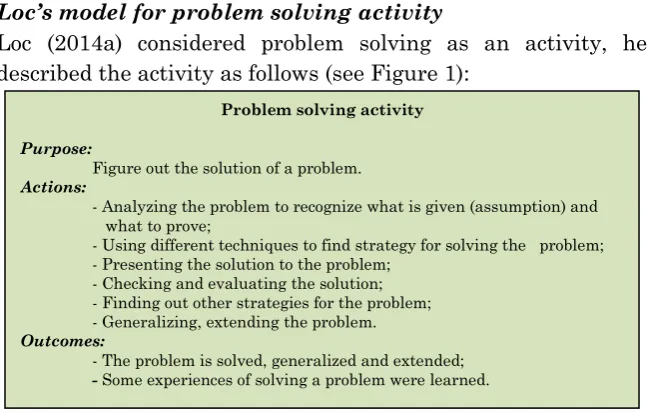
Loc (2014a) considered problem solving as an activity, he described the activity as follows (see Figure 1):
Figure 1: Problem solving as an activity (Loc, 2014a)
Solving problem with the help of dynamic software “GeoGebra”
GeoGebra is a dynamic software which have used popularly in teaching and learning in several countries. In Vietnam, the
Problem solving activity
Purpose:
Figure out the solution of a problem.
Actions:
- Analyzing the problem to recognize what is given (assumption) and what to prove;
- Using different techniques to find strategy for solving the problem; - Presenting the solution to the problem;
- Checking and evaluating the solution; - Finding out other strategies for the problem; - Generalizing, extending the problem.
Outcomes:
- The problem is solved, generalized and extended;
result of the study conducted by Loc and Triet (2014) showed that:
GeoGebra became the dynamic software which learners preferred to the other software. The learners have highly evaluated GeoGebra because it integrates dynamic geometry, algebra, calculus, and statistics into a single easy-to-use package; so it is helpful and comfortable for students and mathematics teachers.
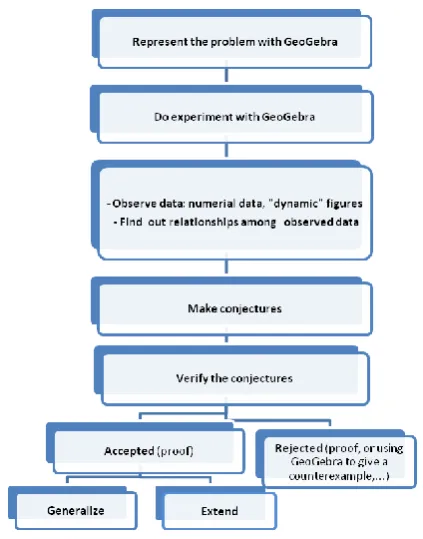
About using dynamic software “GeoGebra” to solve a problem, Loc (2014b) developed the model “SPWG” (Solving Problem
With GeoGebra) as below (see Figure 4). In the model, thanks to the efficient assistance of GeoGebra, the problem solver could find out the strategies for solving a problem through the stages of making and verifying conjectures.
Figure 4: Model SPWG – Solving Problem With GeoGebra (Loc, 2014b)
Step 1: Represent the problem: draw geometric figure, construct the graph of functions, build data table.
Step 2: Use dynamic property, tools for computation, spreadsheets to have dynamic data for the problem. Step 3: Find out relationships among observed data.
Step 4: Formulate conjectures which help problem solver to find out strategies for solving the problem.
Step 5: Verify conjectures in order to reject or to prove. Step 6: Check the solution, generalize or extend the problem.
Statements of research problem
In the current textbook “Hình học 11” (Geometry 11, 2007) in Vietnam, there was a problem: “Given two points A and B on the same side of a straight line (L). Find out point C on (L) such that the sum of two distances AC and CB is the minimum” (1). Note that it was Heron’s the problem of the light ray (Courant & Robbins, 1996). This was the problem difficult for the teacher to guide his students to determine the position of C satisfying requirement of the problem naturally by “self – discovering” of his students. However, with the help of dynamic software GeoGebra, we hoped that the above difficulty could be overcome; it was the reason why we conducted a study with following questions:
1. With assistance of GeoGebra and the teacher, do students make the right conjectures on the position of C such that (AC+CB) is the shortest?
2. With assistance of GeoGebra, how does the teacher guide the students to verify the conjectures?
Methodology
The task for students: In order to be easier for students to figure out the solution to the problem, we restated the problem (1) as follows:
Given two points A( 2, 2 ) and B (8, 6 ). Determine point C on Ox such that the sum of two distances AC and CB is the minimum” (2).
All students have not solved the problem before yet.
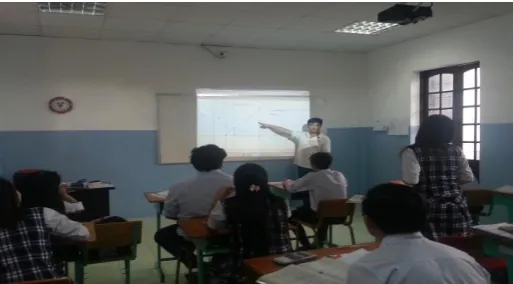
Teaching method:teacher – face – student. (see Figure 2).
Tool:1 laptop for the teacher; 1 projector.
Figure 2: The interaction between the teacher and students in classroom
Result
The process of problem solving
Table 1:The process of problem solving
Steps for solving the problem
Students Teacher
Representing the problem Observing figures and numerical data
Using GeoGebra to represent the problem Doing experiment Asking the teacher for
operating GeoGebra
Acting anđ operating GeoGebra according to requirements of the students
Observing dynamic numerical and figure data
Discovering relationships among data
Making conjectures Stating conjectures on the position of point C Verifying conjectures Observing data given by
the teacher’ operating GeoGebra and acting according to the teacher’s the guidance.
Rejecting conjectures: Using GeoGegra to give counterexamples Accepting conjecture: Guiding the students to prove the conjecture.
Generalizing the problem Stating the problem in a
generalized form.
Making conjectures
- Immediately after the teacher represented the problem in
the coordinate plane Oxy, students stated two conjectures intuitively as below:
Conjecture 1: Construct A1 and B1 on (L) such that AA1
Ox and BB1. If C
A1 or C
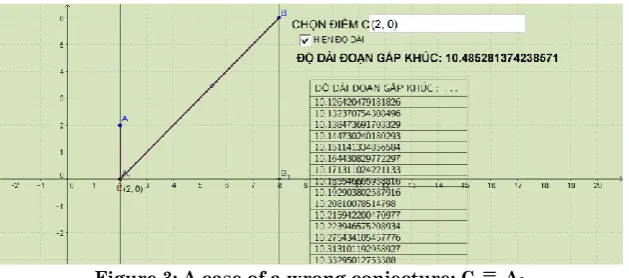
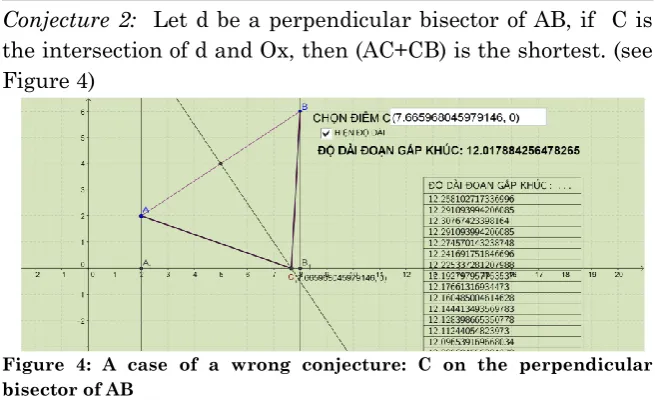
B1, then (AC+CB) is the shortest. (see Figure 3)Conjecture 2: Let d be a perpendicular bisector of AB, if C is the intersection of d and Ox, then (AC+CB) is the shortest. (see Figure 4)
Figure 4: A case of a wrong conjecture: C on the perpendicular bisector of AB
Rejecting conjecture 1 and 2
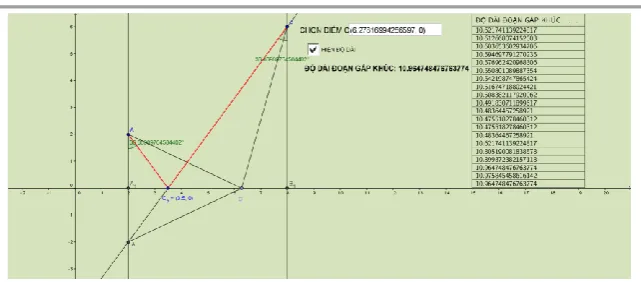
The teacher moved point C on Ox (see Figure 5 ), the results from spreadsheet showed that the conjecture 1 and 2 were discarded.
Figure 5: An case of C to reject two wrong conjectures 1 and 2.
After the above two conjectures were rejected, students asked the teacher for moving C on Ox, and observed the changing values of the sum (AC+CB). Finally, they reached to the right conjecture 3 as follows:
(see Figure 6 )
Figure 6: The position of C such that: (AC+CB)min (= 10).
By observing Figure 6 and spreadsheet, students identified that (AC+CB)min = 10 where
CAA1 is equal to
CBB1,
ACA1 is equal to
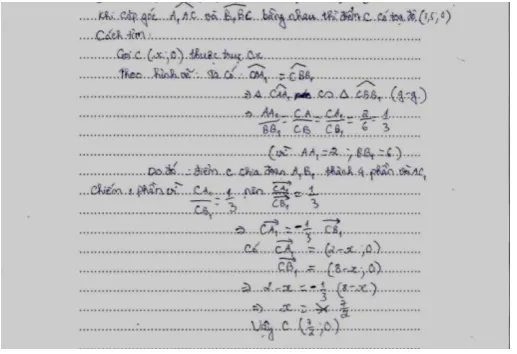
BCB1 and C(3.5;0). Furthermore, three students determined the position C when (AC+CB) is the shortest as below:Because the right triangle AA1C is similar to the right BB1C. From this fact, students found out that the coordinates of C is (3.5; 0) by using the property of similar triangles(see Figure 7).
Notice that how to determine the position of C as the above has not showed that AC + CB min = 10 where C is at (3.5; 0) yet. So that, the teacher continued to guide his students to prove the conjecture 3 in two ways as below:
Proving conjectures 3
In the first way:
In order to prove that (AC+CB) min if only if
CAA1 =
CBB1, the teacher extended BC to cut the line x = 2 at A’ (2; -2)
and guided students to reach the solution to the problem as follows:
- Ask the students to compare AC and A’C, AC+CB and A’B - Then, let any C’ be on Ox: compare: AC’ +C’B and A’C’+C’B,
A’B and A’C’ +C’B.
- Finally, conclude ? AC’ +C’B
AC+CB(see Figure 8)
In the second way:
Let C’ (x; 0) be any point on Ox. We needed to prove that AC’ + C’B
10 for all values of x. In fact,AC’ + C’B
10
(
x
2
)
2
2
2
(
8
x
)
2
6
2
10
, or
(
x
2
)
2
2
2
10
(
8
x
)
2
6
2 (*)Figure 8: Diagram used in the first way for proving the conjecture 3
Generalizing the problem
After finishing solving the problem (2), the teacher introduced Heron’s the problem of the light ray (1) as generalization of the problem (2) to his students, and summarized how to construct point C such that AC + CB min:
The first method for constructing C (the traditional strategy): Let A’ be a symmetric point of A respect to the line (L), then C be the intersection of A’B and (L).
The second method for constructing C (discovered by the student): Let A1, B1 be on (L), such that AA1 and BB1 are perpendicular to (L), then C is on segment A1B1 with
1 1
1 1
BB
AA
CB
CA
.
Discussion and conclusion
only mathematics but also methods for discovering mathematics.
REFERENCES
Boas, R. P. (1990). George Polya. National Academy of Sciences. Washington D.C.
Courant, R. &Robbins, H. 1996. What is Mathematics?: An Elementary Approach to Ideas and Methods, Second edition. Oxford University Press.
Loc, N.P & Triet, L.V.M. 2014. Dynamic software “GeoGebra” for teaching mathematics: Experiences from a training course in Can Tho University. European Academic Research, Vol II , Issue 6 /September 2014. Retrieved from http://euacademic.org/UploadArticle/923.pdf
Loc, N.P. 2014a. Lecture note on activities in teaching and learning mathematics. HCM City: National University of HCM City Press (in Vietnamese)
Loc, N.P. 2014b. Dynamic software “GeoGebra” for solving problem: A try - out of mathematics teachers. Journal of international academic research for multidisciplinary (accepted to publish in October 2014)
Ministry of Education and Training – Vietnam. 2007. Geometry 11. HCM City: Education publishing house (in Vietnamese)