Western University Western University
Scholarship@Western
Scholarship@Western
Electronic Thesis and Dissertation Repository
8-24-2015 12:00 AM
Crowdsourcing
Crowdsourcing
Sherry A. Czekus
The University of Western Ontario
Supervisor David Merritt
The University of Western Ontario Graduate Program in Visual Arts
A thesis submitted in partial fulfillment of the requirements for the degree in Master of Fine Arts © Sherry A. Czekus 2015
Follow this and additional works at: https://ir.lib.uwo.ca/etd
Part of the Fine Arts Commons
Recommended Citation Recommended Citation
Czekus, Sherry A., "Crowdsourcing" (2015). Electronic Thesis and Dissertation Repository. 3132. https://ir.lib.uwo.ca/etd/3132
This Dissertation/Thesis is brought to you for free and open access by Scholarship@Western. It has been accepted for inclusion in Electronic Thesis and Dissertation Repository by an authorized administrator of
(Thesis format: Integrated Article)
by
Sherry Czekus
Graduate Program in Visual Art
A thesis submitted in partial fulfillment of the requirements for the degree of
Master of Fine Arts
The School of Graduate and Postdoctoral Studies The University of Western Ontario
London, Ontario, Canada
ii
Abstract
The integrated article, along with an exhibition at Artlab Gallery, has three chapters.
Chapter One is a comprehensive artist statement that examines my practice of
contemporary painting and its relationship to visual and temporal perception and the
disruption of it in urban crowd culture. Our simultaneous place in physical and virtual
crowds as part of the everyday experience revisits 19th C. flaneurism and the act of seeing
and being seen in public places through technology. Chapter 2 is the Practice
Documentation consisting of a selection of images of paintings created during my MFA
two year candidacy. Chapter 3 is the Case Study titled “Timely Landscapes” featuring
Toronto painter Monica Tap. Her painting process engages the visual and digital
perception of motion, temporality and the everyday commuter experience.
Keywords
iii
Acknowledgments
Firstly, I would like to thank my Advisor, Professor David Merritt, for his exceeding
generosity with his knowledge, experience and guidance throughout my MFA candidacy.
Thank you to Professors Patrick Mahon, Kim Moodie, Sky Glabush, Kelly Wood, Kelly
Jazvac and Christof Migone for their investment and encouragement. I would like to
thank Monica Tap for her kindness and generosity in providing to me insight into her
studio practice and artworks. Thank you to Tricia Johnson, Susan Edelstein, faculty and
staff of the Visual Arts program for the exceptionally supportive role they play in the
education of artists and art educators.
Without the support of my family and friends, this milestone would not have been
possible. I would like to thank my husband Karl for his unwavering patience and
enthusiasm during my candidacy. And to my daughters Jane and Jennifer, their constant
encouragement has been an inspiration to me.
I dedicate my work to my great-grandmother, Maggie Braddon Earley (1892-1964), who
iv
Table of Contents
Abstract ... ii
Acknowledgments... iii
Table of Contents ... iv
Introduction ... v
Chapter 1: Comprehensive Artist Statement... 1
Bibliography ... 12
Chapter 2: Practice Documentation ... 14
Chapter 3: Case Study ... 28
Bibliography ... 41
v
Introduction
This Master of Fine Arts thesis dossier is comprised of three chapters that accompany my
thesis exhibition which will take place at the Artlab Gallery at Western University from
August 13th until 27th, 2015. The three chapters of this thesis include a Comprehensive
Artist Statement, Practice Documentation, and a Case Study of painter Monica Tap. This
thesis dossier, in addition to the artwork I have presented in my thesis exhibition titled
“Crowdsourcing” represents the research I conducted related to urban crowd culture.
The first chapter consists of my Comprehensive Artist Statement where I discuss my
conceptual and material approach to contemporary painting in the current conditions of
urban crowd culture. My painting explores the temporal condition of social space through
image making in relation to digital technology. Reflecting on 19th C. flaneurism, the act
of seeing and being seen drives the perceptual tension that exists between the online and
physical crowd. China ink washes on mylar and oil paint on canvas are two material
processes where I explore the material expression of the physical and networked
environments as we access them simultaneously.
The second chapter is comprised of my Practice Documentation. The images represent a
collection of works made during my MFA candidacy. The works presented are China ink
on mylar and oil paintings accompanied by the title, material description, dimensions of
each work and include a brief description of the key elements of the work.
In the third chapter, the Case Study of painter Monica Tap titled “Timely Landscapes”
explores the artist’s process of mediating digital imaging though contemporary painting. The landscape serves as a motif in Tap’s investigation of temporality and motion.
Through her painting, Tap translates the effects of digital and human perception in her
negotiation of representation and abstraction. The Case Study developed though my
interview with Tap in her studio in Toronto in July 2014, research material gathered
through an informal question period between the artist and Dan Adler, along with articles
1
Chapter 1: Comprehensive Artist Statement
Crowdsourcing
‘And so away he goes, hurrying, searching. But searching for what? Be very sure
that this man, such as I have depicted him - this solitary, gifted with an active
imagination, ceaselessly journeying across the great human desert - has an aim loftier
than of a mere flaneur, an aim more general, something other than the fugitive pleasure
of circumstance. He is looking for that quality which you must allow me to call
‘modernity’; for I know no better word to express the idea I have in mind.”1
Making my recent paintings begins with becoming one of the crowd. Passing
through the mass of people, meandering through a market of fresh produce and walking
along the streets of a large city centre, I am drawn to the current moment in which the
urban crowd as a figure in itself is continually present. What underscores this moment is
our presence in online communities that we access fluidly through networked electronic
devices while being one in a physical crowd. I am aware of how people disengage from
this space while checking their cell phones. The gesture of this physical-virtual being is
marked -- head down, arms bent and hand together at mid chest, while sitting, standing
and walking; the stance when one is one in many crowds at once. This interruption of the
physical realm alters our visual perception and it is this sensation in our current urban
experience that turns my attention to painting.
Observations of modern urban culture were first seen through the lens of the
flaneur in 19th C. Paris.2 The flaneur was characterized in the literature of Baudelaire as a
man in the city who found beauty in the transitory nature of the crowd and the civilization
of urban space.3 In “Fancy Footwork”, Rob Shields describes the relationship between
the flaneur and the crowd today.
“The flaneur is out to see and be seen, and thus requires a crowd to be able to
watch others and take in the bustle of the city in the security of his anonymous
status as part of the metropolitan throng. The crowd is also an audience. Flanerie
is thus a crowd practice, a connoisseur’s ‘art of doing’ crowd behavior.”4
In the tradition of flaneurism, I take video as a way of seeing to trace my passage
alongside large and small crowds in urban spaces.
Video provides the temporal and spatial potential in the stills to construct my
paintings as record of my mobile perspective along with the movement of the crowd. To
examine the fleeting milieu of the city, I developed parameters for my project in which
one-second intervals are isolated as a means to establish a chronological baseline. I
approached the one-second interval by isolating 24 still frames from one second of video
and photographing one second of video on the screen. The stills allow reimagining the
interruption of the physical experience, the motion, temporality and dimension of the
urban landscape. Straddling the boundaries of representation and abstraction, the
perception of time and space in the urban environment is explored through the translation
of video imagery into the process and materiality of painting.
2 Walter Benjamin. 2014. "On Some Motifs in Baudelaire." (1939, trans. 1969) in The Lyric Theory Reader: A Critical Anthology, ed. Virginia Jackson and Yopie Prins. (Baltimore, Maryland: Johns Hopkins University Press), 327-338. Walter Benjamin was a key theorist and literary critic with an interest in the work of Baudelaire and the development of urban culture in Paris.
3 Theodore Reff. Manet and Modern Paris. (Chicago: The University of Chicago Press, 1982), 24.
4 Rob Shields, "Fancy Footwork: Walter Benjamin's Notes on Flanerie." in The Flaneur, ed. Keith Tester.
3
Translating the images made from video at first seemed futile. The paint and the
canvas seemed to arrest the sensation of motion I was trying to convey. Photographing
the video eventually led to painting projected video. I projected a short video vertically
on the wall and attempted to paint the figures and images as they moved through space.
My process turned to China ink due to its transparency and thin viscosity. The
non-porous nature of mylar paired well with the immediacy of the ink wash for the purpose of
recreating the temporal environment of the crowd. The project concentrates on oil
painting on canvas and China ink on mylar in a parallel study of materiality in the
temporal environment of the urban crowd.
The ink wash on mylar work titled “Market” (Figure 1) was made in one studio
session due to the time sensitive nature of the materials. The process of applying and then
washing the ink away with water layers several moments on the mylar so that each
moment can be seen through the transparency of the black ink wash. Traces of these
moments become entirely erased leaving white areas on the mylar as a memory of their
former presence. The space and figures I was depicting are not time-bound as in still
photography. The images seem to slip out of reach. Appearing only through fragments of
the moment rather than the complete scene, the works pass between representation and
abstraction.
A lemon and ochre striped sleeve, sienna leather shoulder, vermillion woolen
tassel, blue denim calf, gold glitter of a Coach shoe buckle appear at once now. The
screen beckons. Advertisements, articles and photographs scroll through the newsfeed
before I can refocus on the activity in the tangible realm as the pace of the crowd carries
me along. The way we oscillate between the physical and virtual crowd further skews our
perception of the moment as the call to the screen of the smartphone lures our attention
away from the physical realm. Temporality and the state of continuous motion within the
crowd poses paradoxical questions for painting. The temporal environment of the crowd
and continuous movement in all directions simultaneously is impossible to take in at
once. Any attempt to follow the direction of the collective motion from the beginning to
the end within the mass renders the devices of linear time futile. Merleau-Ponty states in
“Phenomenology of Perception”,
“Within things themselves, the future and the past are in a kind of eternal state of
pre-existence and survival; the water which will flow by tomorrow is at this
moment at its source, the water which has just passed is now a little further
downstream in the valley. What is past or future for me is present in the world. It
is often said that, within things themselves, the future is not yet, the past is no
longer, while the present, strictly speaking, is infinitesimal, so that time
collapses.”5
The movement in the physical crowd fragments the chronological sense of time as we
slide between realities.
Painting creates a third space, as a way of intertwining physical space and the
space of the network in a reimagined perception of the crowd experience. The paintings
reveal the fragmentation of perception as the crowd steps between the physical and online
environment. The past, present and future seem inconsequential in this moment. Christine
Ross refers to a nonlinear sense of time in “The Temporal Turn in Contemporary Art” as
a philosophical assessment of time. In her study of time, Ross suggests tenseless time
5
does not follow a linear trajectory in the sense of the past, present and future. Tensed time
is related to language and experienced reality despite the tenselessness of reality.6 The
present moment eventually becomes what Ross describes as the past or before another
moment.7 In her example of a video by artist Melik Ohanian, Ross describes a
tenselessness that gives density to the slice of time or slice of space being observed; it
contains a density that discloses his installations to be part of but also contestations of
presentism.’8 For Ross, nonlinear time, while not a clear path leading from the past to the
future, holds the richness of expanded and layered moments that circulate in the present
moment. In “The Painter of Modern Life”, Baudelaire believes, “(t)he pleasure which we
derive from the representation of the present is due not only to the beauty with which it
can be invested, but also to its essential quality of being present.”9
My painting explores
the temporal condition of social space through image making in relation to the digital
environment.
6 Christine Ross, “The Past is Present; It’s The Future Too: The Temporal Turn in Contemporary Art”.
(London: Bloomsbury. 2012) 225.
7 Ibid, 223.
8 Ibid, 212.
Figure 2. Art Goers, 2014, oil on canvas, 45” x 60”
My perceptual experience of the urban environment transits between figuration
and abstraction nuanced through the materiality of paint and the act of painting. The
colour contrast of paint, its thickness and thinness, opacity and density, layering and
scraping away are material ways the medium exerts its influence on the image and the
reading of the work. Layering a series of 24 images or one second of still photographs
over one another on canvas in the work entitled ‘Art Goers’ (Figure 2) shows a literal
depiction of linear time in the movement and position of the figures in an enclosed space.
Another painting titled ‘Suspend’ (Figure 3) is an abstract work created from stills made
from one second of video taken of a crowd in a public art museum. Depicting the way
light and objects travel across the canvas in the density of the linear second posed
valuable questions as to the position in space of the object in light and the perception of
the object or figure as a whole. Linear time is present through the trailing light and
remnant fragments of present objects. The way the paint becomes caught up in the tooth
of the canvas mediates the tension between the speed of the movement of the figures and
7
Figure 3. Suspend, 2014, oil on canvas, 45” x 60”
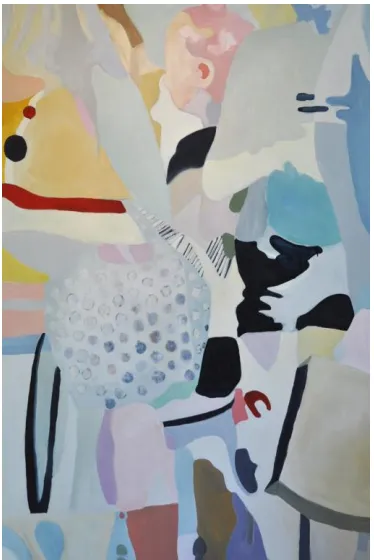
The life-size oil paintings (Figure 4 and 5) portray a slice of the crowd with a view
through the tops of shoulders as the masses of people move ahead. Once the image is
mapped out on the canvas, the departure from the stilled video leads to an abstracted
fragmentation of the figures. Signifying the notion that we see the figure as a sum of its
parts rather than as a whole, the perception of the collective figures of the crowd
disintegrates. Some areas of colour create a flat, shallow space while others are thinly
washed revealing the ground. Objects are partially depicted left suspended in space.
(Figure 4) The size and scale of the oil paintings relate directly to the life size of the
viewer in an experiential seeing of the work as the figures approach and move in the
direction of the viewer. Select details worn by the crowd members emerge in the
paintings as a record of another moment in advertising and fashion. A handbag, a button,
a pair of boots, a buckle and striped graphic prints are detailed in the paintings as they
attempt to synthesize a particular moment of the crowd. (Figure 5) According to Shields,
visual could be said to be the premium mobile of the flaneur’s being.”10 Shields proposes
the flaneur as consumer of the visual and is visually consumed,11 a trend that continues in
urban and online communities today.
Figure 4. Untitled, 2015, oil on canvas, 70” x 52”
10 Rob Shields, "Fancy Footwork: Walter Benjamin's Notes on Flanerie." in The Flaneur, ed. Keith Tester.
(New York: Routledge, 1994), 65.
9
Figure 5. Untitled, 2015, oil on canvas, 72” x 48”
With the turn of my canvas to a vertical orientation, the size of the canvas and the
figures are enlarged to a human scale to produce the sensation of being within the crowd.
(Figure 4 and 5) The position of ‘we’ and ‘them’ is one that fluctuates for both the
participant and the viewer. The decision to step into or out of the work is the determining
factor as to whether the viewer is one in the crowd (‘I’) or of the crowd (‘we’). Jean Luc
Nancy in “Being Singularly Plural” discusses the idea that ‘I’ cannot be in a state of
being without ‘we’; we have no meaning without co-existence. The meaning for our
existence lies in the concept of community. Nancy suggests, “…the truth of this
paradoxical ‘first-person plural’ which makes sense of the world as the spacing and
intertwining of so many worlds (earth's, skies, histories) that there is a taking place of
meaning, or the crossing through [passages] of presence. ‘We’ says (and "we say") the
unique event whose uniqueness and unity consist in multiplicity.”12
12 Jean Luc Nancy, 2000. Being Singular Plural, trans. Anne E. O'Bryne and Robert D. Richardson.
Nancy also notes that although we are individuals, it is exactly this group of
individuals that forms the idea of ‘people’. According to Nancy, "People" clearly states
that we are all precisely people, that is, indistinctly persons, humans, all of a common
"kind," whose existence is defined as both group and individual.13 Without the
individual, the group cannot exist and alternatively, without the group, the individual is
without meaning, is the paradox that Nancy describes.
While Nancy reflects upon the relationship between the individual and the crowd
and their dependency on one another for meaning and survival, sociologist Castells
questions the possibilities for engagement of the crowd in urban spaces in a networked
world. “The development of electronic communication and information systems allows
for an increasing disassociation between spatial proximity and the performance of
everyday life’s functions: work, shopping, entertainment, healthcare, education, public
services, governance and the like. Accordingly, futurologists often predict the demise of
the city, or at least of cities as we have known them until now, once they are voided of
their functional necessity.”14
If Castells’ predictions about the future and the end of cities
as we know them is true, then the influence of the social network will eventually redefine
the crowd and threaten the existence of our physical social community as we know it
today.
The present crowd lives in two worlds; a world of the past made present in the
artifacts of society and urban architecture and another world that rides the flow of
technological advancement. Technology is exponentially gaining momentum as society
chases it for its lure of more, yet smaller and faster. Simon Pont in “Digital State” puts
forth a startling reality about the invasion of technology on society and the body.
“Although we are living in technologically accelerated times, the social impact of
the web will become evident only when it is pervasive, ubiquitous and invisible, a
13 Ibid., 7.
14 Manuel Castells, The Rise of the Network Society. Vol. 1. (Malden, MA: Blackwell Publishers Inc.,
11
tool used so intuitively by the generation that grows up with it that it is no longer a
tool, but an extension of the self. Once it has vanished, we will know that the web
has become central to how we live in and experience the world.”15
The body as a placeholder in both realms simultaneously, a contingent and temporal
object, poses new questions for artists in light of the upsurgence of the online
environment. I explore the problem of presenting the dual reality of the crowd on the two
dimensional surface. While traditional materials such as paint, ink and canvas are charged
historically, painting allows me to take up the problem of presenting the crowd through
the lens of technology that has not yet been determined by past movements in art.
Artists of the past engaged with urban culture through the lens of the flaneur. In
our current culture we have an additional social realm that holds all the relevance of the
physical world to negotiate what is experienced through the lens of both genders. I
practice the act of flanerie without assuming the engendered persona of the 19th C.
Flaneurism, as personified in the literature of Baudelaire, has become a concept related to
the observation of and participation in crowd culture. The emergence of the virtual realm
adds to the complexities of the way we understand crowd culture, both visually and
perceptually. Through the negotiation between figuration and abstraction and figure and
ground, the canvas is a field in which I can explore the exchange of tensions in painting.
15 Simon Pont, Digital State: How the internet is changing everything. (Philadelphia, PA: Kogan Page
Bibliography
Baudelaire, Charles. 1964. The Painter of Modern Life and Other Essays. Edited by
Jonathan Mayne. London: Phaidon Press.
Benjamin, Walter. 2014. "On Some Motifs in Baudelaire." In The Lyric Theory Reader:
A Critical Anthology, edited by Virginia Jackson and Yopie Prins, 327-338.
Baltimore, Maryland: Johns Hopkins University Press.
Castells, Manuel. 2000. The Rise of the Network Society. Vol. 1. Malden, MA: Blackwell
Publishers Inc.
Clark, T. J. 1984. The Painting of Modern Life: Paris in the Art of Manet and His
Followers. London: Thames and Hudson Ltd.
Cutting, James E. 2002. "Representing Motion in a Static Image: Constraints and
Parallels in Art, Science, and Popular Culture." In Perception, volume 31:
1165-1193.
Merleau-Ponty, Maurice. 1958. Phenomenology of Perception. New York: Routledge.
Nancy, Jean Luc. 2000. Being Singular Plural. Translated by Anne E. O'Bryne and
Robert D. Richardson. Stanford, California: Stanford University Press.
Poe, Edgar Allan. 1971. "The Man Of The Crowd." In Seven Tales, edited by W. T.
Bandy. New York: Schocken Books.
Pont, Simon. 2013. Digital State: How the Internet is Changing Everything. Philadelphia,
PA: Kogan Page Limited.
Reff, Theodore. 1982. Manet and Modern Paris. Chicago: The University of Chicago
13
Ross, Dr. Christine. 2012. The Past is Present; It's The Future Too, The Temporal Turn
in Contemporary Art. London: Bloomsbury.
Shields, Rob. 1994. "Fancy Footwork: Walter Benjamin's Notes on Flanerie." In The
Flaneur, edited by Keith Tester, 61-80.New York: Routledge.
Wolff, Janet. 1989. "The Invisible Flaneuse: Women and the Literature of Modernity." In
The Problems of Modernity Adorno and Benjamin, edited by Andrew Benjamin,
Chapter 2: Practice Documentation
Market, 2014, ink on mylar, 30” x 22”
The ink works on mylar sourced from video stills of crowd scenes in markets, art
museums and sidewalks of main streets are overlaid to produce an image that contains a
15
Untitled, 2014, ink on mylar, 30” x 36”
The atmospheric conditions in the crowd in an outdoor urban space are explored in this
work. In tracing three video stills on mylar, this work illustrates a series of moments that
happened on a New York City street corner in Midtown Manhattan one rainy November
17
Untitled, 2014, oil on canvas, 40” x 48”
Taking a stationary viewpoint outside of the crowd is one position I use to video various
relationships to motion. This painting is produced in reference to a digital image of video
I shot in the market. One second of video was photographed on the screen using a one
Untitled, 2014, oil on canvas, 45” x 60”
This painting, created from a photograph of video, represents one second of video
imaging. The tensions between figuration and abstraction are examined through imaging
various points of reference. The difference between the previous work and this painting is
19
Untitled, 2015, oil on canvas, 30” x 32”
Three video stills are combined on the canvas and contain figures that move through the
space in each of the overlaid images. The work is thinly painted so each moment is
Art Goers, 2014, oil on canvas, 45” x 60”
In a series of video stills, one second of time is depicted on the canvas. 24 consecutive
frames were painted thinly on top of one another to reveal the moments beneath one
another as a way of imaging motion of specific objects in the frame. The patrons are in
the lobby of the Museum of Modern Art in New York. In an un-cued type space, the
21
Untitled, 2015, oil on canvas, 60” x 45”
This work explores the relationship between painting and photography in the manner that
painting translates the capture of the solidness of the still object and the translucency of
Untitled, 2015, oil on canvas, 60” x 36”
The figure-ground relationship is explored particularly in the foreground in this painting.
A thin blue ground that forms the legs of the woman for example, is one method of
23
Untitled, 2015, oil on canvas, 70” x 52”
In order to impart the sensation of being one in the crowd to the viewer, the size and scale
Untitled, 2015, oil on canvas, 72” x 48”
The life-size figures in the crowd are fragmented to render the painterly interruption in
the visual and virtual field of the urban crowd in a space that painting takes up through its
physicality. Geometric patterns and objects of fashion catch my attention in the folds of
25
Untitled, 2015, oil on canvas, 72” x 48”
My attention is drawn to the way the crowd breaks up into a series of moving forms once
outlined on the canvas. Through the merging of the figures and their parts, my
exploration continues to drift between representation and abstraction in the depiction of
Untitled, 2015, oil on canvas, 24” x24”
I make studies of details of the video stills of the crowd in order to explore the
possibilities for a painterly translation of the ephemeral experience of movement in the
27
Chapter 3: Case Study
Monica Tap: Timely Landscapes
In this case study of noted Toronto painter Monica Tap, I will discuss the art
making process and conceptual framework of the artist in her approach to the
representation of motion through the lens of digital technology in the paintings she has
created since the 1990’s. Using the landscape as a motif, Tap explores the way movement
is perceived through the lens of the camera. At first it may appear that Tap has an intense
engagement with the landscape as a subject but the concentration in her works is found in
the depiction of time and motion. The banality of the landscape along the highways she
travels as a commuter has become the conceptual framing used to translate her theories of
art making.
I will focus primarily on the works made for the series ‘Six Ways From Sunday’
(2012) and ‘One-Second Hudson’ (2007), two bodies of work that directly engage with
the intermediality of painting and digital technology. This case study is developed from
notes taken during my personal interview with the artist, an informal interview with
Monica Tap by Dan Adler in her spring 2014 exhibition at MKG127 in Toronto, in
29
Figure 1. Memento, 2002, oil on canvas, 80 x 90"16
In “The Painter of Modern Life”, Baudelaire states, “It is doubtless an excellent
thing to study the old masters in order to learn how to paint; but it can be no more than a
waste of labor if your aim is to understand the special nature of present day beauty.”17
The mediation of Monica Tap’s mark making began in the mid 1990’s as she began
making paintings of layered images of etchings by the Dutch Old Masters as an homage
to her Dutch ancestry. Her aim was not to learn how to paint in the manner of the Old
Masters as much as to gain an understanding of the type and construction of their marks.
The paintings were produced by tracing the etchings projected on the canvas and each
16 Monica Tap. “Memento”, 2002. Oil on Canvas, 80” x 90”. www.monicatap.com. Accessed August 16,
2014. http://www.monicatap.com/artwork/memento_2002.html
was traced in a different colour.18 The process resulted in an abstracted image that still
characterized the landscape yet emphasized colour, gestural strokes and abstraction.
(Figure 1) Tap clarifies her case for her use of the landscape as she states in an interview
in 2011 with Robert Enright, “(the landscape is) pliable in terms of how it can be
abstracted and still be perceptually understood.”19 With the landscape serving as a motif,
she was exploring contemporary theories regarding originality, authorship and its
deferral. Appropriation, by way of making someone else’s mark by tracing projections on
the canvas, was a way of merging the works of the Old Masters and contemporary art.20
The mediation of this historical imagery was the conduit to the digitally mediated
imagery in her subsequent series of paintings.
Tap’s mark making took a more painterly turn about 2005 due to a shift in source
material moving from tracing projected images of etchings to tracing her own images
from the video feature of her cell phone camera. Video, as a continuous field of pixels,
required a different type of mark.21 At the time, the artist observed new media technology
entering the realm of contemporary art, particularly in time-based work using stop
motion. The artist found the stills contained within 30 seconds of video she made were
“dumb” images: there was nothing there - no composition, no colour, nothing to work
18 Monica Tap. Interview by Sherry Czekus. Toronto, ON, July 31, 2014.
19 Robert Enright and Jeff Nye. Another Roadside Abstraction: David Garneau and Monica Tap. (Regina,
SK: Dunlop Art Gallery, 2011), 35.
20 Monica Tap. Interview by Sherry Czekus. Toronto, ON, July 31, 2014.
31
with.22 The artist embraced the limits of the camera and then invoked her own temporal
and painterly interpretations towards a new pictorial approach. Her interest developed in
sequencing and conceptual framing. Rather than editing the image to produce an aesthetic
composition, she painted everything in the frame retaining the 3:4 aspect ratio of the
video screen in her canvases. Tap’s questions concerning the boundaries of representation
and abstraction turned her investigation toward the space between stillness and motion.23
Tap’s objective was to keep the space active on the canvas. Applying paint and
working with it while it was still wet and scraping and going back into the work was a
new process for her. To compose her paintings, digitized video stills were projected on
the canvas and painted one on top of another, mimicking her process previously used
with the etchings of the landscape. Tap’s intention ultimately became one of bringing a
single moment to the canvas by isolating the stills, the outcome of which was the 2007
series “One-Second Hudson” made from images one fifteenth of a second in duration.24
(Figure 2)
22 Ibid.
23 Ibid.
24 Gary Michael Dault, “Landscape Capture Rush and Tumble of Time," Globe and Mail, April 24, 2010,
Figure 2. One-second Hudson no. 8, 2007, oil on linen, 24 x 32 inches25
Tap shot low-resolution video footage and still photographs through the window
of a moving vehicle to use as source material. Rather than portraying a traditional
aestheticized view, the pictorial space became clearly rooted in our current moment. Tap
explains to Robert Enright in an interview, “The perceptual is key to these paintings.
Trying to account for the technological failure of low resolution, 10 frames per second
video to capture the landscape at high speed brings the pictures to a point where you can
start to recognize something, a representation that is solid and understood. I like to keep
33
the image hovering at that perceptual threshold…”26 The paintings in the series “Six
Ways From Sunday” made from video stills shot from the car window, depict a colourful
interpretation of the view of the rushing landscape as Tap’s paintings shift between the
pixilated and human view. Tap’s painting “Thursday” (Figure 3) however does not
record the chronological passing of time in the way it appears to speed past us but rather
presents us with an interpretation of digital capture of the sensation of speed. The artist
reveals to Enright, “There’s an inherent irony in the video capture that I do. The first time
I actually see the landscape is when I start to review it frame by frame on my computer. I
haven’t seen it in the recording because we’re driving too fast.”27
Figure 3. Thursday, 2012, oil on canvas, 60 x 100 inches28
26 Robert Enright and Jeff Nye. Another Roadside Abstraction: David Garneau and Monica Tap. (Regina, SK: Dunlop Art Gallery, 2011), 38.
27 Ibid, 43.
28 Monica Tap. “Thursday”, 2012. Oil on Canvas, 60” x 100”. www.monicatap.com. Accessed August 16,
In her painting, Tap reproduces the conditions of the kind of vigilant perception
that characterizes driving and the commuter experience. The speed of the landscape
rushing past the car abstracts the detail. Clusters of flat areas of colour represent the
natural colour of the scene and the atmospheric conditions. Negotiating between motion
and stillness, she tests the effect of velocity on digital and human perception in contrast to
the slow, lingering process of painting. The video capture through the windshield results
in the layering of paint on the canvas that stands between the idea of the landscape and
the painter.29 The windshield becomes the filmic screen and the canvas. Shadows created
by the glare on the window in front of the moving landscape keep the viewer moving
across the surface of the paintings. The space is further disrupted by the shards of light
painted as individual areas of colour that fragment the sensation of movement. She
deliberately conceals the horizon in the 100 kilometer per hour paintings to accentuate
this disorienting viewpoint. The disruption of the glass reflections and rolling motion in
the foreground result in the inaccessibility of the painted image providing no place for the
viewer to rest.30
Through examination of source material in her studio, Tap negotiates the recorded
media experience alongside that of human visual perception and memory. Without the
use of digital technology, the ability to recall the details in an entire scene is impaired. It
became apparent that because of the high speed at which she travelled she could not take
in the whole scene. Technology is necessary to see something that was otherwise missed
29 Monica Tap. Interview by Sherry Czekus. Toronto, ON, July 31, 2014.
35
and so Tap analyzes the moments that have slipped past her during her journey as she
replays the video. As a way of thinking about sequencing and “perception, she paints
everything in the frame as it occurred. Digital artifact, where the low-res video image
compresses the detail in areas of bright light or motion, fascinates Tap. Her process of
mark making reproduces the fragments of time and the space one fragment occupies.31 In
the painting “Borealis II (glare)” (Figure 4), the flatness of the white layers painted in the
top centre of the work imparts a visual sensation of luminous abstraction in the way the
sunlight pours through the trees.
Figure 4. Borealis II (glare), 2012, oil on canvas, 51x 67 inches32
Pixels and digital artifact represented in Tap’s paintings since 2005 can be seen
as examples of what artist and theorist James Bridle has termed “New Aesthetic”. Bridle
31 Monica Tap. Interview by Sherry Czekus. Toronto, ON, July 31, 2014.
32 Monica Tap. “Borealis II (glare)”, 2012. Oil on Canvas, 51” x 67”. www.monicatap.com. Accessed
coined the title “New Aesthetic”33,34 as a way of illustrating how the presence of digital
technology has infiltrated contemporary visual culture. He theorizes that we now see the
world through a digital lens rather than a human eye because of our increasing exposure
to digital imaging and screen technology.35 In the video documentary “Waving at the
Machines”, Bridle states, “If you look very, very closely at these imaginary places you
can start to see the grain of them, the outline of them which is pixilated, which is digital
because these spaces of our imagination are entirely digital now. This is where we do our
thinking. This kind of notional space is where we imagine possible visions of the future.
That’s what these are.”36 Tap has developed a kind of digital abstraction in her paintings
in response to low-res image sources by translating the temporal effect of artifact. The
image compression, particularly in areas of movement and intense light and darkness, has
the effect of slowing down the image and keeping the image inside the boundaries of the
canvas.
In the context of intermediality, Tap mediates the video imaging of the commuter
viewpoint through the physicality of painting. As she paints the impression of the motion
she experiences both visually and digitally, Tap sets the parameters on the canvas. To
pace the movement in the paintings, she varies the thickness of the paint. At times, the
33 The title of the project “The New Aesthetic” was given by James Bridle. The project examines visual
culture in the age of digital technology.
34 James Bridle, "The New Aesthetic: Waving At The Machines." Booktwo.org video, 54:21. December 5, 2011. http://booktwo.org/notebook/waving-at-machines/ (accessed August 7, 2014).
35 Ibid.
36 James Bridle, "The New Aesthetic: Waving At The Machines." booktwo.org. December 5, 2011.
37
work reveals the wash underlying the heavily painted areas. Sharp edges contrast with
softly painted edges. Interruptions of flat planes of colour isolate portions of movement
and light through levels of glass. Tap’s preoccupation with the surface constructs a
shallow space much like the space associated with her ‘dumb’37 video images.
Painted forms repeat in what Tap refers to as a stutter of the image as a
registration of linear time through the work.38 The forms that signify motion through the
stutter effect are painted to direct the movement in the paintings. On close inspection of
the painterly surface of the works, one can see that the artist is not pulling a brush across
the freshly painted surface to create a sense of a blur. Instead, Tap lays down small areas
of colour side by side depicting a digital rendering process mimicking the persistence of
vision to create the cinematic illusion of movement. In “Picturing Motion”, James E.
Cutting reveals ways to represent motion and develops criteria in which to judge them
from a scientific perspective. He suggests that the image would appear too static if
motion was not at all indicated in the work. The reader of the image is required then to
read the signifiers of motion and make sense of them.39 Strategies such as multiple
images, blur and vector lines superimposed on an image are indications of motion Tap
uses to recreate the moving experience of the view through the windshield.40 Within her
37 Tap refers to the video stills as being dumb images, stating there are no pictorial or painterly qualities in
the stills.
38 Monica Tap. Interview by Sherry Czekus. Toronto, ON, July 31, 2014.
39 James E. Cutting, "Representing Motion in a Static Image: Constraints and Parallels in Art, Science, and
Popular Culture." in Perception, volume 31 (2002): 1169.
conceptual framework of expression, her painting technique engages this intersection
between digital video and painting.
The intermediality between digital technologies and painting underpins Tap’s
work. Paint remains the medium of translation. Still, why paint in the post-modern era?
The artist explains that she is rooted in the history of painting. When interviewed by
Robert Enright about “her involvement with the compression of time and an expansion of
space”41, Tap replied, “Film has an indexical relationship, like photography, to what it
records; whereas video uses these complex algorithms in order to make decisions – I’m
personifying the machine here – about what matters and what doesn’t, and what are the
points of greatest difference. It will eliminate whatever information it can in order to
compress the image sufficiently and still maintain a sense of what’s there. That’s not so
different from what painters do.”42
In “The Logic of Sensation”, Gilles Deleuze states that the entire history of
painting is contained on the blank canvas and it is the job of the painter to strip away
what is not needed in the current moment of painting.43 Tap departs from the pastoral
view of the landscape and reworks the terrain on the canvas to impart a modern
observation and sensation of her commuter experience. Her process and its mediation
through the digital lens produces a kind of aesthetic as she reconsiders the mark required
41 Robert Enright and Jeff Nye. Another Roadside Abstraction: David Garneau and Monica Tap. (Regina,
SK: Dunlop Art Gallery, 2011), 43.
42 Ibid.
43 Gilles Deleuze, “The Painting Before Painting” in Francis Bacon: The Logic of Sensation. (Minnesota:
39
to produce the moving sensation she is after. According to James Bridle’s “New
Aesthetic”, regardless of the source she traces for her paintings, Tap can only produce a
digitized type of mark as he claims we now imagine the world digitally.
Deleuze states, “… the act of painting is always shifting, it is constantly
oscillating between a beforehand and an afterward: the hysteria of painting … Everything
is already on the canvas, and in the painter himself, before the act of painting begins.
Hence the work of the painter is shifted back and only comes later, afterward: manual
labor, out of which the Figure will emerge into view…”44 What stands before the painter
is the white canvas and according to Deleuze, it’s an object loaded with a history and
subjectivity yet open to the possibilities time can bring to it.45 Tap acknowledges and
acts on the potential for shifts in the language of painting and their relationship to media
that give momentum to her practice.
44 Ibid, 80.
List of Figures
Figure 1. Tap, Monica. “Memento”, 2002. Oil on Canvas, 80” x 90”. www.monicatap.com. Accessed August 16, 2014.
http://www.monicatap.com/artwork/memento_2002.html
Figure 2. Tap, Monica. “One-second Hudson no. 8”, 2007. Oil on Canvas, 24” x 32”. www.monicatap.com. Accessed August 16, 2014.
http://www.monicatap.com/artwork/one_second_hudson_08.html
Figure 3. Tap, Monica. “Thursday”, 2012. Oil on Canvas, 60” x 100”. www.monicatap.com. Accessed August 16, 2014.
http://www.monicatap.com/artwork/six_ways_from_sunday_thursday.html
Figure 4. Tap, Monica. “Borealis II (glare)”, 2012. Oil on Canvas, 51” x 67”. www.monicatap.com. Accessed August 16, 2014.
41
Bibliography
Adler, Dan. 2010. "Crossovers: Border Crossings: Monica Tap." monicatap.com.
Accessed July 20, 2014.
http://www.monicatap.com/files/monica_tap_border_crossings_n116_2010.pdf.
Baudelaire, Charles. 1965. The Painter of Modern Life and Other Essays. London:
Phaidon Press.
Beveridge, Sarah. 2008. "Observation in Motion." Monica Tap: One-second Hudson.
Barrie: McLaren Art Centre.
Bridle, James. 2011. "The New Aesthetic: Waving at the Machines." booktwo.org.
December 5. Accessed August 7, 2014.
http://booktwo.org/notebook/waving-at-machines/.
Cutting, James E. 2002. "Representing Motion in a Static Image: Constraints and
Parallels in Art, Science, and Popular Culture. In "Perception, volume 31:
1165-1193.
Dault, Gary Michael. 2010. "Globe and Mail: Landscape Capture Rush and Tumble of
Time." monicatap.com. April 24. Accessed July 20, 2014.
http://www.monicatap.com/files/globe_review_2010-04-24_dault.pdf.
Deleuze, Gilles. 2005. Francis Bacon: The Logic of Sensation. Minnesota: University of
Minnesota Press.
Enright, Robert and Jeff Nye. 2011. Another Roadside Abstraction: David Garneau and
Monica Tap. Regina, SK: Dunlop Art Gallery.
McKay, Sally. 2012. "The Pictorial Intelligence of Monica Tap." Art F City. June 13.
Accessed August 7, 2014.
Smith, Pete. 2010. "Operating Systems." Monica Tap and Michel Daigneault: Unnatural.
St. Catherines: Rodman Hall Art Centre/Brock University.
Tap, Monica. 2012. Borealis II (glare). Toronto.
Tap, Monica, interview by Dan Adler. 2014. Dan Adler In Discussion with Monica Tap
(May 31).
Tap, Monica, interview by Sherry Czekus. 2014. Monica Tap Interview (July 31).
—. 2003. Monica Tap paintings:paintings. Owen Sound, ON: Tom Thompson Memorial
Art Gallery.
Tap, Monica. 2007. One-second Hudson no. 8. Toronto.
43
Curriculum Vitae
Sherry Czekus
Education
2015
MFA - University of Western Ontario, London, ON
2010
Bachelor of Arts: Honours Fine Arts, Studio Specialization, University of Waterloo, Waterloo, Ontario
Selected Exhibitions
2015
Crowdsourcing, MFA Thesis Show, Artlab Gallery, University of Western Ontario, London, ON Eurospa Pop Up Exhibition, Toronto, ON
Spring Show, Paula White Diamond Art Gallery, Waterloo, ON Periphery/Core, Satellite Project Space, London, ON
2014
Sum of Two and Three, One More Than Four, Artlab Gallery, Western University, London, ON
Big Ideas, Paula White Diamond Art Gallery, Waterloo, ON
Fall Group Show, Stax Gallery, Hamilton, ON
2013
Passing By, 2013 Spring, Paula White Diamond Art Gallery, Waterloo, ON The Square Foot Show, Paula White Diamond Art Gallery, Waterloo, ON Globe Studios Spring and Fall Exhibition, Kitchener, ON
2012
Maggio Artistico 2012, Juried Show, Kitchener ON
The Square Foot Show, Paula White Diamond Art Gallery, Waterloo, ON
2011
Possibilities, Cambridge Galleries (Preston Gallery), Cambridge, ON, with Maca Suazo Curator - Iga Janik
Silicon W Group Exhibition (September-December), Juried Show, Kitchener, ON Maggio Artistico 2011, Juried Show, Kitchener ON
Narratives of Violence, Narratives of Healing, Robert Langen Gallery, Wilfrid Laurier University (by invitation-alumni and faculty of University of Waterloo, Fine Arts Department), Waterloo, ON
2010
Toronto Outdoor Art Exhibition, Juried Show, Toronto ON The Square Foot Show, AWOL Gallery, Toronto, ON
Selection of Five Graduating Fourth Year Works from Relative Proximity, Region of Waterloo,150 Frederick Street, Kitchener, ON
2009
Process, Third Year Drawing student exhibition, Artery Gallery, University of Waterloo,
Waterloo, ON
Brush With Art – Dean’s Gallery, Seasonal 2009 Exhibition, University of Waterloo, Waterloo, ON, Co-curator and exhibitor
Centred, Third year student painting exhibition, Front Gallery, University of Waterloo, Waterloo, ON
Annual Juried Fine Arts SOFA Show, Zavitz Gallery, University of Guelph, Guelph, ON and Student Life Centre, University of Waterloo, Waterloo, ON
Available Space Art Project, Spring Exhibition, Walter Fedy Partnership Office Building, Kitchener, ON
Publications and Media
Sum of two and Three, One More Than Four, 2nd Year MFA Exhibition Catalogue, October 2014. Canadian House and Home, October 2011. ‘Designer Face Off’
‘The Breakout Kings’ television production set, 2010
Selected Collections