Visual Image Sequential Motion Detection via Half Quadratic
Minimization Method
Ran Zhu*, Yunli Long, and Wei An
Abstract—In this paper, we present a straightforward numerical algorithm for visual image sequential motion detection based on half quadratic minimization method. As for the standard visual image sequences with RGB color representation, an intuitive way is to convert it to grayscale image to achieve an approximate motion detection with relatively low computational load. Instead, we propose a sequential processing scheme for more accurate detection by utilizing the motion detection algorithm separately and then performing fusion on a higher level. In this way, we extend the motion detection technique for grayscale images to be capable of dealing with visual videos. Experiment results show that the proposed algorithm can provide more robust motion detection performance and be successfully utilized in practical visual surveillance applications.
1. INTRODUCTION
Image sequence-based motion detection technologies are widely applied in a variety of practical surveillance applications [1]. Traditional target detection on single frame image generally makes use of imaging characteristics of the targets of interest, such as in synthetic aperture radar (SAR) images [2, 3] and infrared images [4, 5]. However, for moving target detection from image sequences, the target motion is the most distinguishable characteristic to effectively extract targets.
Conventional methods for motion detection include temporal difference [6], spatio-temporal filtering [7] and optical flow estimation [8, 9]. Optical flow is one of the most classical motion detection algorithms which approximately calculate a two-dimensional motion field according to spatio-temporal patterns of the image intensity [10, 11]. A complete overview of the developments and typical processing framework in visual surveillance is presented in [12]. Visual surveillance using the absolute difference technique in practical systems is evaluated in [13]. For automatic target tracking from image sequences, the authors in [14] proposed new image metrics that can effectively differentiate moving targets from backgrounds.
In addition, background subtraction is another effective way to directly detect the moving objects [15, 16]. By assuming that the intensity value of background pixel has the maximum probability along the image sequence, a background subtraction method based on pixel intensity classification is proposed in [17]. A Gaussian mixture model based background subtraction algorithm is proposed in [18], which can constantly update the parameters and select the appropriate number of components for each pixel. [19] presents a real-time foreground-background segmentation algorithm by quantizing each pixel into codebooks to represent the background model over a image sequence. Furthermore, a universal sample-based motion detection technique is proposed in [20], which is a new milestone for the group of background subtraction algorithms.
Received 28 November 2017, Accepted 26 February 2018, Scheduled 5 March 2018 * Corresponding author: Ran Zhu ([email protected]).
A thorough theoretical analysis on the variational approach for motion segmentation and background restoration of grayscale images has been presented in [21]. By modeling the task as an optimization problem, moving objects are detected by an iterative algorithm via the half quadratic (HQ) minimization method in [22]. As for segmentation in color videos, the authors presented a practical system for coupled background modeling and moving object segmentation in [23]. Variational approach based on the conditional probability of the spatio-temporal image gradient and prior parametric motion model is proposed in [24, 25]. Note that such a minimization processing scheme can also be applied to multiplicative noise models as discussed in [26]. In particular, a variational approach for simultaneous motion detection and background restoration focusing on motion-blurred videos has been well studied in [27].
In this paper, we focus on the problem of motion detection in visual image sequences and propose a variational algorithm based on fusion of the half quadratic minimization results of different channels. The proposed algorithm is more efficient since the batch processing scheme in [22] is extended to a sequential processing scheme after initial stage, and thus the iterative computation operates mainly on the image data of current frame rather than the whole batch of images.
The remainder of the paper is organized as follows. In Section 2, an iterative algorithm for image sequence motion detection based on half quadratic minimization is presented. A motion detection fusion scheme for visual image sequences is described in Section 3. Experiment results of the algorithm tested on real visual images are presented in Section 4. The paper is concluded in Section 5.
2. HALF QUADRATIC MINIMIZATION BASED MOTION DETECTION
We assume that the image data acquired at frameh are denoted as Fh(x)∈L∞(Ω) (x∈Ω, Ω⊂R2 is
bounded). In the initial stage, we can get the background estimationBT and motion detection results from 1 toT (i.e.,C1, . . . , CT) based on the firstT frames image dataF1, . . . , FT by the batch processing method proposed in [22]. The objective functions for optimization in batch processing scheme are
inf
B,C1,...,CT
T h=1 ΩC 2
h(B−Fh)2dx+αc T
h=1
Ω
(Ch−1)2dx+αrb
Ω
|∇B|dx (1)
Motion detection resultCh (h = 1, . . . , T) is an identification function which takes value between
0 and 1, with 0 indicating the moving object region and otherwise the static background. After the initial stage, we get initial estimate of the background BT and motion detection results of frame 1 to frameT. Then we are ready to start the sequential processing for the rest incoming images, i.e., FT+1
and so on. At time step T + 1, we fix the detection resultsC2, . . . , CT, then the optimization problem in Eq. (1) is simplified as follows.
inf
B,CT+1
T+1
h=2
Ω
Ch2(B−Fh)2+αc(Ch−1)2
dx+αrb
Ω
|∇B|dx (2)
In order to overcome the difficulty in solving the Euler Lagrange equation of the above minimization problem, an extra defined functionaldBis introduced, which is essentially important in the half quadratic
minimization process. Details on the mathematical proof and analysis please refer to [21]. For brevity, in this section, we present our modified algorithm which is designed specifically for visual image sequence analysis directly as follows.
When the current frame of imageFT+1 is acquired, we initializeB0 ≡BT,CT0+1 ≡1 and calculate
the summations of existing detection results as follows.
S01 =
T
h=2
(Ch)2 (3)
S02 =
T
h=2
(Ch)2Fh (4)
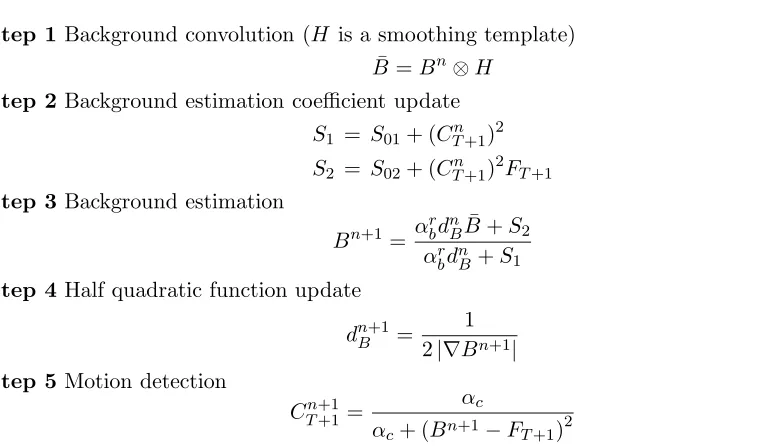
Step 1 Background convolution (H is a smoothing template) ¯
B =Bn⊗H (5)
Step 2 Background estimation coefficient update
S1 = S01+ (CTn+1)2 (6)
S2 = S02+ (CTn+1)2FT+1 (7)
Step 3 Background estimation
Bn+1= α
r
bdnBB¯+S2
αrbdnB+S1 (8)
Step 4 Half quadratic function update
dnB+1 = 1
2|∇Bn+1| (9)
Step 5 Motion detection
CTn+1+1=
αc
αc+ (Bn+1−FT+1)2
(10)
After a predefined number of iterations N, the background estimation at frame T + 1 is set as
BT+1=BN, which is also the initial value for background convolution step at the next time step. Note
that total variation regularization is applied on the estimated background B, which is proved to be effective in preserving the edges in images, thus the characteristics of objects in the scenario can be preserved as well [28, 29]. Motion detection step is straightforward since for simplicity, we do not set regularization on the detection results Ch (h=T + 1, T + 2, . . .).
3. VISUAL IMAGE SEQUENCE PROCESSING
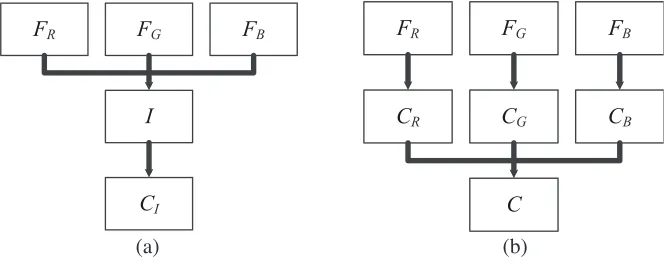
For motion detection in visual image sequences, an intuitive idea is to convert the RGB color image to a grayscale image and then apply the above algorithm. We assume that FR, FG,FB are the R,G,
and B components of a visual imageF. Equivalent gray valueI for each pixel can be calculated as the average of the R,G, and B component images.
I = FR+FG+FB
3 (11)
Taking the frame 1250 as example, Fig. 1 shows the original image and the corresponding converted grayscale image. More generalized form as a weighted sum of the R,G, and B component images is
I =ωRFR+ωGFG+ωBFB (12)
For example, in applications of analog color television signals encoding, the weight coefficients are set as ωR= 0.299, ωG = 0.587 and ωB = 0.114. When it comes to digital color encoding, combination of
ωR= 0.2125, ωG= 0.7154 andωB = 0.072 is recommended [1].
In this way, we can operate the motion detection algorithm merely on the grayscale image converted from RGB image. A main advantage is that the computational load is reduced since only one channel of the image data needs to perform the iterative motion detection algorithm. However, as we will see in the next section, this irreversible conversion inevitably degrades the detection performance due to the loss of information.
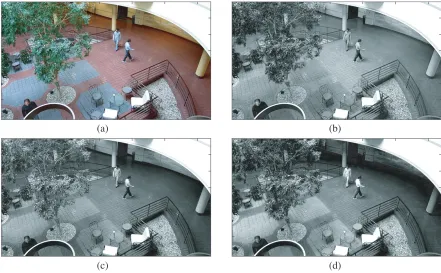
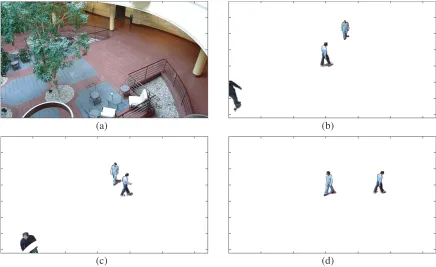
Figure 2 presents the RGB decomposition of a visual image at frame 1275. In this paper, we perform the motion detection algorithm on component image data FR, FG, and FB, and then we get
the moving object index matrices ofR,G, andB channels, which are denoted asCR,CG, andCB. The
final moving object detection result fusion can be calculated as the pointwise minimum of the above moving object index matrices.
C = min(CR, CG, CB) (13)
(a) (b)
Figure 1. Scenario at frame 1250. (a) Original visual imageF. (b) Converted grayscale imageI.
(a) (b)
(c) (d)
Figure 2. Scenario at frame 1275. (a) Original visual image F. (b) R component image FR. (c) G
component image FG. (d)B component image FB.
4. EXPERIMENT RESULTS
In this section, we verify the proposed visual image sequence motion detection algorithm by testing the real visual image data of a practical surveillance application. We further compare the proposed motion detection approach with representative methods such as optical flow and ViBe algorithm.
Parameters in the energy function are arb = 100 and ac = 3000, and iteration times are set to
10. Length of the temporal sliding window is set as 50. The smoothing template in the background convolution step introduced in Section 2 is selected as
H = 1
12
1 2 1
2 0 2 1 2 1
(14)
More specifically, for discrete images of size M×N, the gradient operation (∇u)i,j = ((∇u)1
R G B
I
R G B
R G B
(a) (b)
Figure 3. Processing schemes. (a) Grayscale image processing. (b) RGB color image processing.
is calculated according to
(∇u)1i,j =
ui+1,j−ui,j if i < M
0 if i=M (15)
(∇u)2i,j =
ui,j+1−ui,j if j < N
0 if j =N (16)
Motion detection results under the grayscale image processing scheme are presented in Fig. 4. Set of pixels that are assumed to be the moving target is
SI={(i, j) : (CI)i,j <0.5} (17) In Fig. 4(b), we show the extracted objects, i.e., {Fi,j = (FR, FG, FB)i,j : (i, j) ∈SI}. Note that there
are some lost part of the objects due to the color of the objects and varying ambient lights, especially when the color of moving object is close to that of the static background.
(a) (b)
Figure 4. Grayscale image motion detection results. (a) Motion detection result CI. (b) Moving objects extracted from the scene.
However, under the RGB color image processing scheme, if the pixel indices which are regarded as moving object regions of R,G, and B channels are
SR = {(i, j) : (CR)i,j <0.5} (18) SG = {(i, j) : (CG)i,j <0.5} (19)
SB = {(i, j) : (CB)i,j <0.5} (20)
then the overall moving region pixel set is simply the union ofSR,SG, andSB.
S=SR∪SG∪SB (21)
(a) (b)
(c) (d)
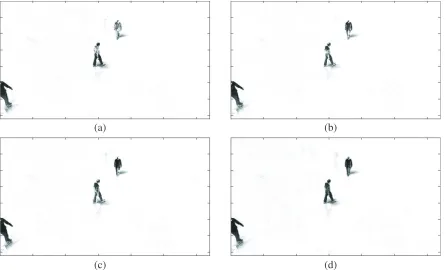
Figure 5. Motion detection results of RGB color image via HQ minimization. (a) Motion detection result ofRchannel. (b) Motion detection result ofGchannel. (c) Motion detection result ofB channel. (d) Motion detection fusion result.
(a) (b)
(e) (f)
Figure 6. Moving object detection results comparison. (a) Optical flow result of frame 1275. (b) Optical flow result of frame 1300. (c) ViBe result of frame 1275. (d) ViBe result of frame 1300. (e) HQ minimization result of frame 1275. (f) HQ minimization result of frame 1300.
(a) (b)
(c) (d)
Figure 7. Moving object extraction results. (a) Background estimation. (b) Frame 1250. (c) Frame 1275. (d) Frame 1300.
Motion detection results of R,G, and B channels and the final fusion result are shown in Fig. 5. We see that the lost part of the moving object in the detection result ofRchannel (see Fig. 5(a)) can be supplemented byGandB channels. Obviously, compared to the results of grayscale processing scheme, shapes of the moving objects in the fusion results are more complete.
a coupled way. And fusion of motion detection results of all the channels guarantees the validity and completeness of the extract results.
Extracted objects (i.e.,{Fi,j : (i, j) ∈S}) at different frames are shown in Fig. 7. Note that in this
method, we can also restore the visual background by the combination of the background estimation inR,G, and B channels. Compared to Fig. 4, the visual segmentation of moving objects via proposed method is more accurate and complete. Unlike the conventional motion detection algorithms which usually give hard decision (0 or 1), the proposed HQ minimization method gives soft detection results between 0 and 1. Such a detection result in the probability field can be further applied in the track-before-detect algorithms [30], which has the potential to form a novel detection and tracking processing scheme for visual videos.
5. CONCLUSION
In this paper we propose a motion detection algorithm for visual image sequences, which is a sequential method suitable for video processing in practical surveillance systems. Based on the half quadratic minimization technique, the conventional motion detection algorithm for grayscale images is extended to be applicable to visual videos. Fusion of the motion detection results of multiple channels over a sliding window of frames significantly improves the ability to accommodate variance of the ambient light. Experiment results verify that we can get more accurate and complete moving object detection by the proposed method. Future work includes possible extensions for static camera with non-Gaussian imaging noises, which can provide improved robustness of the algorithm and be utilized for more general applications.
REFERENCES
1. Burger, W. and M. Burge, Principles of Digital Image Processing: Fundamental Techniques, Springer, Berlin, 2009.
2. Yang, M. and G. Zhang, “Unsupervised target detection in sar images using scattering center model and mean shift clustering algorithm,” Progress In Electromagnetics Research Letters, Vol. 35, 11– 18, 2012.
3. Yang, M. and G. Zhang, “A dictionary-based image fusion for integration of SAR and optical images,”Progress In Electromagnetics Research Letters, Vol. 49, 87–90, 2014.
4. Diao, W., X. Mao, and V. Gui, “Metrics for performance evaluation of preprocessing algorithms in infrared small target images,” Progress In Electromagnetics Research, Vol. 115, 35–53, 2011. 5. Zhao, B., S. Xiao, H. Lu, and J. Liu, “Point target detection in space-based infrared imaging system
based on multi-direction filtering fusion,”Progress In Electromagnetics Research M, Vol. 56, 145– 156, 2017.
6. Lipton, A. J., H. Fujiyoshi, and R. S. Patil, “Moving target classification and tracking from real-time video,” Proceedings of Proc. IEEE Workshop Applications of Computer Vision, 8–14, Princeton, NJ, USA, 1998.
7. Caspi, Y. and M. Irani, “Spatio-temporal alignment of sequences,” IEEE Transactions on Pattern Analysis and Machine Intelligence, Vol. 24, No. 11, 1409–1424, 2002.
8. Barron, J. L., D. J. Fleet, and S. S. Beauchemin, “Performance of optical flow techniques,” International Journal of Computer Vision, Vol. 12, No. 1, 43–77, 1994.
9. Barranco, F., J. Diaz, E. Ros, and B. D. Pino, “Visual system based on artificial retina for motion detection,” IEEE Transactions on Systems, Man, and Cybernetics, Part B (Cybernetics), Vol. 39, No. 3, 752–762, 2009.
10. Horn, B. K. P. and B. G. Schunck, “Determining optical flow,” Artificial intelligence, Vol. 17, No. 1–3, 185–203, 1981.
12. Hu, W., T. Tan, L. Wang, and S. Maybank, “A survey on visual surveillance of object motion and behaviors,” IEEE Transactions on Systems, Man, and Cybernetics, Part C (Applications and Reviews), Vol. 34, No. 3, 334–352, 2004.
13. Mhatre, S., S. Varma, and R. Nikhare, “Visual surveillance using absolute difference motion detection,” Proceedings of IEEE International Conference on Technologies for Sustainable Development, 1–5, Mumbai, India, 2015.
14. Diao, W., X. Mao, H. Zheng, Y. Xue, and V. Gui, “Image sequence measures for automatic target tracking,”Progress In Electromagnetics Research, Vol. 130, 447–472, 2012.
15. Li, C. and Y. Jiang, “An effective background reconstruction method for video objects detection,” Proceedings of IEEE International Conference on Networking and Distributed Computing, 161–165, Hangzhou, China, 2012.
16. Jiang, S., Z. Wei, S. Wang, Z. Zhou, and J. Zhang, “A new algorithm for background extraction under video surveillance,” Proceedings of IEEE Conference Anthology, 1–4, China, 2013.
17. Hou, Z. and C. Han, “A background reconstruction algorithm based on pixel intensity classification,”Journal of Software, Vol. 16, No. 9, 1568–1576, 2005.
18. Zivkovic, Z. and F. V. D. Heijden, “Efficient adaptive density estimation per image pixel for the task of background subtraction,”Pattern Recognition Letters, Vol. 27, No. 7, 773–780, 2006. 19. Kim, K., T. H. Chalidabhongse, D. Harwood, and L. Davis, “Real-time foreground-background
segmentation using codebook model,”Real-Time Imaging, Vol. 11, No. 3, 172–185, 2005.
20. Barnich, O. and M. Van Droogenbroeck, “ViBe: A universal background subtraction algorithm for video sequences,”IEEE Transactions on Image Processing, Vol. 20, No. 6, 1709–1724, 2011. 21. Aubert, G. and P. Kornprobst, Mathematical Problems in Image Processing, Partial Differential
Equations and the Calculus of Cariations, Springer, Berlin, 2006.
22. Kornprobst, P., R. Deriche, and G. Aubert, “Image sequence analysis via partial differential equations,” Journal of Mathematical Imaging and Vision, Vol. 11, No. 1, 5–26, 1999.
23. Francois, A. and G. Medioni, “Adaptive color background modeling for real-time segmentation of video streams,” Proceedings of International Conference on Imaging Science, System and Technology, 1–6, 1999.
24. Cremers, D. and S. Soatto, “Variational space-time motion segmentation,” Proceedings of IEEE International Conference on Computer Vision, 886–893, Nice, France, 2003.
25. Cremers, D. and S. Soatto, “Motion competition: A variational approach to piecewise parametric motion segmentation,” International Journal of Computer Vision, Vol. 62, No. 3, 249–265, 2005. 26. Aubert, G. and J. Aujol, “A variational approach to removing multiplicative noise,”Siam Journal
on Applied Mathematics, Vol. 68, No. 4, 925–946, 2008.
27. Bar, L., B. Berkels, M. Rumpf, and G. Sapiro, “A variational framework for simultaneous motion estimation and restoration of motion-blurred video,”Proceedings of IEEE International Conference on Computer Vision, 1–8, Rio de Janeiro, Brazil, 2007.
28. Tikhonov, A. N. and V. Y. Arsenin,Solutions of Ill-posed Problems, Winston and Sons, Washington, D.C., 1977.
29. Rudin, L., S. Osher, and E. Fatemi, “Nonlinear total variation based noise removal algorithms,” Physica D, Vol. 60, No. 1-4, 259–268, 1992.