An Efficient and Robust Embedded Digital
Signature Based Data Sharing Scheme in
Cloud Computing
Mr. Vandarani Tarun,
M. tech, P.G Student,Department of CSE, S.R.K.R College of Engineering,
Bhimavaram.
Dr. G.V. Padma Raju,
Professor,Department of CSE, S.R.K.R College of Engineering,
Bhimavaram.
Dr. G.N.V.G. SIRISHA,
Assistant Professor, Department of CSE, S.R.K.R College of Engineering,Bhimavaram
Abstract
One of the most promising encryption techniques for secure data sharing in the field of Cloud
Computing is Cipher text-Policy Attribute-Based Encryption (CP-ABE).This encryption technique has turned to be
an important encryption technology to tackle the challenge of secure data sharing. In this encryption technique,
data user’s private keys and cipher texts are associated with a set of attributes. This technique completely encrypts
the data and does not have any control over the individual attributes in the data. So, in order to overcome this
problem a concept called attribute with weights was introduced, so that it can have control over the individual
elements in the data and could be able to hide sensitive information while sharing data with the users. But the
problem of malicious cloud insider still persists. Visualize in the context of an online health records system. Data
user can access the health record by satisfying their arbitrary constraints defined by the data owner. Once they get
access to the data, the system cannot prohibit or monitor their valid usage of the data. So an Embedded Digital
Signature algorithm is proposed. This algorithm can embed the accessing data user’s credentials in each health
record they access which has a stealth effect of catching and prosecute them in case of an unauthorized data
breach. Hence, the resulting scheme becomes more secure.
Keywords-- Cloud Computing, Data sharing, CP-ABE Attribute, Encryption, Embedded Digital Signature;
Introduction
The vast development in technology and internet
now a day has made data portability very easy. We can
nowadays share almost everything in online like
pictures, movies, thoughts, etc.[1] [2]. If anybody
need’s an emergency help from a doctor or hospital for
chronic diseases like cardio, neuron related previous
data, are now able to do all these things easily with the
help of internet or cloud technology. Because of the
increase in the number of internet users, it has become
a necessity to protect our data from being misused. An
unauthorized user should not be able to access our
private data.
Accordingly, how securely and efficiently
share user data has become one of the toughest
challenges in the scenario of cloud computing [3], [4].
For this reason we have to take care of data by
implementing data protection techniques like CP-ABE
idea of what cipher text-policy attribute-based
encryption is. Roughly, it can be viewed as a
generalization of identity-based encryption. So as in
identity-based encryption, there is a single public key,
and there is a master private key that can be used to
make more limited private keys.
However, CP-ABE is much more flexible
than plain identity-based encryption [7], it allows
complex rules specifying which private keys can
decrypt which cipher texts. Specifically, the private
keys are associated with sets of attributes or labels,
when we encrypt, encrypt data and access policy
which specifies which keys will be able to decrypt.
Along with the concept of CP –ABE , and include the
concept of Embedded Digital Signature then there is a
atmost possibilty to overcome the problem of misusage
of the Data Owner’s sensitive information to a very
large extent.
Fig1: System model of CP-WABE-RE scheme in cloud computing
1. Literature Survey
In 2016 Hangman Zhu and Rue
Jiang proposed “A Secure Anti-Collusion Data Sharing
Scheme for Dynamic Groups in the Cloud”, In this
paper, whenever Data Owner wants to share data with
some end user, he performs some encryption technique
and generates a secret key, and sends that secret key to
the end user with whom he wants to share data. The
end user has to enter the secret key manually. Data
Owner grants the permission to End user for accessing
his data by providing a secret key to him. But after
some time even if Data Owner revokes the permission
given to the End user, the secret key is still visible to
the End User.
In 2014, Hiding et al introduced
“Ciphertext-policy hieratical attribute-based encryption with short
cipher texts” wherein the drawback of entering the
secret key manually was resolved, but this encryption
model completely encrypts the file and it does not have
any control over the individual elements of the file.
There may arise some situations where Data Owner
may wants to show only some particular data and hide
some sensitive information from the end user. But
using this type of encryption method may not help the
Data Owner to hide information from the end user.
In 2016 Shula Wang, Kauai Liang, Joseph K.
Liu proposed, “Attribute Based Data Sharing Scheme
Revisited in Cloud Computing” wherein we can have
users by giving weights to the attributes and you can
hide those particular attributes from the end user. But
this process still has a limitation like the data which is
shared by the Data Owner is in the text format and it
can be easily manipulated. The owner may share the
data over internet and end user can download the data
and there may be a chance that the end user can change
some important information related to the Data Owner,
as the data is in a text format and there may be a
chance that the end user can publish the same data
again over the internet.
2. Our Contributions
In order to overcome all the limitations seen
in the above mentioned base paper, An Embedded
Digital Signature based Data sharing scheme in Cloud
Computing is proposed. Now whenever the Data
Owner shares information with the end user, the data is
shared in the form of an image instead of text. As the
data is in image format the end user will not be able to
make any changes to the original data of the Data
Owner. Moreover, it also have a Digital Signature
embedded within the data and this Digital Signature
varies from one user to another. So with the help of
this Digital Signature embedded within the data, we
can easily catch the person who has misused or
manipulated the data.
The Digital Signature does not come along
with the data but it comes within the data that is the
reason why we call it embedded. Now days the mobile
phones are coming with embedded batteries which
means that the battery cannot be removed at any cost.
In the same way here, whenever the Data Owner
shares the data with the end user, that particular data
has Page id embedded in it. Which is nothing but, the
Digital signature which cannot be removed and it is
coming along with the data. Hence, this technique
assures the security and confidentiality to the Data
Owner’s data and protecting it from malicious user.
Fig2: System Framework of CP-WABE-RE scheme
In previous systems developed using
CP-WABE-RE the cipher text components generated
ensured security by overcoming the key escrow
problem. The problem of malicious cloud insider still
persists. Consider in the context of online medical
health records system. An authorized user can access
the health record satisfying the access structure defined
by the data owner. Once they get access to the data the
system cannot prohibit or monitor their valid usage of
An Embeddable Digital Signature algorithm
is proposed, that can embed the accessing users
credentials in each health record they access which has
a secret effect of catching and informing the Data
Owner’s in case of an unauthorized data breach. Fig 3
shows how a digital ID is embedded in a PDF
Document. A digital signature [8] can be used with any
kind of message whether it is encrypted or not. Simply
the receiver can be sure of the sender's identity and that
the message arrived intact. Digital signatures make it
difficult for the signer to deny having signed
something (non-repudiation) assuming their private
key has not been compromised as the digital signature
is unique to both the document and the digital signer.
In many countries, including the United States, digital
signatures have the same legal significance as the more
traditional forms of signed documents.
Fig3: Digital ID embedded in a PDF Document.
3. SYSTEM MODEL
As illustrated in Fig. 1 and Fig. 2, the system
model and framework of CP-WABE-RE scheme in
cloud computing are given, where the system consists
of four types of entities: KA, CSP, DO and Users. In
addition, we provide the detailed definition of
CP-WABE-RE scheme.
Key Authority (KA):
It is a semi-trusted entity in cloud system.
Namely, KA is honest-but-curious, which can honestly
perform the assigned tasks and return correct results.
However, it will collect as many sensitive contents as
possible. In cloud system, the entity is responsible for
the users’ enrollment. Meanwhile, it not only generates
most part of system parameter, but also creates most
part of secret key for each user.
Cloud Service Provider (CSP):
It is the manager of cloud servers and also a
semi-trusted entity which provides many services such
as data storage, computation and transmission. To
solve the key escrow problem, it generates both parts
of system parameter and secret key for each user.
Data Owners (DO):
Data owners of files to be stored in cloud system. Data owners are in charge of defining access
structure and executing data encryption operation.
Data owners also upload the generated cipher text to
CSP.
Users want to access ciphertext stored in cloud
system. Users download the ciphertext and execute the
corresponding decryption operation.
4. Algorithm
Representing the CP WABE RE with
Embedded DS in four steps:
Step 1: System Initialization
In System Initialization step, Firstly set up
KA and CSP which means they can create an
understanding between KA and CSP that everything
related to storage will be taken care by CSP and
information related to keys will be taken care by KA.
KA will also make sure to have the control over the
individual elements of the data instead of having
control over the entire data.
Step2: New File Creation
In this step the encryption modules plays
major role. The file which the Data owner wants to
share with the end user will be encrypted in this step.
Step 3: New User Authorization
In this step, the key is generated and the
encrypted data will be shared among the users. If the
user is authorised person then only he can access the
data, an unauthorised user cannot access the data.
Step4: Embedded Digital Signature
In this step, a Digital Signature is embedded
within the data. which the Data Owner wants to share
with the end user. which means that Data owner is
sharing the data with an embedded Digital Signature in
it, so that it can be able to reduce the misuse of data to
some extent and can ensure authentication,
confidentiality, Data Integrity, Non repudiation.
5. Comparison
Table: Comparison of Various ABE Techniques Used In Cloud Computing
number of weighted
attributes
The storage cost of
Secret key(KB)
2 5
3 10
5 15
7 20
9 25
Fig: 1 the storage cost of secret key.
Analysis of Key Escrow:
The storage overhead and computation cost of
user secret key are compared as plotted in Fig. 1. The
number of weighted attributes used in this simulation
is N = {5, 10, 15, 20, 25}. We find that the storage
overhead of user secret key. We also observe that all
experimental results are gradually increasing and
approximately follow a linear relationship with the
number of weighted attributes.
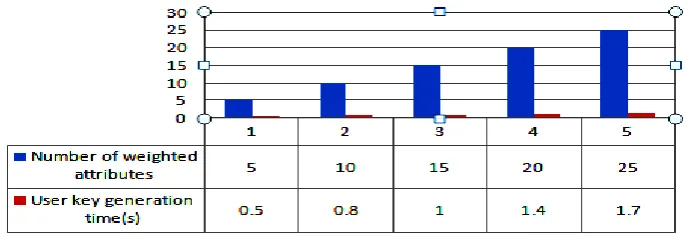
Number of
weighted attributes
User key generation
time(s)
5 0.5
10 0.8
15 1
20 1.4
Fig: 2 the time cost of user key generation
Fig. 1 plots the relationship between the
storage overhead of ciphertext and the number of
weighted attributes in access policy. Fig. 2 shows
encryption time of ciphertext versus the number of
weighted attributes. When ωi _= ωi1 (here we assume
that an attribute can be represented 5 attributes which
possess different weights), we find that CP-WABE-RE
scheme requires less storage cost and encryption time
than the others. We also observe that all results
approximately follow a linear relationship with the
number of weighted attributes in access tree.
7. Conclusion
In this paper, an Embedded Digital Signature
based data sharing scheme along with the concept of
Cipher text Policy Attribute Based Encryption
Removing Escrow (CP-ABE-RE) is proposed with
help of this Data Owner can share data with the end
users securely and the shared data is in an image
format with a Digital Signature embedded in it which
makes it impossible for the end user to manipulate the
data. Therefore, security is assured to the data owner’s
information.
8. References
[1] S.Lai, J.K. Liu, K.-K. R. Coho, and K. Liang,
“Secret picture: An efficient tool for mitigating deletion delay on OSN,” in Proc. 17th Int. Conf. Inf.
Common. Secure., 2015, pp. 467–477.
[2] K. Liang, J. K. Liu, R. Lu, and D. S. Wong,
“Privacy concerns for photo sharing in online social networks,” IEEE Internet Comput., vol. 19, no. 2, pp.
58–63, Mar./Apr. 2015.
[3]C.-K. Chu, W.-T. Zhu, J. Han, J.-K. Liu, J. CSU,
and J.Zhou, “Security concerns in popular cloud
storage services,” IEEE Pervasive Comput., vol. 12,
no. 4, pp. 50–57, Oct./Dec. 2013.
[4] C. Wang, S. S. M. Chow, Q. Wang, K. Ran, and
W.Lou,“Privacy preserving public auditing for secure
cloud storage,” IEEE Trans. Comput., vol. 62, no. 2,
pp. 362–375, Feb. 2013.
[5] A. Bale and K. Kuppusamy, “An expressive and
provably secure ciphertext-policy attribute-based
encryption,” Inf. Sci., vol. 276, no. 4, pp. 354–362,
Aug. 2014.
[6]H.Dengetal., “Ciphertext-policy hierarchical
attribute-based encryption with short cipher texts,” Inf.
Sci., vol. 275, no. 11, pp. 370–384, Aug. 2014.
[7] A. Sashay and B. Waters, “Fuzzy identity-based
encryption,” in Proc. 24th Annul. Int. Conf. Theory
Appl. Cryptograph. Techno., 2005,pp.457–473