Hierarchical Functional Encryption
Zvika Brakerski∗ Gil Segev†
Abstract
Functional encryption provides fine-grained access control for encrypted data, allowing each user to learn only specific functions of the encrypted data. We study the notion of hierarchical functional encryption, which augments functional encryption withdelegationcapabilities, offering significantly more expressive access control.
We present ageneric transformationthat converts any general-purpose public-key functional encryption scheme into a hierarchical one without relying on any additional assumptions. This significantly refines our understanding of the power of functional encryption, showing that the existence of functional encryption is equivalent to that of its hierarchical generalization.
Instantiating our transformation with the existing functional encryption schemes yields a va-riety of hierarchical schemes offering various trade-offs between their delegation capabilities (i.e., the depth and width of their hierarchical structures) and underlying assumptions. When start-ing with a scheme secure against an unbounded number of collusions, we can supportarbitrary hierarchical structures. In addition, even when starting with schemes that are secure against a bounded number of collusions (which are known to exist under rather minimal assumptions such as the existence of public-key encryption and shallow pseudorandom generators), we can support hierarchical structures of bounded depth and width.
∗Department of Computer Science and Applied Mathematics, Weizmann Institute of Science, Rehovot 76100, Israel.
Email: [email protected]. Supported by the Israel Science Foundation (Grant No. 468/14) and by the Alon Young Faculty Fellowship.
1 Introduction
The rapidly evolving vision of functional encryption [SW08, BSW11, O’N10] offers tremendous flex-ibility when accessing encrypted data. Specifically, functional encryption schemes support restricted decryption keys that allow users to learn specific functions of the encrypted data and nothing else. Motivated by the early examples of functional encryption schemes for specific functionalities (such as identity-based encryption [Sha84, BF03, Coc01]), extensive research has recently been devoted to the study of functional encryption (see, for example, [SW08, BSW11, O’N10, GVW12, AGV+13, BO13, BCP14, GGH+13, GKP+13, ABS+15, Wat15, GGH+16, AS15, BS15, KSY15, BKS16] and the references therein).
In a functional encryption scheme, a trusted authority holds a master secret key known only to the authority. When the authority is given the description of some function f as input, it uses its master secret key to generate a functional key skf associated with the function f. Now, anyone
holding the functional key skf and an encryption of any message x, can compute f(x) but cannot
learn any additional information about the message x. Such fine-grained access to encrypted data is extremely useful for a wide variety of applications, including expressive access control, spam filtering, mining encrypted databases, and more (we refer the reader to the survey by Boneh, Sahai and Waters [BSW12] for an in-depth discussion of these applications).
Hierarchical functional encryption. Motivated by the applicability of functional encryption
to expressive access-control systems, in this paper we study the notion of hierarchical functional encryption, which was introduced by Ananth, Boneh, Garg, Sahai and Zhandry [ABG+13]. The hierarchical notion augments standard functional encryption with delegation capabilities, enabling significantly more expressive access control.
Specifically, recall that in a functional encryption scheme, the holder of the master secret keymsk
can generate a functional keyskf corresponding to any given functionf. In a hierarchical functional
encryption scheme, the holder of any such functional key skf can in turn generate a functional
key skg◦f corresponding to the function g◦f for any given function g. Now, anyone holding the
delegated functional keyskg◦f and an encryption of any messagex, can compute (g◦f)(x) =g(f(x))
but cannot learn any additional information about the message x. Such expressive delegation capabilities give rise to hierarchical access control, which is a sought-after ingredient in modern access control systems. In particular, the notion of hierarchical functional encryption generalizes those of hierarchical attribute-based encryption, hierarchical identity-based encryption and more (see the discussion at the end of Section 3 on the delegation capabilities of functional encryption).
Ananth et al. formalized a notion of security for hierarchical functional encryption schemes, and sketched how the functional encryption scheme of Garg et al. [GGH+13] can be transformed into a hierarchical one by using a general-purpose indistinguishability obfuscator [BGI+12, GGH+13].1 Their approach, however, is both tailored to the specific functional encryption scheme of Garg et al. [GGH+13], and can only support hierarchical structures ofconstant depth (i.e., can only support a constant number of successive delegations).2
The significance of augmenting functional encryption with delegation capabilities was also rec-ognized by an independent work of Chandran, Goyal, Jain and Sahai [CGJ+15]. Their work uses sub-exponentially-secure indistinguishability obfuscation (and sub-exponentially-secure hierarchical
1
It was recently shown by Ananth and Jain [AJ15] and by Bitansky and Vaikuntanathan [BV15] that indistinguisha-bility obfuscation can be constructed from some flavors of functional encryption. Specifically, fromsuccinctfunctional encryption withsub-exponential security. Our approach is both more direct and requires no such properties.
2
In the hierarchical scheme of Ananth et al. [ABG+13], a delegated functional keyskg◦f for the functiong◦f is
computed fromskf by applying the obfuscator to a program that containsskf as part of its description. Thus, since
IBE) for constructing an adaptively-secure hierarchical functional encryption scheme that supports hierarchical structures of any pre-determined polynomial depth (see Table 1 for for a comparison of the assumptions underlying the known hierarchical functional encryption schemes and of their supported hierarchical structures). In addition, their work introduces and realizes the notion of a multi-authority functional encryption scheme, which is an interesting distributed extension of functional encryption which is not a subject of study in our work.
1.1 Our Contributions
We present a generic transformation that converts any general-purpose public-key functional en-cryption scheme into a hierarchical one without relying on any additional assumptions (and, in particular, without relying on indistinguishability obfuscation). Our transformation allows instanti-ations based both on unbounded-collusion functional encryption schemes and on bounded-collusion ones. This level of generality yields a variety of hierarchical schemes based on various assumptions in the standard model. These include strong assumptions such as indistinguishability obfuscation [GGH+13, Wat15] or multilinear maps [GGH+16], and much milder assumptions such as learning with errors [GKP+13], and even the existence of any public-key encryption scheme and low-depth pseudorandom generator [GVW12].
We stress that our result stands even if it turns out that indistinguishability obfuscation is im-possible to achieve or requires strong computational assumptions. One could view it as evidence that the hierarchical properties do not stem from the “obfuscation-like” features of functional encryption, but rather from the more rudimentary properties that are achievable under minimal assumptions.
Security and efficiency. In terms of security, the schemes resulting from our transformation
guarantee semi-adaptive security. Moreover, by assuming that the underlying functional encryption scheme is sub-exponentially secure, we obtain adaptive security via a standard complexity leveraging argument. In terms of efficiency, our approach results in keys and ciphertexts with a rather low overhead compared to the efficiency of the underlying functional encryption scheme. A ciphertext in our scheme is essentially a ciphertext of the underlying scheme. A delegated functional key for
g◦f contains two functional keys for functions that essentially compute f and g, respectively, in addition to some basic cryptographic computation (an evaluation of a PRF, and an encryption of a ciphertext of the underlying scheme). We refer the reader to the overview below for more details on the security and efficiency of the schemes resulting from our approach.
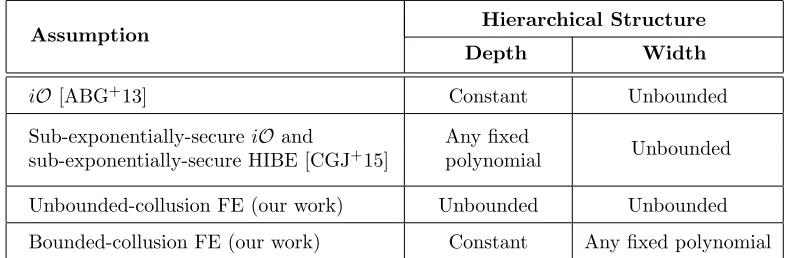
Instantiations. The variety of schemes resulting from our transformation offer different trade-offs
Assumption Hierarchical Structure
Depth Width
iO[ABG+13] Constant Unbounded
Sub-exponentially-secureiOand
sub-exponentially-secure HIBE [CGJ+15]
Any fixed
polynomial Unbounded
Unbounded-collusion FE (our work) Unbounded Unbounded
Bounded-collusion FE (our work) Constant Any fixed polynomial
Table 1: A comparison of the assumptions underlying the known hierarchical functional encryption schemes and of their supported hierarchical structures. We note that indistinguishability obfuscation (iO) is known to imply unbounded-collusion functional encryption [Wat15], which in turn clearly implies bounded-collusion functional encryption. In addition, bounded-collusion functional encryption is implied by much milder as-sumptions such as learning with errors [GKP+13], and even the existence of any public-key encryption scheme
and low-depth pseudorandom generator [GVW12].
1.2 Overview of Our Approach
Formally, a hierarchical FE scheme contains the standard (Setup,KG,Enc,Dec) algorithms, in addi-tion to a new delegation algorithmDelegate. The delegation algorithm Delegate(hskf, g) is identical
in syntax to the KG algorithm, except that it takes a functional key hskf (which can itself be the
output of a previous delegation) instead of the master secret key msk. Its output is a key hskg◦f
corresponding to the composed function g◦f.
Indeed, the way we implement this functionality is by associating a unique master secret key with any delegable functional key. Namely, a delegable keyhskf (with respect to the master key pair
(msk,mpk)) will contain a fresh master secret keymsk′ in addition to a “standard” functional key for a re-encryption functionskReEncf,mpk′ (the key pair (msk′,mpk′) is generated using the standard setup procedure). The function ReEncf,mpk′(x), intuitively, takes an input x and outputs a functional encryption off(x) under the new keympk′. It is obvious that since msk′ is a part of hskf, then the
owner ofhskf = (skReEncf,mpk′,msk
′) can derivef(x) itself if it so desires. The beauty of this procedure
is that it can then be repeated. If hskf needs to be delegated via Delegate(hskf, g), then one only
needs to generate a new pair (msk′′,mpk′′), use msk′ to obtain sk′ReEncg,mpk′′ and output hskg◦f =
(skReEncf,mpk′,sk′ReEncg,mpk′′,msk′′). In the decryption process, we start with some ct = FE.Encmpk(x),
use the first component of the key to obtain ct′ = FE.Encmpk′(f(x)), and then using the second component to obtainct′′ =FE.Encmpk′′(g(f(x))). Finally,msk′′is used to decryptct′′and thus learn the valueg(f(x)).
Care needs to be taken in order to securely realize the above intuition. In particular, one has to come up with a source of randomness for the re-encryption process. This is done by slightly modifying the encryption algorithm of the hierarchical scheme such that Enc(mpk, x) =
FE.Enc(mpk,(x, K,⊥)), where K is a key to a puncturable pseudorandom function PRF, and ⊥ is a placeholder that will only be used in the proof. Similarly, we will generate functional keys of the form skReEncf,t,mpk′,c, where t is a random tag and c is a random string that will be used in the proof. The function ReEncf,t,mpk′,c(x, K,⊥) will compute f(x) and encrypt the tuple (f(x), K′,⊥) under msk′ using randomness r′. The randomness for the generation of K′ and r′ is produced by evaluating PRFK(t).
If its input is of the form (·,·,k), wherekis a key for a symmetric encryption scheme, then the first two arguments are ignored andSKE.Deck(c) is output. Thus we implement a “trapdoor circuit” (or a “Trojan”) as per [DIJ+13, ABS+15].
Security notion. The notions of security that we consider in this work are those formalized by
Ananth et al. [ABG+13]. Specifically, we consider adversaries that obtain functional keys for various functions of their choice by issuing key-generation queries and delegation queries. We require that such adversaries have only a negligible advantage in distinguishing the encryptions of two challenge messages, x∗0 andx∗1, of their choice as long as for any functionf for which they obtain a functional key it holds that f(x∗0) = f(x∗1), where such a key may be produced either as a result of a key-generation query or a delegation query (we refer the reader to Section 3 for more details).
We prove that if the underlying scheme FE is selectively secure then the resulting hierarchical scheme is selectively secure, and if FE is semi-adaptively secure then the resulting hierarchical scheme is semi-adaptively secure.3 We leave it as an intriguing open problem to design a hierarchical functional encryption scheme that guarantees adaptive security. We note that already in the less-expressive setting of identity-based encryption, designing adaptively-secure hierarchical schemes is extremely challenging. In particular, Lewko and Waters [LW14] recently showed why known proof methods fall short of proving adaptive security even for adaptively-secure hierarchical identity-based encryption (which is a special case of hierarchical FE) without degrading exponentially with the number of delegation levels.
Proof overview. Let us focus on the case of selective security, semi-adaptive security follows by a practically identical argument. In the selective security game, the adversary first specifies challenge messages x∗0 and x∗1, receives mpk, and then makes a sequence of key-generation and delegation queries. One could visualize the structure that is generated by these queries as a tree, whose root is (msk,mpk) and whose nodes are the key pairs that are generated upon each call to KGorDelegate. Each such call generates a new child for one of the nodes in the tree, as per the adversary’s choice. Each node is associated with a function f which was input to KG/Delegate in its creation, and also with a function ˜f, which is the composition of all functions from the root to that node. If
˜
f(x∗0) = ˜f(x∗1) then we say that the node is observable, since the adversary is allowed to see the functional keyhskf˜associated with that node. We can assume w.l.o.g that all the leaves of the tree are observable.
The high-level intuition of the proof is the following. Let us pretend that ReEnc is actually capable of outputting a re-encrypted ciphertext which is encrypted with true randomness, rather than with pseudorandomness. Now, consider an unobservable node i(i.e., a node corresponding to
fi and ˜fi for which ˜fi(x0∗)̸= ˜fi(x∗1)) that only has observable children. This means that all functions
ReEncf,t,mpk′,c that are generated relative to this node’s mski will output the same value whether
the challenge ciphertext is an encryption ofx∗0 or of x∗1. The security of the underlying scheme will guarantee that the re-encrypted ciphertext cannot be used to distinguish x∗0 from x∗1. Let us take another leap of faith and pretend that not only the re-encrypted ciphertext cannot distinguish x∗0
from x∗1 but it is in fact identical in both cases. Then the above process can propagate towards the root of the tree, where at every step we increase the number of nodes whose output is the same regardless of whether the challenge ciphertext encryptsx∗0 orx∗1. Once this process gets all the way
3
to the root and applied to the challenge ciphertext itself, the proof is complete.
This intuition is implemented using the mechanisms of punctured programming [SW14] and “trapdoor circuits” [DIJ+13] (or “Trojans” [ABS+15]). We will replace thecvalues inReEncf,t,mpk′,c
with symmetric encryptions of our “fantasy ciphertexts” (ones that are encrypted with true ran-domness), and append the challenge ciphertext with the appropriate symmetric decryption key (in fact, multiple symmetric keys will be needed, one for every level of the hierarchy, and one has to carefully control their propagation along the tree). Puncturable PRFs will be used to argue that the use of fantasy ciphertexts is indistinguishable from the actual output of ReEncf,t,mpk′,c, which
will allow the proof idea from above to go through. This requires a careful and delicate argument since we can only puncture a PRF key that had been generated with fresh randomness, hence one has to also consider fantasy PRF keys and propagate them along the tree as well together with the fantasy ciphertexts. The formal proof thus contains many fine points and a large number of steps, and is provided in Section 4.
1.3 Related Work
Hierarchical encryption schemes. Encryption schemes supporting a hierarchical structure have
been extensively studied in the setting of identity-based encryption, and have been recently studied in the more general setting of attribute-based encryption and functional encryption.
The line of research on hierarchical identity-based encryption has been extremely successful, starting with schemes in the random oracle model, evolving through selectively-secure schemes in the standard model and graduating to adaptively secure schemes for polynomially many levels. It is far beyond the scope of this paper to provide an extensive overview of this line of research, and we refer the reader to [GS02, HL02, BB04, BBG05, BW06, GH09, Wat09, ABB10a, ABB10b, LOS+10, LW10, LW11, CHK+12, LW14] and the references therein.
Recently, Boneh et al. [BGG+14] constructed an attribute-based encryption scheme that supports delegation of keys. This scheme enables anyone holding a keyskP corresponding to a predicateP to
generate a keyskP∧Q corresponding to the predicate P ∧Q for any given predicateQ. Now, given
the keyskP∧Qand an encryption of any pair (x, m), one can recovermif and only if (P∧Q)(x) = 1.
Although the setting of attribute-based encryption is significantly more expressive than the identity-base one, it does not seem to come close to the general setting of functional encryption that we consider in this paper.
Finally, as discussed above, Ananth et al. [ABG+13] sketched how the functional encryption scheme of Garg et al. [GGH+13] can be transformed into a hierarchical one by using a general-purpose indistinguishability obfuscator. When compared to their scheme our approach offers two main advantages. First, whereas Ananth et al. rely on a specific scheme and on indistinguishability obfuscation, we can rely on any underlying general-purpose scheme. This enables us to rely on a variety of underlying assumptions, including learning with errors and even the existence of any public-key encryption scheme and low-depth pseudorandom generators, as discussed in Section 1.1. Furthermore, as new functional encryption schemes are presented, they can immediately be plugged in to our construction. Second, the schemes resulting from our transformation guarantee semi-adaptive security, whereas the scheme of Ananth et al. guarantees only the somewhat less realistic notion of selective security.
Encapsulation techniques in functional encryption. Key encapsulation is a very useful
al. [ABS+15], followed by Brakerski et al. [BKS16], showed that key encapsulation is useful also for functional encryption, and can be used for generically enhancing the functionality and the security of such schemes. Their approaches suggest that encapsulation techniques may in fact be a general tool that is useful in the design of functional encryption schemes. As discussed in Section 1.2, our construction relies on encapsulation techniques as a key ingredient, significantly extending the ini-tial ideas of Ananth et al. and Brakerski et al. from encapsulating keys to realizing a re-encryption mechanism that generates a hierarchical structure.
1.4 Paper Organization
The remainder of this paper is organized as follows. In Section 2 we provide an overview of the notation, definitions, and tools underlying our constructions. In Section 3 we present the notion of a hierarchical functional encryption scheme and define its security. In Section 4 we present our generic construction of a hierarchical functional encryption scheme.
2 Preliminaries
In this section we present the notation and basic definitions that are used in this work. For a distribution X we denote by x ← X the process of sampling a value x from the distribution X. Similarly, for a set X we denote by x ← X the process of sampling a value x from the uniform distribution over X. For an integer n ∈ N we denote by [n] the set {1, . . . , n}. Throughout the paper, we denote by λ the security parameter. A function neg : N → R is negligible if for every constant c > 0 there exists an integer Nc such that neg(λ) < λ−c for all λ > Nc. Two sequences
of random variables X = {Xλ}λ∈N and Y = {Yλ}λ∈N are computationally indistinguishable if for
any probabilistic polynomial-time algorithm A there exists a negligible function neg(·) such that Pr[A(1λ, Xλ) = 1]−Pr[A(1λ, Yλ) = 1]≤neg(λ) for all sufficiently large λ∈N.
2.1 Pseudorandom Functions
Let{Kλ,Xλ,Yλ}λ∈Nbe a sequence of sets and letPRF = (PRF.Gen,PRF.Eval) be a function family
with the following syntax:
• PRF.Genis a probabilistic polynomial-time algorithm that takes as input the unary represen-tation of the security parameterλ, and outputs a keyK∈ Kλ.
• PRF.Evalis a deterministic polynomial-time algorithm that takes as input a key K ∈ Kλ and
a value x∈ Xλ, and outputs a value y∈ Yλ.
The sets Kλ, Xλ, and Yλ are referred to as the key space, domain, and range of the function
family, respectively. For K ∈ Kλ, we use the notation PRF.Eval(K,·), PRF.EvalK(·) andPRFK(·)
interchangeably. The following is the standard definition of a pseudorandom function family.
Definition 2.1(Pseudorandomness). A function familyPRF = (PRF.Gen,PRF.Eval) is pseudoran-dom if for every probabilistic polynomial-time algorithmA there exists a negligible functionneg(·) such that
AdvPRF,A(λ)
def
= Pr
K←PRF.Gen(1λ) [
APRF.EvalK(·)(1λ) = 1 ]
− Pr
f←Fλ [
Af(·)(1λ) = 1]
≤neg(λ),
In addition to the standard notion of a pseudorandom function family, we rely on the seem-ingly stronger (yet existentially equivalent) notion of a puncturable pseudorandom function family [KPT+13, BW13, SW14, BGI14]. In terms of syntax, this notion asks for an additional probabilistic polynomial-time algorithm,PRF.Punc, that takes as input a keyK ∈ Kλ and a setS ⊆ Xλ and
out-puts a “punctured” key KS. The properties required by such a puncturing algorithm are captured
by the following definition.
Definition 2.2(Puncturable PRF). A pseudorandom function familyPRF = (PRF.Gen,PRF.Eval,
PRF.Punc) is puncturableif the following properties are satisfied:
1. Functionality: For all sufficiently large λ∈N, for every setS ⊆ Xλ, and for everyx∈ Xλ\S
it holds that
Pr
K←PRF.Gen(1λ);
KS←PRF.Punc(K,S)
[PRF.EvalK(x) =PRF.EvalKS(x)] = 1.
2. Pseudorandomness at punctured points: Let A = (A1,A2) be any probabilistic
poly-nomial-time algorithm such that A1(1λ) outputs a set S ⊆ Xλ, a value x ∈ S, and state
information state. Then, for any suchAthere exists a negligible function neg(·) such that
AdvPRF,A(λ)
def
= |Pr [A2(KS,PRF.EvalK(x),state) = 1]−Pr [A2(KS, y,state) = 1]| ≤neg(λ)
for all sufficiently large λ ∈ N, where K ← PRF.Gen(1λ), (S, x,state) ← A1(1λ), KS = PRF.Punc(K, S), andy ← Yλ.
For our constructions we rely on pseudorandom functions that need to be punctured only at a single point (i.e., in both parts of Definition 2.2 it holds that S = {x∗} for some x∗ ∈ Xλ). As
observed by [KPT+13, BW13, SW14, BGI14] the GGM construction [GGM86] of PRFs from any one-way function can be easily altered to yield such a puncturable pseudorandom function family.
Augmented evaluation. When dealing with pseudorandom functions that need to be punctured
only at a single point, we find it natural to consider an “augmented” evaluation algorithm that outputs a pre-determined value y∗ at the punctured point. That is, we extend the functionality of
PRF.Evalsuch that given an augmented key of the form (Kx∗,(x∗, y∗)), it holds that
PRF.Eval(Kx∗,(x∗,y∗))(x) = {
y∗, ifx=x∗
PRF.EvalKx∗(x), ifx̸=x∗
.
2.2 Private-Key Encryption with Pseudorandom Ciphertexts
A private-key encryption scheme over a message spaceX ={Xλ}λ∈Nis a triplet Π = (KG,Enc,Dec)
of probabilistic polynomial-time algorithms. The key-generation algorithm KG takes as input the unary representation 1λ of the security parameterλ∈Nand outputs a secret keyk. The encryption algorithm Enc takes as input a secret key k and a message x ∈ Xλ, and outputs a ciphertext c.
The decryption algorithm Dec takes as input a secret key k and a ciphertext c, and outputs a message x ∈ Xλ or the dedicated symbol ⊥. In terms of correctness we require that for any key k
that is produced by KG(1λ) and for every message x∈ Xλ it holds that Dec(k,Enc(k, x)) =x with
a uniformly distributed string does not decrypt to a valid message with overwhelming probability, i.e. Dec(k, ρ) = ⊥ with probability (1−neg(λ)) over the randomness of the key k and a uniformly distributed string ρ of the same length as the ciphertext4. In terms of security, we rely on the following standard notion of pseudorandom ciphertexts which can be based on any one-way function (see, for example, [Gol04]).
Definition 2.3 (Pseudorandom ciphertexts). A private-key encryption scheme Π = (KG,Enc,Dec) haspseudorandom ciphertextsif for any probabilistic polynomial-time adversaryA= (A1,A2), there exists a negligible function neg(·) such that
AdvPCΠ,A(λ)def= Pr [
ExpPCΠ,A(λ) = 1 ]
−1
2
≤neg(λ),
for all sufficiently large λ ∈ N, where the random variable ExpPCΠ,A(λ) is defined via the following experiment:
1. k←KG(1λ),b← {0,1}.
2. (x∗,state)← A1Enc(k,·)(1λ), wherex∗∈ Xλ.
3. c∗0 ←Enc(k, x∗),c∗1← {0,1}|c∗0|.
4. b′ ← AEnc(k2 ,·)(c∗b,state).
5. Ifb′ =b then output 1, and otherwise output 0.
2.3 Public-Key Functional Encryption
A public-key functional encryption scheme over a message spaceX ={Xλ}λ∈Nand a function space F ={Fλ}λ∈N is a quadruple Π = (Setup,KG,Enc,Dec) of probabilistic polynomial-time algorithms.
The setup algorithmSetuptakes as input the unary representation 1λof the security parameterλ∈N
and outputs a master-secret key msk and a master-public key mpk. The key-generation algorithm
KGtakes as input a master-secret keymskand a functionf ∈ Fλ, and outputs a functional keyskf.
The encryption algorithm Enc takes as input a master-public key mpk and a message x∈ Xλ, and
outputs a ciphertext ct. In terms of correctness we require that for all sufficiently largeλ∈N, for every functionf ∈ Fλ and message x∈ Xλ it holds thatDec(KG(msk, f),Enc(mpk, x)) =f(x) with
all but a negligible probability over the internal randomness of the algorithms Setup,KG, andEnc. We rely on the standard indistinguishability-based notion of adaptive security for public-key functional encryption (see, for example, [BSW11, O’N10, BO13, ABS+15]), asking that encryptions of any two messages, x0 and x1, are computationally indistinguishable given access to functional keys for any functionf such that f(x0) =f(x1).
Definition 2.4(Adaptive security). A functional encryption scheme Π = (Setup,KG,Enc,Dec) over a message space X = {Xλ}λ∈N and a function space F = {Fλ}λ∈N is adaptively secure if for any
probabilistic polynomial-time adversaryA= (A1,A2) there exists a negligible function neg(·) such that
AdvFEΠ,A(λ)def= Pr [
ExpFEΠ,A(λ) = 1 ]
−1
2
≤neg(λ),
for all sufficiently large λ ∈ N, where the random variable ExpFEΠ,A(λ) is defined via the following experiment:
4
1. (msk,mpk)←Setup(1λ),b← {0,1}.
2. (x∗0, x∗1,state) ← A1KG(msk,·)(1λ,mpk), where x∗
0, x∗1 ∈ Xλ, and for each function f ∈ Fλ with
which A1 queriesKG(msk,·) it holds thatf(x∗0) =f(x∗1). 3. ct∗ ←Enc(mpk, x∗b).
4. b′ ← AKG(msk2 ,·)(ct∗,state), where for each function f ∈ Fλ with which A2 queriesKG(msk,·) it holds that f(x∗0) =f(x∗1).
5. Ifb′ =b then output 1, and otherwise output 0.
In addition to the above notion of adaptive security we consider two natural relaxations: semi-adaptive security, and selective security. Semi-adaptive security is defined via an experiment
ExpsemiFEΠ,A (λ) that is obtained from the experiment ExpFEΠ,A(λ) by asking the adversary to determine the challenge messages before making any key-generation queries (but after receiving the public key). Selective security is defined via an experiment ExpselFEΠ,A (λ) that is obtained from the experi-mentExpFEΠ,A(λ) by asking the adversary to determine the challenge messages in advance (i.e.,before
receiving the public key).
Known constructions. General-purpose functional encryption schemes that satisfy the above
notion of adaptive security are known to exist based on a variety of assumptions. Ananth et al. [ABS+15] gave a generic transformation from selective security to adaptive security, implying that schemes that are adaptively secure for any number of key-generation queries can be based on indistinguishability obfuscation [GGH+13, Wat15], differing-input obfuscation [BCP14, ABG+13], and multilinear maps [GGH+16]. In addition, schemes that are adaptively secure for a bounded number B = B(λ) of key-generation queries can be based on the Learning with Errors (LWE) assumption (where the length of ciphertexts grows withBand with a bound on the depth of allowed functions) [GKP+13], based on any public-key encryption scheme and pseudorandom generators computable by small-depth circuits (where the length of ciphertexts grows with B and with an upper bound on the circuit size of the functions) [GVW12], and even based on any public-key encryption scheme (for B = 1) [GVW12].
3 Hierarchical Functional Encryption
In this section we define the notion of a hierarchical functional encryption scheme and formalize several notions of security for such schemes (based on [ABG+13]). A hierarchical functional encryp-tion scheme is a funcencryp-tional encrypencryp-tion scheme that supports delegaencryp-tion of funcencryp-tional keys: Given a functional keyskf corresponding to a functionf, and given a function g, it is possible to efficiently
compute a functional keyskg◦f corresponding to the functiong◦f (i.e., the function that first applies
f and then applies g). This capability is provided via a delegation algorithm denote Delegate. Formally, a hierarchical functional encryption scheme over a message space X = {Xλ}λ∈N
and a function space F = {Fλ}λ∈N is a tuple Π = (Setup,KG,Enc,Dec,Delegate) of
probabilis-tic polynomial-time algorithms, where (Setup,KG,Enc,Dec) is a functional encryption scheme (see Section 2.3), and Delegate is a delegation algorithm that operates as follows: It takes as input a functional keyskf (which had been produced either by the key-generation algorithm or by the
del-egation algorithm itself) corresponding to a functionf ∈ Fλ, and a functiong∈ Fλ, and outputs a
functional keyskg◦f.
Correctness. In terms of correctness we require that for everyλ∈N, for every polynomialℓ=ℓ(λ), for every sequence of functionsf1, . . . , fℓ∈ Fλ, and for every messagex∈ Xλ, it holds that
with all but a negligible probability over the internal randomness of the algorithms Setup, KG,
Enc and Delegate, where skf1 ← KG(msk, f1) and skfi+1◦···◦f1 ← Delegate(skfi◦···◦f1, fi+1) for every
i∈[ℓ−1]. One can also consider schemes that supportℓdelegation levels for somefixedpolynomial
ℓ = ℓ(λ), although we note that our scheme in this paper supports any polynomial number of delegation levels.
Security. As in the work of Ananth et al. [ABG+13, Appendix E] we consider the natural extensions of the existing indistinguishability-based definitions of functional encryption [BSW11, O’N10] to the hierarchical setting. Specifically, we consider adversaries that obtain functional keys for various functions of their choice by issuing key-generation queries and delegation queries. We require that such adversaries have only a negligible advantage in distinguishing the encryptions of two challenge messages, x∗0 andx∗1, of their choice as long as for any functionf for which they obtain a functional key it holds thatf(x∗0) =f(x∗1).
The experimentExpHFEΠ,A(λ). Let Π = (Setup,KG,Enc,Dec,Delegate) be a hierarchical public-key functional encryption scheme over a message spaceX ={Xλ}λ∈Nand a function spaceF ={Fλ}λ∈N,
and letAbe a probabilistic polynomial-time adversary. For eachλ∈Nwe denote byExpHFEΠ,A(λ) the random variable that is defined via the following experiment involving the scheme Π, the adversary
A, and a challenger:
1. Setup phase: The challenger samples (msk,mpk)←Setup(1λ) andb← {0,1}.
2. Pre-challenge phase: A on input (1λ,mpk) adaptively issues queries of the form (f,parent,
mode), where f ∈ Fλ, parent ∈ N∪ {0} and mode ∈ {OutputKey,StoreKey}. The ith query
(fi,parenti,modei) is answered by the challenger as follows:
(a) Ifparent= 0 then the challenger generateshski←KG(msk, f).
(b) Else, ifhskparenti had already been generated (and is not⊥), then the challenger generates hski←Delegate(hskparenti, f). Otherwise sethski=⊥.
(c) Finally, ifmodei =OutputKey then the challenger outputshski, and ifmode=StoreKey
then the challenger outputs⊥.
3. Challenge phase: A outputs (x∗0, x1∗) ∈ Xλ× Xλ, and then the challenger computes ct∗ ← Enc(mpk, x∗b) and sends it to A.
4. Post-challenge phase: Aadaptively issues queries as in the pre-challenge phase.
5. Output phase: Aoutputs b′, and the output of the experiment is 1 if and only ifb′ =b.
Valid adversaries. As standard in functional encryption, we rule out adversaries that can easily
distinguish between the two challenge messages,x∗0 and x∗1, using their queries. Specifically, we say that an adversary is valid if for any query (fi,parenti,modei) where modei =OutputKey, it holds
that ˜fi(x∗0) = ˜fi(x∗1), where ˜f is defined recursively by ˜fi = fi ◦f˜parenti and f0(x) = x (if any of
these values is not well defined then ˜fi(x)≡ ⊥for allx). Having defined the experimentExpHFEΠ,A(λ)
and the notion of a valid adversary, we are now ready to present our notion of adaptive security for hierarchical functional encryption schemes.
Definition 3.1. A hierarchical functional encryption scheme Π = (Setup,KG,Enc,Dec,Delegate) over a message spaceX ={Xλ}λ∈Nand a function spaceF ={Fλ}λ∈Nisadaptively secureif for any
probabilistic polynomial-time valid adversaryA there exists a negligible functionneg(·) such that
AdvHFEΠ,A(λ)def= Pr [
ExpHFEΠ,A(λ) = 1 ]
−1
2
≤neg(λ),
In addition to our notion of adaptive security we consider two natural relaxations: semi-adaptive security, and selective security. Semi-adaptive security is defined via an experiment ExpsemiHFEΠ,A (λ) that is obtained from the experimentExpHFEΠ,A(λ) by eliminating the pre-challenge query phase (note that the adversary determines the challenge messages after receiving the public key). Selective security is defined via an experimentExpselHFEΠ,A (λ) that is obtained from the experiment ExpHFEΠ,A(λ) by asking the adversary to determine the challenge messages in advance (i.e., before receiving the public key).
Discussion: The delegation capabilities of functional encryption. It is important to point
out that given a functional keyskf, one cannot hope to delegate anything beyond the set of functions
g◦f while maintaining the security properties of functional encryption. To see this, assume towards contradiction that there exists a function h such that h cannot be expressed asg◦f, but skh can
be derived fromskf. Since the value of h(x) cannot be inferred just by examining the value off(x),
there must exist two inputs, x0 and x1 such that f(x0) = f(x1) but h(x0) ̸= h(x1). Given skf,
therefore, one should not be able to distinguish encryptions ofx0 and x1, but by delegating to skh,
this becomes possible, hence the contradiction.
The above optimality claim may seem a little confusing when we think about special cases such as attribute-based encryption (ABE) or even identity-based encryption (IBE). In ABE for example, each ciphertext contains an attributex and a messagem, andskf revealsm if and only iff(x) = 1.
In hierarchical ABE (HABE) [GVW13, BGG+14], givensk
f, one should be able to deriveskf∧f′ for
allf′. At first glance, this seems to not be covered by our definition sincef∧f′ cannot be expressed asg◦f. However, we notice that in fact when thinking about HABE as a special case of functional encryption, it must be the case that what we call skf, is in fact a functional key for the function
f+(x, m) = ((f(x) = 1)?(x, m) :⊥) (i.e., the function that takes (x, m) as input, and if f(x) = 1 it returns (x, m) and otherwise it returns ⊥). This is because if f(x) = 1 then x can always be recovered by considering delegated keys that fix the value of each bit of x to 0 or 1, and check if decryption still works. It is clear from this viewpoint that (f ∧f′)+ can be seen as g◦f+ for an appropriate g. Therefore, our definition and construction are fully compatible also with the more restricted settings of HABE and HIBE.
4 Our Generic Transformation
In this section we show how to transform any general-purpose public-key functional encryption scheme into a hierarchical one. Our construction relies on the following building blocks:
1. A general-purpose public-key functional encryption scheme FE = (FE.Setup,FE.KG,FE.Enc,
FE.Dec).
2. A private-key encryption scheme SKE = (SKE.KG,SKE.Enc,SKE.Dec).
3. A puncturable pseudorandom function family PRF = (PRF.Gen,PRF.Eval,PRF.Punc).
Our hierarchical schemeHFE = (Setup,KG,Enc,Dec,Delegate) is defined as follows.
• The setup algorithm. On input the security parameter 1λ the setup algorithm samples and
outputs (msk,mpk)←FE.Setup(1λ).
• The encryption algorithm. On input the public keympk and a messagex, the encryption
• The key-generation algorithm. On input the master secret key msk and a function f, the key-generation algorithm first generates a fresh key pair (msk′,mpk′)←FE.Setup(1λ) and
uniformly samples a tagt← {0,1}λ. Then, it uniformly samplesc← {0,1}ℓ whereℓ=ℓ(λ) is the length of anSKE encryption of anFE ciphertext.5 Finally, it computesskf ←FE.KG(msk, ReEncf,t,mpk′,c), where ReEnc is defined in Figure 1, and outputshskf = (skf,msk′).
• The delegation algorithm. On input a (possibly delegated) functional key of the form
hskfi◦···◦f1 = (skf1, . . . ,skfi,msk′) for some integer i≥ 1, and a function fi+1, the delegation
algorithm uses the key-generation algorithm described above to compute (skfi+1,msk′′) ← HFE.KG(msk′, fi+1), and outputshskfi+1◦···◦f1 = (skf1, . . . ,skfi,skfi+1,msk′′).
• The decryption algorithm. On input a functional key hskfi◦···◦f1 = (skf1, . . . ,skfi,msk′)
for some integer i≥ 1, and a ciphertext ct, the decryption algorithm first sets ct0 = ct and computes ctj ← FE.Dec(skfj,ctj−1) for j = 1, . . . , i. Then, cti is decrypted by using msk
′ for
generating a functional key for the identity function ID∈ F:
w←FE.Dec(FE.KG(msk′,ID),cti).
Finally,wis parsed as a tripletw= (y,·,·), of which the first elementy is returned as output.
ReEncf,t,mpk′,c(x, K,k)
1. Compute ct←SKE.Dec(k, c), (s, r) =PRF.Eval(K, t), and K′=PRF.Gen(1λ;s). 2. Ifct̸=⊥then output ct, and otherwise outputFE.Enc(mpk′,(f(x), K′,⊥) ;r).
Figure 1: The function ReEncf,t,mpk′,c.
In what follows we first discuss the correctness of our resulting scheme, then discuss its param-eters and overhead, and then state and prove its security based on that of its underlying building blocks.
Correctness. The correctness of our scheme follows easily by induction on the delegation depth i. Let (msk,mpk)←Setup(1λ), and fix a message x∈ Xλ and a sequence of functionsf1, . . . , fi∈ Fλ.
For i= 1 the correctness of decrypting a ciphertext ct0 ← FE.Enc(mpk,(x, K0,⊥)) using a key
hskf1 = (skf1,msk1) ← KG(msk, f1) follows from that of the underlying scheme FE. Specifically,
the decryption algorithm first computesct1 ←FE.Dec(skf1,ct0), and by the correctness ofFE with
an overwhelming probability it holds that ct1 = FE.Enc(mpk1,(f1(x), K1,⊥);r1), where (s1, r1) =
PRF.Eval(K0, t) for some t chosen during the key generation, K1 = PRF.Gen (
1λ;s1 )
, and mpk1 is a master public key that is sampled together with msk1. Next, the decryption algorithm decrypts
ct1 withmsk1, and noting that r1 is pseudorandom given the triplet (mpk1, f1(x), K1) we can once again rely on the correctness of the underlying schemeFE and argue that the decryption algorithm outputsf1(x) with an overwhelming probability.6
5To be accurate,ℓis also a function of the message space of the scheme and of the specific properties of the master
secret key. We refrain from mentioning these implicit parameters to avoid cluttering of notation. We note however that this imposes an a-priori bound on the length of the ciphertext and thus also on the message space of our resulting scheme. Lifting this restriction is an interesting research direction.
6
Assume that the scheme is correct for up to i−1 levels of delegation, and consider decrypt-ing a ciphertext ct0 ← FE.Enc(mpk,(x, K0,⊥)) using a key hskfi◦···◦f1 = (skf1, . . . ,skfi,mski) ← Delegate(hskfi−1, fi) that is generated usingi levels of delegation. Then, the correctness for up to
i−1 levels guarantees that by repeatedly applying the keysskf1, . . . ,skfi−1 starting with the initial
ciphertextct0 as prescribed by the decryption algorithm, we obtain with an overwhelming probabil-ity a ciphertext cti−1 =FE.Enc(mpki−1,((fi−1◦ · · · ◦f1)(x), Ki−1,⊥);ri−1) for somempki−1, Ki−1 and ri−1, where ri−1 is pseudorandom given the triplet (mpki−1,(fi−1◦ · · · ◦f1)(x), Ki−1). Next, the decryption algorithm computes cti ← FE.Dec(skfi,cti−1), and by the correctness of FE with
an overwhelming probability it holds that cti = FE.Enc(mpki,((fi ◦ · · · ◦f1)(x), Ki,⊥);r′), where
(si, ri) =PRF.Eval(Ki−1, t) for some t chosen during the key generation,Ki =PRF.Gen
(
1λ;si−1 )
, and mpki is a master public key that is sampled together with mski. Note that again ri is
pseu-dorandom given the triplet (mpki,(fi◦ · · · ◦f1)(x), Ki). Therefore, when the decryption algorithm
decryptscti withmski, it outputs (fi◦ · · · ◦f1)(x) with an overwhelming probability.
Parameters and overhead. We now discuss the parameters that govern the properties that
are required of the underlying scheme and thus the overhead of our construction. We address two parameters of the hierarchy: The width which is the maximal number of delegated keys that are derived from each key at the previous level, and the depth which is the maximal number of successive derivations.7 The functionality and security of our scheme hold for arbitrary and a-priori unbounded width and depth. However, if the underlying scheme is restricted in some way, then this restriction could propagate through our reduction. For example, if the underlying scheme only supports bounded collusion, then the maximal width will be restricted. Furthermore, since the
ReEnc function produces a functional ciphertext with respect to the next level of the hierarchy, certain instantiations could produce a cascading effect that will increase the overhead. We analyze these restrictions below and show that in some cases they can be overcome completely and in others they can be managed.
Define the compactness parameter of a (standard) FE scheme, denoted C(λ, S), as the compu-tational complexity of encrypting a message of length λ (or some other fixed length which does not depend on S), while allowing to produce functional keys for size S functions. Note that C is also a bound on the length of the ciphertext, and in the currently-known schemes it also governs the complexity of key generation (see Section 2.3 for the currently-known schemes). Then in our construction, the ciphertext encryption complexity at depth i, which we denote by Ci is at most
Ci≤C(λ, Ci+1·poly(λ)). This relation follows immediately from the description of the scheme. For a scheme which only allows bounded collusion, the compactness is C(λ, S, B), where B is the bound on the number of collusions. In this case, the width factors in as well such that for a scheme with width wit holds that Ci≤C(λ, Ci+1·poly(λ), w).
In particular, in the known schemes with unbounded collusion [GGH+13, Wat15, GGH+16], the encryption complexity is independent of S and therefore instantiating our construction with such a scheme will support arbitrary polynomial depth and width while keeping the encryption complexity polynomial. In fact, one can show, via a little modification of [ABS+15], that any scheme that supports unbounded collusions can be modified using randomized encodings to one where the compactness is independent ofS.
For known schemes with bounded collusion, such as those based on public-key encryption [GVW12] or on LWE [GKP+13], the compactness is C(λ, S, B) ≤ poly(λ)·S·B, which implies thatCi is bounded byCi+1·poly(λ)·w. If we intend to support a total depthd, then unfolding the reduction, the bound we have isC0≤wd·λO(d). This means that if we wish to keep the encryption
7
complexity polynomial in λ, we can only allowd=O(1) and w = poly(λ). Furthermore, we must know wahead of time in order to instantiate the parameters of the scheme.
Security. The following theorem captures the security of our resulting scheme. We note that the
assumptions stated in the theorem are all known to be implied by the existence of any (selectively-secure) general-purpose public-key functional encryption scheme (see Section 2 for formal descrip-tions of our building blocks and their known instantiadescrip-tions).
Theorem 4.1. Assuming that (1) FE is semi-adaptively (resp., selectively) secure (2) SKE has
pseudorandom ciphertexts, and (3)PRF is a puncturable pseudorandom function family, thenHFE is a semi-adaptively-secure (resp., selectively-secure) hierarchical functional encryption scheme.
Proof. For ease of exposition we focus here on the case where the underlying scheme FE is
semi-adaptively secure. The proof for the case whereFE is only selectively secure is identical, except for requiring the adversary to provide the challenge messages prior to receiving the public parameters. Let A be a valid probabilistic polynomial-time adversary (as defined in Section 3). We present a sequence of experiments and upper bound A’s advantage in distinguishing each two consecutive experiments. The first experiment is the experiment ExpsemiHFEHFE,A (λ) and the last experiment is com-pletely independent of the bit b. This enables us to prove that there exists a negligible function
neg(·) such that
AdvsemiHFEHFE,A (λ)def= Pr [
ExpsemiHFEHFE,A (λ) = 1 ]
−1
2
≤neg(λ) for all sufficiently large λ∈N.
How to read this proof. To read our proof, one starts from the first hybrid and proceeds in
order to the next, each adjacent hybrid is shown to be computationally indistinguishable from its predecessor. When a loop is encountered, this means that a sequence of hybrids is now being defined, one hybrid for each “iteration” of the loop. The hybrid defined in the first iteration needs to be indistinguishable from the last hybrid before the loop, and all hybrids except the first need to be indistinguishable from the hybrid of the previous iteration. In a nested loop, each iteration of the external loop represents a generation of many hybrids, as many as the internal loop generates. In such case, in the first iteration of the external loop, and the first iteration of the internal loop, the hybrid being defined needs to be indistinguishable from the one preceding the loop. However, in the next execution of the external loop, the first iteration of the internal needs to be indistinguishable with the last iteration of the internal loop that have been carried out in the previous iteration of the external loop. For example, say that the external loop iterates fori= 1, . . . , S and the internal loop iterates forj= 1, . . . , T. Then what we prove forH(i,j)is that: H(1,1) is indistinguishable from the last hybrid before the loop, H(i,1) for i >1 is indistinguishable from H(i−1,T), and for i, j >1 thatH(i,j) is indistinguishable from H(i,j−1).
In order to explain the purpose of the different steps in the proof, we also include invariants
which are properties of the distribution of the current experiment. The invariant holdsonly at that point in the proof where it appears and does not necessarily hold in following hybrids. An invariant inside a loop holds whenever the flow of the proof reaches that point in the loop. Namely, going back to our nested loop example from above, an invariant that appears after the “for i= 1, . . . , S” statement, holds for the experiment immediately preceding the loop, and for all hybrids H(i,T), exceptH(S,T). An invariant that appears after the “forj= 1, . . . , T” statement, should hold for the hybrid immediately preceding the loop, as well as for allH(i,T), exceptH(S,T).
writing complicated proofs, and will find additional uses. In what follows we first describe the notation used throughout the proof, and then describe the experiments.
Notation. Let Q = Q(λ) denote a polynomial upper bound on the number of queries that are
made by A in the experiment ExpsemiHFEHFE,A (λ). We denote these queries by {(fi,parenti,modei)}i∈[Q] and we also consider an implicit “zeroth” query which generates the master key pair (msk,mpk) of the scheme. This allows us to define the depth of the ith query, denoted d(i), s.t. d(0) = 0 and
d(i) = d(p(i)) + 1 for i > 0, where we use p(i) as shorthand for parenti. Thus we can view A’s queries as a tree rooted by the zeroth query, where each query (fi,parenti,modei) is the child of the
queryp(i) and has depthd(i) in the tree.
For any query i∈ {0, . . . , Q}, we define a function ˜fi as follows: ˜f0 is the identity function, and for all i >0 we define ˜fi =fi◦f˜p(i). In other words, the ith query (fi,parenti,modei) generates a
delegated key that allows to compute the function ˜fi(x) given an encryption of x. We say that the
ith query isobservable if ˜fi(x∗0) = ˜fi(x∗1), andunobservable otherwise. We note that if theith query is unobservable then necessarilymodei=StoreKey.
We let (mski,mpki) denote the key pair generated by the challenger while answering theith query,
and let (msk0,mpk0) be the master key pair (msk,mpk) that is generated by the setup algorithm. Similarly, we letti denote the tag that is sampled while answering the ith query.
We denote by x∗0 and x∗1 the challenge messages that are chosen by A, and by K∗ the PRF key that is used for computing the challenge ciphertext. We further define K0∗ = K∗, and for all
i >0 we defineKi∗,s∗i, and ri∗ as follows: (s∗i, ri∗) =PRF.Eval(Kp(∗i), ti), and Ki∗=PRF.Gen(1λ;s∗i).
Note that these are exactly the values that are computed by the ReEnc function produced in the
ith query, when evaluated on the challenge ciphertext.
Finally, throughout the proof we find it convenient to denote by$ a fresh value that is sampled uniformly and independently of all other existing values.
Experiment H0. This is the experimentExpsemiHFEHFE,A(λ) (see Section 3).
Experiment H1. This experiment is obtained from the experiment H0 by having the challenger
sample in advance the tags and the key pairs that are used for replying to A’s queries. In fact, we will sample these values in a redundant manner so that we prepare several such triplets for each query, and the choice of which triplet to use is determined by the depth of the query. We thus have the following claim:
Specifically, at the beginning of the experiment, for alli, d∈[Q] the challenger samplest(o)
i,d, t
(u)
i,d ← {0,1}λ and (mski,d,mpki,d) ← FE.Setup(1λ). Then, the experiment proceeds exactly as in H1,
and whenever the challenger needs to sample ti and (mski,mpki) for replying to the ith query,
it will use ti = t(o)i,d(i) if i is an observable query, and ti = t(u)i,d(i) otherwise. It will further use
(mski,mpki) = (mski,d(i),mpki,d(i)).
looking ahead, this experiment allows the challenger to know in advance, for every possible depth, a polynomial superset of the tags and key pairs that will be produced for replying to queries of this depth. The view of the adversary in this experiment is distributed identically to its view in the experimentH0, yielding the following observation:
Observation 4.2. For all λ∈N it holds that
Pr[H0(λ) = 1] = Pr[H1(λ) = 1].
Experiment H2. This experiment is obtained from the experiment H1 as follows. After the
if any of the valuest(o)i,d ort(u)i,d for some (i, d)∈[Q]2 appears more than once. In such case the output of the experiment is defined as⊥, and otherwise the experiment is identical to the experiment H1. A standard union bound implies that the experiments H1 and H2 differ with probability at most 2(Q+ 1)4·2−λ =neg(λ), yielding the following observation:
Observation 4.3. For all λ∈N it holds that
|Pr[H1(λ) = 1]−Pr[H2(λ) = 1]| ≤
2(Q+ 1)4 2λ .
Experiment H3. This experiment is obtained from the experiment H2 by sampling a sequence
k0, . . . ,kQ−1 ←SKE.KG(1λ) of symmetric keys (one for each possible depth – recall thatQis always an upper bound on the maximal depth), and modifying the symmetric ciphertextcthat is generated by the key-generation algorithm when replying to each query as follows: When replying to the ith query (fi,parenti,modei), instead of sampling cuniformly, the key-generation algorithm computes
ci =SKE.Enc
(
kd(i)−1,cti; $)
wherecti =FE.Enc(mpki,( ˜fi(x∗b), Ki∗,⊥);ri∗) (recall that throughout the proof we find it convenient
to denote by$a fresh value that is sampled uniformly and independently of all other existing values). Note thatcti is exactly the same as the “cti” value that is computed in the process of decrypting
the challenge ciphertext using theith functional key (and is also computed as an intermediate value when decrypting the challenge ciphertext with any descendant of the ith key). See the decryption algorithm above.
It thus makes sense to extend our notation and denote the challenge ciphertext by ct0 (as in the decryption algorithm). Note that while ct0 is encrypted with true randomness and includes a properly generated PRF key, all othercti’s are encrypted using pseudorandomness and contain PRF
keys that were generated pseudorandomly. We further say that cti is observable if the ith query is
an observable query and unobservable otherwise.
To see why the adversary’s view in H3 is indistinguishable from H2, we note that in H3, the symmetric keysk0, . . . ,kQ−1 are used only for generating theci’s. In other words, this experiment
can be carried out given only access to an encryption oracleSKE.Enc(kd,·) for eachd∈ {0, . . . , Q−1}
(instead of explicit access to the actual keys k0, . . . ,kQ−1). This enables us to use the ciphertext pseudorandomness ofSKE to prove computational indistinguishability fromH2, yielding the follow-ing claim in a rather straightforward manner:
Claim 4.4. Assuming that SKE has pseudorandom ciphertexts, there exists a negligible function
neg(·) such that
|Pr[H2(λ) = 1]−Pr[H3(λ) = 1]| ≤neg(λ)
for all sufficiently large λ∈N.
For d= 0, . . . , Q:
Invariant 4.5. In the previous experiment, it should hold that all ciphertexts cti that correspond
to unobservable queries (i.e., queries for which ˜fi(x∗0) ̸= ˜fi(x∗1)) such that d(i) < d are of the form FE.Enc(mpki,(⊥, Ki∗,kd(i)); $), and all such ciphertext such that d(i) = d are of the form
• Ifiis such thatd(i)< dand ˜fi(x∗0)̸= ˜fi(x∗1), then it holds thatcti=FE.Enc
(
mpki,(⊥, Ki∗,kd(i) )
; $) and Ki∗=PRF.Gen(1λ; $).
• Ifiis such thatd(i) =dand ˜fi(x∗0)̸= ˜fi(x∗1), then it holds thatcti=FE.Enc
(
mpki,
( ˜
fi(x∗b), Ki∗,⊥
) ; $
)
and Ki∗=PRF.Gen(1λ; $).
• Ifiis such thatd(i)> dor ˜fi(x0∗) = ˜fi(x∗1), then it holds thatcti=FE.Enc
(
mpki,
( ˜
fi(x∗b), Ki∗,⊥
) ;r∗i
)
and Ki∗=PRF.Gen(1λ;s∗i).
We note that this indeed holds for d= 0 in experimentH3.
For i= 0, . . . , Q:
Experiment H(4i,d). In this experiment, the challenger changes the wayctiis computed as follows.
Before generatingcti, the challenger checks if bothd(i) =dandcti is unobservable ( ˜fi(x∗0)̸= ˜fi(x∗1)). If both conditions hold then it sets
cti =FE.Enc(mpki,(⊥, Ki∗,kd); $).
Otherwisecti is computed as in the previous experiment.
To see why the adversary’s view in this experiment is indistinguishable from the previous hybrid, we note that for any child ofi, i.e., j such thatp(j) =i,
ReEncfj,tj,mpkj,cj( ˜fi(x∗b), Ki∗,⊥) =ReEncfj,tj,mpkj,cj(⊥, Ki∗,kd) =ctj .
This is because necessarily d(j) = d+ 1 > d and due to Invariant 4.5. Thus, the security of the (mski,d,mpki,d) key pair guarantees that this hybrid is indistinguishable from the previous one: Since cti is unobservable, then necessarily the adversary cannot access mski,d directly, but rather only via
further delegation (i.e., via functional keys toReEncfj,tj,mpkj,cj). This yields the following claim in
rather straightforward manner:
Claim 4.6. Assuming that FE is semi-adaptively secure, there exists a negligible function neg(·)
such that
Pr [
H(0,0)
4 (λ) = 1 ]
−Pr[H3(λ) = 1]≤neg(λ)
and
Pr [
H(i,d)
4 (λ) = 1 ]
−Pr [
H(i−1,d)
4 (λ) = 1]≤neg(λ)
for all d∈ {0, . . . , Q} and i∈ {1, . . . , Q}, and for all sufficiently large λ∈N.
End For i.
Invariant 4.7. In the previous experiment, it should hold that all ciphertextscti corresponding to
unobservable queries such that d(i)≤dare of the form FE.Enc(mpki,(⊥, Ki∗,kd(i)); $) and further
Ki∗ =PRF.Gen(1λ, $).
Recall that our goal is to restore Invariant 4.5 for value (d+ 1). To this end, we next need to replace r∗j and s∗j for all j such that d(j) =d+ 1, with random values (rather than values that are generated fromKp(∗j)).