A Novel Public Transport tracking system using GPS/
GPRS and ARM Cortex Processor
1
Raneru Priyanka&
2mr.G.Ramesh
1
M-Tech Dept of ECE, Khammam Institute of Technology&sciences
2
Assistant professor in Khammam Institute of Technology & sciences
Abstract: - Nowadays, utilization of motor conveyances is becoming compulsory for virtually
every people. So, due to the incrementing the number of conveyances on roads traffic controlling
became crucial one and additionally major quandary for general public as well as regime. In this
paper, a conveyance monitoring system is proposed by utilizing the embedded system
technology, which gives the keenly intellective management of public convey. This design
includes the GPS, GPRS, ARM, Embedded Linux operation system etc. the proposed design
provides the scheduling of communication, location tracing and ceases broadcasting, and video
monitoring and additionally counts theNumber of public convey conveyances. The proposed
design is prototype for desired application.
Key words - Embedded Linux system, GPS,GPRS, ARM, Public Transport
1. INTRODUCTION
In present, the motor convey incrementing
so the controlling of conveyances on roads
becomes a major issue. This withal effects
on mundane people and restricts the
development of current city. If we provide a
system that monitors and controls this
convey on roads it avails to surmount this
quandary. A good number of tracking
systems had so far been developed with a
wide range of tracking facilities .But the
operation cost of most of these systems is
higher which obviates from widespread use.
On the other hand, the rate of car larceny,
asset larceny, child abducting in many
countries are incrementing at a higher rate.
The objective of this research is to reduce
the cost of the tracking system utilizing the
latest technologies and making it available
to the mundane people. The system utilizes
an On-Conveyance Module consists of GPS
receiver and GSM modem, the contrivance
resides in the conveyance to be tracked. In
order to track the kineticism of the
Conveyance Google Maps utilized for
mapping the location. The GSM modem
fetches the GPS location and sends it to the
work had been carried in the field of object
predicated system ranging from GSM
predicated location tenaciousness to GPS
predicated location Tenaciousness. The
integration of GPS and GSM was first
established utilizing SMS as a method of
transmitting GPS coordinates. The inclusion
of GPRS technology to transmit location
coordinates to a remote server facilitates the
tracking of object remotely utilizing any
computer connected to the web.
AVL-Automatic Conveyance Location system
was discussed in details by Al-Bayari and
Sadoun that presented under GIS
environment. However a consummate
FPGA implementation of the conveyance
position tracking system utilizing concise
message accommodations (SMS) discussed
the design and implementation of a mobile
object management system that makes
utilization of the subsisting GSM networks
and its extension GPRS for data
communication. Hsiao and Chang developed
analytical model to an allies the optimal
location update strategy with the objective
of minimum total cost. Tamil etc. did
homogeneous works compared with ours but
utilized the SMS for the communication. A
more recent work by NishikantaPation video
surveillance and tracking of moving civilian
conveyance incipient dimension to the
development of the tracking systems
2. RELATED WORK
Subsisting method
The paper proposes a system which fixates
on enhancing the usability and productivity
of subsisting bus conveyance system in
Indian cities. The paper introduces a
framework as an amelioration to the
subsisting city bus public convey system in
India - Advent Time Prognostication of bus
in authentic time and approximate Seat
Availability in the bus. ZigBee and
GSM/GPRS Technologies can be utilized to
establish a wireless network among Buses,
Bus Ceases and Central Bus Stand in order
to engender this interconnection.
Proposed system
Current bus accommodations are congested,
unreliable, untimely and uncoordinated in
India. The ownership and operation of most
public convey accommodations have
significantly reduced its productivity.
India’s cities desperately necessitate
ameliorated and trustworthy public convey
accommodation. The public convey needs to
scale the productivity with incrementing
population and its needs; the amelioration in
infrastructure must be availed with the
perspicacious approaches of
gregarious issue has enheartened us to come
up with a conception for the betterment. The
paper additionally suggests modifications in
the design of currently used Digital
Ticketing Machine to implement the feature
of conveying the seat availability.
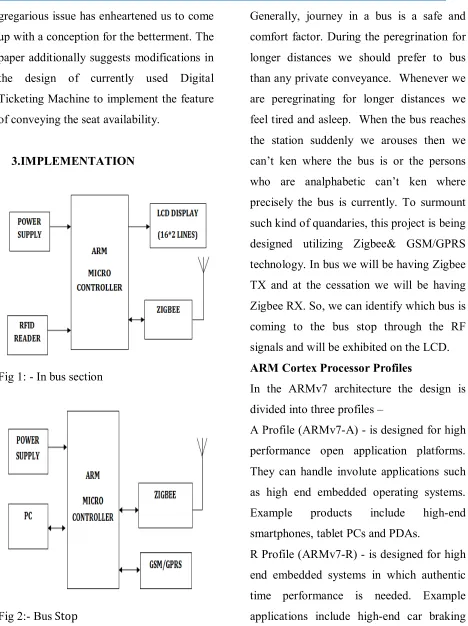
3.IMPLEMENTATION
Fig 1: - In bus section
Fig 2:- Bus Stop
Generally, journey in a bus is a safe and
comfort factor. During the peregrination for
longer distances we should prefer to bus
than any private conveyance. Whenever we
are peregrinating for longer distances we
feel tired and asleep. When the bus reaches
the station suddenly we arouses then we
can’t ken where the bus is or the persons
who are analphabetic can’t ken where
precisely the bus is currently. To surmount
such kind of quandaries, this project is being
designed utilizing Zigbee& GSM/GPRS
technology. In bus we will be having Zigbee
TX and at the cessation we will be having
Zigbee RX. So, we can identify which bus is
coming to the bus stop through the RF
signals and will be exhibited on the LCD.
ARM Cortex Processor Profiles
In the ARMv7 architecture the design is
divided into three profiles –
A Profile (ARMv7-A) - is designed for high
performance open application platforms.
They can handle involute applications such
as high end embedded operating systems.
Example products include high-end
smartphones, tablet PCs and PDAs.
R Profile (ARMv7-R) - is designed for high
end embedded systems in which authentic
time performance is needed. Example
applications include high-end car braking
M-Profile (ARMv7-M) – is designed for
deeply embedded microcontroller type
systems. Processors belonging to this profile
are the subject for this manual and are
studied in more preponderant detail. The
Cortex-M3 processor fortifies only the
Thumb-2 (and traditional Thumb)
injuctiveauthorization set. In lieu of utilizing
ARM ordinant dictations, as in traditional
ARM processors, it utilizes Thumb-2
injuctive authorization set for all operations.
As a result, the Cortex-M3 processor is not
rearward compatible with traditional ARM
processors, which utilize the ARM as well
as Thumb ordinant dictation set. The
Thumb-2 injuctive authorization set is a very
consequential feature of the ARMv7
architecture. For the first time, hardware
divide ordinant dictation is available on an
ARM processor, and a number of multiply
ordinant dictations are withal available.
Power Supply Unit
The input to the circuit is applied from the
regulated power supply. The ac. input i.e.,
230V from the mains supply is step down by
the transformer to 12V and is alimented to a
rectifier. The output obtained from the
rectifier is a pulsating dc voltage. So in
order to get a pristine dc voltage, the output
voltage from the rectifier is alimented to a
filter to abstract any ac components present
even after rectification. Now, this voltage is
given to a voltage regulator to obtain a
pristine constant dc voltage. The block
diagram of regulated power supply
Hardware components
Fig:-3 Components of power supply
Zigbee
The denomination ZigBee is verbalized to
emanate from the domestic honeybee which
utilizes a zig-zag type of dance to
communicate paramount information to
other hive members. This communication
dance (the "ZigBee Principle") is what
engineers are endeavoring to emulate with
this protocol a bunch of separate and simple
organisms that join together to tackle
intricate tasks. ZigBee is a low-power
wireless communications technology and
international standard protocol for the
next-generation wireless network, reducing data
construction with simplified protocol and
circumscribed functionality. ZigBee utilizes
the PHY and MAC layers defined by
IEEE® 802.15.4, which is the short-distance
wireless communication standard for 2.4
GHz band. ZigBee comprises the
ZigBeeplatform designations and ZigBee
profiles defined by the ZigBee Coalition.
Rfid reader
An RFID reader’s function is to interrogate
RFID tags. The expedient of interrogation is
wireless and because the distance is
relatively short; line of optical discernment
between the reader and tags is not
compulsory. A reader contains an RF
module, which acts as both a transmitter and
receiver of radio frequency signals. The
transmitter consists of an oscillator to
engender the carrier frequency; a modulator
to impinge data commands upon this carrier
signal and an amplifier to boost the signal
enough to arouse the tag. The receiver has a
demodulator to extract the returned data and
additionally contains an amplifier to fortify
the signal for processing. A microprocessor
forms the control unit, which employs an
operating system and recollection to filter
and store the data. The data is now yare to
be sent to the network.
GSM/GPRS
The Ecumenical System for Mobile
communication, conventionally called GSM,
Telecommunications Standards Institute
(ETSI) to describe protocols for second
generation (2G) digital cellular networks
utilized by mobile phones. The GSM
standard was developed as a supersessionfor
first generation (1G) analog cellular
networks, and pristinely described a digital,
circuit switched network optimized for full
duplex voice telephony GSM is a cellular
network, which denotes that mobile phones
connect to it by probing for cells in the
immediate vicinity.
The General Packet Radio Accommodation
(GPRS) is a packet-switched data
transmission protocol, which was
incorporated into the GSM standard in 1997.
It is rearwards-compatible with systems that
use pre-1997 versions of the standard. GPRS
does this by sending packets to the local
mobile phone mast (BTS) on channels not
being utilized by circuit-switched voice calls
or data connections. Multiple GPRS users
can apportion a single unutilized channel
because each of them utilizes it only for
infrequent short bursts. The advantage of
packet-switched connections is that
bandwidth is only used when there is
genuinely data to transmit.
LCD stands for Liquid Crystal Display.
LCD is finding wide spread use replacing
LEDs (seven segment LEDs or other multi
segment LEDs) because of the following
reasons: The declining prices of LCDs.The
ability to display numbers, characters and
graphics. This is in contrast to LEDs, which
are limited to numbers and a few characters.
Incorporation of a refreshing controller into
the LCD, thereby relieving the CPU of the
task of refreshing the LCD. In contrast, the
LED must be refreshed by the CPU to keep
displaying the data.Ease of programming for
characters and graphics.
3. RESULTS OF THE PROJECT
Fig:-4 Project Rfid reader& Card
Fig:-5 ARM Cortex Processor
Fig:-6 GSM/GPRS
4. CONCLUSION
In this work we are discussed and
implemented a public transport control
system by using the GSM, GPS and
ARM microcontroller. By this system
we can get the desired application and
also it will be useful for the public.
Since it is a prototype for the actual
application if we implement in real time
manner. By the presented system the
vehicles can be controlled by available
modules which are available in human
mobiles and also vehicles.
5. REFERENCES
[1]. KhondkerShajadulHasan,
MashiurRahman, Abul L.Haque, M
AbdurRahman, TanzilRahman and
MMahbuburRasheed” Cost Effective
GPS-GPRS BasedObject Tracking
System” InternationalMultiConference
of Engineers and ComputerScientists
2009 Vol I IMECS 2009, March 18 -
20,2009, Hong Kong
[2]. Al-Bayari, O., B. Sadoun, “New
centralized automaticvehicle location
communications software system
underGIS environment”, International
Journal ofCommunication Systems, Vol
18, Issue 9, April 2005,pp. 833–846
[3]. Hapsari, A.T., E.Y. Syamsudin, and
I. Pramana, “Designof Vehicle Position
Tracking System Using ShortMessage
Services And Its Implementation on
FPGA”,Proceedings of the Conference
on Asia South PacificDesign
Automation, Shanghai, China, 2005
[4]. Fan, X., W. Xu, H. Chen, and L.
Liu, “CCSMOMS:AComposite
Communication Scheme for Mobile
ObjectManagement System”, 20th
International Conference onAdvanced
Information Networking and
Applications,Volume 2, Issue 18-20,
April 2006, pp. 235–239
[5]. Hsiao, W.C.M., and S.K.J. Chang,
“The OptimalLocation Update Strategy
of Cellular Network BasedTraffic
Information System”, Intelligent
TransportationSystems Conference,
2006.
[6]. Tamil, E.M., D.B. Saleh, and M.Y.I.
Idris, “A MobileVehicle Tracking
System with GPS/GSM
Technology”,Proceedings of the 5th
Student Conference on Researchand
Development (SCORED),
PermalaBangi, Malaysia,May 2007
[7]. Pati, N., “Occlusion Tolerant Object
RecognitionMethods for Video
Surveillance and Tracking of
MovingCivilian Vehicles”, MS Thesis
(Computer Engineering),University of
North Texas, Denton, USA,
December2007
[8]. Insurence Issue Institue. “III
Presentations”,
Available:http://www.iii.org/media/hott
opics/ insurance/ test4/
[9]. Al-Bayari, O., B. Sadoun, “New
centralized automaticvehicle location
underGIS environment”, International
Journal ofCommunication Systems, Vol
18, Issue 9, April 2005,pp. 833–846
[10]. Hapsari, A.T., E.Y. Syamsudin,
and I. Pramana, “Designof Vehicle
Position Tracking System Using
ShortMessage Services And Its
Implementation on FPGA”,Proceedings
of the Conference on Asia South
PacificDesign Automation, Shanghai,
China, 2005
Autors Profiles
Raneru priyanka completed my B.Tech in electronics and communication engineering with80 % in the year of passing 2014 in
Khammam Institute of
Technology&sciences College which is located in khammam. Now, pursuing M.Tech in embedded system In khammam Institute of Technology&sciences.
Mr.G.Ramesh completed his M.Tech in digital systems & computer electronics from JNTUH,Hyderabad.Now, he is working as Assistant professor in Khammam Institute of Technology & sciences which is located in