New Impossibility Results for Concurrent Composition and
a Non-Interactive Completeness Theorem for Secure Computation
Shweta Agrawal∗ Vipul Goyal† Abhishek Jain‡ Manoj Prabhakaran§ Amit Sahai¶
Abstract
We consider theclient-serversetting for the concurrent composition of secure protocols: in this setting, a single server interacts with multiple clients concurrently, executing with each client a specified protocol where only the client should receive any nontrivial output. Such a setting is easily motivated from an application standpoint. There are important special cases for which positive results are known – such as concurrent zero knowledge protocols – and it has been an open question explicitly asked, for instance, by Lindell [J. Cryptology’08] – whether other natural functionalities such as Oblivious Transfer (OT) are possible in this setting.
In this work:
• We resolve this open question by showing that unfortunately, even in this very limited concurrency setting, broad new impossibility results hold, ruling out not only OT, but in fact all nontrivial asymmetric functionalities. Our new negative results hold even if the inputs of all honest parties are fixed in advance, and the adversary receives no auxiliary information.
• Along the way, we establish a newunconditional completeness resultfor asymmetric functionalities, where we characterize functionalities that arenon-interactively completesecure against active adversaries. When we say that a functionalityF is non-interactively complete, we mean that every other asymmetric functionality can be realized by parallel invocations of several copies ofF, with no other communication in any direction. Our result subsumes a completeness result of Kilian [STOC’00] that uses protocols which require additional interaction in both directions.
∗
UCLA. Email:[email protected]. Research supported in part from a DARPA/ONR PROCEED award, NSF grants 1136174, 1118096, 1065276, 0916574 and 0830803, a Xerox Faculty Research Award, a Google Faculty Research Award, an equipment grant from Intel, and an Okawa Foundation Research Grant. This material is based upon work supported by the Defense Advanced Research Projects Agency through the U.S. Office of Naval Research under Contract N00014-11-1-0389. The views expressed are those of the author and do not reflect the official policy or position of theDepartment of Defense or the U.S. Government.
†
MSR, India. Email:[email protected]
‡
UCLA. Email:[email protected]
§
UIUC. Email:[email protected] by NSF grant CNS 07-47027. ¶
1 Introduction
Consider the following scenario: Goldman Sachs, which has collected in-depth market research and analysis on various companies, wishes to offer a paid service to high-profile investors who are interested in using this market research. For this purpose, it has set up a large server to which potential clients can connect in order to obtain answers to queries of an authorized kind (for which they have paid). Potential investors, however, are wary of Goldman Sachs learning about their business plans, and would want to hide the queries from Goldman Sachs – indeed, Goldman Sachs should learn nothing at all except that the client performed an authorized query. On the other hand, Goldman Sachs would like to ensure that in one session, a client can only learn the answer to a single query of a kind that it is authorized to ask. In particular, it would like to ensure that multiple clients who may connect to the server simultaneously, cannot perform a coordinated attackto learn more information than what each of them paid for (or even carry out an unauthorized query).
Can we satisfy these requirements? While well-known two-party computation protocols (e.g., [Yao86, GMW87]) offer remarkably powerful simulation-based security guarantees, these guarantees hold only in the stand-alone model, where only one protocol execution takes place. Our scenario is slightly more complex, as it has some mild concurrency in that multiple clients may interact with the server concurrently. At the same time, we are making the plausible assumption that the server is programmed only to interact with clients using the prescribed protocol, and we do not seek to guarantee security of any other protocols that the clients may be engaged in while they are communicating with the server1. Arguably, such aclient-serversetting (formally, asymmetric functionalities in a “fixed-role concurrent self composition” setting) is of great practical relevance. But apart from the practical significance, from a theoretical point of view, it is an important question as to whether restricting to such a model of concurrent executions of a single protocol, allows us to recover strong security guarantees for two-party computation (at least for some functionalities).
In this work, we consider secure computation in the client-server setting, and show that, even in this highly restricted concurrency setting, broad impossibility results for secure computation hold.
• We establishnew and broad impossibility resultsfor achieving security under fixed-roles concurrent self composition, ruling out all finite functionalities(except “trivial” ones which have universally composable protocols), including many natural functionalities such as oblivious transfer. Our results hold even if the inputs to the parties in all sessions are fixed before the protocols commence.
• Along the way, we establish a newunconditional completeness resultfor asymmetric functionalities, where we characterize functionalities that are non-interactively complete2 for secure computation against active adversaries. This subsumes a result of Kilian [Kil00] that used a protocol which had additional interaction and, for its security, relied on the properties of a Nash equilibrium of a zero-sum game.
Background: Security under Concurrent Composition. With the proliferation of the network setting, in particular theInternet, the last decade has seen a push towards constructing protocols that have strong concurrent composability guarantees. For example, we could require security underconcurrent self-composition(which is the focus of this work): a protocol should remain secure even when there are multiple copies executing concurrently. The framework of universal composability (UC) [Can01] was introduced to capture the more general setting of concurrent general composition, where a protocol may be executed concurrently with not only several copies of itself but also with other arbitrary protocols.
General positive results for UC secure computation have been obtained based on various trusted setup assumptions such as a common random string [CF01, CLOS02, BCNP04, CPS07, Kat07, LPV09]. Whether a given set of players is actually willing to trust an external entity, however, is debatable. Indeed a driving goal in cryptographic research is to eliminate the need to trust other parties. Ideally, we would like to achieve security under concurrent composition in theplain model(which is the main focus of this work).
1
If we did consider the security of other protocols that the clients were engaged in, then known sweeping impossibility results would apply. See further details below.
2
The Dark Side of Concurrency. Unfortunately, in the plain model, by and large, most of the results have been negative.3 UC secure protocols for most functionalities of interest were ruled out in [CF01, CKL03, PR08]. (Recently, these were extended to various public key models in [KL11].) These impossibility results were extended to the setting of general composition by Lindell [Lin03] who proved that security under concurrent general composition implies UC security. Later, Lindell [Lin04] established broad negative results even for the setting of concurrent self-composition by showing equivalence of concurrent self-composition and general composition for functionalities where each party can “communicate” to the other party via its output (referred to asbit transmitting functionalities). Barak et al. [BPS06] (and more recently, [Goy11]) obtained negative results for very specific functions in the “static-input” setting (i.e., where the inputs of honest parties are fixed in advance for all the protocol sessions).
On the positive side, there has been much success in obtaining construction for zero-knowledge and related functionalities, with security in similar models (e.g., [DNS98, RK99, KP01, PRS02, BPS06, Lin08]). Very recently, Goyal [Goy11] has been able to obtain positive results for a large class of functionalities in this setting with the restriction that an honest party uses thesame, static input in all of the sessions. However these results do not translate to the more general setting where the server may choose different inputs in different sessions. Indeed, in a scenario such as the one discussed earlier, if the server is required to use the same static input in all sessions, it will have to allow all clients the same level of access, and further use its entiredatabase in every computation (which may be impractical).
Our Question: Static-Input, Fixed-Roles Concurrent Self-Composition? In this work, we study the (im)possibility of achieving secure two-party computation with respect to a very weak notion of concurrency as occurs in theclient-serversetting: one server interacts with many clients using the same protocol, always playing the same role, while each (honest) client interacts only with the server. Further, the functionalities being computed areasymmetric, in that only the client gets any output.4
The adversarial model is that either the clients or the server may be adversarial – this is referred to as the fixed roles setting in the literature [Lin04].5,6 We note that this is a very natural setting and captures several important functionalities such as oblivious transfer. However, despite extensive prior work on concurrent security, this setting has remained largely unstudied for general secure two-party computation (with the exception of [BPS06, Goy11] as discussed above). Indeed, concurrent security of oblivious transfer under (unbounded) concurrent composition was left was an explicit open problem by Lindell (see [Lin08, pg. 6]).
The importance of the above question stems from the fact that if the answer is positive, then it would enable security of many application scenarios, such as the one discussed at the beginning. On the other hand, if the answer is negative, then the situation would indeed be quite stark, and reaffirm the need for relaxing the standard security definitions. The recent positive results of Goyal [Goy11] may give hope that the answer is positive. Unfortunately, in this work, we show that the latter case holds.
We now proceed to describe our results.
1.1 Our Results
We obtain negative results regarding two-party computation with security under concurrent self-composition in the fixed-rolessetting, along with positive results on UC-secure reductions that were used to get the negative results. (These are formally stated inSection 6.)
3
We remark that several works have obtained positive results for “non-standard” simulation-based security, in which the simulator, for example, has access to super-polynomial computational power [Pas03, PS04, BS05, MPR06, GJO10, CLP10, GGJS12]. In this work, we will focus on security w.r.t. standard (polynomial time) simulation.
4
Functionalities in which both parties receive output (which is not entirely a function of their local input) are more “complex” and already ruled out by Lindell [Lin04], when the inputs could be adaptively chosen.
5
One could consider the corruption model where one or more clients and the server are corrupted. We note that if communication pattern is “bipartite” (i.e., honest clients do not talk to each other), then this is also covered in the fixed roles setting.
6
• We give afull-characterizationof security under concurrent self-composition for deterministicasymmetric finite functionalities (in which only one party receives output). (Theorem 5.) Specifically, we prove that nonon-trivialdeterministic asymmetric finite functionality can be computed securely under concurrent self composition, whiletrivialones can be computed UC securely against active adversaries. (A deterministic asymmetric functionality is said to be non-trivial if there does not exist a single input for the receiver that “dominates” all other inputs.) Our results are unconditional and hold in thestatic-inputsetting, and thus also rule out the more general case where a party may choose its input in a sessionadaptively, based on the outcomes of the previous sessions. Further, our results are “robust” in the sense that the impossibility is not because honest parties could choose their inputs by reacting to signals sent by corrupt parties over subliminal channels.
In particular, our results rule out concurrent security of 1-out-of-2 oblivious transfer and thus settle the open question of Lindell [Lin08]. Furthermore, to the best of our knowledge, these are the first broad impossibility results in thestatic-inputsetting. (In contrast, prior works which considered static inputs [BPS06, Goy11] only ruled out very specific functionalities.)
• To prove the above, we first construct a new UC-secure asynchronous non-interactiveprotocol for 1-out-of-2 oblivious transfer (FOT) using any given non-trivial deterministic asymmetric functionalityF, thereby subsuming a result of Kilian [Kil00]. By a non-interactive protocol we mean that the only step in the protocol is to invoke, in parallel, several copies of the given functionalityF; we say that the protocol is asynchronous if it remains secure even if the adversary can adaptively schedule the different invocations ofF. (Theorem 3.)
– Combining the above protocol with a UC-secure non-interactive protocol from [IPS08, Full version] for any asymmetric functionalityF givenFOT, we obtain a full characterization of completeness among deterministic asymmetric functionalities with respect to non-interactive reductions. (Theorem 7.)
• We further devise acomposition theoremfor static-input fixed-role concurrent security. (Theorem 1.) This theorem holds only for asynchronous non-interactive protocols. Given this theorem and our asynchronous non-interactive OT protocol, we complete the proof of our main result by establishing the impossibility of static-input, fixed-role concurrently secure protocols forFOT. (Theorem 2.)
Independent Work. Independent of our work, exciting results concerning the impossibility of concur-rently secure computation have been obtained recently by Garg et al. [GKOV12]. We refer the reader to [GKOV12] for more details.
1.2 Our Techniques
Asynchronous Non-Interactive Protocol forFOT. As mentioned above, the first ingredient in our main result, and a contribution of independent interest, is an asynchronous non-interactive protocol for FOT given any non-trivial deterministic asymmetric functionality F. To obtain the impossibility result in the static-input setting it is vital that this protocol is non-interactiveand asynchronous.
LetF be anon-trivialasymmetric functionality that takes inputsxandyfrom Alice and Bob respectively, and outputs f(x, y)to Bob. The intuitive reason why such a functionalityF can yieldFOTis that Bob has no input which will let it learn Alice’s input toFexactly (up to equivalent inputs), where as Alice does not learn anything about Bob’s input toF. In particular, one can find two inputsyˆ0 andyˆ1 for Bob, such that if Alice chooses her inputxat random, the only way Bob can learnf(x,yˆ0)with full certainty is if he choosesyˆ0as his input; similarly, unless he deterministically chooses yˆ1 as his input, Bob will be left with some entropy regardingf(x,yˆ1). Thus
Bob can choose to learn at most one off(x,yˆ0)andf(x,yˆ1)exactly. There are two main challenges in turning this idea into an implementation ofFOT:
– Alice and Bob may deviate from the prescribed distributions when choosing their inputs toF. In particular, any solution to the above issue should work even if Bob uses an input other thanyˆ0 andyˆ1.
Kilian [Kil00] handles the issue of active adversaries using properties of a Nash equilibrium of an appropriate zero-sum game. However, this approach (apart from being not asynchronous) appears suitable only for constructing an erasure channel, and does not permit Bob to use an input. (Converting the erasure channel to FOT requires interaction.) The way [KM11] handles active corruption using cut-and-choose checks is highly interactive and again inadequate for our purposes.
One natural approach one could consider is to use an extractor to amplify the uncertainty Bob has about f(x,yˆ0)orf(x,yˆ1)from many invocations ofF (withxindependently randomly chosen each time). That is, if Bob has some uncertainty about at least one of the strings,R0 andR1 whereR0 (respectively,R1) is defined as the string of outputs Bob would have received if he chose yˆ0 (respectively,yˆ1) as his input in all invocations of F, then Alice can choose two seeds for a strong extractor and obtain two masksr0 andr1 as the strings extracted
from R0 andR1 respectively, using these seeds. Unfortunately, this is not secure in an asynchronous protocol. Alice must transmit the extractor seeds she picked to Bob (for which she can use instances ofF). However, in an asynchronous non-interactive protocol, a corrupt Bob canfirst receive the extractor seedsbefore picking its inputs for the other instances ofF; hence the seeds are not independent of the information Bob obtains aboutR0andR1, and the guarantees of extraction no more hold.
We get around this by avoiding usingthe full power of extractors, and in fact using a deterministic function in its place. For instance, whenf is a boolean function, consider definingr0 as simply the XOR of all the bits inR0
(and similarlyr1). Since Alice picks her inputxtoF independently for each invocation, this still guarantees that
if Bob has uncertainty about sufficiently many bits inR0, then he has almost no information aboutr0.
But using a linear function in place of the extractor will not suffice when Bob can use inputs other thanyˆ0and ˆ
y1. In particular, for boolean functions again, if there is an inputyˆ2such thatf(x,yˆ2) =f(x,yˆ0)⊕f(x,yˆ1), then using this input in all invocations, Bob can learn R0 ⊕R1, andr
0 ⊕r1. Our solution to this is to use a simple
“quadratic” function, after appropriately mapping Bobs outputs to a field. This lets us ensure that one of the two “extracted” stringsr0andr1remains almost uniformly random, even given the other string.
Impossibility for FOT. As the next step towards our final impossibility result, we rule out a protocol for concurrent OT even for the case where both parties have fixed roles. The basic idea behind this impossibility result builds on the techniques from [BPS06, Goy11]. The proof proceeds in the following steps. Suppose, towards contradiction, we are given a protocolΠOTthat securely realizes OT in our setting.
1. First, we will construct an instance of thechosen protocol attackfor this protocol. More precisely, we will construct a protocolΠdOT such that the protocolsΠOT andΠdOT areinsecurewhen executed concurrently. We will have three parties in the system: Alice and Eve runningΠOT(as sender and receiver respectively); Eve and David runningΠdOT (as sender and receiver respectively). In our chosen protocol attack, Eve will be the corrupted party acting as man-in-the-middle between Alice and David and violating security ofΠOT (seeSection 4for more details of this step).
2. Next, we will useone time programs (OTPs) [GKR08, GIS+10] to eliminate David. In more detail, Eve simply gets a set of one-time programs implementing the next message function of David.
3. To execute these one-time programs, the (possibly adversarial) Eve is required to carry out a number of oblivious transfer invocations. In these invocations, Alice can be given the required key and can act as the sender. Fortunately, oblivious transfer is exactly the functionality that ΠOT provides! So these OT invocations can be executed using the protocolΠOT.
More details are provided inSection 4.
2 Preliminaries
Below we present some of the important definitions we need. Throughout this paper, we denote the security parameter byκ.
2.1 Notation
The following standard notation will be used throughout the paper. We say that a function f : R+ → R+ is
negligible if for all d > d0 we havef(λ) < 1/λdfor sufficiently large λ. We writef(λ) < negl(λ). For two
distributionsD1andD2over some setΩwe define the statistical distance SD(D1,D2)as
SD(D1,D2) := 1 2
X
x∈Ω
Pr
D1
[x]−Pr D2
[x]
We say that two distribution ensemblesD1(λ)andD2(λ)are statistically close or statistically indistinguishable if SD D1(λ),D2(λ)
is a negligible function ofλ.
Similarly, we say thatD1(λ)andD2(λ)are computationally indistinguishable (denoted asD1
c
≡ D1) if for
ev-ery probabilistic polynomial time distinguisherDist, we have that|Pr (Dist(D1(λ)) = 1)−Pr (Dist(D2(λ)) = 1)|= µ(λ)whereµ(·)is some negligible function ofλ.
2.2 Real and Ideal models.
IDEAL MODEL. An ideal execution with an adversary who controlsP2 proceeds as follows (when the adversary
controlsP1, the roles are simply reversed):
Inputs: P1 andP2 obtain a vector ofm inputs (where m denotes the number of sessions that P1 and P2 will
execute), denoted~xand~yrespectively.
Session initiation: The adversary initiates a new session by sending astart-sessionmessage to the trusted party. The trusted party then sends(start-session, i)toP1, whereiis the index of the session.
Honest party sends input to trusted party: Upon receiving (start-session, i) from the trusted party, honest partyP1sends(i, xi)to the trusted party, wherexidenotesP1’s input for sessioni.
Adversary sends input to trusted party and receives output: Whenever the adversary wishes, it may send a message (i, yi0) to the trusted party for any yi0 of its choice. Upon sending this pair, it receives back (i, f2(xi, y0i)) where xi is the input value that P1 previously sent to the trusted party for session i. The
only limitation is that for anyi, the trusted party accepts at most one pair indexed byifrom the adversary.
Adversary instructs trusted party to answer honest party: When the adversary sends a message of the type (send-output, i)to the trusted party, the trusted party sends(i, f1(xi, yi0))toPi, wherexiandy0idenote the respective inputs sent byP1and adversary for sessioni.
Outputs: The honest partyP1 always outputs the valuesf1(xi, yi0) that it obtained from the trusted party. The adversary may output an arbitrary (probabilistic polynomial-time computable) function of its auxiliary input z, input vector~yand the outputs obtained from the trusted party.
REAL MODEL. We now consider the real model in which a real two-party protocol is executed (and there exists no
trusted third party). LetF be as above and letΠbe a two-party protocol for computingF. LetAdenote a non-uniform probabilistic polynomial-time adversary that controls eitherP1orP2. Then, the real concurrent execution
of Π with security parameterκ, input vectors~x, ~y and auxiliary input z to A, denotedrealΠ,A(κ, ~x, ~y, z), is defined as the output pair of the honest party andA, resulting from the following real-world process. The parties run concurrent executions of the protocolΠ, where the honest party follows the instructions ofΠin all executions. The honest party initiates a new session iwith input xi whenever it receives a start-sessionmessage fromA. The scheduling of all messages throughout the executions is controlled by the adversary. That is, the execution proceeds as follows: the adversary sends a message of the form(i,msg)to the honest party. The honest party then addsmsgto its view of sessioniand replies according to the instructions ofΠand this view.
2.3 One Time Programs
A one-time program (OTP) [GKR08, GIS+10] for a function f allows a party to evaluatef on a single inputx chosen by the party dynamically. Thus, a one-time program guarantees that no efficient adversary, after evaluating the one-time program on some inputx, can learn anything beyond(x, f(x)). In particular he gains no information about f(y) for any y =6 x outside of the information provided by f(x). OTPs are non interactive; an OTP corresponding to some functionf,OTP-msgf given to a user by some environment (or user)U allows the user to evaluatef onceon some input of its choice, with no further interaction withU. It is shown in [GKR08, GIS+10] that OTPs cannot be implemented by software alone. Thus, an OTP is typically implemented as a software plus hardware package, where the hardware is assumed to be secure (that is, can only be accessed in a black box way via its interface), and the software can be read and tampered with. The secure hardware devices that are used are calledone time memorydevices (OTM).
An OTM is a memory device initialized by two keysk0, k1which takes as input a single bitb, outputskb and then “self destructs”. OTMs were inspired by the oblivious transfer protocol, and indeed, for our purposes, we will find it necessary to use oblivious transfer in place of one time memory tokens. This approach is not new and has been used in previous works as well [GIS+10]. Thus, for our setting, we will define one-time programs in the FOT-hybrid model directly for ease of use. We state this definition in terms of anasynchronous, non-interactive protocol (as defined above) for an asymmetric “one-time program functionality”FOTP, which accepts a circuitf from the partyP1 and an inputxfrom the partyP2, and returnsf(x)toP2 (and notifiesP1) (seeFigure 1). The
protocol is required to be secure only against corruption ofP2. Note that the requirement of being non-interactive
makes this non-trivial (i.e.,P2cannot send its input toP1 and have it evaluated).
Ideal Functionality of One Time Program
InFigure 1, we describe the ideal functionality of a One Time Program.
FunctionalityFOTP
Create Upon receiving(sid,create, P1, P2, f)fromP1(with a fresh session IDsid), wheref is
a circuit for a function, do:
1. Send (sid,create, P1, P2,size(f))toP2, where thesizeoutputs the size of the circuit and
the number of input wires it has.
2. Store(sid, P2, f).
Execute Upon receiving(sid,run, x)fromP2, find the stored tuple(sid, P2, f)(if no such tuple
exists, do nothing). Send(sid,value, f(x))toP2 and delete tuple(sid, P2, f). (Ifxis not of the
right size, definef(x) =⊥.) Send(sid,evaluated)toP1.
Definition 1 (One-Time Program). (Adapted from [GKR08, GIS+10]) Aone-time program (OTP) schemeis an asynchronous two-party non-interactive protocolΠFOT(in theF
OT-hybrid model) that UC-securely realizesFOTP (as defined inFigure 1) when the adversary is allowed to corrupt onlyP2.
In other words, ifΠFOTis a one-time program scheme, then for every probabilistic polynomial time adversary
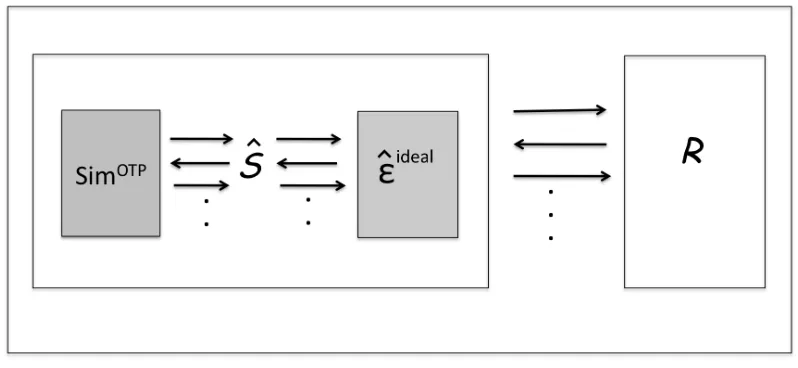
A corrupting P2, and adaptively scheduling the FOT sessions in the real-model execution of Π, there exists a probabilistic polynomial time ideal-world adversarySimOTP(the simulator), such that for every environmentZ, it
holds thatIdealfSimOTP,Z ≡c RealΠA,Z, whereIdealfSimOTP,ZandReal
Π
A,Z denote the outputs produced bySimOTPand
Arespectively.
We shall refer to an execution of an OTP scheme with inputfforP1as anOTP forf.
We note that OTPs exist if a (standalone secure) Oblivious Transfer protocol exists [GIS+10], which in turn exists if a concurrent secure OT protocol exists. Thus, for proving the impossibility of concurrent secure OT protocols, we can assume the existence of OTPs “for free.”
Intuitively, this means that for every probabilistic polynomial time algorithmA given access to a one-time program (or non interactive protocol Π) for some function f, there exists another probabilistic polynomial time algorithmSimOTPwhich is given one time black box access tof, i.e. it can request to see the valuef(x)for any
xof its choice, such that (for anyf) the output distributions ofSimOTP(denoted byIdealfSimOTP) andA(denoted
byRealΠA) are computationally indistinguishable, even to a machine that knowsf.
According to our definition above, in an OTP protocol all communication is via asynchronous, parallel invocations of FOT. However, to reflect the structure of OTPs as originally defined in [GKR08, GIS+10] we shall consider the protocol to consist of someFOTinstances invoked to simply communicate a messageOTP-msg
(which, w.l.o.g, an adversary would schedule first) and several other OT instances whose outputs we shall refer to as keys. (The reader may consider the OTP-msg to be empty, without any harm.)
Properties of OTPs: OTPs can be seen as providing a stronger privacy guarantee than garbled circuits. The garbled circuit construction works against honest-but-curious adversaries, but in our case we will need to consider malicious adversaries. More precisely, the garbled circuit simulator generates a dummy garbled circuit for circuit C, after the inputxis specified, i.e. only after it knows the circuit’s outputC(x). On the contrary, in our setting, we will need the simulator to construct the garbled circuitbeforehe knows which input the adversary will choose to run it on. Garbled circuit simulators cannot handle this but OTP simulators can. We note that Barak et al. [BPS06] handle this by augmenting the garbled circuit construction with amaskingtechnique, in which the desired output of the garbled circuit is masked with a random value in a way that allows the simulator to produce the garbled circuit for some random output (prior to knowing the desired output of the circuit), and provide keys/inputsafterknowing the circuit output, in a manner that the input masks and output mask cancel each other out. Goyal [Goy11] instead used one-time programs that offer a cleaner abstraction to handle this issue directly. Hence we will find it more convenient to work directly with one-time programs.
OTP simulator : In the real world, the output of the adversaryAconsists of a one time programOTP-msgReal
for a function f of circuit size ` (say), as well as one input to OTP-msgReal, denoted by keysReal = {keyReal1 , . . .keyRealk }(forkinput wires). Thus,RealΠA,Z ={OTP-msgReal,keysReal}.
We describe how our OTP simulator (denoted bySimOTP) interacts with some environment (or user), sayU.
1. U givesSimOTPa circuit size`,SimOTPreturns a one time programOTP-msgIdealfor circuit size`.
2. Let us assume that OTP-msgIdeal has k input wires, and denote these inputs by keyIdeal1 , . . . ,keyIdealk . U may query SimOTP for the inputs to be provided to OTP-msgIdeal. Then, SimOTP returns inputs {keyIdeal1 , . . . ,keyIdealt } for the first tbits, for some t < k (we refer to the inputs as keys since they are similar to the keys that are input to garbled circuits).
3. After returningtinputs,SimOTP produces a value, sayx, and queriesU forf(x), i.e. the desired output of
4. Uprovides the output, at which pointSimOTPreturns the values for the remaining input wires{keyIdealt+1, . . . ,keyIdealk }. We will denotekeysIdeal={keyIdeal1 , . . . ,keyIdealk }.
5. OutputIdealfSim
OTP ={OTP-msg
Ideal,keysIdeal}≡ {c OTP-msgReal,keysReal}=RealΠ
A,Z.
Secure Computation Under Concurrent Self-Composition. In this section, we present the definition for concurrently secure two-party computation.
The definition we give below is an adaptation of the definition of security under concurrent self-composition from [Lin04], but with two further restrictions to the model —fixed-rolesandstatic-inputs— i.e., there are only two parties engaged in multiple executions of a given protocol, with each playing the same “role” in all the sessions, and the inputs of the honest parties for each session is fixed in advance. (Recall that since the focus in this work is on obtaining impossibility results, our results are stronger by adding these restrictions.) Some parts of the definition below have been taken almost verbatim from [Lin04].
A two-party functionality7 F with input domainsX andY for the two parties is defined by two functions f1 :X×Y →ZAandf2:X×Y →ZB, whereZA, ZBare the output domains. For most part we shall consider the input and output domains to be finite sets. Such functionalities are calledfinite functionalities. (Again, since our focus is on impossibility results, it is more interesting to show impossibility of finite functionalities than of infinite functionalities.)
We will denote the two parties that wish to jointly instantiateFas Alice and Bob (or sometimesP1andP2). If
Alice’s input isx∈Xand Bob’s input isy∈Y, then the functionality would outputf1(x, y)to Alice andf2(x, y)
to Bob (unless aborted by a corrupt party). A functionality is calledasymmetricif only Bob receives any output; more precisely, in an asymmetric functionality f1 is the constant function (Alice does receive this fixed output
to indicate the termination of execution). An asymmetric functionality will be defined using a single function f :X×Y →Z.
In this work, we consider a malicious, static adversary. The scheduling of the messages across the concurrent executions is controlled by the adversary. The security of a protocol is analyzed by comparing what an adversary can do in the protocol to what it can do in an ideal scenario, where a trusted party computes the function output on the inputs of the parties. We do not require fairness (i.e., our impossibility is not a consequence of requiring fairness) and hence in the ideal model, we allow a corrupt party to receive its output in a session and then optionally block the output from being delivered to the honest party, in that session. Unlike in the case of stand-alone computation, in the setting of concurrent executions, the trusted party computes the functionality many times, each time upon different inputs. InSection 2.2we present further details of the real and ideal model executions, following the description in [Lin04].
The output pair of the ideal-model adversaryS and the honest party (or both parties, when neither corrupt) in an ideal-model execution of a functionalityFwith security parameterκ, input vectors~x,~yand auxiliary inputzto S, will be denoted asIDEALF,S(κ, ~x, ~y, z). Similarly, the output pair of the real-model adversaryAand the honest party (or parties) in a real-model concurrent execution of a protocolΠwith security parameterκ, input vectors~x, ~
yand auxiliary inputztoAwill be denoted byREALΠ,A(κ, ~x, ~y, z).
Definition 2(Security under Concurrent Self-Composition). A protocolΠis said tosecurely realizea functionality F under concurrent compositionif for every real model non-uniform probabilistic polynomial-time adversaryA, there exists an ideal-model non-uniform probabilistic expected polynomial-time adversary S, such that for all polynomialsm=m(κ), everyz∈ {0,1}∗, every pair of input vectors~x∈Xm,~y∈Ym,
{IDEALF,S(κ, ~x, ~y, z)}κ∈
N
c
≡ {REALΠ,A(κ, ~x, ~y, z)}κ∈
N
We shall also consider a few stronger security definitions, that we achieve in our positive results (used in proving the main negative result). Firstly, we can require the above to hold even with probabilistic expected
7
polynomial time adversaries in the real-model. Secondly, we could in fact allow the real-model adversary to be computationally unbounded, and allow the ideal-model adversary to be unbounded too.8 Also, we shall consider Universally Composable (UC) security [Can01, Can05]. We shall not present the details of the UC security definition (which has several slight variants, with essentially the same properties), but remark that it implies concurrent self-composition and more.
Finally, sometimes we permit the real model protocols to invoke ideal functionalities as sub-protocols (denoted like ΠF, where F is the ideal functionality invoked by the parties in Π). In all the instances we do this, we can actually consider UC-security of the protocol; however this definition can be easily generalized to security under concurrent self-composition too, and would be useful in stating a composition theorem (without involving UC-security).
Non-Interactive Protocols and Asynchronous Non-Interactive Protocols. A two-party protocolΠF (i.e., in theF-hybrid model) is called anon-interactive protocolif the protocol has the following structure: the two parties carry out local computation; then together they invoke one or more parallel, synchronized sessions of F; then they carry out more local computation and produce outputs. By synchronized sessions we mean that even corrupt players can invoke these sessions only in parallel.9 We shall also require that all copies ofF are invoked with the same fixed roles for the two parties.
A two-party protocol ΠF is called an asynchronous non-interactive protocol if the protocol has the above structure, but the parallel sessions of F are parallel but asynchronous. By this we mean that a corrupt player can invoke these sessions in arbitrary order, choosing the inputs for each session based on the outputs from prior sessions; the honest players have to choose their inputs a prioriand remain oblivious to the order in which the sessions are invoked.
One Time programs. A one-time program (OTP) [GKR08, GIS+10] for a functionf allows a party to evaluate fon a single inputxchosen by the party dynamically. As introduced in [GKR08, GIS+10], an OTP is implemented as a package consisting of some software and hardware tokens (specifically one time memory tokens), that essentially provided the party with asynchronousaccess to several oblivious transfer invocations. We shall treat OTPs as anasynchronous non-interactive protocolin the OT-hybrid model (as was done in [GIS+10]), that securely realizes an asymmetric “one-time program functionality”FOTP against corruption of the receiver alone. (See in
Section 2.3 for a discussion.) FOTP accepts a circuitf from the partyP1 and an inputxfrom the partyP2, and
returnsf(x)toP2(and notifiesP1) (seeFigure 1inSection 2.3).
Definition 3 (One-Time Program). (Adapted from [GKR08, GIS+10]) Aone-time program (OTP) schemeis an asynchronous two-party non-interactive protocolΠFOT(in theF
OT-hybrid model) that UC-securely realizesFOTP (as defined inFigure 1) when the adversary is allowed to corrupt onlyP2.
We shall refer to the collection of inputsP1provides to theFOTinstances in an execution ofΠFOT when its input is a circuitf, as anOTP forf.
We note that OTPs exist if a (standalone secure) Oblivious Transfer protocol exists [GIS+10], which in turn exists if a concurrent secure OT protocol exists. Thus, for proving the impossibility of concurrent secure OT protocols, we can assume the existence of OTPs “for free.”
Our use of OTP parallels the use of garbled circuits in the impossibility result in [BPS06]. Following [Goy11], we use OTPs instead of garbled circuits, since they have stronger security properties (namely, security against an actively corrupt receiver), and allows one to simplify the construction in [BPS06].
8
This is not a strengthening of the security definition, as the ideal-model is more relaxed now; however, the protocols we shall consider will satisfy this definition in addition to the other definitions.
9
A more accurate notation for such a protocol that invokes at mosttsessions ofF, would beΠFt, whereFt
3 A Non-Interactive Protocol for OT from Any Non-Trivial Asymmetric SFE
The goal of this section is to obtain an asynchronous, non-interactive protocol forFOTin theF-hybrid model, for anyfinite deterministic “non-trivial” asymmetric functionalityF. For our purposes, we define atrivialasymmetric functionality as follows. (As elsewhere in this paper, we consider only deterministic functionalities.)
Definition 4 (Dominating input.). In an asymmetric functionality defined by a function f : X ×Y → Z, an inputy ∈Y for the receiver is said todominateanother inputy0 ∈ Y if∀x1, x2 ∈X,f(x1, y) =f(x2, y) =⇒
f(x1, y0) =f(x2, y0).
Definition 5(Trivial functionality.). An asymmetric functionality is calledtrivialif there exists an input for Bob that dominates all of its other inputs in the functionality.
Background. In [Kil00] Kilian presented an elegant protocol to show that any non-trivial asymmetric func-tionality is complete for security against active adversaries. The protocol, which constructs an erasure channel from a non-trivial asymmetric functionality F, achieves security against active adversaries by using an input distribution to F derived from the Nash equilibrium of a zero-sum game defined using F. Kilian shows that an adversary deviating from the prescribed distribution cannot change the erasure probability in the protocol. This rather enigmatic protocol does invokeFwith fixed roles, but is not useful for showing impossibility of concurrent secure protocol forF, because it is modestly interactive (two steps which should occur one after the other) and more importantly, because it yields only an erasure channel and not a 21
-OT.10 The only known substitute for this protocol, by [KM11], is much more interactive, involving several rounds of communication in both directions, apart from the invocation ofF. Our challenge is to devise anasynchronous non-interactiveprotocol which usesF with fixed-roles and directly yields 21
-OT. Being non-interactive and asynchronous requires that all the sessions are invoked together by an honest party, but the adversary is allowed to schedule them adaptively, and base its inputs for later sessions based on the outputs from earlier sessions (rushing adversary). As mentioned inSection 1.2, this rules out some standard techniques like privacy amplification (using extractors), since the adversary can learn the seed used for extractionbeforeit extracts partial information about a string to which the extraction will be applied.
We present a new and simple non-interactive OT protocol which uses a simple non-linear “extraction” strategy that does not require a seed, but is sufficient to amplify the uncertainty about certain values into almost zero information about at least one of two extracted values. Our protocol is in fact UC-secure (in the PPT as well as information theoretic settings) and is asynchronous.
3.1 The New Protocol
Our asynchronous non-interactive protocol UC-securely realizes the 21-OT functionality FOT in the F-hybrid model, whereFis a finite11asymmetric functionality defined by a functionf :X×Y →Z, andFisnot trivial. Note that (since domination is transitive) this means that there are at leasttwo inputsinY — denoted byyˆ0andyˆ1 — which are not dominated by any other inputy∈Y.
To define the protocol, first we pick a prime numberp ≥ min{|X|,|Z|}. Then we can define two maps to relabel the columns corresponding toyˆ0 andyˆ1in the function table off using elements inZp– i.e., two injective functions N0 : Z0 → Zp, N1 : Z1 → Zp, whereZb = {f(x,yˆb)|x ∈ X}– such that there exist xˆ0,xˆ1 ∈ X satisfying the following.
N0 f(ˆx0,yˆ0)
N1 f(ˆx0,yˆ1)
N0 f(ˆx1,yˆ0)
N1 f(ˆx1,yˆ1)
=
0 1
1 0
We claim that this is possible as follows.
10
Our impossibility result inSection 4holds only for 21-OT, and not for erasure channels. Indeed, using techniques in [Goy11, GJO10], it would be possible to construct concurrent secure protocols for an asymmteric functionality like erasure channels, in which Bob does not have any input.
11For simplicity, following [Kil00], we require|X|,|Y|to be constant. But the security of the protocol presented here only requires|X|
Claim6. Iff :X×Y →Z is a function with two inputsyˆ0,yˆ1 ∈Y which are not dominated by any other input inY, for any numberp≥min{|X|,|Z|}, there exist two injective functionsN0:Z0→Zp,N1 :Z1 →Zp, where
Zb={f(x,yˆb)|x∈X}, such that there existxˆ0,xˆ1 ∈Xsatisfying the following:
N0 f(ˆx0,yˆ0)
N1 f(ˆx0,yˆ1)
N0 f(ˆx1,yˆ0)
N1 f(ˆx1,yˆ1)
=
0 1
1 0
Proof. DefineN0 andN1as follows. Sinceyˆ0 does not dominateyˆ1, there arex1, x2 ∈X such thatf(x1,yˆ0) =
f(x2,yˆ0) =α(say), butf(x1,yˆ1)6=f(x2,yˆ1); we letN0 :α7→0. Symmetrically, there arex3, x4 ∈Xsuch that
f(x3,yˆ0)6=f(x4,yˆ0)butf(x3,yˆ1) =f(x4,yˆ1) =β,say; we letN1 :β 7→0. Now, sincef(x1,yˆ1)6=f(x2,yˆ1),
w.l.o.g assume thatf(x1,yˆ1)6=β(swappingx1andx2 if necessary), and then letN1 :f(x1,yˆ1)7→1. Similarly,
sincef(x3,yˆ0) 6= f(x4,yˆ0), w.l.o.g assume thatf(x3,yˆ0) 6= α(swappingx3 andx4 if necessary), and then let
N0 :f(x3,yˆ0)7→1. (Then we can extendN0andN1arbitrarily as injective mappings fromZ0andZ1 (resp.) to Zp, since thanp≥ |Z0|andp≥ |Z1|.) We can then setxˆ0to bex1andxˆ1to bex3.
To illustrate this for the case of boolean functions (p = |Z| = 2), we note that for a non-trivial boolean functionality, the function table off, restricted to the two columns corresponding toyˆ0 andyˆ1 must have one of the following minors (possibly with the columns reordered, in the last case):
h0 1
1 0 0 0
i h0 1
1 0 1 1
i h0 0
0 1 1 1
i
. In the first two casesN0, N1can be the identity map and in the last case exactly one ofN0, N1would be the identity.
The protocol is now defined as follows, in terms of the inputsyˆ0,yˆ1 ∈Y,xˆ0,xˆ1 ∈Xand the functionsN0, N1
as identified above.
Alice’s program:Alice’s input is two bitss0, s1.
1. Alice carries out the following computations:
• Fori= 1to2κ, pickxi←X.
• For eachi, letR0i =N0(f(xi,yˆ0))andR1i =N1(f(xi,yˆ1)).
• Letr0=Pκi=1R0iR0κ+i, andr1 =Pκi=1R1iR1κ+i.
• Letm0=s0+r0andm1 =s1+r1(interpreting bitss0, s1as elements in{0,1} ⊆Zp).
2. Alice invokes, in parallel, several copies ofF with the following inputs:
• Sessionsi= 1to2κwith inputsxi.
• 2dlogpemore sessions to “communicate” the bits of(m0, m1): in a session to send a bit 0, use input ˆ
x0, and in a session to send a bit 1, use inputxˆ1.
3. If allFsessions are completed, then Alice completes the protocol (i.e., outputs an acknowledgment).
Bob’s program: Bob’s input is a choice bitb.
1. Bob invokes the same copies ofFas Alice with the following inputs:
• In each of the2κsessions numberedi= 1to2κ, use inputyˆb, and obtainRbi.
• In each of the sessions used for communication, use inputyˆ0; obtain all bits of(m0, m1).
Intuition. The protocol is easily seen to be correct. Also, security when Alice is corrupt is easy to argue asF does not give any output to Alice. (The simulator can extract Alice’s inputs by considering what Bob would output when his input isb= 0andb= 1.) The interesting case is when Bob is corrupt.
Note that in the protocol, all the instances of F are invoked in parallel by the honest parties, but a rushing adversary that corrupts Bob can dynamically schedule the sessions and also choose its inputs for these sessions adaptively, based on the outputs received thus far. The main idea behind showing security against Bob is that one ofr0 andr1 appears completely random to Bob (even given the other one), no matter how he chooses his inputs
yi. For this we define a pair ofF sessions(i, κ+i)to be a “0-undetermined pair” ifRi0R0κ+i is not completely determined by the view of the adversary in those sessions, combined withR1iR1κ+i; simiarly we define the pair to be a “1-undetermined pair” ifR1
iR1κ+iis not completely determined by the view of the adversary in those sessions, combined withR0iR0κ+i. Then, as shown inClaim 7, there will be a constant probability that any pair will be either 0-undetermined or 1-undetermined.
Note that for any inputythat the adversary chooses in the first session out of a pair, it does not dominate at least one ofyˆ0andyˆ1. With constant probability the adversary will be left with some uncertainty about eitherf(x,yˆ0) orf(x,yˆ1), wherexstands for Alice’s input in this session. Supposef(x,yˆ0)is not fully determined. Now, with a further constant probability Alice’s input in the other session in the pair would bex0 = ˆx1. Then, even if Bob learnsx0 exactly, he remains uncertain off(x,yˆ0).f(x0,yˆ0) = f(x,yˆ0)·1. This uncertainty remains even if Bob learnsf(x,yˆ1).f(x0,yˆ1) =f(x,yˆ1)·0, as it is independent ofx. This slight uncertainty about a term inr0orr1
gets amplified by addition inZp.
To complete the intuitive argument of security, we need to also consider how the simulator for Bob can extract his input bitb. The simulator would let Bob schedule several sessions, until a constant fraction of the pairs(i, κ+i) have had both sessions completed. At this point Bob would have already accumulated sufficient uncertainty about one ofr0andr1, sayrb, that will remain no matter what he learns from the remaining sessions. Further, not having
invoked the remaining sessions will ensure that at this point he still has no information about the other elementrb. So, at this point, the simulator will sendb= 1−bto the idealFOTand learn whatrbshould be, and can henceforth “pretend” that it was always using that value ofrb. Pretending thus (i.e., sampling Alice’s inputs for the remaining sessions according to the right conditional distribution) can be efficiently done by rejection sampling (sincepis a constant).
Formal Proof. Note that in the protocol, all the instances ofF are invoked in parallel by the honest parties, but a rushing adversary that corrupts Bob can dynamically schedule the sessions and also choose its inputs for these sessions adaptively, based on the outputs received thus far.
When Both Parties are Honest. Correctness when both parties are honest follows from the fact that an honest Bob can exactly computerbby using inputs as prescribed by the protocol.
When Alice is Corrupt. Security when Alice is corrupt easily follows from the fact thatF does not give any output to Alice. We consider an efficient simulator which waits for Alice to invoke all the sessions ofF, and based on Alice’s inputs to instances of F, computes both (r0, m0) and(r1, m1). Then, for j = 0,1 it computes the
numbersj =mj −rjand sets the bits0j = 0ifsj = 0, ands0j = 1otherwise. The simulator sends(s00, s01)to the idealFOTfunctionality, to complete the simulation. It is easy to verify that this is a perfect simulation.
When Bob is Corrupt. The main idea behind showing security against Bob is that one ofr0 and r1 appears
completely random to Bob (even given the other one), no matter how he chooses his inputsyi. For this we define a pair ofF sessions(i, κ+i)to be a “0-undetermined pair” ifR0iR0κ+iis not completely determined by the view of the adversary in those sessions, combined withRi1R1κ+i; simiarly we define the pair to be a “1-undetermined pair” ifR1iR1κ+i is not completely determined by the view of the adversary in those sessions, combined withR0iR0κ+i. As shown below, given the way we have definedR0i andR1i (andN0andN1), there will be a constant probability
Claim 7. There is a constant > 0,12 such that, for any pair of sessions(i, κ+i), for any adversarial strategy of scheduling them and choosingyi andyκ+i, with probability at leastthe pair will be either 0-undetermined or
1-undetermined.
Proof. W.l.o.g, we can assume that the adversary schedules session i first (the other case being symmetric). Suppose it uses input yi = y for this session. Note that y does not dominate at least one of yˆ0 and yˆ1 (if y 6∈ {yˆ0,yˆ1}, it dominates neither).
Suppose y does not dominate yˆ0. That is, there exists some x, x0 ∈ X such that f(x, y) = f(x0, y) but f(x,yˆ0) 6= f(x0,yˆ0). With probability 2/|X|, the input xi ∈ {x, x0}. Further, independently, with probability
1/|X|,xκ+i = ˆx1. Thus with probability2/|X|2, we will haveR0iR0κ+i =f(xi,yˆ0).1 =f(xi,yˆ0) andR1iR1κ+i = f(xi,yˆ1).0 = 0. In this case, the adversary cannot determineR0iR0κ+i(which could be eitherf(x,yˆ0)orf(x0,yˆ0)), givenf(xi, y),f(xκ+i, y0)for anyy0(or evenxκ+iitself) andR1iR1κ+i = 0.
Similarly, if y does not dominate yˆ1, then with probability at least 2/|X|2, R1
iR1κ+i cannot be completely determined fromf(xi, y),xκ+iandR0iR0κ+i= 0.
Thus, in either case, with probability at least2/|X|2, the pair becomes either 0-undetermined or 1-undetermined.
This slight uncertainty about a term inr0 orr1 gets amplified by addition inZp (seeLemma 8). To formalize the intuition into a proof of security, we need to build an appropriate simulator, that works even when Bob can schedule theFsessions in arbitrary order. We divide the invocations ofFinto the following imaginary phases:
• Communication Phase: W.l.o.g, we assume that Bob first schedules all the communication sessions, and uses inputyˆ0 in them. (Any other strategy is “dominated” by this, in that it can be simulated by an adversary as above.)
• Phase 1: This phase starts when Bob invokes one of the2κsessions numbered 1 to2κ, and lasts until, for c1κvalues ofi∈[κ], both sessionsiandκ+ihave been invoked (wherec1is a constant to be determined).
• Phase 2: This phase consists of the rest of the invocations ofF.
The simulator will behave differently based on which phase it is in, as follows:
• Communication Phase: Randomly pick m0, m1 ← Zp, and faithfully simulate all the communication
sessions using these.
• Phase 1: In Phase 1, to simulate a new sessioni, accept yi from Bob and returnf(xi, yi)for a uniformly random inputxi.
• Input Extraction: At the end of Phase 1, the simulator asserts thatc2κof these pairs are either 0-undetermined
or 1-undetermined (for a constantc2, also to be determined), and else aborts the simulation. (This, as we shall
argue, happens with negligible probability.) Then, forb∈ {0,1}, at least(c2/2)κpairs areb-undetermined.
Simulator sendsb= 1−btoFOTand gets backsb ∈ {0,1}.
• Phase 2: Now the simulator will samplexifor the remaining sessions uniformly at random, but conditioned on rb = mb −sb, where rb = Pκi=1RbiRbκ+i. This can be done efficiently by rejection sampling. (The simulator can abort afterκunsuccessful trials.)
We shall argue that, for a suitable choice of the constantsc1, c2, for any input(s0, s1) for Alice, the above
simulation is good – i.e., indistinguishable from an actual execution of the protocol.
The analysis rests on the following observations about the real execution:
1. (r0, r1)are almost (i.e., up to negligible statistical distance) uniformly distributed overZp×Zp.
2. Conditioned on any value of (r0, r1), xi in the sessions invoked by the adversary in Phase 1 are almost uniformly random.13
3. Let(b, b)be defined after Phase 1 the same way it is defined by the simulator. Then,rb is almost uniform even conditioned onrband the view of the adversary in Phase 1 and Phase 2.
Given the above three observations, it is immediate that the simulation is good. In the rest of the proof we prove the above three observations.
To prove the first item note that except with negligible probability, forN = Θ(κ)values ofi∈[κ],xi = ˆx0 and for another N values of i, xi = ˆx1. We will condition on this event happening, and let S0 be the set of
first N indices i with xi = ˆx1; similarly let S1 be the set of first N indices i with xi = ˆx0. Note that then r0 = u0 +v0 whereu0 := Pi∈S0N0 f(xκ+i,yˆ
0)
andv0 is indepedent ofu0; similarly r1 = u1+v1 where
u1 := Pi∈S1N1 f(xκ+i,yˆ 1)
andv1 is indepedent of u1. (v0 andv1 are correlated.) To show that(r0, r1) is
almost uniformly distributed inZp×Zp, it is enough to show that(u0, u1)are distributed that way. Firstly, sinceS0
andS1 are disjoint, they are independent of each other. To see that they are almost uniform, we rely onLemma 8,
using distributions D0 and D1 defined as the distribution of N0 f(x,yˆ0)
and N1 f(x,yˆ1)
respectively, for uniformx←X.
To prove the second item, for ease of analysis, we shall consider a stronger adversary for Phase 1, which learns the value ofxi in each session it invokes in Phase 1. W.l.o.g we may assume that it first invokes the sessionsi= 1 toκ, and then adaptively invokes sessionsi∈T ⊆[κ+ 1,2κ]where|T|=c1κ. There is a constantcsuch that,
except for a negligibly probable event — which we shall condition on not occuring — there are at leastcκvalues ofi∈ [κ]for whichxi = ˆx0 andcκvalues ofi ∈ [κ]for whichxi = ˆx1. We shall setc1 so thatc > c1. Then
there are setsS0, S1 ⊆[κ+ 1,2κ]\T, with|S0|=|S1|= (c−c1)κsuch that fori∈S0,xi = ˆx1and fori∈S1,
xi = ˆx0. UsingS0, S1 to defineu0, u1 as before, similar to the argument above, we haverb = ub +vb, where (u0, u1)is almost uniform overZp×Zpand (almost) independent ofvband thexivalues revealed to the adversary in Phase 1.
Finally, to prove the third item, we return to the normal adversary (who does not learn xi exactly, but only f(xi, yi) for a yi that it adaptively chooses). By Claim 7, except with negligible probability, out of the c1κ
pairs that have both sessions invoked, at least (c2/2)κ pairs are b-undetermined. The distribution from which
an undetermined value for the pair(i, κ+i)is sampled is decided by(xi, yi, xκ+i, yκ+i). Hence there are only a constant number of such distributions. LetDbe the most frequent of these distributions among theb-undetermined (c2/2)κpairs. LetW ⊆[κ]be such that fori∈W, the pair(i, κ+i)isb-undetermined and is associated with the
distributionD. Then|W|= Θ(κ). We can consider revealing(xj, xκ+j)for allj6∈W, as well as the adversary’s view (i.e.,f(xi, yi), f(xκ+i, yκ+i)) andRbiRκb+ifor alli∈W (since the definition of being undetermined allows conditioning on the last two). Then byLemma 8, similar to above arguments,rb is still uniform conditioned onrb and the view of the adversary (which are subsumed by(xj, xκ+j)forj6∈W, andRbiRbκ+ifori∈W).
Lemma 8. Letp be a fixed prime number. LetDbe a distribution overZp, such that for some constant > 0, for allz ∈ Zp,Pra←D[a = z] < 1−. For any positive integerN, leta1,· · · , aN be i.i.d random variables sampled according toD. Then the statistical distance between the distribution ofPNi=1ai(summation inZp) and the uniform distribution overZp is negligible inN.
13
Note thatwhichsessions are invoked can depend on(r0, r1), but for any such choice of sessions, thevaluesofxiin those sessions
Proof. We give an elementary argument to prove this lemma. First, for simplicity, consider the case that eachai has a support of size two. W.l.o.g, we can assume that one of the values in the support is 0. This is because, otherwise we can simply consider the summation ofa0i =ai−z∗, wherez∗is an element in the support ofai, and the statistical distance ofP
iaifrom the uniform distribution is the same as that of P
ia0i.
Then, letaibezwith probabilityδand0with probability1−δ, whereδis bounded away from 0 and 1. For any valuew∈Zp, considerPr [P
iai=w]. Letu=wz−1(u∈Zp will be treated as an integer in{0,· · · , p−1}). Then
Pr "
X
i
ai =w #
=X
t≥0
N tp+u
δtp+u(1−δ)N−(tp+u)
Pr "
X
i
ai = 0 # =X t≥0 N tp
δtp(1−δ)N−tp.
(1)
We argue that, for anyw∈Zp, the above two summations are close to each other.14 For this we show that, for all
values ofu,P t≥0
N tp+u
δtp+u(1−δ)N−(tp+u)= 1p ±(1−α)N for some constant0< α <1.
LetSk= ((1−δ) +δωk)N whereω=ei2π/p, is apthroot of unity. Using the binomial expansion ofSkand the fact thatPp−k=01ωk= 0, we get
X
t≥0
N tp+u
δtp+u(1−δ)N−(tp+u)= 1 p
p−1
X
k=0
ω−kuSk.
Now,Pp−k=01ω−kuSk = 1 + Pp−1
k=1ω
−kuS
k, becauseS0 = 1. Further, for0< k≤p−1,|(1−δ) +δωk| ≤1−α,
where we takeα= 1− |(1−δ) +δω|. Sincepis a constant andδis also a constant with0< δ <1,αis a constant with0< α <1. Then,
p−1
X
k=1
ωkuSk ≤ p−1
X
k=1
|ωkuSk|
= p−1
X
k=1
|Sk| ≤(p−1)(1−α)N < p(1−α)N.
Thus indeed,
X
t≥0
N tp+u
δtp+u(1−δ)N−(tp+u)= 1
p ±(1−α) N
Since this holds for all values ofu, includingu = 0, the difference between the two probabilities in (1) is at most2(1−α)N, which is negligible inN.
This proves the lemma whenDhas a support of size 2. For the general case, whenDhas a larger support, let z0, z1be two elements with the most weight according toD. Then, we note that there would be a constantγ >0
such that, except with negligible probability, for at leastγNvalues ofi∈[N],ai ∈ {z0, z1}. So we can condition
on this event occurring. Conditioned on this, P
iai is distributed asv+PγNi=1ui whereui are i.i.d according to Drestricted to{z0, z1}, andvis independent ofu. By appealing to the case of binary support, we conclude that
P
iaiis almost uniformly random.
Going Beyond Finite Functionalities. We note that if|Y|ispoly(κ), then we can have the above protocol use a uniform distribution over a subset ofXof size at most2|Y|, restricted to which the functionality is still non-trivial.
Thus, we note that our protocol can be easily made to work for infinite functionalitiesf for which there exists a bounded-size subset ofX, restricted to whichf is non-trivial.
In order to extend our results to all non-trivial infinite functionalities, we can further build upon the above idea. We note in our OT protocol presented in Section 3, if we can somehow “restrict” Bob to using non-dominating inputsyˆ0andyˆ1 (more generally, a bounded-size subset), then we would only require Alice to sample her inputs in the protocol from a bounded-size subset of domainX. In this case, our protocol can easily handle asymmetric infinite functionalities.
Then, we note that our impossibility results for static-input fixed-roles concurrent self composition can be easily extended to rule out all non-trivial asymmetric infinite functionalities in the following manner:
• First, towards a contradiction, given a static-input fixed-roles concurrently secure protocolΠfor a non-trivial asymmetric infinite functionalityf, we can “compile” it using stand-alone zero knowledge proof system to obtain a static-input fixed-roles concurrently secure protocolΠ∗ for functionalityf∗, wheref∗ is the same asf, except that Bob’s input domainY∗is bounded-size. Very roughly, the compiled protocolΠ∗works as follows: with each outgoing messageminΠ, Bob now additionally gives a zero-knowledge proof to prove that the message was computed using an input inY∗.
• Now, combiningΠ∗with our asynchronous non-interactive OT protocol forf∗and the composition theorem inSection 5, we can obtain a static-input fixed-roles concurrently secure protocol for OT. Combining this with the impossibility result for OT inSection 4, we obtain a contradiction.
Remark. We note that a downside of the above approach is that it requires computational assumptions (in particular, one-way functions for zero-knowledge proofs). This is in contrast to the case of asymmetric finite functionalities where we obtained an unconditional (non-interactive) completeness result.
4 Impossibility of Concurrent Oblivious Transfer
In this section, we will prove the impossibility of 21-OT secure under concurrent self-composition in the static-input, fixed-roles setting. To show this, we proceed as follows. First, we note that for any functionality to be secure, it must hold that for everyinput to the functionality, a real world attack, successful with non-negligible probability (say), implies an ideal world attack that succeeds with probability at least−negl. Now, suppose towards contradiction, we are given a protocolΠOT that securely realizes the OT functionalityFOT under static-input, fixed-roles concurrent self-composition. We will exhibit a set of inputs (for sender and receiver) and a real-world adversarial receiver that is able to perform a concurrent attack and manages to learn a secret value, calledsecretwith probability 1. We will then prove that if there exists an adversarial receiver in the ideal world that is able to learnsecretwith high enough probability, then we can break the stand-alone security ofΠOTagainst a cheating sender, thus arriving at a contradiction.
The high level structure of our proof is as follows:
1. First, we will construct an instance of thechosen protocol attackfor the OT functionality. More precisely, letΠOT be a secure protocol that implements the OT functionality. Then we will construct a protocolΠdOT such that the protocolsΠOTandΠdOTareinsecurewhen executed concurrently.
2. Next, we will useone time programs(OTPs) to transform the above concurrent protocol executions ofΠOT andΠdOTinto self composition of OT protocolΠOT.
3. This will provide us with particular inputs to the OT functionality, such that when a malicious receiver Bob engages in concurrent executions ofΠOTwith an honest sender Alice (with these inputs), he will be able to outputsecretwith probability1. This will give us a real world attack.
4. We will then show the infeasibility of an adversarial receiver in the ideal world that successfully outputs
4.1 Chosen Protocol Attack
LetΠOTbe a protocol that securely realizes the OT functionality. To fix notation, let us consider two parties Alice and Bob that are executing an instance ofΠOT. Say that Alice’s input bits are denoted bys0 ands1 and Bob’s
input bit isb. Upon successful completion of the protocol, Bob obtainssb. Next, letΠdOT be a slightly modified version ofΠOTwhere the receiver Bob also has both of Alice’s inputs,s0ands1 in addition to his bitb. InΠdOT, Bob and Alice run an execution ofΠOTwith inputsbands0,s1 respectively. Upon receiving an outputs∗, Bob
checks whethers∗ =sb. If so, he sendssecret=s¯bto Alice.
Now, consider the following scenario involving three parties Alice, Eve and David. Alice holds input bits s0,s1, while David holdss0, s1, as well as a random input bitb. Alice plays the sender with receiver Eve in an
execution ofΠOT, and Eve plays sender with receiver David in an execution ofΠdOT. It is clear that a malicious Eve can launch “man-in-the-middle” attack, playing simultaneously with Alice and David, and by merely forwarding Alice’s message to David and David’s back to Alice, she can learn the valuesecret= s¯b. However, note that if
the execution ofΠOTis replaced with an ideal call to the OT functionality, then the attack does not carry through. (To avoid repetition, we skip proof details here and instead present them later more formally).
4.2 ConvertingΠdOTtoΠOT
Note that the above attack is valid in the setting of concurrent general composition. However, we are interested in the setting of concurrent self composition, where onlyΠOT is executed concurrently. Towards this end, in this section, we will convert the protocolΠdOTinto a series of OT calls which can be implemented byΠOT. SinceΠOT executed concurrently withΠdOTis insecure, this will allow us to show thatΠOTis insecure under concurrent self composition.
To begin, we transform the protocolΠdOT run by Eve (as sender) and David into a sequence of calls made by Eve to an ideal reactive functionality (with inputs fixed in advance). As in [BPS06], it is natural to instantiate this ideal functionality by thenext message functionFDavidof David’s strategy in protocol
d
ΠOT. Then Eve can simulate the interaction with David by invokingFDavideach time she expects a message from David.
More precisely, the inputs toFDavidwill be the bitss
0 ands1, a random bitb, a message from Eve denoted
byei, and a statestatei−1(sinceFDavidis a reactive functionality, it needs to knowstatei−1 in order to compute
statei), and the output ofFDavidwill be David’sithmessage in d
ΠOTandstatei. By doing this, Eve can, as before, play the receiver in an execution ofΠOTwith Alice as the sender (with inputss0, s1) and carry out the man in the
middle attack by invokingFDavid. We will denote the real world attacker played by Eve as above, byEˆreal.
As the next step, we will to replace the ideal calls toFDavidmade byEˆrealby a series of OTs executed between Alice andEˆreal. Letndenote the number of messages that David sends in protocol
d
ΠOT. Then, consider the one time programsOTP-msg1, . . . ,OTP-msgnwhereOTP-msgicomputes theithnext message function of David. We will provide Alice with all the keys {keysi}n
i=1 to the OTPs. Then, to evaluate the ith OTP,Eˆreal executes
(multiple sessions of)ΠOTwith Alice to obtain the keys corresponding to her input.
Also note that OTPs arestatelessby definition, but David’s next message functionality isstateful, i.e. David’s (i+ 1)th message depends on the previous i messages. Looking ahead, we will require that the OTPs only be invoked by the ideal world attacker in consecutive order. We ensure this by allowing each OTP-msgi to pass its private state to OTP-msgi+1 using standard techniques (as used in [BPS06, Goy11]). Specifically, we will add to the (fixed) inputs of OTP-msgi a keyK for an authenticated encryption scheme. Now,OTP-msgi
outputs not only David’s next messagedi, but also an authenticated encryption of its resultant state, denoted by τi =EncK(statei). As input,OTP-msgi requests not only messageei, but also a valid authenticated encryption τi−1such thatDecK(τi−1) =statei−1. This forces the functionalityFDavidimplemented by OTPs, to be invoked
in proper order. For the rest of the article, we will assume that any OTPs we use are made “stateful” in this way.
Note that there are two kinds of executions ofΠOT being carried out between Alice andEˆreal : the “main” OT execution where Alice uses inputss0,s1, and the additional OT executions that allow Eve to obtain keys for
the one time programs. For clarity of exposition, we will refer to the “main” execution asΠmainOT and each of the remaining ones asΠDavid