Optimal Contracts for Outsourced Computation
Viet Pham, MHR. Khouzani, Carlos Cid, Royal Holloway University of London {viet.pham.2010,arman.khouzani,carlos.cid}@rhul.ac.uk
While expensive cryptographically verifiable computation aims at defeating malicious agents, many civil purposes of outsourced computation tolerate a weaker notion of security, i.e., “lazy-but-honest” contrac-tors. Targeting this type of agents, we develop optimal contracts for outsourcing of computational tasks via appropriate use of rewards, punishments, auditing rate, and “redundancy”. Our contracts provably minimize the expense of the outsourcer (principal) while guaranteeing correct computation. Furthermore, we incorporate practical restrictions of the maximum enforceable fine, limited and/or costly auditing, and bounded budget of the outsourcer. By examining the optimal contracts, we provide insights on how resources should be utilized when auditing capacity and enforceability are limited. Finally, we present a light-weight cryptographic implementation of the contracts and discuss a comparison across different implementations of auditing in outsourced computation.
Key Words and Phrases: Outsourced Computing, Moral Hazard, Optimization, Game Theory ACM Reference Format:
Viet Pham, MHR Khouzani and Carlos Cid, 2014. Optimal contracts designed for outsourcing of computa-tional tasks via appropriate use of rewards, punishments, auditing rate, and redundancy scheme.ACMX, X, Article X (February 2014), 27 pages.
1. INTRODUCTION
The idea of outsourcing complex computation tasks has been proposed and imple-mented in a variety of applications. Research projects involving complex analysis on a huge multitude of data have utilized parallel processing of their computations on the processors of millions of volunteering Internet users. These include search for extra-terrestrial life (SETI@Home), investigation of protein folding and computational drug design (Folding@HomeandRosetta@home). Businesses from different sections includ-ing finance, energy infrastructure, mininclud-ing and commodities transport, technology and innovation [Fullbright 2011] have also realized the benefits of outsourcing their data and computation, and “moving to the cloud”. The cloud, as a dedicated infrastructure with specialized man-force and powerful computing capabilities, along with the ability to pool demands from different clients and dynamic assignment of the resources can reduce the cost of computation. On the other hand, the outsourcer is also relieved from the dedicated investment in its computing infrastructure and in addition, has the total flexibility of pay-per-use paradigm, to flex on or to flex-off services effortlessly [Full-bright 2011]. The growing trend of outsourced computing have made possible small virtualized computers and smart devices with powerful computational power, with ap-plications in critical mission scenarios as well as everyday use.
Irrespective of the auditing mechanism, the outsourcer can set an extremely large fine for detected wrong results, and make cheating theoretically impossible even for the lowest probability of cheat detection. However, in practice, an extremely large fine is a non-credible threat. A more reasonable assumption is a cap on the maximum en-forceable fine, with the special interesting case where the cap is zero. In this paper we provide a concrete and general approach based on Principal-Agent modelling from game theory to optimal contract designs for outsourcing from the client (principal) to the servers (agents). Specifically, we assume a general maximum enforceable fine, maximum budget, and costly and/or limited auditing rate. We formulate the utilities of both the principal and the agents, as well as essential constraints that guarantee honest computation (incentive compatibility) along with their acceptance of the offer (participation). This allows us to effectively and systematically compute the optimal contract such that the principal’s expense is minimized. Our work hence provides a benchmark enabling meaningful comparison among different deployments of compu-tation outsourcing.
The paper is structured as follows: In Section 2, we briefly overview previous re-sults in relation to our approach and describe our contributions. This is followed by a detailed motivation of our contract model in Section 3, along with descriptions of important constraints that make the problem non-trivial. In Section 4, we compute optimal contracts involving only one agent, and explore related improvements. In Sec-tion 5, we allow the principal to also potentially outsource the same task to multiple non-colluding agents as an alternative means of auditing and develop optimal hybrid contracts. We further establish the global optimality of our hybrid two-agent contracts among all possible contracts involving any number of non-colluding agents with re-spect to the notion of Nash Equilibria. In Section 6, we comment on cryptographic implementation of our contracts, i.e., how to enforce the terms and policies in an au-tomated way. We also briefly discuss and contrast different techniques of auditing be-sides simple recomputation. Finally, in Section 7, we conclude the paper with a sum-mary of the results and remark on some potential future directions.
2. RELATED WORKS
A line of research is focused on designing reliable verification techniques for outsourc-ing of special-purpose computations. For instance, [Wang et al. 2011] investigates out-sourcing of linear optimizations. Other notable examples are queries on outsourced databases, including typical queries [Atallah et al. 2008; Chen et al. 2008] and aggre-gation [Yi et al. 2009]. Their main paradigm is for the querier to rely on trusted infor-mation directly given by the data owner (outsourcer) to verify the results returned by the servers.
Verification methods for general-purpose computing also appear in several remark-able works. In [Monrose et al. 1999] verification is performed by re-executing parts of the computation. A variation is presented in [Canetti et al. 2011] in which the authors utilize redundancy over multiple agents, assuming that at least one of them is hon-est. Outsourced computation has also caught attraction in cryptographic research: in a seminal work, the authors of [Gennaro et al. 2010] formally define verifiable com-putation and give a non-interactive solution. Their solution uses Yao’s garbled circuits to represent the computation and homomorphic encryption to hide such circuits from the agents. More efficient but interactive solutions that useprobabilistically-checkable proofs(PCPs) have since been developed such as PEPPER[Setty et al. 2012a] and GIN
-GER[Setty et al. 2012b].
verification techniques are, however, costly in terms of computation, memory, incen-tive rewards, etc., either to the prover or the verifier, or both. For example, the scheme in [Monrose et al. 1999] requires partial re-execution of the tasks, and the verifica-tion in [Canetti et al. 2011] incurs cost in the redundancy of the number of computing agents. Also, efficient protocols like PEPPERstill incurs a cost in the order ofm3[Setty
et al. 2012a] on the principal, wheremis the size of the problem. The cost of employ-ing verifiable computemploy-ing across these different schemes hence raises the important question of how to use them economically, especially when there is a flexibility in pa-rameters that govern the overall cost to the outsourcer. Motivated by this question, we abstract the verification techniques as an auditing tool with a exogenous cost and provide incentive-based contracts that minimize the expected cost of the principal. Our model can be applied to any special-purpose or generic verification scheme. Our con-tributions generalize the results in [Belenkiy et al. 2008; Nix and Kantarcioglu 2012] by (1) extending the feasibility of honesty enforcing schemes for any bound on the enforceable fines andanyauditing capacity; (2) explicitly accounting for the cost of au-diting and treating the auau-diting rate as one of the choice variables; and (3) providing optimal contract that minimize the aggregate cost of the principal as a combination of incentive payments and auditing costs. In short, our work explicitly extends both applicability and efficiency of incentive-based solutions based on a general abstraction of the verification method employed.
3. PROBLEM DEFINITION: GENERAL SETUP
In this section, we describe the general setting of the problem and basic assumptions behind our model. A list of the main notations is provided in Table I for reference.
The outsourcer, which we refer to as theprincipal1has a deterministiccomputation taskto be executed to obtain the output (result). Instead of executing the task itself, the principal hires a set ofagents2to do this. The principal aims to enforcefully honest computation of the task through setting a contract, involving rewards, auditing, and punishments (fines).
The principal and the agents are each selfish non-cooperative expected utility max-imizers. Initially, we assume that everybody is risk-neutral, i.e., they have no strict preference between their expected utility and their utility of expected reward, and hence [Gintis 2009, ch.2.4], their utilities are linear function of the costs (with nega-tive sign) and the rewards (with posinega-tive sign). Moreover, we assume that agents are “lazy but not malicious”, that is, they do not have any interest in potentially report-ing dishonest computations other than savreport-ing in their computation cost. Suppose the range and the probability distribution of the computation result is known. Generating a guessed output according to this distribution has zero computation cost and accuracy probability ofq0(which can be negligibly small if the range of the output is large). For
the sake of generality, as in [Belenkiy et al. 2008], suppose each agent also has access to a private and independent tricky algorithmAlgthat generates the correct output with probability q1, where q0 < q1 < 1, at the cost of c(q1) ≥ c(q0) = 0. The cost of
honest computation isc(1), which is strictly greater thanc(q1). To enforce honesty of the agents, the principalauditsthe returned result with probabilityλ. We assume that auditing is perfect, i.e., if the output is indeed correct, the audit definitely confirms it (no “false positives”), and if the output is incorrect, the audit surely detects it (no “false negatives”). In the most basic contract, the principal decides on an auditing rateλ, sets
1Also called theboss[Belenkiy et al. 2008],master[Christoforou et al. 2013], outsourcer[Carbunar and Tripunitara 2012],client[Gennaro et al. 2010],data owner[Nix and Kantarcioglu 2012], etc.
a penalty (fine)ffor detected erroneous answers and rewardrotherwise. What makes the problem non-trivial is the following list of observations:
(1) Costly detectability of cheating: that auditingallof the results is eitherinfeasibleor undesirable. Regarding the infeasibility, suppose that in the long run the principal has a continuous demand (e.g. the Folding@Home project) of tasks awaiting com-putation, appearing at a rate ρtasks per unit time. Also, suppose that each audit takes the principalνmachine cycles, and the computation capacity of the principal’s machine isκcycles per unit time. Then the maximum feasible rate of verification is
κ νρ.
3 Moreover, auditing (e.g. through re-computation) may be costly as it will
con-sume the computation power of the principal’s machine and slow it down, or it will require obtaining additional hardware. The principal chooses the probability of au-diting of a task λ ∈ [0,Λ], where 0 < Λ ≤ 1 is associated with the computational capacity of the principal. The principal incurs the costΓ(λ)which is non-decreasing inλ. For simplicity of exposition, we assume a linear relation:Γ(λ) =γλfor a given
γ ≥ 0. An alternative to the occasional redoing of the whole computation by the principal can be using a third-party cloud that is highly reliable but costly (with per access cost ofγ). For this scenario, the maximum auditing rateΛis one, i.e., all of the tasks could be audited, albeit at an excessive cost.
(2) Limited enforceability of the fines: The problem of verifiable computing could become trivial if there is no bound on the fine that can be practically levied on a wrongdoer: as long as there is even a tiniest probability of detection, then the principal can make the expected utility of the smallest likelihood of cheating become negative by setting the fine for erroneous results large enough. The issue with this argument is that such a fine may be extremely large and hence, become anincredible threat, in that, if the cheating of an agent is indeed caught, the fine is practically or legally non-collectable. Thus, existence (feasibility) results of honesty enforcement that rely on choosing a “large enough” fine are rather straightforward and uninteresting. In particular, such approaches leave unanswered the question of whether honest com-putation is still attainable for a bounded enforceable fine below their prescriptive threshold. Moreover, such results do not provide a good metric of comparison be-tween alternative incentive schemes, or across different choices of parameters for a particular scheme. We will explicitly introduceF ≥0in our model to represent the maximum enforceable fine and obtain the optimal contracts subject to f ≤F. This can be the “security deposit”, prepaid by the agent to the principal, that is collectible upon a provable detection of an erroneous result. A special case of interest isF = 0, i.e., when the only means of punishment is refusal to pay the reward.
(3) Limited budget: As with the maximum enforceable fine to make it a credible threat, the maximum instantaneous “budget” of the principal leads to a bound on the ward to make it a credible promise. Let the maximum instantaneous payable re-ward by the principal beR. Thus, we require:r≤R.
4. CONTRACTS FOR SINGLE AGENT
In this section, we consider the case where the contract is designed for and proposed to only one computing agent. We provide the optimal contract for the basic model in
3Note that even when the principal is verifying at full capacity, it should not pick the next immediate task to verify after finishing the previous one, since it may create a “learnable” pattern of audited tasks, which the agent can use to only be honest when computing them. This however can be avoided if the principal picks uniformly randomly tasks at the rate of κ
νρ and store them in a queue. However, the practical buffer
has a storage limit. Consequently, the maximum feasible auditing rate with no essential pattern is strictly less than the full capacity rate κ
Table I: List of main notations
parameter definition
λ probability of auditing an outsourced computation by the principal
Λ the physical upper-bound onλ
γ cost of auditing (incurred by the principal)
q probability of a correct computation by the agent
q0 the correctness probability of a random guess from the output space c(q) the expected cost of computation to an agent for the correctness level ofq c(1), c cost of an honest computation to an agent
f fine collected from agent upon detection of an erroneous computation
F the maximum enforceable fine
r reward to the agent for an unaudited or audited and correct computation
R the maximum feasible reward
z the reserve utility (a.k.a., fallback utility or aspiration) of the agent
H auxiliary coefficient defined asc(1) +z(§4)
K auxiliary coefficient defined as(c(1)−c(q1))/(1−q1)(§4) C the expected cost of the contract to the principal
α probability of using two agents for the same computation (§5.1)
F0 auxiliary coefficient defined asc/Λ−c(Proposition 5.1,§5.1)
F1 auxiliary coefficient defined asc[c−γ]+/[2γ−c]+(Proposition 5.1,§5.1)
subsection 4.1. In subsection 4.2, we investigate what happens if the risk-neutrality as-sumption of the agents is relaxed. Next in subsection 4.3, we comment on moderating against using tricky algorithms and clever guesses. Subsequently, in subsection 4.4, we discuss the optimal choice of the principal in the light of the optimal contracts thereto-fore developed. We close the case of single-agent in subsection 4.5 by generalising our results to contracts in which the principal is allowed to reward unaudited and verified tasks potentially differently. In Section 5, we will investigate the multi-agent case.
The action of the agent, given the parameters of the contract set by the principal, is first whether to accept it, and if so, which (probabilistic) algorithm to choose for computation of the assigned task. Since a naive random guess is correct with proba-bility q0, we assume that the agent’s algorithm is correct with probability q ∈ [q0,1].
LetuAdenote the expected utility of the agent after accepting the contract. With cor-rectness probability of q, the agent is caught (and fined) with probability (1 −q)λ. Hence,uAis composed of expected reward[1−(1−q)λ]r, minus the expected cost com-posed of the costc(q)of the agent’s algorithm and the expected fines(1−q)λf. Hence:
uA(q) = [1−(1−q)λ]r−c(q)−(1−q)λf. The agent may be able to achieve the same level of correcness, i.e.,q, with different randomizations between the tricky algorithm
Alg, the honest algorithm and random (naive) guessing. It is sraigtforward to make the following observation: For anyq, the bestc(q)is achieved as follows:
a) If[c(1)−c(q1)]/(1−q1)> c(1)/(1−q0), then:c(q) = L
q0,q1(q) q0≤q≤q1
Lq1,1(q) q1≤q≤1 ;
b) If[c(1)−c(q1)]/(1−q1) < c(1)/(1−q0), then: c(q) = Lq0,1(q), where in both cases,
Lx,y(z) :=c(x) +
c(y)−c(x)
y−x (z−x), i.e., the linear combination of the costs of the
corresponding two end points.
4.1. Optimum Contract for a Single Agent
The principal chooses the contract by setting the rate of auditing and reward and pun-ishment values, in order to maximize its own utility and ensurefully honest computa-tion. Hence, the reward and punishments,randf, should be chosen such that honest computation is the optimal course of action for the agent, if the contract is accepted. This means ensuring: 1 = arg maxuA(q). Following the Principal-Agent modelling in game theory (e.g. [Gintis 2009, ch.7] or [Rasmusen 1994, ch.6]), we will refer to this as theincentive compatibilityconstraint. For case (a), this becomes:
uA(1) =r−c(1)≥uA(q1) = [1−(1−q1)λ]r−c(q1)−(1−q1)λf (1) The agent accepts the contract if its expected utility is larger than itsreserve utility,
z≥0.4Given incentive compatibility, thisparticipation constraintis hence:5
uA(1) =r−c(1)≥z. (2)
The principal wants to get away with the least reward and auditing rate. Therefore, the optimalcontract for the single agent reduces to solution of the following optimization:
min
r,f,λC:=r+γλ (3a)
s.t. r≤R, 0≤f ≤F, 0≤λ≤Λ, (3b)
r≥H, rλ+f λ≥K (3c)
where (3c) is derived from (1) and (2) in which we have used the auxiliary coefficients
H :=c(1) +zandK:= [c(1)−c(q1)]/(1−q1)for brevity. Then (proof in Appendix-A): PROPOSITION 4.1. With the parameters given in Table I, the contract that enforces honest computation and is accepted by the agent, and minimizes the cost of the principal is by settingf∗=F and choosingλ∗,r∗as given by the following:6
γ≤ K
Λ2: [K Λ −H]
+
≤F: λ∗= K
H+F, r ∗
=H,C∗=H+ γK H+F
[K Λ −R]
+
≤F <[K Λ −H]
+
: λ∗= Λ, r∗=K Λ −F, C
∗
=K
Λ +γΛ−F
γ > K Λ2:
[pKγ−H]+≤F: λ∗= K
H+F, r ∗
=H, C∗=H+ γK H+F
[pKγ−R]+≤F <[pKγ−H]+: λ∗= r
K γ, r
∗
=pKγ−F,C∗= 2pKγ−F
[K Λ −R]
+
≤F <[pKγ−R]+: λ∗= K R+F, r
∗
=R, C∗=R+ γK R+F
For F < [KΛ −R]+, the optimization is infeasible, i.e., there is no honesty-enforcing contract that is also accepted by the agent.
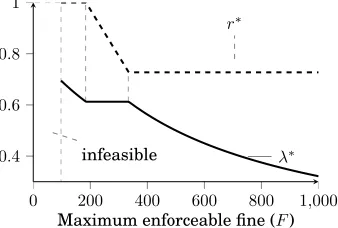
Discussion. The first observation is that the optimal contract should fully utilize the maximum enforceable fine and punish at no less than F. For large values of enforce-able fines, we note that r∗ is at H, the minimum value to ensure participation, and
4The reserve utility (also referred to as thefall-back utilityoraspiration wage) is the minimum utility that the agent aspires to attain or can obtain from other offers. Naturally,z≥0. Note that an implicit assumption here is that the agent is replaceable by any other agent with the same fall-back utility, i.e., there are many agents available with the same reserve utility. Without this assumption, the agent has negotiation power by refusing the contract knowing that it cannot be replaced. Alternatively,zcan be thought as to (exogenously) capture the negotiation power of the agents. This is an assumption we make throughout the paper. 5Participation constraint is sometimes also called Individual Rationality constraint.
0 200 400 600 800 1,000 0.4
0.6 0.8 1
λ∗ r∗
infeasible
Maximum enforceable fine (F)
Fig. 1: Change of contract parameters r∗, λ∗ w.r.t. the maximum enforceable fine F
(Prop. 4.1, case ofγ > K
Λ2), whereK= 450,γ= 1200,Λ = 0.7, andc= 400.
limF→∞λ∗= 0, which yieldslimF→∞C∗=H. These are compatible with intuition as a
huge fine implies that honesty can be enforced with minimum compensation and mi-nuscule rate of inspection. When auditing is cheap (γ≤K/Λ2), increasing the auditing rate is the better option to compensate for lower values ofFto maintain incentive com-patibility (honest computation). This is unless the auditing rate is at its maximumΛ, in which case, reward must increase aboveH to maintain incentive compatibility and compensate for the low value ofF. Note that in this case, the participation constraint is not active and is satisfied with a slack, while the incentive compatibility constraint is satisfied tightly. For yet lower values of enforceable fineF, even maximum reward
r=Rand auditing rateλ= Λmight not impose a strong enough threat against cheat-ing, hence the infeasibility region. When auditing is expensive (γ > K/Λ2), in order to
retain incentive compatibility in the situation of very low fineF, the principal should increase reward, and only consider more frequent auditing if the reward budgetRhas been reached. Fig. 1 depicts the optimal parameters of the contract versus the maxi-mum enforceable fine for the latter case (γ > K/Λ2).
Note that the infeasible region does not necessarily exist. Specifically, when the prin-cipal’s instantaneous budgetRis larger thanK/Λ, then there is always a feasible con-tract. Then even for F = 0, i.e., no enforceable fine, a contract that enforces honest computing is feasible, albeit by using high values of reward and/or auditing rate. In such cases, the principal “punishes” audited erroneous computations only through not rewarding the agent. From the proof, however, it becomes clear that honesty cannot be enforced with zero auditing rate, and consequently, the case ofΛ = 0trivially leads to infeasibility. Moreover, to satisfy the participation constraint at all,Rhas to be at least as large asH. Hence, forR < H, likewise, there exists no feasible contract for anyF. The proof also shows that except for the special case ofγ= 0, the optimal contract has the feature that it isunique.
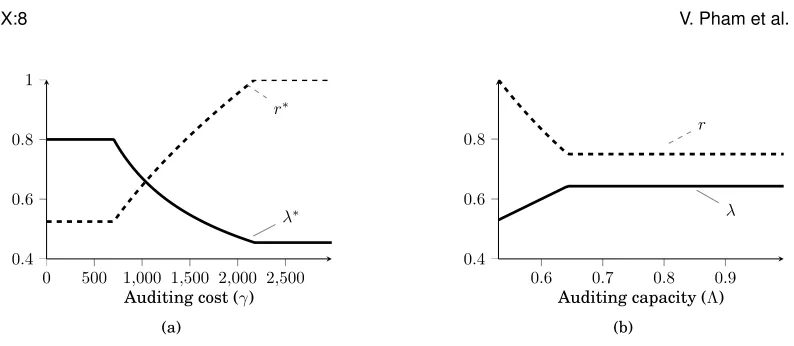
Figures 2a and 2b depict the change in the structure of the optimal contract versus varying auditing costγand the maximum auditing capacity, respectively. From Fig. 2a, we can see that for larger values ofγ, the optimal contract utilizes lower values of in-spection rateλ∗while using higher values of rewardrto enforce honest computation.
0 500 1,000 1,500 2,000 2,500 0.4
0.6 0.8 1
λ∗ r∗
Auditing cost (γ)
(a)
0.6 0.7 0.8 0.9 0.4
0.6 0.8
λ r
Auditing capacity (Λ)
(b)
Fig. 2: Optimal contract parameters w.r.t (a) the auditing costγ, withK= 450,Λ = 0.8,
c= 400, and (b) auditing capacityΛ, withK= 450,γ= 450,c= 450.
4.2. A Risk-Averse Agent
So far, we modelled the agent as risk-neutral, i.e., one that is indifferent between its expected utility and utility of expectation, leading to a linear utility function. However, empirically, individuals tend to show risk-aversion regarding decisions that affect their income. By definition, (strict) risk aversion is (strict) preference of expected utility over utility of expectation. FollowingJensen’s inequality, this is equivalent to assuming a (strictly) concave utility function (ref. e.g. [Gintis 2009, ch.2.4]). We have the following simple but re-assuring result:
PROPOSITION 4.2. The optimal contract given in Proposition 4.1 developed for a risk-neutral agent stays feasible for any risk-averse agent as well.
The proof is provided in Appendix-B. Note that even though the feasibility of our con-tract is guaranteed, its optimality might no longer hold. This is because a lower value of fine and/or rewards could potentially maintain incentive compatibility, as intuitively, cheating with a chance of getting caught can be seen as a lottery. However, because the level of risk-averseness of an agent is unknown, we argue that it is best practice to design the optimal contract for the worst case with respect to risk, i.e., risk neutral-ity. Specially, if a contract is designed assuming a particular degree of risk-aversion of the agent but the agent turns out to be less risk-averse than assumed, then the incentive-compatibility for honest computation may be violated, failing the principal’s intolerance of erroneous computations. Accordingly, for the rest of the paper, we will retain risk-neutrality for agents.
4.3. Mitigating clever guesses
An inherent problem of outsourced computation is that a (not always) correctly guessed output is indistinguishable from an honestly computed one. For instance, consider the question of whether a large natural number is a prime: the deterministic guess of “no” is most likely correct. Also, since the principal might not know the exact cost and suc-cess probability of potential guessing algorithms, it is hard to design a contract that enforces honesty. Therefore, the principal may prefer to avoid identifying the parame-ters of guessing algorithms altogether.
requir-ing snapshots of the intermediate steps makes guessrequir-ing of the correct output more costly. Letc(q1) be the cost of a tricky algorithm that tries to produce the expanded output with the intermediate steps of the honest computation, where it succeeds with probabilityq1. We make the assumption that nowc(q1)> q1c(1), so that any guessing
algorithm with costc(q1)can be replaced with a randomization between naive guess (with weight1−q1) and honest computation (with weightq1). Thus, for incentive
com-patibility, we only need to make sure that the agent’s utility from honest computation is better than a naive guess that succeeds with negligible probability q0 = negl. To
avoid distraction in our analysis, we assumeq0 = 0, as the results can easily be
real-ized forq0=negl. Our simplified constraints for the contract become:
participation: r≥c(1) +z, incentive compatibility: r≥ 1
λc(1)−f. (4)
Comparing to the constraints in (3c), this translates to changingKtoc(1). This in turn implies that the new incentive compatibility constraint requires a strictly lower fine value. Intuitively, as guessing becomes more difficult, cheating becomes less attractive and hence can be deterred with a smaller fine. Hereafter, we assume that the princi-pal is employing this technique and use the above incentive compatibility constraint. Moreover, for simplicity of exposition, we assume that the reserve utilityzis zero, and henceH becomesc(1), which we will abbreviate asc.
4.4. Optimal Choice for the Principal
So far we have considered auditing as a blackbox and only included its cost and capac-ity into the model. However, when auditing is via redoing the computation (at the cost ofγ) it might be optimal for the principal to not offer any contract at all. Indeed, when
Λ = 1, the principal can potentially audit all computations by redoing them. Specifi-cally, if the optimal contract costsC∗ ≥γ, then it is optimal for the principal to do the computation itself, as that only costsγΛ = γ. In caseΛ <1, the principal cannotdo all the computations, and must outsource a portion of it. Interestingly, the following proposition establishes that the principal’s optimal choice is either to not outsource at all, or fully outsource its computation.
PROPOSITION 4.3. Consider the case where auditing is through redoing the compu-tation. Letxbe the probability that the principal computes the tasks itself. Then, either
x∗ = 0 and the optimal contract is as per Proposition 4.1, or x∗ = Λ = 1 and there should be no outsourcing.
The proof is in Appendix-C. The proposition has this important corollary:
COROLLARY 4.4. When Λ < 1, the optimal choice for the principal is to use the optimal contact given by Proposition 4.1. WhenΛ = 1, the optimal choice of the principal is to compare the expected cost achieved by the optimal contract in Proposition 4.1 (for the value of maximum enforceable fine at hand) against γ, and accordingly decide to outsource or independently compute all of the tasks.
4.5. Optimal Contract for a Single Agent: Two-Level Reward
In our contracts so far, verified correct results and unaudited results are rewarded identically atr. Suppose, alternatively, that the principal rewardsr0 for accepted but
reward changes to:
min r0,r1,f,γ
C:=r1λ+r0(1−λ) +γλ
s.t. r0, r1≤R, f≤F, 0≤λ≤Λ, r1λ+r0(1−λ)≥c, r1≥ c λ−f.
PROPOSITION 4.5. ForF ≥[c/Λ−R]+, the optimal single-agent contract for
two-level rewarding is given as: f∗ = F, λ∗ = c/(F+R), r∗1 = R, r0∗ = F c/(R−c+F),
C∗=c(1 + (γ+c−R)/(F+R)). ForF <[c/Λ−R]+, the contract is infeasible.
The proof is similar to that of Proposition 4.1, and is omitted for brevity.
Discussion of the two level reward contract.First, note that there is no improvement in terms of the infeasibility region compared with the single-level reward contract. However, the achieved cost is always better. This was to be expected as the single-level rewarding can be thought of as a special case of two-level. However, the behaviour of the optimal contract now does not depend on the value of the auditing costγ. This is where the strength of the two-level rewarding lies: for high values ofγ, the two-level contract increasingly outperforms the single reward-level contract.
Note that the optimal reward for audited and correct resultsr1 is at the principal’s
maximum budgetRirrespective of the value ofF. The value of reward for unaudited resultsr0is always strictly less thanc, i.e., the cost of honest computation (and hence
strictly less thanr1as well). The value ofr0, unliker1, depends onF: For higher
val-ues of maximum enforceable fine, in fact somewhat unexpectedly, the optimal contract chooses increasing values of rewardr∗0. Still intuitively, a larger threat allows less
ne-cessity for auditing, and thus the contract starts to behave as a “lottery”, in which the low-chance “winner” receivesr1∗=Rand the “loser”r0< c < R.
5. OPTIMAL CONTRACTS FOR MULTIPLE AGENTS
When there are more than one agent available, the set of possible contracts gets ex-tended. Specifically, as e.g. [Belenkiy et al. 2008] and [Nix and Kantarcioglu 2012] discuss, the principal has the option of submitting the same task to multiple agents and comparing the outcomes. We will refer to this option as theredundancyscheme. If the returned results do not match, it is clear that at least one agent is cheating. Fur-thermore, as [Nix and Kantarcioglu 2012] assumes, if the agents are non-colluding, and returning the intermediate steps along with the computation result is required, then the probability that the results produced by cheating will be the same will be neg-ligible, which we again assume to be zero (for simplicity). Hence, the returned results are correctif and only if they are the same.
In the next subsection, we develop optimal contracts considering two agents. Subse-quently, we establish the global optimality of two-agent contracts among any number of agents with respect to the notion of Nash Equilibrium.
5.1. Optimal Contracts for Two Agents
and doing independent audits. In this section, we investigate optimal contracts among all hybrid schemes.
Besides lack of collusion, we assume the agents do not communicate either. There-fore, on the event that any of the agents receives a task, it has no information about the busy/idle state of the other agent. The action of each agent is selection between honest computation, which we represent byH, and cheating, which we denote byC. Since the agents have no information about the state of the other agent, the set of their (pure) strategies and actions are the same.
The expected utility of each agent depends in part on the action of itself and of the other agent. LetuA(a1, a2)represent the utility of agent 1 when it chooses action a1 and agent 2 chooses a2, where a1, a2 ∈ {H,C}. The principal wants to enforce
honest computation with probability one. IfuA(H,H)≥ uA(C,H), then given that agent 2 is going to be computing honestly, agent 1 will prefer to do the same too, and due to symmetry, likewise for agent 2. In the game theoretic lingo, this means that
(H,H)is a (Nash) equilibrium. If, further,uA(H,C)≥uA(C,C), then(H,H)will be the dominant (Nash) equilibrium, i.e., honest computation is the preferred action irrespective of the action of the other agent.
The principal utilizes the redundancy scheme with probabilityαor employs only one of the agents (selected equally likely)7with probability1−α. If the principal chooses only one agent, then it audits it with probabilityρ. Since auditing only occurs when a single agent receives the task, the likelihoodλthat the task will ever be audited is
ρ(1−α). As in the single-agent single-reward scenario, if only one agent is selected, the agent is rewardedrif there is no indication of wrongdoing, and is punishedfif audited and caught wrong. When the redundancy scheme is selected and the returned results are equal, both agents are rewardedr. Otherwise, the principal performs an indepen-dent audit with probabilityβ. When the results are different but the auditing does not occur, the principal has no way of identifying a culprit and treats them equally: both are fined atf. When the results are different and the auditing is done, then the cheat-ing agent(s) are fined atf, but if one of the agents is right, then that agent is rewarded at the maximum value:R.8 With the model so described, the expected utilities of an agent are computed as follows:9
uA(H,H) =r−c, uA(C,H) =(1−α−λ)r/2−(α+λ/2)f.
Hence, the conditionuA(H,H)≥uA(C,H)becomes:r≥(1 +α)c/(λ+ 2α)−f. Sub-ject to making(H,H)an equilibrium, the contract is accepted if the expected utility of it to the agents is above their reserve utility, which we assume here too to be zero for simplicity:r−c≥0. Then the expected cost of the contract to the principal is:
C= 2rα+γλ+r(1−α) = (1 +α)r+γλ.
The principal choosesλ,α,f,r,β such that honest computation is enforced, the con-tract is accepted, and the expected cost of the principal is minimized. λand αmust satisfy the structural condition0 ≤ α ≤ 1, 0 ≤ λ ≤ Λ andα+λ ≤ 1. The instanta-neous budget of the principal imposesr≤Rifα= 0, and2r≤Rifα >0. We assume
R ≥ 2c, since otherwise, the principal can never employ both of the agents without violating its instantaneous budget constraint, and hence, the problem reduces to the
7We will formally show through the proof of proposition 5.3 that equal randomization is the best option. Intuitively, this removes any information that the agents may infer upon receiving a task.
8Note that this extra auditing threat ofβ >0 is only instilled to make(C,C)(both agents cheating) a non-equilibrium if the goal is to make(H,H)the dominant Nash.
single agent problem. Then, the budget constraint simplifies tor≤R/2. Therefore, the optimal contracts for two agents that make (H,H)an equilibrium are solutions of the optimization problem of:
min
r,f,α,λr(1 +α) +γλ subject to:
r≤R/2, f ≤F, 0≤λ≤Λ, λ≤1−α, α≥0, r≥c, r≥ c(1 +α) λ+ 2α −f.
To make(H,H)the (unique) dominant Nash equilibrium, the principal should also ensure:u(H,C)≥u(C,C), where:
u(H,C) =(1−α)r/2 +αβR−α(1−β)f−c, u(C,C) =(1−α−λ)r/2−(α+λ/2)f.
If the principal manages to make (H,H) a dominant Nash equilibrium, then the value of β does not directly affect the expected cost of contract. However, for the threat of the auditing when the results are dissimilar to be credible, the principal must have enough free auditing capacity left. Hence, we must have:λ+αβ ≤ Λ. To attain the lowest cost contracts, the principal should set αβ at its minimum possible value.u(H,C)≥u(C,C)implies:αβ≥[c(1 +α)−λ(r+f)]/(2R+ 2f).
PROPOSITION 5.1. Let F0 = c/Λ−c andF1 = c[c−γ]+/[2γ−c]+,10 the optimal
one-level reward two-agent contract that makes(H,H)a Nash equilibrium is:
F1≤F : f∗=F, α∗= c 2F+c, λ
∗
= 0, r∗=c, C∗=c(1 + c 2F+c)
F0≤F < F1: f∗=F, α∗= 0, λ∗= c c+F, r
∗
=c, C∗=c(1 + γ F+c)
F <min(F0, F1) : f∗=F, α∗=
c−Λ(c+F) c+ 2F , λ
∗
= Λ, r∗=c, C∗= c(c+F)(2−Λ) c+ 2F +γΛ
ForΛ = 1,(H,H)is moreover the dominant Nash equilibrium.
COROLLARY 5.2. If auditing is more expensive than the cost of honest computation (γ ≥ c), the optimal contract only uses the redundancy scheme. Whenγ ≤ c/2, either there is no redundancy scheme (α= 0) or the whole auditing capacity is used (λ∗= Λ). The first part of the corollary is quite intuitive: whenγ > c, any instance of outsourcing to a single agent and performing independent auditing can be replaced by the redun-dancy scheme (job duplication) and strictly lower the cost byγ−c.
Further Discussion. First, note that in our optimal two-agent contract, as long as
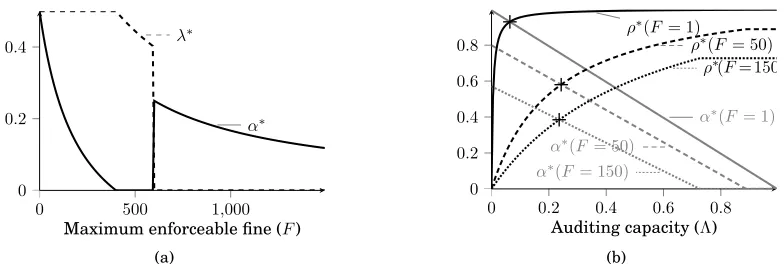
R≥2c, there is no infeasible region: there is always a contract that makes(H,H)an equilibrium. Moreover, the payment to any of the agents is never more than the cost of honest computation. Fig. 3a provides a pictorial representation of the proposition where c/2 < γ < cand Λ = 0.5. When the enforceable fine is large, the redundancy scheme is preferable. This is despite the fact that the redundancy scheme is more expensive than auditing: it costs an extra c as opposed to γ < c. In other words, for high values of fine, the redundancy scheme is a more effective threat against cheating than independent auditing. WhenFis less thanF1, the independent auditing becomes
the preferred method. For lower values ofF, when the auditing capacity is all used up, the redundancy scheme is added to compensate for the low value of fine to maintain incentive compatibility. Fig. 3b depicts the effect of auditing capacity,Λ, on the optimal contract where c/2 < γ < c. When Λ = 0, redundancy scheme is the only means to enforce honest computation. If furthermore no fine can be enforced (F = 0), thenα= 1:
0 500 1,000 0
0.2 0.4
α∗ λ∗
Maximum enforceable fine (F)
(a)
0 0.2 0.4 0.6 0.8
0 0.2 0.4 0.6 0.8
α∗(F= 1)
α∗(F= 50)
α∗(F = 150)
ρ∗(F = 1)
ρ∗(F = 50) ρ∗(F= 150)
Auditing capacity (Λ)
(b)
Fig. 3: Optimal contract (where c = 400, γ = 250) w.r.t. (a) max. enforceable fine F
(Λ = 0.5); and (b) auditing capacityΛ (F1 = 600). Recall ρ = 1−λα is the conditional
probability of auditing given the job is assigned to a single agent.
the job should be always duplicated. AsΛincreases, there is a gradual transition from using redundancy scheme to independent auditing (F < F1).
5.2. Global Optimality of Two-Agent Contracts
In developing the optimal contracts for two-agent case, we made a few critical assump-tions: (a) the independent auditing is perfect; (b) the agents are colluding and non-communicating; (c) the range of intermediate steps is large enough that the probability of any two guessed results to be same, or the guessed result to be the correct result, is negligible; and (d) the agents are lazy but not malicious. It turns out that these assumptions are sufficient to warrant global optimality of two-agent contracts among contracts that engage any number of agents in the following notion:
PROPOSITION 5.3. The contract that hires at most two agents and chooses its terms
according to proposition 5.1, is globally optimal, that is, it achieves the least cost to the principal among all contracts that employ any number of agents and aim to make honest computation a Nash Equilibrium.
The proof is provided in Appendix-D. The above proposition shows that our contract for two agents is not just a special case solution of multiple agents, but it is indeed the solution involving any number of agents. In other words, given the stipulated as-sumptions, there is no advantage ever in hiring more than two agents. Incidentally, the proof also shows that the best contracts makes the probability of any of the agents to be hired equal. This makes intuitive sense, as unequal probability of task assignment creates some “information” which the agents can potentially exploit to their benefit, and to the detriment of the principal.
6. CONTRACT IMPLEMENTATION
For completeness of the solutions, in this section we discuss notable technical concerns on the implementation of our contracts.
6.1. Intermediate steps and hash functions
steps: Instead of sending a large amount of data detailing these steps, the agent can only send the cryptographic hash of such data. On receiving the agent’s hashhA, the principal repeats the computation, and computes its own hashhP from the intermedi-ate steps, then verifies thathA=hP.
Informally, the use of hash function is considered secure if it is unlikely that the agent can come up with the correct hash without knowing the correct intermediate steps. The authors in [Belenkiy et al. 2008] require such hash function to be a “random oracle”, i.e., a function mapping in which each output is chosen uniformly randomly re-gardless of the input. While this is a sufficient condition, the notion of random oracle is rather impractical, and also an overkill. Indeed, we argue that for this purpose of hash checking, it is necessary and sufficient that the hash function is either “collision resistant” or “one-way”, that is, it should be difficult to either find two different mes-sages with the same hash, or find a message that corresponds to a particularly chosen hash value.
Lastly, note that the process of hashing the intermediate steps may itself carry a considerable cost as well. For instance, if the computation task itself is to hash a large string, then the cost of hashing the intermediate steps (if the same hash function is used) would be at least as much as computation cost. Therefore, either the use of hash function on intermediate steps must be negligible compared to that of the original computation task, or the extra cost of hashing must enter the contract model.
6.2. Enforcing contract policies
With regards to legal enforcement of the contract, it is necessary that behaviours of contract participants are observable and verifiable. Actions such as “assigning a job” or “paying a reward” are of this type. However, probabilistic behaviours, e.g., “employing two agents with probabilityα”, are usually unverifiable. Our contracts unfortunately rely on these probabilistic actions of the principal as explicitly stated in the terms and policies for auditing, task duplication and/or rewarding (the latter in two-level reward contracts of §4.5). It is critical to ensure (by both ends) that the principal in reality sticks to such actions, for two reasons: Firstly, the principal must establish to the agents its compliance to the contract so as to make the threats credible. Secondly, the agent needs an assurance that the principal cannot deviate from the contract and thus take away some of its benefits (in two-level rewarding). Without an appropriate security measure, this is usually not possible, e.g., the fact that the principal does not audit tells little about whether its auditing probability is indeedλ= 0.3orλ= 0.6. This important contract implementation issue has not been discussed in previous works.
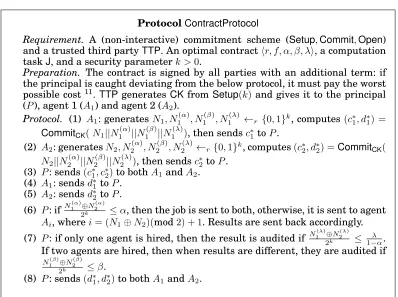
In Fig. 4, we propose a communication protocol between the principal and two agents that resolves this problem. Particularly, our security objective is to make sure that the principal gains negligible benefit by deviating from its prescribed behaviour as stated in the contract. To fulfil this objective, we rely on the fact that the contract can be legally enforced by an authority (e.g., a court), and thus punishment on the principal’s cheating is guaranteed if there is enough evidence for the accusation. What remains is to ensure that agents can prove the principal’s deviation (from the contract) whenever the principal benefits from doing so. Note that the principal may still deviate without additional benefit, which might be difficult to discover.
The main idea behind the protocol is to engage the agents into influencing the principal’s probabilistic actions, as opposed to letting the principal to decide its ac-tions alone. We allow each agent i to initiate a tuple of uniformly random nonces
hNi, N (α) i , N
(β) i , N
(λ)
ProtocolContractProtocol
Requirement. A (non-interactive) commitment scheme (Setup,Commit,Open) and a trusted third partyTTP. An optimal contracthr, f, α, β, λi, a computation taskJ, and a security parameterk >0.
Preparation. The contract is signed by all parties with an additional term: if the principal is caught deviating from the below protocol, it must pay the worst possible cost 11. TTPgenerates CKfrom Setup(k)and gives it to the principal (P), agent 1 (A1) and agent 2 (A2).
Protocol. (1) A1: generatesN1, N (α) 1 , N
(β) 1 , N
(λ)
1 ←r {0,1}k, computes (c∗1, d∗1) = CommitCK(N1||N
(α) 1 ||N
(β) 1 ||N
(λ)
1 ), then sendsc∗1toP.
(2) A2: generatesN2, N (α) 2 , N
(β) 2 , N
(λ)
2 ←r{0,1}k, computes(c∗2, d∗2) =CommitCK(
N2||N (α) 2 ||N
(β) 2 ||N
(λ)
2 ), then sendsc∗2toP.
(3) P: sends(c∗
1, c∗2)to bothA1andA2.
(4) A1: sendsd∗1toP.
(5) A2: sendsd∗2toP.
(6) P: if N (α) 1 ⊕N
(α) 2
2k ≤α, then the job is sent to both, otherwise, it is sent to agent
Ai, wherei= (N1⊕N2)(mod2) + 1. Results are sent back accordingly.
(7) P: if only one agent is hired, then the result is audited if N1(λ)⊕N (λ) 2 2k ≤
λ 1−α. If two agents are hired, then when results are different, they are audited if
N1(β)⊕N2(β) 2k ≤β.
(8) P: sends(d∗1, d2∗)to bothA1andA2.
Fig. 4: Communication protocol for the contract
For example,Ni(λ)are used to decide whether the principal will audit. The correspond-ing nonces from the two tuples are xor-ed together to preserve uniform randomness, in case one of the agents does not generate the nonces properly. Also, since we assume no collusion, agents do not communicate directly, and hence must give the nonces to the principal. Therefore, the only way for the agents to be sure that the principal treats the nonces properly is for them to also obtain these nonces (via the principal) from each other, and contrast against the observed principal’s action. Using cryptographic com-mitments, we make sure that the principal cannot meaningfully modify agents’ nonces before forwarding them, i.e., so that it can later deviate without being detected. After the computation results are returned, the principal securely reveals to the agents the behaviour it was expected to follow, then proceeds to rewarding/punishing the agents based on the returned results.
Table II: Examples of cost model for verification techniques
recomp. Yao’s[Gennaro et al. 2010]
PEPPER[Setty et al. 2012a]
Traces[Monrose et al. 1999]
Quin[Canetti et al. 2011] Principal |f| |f()| · |Encf ull| |π(f)| · |Encadd| |f| log|f|
Agent(s) |f| |BC(f)| · |Encf ull| |π(f)| · |Encadd| |f| 2|f| | |: size of the problem f(): output off
BC: boolean-circuit representation π: PCP representation
Encf ull(resp.Encadd): An operation of fully (resp. additive) homomorphic encryption
correctness and security of the protocol are informally stated as follows, which are formalised and proved in the appendix.
PROPOSITION 6.1. Suppose thatContractProtocolis followed honestly by all partic-ipants, then the principal’s behaviour is negligibly different from the contract’s specifi-cation, i.e.,hr, f, α, β, λi.
PROPOSITION 6.2. Suppose all participants in ContractProtocol are PPT algo-rithms. Suppose that (Setup,Commit,Open) is a secure non-malleable commitment scheme, and that contract terms can be legally enforced and that both agents are honest, then for any PPT principal that deviates fromContractProtocol, it receives additionally negligible payoff, given that the job is assigned to at least one agent.
6.3. Modelling auditing/verification techniques
We mention from the beginning that our optimal contract does not replace rigorous ver-ification techniques, but in fact relies on them as abstract auditing tools. It thus serves as a framework to not just study the economics of these techniques, but also compare and contrast among them. However, to fit our model, it is essential that the decision to audit must be hidden from the agent(s). For example, consider auditing using the scheme in [Gennaro et al. 2010]. Because it requires some preparation before the com-putation, the agent would know in advance whether an audit will happen, and thus probabilistic auditing is meaningless. As a workaround, we assume that this scheme is always active, but the principal would decide (with probabilityλ) whether to invoke the Verify step which costsO(m·poly(k)), where mis the size of the Boolean circuit representing the computation, andpoly(k) is some polynomial in a security parameter
k >0. That way the agent would be oblivious to whether the audit will happen. For a comparison, we have listed in Table II the cost model of some of the general-purpose verification methods in our literature review. It suggests that computation and re-dundancy are still enormously less expensive than notable cryptographic solutions.
7. CONCLUSION
We observed that outsourcing all or none of the tasks is optimal (and not partial outsourcing). We showed that when the enforceable fine is restricted, achieving honest computation may still be feasible by appropriately increasing the reward above the sheer cost of honest computation. We demonstrated that when auditing is more expen-sive than the cost of honest computation, redundancy scheme is always the preferred method, and when the auditing cost is less than half of the cost of honest computation, independent auditing is preferable. When the cost of auditing is between half and the full cost of honest computation, the preferred method depends on the maximum en-forceable fine: for large enen-forceable fines, redundancy scheme is preferred despite the fact that it is more expensive “per use” than independent auditing, since owing to its higher effectiveness, it can be used more sparingly. We established the global optimal-ity of contracts involving at most two agents among any arbitrary number of agents as far as implementing honesty as a Nash Equilibrium is aimed for. Finally, we presented a light-weight cryptographic implementation of our contracts that provided mutual af-firmation on proper execution of the agreed terms and conditions.
An interesting problem for future research is dynamic contracts that either learn the hidden parameters of the utilities of agents or re-act to global changes in the computa-tion costs and re-adjust the terms of contracts accordingly. Designing optimal contracts that are also resilient against collusions and/or communication between agents is also an interesting subject of future investigation.
REFERENCES
ATALLAH, M. J., CHO, Y.,AND KUNDU, A. 2008. Efficient data authentication in an environment of untrusted third-party distributors. InIEEE ICDE.
BAZARAA, M. S., SHERALI, H. D.,ANDSHETTY, C. M. 2013.Nonlinear programming: theory and algorithms. John Wiley & Sons.
BELENKIY, M., CHASE, M., ERWAY, C. C., JANNOTTI, J., K ¨UPC¸ ¨U, A.,AND LYSYAN
-SKAYA, A. 2008. Incentivizing outsourced computation. InNetEcon. ACM.
CANETTI, R., RIVA, B.,AND ROTHBLUM, G. N. 2011. Practical delegation of compu-tation using multiple servers. InACM CCS.
CARBUNAR, B. AND TRIPUNITARA, M. V. 2012. Payments for outsourced computa-tions. IEEE Transactions on Parallel and Distributed Systems 23,2.
CHEN, H., MA, X., HSU, W., LI, N.,ANDWANG, Q. 2008. Access control friendly query
verification for outsourced data publishing. InESORICS.
CHRISTOFOROU, E., ANTA, A. F., GEORGIOU, C., MOSTEIRO, M. A.,AND S ´ANCHEZ,
A. 2013. Applying the dynamics of evolution to achieve reliability in master–worker computing.Concurrency and Computation: Practice and Experience.
FULLBRIGHT, N. R. 2011. Outsourcing in a brave new world: An international survey of current outsourcing practice and trends. Tech. rep.
GENNARO, R., GENTRY, C.,ANDPARNO, B. 2010. Non-interactive verifiable comput-ing: Outsourcing computation to untrusted workers. InCRYPTO. Springer.
GINTIS, H. 2009. Game Theory Evolving: A Problem-Centered Introduction to
Model-ing Strategic Interaction. Princeton University Press.
MONROSE, F., WYCKOFF, P., AND RUBIN, A. D. 1999. Distributed execution with
remote audit. InNDSS.
NIX, R. AND KANTARCIOGLU, M. 2012. Contractual agreement design for enforcing honesty in cloud outsourcing. InGameSec. Springer.
RASMUSEN, E. 1994. Games and information: an introduction to game theory.
SETTY, S., MCPHERSON, R., BLUMBERG, A. J., AND WALFISH, M. 2012a. Making
2012b. Taking proof-based verified computation a few steps closer to practicality. In USENIX Security.
WANG, C., REN, K.,AND WANG, J. 2011. Secure and practical outsourcing of linear
programming in cloud computing. InINFOCOM, 2011.
YI, K., LI, F., CORMODE, G., HADJIELEFTHERIOU, M., KOLLIOS, G., AND SRIVAS -TAVA, D. 2009. Small synopses for group-by query verification on outsourced data streams. ACM TODS.
APPENDIX
A. PROOF OF PROPOSITION 4.1
We present the proof for the case of γ > 0. The case of γ = 0 follows more simply. For simplicity, let us fix a feasible fine and compute the solution in terms off. In the end, we will show that f = F is indeed optimal.12 We will ignore the constraint of
λ≥0since it is strictly implied by the constraints in (3c) (the incentive compatibility). Furthermore,r≥H impliesr >0.
We use the Karush-Kuhn-Tucker (KKT) conditions [Bazaraa et al. 2013] to solve the above nonlinear (non-convex) programming.13 Note that our cost and constraint functions are all continuously differentiable. We first use the Mangasarian–Fromovitz constraint qualification (MFCQ) to establish that any minimum must satisfy the KKT conditions, i.e., KKT are necessary conditions of optimality. In the absence of equality constraints, the MFCQ condition means that the gradients of the active inequality constraints are positive-linearly independent at optimum points.
In the special case ofR =H, the constraintsr ≥ H andr ≤ Rimply r =H = R, and hence, the optimization problem can be rewritten with onlyλas a variable, which is simple to analyse. WhenR > H, only one of the constraintsr−R≤0 andH−r≤ 0 is ever active. We will investigate them one at a time. The gradients of the other inequality constraintsr−R≤0,λ−Λ≤0andK−rλ−f λ≤0are respectively:(1,0),
(0,1)and(−λ,−r−f). Note that only forf =K/Λ−R, the last three inequalities can be all active. For this case, the domain of feasible solutions reduces to the singleton point of r = R, λ = Λ. For f < K/Λ−R, no feasible solution exists. For all other cases, at most two of the constraints are active at a time, whose gradients can never be linearly dependent:(1,0)and(0,1)are clearly linearly independent, and both elements of(−λ,−r−f)are strictly negative, hence it is linearly independent from each of the other two. Now, consider theH−r≤0constraint whose gradient is(−1,0). Note that three of the constraints may be simultaneously active, but their gradient will not be positive-linearly dependent, because both elements of(−λ,−r−f)are strictly negative. Hence, the MFCQ normality condition holds.
To systematically obtain the KKT conditions, we introduce the dual multipliersµ1, µ2,µ3andµ4, and transform the problem in (3) as follows:
min r,f,λ,µi
¯
C=r+γλ+µ1(r−R)+µ2(λ−Λ) +µ3(H−r) +µ4(K−f λ−rλ)
s.t.: primary feasibility: r≤R, λ≤Λ, r≥H, rλ+f λ≥K (7a) duality feasibility: µ1, µ2, µ3, µ4≥0, (7b)
complementary slackness: µ1(r−R) = 0, µ2(λ−Λ) = 0, (7c)
12Alternatively, the following simple argument shows from the beginning thatf must be at its maximum valueF: Note that the principal can increase the auditing rateλ, or rewardror the finef in order to enforce the incentive compatibility constraint. Of these three variables, only increasing the fine is costless to the principal.
µ3(H−r) = 0, µ4(K−f λ−rλ) = 0. (7d) The first order conditions of optimality are:
∂C¯
∂r = 0⇔µ4λ= 1 +µ1−µ3,
∂C¯
∂λ = 0⇔µ4r=γ+µ2−f µ4. (8)
The full solution as in the proposition withF replaced byf is now derived by straight-forward investigation of the above conditions. The proof then concludes by noting that the cost such found is strictly decreasing inf, and hencef∗=F.
B. PROOF OF PROPOSITION 4.2
The only two constraints in the optimal contract that may change are the incentive compatibility and participation: (1), (2). The new participation constraint is:u(r−c)≥ u(z). Due to the increasing property of u(·), this new constraints translates back to
r−c≥z, hence no change here.
For analysing the new incentive-compatibility constraint, let us represent the mixed action of the agent by L(x, y,1−x−y) which means making a random guess with probability x, using the tricky algorithm with probability y, and doing the honest computation with probability 1−x−y. With a slight abuse of notation, letX[L] be the random variable representing the utility of the agent given its mixed action L. Then the risk-neutral incentive compatibility constraint as given in (1) is ensuring thatEX[L(0,0,1)] ≥ EX[L(x, y,1−x−y)]. Becauseu(·)is increasing, this inequality
implies: u(EX[L(0,0,1)]) ≥ u(EX[L(x, y,1−x−y)]). Further, following Jensen’s
in-equality, sinceuis concave,u(EX[L(x, y,1−x−y)])≥Eu(X[L(x, y,1−x−y)]). Note thatX[L(0,0,1)]is a deterministic random variable (specifically, payoff ofr−c(1)w.p. one). Hence:u(EX[L(x, y,1−x−y)]) = Eu(X[L(x, y,1−x−y)]). Therefore, we have
shown that (1) implies: Eu(X[L(x, y,1−x−y)]) ≥ Eu(X[L(x, y,1−x−y)]), which is
the incentive compatibility constraint for a risk-averse agent.
C. PROOF OF PROPOSITION 4.3
Lety represent the probability that the task is outsourced to the agentandthe prin-cipal audits it. For a general choice of x ∈ [0,Λ], the expected cost of the principal is C = r(1−x) +γ(x+y). The new incentive compatibility for honest computation (given the agent receives the task) is: r−c ≥ r(11−−xx−y) −1f y−x ⇔ r ≥ c(1y−x) −f. An optimal contract is thus a solution of minr,f,x,yC := r(1−x) +γ(x+y) subject to: r ≤ R, f ≤F, 0 ≤x, y ≤ Λ, x+y ≤ Λ, r ≥c, r ≥ c(1y−x) −f. The rest of the proof follows similar to that of Proposition 4.1.
D. PROOF OF PROPOSITION 5.3
PROOF. First, we provide an argument that if the optimal contract indeed assigns a task to more than one agent, then it does not benefit from hiring them agents in a “sequential” manner. Next, we prove that two-agent contract is the best solution among all “non-sequential” contracts by converting any given contract to a two-agent contract and improving the cost of the outsourcer.
first step only one agent is assigned the task, there are again two possibilities: (a) the agent is audited, in which case the principal unequivocally knows whether cheating has occurred and hence, there is no need for subsequent steps; or (b) the returned result is not audited. In the latter case, the agents that are hired in the next immediate step can be combined with the single agent hired in the first step and thought of as they are all hired in a the step. Then, the argument for multiple agents in the first step can be applied to remove the need for any subsequent steps. Therefore, any optimal contract is either non-sequential or can be converted to a non-sequential one.
Now, letλjbe the (unconditional) probability that agentjis independently audited. Also letpjibe the (conditional) probability that agentjreceives the task ifiagents are assigned. The expected cost of the contract to the principal is the following:
C=r N X
i=2
iαi+r(1− N X
i=1 αi) +γ
N X
j=1 λj=r
N X
i=2
(i−1)αi+r+γ N X
j=1 λj
Let ϕj be the probability that agent j receives the task. Then: ϕj = P N
i=2pjiαi + pj1(1−P
N
i=2αi). The expected utility of agent j for honest computation given that it has received the message, and given that the rest of the agents are honest, is sim-ply r−c. Now, let us define ψj to be the probability that agent j is rewarded given its strategy is to cheat. Given the honesty of all other agents, agent j is rewarded only if it is the only one that is assigned the task and it is not audited on. This gives:
ψj =pj1(1−P N
i=2αi)−λj. Therefore, the expected utility of agentjfor cheating given it is assigned the task and all other agents are honest isrψj/ϕj−f(ϕj−ψj)/ϕj. Hence, the incentive compatibility constraint, i.e., uj(H,H)≥uj(C,H)withH represent-ing the honest strategy of otherN −1agents, becomes:r≥ ϕj
ϕj−ψj
c−f. Taking into account the incentive compatibility of all of the agent, we have:
r≥max j
PN
i=2pjiαi+pj1(1−P N i=2αi) PN
i=2pjiαi+λj
The participation constraint given that the honesty of all agents is established is sim-plyr−c≥0. Thus, the optimal contract is given by the following optimization:
min αi,λj,pji,r,f
C=r N X
i=2
(i−1)αi+r+γ N X
j=1 λj
s.t. N r≤R, f≤F, λj, pj1, αi≥0, λj≤(1− N X
i=2 αi)pj1,
N X
j=1
pji= 1∀i, N X
j=1 λj+
N X
i=2 αi≤1, N
X
j=1
λj≤Λ, r≥max j
PN
i=2pjiαi+pj1(1− PN
i=2αi) PN
i=2pjiαi+λj
, r−c≥0.
Now, suppose there is a claimed solution in whichαi>0for at least onei∈ {3, . . . , N}. In what follows we construct an alternative solution that improves the cost to the principal in whichαi= 0for all3≤i≤N. Consider this alternative contract:
ˆ α2=
N X
i=2
αi, αˆi= 0∀i≥3, λˆj= N X
k=1
First, we show that given the feasibility of the claimed contract, this alternative con-tract is also feasible, and subsequently, establish the improvement in the achieved cost. The only non-trivial constraint to check for feasibility of the above contract is the incentive compatibility constraint:
r≥ 1 N
PN i=2αi+
1 N(1−
PN
i=2αi)/N 1
N PN
i=2αi+ 1 N
PN j=1λj
= 1
PN i=2αi+
PN j=1λj
(9)
From the feasibility of the claimed contract, we have:
r≥max j
PN
i=2pjiαi+pj1(1−P N i=2αi) PN
i=2pjiαi+λj
⇒r≥ PN
j=1
PN
i=2pjiαi+pj1(1−P N i=2αi)
PN j=1
PN
i=2pjiαi+λj = PN i=2 PN
j=1pjiαi+P N
j=1pj1(1−P N i=2αi)
PN
i=2 PN
j=1pjiαi+P N j=1λj
=
PN
i=2αi+ (1−P N i=2αi) PN
i=2αi+ PN
j=1λj
which gives (9). This establishes that the new solution is also feasible. In the first line of the above argument, we used the following simple lemma:
LEMMA D.1. If we havea≥maxj∈J bj cj
wherecj>0for allj ∈ J, thena≥ P
j∈Jbj P
j∈Jcj .
Now:Cˆ= ˆrPN
i=2(i−1) ˆαi+ ˆr+γλˆ =rP N
i=2αi+r+γP N
j=1λj ≤rP N
i=2(i−1)αi+r+ γPN
j=1λj=C.
E. PROOF OF PROPOSITION 6.1
PROOF. This result is rather straightforward. We notice that the principal’s be-haviour is driven by the nonces, as indicated in step 6 and 7 ofContractProtocol. Since the nonces are generated uniformly randomly from {0,1}k, the xor-ed version of the nonces (e.g.,N1(α)⊕N2(α)) are also uniformly random. It is then easy to verify that the probabilistic behaviour of the principal is statistically indistinguishable from the con-tract specification. For example, considering the decision of whether one or two agents are employed, withX is the random variable in thatX= 2with probabilityα, then
|Pr[N (α) 1 ⊕N
(α) 2
2k ≤α]−Pr[X= 2]|=|Pr[
N←r{0,1}k
2k ≤α]−α|=| bα2kc
2k −α| ≤ 1 2k (10) Other parts of the behaviour can be proved similarly.
F. PROOF OF PROPOSITION 6.2
PROOF. Before proceeding with the proof, let us formalise the statement of the
As a result, we decide to let such a plan be picked by the agents rather than the principal. The protocol for “picking plan” should satisfy the following properties:
—Correctness: Honest execution of the protocol must ensure that the plan is picked according∆(Ω).
—Hiding: Before the contract is executed, the agents must know nothing about the picked plan.
—Revealing: After the contract is executed, there must be a secure way for the plan to be revealed to the agents.
—No cheating: Suppose that the agents execute the protocol honestly, then by deviating from it the principal does receive any better benefit.
While the need for correctness is clear, we note that the hiding property guarantees our original assumption that the agents do not know the principal’s behaviour until they have carried out and returned the computation. Finally, the revealing and no cheating properties facilitate detection of the principal’s deviation and/or assurance that such deviation is not beneficial. Informally, detection of deviation is a process in which an agent contrasts what it obverses as the principal’s behaviour against a planω ∈Ωthat was picked by the agents. An inconsistency between the plan and the observed behaviour would indicate to that agent of the principal’s deviation.
Next, we defineBto be the set of possibleobservablebehaviours, along with consis-tency relations∼1and∼2(forA1andA2respectively), such thatω∼ib⇔b∼iωfor all pairs(ω, b)∈Ω× Bandi= 1,2. Here an observable behaviour is a collection of actions that could be easily and costlessly reproduced (in front of the judges) for verification. For example, the action of assigning a job to an agent, or giving a reward (shown in the bank statement) are observable.
Finally, in order to capture the principal’s benefit from deviation, we need to define its utility for each outcome of the contract execution. Essentially this utility is a func-tion uP : Ω2×(B2\ {(∅,∅)}) →R, in which a tuple(ω1, ω2, b1, b2) ∈Ω2× B2 indicates
the agents’ views on the chosen plan (i.e., ω1 andω2), and the principal’s chosen
be-haviours regarding each agent (i.e.,b1andb2). Here∅denotes the fact that an agent is
not employed, and hence(∅,∅)should be excluded, since in that case the principal will need to form a new contract (possibly with different agents).
Our solution relies heavily on commitments, and hence can be described by a tuple
(S,C,D)of setup, commit, and decommit algorithms. Formal security definition of the above requirements is:
Definition F.1. A secure contract implementation mechanism for ∆(Ω),B, ∼1, ∼2,
anduP : Ω2×(B2\ {(∅,∅)})→Ris a tuple of PPT algorithms(S,C,D)such that:
—Correctness:given the following experiments
Prot(∆(Ω), k) : Ideal(∆(Ω)) :
CK← S(k) ω←∆(Ω)
(c1, d1)← CCK(∆(Ω)) b1←R{b∈ B|b∼1ω} (c2, d2)← CCK(∆(Ω)) b2←R{b∈ B|b∼2ω} (ω, b1, b2)← DCK(c1, d1, c2, d2) return(ω, b1, b2) return(ω, b1, b2)
it must hold thatProt(∆(Ω), k)andIdeal(∆(Ω))are statistically indistinguishable, i.e.,
sup o∈Ω×B2
—Hiding:for every PPT algorithm A = (A1, A2)(curious agent), there exists a PPT
algorithmA∗= (A∗1, A∗2)satisfying:
Pr
CK← S(k); (c, d)← CCK(∆(Ω)); (c0, d0, m)←A1(∆(Ω),CK);ω← A2(c, m,∆(Ω),CK); (ω0, b1, b2)← DCK(c, d, c0, d0) :⊥6=ω=ω0
−Pr
CK← S(k); (c, d)← CCK(∆(Ω)); (c0, d0, m)←A∗1(∆(Ω),CK); ω∗←A∗2(m,∆(Ω),CK); (ω0, b1, b2)← DCK(c, d, c0, d0) :⊥6=ω∗=ω0
≤(k) (11) —Revealing:for every PPT algorithmP (cheating principal) we have
Pr
CK← S(k); (c, d)← CCK(∆(Ω)); (c0, d1, d2)←P(c, d,∆(Ω),CK); (ω1,·,·)← DCK(c, d, c0, d1); (ω2,·,·)← DCK(c, d, c0, d2) :ω16=ω2∧ω1, ω26=⊥
14≤(k) (12)
—No cheating:given the following experiment
Real(∆(Ω), k, P) : CK← S(k)
(c1, d1)← CCK(∆(Ω))
(c2, d2)← CCK(∆(Ω))
(c01, c02)←P(c1, c2)
ifc01=c2∨c02=c1return(⊥,⊥,∅,∅)15 (d01, d02, b1, b2)←P(c1, d1, c2, d2)
(ω1,·,·)← DCK(c1, d1, c02, d02) (ω2,·,·)← DCK(c01, d01, c2, d2) return(ω1, ω2, b1, b2)
it must hold that for all PPT algorithmP(cheating principal)
E[uP(ω1, ω2, b1, b2)|(ω1, ω2, b1, b2)←Real(∆(Ω), k, P); (b1, b2)6= (∅,∅)]
−E[uP(ω, ω, b1, b2)|(ω, b1, b2)←Prot(∆(Ω), k); (b1, b2)6= (∅,∅)]≤(k) (13)
The next step before constructing a protocol that satisfies the above definition is to formaliseΩ,B,∼1,∼2, anduP. The set of possible plans can be described as
Ω ={A1, A2} × {audit, reward} ∩ {(A1, A2, reward)} × {audit, punish all} ∩ {⊥}.
In other words, a plan must specify the employed agent(s), as well as what to do when the results are returned. The{audit, punish all}option for two-agent employment spec-ifies the principal’s action when conflicting results are returned. Also for convenience we putrewardalongside two-agent employment to indicate that when identical results are returned, the reward is blindly given to the agents. Note that in each plan we do not consider reward and punishment values, because these figures are set out clearly in the contract. As a result, we will also not consider them in the observable behaviour, as below:
B={A1, A2} × {audit, reward} ∩ {∅}
Our construction ofBrelies on theassumptionthat the acts of auditing and blind re-warding are distinguishable and verifiable to the agents. Note that we do not consider
14The·symbol indicates an irrelevant output which we omit for simplification.