Using Indistinguishability Obfuscation via UCEs
Christina Brzuska1 Arno Mittelbach2 1Tel Aviv University, Israel
2Darmstadt University of Technology, Germany
[email protected] [email protected]
Abstract. We provide the first standard model construction for a powerful class of Universal Com-putational Extractors (UCEs; Bellare et al. Crypto 2013) based on indistinguishability obfuscation. Our construction suffices to instantiate q-query correlation-secure hash functions and to extract polynomially many hardcore bits from any one-way function.
For many cryptographic primitives and in particular for correlation-secure hash functions all known constructions are in the random-oracle model. Indeed, recent negative results by Wichs (ITCS 2013) rule out a large class of techniques to prove the security of correlation-secure hash functions in the standard model. Our construction is based on puncturable PRFs (Sahai und Waters; STOC 2014) and indistinguishability obfuscation. However, our proof also relies on point obfuscation under auxiliary inputs (AIPO). This is crucial in light of Wichs’ impossibility result. Namely, Wichs proves that it is often hard to reduce two-stage games (such as UCEs) to a “one-stage assumption” such as DDH. In contrast, AIPOs and their underlying assumptions are inherently two-stage and, thus, allow us to circumvent Wichs’ impossibility result.
Our positive result is also noteworthy insofar as Brzuska, Farshim and Mittelbach (Crypto 2014) have shown recently, that iO and some variants of UCEs are mutually exclusive. Our results, hence, validate some of the new UCE notions that emerged as a response to the iO-attack.
Contents
1 Introduction 3
2 Preliminaries 9
2.1 Obfuscation . . . 10 2.2 Universal Computational Extractors (UCE) . . . 13 2.3 Puncturable PRFs . . . 15
3 UCEs from iO and Point Obfuscation 15
3.1 Strongly Unpredictable and q-Query Sources . . . 16 3.2 A UCE Construction Secure Against Sources in Ss-cup∩ S1-query . . . . 18
3.3 A UCE Construction Secure Against Sources in Ss-sup∩ Sq-query. . . . 24
4 Applications 25
4.1 Hash Functions Secure under Correlated Inputs . . . 25 4.2 Universal Hardcore Functions . . . 26
5 The BFM Impossibility Result 27
A Constructions and Candidates for Obfuscation Schemes 34
B AIPO Implies One-way Functions 35
1
Introduction
For many cryptographic primitives, it is easy to construct a secure scheme in the random oracle model, but it is hard to give a construction in the standard model. For example, correlated-input hash functions (CIH) which were introduced by Goyal, O’Neill, and Rao [GOR11], are easy to construct in the random oracle model, because the random oracle itself is secure under correlated inputs. However, up to now, no standard-model construction is known, and indeed, a recent black-box separation by Wichs [Wic13] explains why it is so hard to construct them. Namely, the security definition of a CIH involves a pair of adversaries (A1,A2) and is thus a two-stage game (i.e., the adversary is not a single
algorithm but consists of two separate algorithms). The first adversary samples correlated inputs (x1, ..., xt). Then a hash key hk is generated and the second adversary with access to hk needs to
distinguish between getting a tuple of random strings and getting the tuple (H(hk, x1), ..., H(hk, xt)).
Now, Wichs employs a meta reduction to show that it is unlikely to have a black-box reduction R
from CIH to a (one-stage) cryptographic assumption such as the decisional Diffie–Hellman assumption (DDH). Namely, he shows that if such a reduction to DDH exists, then the DDH assumption is wrong.
In his proof, he substantially exploits that the CIH game is a two-stage game. For a black-box reduction
R it must hold that if the reduction R gets access to a pair of oracles (A1,A2) that break CIH, then RA1,A2 must also break DDH. Wichs constructs a pair of inefficient adversaries (A
1,A2) which,
however, can be efficiently emulated using a stateful simulatorSim. That is, the simulator simulates both adversaries together while sharing state between them. As the reduction cannot distinguish between the two settings RA1,A2 andRSim this breaks DDH, and hence, if we believe that DDH is a
hard problem, then such an Rcannot exist. Note that Wichs’ proof is not specific to DDH, but rather applies to any one-stage assumption and presents a substantial barrier to prove security. Moreover, Wichs’ impossibility result extends to a range of security notions that are specified by two-stage games.
In this paper, we use cryptographic obfuscation techniques to circumvent Wichs’ impossibility result and achieve security notions that are based on two-stage assumptions. Towards this goal, the key idea is to combine point-function obfuscation and indistinguishability obfuscation.
Point and indistinguishability obfuscation. A point functionpx is a function that returns 1 on
input x and ⊥on all other values. A point function obfuscator under auxiliary input AIPOreturns a point functionp←$ AIPO(x) that hides the pointxeven in case the adversary receives some side-channel
informationzaboutx. More formally, the security ofAIPOis defined as security for all computationally unpredictable distributionsD, that is, Doutputs a pair (x, z), wherexis a point andz is some leakage that hides x computationally. AIPOis secure, if for all computationally unpredictable D, (AIPO(x), z) is indistinguishable from (AIPO(u), z), where (x, z) ← D and u is a uniformly random point. Such AIPOschemes have been constructed in [Can97, BP12].
While point function obfuscators are obfuscation schemes for a very specific class of functionalities (namely point functions) Garg et al. [GGH+13] have recently revived the study of general obfuscation
schemes with their candidate construction of indistinguishability obfuscation. The notion of indistin-guishability obfuscation is weaker than VBB-obfuscation—thereby circumventing the impossibility results of Barak et al. [BGI+01, BGI+12]—and says intuitively that, for any two circuits that compute
the same function, their obfuscations are indistinguishable. The publication of the candidate for indistin-guishability obfuscation by Garg et al. inspired simultaneous breakthroughs for hard problems in various sub-areas of cryptography [SW14, BCP14, ABG+13, GGHR14, HSW14, BZ14, BST14, GGG+14]
Correlated-input hash-functions. In this paper, we give the first standard-model construction
for q-query CIHs. Our CIH is not only one-way under correlated inputs, but also outputs elements that are indistinguishable from random. We will compare our notion of q-query CIH with other notions of CIHs shortly.
On a high-level, our construction is a de facto instantiation of a random oracle. As the behavior of a PRF is similar to that of a random function, we instantiate the random oracle by securely delegating a PRF, that is, we obfuscate a PRF with a hard coded key. Indeed, our hash-function construction only consists of a (puncturable) PRF that is obfuscated via an indistinguishability obfuscator (iO):
Hash Construction: iO(PRF(k, .)).
Bellare, Stepanovs, and Tessaro (BST; [BST14]) already used this natural construction in the direct construction of hardcore functions for injective one-way functions from indistinguishability obfuscation. We will discuss BST and the relation to our our work shortly.
Noteworthy, and we will also come back to this, is that before obfuscating the PRF we need to pad the circuit to a specific length. This is needed when using indistinguishability obfuscation to move from one circuit to another one in the security proof and thus the construction must be padded to the length of the biggest circuit needed within the security proof. Jumping ahead, we note that although our construction and that of BST look identical on the outside the padding is different. For BST, the construction needs to be padded differently depending on the size of the one-way function. In turn, our padding is universal and thus, we yield a universal hardcore function that works for any one-way function.
Circumventing Wichs’ impossibility result. Although the construction is natural, proving its
security is non-trivial, as the security guarantees of iO do not even allow us to show easily that it is hard to extract the PRF key. Towards proving the security of our construction, we build on the puncturable PRF technique by Waters and Sahai [SW14] and combine it with point function obfuscators secure under auxiliary input (AIPO).
Using AIPOs is crucial to circumvent the impossibility result by Wichs [Wic13], because the security of AIPOs is defined via a two-stage security game. The first AIPO adversary samples a point, and the second adversary tries to break the obfuscation of the point function. In a sense, the impossibility result of Wichs tells us that using a two-stage assumption such as AIPO in the proof is, indeed, necessary. In particular, iO and PRFs are both one-stage assumptions. Note that, as AIPOs are only used in the proof and not in the construction, it might be possible that the same construction can be proven secure without making use of AIPOs possibly through some other two-stage assumption.
Universal hardcore functions for any one-way function. Bellare, Stepanovs, and
Tes-saro (BST; [BST14]) recently established that the same construction (with a different amount of padding) also yields a hardcore function for any injective one-way function, assuming a puncturable PRF and iO.
For general one-way functions, BST gave a second, different construction of a hardcore function and proved it based on so-called differing-inputs obfuscation. Differing-inputs obfuscation is a stronger assumption than iO and has been shown conditionally impossible by Garg et al. [GGHW14a] assuming special-purpose obfuscators. Therefore, in the current version of their paper, Bellare et al. [BST14] use a weaker variant of diO that is not affected by the results of Garg et al. [GGHW14a].
function has “output-only dependence”. This means that hardcore bitsh(x) are completely determined by f(x), or in other words, for any inputs x and x0 such thatf(x) =f(x0) it holds thath(x) =h(x0). We note that the only candidate for iO for Turing machines is currently based on full diO.
The conditional negative result for output-only dependent hardcore functions does not apply to the construction iO(PRF(k, .)) which is the construction that we use throughout this paper and which BST—with a different amount of padding—prove to be a hardcore function for injective one-way functions. In turn, assuming AIPO in addition to iO allows us to prove this construction secure for all one-way functions, even those that have many pre-images. Another difference with the BST result is that we yield a universal hardcore function for any one-way function while their padding depends on the one-way function.
Our proof builds on ideas by BST, and we will come back to their result in the context of presenting our proof techniques. We note that for our security proof, we assume AIPO in addition to iO and thereby are able to avoid diO variants altogether. The assumption of point obfuscators is currently incomparable to the assumption of differing-inputs obfuscation as well as to more restricted versions that were used by BST. It is an interesting question to explore the relationship between these assumptions.
Modularizing proofs via UCEs. We could prove the security of our construction directly, but
instead, we split our proof into two parts. First, we show that our construction enjoys some useful, abstract properties. Then we use results by Bellare et al. [BHK13a] that show that these abstract properties suffice for the application at hand. This way, we provide a means of using iO in a black-box way. Our abstraction is a version of UCE security [BHK13a] that we discuss next.
The UCE Framework by Bellare, Hoang, and Keelveedhi (BHK; [BHK13a]) introduces assumptions that allow us to instantiate random oracles in a wide range of applications. Loosely speaking, UCEs are PRF-like assumptions that split the distinguisher into two parts: a first adversary S that gets access to a keyed hash function or a random oracle (and which is called the source), and a second adversary D that gets the hash key hk (and which is called the distinguisher). The two algorithms together try to guess whether the source was given access to a keyed hash function (under a randomly chosen key) or to a random oracle.
Concretely, the UCE notions are defined via a two-stage UCE game (we depict the communication flow in Figure 1 and the pseudocode in Figure 2). First, the sourceSis run with oracle access to Hash
(which either implements a random oracle or the hash function with a randomly chosen key hk) to output some leakage L. Subsequently, distinguisher Dis run on the leakage L and hash key hk but without access to oracleHash. Distinguisher Doutputs a single bitb indicating whether oracleHash
implements a random oracle or hash function Hwith keyhk.
Without any restrictions, (S,D) can easily win the UCE game. For example, say, sourceS makes a random query x to receivey← Hash(x) and outputs (x, y) as leakage. As distinguisher Dknows the hash key hk as well as the leakage (x, y), it can recompute the hash value and check whether
y=H(hk, x).
BHK present several possible restrictions on the source which give rise to various UCE notions. It turns out to be particularly useful to restrict sources to be computationally unpredictable, that is, the leakage created by the source S—when interacting with a random oracle—should not reveal (computationally) any of the source’s queries toHash. This notion is denoted by UCE[Scup], whereScup
denotes the class of computationally unpredictable sources [BHK13b]. BHK show that UCE[Scup]-secure
refinements have been proposed since, including a statistical notion of unpredictability denoted bySsup
as well as source classes containing sources that are structurally required to produce output in a special way as well as sources which are restricted to only a fixed number of queries [BHK13b, BFM14, MH14b].
Our notion of UCE security strengthens the notion of unpredictability to what we call strong unpredictability and we denote the corresponding class of sources by Ss-cup for the computational
variant and by Ss-sup for its statistical version. Namely, we demand that the leakage be
computation-ally/statistically unpredictable even if the predictor additionally gets the answers to the queries that the source received from the oracle. We give the pseudo-code for strong unpredictability in Figure 3. It turns out that UCEs for strongly computationally unpredictable sources that can only make a single query (denoted by UCE[Ss-cup∩ S1-query]) already imply hardcore functions for any one-way
function. Furthermore, UCEs for strongly statistically unpredictable sources that can only make q
queries (denoted UCE[Ss-sup∩ Sq-query]) implyq-query correlation-secure hash functions. We note that
strongly unpredictable sources can be regarded as a generalization of so-called split sources [BHK13b] which were introduced by BHK after the BFM impossibility results. We will discuss the exact relationship later.
So far UCEs have only been constructed in idealized models. BHK showed that a random oracle is UCE-secure in the strongest proposed settings and conjectured that HMAC is UCE-secure if the underlying compression function is modeled as an ideal function. This conjecture has recently been confirmed by Mittelbach [Mit14] who shows that HMAC and various Merkle-Damg˚ard variants are UCE-secure in the ideal compression function model. We note that so far, no standard model instantiation of any (non-trivial) UCE variant has been proposed and, hence, we present the first standard model construction of UCEs.1
Techniques. Our construction is based on indistinguishability obfuscation and similar to many
other recent constructions from iO [SW14, BST14, HSW14, BZ14] our construction also makes use of puncturable PRFs [SW14] which admit the generation of keys that allow to evaluate the PRF on all points except for points in a small target set (often containing just a single point). Our security reduction, however, differs from existing techniques. That is, we make use of point function obfuscations which allows us to hide the punctured points within our constructed circuits. Hiding the punctured points was also the key problem in the earlier discussed work by Bellare, Stepanovs and Tessaro [BST14] who construct hardcore-functions for one-way functions. They solve the problem elegantly by using the one-way function from the security game to blind the punctured point by embedding the image under the one-way function. However, when testing whether a given point is equivalent to the punctured point this test is ambiguous which is why they need to assume differing-inputs obfuscators for one-way functions that map more than polynomially many points to the same image value. This is where point function obfuscation comes into the picture which allows us to bypass any assumptions related to differing-input obfuscation variants. Yet, of course, point obfuscators are as far as is currently known is an assumption incomparable to differing-inputs obfuscation.
Point obfuscation and iO. In a recent and independent work, Hofheinz uses point obfuscation
in a similar way to construct fully secure constrained pseudorandom functions [Hof14] in the random oracle model. A constrained PRF is a generalized form of a puncturable PRF which allows for the generation of keys that enable the holder to evaluate the PRF on a set of points but not on all points. In contrast to previous constructions [BW13, BGI14, KPTZ13] Hofheinz uses point obfuscation and an extension he introduces asextensible testers in conjunction with indistinguishability obfuscation to hide
1The UCE Framework is very flexible and it is, for example, possible to define a UCE restriction that corresponds to
which points a given key allows to honestly evaluate. This allows him to achieve full security without relying on complexity leveraging which was used in previous constructions entailing a superpolynomial loss of security in the adaptive setting. We note that unlike this work Hofheinz relies on the simpler assumption of plain point obfuscation (that is, obfuscation without auxiliary inputs) and he shows how to build extensible testers based on the DDH-based point obfuscator by Canetti [Can97].
Brzuska and Mittelbach study the connection between point obfuscation with multi-bit output secure in the presence of auxiliary inputs and indistinguishability obfuscation [BM14]. They show that indistinguishability obfuscation and a strong form of multi-bit point obfuscation are mutually exclusive. Their results do not carry over to the setting of statistically hard-to-invert auxiliary information (which we rely on for our construction of CIHs) and it is not clear if their results can be extended to cover plain AIPO, that is point functions with single-bit outputs.
Our results. We next discuss the specific UCE assumptions that our construction will meet and the relation to the specific point obfuscation schemes used. In Section 3 we will show that our construction is UCE[Ss-cup∩ S1-query]-secure assuming iO, puncturable PRFs and the existence of AIPO. That is, we
consider functions which are UCE-secure for computationally strongly unpredictable sources that make a single query. In Section 3.3, we prove that our construction is also UCE[Ss-sup∩ Sq-query]-secure, that
is, secure against statistically unpredictable sources that make at mostq queries.
As explained, we base the security of our construction on the existence of a different (incomparable) notion of point obfuscation. We consider a notion of AIPO which only needs to be secure against statistically unpredictable distributions but, in turn, we require it to beq-composable [CD08, BC10]. Intuitively, q-composability says that an obfuscation remains secure even if an adversary seesq many (possibly related) obfuscations. The reason that we need q-composableAIPO is that now, the source is a allowed to make q queries and hence, we need to hide q points in the proof. q-composable AIPO implies multi-bit point function obfuscation [CD08] and thus does not exist, if iO exists [BM14].
However, as we here only consider sources inSs-sup, that is, sources which are only statistically
strongly unpredictable, it suffices that our AIPO-notion is secure against statistically unpredictable samplers which weakens the notion of AIPO. Matsuda and Hanoka [MH14a] have recently shown that q-composableAIPOsecure against statistically unpredictable samplers is implied by composable VGB-AI point obfuscators, a notion that Bitansky and Canetti constructed under theq-Strong Vector Decision Diffie Hellman assumption [BC10]. Note that, for the proof to work, we need to let the circuit size of our construction grow, artificially, with the number of queriesq. Towards this goal, we use some padding that does not have any functionality.
In summary we get the following results:
Theorem [informal].
• Our construction is UCE[Ss-cup∩ S1-query]-secure assuming indistinguishability obfuscation for all circuits in P/poly andAIPO secure with respect to computationally hard-to-invert auxiliary information exist.
• Our construction isUCE[Ss-sup∩ Sq-query]-secure assuming indistinguishability obfuscation for all circuits in P/poly and q-composable AIPOwith respect to statistically hard-to-invert auxiliary information exist.
On the feasibility of our AIPO assumptions. StandardAIPO secure against computationally
on pseudorandom permutations. We present the constructions and the underlying assumptions in Appendix A. One might hope thatAIPOis naturally composable. However, Canetti et al. show that this is generally not the case [CD08, BC10]. On the other hand, Bitansky and Canetti [BC10] show that under the t-Strong Vector Decision Diffie Hellman assumption the original point obfuscation scheme of Canetti [Can97] composes in the so-called virtual grey-box (VGB) setting. The VGB setting was introduced by Bitansky and Canetti [BC10] and is a relaxation of the strongest obfuscation setting the virtual black-box (VBB) setting [BGI+01, BGI+12]. Similarly to VBB obfuscation, VGB obfuscation is in general not achievable, yet for the class of point functions it seems in reach [BC10]. The VGB setting is particularly interesting because “plain” VGB and VGB with auxiliary information are equivalent [BC10]. This result stands in contrast to the VBB setting where allowing auxiliary information results in a stronger notion. Furthermore, we currently have no candidate constructions for composable point obfuscation schemes in this stronger setting. We note that composable obfuscation in the VGB setting is sufficient for our purpose as Matsuda and Hanaoka [MH14a] show that this setting already implies q-composable AIPO with respect to statistically unpredictable samplers which form the basis for our q-query correlation-secure hash functions.
In a very recent work Brzuska and Mittelbach (BM) investigate the connection between indistin-guishability obfuscation and multi-bit output point obfuscation secure in the presence of auxiliary input (MB-AIPO) [BM14]. A multi-bit point function px,m is zero everywhere except onx where it outputsm. BM show that various strong notions of MB-AIPO and indistinguishability obfuscation are mutually exclusive. However, their results do not seem to carry over to plain AIPO, that is to AIPO for plain point functions as needed in our constructions. We refer to [BM14] for a discussion on MB-AIPO and discuss the implications of an extension of the results of BM to plain AIPO shortly when talking about the feasibility of our UCE notions.
On the feasibility of our UCE notions. In a recent work, Brzuska, Farshim, and Mittelbach
(BFM; [BFM14]) show that, assuming indistinguishability obfuscation exists, no standard model hash construction can be UCE-secure with respect to computationally unpredictable sources. Our construction achieves a weaker yet related notion of security, namely UCE-security with respect to strongly computationally unpredictable sources which raises the question whether the BFM result can be extended to this setting.
The BFM result crucially hinges on the possibility of extending the output-length of the studied hash construction such that it is significantly larger than the key size. For example, this can be achieved by using multiple queries to the hash construction or via extending the output size by applying a pseudo-random generator [BFM14, BHK13c]. Both approaches fail with our construction: the size of our hash key grows with the number of allowed queries and since we consider strong unpredictability it seems implausible to prove the construction PRG(H(·,·))-secure under the assumption that H is UCE-secure with respect to strongly computationally unpredictable sources. Thus, we think that extending the BFM attack is implausible. Furthermore, if it can be extended this would immediately imply that indistinguishability obfuscation implies the non-existence of AIPO, which would be a surprising result. We discuss the BFM result in greater detail in Section 5 and note that, even if an extension of the BFM result were to break AIPOs with computational unpredictability, then the second construction would not be affected, as it only considers AIPOs secure with respect to statistically hard-to-invert auxiliary information.
Notions of Correlation-Secure Hash-Functions. We now compare our notion of q-query
previous works, each input value is hashed using the same hash-key. In turn, Freeman et al. [FGK+13] as well as Rosen and Segev [RS10] use a fresh hash-key for every input. Notably, the correlation-secure functions that they construct also have a trapdoor. Note that the correlated-input variant2 of the IND security game for deterministic public-key encryption [BFOR08, BBO07, BFO08] and the CIH game are almost identical if it is required that the CIH has a trapdoor. We can then view the computation of the CIH as an encryption operation and the CIH game becomes a slightly stronger version of the IND security game (that is, a real-or-random rather than a left-or-right game). Hence, a CIH function which has a trapdoor is also a deterministic public-key encryption scheme.
As in the schemes of [FGK+13, RS10] a new key needs to be generated for every new message, the constructions are not a deterministic public-key encryption scheme. In turn, if our q-query CIH were a trapdoor function, then by definition, it would also be a q-query deterministic public-key encryption scheme. Unfortunately, our construction of a q-query CIH does not come with a trapdoor, and we do not know whether this is possible.
Another related notion of CIH arestatistically secure q-query CIHs. Here, as for our notion of q-query CIH, the key size may grow with the number of queries and one uses the same hash key for each query. In contrast to our security notion one here requires that the output is statistically close to random given the hash key. As we are concerned with statistical security, this notion is only achievable for distributions that come with a notable amount of entropy, that is, the q pre-images need to have entropy that is at least q times the output length. In turn, for the notion of entropy that we consider, the entropy of the pre-images does not need to grow with q and can also be less than the length of the output.
Hence, this notion of statistically secure CIH only applies to a substantially smaller class of distributions. In turn, while our construction relies on the strong assumption of indistinguishability obfuscation, statistically secure CIH can be achieved without any assumptions. That is, if the pre-images carry enough (true) entropy, then one can extractq uniformly random image values by using a
q-wise independent hash-functions [FOR12].
Finally, Goyal, O’Neill, and Rao [GOR11] construct CIHs that are secure under polynomially related inputs and introduce a hierarchy of CIH notions: One-wayness under correlated inputs,unpredictability
under correlated inputs and pseudorandomness under correlated inputs. These notions describe a hierarchy of security notions when we consider CIHs with superlogarithmic output length. We note that we achieve the strongest of these notions, namelypseudorandomness under correlated inputs.
2
Preliminaries
Notation. By λ∈N, we denote the security parameter that we give to all algorithms implicitly in unary representation 1λ. By {0,1}` we denote the set of all bit-strings of length`, and by {0,1}∗ the
set of all bit-strings of finite length. If x, y∈ {0,1}∗ are two bit strings of the same length, then we denote their inner product over GF(2) byhx, yi. The length of xis denoted by |x|. For a finite set X, we denote the action of samplingxuniformly at random fromX byx←$ X, and denote the cardinality
of X by|X|. We denote by [i] the set{1, . . . , i}. Algorithms are assumed to be randomized, unless otherwise stated. We call an algorithm efficient orPPT if it runs in time polynomial in the security parameter. If A is randomized then by y ← A(x;r) we denote that A is run on input x and with random coins r and produced output y. If no randomness is specified, then we assume that A is run with freshly sampled uniform random coins, and write this asy←$ A(x). We often refer to algorithms,
or tuples of algorithms, as adversaries. If E is an event then we denote by Pr[E] its probability and
2
ifX is a random variable, we denote its expectation byE[X]. We writeX|E to denote the random variableX conditioned on eventE. We say a function negl(λ) is negligible ifnegl(λ)∈λ−ω(1). We say
a function polyis polynomial ifpoly∈λO(1).
If we speak of an ensemble or a family{Cλ}λ∈N of circuits, denoted by a calligraphic letter such
as C, we mean that Cλ contains a set of circuits for each security parameter λ∈N. We speak of a sequence of circuits {Cλ}λ∈N to denote a non-uniform circuit, that is, one circuit for every security
parameter. By a distribution or an ensemble of distributions D ={Dλ}λ∈N we identify a function
ensemble{fλ:Sλ →[0,1]}λ∈N with corresponding setSλ that assigns each element inSλ a probability
weight in [0,1] such that P
x∈Sλfλ(x) = 1 for all λ ∈ N. We consider only efficiently sampleable
distributions D by which we mean that a (possibly non-uniform) algorithmSamλ exists that on input
a uniformly random stringr outputs a value inSλ according to distributionDλ, that is, such that for
all λ∈N and x∈Sλ
Prr[Samλ(r) =x] =fλ(x).
We often say we “run” a distribution or we simply write Dλ(1λ) to denote that the corresponding
sample algorithm is invoked on fresh random coins.
2.1 Obfuscation
Obfuscation has a long tradition within cryptographic research and comes in many flavors. In the following section we present the various definitions that we use in this paper. We discuss constructions and candidates in Appendix A.
We start by recalling the strongest definition of virtual black-box (VBB) obfuscation with auxiliary inputs due to [BGI+01, GK05, BGI+12].
Def inition 2.1 (Worst-case obfuscator with auxiliary input (VBB-AI)). A PPT O is a worst-case obfuscator with auxiliary input for an ensemble C={Cλ}λ∈N of poly-size circuits if it satisfies:
• Functionality. For any λ∈N and C∈ Cλ,O(C) is a circuit which computes the same function as C, that is, for allx it holds
Pr
C0(x) =C(x) C0←$ O(C)= 1.
• Polynomial slowdown. For any λ∈N and C∈ Cλ, Pr[|C0| ≤poly(|C|) |C0←$ O(C) ] = 1.
• Virtual black-box. For any PPT adversary A there is a PPT simulatorSim such that for all sufficiently large λ∈N, C∈ Cλ and z∈ {0,1}poly(λ):
Pr[A(z,O(C)) = 1]−Pr h
SimC(z,1|C|) = 1
i
≤negl(λ)
where the probability is taken over the coins of A, Sim and O.
VBB obfuscation with auxiliary input requires that for anyPPT adversary given the code of some functionality (and some auxiliary input) there exists aPPTsimulator that given only black-box access to the functionality (and as input the same auxiliary input) produces a computationally indistinguishable distribution.
Indistinguishability obfuscation. While VBB and VGB obfuscation as defined above provably
do not exist in general for all circuits [BGI+01, BC10], weaker notions such as indistinguishability obfuscation may well exist. VBB requires the existence of a simulator. On the other hand, an indistinguishability obfuscation (iO) scheme only ensures that the obfuscations of any two functionally equivalent circuits are computationally indistinguishable. Indistinguishability obfuscation was originally proposed by Barak et al. [BGI+01] as a potential weakening of virtual-black-box obfuscation. We recall the definition from [GGH+13].
Def inition 2.2. APPTalgorithm iOis called an indistinguishability obfuscatorfor a circuit ensemble C={Cλ}λ∈N if the following conditions are satisfied:
• Correctness. For all security parametersλ∈N, for all C∈ Cλ, and for all inputs x we have that
PrhC0(x) =C(x) :C0←$ iO(1λ, C)
i
= 1.
• Security. For any PPT distinguisherD, for all pairs of circuits C0, C1 ∈ Cλ such that C0(x) = C1(x) on all inputs x the following distinguishing advantage is negligible:
Pr
h
D(1λ,iO(1λ, C1)) = 1 i
−Pr
h
D(1λ,iO(1λ, C0)) = 1 i
≤negl(λ).
Differing-inputs obfuscation. The notion of differing-inputs obfuscation is closely related to
indistinguishability obfuscation and also goes back to the seminal paper of Barak et al. [BGI+01]. While indistinguishability obfuscation requires circuits to be identical on all inputs, differing-inputs obfuscation intuitively says that if a distinguisher can tell apart two obfuscated circuits then one can efficiently extract a value on which the circuits differ. We follow the definition of Ananth et al. [ABG+13] and Boyle et al. [BCP14] and first define the notion ofdiffering-inputs circuits.
Def inition 2.3 (Differing-inputs circuits). A sample algorithm (C0, C1, z)←$ Sam(1λ) that samples
circuits from a circuit ensembleC ={Cλ}λ∈N is said to be a differing-inputs distribution if for allPPT
algorithms A there is a negligible function negl such that:
PrhC0(x)6=C1(x) : (C0, C1, z)←$ Sam(1λ), x←$ A(1λ, C0, C1, z)
i
≤negl(λ)
Def inition 2.4 (Differing-inputs obfuscation). A PPT algorithm diO is a differing-inputs obfuscator
for a differing-inputs distribution Sam (for circuit ensemble{Cλ}λ∈N) if the following holds:
• Correctness. For all security parametersλ∈N, for all C∈ Cλ, and for all inputs x we have that
Pr
h
C0(x) =C(x) :C0←$ diO(1λ, C)
i
= 1.
• Security. For any PPT distinguisher D, for any (C0, C1, z)←$ Sam(1λ) the following
distin-guishing advantage is negligible:
Pr
h
D(1λ,diO(1λ, C1), z) = 1 i
−Pr
h
D(1λ,diO(1λ, C0), z) = 1 i
≤negl(λ).
Theorem 2.5 ([BCP14]). Let iO be an indistinguishability obfuscator for P/poly. Let({Cλ},Sam) be a differing-inputs family for which there exists a polynomial d:N→N, such that
Prh|{x:C0(x)=6 C1(x)}| ≤d(λ)
(C0, C1, z)←$ Sam(1
λ)i≥1−negl(λ).
TheniO is a differing-inputs obfuscator for ({Cλ},Sam).
Point obfuscation. While indistinguishability, as well as differing-inputs, obfuscation are
obfusca-tion schemes for general circuits one can also study obfuscaobfusca-tion schemes for particular funcobfusca-tion classes such as point functions. A point functionpx for some valuex∈ {0,1}∗ is defined as
px(s) :=
(
1 ifs=x ⊥ o/w
We consider a variant of point function obfuscators under auxiliary input which was first formalized by Canetti [Can97], although in a slightly different context. We here give the definition from [BP12] presented in a game based formulation. The first definition formalizes unpredictable distributions which are in turn used to define obfuscators for point functions.
Def inition 2.6 (Unpredictable distribution). A distribution ensemble D={Dλ= (Zλ, Xλ)}λ∈N, on
pairs of strings is unpredictable if no poly-size (non-uniform) circuit can predict Xλ from Zλ. That is, for every poly-size circuit sequence {Cλ}λ∈N and for all large enough λ:
Pr(z,x)←$Dλ[Cλ(z) =x]≤negl(λ)
Remark. Alternatively, we could use a variant of Definition 2.6 foruniform distributionsD. Jumping ahead, we note that our positive result, Theorem 3.3 only requires AIPOs secure against uniform adversaries. For ease of presentation, we omit the explicit treatment of uniform and non-uniform adversaries.
Def inition 2.7 (Auxiliary input point obfuscation for unpredictable distributions (AIPO)). A PPT
algorithm AIPO is a point obfuscator for unpredictable distributions if if on input(z, x) it outputs a polynomial-size circuit that returns 1 on x and 0 everywhere else and satisfies the following secrecy property: for any (efficiently sampleable) unpredictable distribution B1 over {0,1}poly(λ)× {0,1}λ it holds for any PPT algorithm B2 that the probability that the following experiment outputs true for
(B1,B2) is negligibly close to 12:
b←${0,1}
(z, x0)←$B1(1λ)
x1←${0,1}λ
p←$ AIPO(xb)
b0←$ B2(1λ, p, z)
return b=b0
Composable VGB point obfuscation. The definition of AIPO requires that a single point
obfuscation is secure. A natural question to ask is whether the scheme remains secure even if the adversary is allowed to see multiple obfuscations, possibly of related points. This leads to the study of composition of obfuscators and the version we consider in this work is composition by concatenation formalized by Lynn, Prabhakaran, and Sahai [LPS04]:
Def inition 2.8(t-composable obfuscation [LPS04]). APPTmachineOis at-composable obfuscator for a circuit ensembleC={Cλ}λ∈N if it satisfies the functionality and polynomial slow-down requirements,
as in Definition 2.1, and for any PPT distinguisher A and polynomialp, there is a simulator Sim, such that for any sequence of circuits C1, . . . , Ct∈C
λ (where t=poly(λ)), and any sufficiently large λ:
Pr
A(O(C1), . . . ,O(Ct)) = 1−Pr
h
SimC1,...,Ct(1|C1|, . . . ,1|Ct|) = 1
i ≤
1
p(λ)
where oracle C1, . . . , Ct gets as input(x, i) and returns Ci(x).
Note that while [LPS04] consider t-composability in the VBB setting, we only require the relaxed VGB setting, that is, we allow the simulator to run in unbounded time. Interestingly, while VBB obfuscation in the presence of auxiliary input (AI) is a seemingly stronger requirement than plain VBB obfuscation, Bitansky and Canetti show that AI does not add any power to VGB. Note that in this setting we can only allow auxiliary input that statistically hides the target points, as the simulator could otherwise trivially recover the obfuscated points from the auxilliary input.
Proposition 2.9 ([BC10]). Let O be a VGB obfuscator for a circuit ensemble C={Cλ}λ∈N. ThenO
is also a VGB obfuscator with (statistically unpredictable) auxiliary input for the ensemble.
Bitansky and Canetti, furthermore, show that the point obfuscation scheme of Canetti [Can97] is at -composable VGB point obfuscator under thet-Strong Vector Decision Diffie Hellman assumption [BC10]. Note that, as we can first compose and then introduce auxiliary input, this implies that under the
t-Strong Vector Decision Diffie Hellman assumption Canetti’s obfuscation scheme is also a VGB-AI point obfuscator. We recall the scheme by Canetti [Can97] in Appendix A.
From VGB back to AIPO. In this work we develop techniques to work with AIPOs. In a recent
work, Matsuda and Hanaoka [MH14a] relate the notions of VGB point obfuscators (resp. VGB-AI point obfuscators) and AIPO and show that composable VGB-AI point obfuscators imply the existence of composable AIPO with respect to statistically unpredictable distributions (Matsuda et al. call this notion AIND-δ-sPUAI [MH14a]). Statistically unpredictable distributions are defined analogously to unpredictable distributions (Definition 2.6) with the exception that we allow the predictor to run in unbounded time.
2.2 Universal Computational Extractors (UCE)
The UCE Framework by Bellare, Hoang, and Keelveedhi (BHK; [BHK13a]) introduces assumptions that allow us to instantiate random oracles in a wide range of applications and which are not succeptible to the impossibility result by Canetti, Goldreich and Halevi [CGH98]. Loosely speaking, UCEs are PRF-like assumptions that split the distinguisher into two parts: a first adversaryS that gets access to a keyed hash function or a random oracle (and which is called the source), and a second adversary D that gets the hash key hk (and which is called the distinguisher). The two algorithms together try to guess whether the source was given access to a keyed hash function or to a random oracle.
S Hash
D(hk) b0
L
x
y
1λ
Figure 1: Schematic of the UCE game.
MainUCESH,D(λ)
b←${0,1}; hk←$H.KGen(1λ) L←$SHash(1λ)
b0←$D(1λ,hk, L) return(b=b0)
Hash(x) ifT[x] =⊥then
ifb= 1thenT[x]←H.Eval(hk, x) elseT[x]←${0,1}H.ol(λ)
returnT[x]
MainPredPS(λ)
done←false; Q← ∅
L←$SHash(1λ); done←true
Q0←$PHash(1λ, L)
return(Q∩Q06=∅)
Hash(x)
ifdone=false then Q←Q∪ {x}
ifT[x] =⊥then T[x]←${0,1}H.ol(λ)
returnT[x]
Figure 2: The UCE security game together with the unpredictability game (on the right). In the UCE game sourceShas access toHash, which returns real or ideal hash values, and leaksLto a distinguisher
D. The latter additionally gets the hash key and outputs a bitb0. On the right we give the unpredictability game.
to output some leakage L. Subsequently, distinguisher Dis run on the leakageL and hash keyhk but without access to oracleHash. Distinguisher Doutputs a single bitb indicating whether oracleHash
implements a random oracle or hash function Hwith keyhk.
Without any restrictions, (S,D) can easily win the UCE game. For example, say, sourceS makes a random query x to receivey← Hash(x) and outputs (x, y) as leakage. As distinguisher Dknows the hash key hk as well as the leakage (x, y), it can recompute the hash value and check whether
y=H(hk, x). BHK present several possible restrictions on the source which give rise to various UCE notions.
Formal UCE Definition. In line with [BST14] we consider families of functions F consisting
of algorithms F.KGen,F.kl, F.Eval, F.il and F.ol. Algorithm F.KGen is aPPT algorithm taking the security parameter 1λ and outputting a keyk∈ {0,1}F.kl(λ) whereF.kl:
N→Ndenotes the key length. FunctionsF.il:N→NandF.ol:N→Ndenote the input and output length functions associated to F and for any x∈ {0,1}F.il(λ) and k←
$ F.KGen(1λ) we have thatF.Eval(k, x)∈ {0,1}F.ol(λ), where the
PPT algorithmF.Evaldenotes the “evaluation” function associated to F.
We denote hash functions byH. Let H= (H.KGen,H.Eval,H.kl,H.il,H.ol) be a hash-function family and let (S,D) be a pair of PPT algorithms. We define the UCE advantage of a pair (S,D) againstH through
AdvuceH,S,D(λ) := 2·Pr
h
UCESH,D(λ)
i −1,
where game UCESH,D(λ) is shown in Figure 2 on the left (in Figure 1 we give a schematic overview of the communication within the game).
Unpredictability. Without any further restrictions there are PPT pairs (S,D) that achieve an
advantage in the UCESH,D(λ) game close to 1. BHK define several possible restrictions for sources yielding various flavors of UCE assumptions [BHK13a]. Here, we are interested in a strengthened version of the original computational unpredictability [BHK13a] restriction. A source S is called
computationally unpredictable if the advantage of anyPPT predictorP, defined by
is negligible, where game PredPS(λ) is shown in Figure 2 on the right. In line with [BHK13b], we call the class of all computationally unpredictable sourcesScup, whereScup denotes the class (set) of all
computationally unpredictable sources. Similarly, we define the class of statistically unpredictable sources where the predictor in game PredPS(λ) can run in unbounded time but is still restricted to only polynomially many oracle queries. The class of statistically unpredictable sources is denoted bySsup.
UCE Security. We say a hash function H is UCE secure for sources S ∈ S denoted by UCE[S], if for all PPT sources S ∈ S and all PPT distinguishers D the advantage AdvuceH,S,D(λ) is negligible. In that way we get the UCE assumptions UCE[Scup] and UCE[Ssup], that is, UCE with respect to
computationally (resp. statistically) unpredictable sources.3
2.3 Puncturable PRFs
Besides point function obfuscation schemes, our main ingredient in the upcoming proofs are so-called puncturable pseudorandom functions (PRF) [SW14]. A family of puncturable PRFs G:=(G.KGen,
G.Puncture, G.kl, G.Eval, G.il, G.ol) consists of functions that specify input length, output length and key length as well as a key generation algorithmk←G.KGen, a deterministic evaluation algorithm
G.Eval(k, x) that takes a key k, an inputx of length G.il(1λ) and outputs a valuey of length G.ol(1λ).
Additionally, there is aPPTpuncturing algorithm G.Puncture which on input a polynomial-size set
S ⊆ {0,1}G.il(λ), outputs a special key k
S. A family of functions is called puncturable PRF if the
following two properties are observed
• Functionality preserved under puncturing. For every PPT adversary A such thatA(1λ) outputs a polynomial-size set S⊆ {0,1}G.il(λ), it holds for all x∈ {0,1}G.il(λ) wherex /∈S that:
PrhG.Eval(k, x) =G.Eval(kS, x) :k←$ G.KGen(1λ), kS←$G.Puncture(k, S)
i
= 1
• Pseudorandom at punctured points. For every PPT adversary (A1,A2) such thatA1(1λ) outputs a setS ⊆ {0,1}G.il(λ) and state st, consider an experiment wherek←G.KGen(1λ) and kS=G.Puncture(k, S). Then we have
Pr
h
A2(st, kS, S, G.Eval(k, S)) = 1 i
−PrhA2(st, kS, S, UG.ol(λ)·|S|) = 1
i
≤negl(λ)
whereEval(k, S) denotes the concatenation ofEval(k, x1), . . . ,Eval(k, xk) whereS ={x1, . . . , xk}
is the enumeration of the elements of S in lexicographic order, neglis a negligible function, and
U` denotes the uniform distribution over{0,1}`.
As observed by [BW13, BGI14, KPTZ13] puncturable PRFs can, for example, be constructed from pseudorandom generators via the GGM tree-based construction [GGM84]. Note that, as AIPO implies one-way functions (see Lemma B.1) AIPO, thus, also implies the existence of puncturable PRFs.
3
UCEs from iO and Point Obfuscation
In this section we present our constructions of UCEs from iO and AIPO. We first define the precise UCE notions that our constructions achieve and introduce the UCE restriction ofstrong unpredictability. We will then in Section 3.2 present a construction of a UCE-secure function with respect to sources which
3The notion UCE[Scup] was originally named UCE1 and later changed to UCE[Scup] [BHK13a, BHK13b]. The notion
Main stPredPS(λ)
X∗, Y∗← ∅
L←$SHash(1λ)
x0←$PHash(1λ, L, Y∗
) return(x0∈X∗)
Hash(x)
X∗←X∗∪ {x}
y←${0,1}H.ol(λ)
Y∗←Y∗∪ {y}
returny
Splt SourceSHash(1λ)
(L0,x)←$S0(1λ)
fori= 1, . . . ,|x| do y[i]←$Hash(x[i])
L1←$S1(1λ,y);L←(L0, L1)
returnL
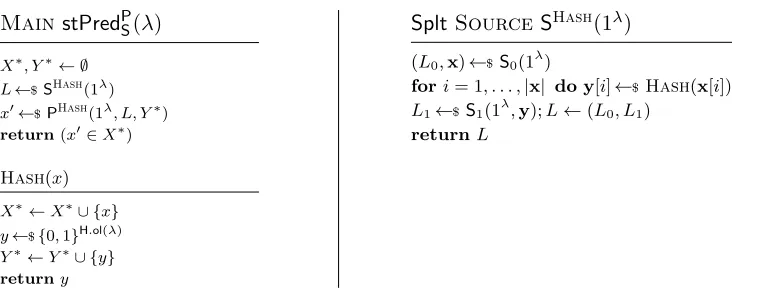
Figure 3: On the left: the strong unpredictability game where the predictor, in addition to the leakage is also given the result of theHashqueries. On the right: the definition of split sources [BHK13b]. A split sourceS=Splt[S0, S1] consists
of two partsS0 andS1 that jointly generate leakageLand neither part gets direct oracle access toHash. Note that the
BFM attack [BFM14] applies to split sources as presented above (see discussion in Section 3.1).
are strongly computationally-unpredictable and which make exactly one oracle query. In Section 3.3 we will show how to extend the construction to allow for an a-priory fixed number of queries by switching to a statistical version of strong unpredictability.
Interestingly, our construction for both cases is basically the same modulo circuit padding. That is, our constructions depend on an obfuscation of a circuit, which in both cases is the same but padded to a different length. A larger but functionally equivalent circuit seems to be necessary to allow for multiple source queries.
We will discuss applications of our constructions in Section 4. In Section 5 we will discuss why our construction does not (seem to) fall pray to the BFM attacks on computationally unpredictable sources [BFM14].
3.1 Strongly Unpredictable and q-Query Sources
We now introduce the precise source restrictions for our upcoming UCE constructions. We define a new restriction that we callstrong unpredictability and which can be seen as either a stronger form of unpredictability or a relaxed version of split sources. Secondly, we consider sources that make only a bounded number of oracle queries.
Strong unpredictability. We consider sources which are strongly unpredictable both in the
computational and in the statistical sense. We denote bySs-cup the class of sources which are strongly,
computationally unpredictable and by Ss-sup the class of strongly, statistically unpredictable sources.
Strong unpredictability is a stronger requirement than unpredictability and we require that the leakage hides queries to Hasheven if the predictor is given the query results. We say that a source Sis called
strongly computationally unpredictable if the advantage of anyPPT predictorP, defined by
AdvstpredS,P (λ) := PrhstPredPS(λ)i,
is negligible, where gamestPredPS(λ) is shown in Figure 3 on the left. For the case of strongly statistically unpredictable sources (Ss-sup) we allow the predictor to be unbounded in its running time, but restrict
the number of oracle queries to be bounded polynomially.
if it can be decomposed into two algorithms S0 and S1 such that neither part gets direct access to
oracleHash. We give the pseudocode of split sources in Figure 3 on the right. In a first step algorithm
S0 outputs a leakage stringL0 together with a vector x. Then, each of the entries inx is queried to
Hashand the results stored in vectory. Finally, the second algorithmS1 is run on vectoryto produce
the second part of the leakageL1.
There is one intricacy with split sources that we discovered when discussing strong unpredictability with Mihir Bellare [Bel14]. S0 outputs a listxthat is then used to generate the input to S1 as
for i= 1, . . . ,|x| do y[i]←$ Hash(x[i])
Asxis alist it allows for duplicate values. This, however, means thatS0 can communicate arbitrary
values toS1 by encoding them using duplicates (e.g., using the two identical values to encode a 0 and
two different values to encode a 1). The result is that the attack due to BFM also applies to split sources. A simple solution to recover split sources is to disallow duplicates in vector x. This yields the following formulation which we henceforth associate with split sources:
SpltSource SHash(1λ)
(L0,x)←$S0(1λ)
fori= 1, . . . ,|x| do if∀j < i:x[j]6=x[i]then
y[|y|+ 1]←$ Hash(x[i])
L1←$S1(1λ,y);L←(L0, L1)
returnL
We note that when considering only single-query split sources, which suffice for the only known application (universal hardcore functions, see Section 4) then both formulations are equivalent.
One can prove that split sources are a (strict) subclass of strongly unpredictable sources, that is,
Ssplt∩ Scup⊆ Ss-cup (and similarly in the statistical case Ssplt∩ Ssup ⊆ Ss-sup). For this note that the
leakage L0 of the first algorithm of a split source is independent of any oracle answers. Similarly, if the
oracle is implemented by a random oracle (which is the case in the unpredictability experiment) then the leakage L1 of the second algorithm is independent of any actual oracle query. The inclusion is strict.
Consider, for example, a source that queriesHashonxto receivey to then outputP RFx(y) that is the
image of a pseudorandom function at point y under key x. For the case of statistical unpredictability consider the source that outputs x⊕y. Both distributions cannot be simulated by a split source. This yields the following lemma:
Lemma 3.1. The class of split sources is a strict subclass of strongly unpredictable sources: Ssplt∩ Scup(Ss-cup and Ssplt∩ Ssup(Ss-sup
We formally prove Lemma 3.1 for the statistical case. The computational case follows analogously.
Proof. We have already seen that there are sources inSs-sup that are not in Ssplt. It thus remains to
show that any source in Ssplt∩ Ssup is also a strongly, statistically unpredictable source. We assume
that we are always in the random oracle setting, that is, Hashis implemented by a random oracle.
Note that this is without loss of generality since membership in Ss-sup is only defined via the strong
unpredictability game which is in the random oracle setting.
Let S = (S0,S1) be a source in Ssplt∩ Ssup and assume there exists a predictor P in the strong
unpredictability game. We construct P0 in the plain unpredictability game. PredictorP0 gets as input leakage L= (L0, L1). It guesses the number of queriesq that were made by sourceS0 and constructs a
vectory0 consisting of q random values of length H.ol(λ). It then runs sourceS1 on input y0 to receive
leakage L01. Finally, it runs predictor P on input ((L0, L01), Y∗) whereY∗ is a random permutation of
Analysis. As the unpredictability game (as well as the strong unpredictability game) is in the random
oracle setting, the simulation of the input for S1 is perfect in caseP0 guesses the correct number of
queries. In this case leakage (L0, L1) and (L0, L01) are distributed identically and the simulation forP
is perfect and hence
AdvpredS,P0(λ) = 1 maxq
· AstpredS,P (λ)
wheremaxq is an upper bound on the maximum number of queries of source S0.
q-query UCE. Our first construction will only admit sources which make exactly one query. We
call such sources single-query sources and denote the corresponding source class by S1-query. We also
consider a relaxed notion to allow for polynomially bounded number of queries for some polynomial
q :=q(λ). We call the corresponding sources q-query sources and denote their source class bySq-query.
We note that sources restricted to a constant number of queries are discussed in [BHK13b].
3.2 A UCE Construction Secure Against Sources in Ss-cup∩ S1-query
We will now present our construction which depending on different assumptions on the existence of point obfuscators will achieve UCE[Ss-cup∩ S1-query]-security or UCE[Ss-sup∩ Sq-query]-security. Note
that depending on the number of supported queries the construction needs to pad the circuit before obfuscating it.
Construction 3.2. Let s:N→N, let Gbe a puncturable PRF and let iO be an indistinguishability
obfuscator for all circuits inP/poly. We define our hash function family H as
H.KGen(1λ)
k←$G.KGen(1λ)
hk←$iO(PAD(s(λ), G.Eval(k,·))) returnhk
H.Eval(hk, x)
C←hk
returnC(x)
where PAD:N× {0,1}∗ −→ {0,1}∗ denotes a deterministic padding algorithm that takes as input an
integer and a circuit and outputs a functionally equivalent circuit padded to length s(λ).4
In other words, the key generation algorithm H.KGen(1λ) runs k ← G.KGen(1λ) and returns iO(G.Eval(k,·)), i.e., an obfuscation of the evaluation circuit of PRF Gwith key khardwired into it. Function H.Eval is basically a universal Turing machine which runs inputx on the obfuscated circuit hk.
Theorem 3.3. IfGis a secure puncturable PRF, if iOis a secure indistinguishability obfuscator and if AIPO exists, then the hash function familyHdefined in Construction 3.2 isUCE[Ss-cup∩S1-query]-secure.
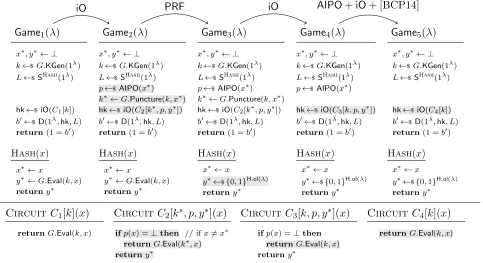
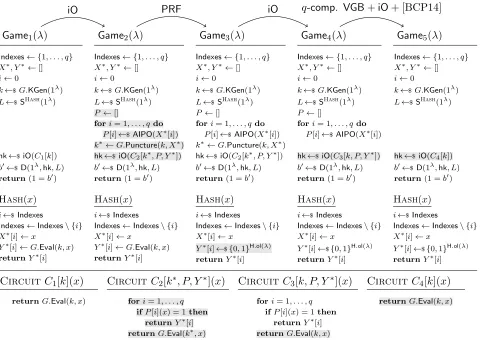
We prove the theorem via a sequence of 5 games (depicted in Figure 4) where gameGame1 denotes
the original UCE[Ss-cup∩ S1-query] game with hidden bitb fixed to 1. We first present the games and
subsequently the analysis of the individual game hops. LetS∈ Ss-cup∩ S1-query.
Game1: The first game is the original UCE[Ss-cup∩ S1-query]-game. Here, the hash key hk is an
obfuscation of the circuit C1[k](x) := G.Eval(k, x) (see Figure 4) where k is a key for the
puncturable PRF.
4
Game1(λ)
x∗, y∗← ⊥
k←$G.KGen(1λ) L←$SHash(1λ)
hk←$iO(C1[k])
b0←$D(1λ,hk, L) return(1 =b0)
Hash(x) x∗←x
y∗←G.Eval(k, x) returny∗
Game2(λ)
x∗, y∗← ⊥
k←$G.KGen(1λ) L←$SHash(1λ)
p←$AIPO(x∗) k∗←G.Puncture(k, x∗)
hk←$iO(C2[k∗, p, y∗])
b0←$D(1λ,hk, L) return(1 =b0)
Hash(x) x∗←x
y∗←G.Eval(k, x) returny∗
Game3(λ)
x∗, y∗← ⊥
k←$G.KGen(1λ) L←$SHash(1λ)
p←$AIPO(x∗) k∗←G.Puncture(k, x∗)
hk←$iO(C2[k∗, p, y∗])
b0←$D(1λ,hk, L) return(1 =b0)
Hash(x) x∗←x
y∗←${0,1}H.ol(λ)
returny∗
Game4(λ)
x∗, y∗← ⊥
k←$G.KGen(1λ) L←$SHash(1λ)
p←$AIPO(x∗)
hk←$iO(C3[k, p, y∗])
b0←$D(1λ,hk, L) return(1 =b0)
Hash(x) x∗←x
y∗←${0,1}H.ol(λ)
returny∗
Game5(λ)
x∗, y∗← ⊥
k←$G.KGen(1λ) L←$SHash(1λ)
hk←$iO(C4[k])
b0←$D(1λ,hk, L) return(1 =b0)
Hash(x) x∗←x
y∗←${0,1}H.ol(λ)
returny∗
CircuitC1[k](x)
returnG.Eval(k, x)
CircuitC2[k∗, p, y∗](x)
ifp(x) =⊥then // ifx6=x∗ returnG.Eval(k∗, x) returny∗
CircuitC3[k, p, y∗](x)
ifp(x) =⊥then returnG.Eval(k, x) returny∗
CircuitC4[k](x)
returnG.Eval(k, x)
iO PRF iO AIPO+iO+ [BCP14]
Figure 4: The games used in the proof of Theorem 3.3 on the top and the used circuits on the bottom. To highlight the changes from game to game we have marked the changed lines with a light gray background color. ByC[k](x) we denote that circuitC depends onk(during construction time) and takesxas input. The arrows above the games indicate the security reduction to get fromGameitoGamei+1.
Game2: Let x∗ be the single query that the source S makes to its Hash oracle and let y∗ :=
G.Eval(k, x∗). Game2 is similar to Game1 except that we puncture the PRF at x∗. Namely, the
hash keyhk does not consist of an obfuscation of C1[k] anymore, but rather of an obfuscation of
the circuit C2[k∗, p, y∗]. The circuits C1[k] andC2[k∗, p, y∗] are functionally equivalent. However,
instead of the normal PRF key,C2 uses a punctured PRF keyk∗ which is punctured at valuex∗
(or equivalently, at all values x wherep(x) = 1). Here,p is computed as the AIPO obfuscation of the point functionpx∗ and hence,p(x) = 1 if and only ifx is equal to the single hash queryx∗ of the source. On input a valuex, circuitC2[k∗, p, y∗] checks whetherp(x) =⊥(i.e., ifx6=x∗): if
so, it returns G.Eval(k∗, x), otherwise it outputs y∗.
Game3: The game is equivalent to Game2 except that oracle Hash now samples y∗ uniformly at
random instead of invoking G.Eval(k, .). Note that C2[k∗, p, y∗] is parametrized byy∗.
Game4: The game is equivalent to the previous game except that now an obfuscation of circuit C3[k, p, y∗] is used as hash keyhk. CircuitC3[k, p, y∗] is identical to circuit C2[k∗, p, y∗], except
that it uses the original PRF keykinstead of the punctured keyk∗. Note that circuitsC3[k, p, y∗]
and C2[k∗, p, y∗] have identical input-output behaviour.
Game5: The game is equivalent to the previous game except that now an obfuscation of circuit C4[k]
is used as hash key hk. Circuit C4[k] is our original circuit again, that is, C4[k](·) :=G.Eval(k,·).
Game5 is our intended target. It is the UCE-security game for our construction in the random
oracle world (that is, oracle Hashimplements a random oracle).
InGame5 we are in an identical setting to the UCE-game with the hidden bit set to 0. That is, the
and C1 are identical, that is they are as in the construction. Thus, we can write the advantage of an
adversary (S,D) in the UCE-security game as
AdvuceS,D,H(λ) = Pr
h
UCESH,D(λ)
b= 1
i
+ Pr
h
UCESH,D(λ)
b= 0
i −1
= PrhGameS1,D(λ)i−PrhGameS5,D(λ)i
≤ 4 X i=1 Pr h
GameSi,D(λ)
i −Pr
h
GameSi+1,D(λ)
i
It remains to show that the individual games are negligibly close.
Game1(λ) to Game2(λ). In order to reduce to the security of the indistinguishability obfuscator
iO, we show that, by construction, the circuitsC1[k] andC2[k∗, p, y∗] compute the same function. If p(x) =⊥, then C2[k∗, p, y∗] returnsG.Eval(k∗, x). Ifp(x) = 1, then x =x∗ and C2[k∗, p, y∗] returns y∗ = G.Eval(k, x∗) = G.Eval(k, x). Hence, on all inputs x, C2[k∗, p, y∗] returns G.Eval(k, x) and so
does C1[k]. Having established that circuits C1[k] and C2[k∗, p, y∗] compute the same functionality,
iO(C1[k]) and iO(C2[k∗, p, y∗]) are indistinguishable and we can bound the difference between games
Game1 and Game2 by the distinguishing advantage against the indistinguishability obfuscatoriO. We
now formalize this intuition.
Firstly, let us externalize some of the variables that the games use and introduce a unified notation for Game1 and Game2. Fori∈ {1,2}, let Gamei[k, r, y∗, k∗](λ) be equal to the gameGamei(λ) where
key k is chosen as PRF key, source S uses randomness r, which defines its single query to Hash,
the result to that query isy∗ and the punctured key is chosen ask∗ (if such a punctured key exists, namely only in Game2). Note that the queryx∗ of the source is well-defined by its randomness. We
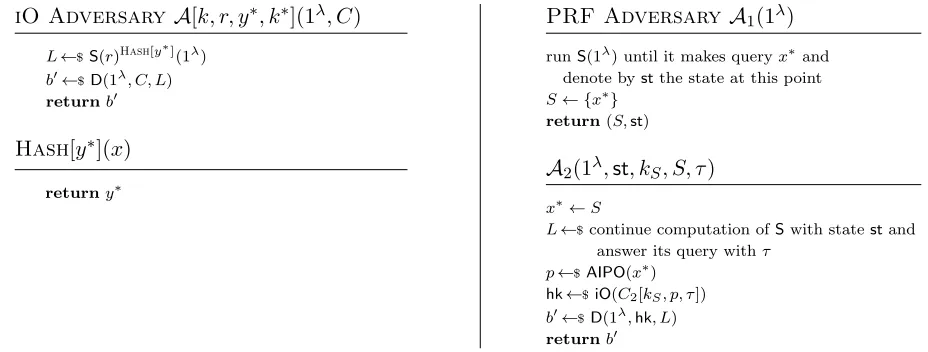
define A[k, r, y∗, k∗](C) to be an adversary against the indistinguishability obfuscator iO that gets a circuit C as input, where C is either an obfuscation of circuit C1[k] or an obfuscation of circuit C2[k∗, p, y∗], wherep is a point obfuscation of the point generated byS with randomnessr. Adversary A[k, r, y∗, k∗](C) runs sourceS(r) to get the queryx∗, returns y∗ on the singleHashquery and receives
leakage L. It then runs distinguisher D on input (1λ, C, L) and outputs whatever D outputs. We
present the pseudo-code of the adversary in Figure 5:
If C =C1[k] then adversary A[k, r, y∗, k∗](C) perfectly simulates game Game1[k, r, y∗](λ) and if C =C2[k∗, p, y∗] then the adversary simulatesGame2[k, r, y∗, k∗](λ). Thus, we can rewrite the difference
between the two games’ distributions
Pr[Game1(λ)]−Pr[Game2(λ)]
as
Ek,r,y∗
h
Pr[Game1[k, r, y∗](λ)] i
−Ek,r,y∗,k∗
h
Pr[Game2[k, r, y∗, k∗](λ)] i
=Ek,r,y∗,k∗
"
Pr[Game1[k, r, y∗](λ)]−Pr[Game2[k, r, y∗, k∗](λ)] #
=Ek,r,y∗,k∗
"
PrhA[k, r, y∗, k∗](1λ,iO(C1[k])) = 1 i
−PrhA[k, r, y∗, k∗](1λ,iO(C2[k∗, p, y∗])) = 1 i
#
=Ek,r,y∗,k∗
h
AdvioiO,A[k,r,y∗,k∗],C
1[k],C2[k∗,p,y∗](λ)
i
≤ max
k,r,y∗,k∗Adv io
iO,A[k,r,y∗,k∗],C
iO Adversary A[k, r, y∗, k∗](1λ, C)
L←$S(r)Hash[y∗](1λ)
b0←$D(1λ, C, L)
returnb0
Hash[y∗](x)
returny∗
PRF Adversary A1(1λ)
runS(1λ) until it makes queryx∗and denote bystthe state at this point S← {x∗}
return(S,st)
A2(1λ,st, kS, S, τ)
x∗←S
L←$continue computation ofSwith statestand
answer its query withτ p←$AIPO(x∗)
hk←$iO(C2[kS, p, τ])
b0←$D(1λ,hk, L) returnb0
Figure 5: Pseudo-code of the iO adversary used in game transition fromGame1toGame2on the left, and the puncturable
PRF adversary used in the transition ofGame2 toGame3 on the right.
By the security of the indistinguishability obfuscator, the advantage of any efficient adversary is negligible and, hence, also maxk,r,y∗,k∗Advio
iO,A[k,r,y∗,k∗],C
1[k],C2[k∗,p,y∗](λ) is negligible.
Game2(λ) to Game3(λ). We reduce the difference between Game2 andGame3 to the security of the
puncturable PRF G. We define an adversary (A1,A2) against the puncturable PRF as follows. On
input the security parameter, adversaryA1 runs sourceS(1λ) on the security parameter. When source S makes its singleHash queryx∗, adversaryA1 stops, outputs {x∗} as puncture set S together with
the current statest of the source S. AdversaryA2 gets as input statest, the punctured keyk∗=kS,
the puncture point{x∗}=S and a target valueτ which is eitherG.Eval(k, x∗) or a uniformly random
value. Adversary A2 uses the source’s state st to continue the simulation of the source S, which
expects an answer from its Hashoracle. The adversaryA2 passes valueτ to Sand receives leakage L. It then constructs an obfuscation p←$ AIPO(px∗) as well as an obfuscation hk←$iO(C2[k∗, p, τ]).
Subsequently, it runs distinguisher Don input (1λ,hk, L) and outputs whateverDoutputs. We give
the pseudo-code of the adversary in Figure 5.
Ifτ =G.Eval(k, x∗), then adversary (A1,A2) perfectly simulatesGame2 and otherwise it perfectly
simulates Game3. Thus, we have that
Pr[Game2(λ)]−Pr[Game3(λ)]≤AdvpG,-prfA1,A2(λ)
which by the security of the puncturable PRFG is negligible.
Game3(λ) to Game4(λ). We show that the circuits C2[k∗, p, y∗] and C3[k, p, y∗] compute the same
function. As the functionality of punctured PRFs is preserved under puncturing, for all x where
p(x) = ⊥, it holds that C2[k∗, p, y∗](x) = G.Eval(k∗, x) = G.Eval(k, x) = C3[k, p, y∗]. For x with p(x) = 1, by definition, both circuits C2[k∗, p, y∗](x) andC3[k, p, y∗] returny∗.
As both circuits are equal,iO(C2[k∗, p, y∗]) andiO(C3[k, p, y∗]) are indistinguishable by the security
of indistinguishability obfuscation. Analogously to the first game hop, we get that
Pr[Game3(λ)]−Pr[Game4(λ)]≤ max k,x∗,y∗,k∗Adv
io
iO,A[k,x∗,y∗,k∗],C
diO SamplerSam(1λ)
x∗, y∗← ⊥
k←$G.KGen(1λ)
L←$SHash(1λ)
p←$AIPO(x∗)
return(C3[k, p, y∗], C4[k], L)
Hash(x)
x∗←x
y∗←${0,1}H.ol(λ)
returny∗
diO Adversary A(1λ, C, L)
b0←$D(1λ, C, L) returnb0
AIPO Adversary B1(1λ)
x∗, y∗← ⊥
L←$SHash(1λ)
k←$G.KGen(1λ) r←${0,1}H.il(λ)
b← hr, x∗i
return(x∗,(b, r, y∗, L))
B2(1λ, b, r, k, L, p)
c← ⊥
τ←$Ext(C3[k, p, y∗], C4[k], L)
ifτ=⊥then c←${0,1}
else ifhr, τi=bthen c←1
elsec←0 returnc
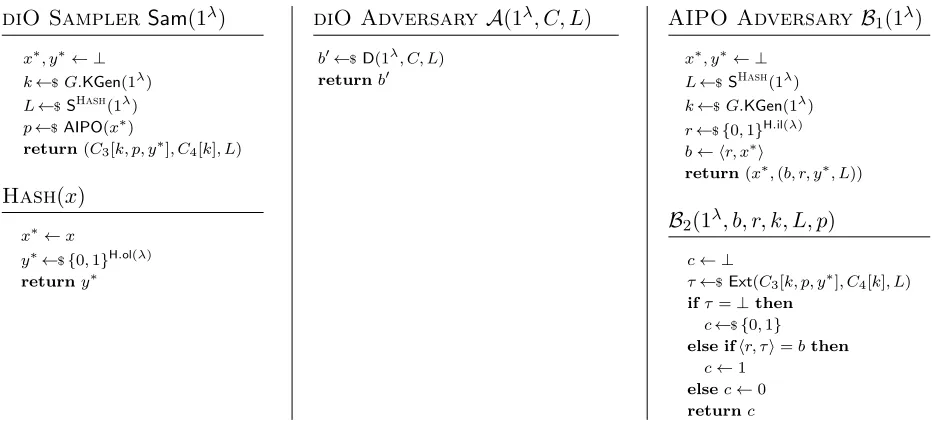
Figure 6: On the left, pseudo-code of the differing-inputs samplerSamthat we use in the transition fromGame3 to
Game4. We present the differing-inputs adversaryAin the middle and the AIPO adversary (B1,B2) on the right. Both of
them are used in the game transition fromGame4 toGame5. Note that theHashoracle given toSin the description of
B1 is equivalent to theHashoracle used by samplerSamon the left.
Game4(λ) to Game5(λ). By construction, the circuits C3[k, p, y∗] and C4[k] only differ on points
wherep(x) is not equal to⊥, that is, they differ on a single point, which is the query point x∗. We will bound the difference between games Game4 and Game5 by the differing-inputs security of the
indistinguishability obfuscator iO. For this, we build on a result by Boyle, Chung and Pass (here given as Theorem 2.5) who show that any indistinguishability obfuscator is also a differing-inputs obfuscator for differing-inputs circuits which differ on at most polynomially many points [BCP14]. As explained above, our circuits differ only on a single point and we can, thus, apply their theorem. In order to argue with the security property of differing-inputs obfuscation, we need to show that the family of circuit pairs (C3[k, p, y∗], C4[k],Sam) is differing-inputs, whereSam is the circuit sampler that runs the
same steps as game Game4 up-to and including the obfuscation of the point functionpx∗, constructs circuits C3[k, p, y∗] andC4[k], and outputs (C3[k, p, y∗], C4[k], L). We give the pseudo-code of sampler
Sam in Figure 6.
Claim 3.4. If AIPO is a secure AIPO obfuscator (see Definition 2.7), then the family of circuit pairs
(C3[k, p, y∗], C4[k],Sam) is differing-inputs.
Before proving Claim 3.4, we show how to use it to prove that the difference betweenGame4(λ)
andGame5(λ) is small. Theorem 2.5 by Boyle et al. [BCP14] says that, if a family is differing-inputs
and only differs on at most polynomially many points, then their indistinguishability obfuscations are indistinguishable. Claim 3.4 establishes that the family (C3[k, p, y∗], C4[k],Sam) is differing-inputs,
and we already observed that circuits C3[k, p, y∗] andC4[k] only differ on a single input value. Hence,
Theorem 2.5 allows us to do an analysis similar to the one from the first game hop. That is, we define adversary Awhich gets as input a circuit C and leakageL whereC is either an indistinguishability obfuscation of circuit C3[k, p, y∗] or of circuit C4[k] as sampled by Sam. It runs distinguisher D on
input (1λ, C, L) and outputs whatever Doutputs. We give the pseudo-code of adversaryA in Figure 6. IfC=iO(C3[k, p, y∗]), then adversaryAperfectly simulates Game4(λ), and ifC =iO(C4[k]), then
it perfectly simulates Game5(λ). Thus, we have