Formal Analysis of Chaumian Mix Nets with
Randomized Partial Checking
∗
Ralf K¨usters
University of Trier
Tomasz Truderung
University of Trier
Andreas Vogt
University of Applied Sciences and Arts,
Northwestern Switzerland
Abstract
Mix nets with randomized partial checking (RPC mix nets) have been introduced by Jakobsson, Juels, and Rivest as particularly simple and efficient verifiable mix nets. These mix nets have been used in several implementations of prominent e-voting systems to provide vote privacy and verifiability. In RPC mix nets, higher efficiency is traded for a lower level of privacy and verifiability. However, these mix nets have never undergone a rigorous formal analysis. Recently, Kahazei and Wikstr¨om even pointed out several severe problems in the original proposal and in implementations of RPC mix nets in e-voting systems, both for so-called re-encryption and Chaumian RPC mix nets. While Kahazei and Wikstr¨om proposed several fixes, the security status of Chaumian RPC mix nets (with the fixes applied) has been left open; re-encryption RPC mix nets, as they suggest, should not be used at all.
In this paper, we provide the first formal security analysis of Chaumian RPC mix nets. We propose security definitions that allow one to measure the level of privacy and verifiability RPC mix nets offer, and then based on these definitions, carry out a rigorous analysis. Altogether, our results show that these mix nets provide a reasonable level of privacy and verifiability, and that they are still an interesting option for the use in e-voting systems.
1
Introduction
The concept of a mix net has been introduced by Chaum [5] as a tool for achieving anonymity. The main application is in electronic voting, but they have also found applications in other domains, such as multi-party computation, payment systems, and anonymous web browsing. The mix nets proposed by Chaum, later calledChaumian mix nets, consist of a sequence
M0, . . . ,Mm−1of mix servers. Each server generates a public/private key pair(pkj,skj)and pub-lishes the public keypkj. So-called senders choose plaintexts to be sent through the mix net. In the context of e-voting, the plaintexts might be the candidates chosen by the senders/voters. Ev-ery sender encrypts her plaintext, saym, under the public keys of all mix servers in the reverse order, i.e., a sender produces a ciphertext of the form: Encpk0(Encpk1(· · ·Encpkm−1(m)· · ·)).
Now, firstM0decrypts all ciphertexts and shuffles the results, thenM1does the same with the
ciphertexts received fromM0, and so on. Eventually, the last mix server,Mm−1, outputs all
not be possible to link the output to the input. In the context of voting, this is important for vote privacy.
Another common form of a mix net is a so-calledre-encryption mix net[20]. Here the mix servers generate a single joint public key for a public-key encryption scheme that allows for random re-encryption and distributed verifiable decryption. Senders encrypt their messages with the public key and the mix servers do not decrypt the ciphertexts but only randomly re-encrypt and shuffle them. (Decryption is performed jointly at the very end of the mixing phase.)
In the context of e-voting, it is crucial that potential manipulations are detected. That is, if plaintexts (votes) have been dropped or manipulated, this should be detected. This property is calledverifiability.
Many constructions have been proposed to obtain verifiable mix nets (see, e.g., [23,19, 7,25,11,12], some of which have been broken [24]). Most of the constructions are quite complex.
A particularly simple and efficient construction is the one proposed by Jakobsson, Juels, and Rivest [11]. They call the new technique they introducerandomized partial checking (RPC), which applies to both Chaumian mix nets and re-encryption mix nets. Roughly speaking, the idea behind RPC is that to check whether or not a mix server cheated, every mix server is supposed to reveal some partial information about the input/output relation. (Which information is to be revealed is randomly chosen and the mix servers should not know it beforehand.) Therefore, a cheating server is caught with some probability. From the design of RPC mix nets it is clear that they do not provide perfect security: there is some non-negligible probability that cheating goes undetected and some partial information about the input/output relation is revealed. As argued in [11], in the context of e-voting the penalties for cheating would be so severe that being caught with some (even small) probability should deter a mix server from cheating. Due to their simplicity and efficiency, RPC mix nets have been used in real implementations of several prominent e-voting systems, including Civitas [6] and Prˆet `a Voter [22]. Some systems, such as Scantegrity [4], have used a similar technique.
In [13], Kahazei and Wikstr¨om have pointed out several severe attacks on RPC mix nets as described in the original work [11] and as implemented in several e-voting systems. They suggest that re-encryption RPC mix nets should not be employed at all, but leave as an open problem to prove or disprove that, with the fixes they suggest, Chaumian RPC mix nets provide sufficient security. Kahazei and Wikstr¨om mention that carrying out such a proof and even coming up with useful security notions for privacy and verifiability is challenging, considering that in any case RPC mix nets can provide restricted forms of privacy and verifiability only.
Given the simplicity, efficiency, and importance of Chaumian RPC mix nets, this is an interesting and practically relevant open problem, for which we provide answers in this paper. More specifically, the contributions of this work are as follows.
Contribution of this paper. Based on work by K¨usters et al. in [15,16], we propose security
definitions which allow one to precisely measure the level of privacy and verifiability Chaumian RPC mix nets provide. As mentioned before, being able to measure the level of security is crucial for RPC mix nets since they are not perfect. Our definitions should be applicable also to other kinds of mix nets.
Since mix nets are mainly used in the context of e-voting, our notion of privacy corresponds to one that has been used in the context of e-voting before [16]. It focuses on the level of privacy for individual senders/voters and basically requires that for every pair of messages an adversary should not be able to tell which of two messages a sender has sent.
specific misbehaving parties can be blamed. This property, which is expected from RPC mix nets, is important in order to deter parties from misbehaving.
We study Chaumian RPC mix net both w.r.t. in-phase and post-phase auditing. Post-phase auditing means that it is checked at the very end of the mixing phase only whether or not the mix servers behaved correctly. For in-phase auditing, the auditing is done for every mix server immediately after it has produced its output.
In RPC mix nets, manipulation of inputs of honest senders might give adversaries (mali-cious mix servers) leverage for breaking privacy. But, as mentioned, if a mix server is caught cheating it might face severe penalties. To be able to study this trade-off (the risk of being caught and the information gain), besides general (venturesome) adversaries who do not mind being caught, we also introduce the concept ofrisk-avoiding adversaries, i.e., adversaries who cheat only if there is no risk of being caught.
For our analysis of accountability and privacy of Chaumian RPC mix nets we make standard cryptographic assumptions. We assume the public key encryption scheme to be IND-CCA2-secure [1] and the commitment scheme used in such mix nets to be perfectly hiding and computationally binding, with Pedersen commitments being an example [21]. (However, a computationally hiding scheme would be sufficient.) As usual for Chaumian RPC mixnets, we require that the public key encryption scheme allows for proofs of correct decryption.
In our analysis of accountability, we discovered an attack which does not seem to have been described in the literature before. While one of the most effective attacks on accountabil-ity/verifiability, it does not further decrease the overall level of security of RPC mix nets. We prove that altogether Chaumian RPC mix nets have a quite good level of accountability, no matter whether in-phase or post-phase auditing is performed. This proves, in particular, that there are no worse attacks on accountability/verifiability than those already known.
As for the level of privacy, it matters whether post-phase or in-phase auditing is performed and whether adversaries are venturesome or risk-avoiding. In the case of in-phase auditing, our results indicate that the level of privacy is very close to the ideal case (where an adversary only learns the plaintexts of the senders after ideal mixing), surprisingly even for venturesome adversaries that are prepared to be caught cheating for sure. In the case of post-phase auditing, such adversaries can, however, break privacy completely. It is quite unlikely though that adversaries are venturesome, at least in the context of e-voting, given the negative consequences such adversaries would have to face. Also, our results show that if an adversary cheats in order to (even only very slightly) increase his advantage in breaking privacy, he will be caught with probability14and this probability grows rapidly if the adversary wants to further increase his chances of breaking privacy.
We note that no rigorous formal analysis of RPC mix nets has been carried out be-fore. In particular, none that provides formal security guarantees for privacy or verifiabil-ity/accountability. As mentioned, Kahazei and Wikstr¨om [13] point out and discuss attacks. In [8], the authors study the distance between the probability distribution of the permutation links in RPC mix nets and the uniform distribution, however, as also pointed out in [13], this result does not capture privacy or verifiability of RPC mix nets.
Structure of this paper. In Section2, we describe Chaumian RPC mix nets and present our
2
Chaumian RPC Mix Net
In this section, we recall the definition of a Chaumian mix net with randomized partial checking [11], aChaumian RPC mix net(or anRPC mix netfor short), and then provide a formal model of this protocol.
We focus here on a variant where duplicates are eliminated before every mixing stage. As noted in [13], duplicate elimination is necessary to prevent a serious attack on privacy. We therefore need to fix some details of the procedure of duplicate elimination (see below).
We will consider two variants of the protocol, already mentioned in [11]: i)in-phase auditing, a variant where auditing takes place as soon as a mix server produced its output and ii)post-phase auditing, where auditing takes place only at then end of the mixing phase, i.e., when the last mix server has output its result. While, as we will see, the two variants do not make a difference for verifiability/accountability, they differ in the level of privacy they provide.
2.1
Description of the Protocol
Set of participants. The set of participants of the protocol consists of a public,
append-onlybulletin boardB,n sendersS1, . . .Sn,m mix serversM0, . . . ,Mm−1, and some number of
auditors.
The role of the auditors is to provide randomness for the auditing phase. The auditors each output a random bit string (more precisely, they first commit to their random bit strings and later open the commitments). Honest auditors output a bit string chosen uniformly at random. These bit strings are combined to one bit string, say by XOR. So, if at least one auditor is honest, the resulting bit string is chosen uniformly at random. We will indeed assume, both for verifiability/accountability and for privacy, that at least one auditor is honest. We note that sometimes heuristics are implemented by which this assumption can be dropped (see [11]). However, as pointed out in [13], especially in the case of in-phase auditing, this leads to problems.
Typically, pairs of mix servers are audited. For the sake of presentation, it is therefore convenient to assume that one mix server performs two mixing steps. We will consider such mix servers in this paper.
Now, an RPC mix net consists of the following phases: setup, submit, mixing, and auditing, where as mentioned before, auditing might be in-phase. Chaumian RPC mix nets require a public-key encryption scheme and a commitment scheme. The precise assumptions required for these schemes are formulated later in this paper.
Setup phase. In this phase, every mix serverMj,j∈ {0, . . . ,m−1}, invokes the key
genera-tion algorithm of a public key encrypgenera-tion scheme in order to generate two pairs of public/private keys. We denote the public keys bypk2jandpk2j+1and the corresponding private keys by
sk2jandsk2j+1. The public keys are posted on the bulletin boardB. Note that, altogether, the
mix servers publish 2mpublic keys,pk0, . . . ,pk2m−1, onB.
Submit phase. In this phase, every (honest) senderSi chooses her input plaintextmi and
performs the following computation. She first encryptsmi under pk2m−1, resulting in the
ciphertextα2im−1. Then, she encryptsαi2m−1underpk2m−2, resulting in the ciphertextαi2m−2,
and so on. In the last step,αi
1is encrypted under pk0, resulting in the ciphertextαi0. This
ciphertext is posted by the sender onBas her encrypted input.
Mixing phase. The sequenceC0=α10, . . . , αn0of the encrypted messages posted by the senders
onBis the input to the mixing phase. In what follows, we refer toαi0byC0[i]; similarly for
x1
x2
x3
x4
x4
y1
y2
y3
y4
Mix server Mj
duplicate elimination
first mixing second mixing C2j
C20j sk2j C2j+1 C2j+2
π2j
sk2j+1 π2j+1
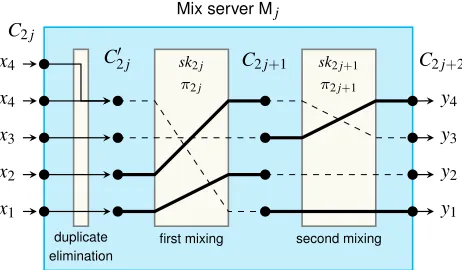
Figure 1: Mixing byMj. Solid bold lines represent audited links and dashed lines represent not audited links.
them, as described below, and posts its output (which, again, is a sequence of ciphertexts) on
B. This output becomes the input to the next mix serverM1, and so on. We will denote the
input to the j-th mix server byC2jand its output byC2j+2, reservingC2j+1for intermediate
output (see Figure1). Recall that one mix server performs two mixing steps.
The outputC2mof the last mix serverMm−1is the output of the protocol. It is supposed to
contain the unencrypted input messagesm1, . . . ,mn(in random order). The steps taken by every mix serverMjare as follows (see also Figure1):
1. Duplicate elimination.Mjremoves all duplicates from its inputC2j, leaving only one copy each. The mix server also removes all messages⊥, indicating decryption failures, from its input. We denote the resulting sequence byC20j. In what follows, we denote byl≤nthe number of messages left inC20j.
2. First mixing.Mjuniformly at random chooses a permutationπ2jof{1, . . . ,l}and posts the sequenceC2j+1onB, whereC2j+1[i]is the result of the decryption ofC20j[π2j(i)]under the private keysk2j. Note that, depending on the encryption scheme, decryption may fail, if the input is not a valid ciphertext. Hence,C2j+1[i]might be⊥.
3. Second mixing.Mj, again, uniformly at random chooses a permutationπ2j+1of{1, . . . ,l}
and posts the sequence C2j+2 on B, where C2j+2[i] is the result of the decryption of
C2j+1[π2j+1(i)]under the privatesk2j+1. The sequenceC2j+2is posted by Mj onB. It is the input to the next mix server.
4. Posting commitments. Mj posts two sequences of commitments onB: commitments to the valuesπ2j(1), . . . , π2j(l)and commitments to the valuesπ2−j1+1(1), . . . , π
−1
2j+1(l)(in this
order).
We note that the duplicate elimination is performed only on the inputC2jto the mix server, not on the intermediate sequenceC2j+1. This simplifies the auditing.
Auditing phase. The outputs of the mix servers are (partially) audited in order to detect
potential misbehavior. As mentioned before, we consider in-phase and post-phase auditing. In-phase auditing is performed for every mix serverMjimmediately after it has posted its outputC2j+2and the commitments onB. In the case that misbehavior is detected, the output
is finished. However, the steps taken for every individual mix server are the same for both types of auditing. We now describe the auditing for the mix serverMj.
First, using the randomness produced by the auditors, for an initial empty setIjand for everyi∈ {1, . . . ,l}it is randomly decided, independently of other elements, whetheriis added toIj⊆ {1, . . . ,l}or not. Provided that the random bit strings jointly produced by the auditors are distributed uniformly at random, the probably thatibelongs toIjis12.
Now, for everyi∈ {1, . . . ,l}the mix serverMjdoes the following, depending on whether ibelongs toIjor not:
Ifi∈Ij, then the mix serverMjis supposed to open (by posting appropriate information on
B) the left link fori, i.e.,Mjis supposed to open itsi-th commitment from its first sequence of commitments, which should be a commitment on the valueπ2j(i). The mix server also has to post a (non-interactive zero-knowledge) proof demonstrating that indeedC2j+1[i]is obtained
by decryptingC20j[π2j(i)]usingsk2j.
Ifi∈/Ij, then, symmetrically, the mix server is supposed to open the right link fori, i.e.,
Mjis supposed to open itsi-th commitment from its second sequence of commitments, which should be a commitment on the valueπ−2j1+1(i). As before, the mix server also has to post a proof that allows an observer to verify that indeedC2j+2[π−2j1+1(i)]is obtained by decrypting
C2j+1[i]usingsk2j+1.
An observer (or a judge) can now verify correctness of the data output byMjin the audit phase. First, the observer verifies that indeed all duplicates have been removed from the input (by checking whether the number of messages output byMjis as expected). Second, one verifies that commitments are opened correctly. Third, one verifies that the opened indices (both from the first and the second sequence) do not contain duplicates (if they do, this means that the mix server has not committed to a permutation, but to some other, non-bijective function). Finally, one verifies the decryption proofs. As pointed out in [13], the third step, which often has been omitted in implementations and is not mentioned in [11], is crucial for verifiability and privacy.
The auditing described above guarantees that for a message from the sequenceC2j+1either
the connection to some message fromC2jor to some message fromC2j+2is revealed, but never
both. Otherwise, an observer could follow the path of an input message to the corresponding output message (see also Figure1for an illustration). Nevertheless, some information about the link between the input and the output is revealed. For example, in Figure1an observer knows that the input valuesx1,x2map toy2,y3in some way and thatx3,x4map toy1,y4in
some way, and hence, for instance, she learns thatx4does not map toy2ory3.
2.2
Modeling Chaumian RPC Mix Nets
We now provide a formal model of Chaumian RPC mix nets, based on a computational model with interactive Turing machines. The computational model follows the one used in [15,16], which we briefly recall before presenting the model of RPC mix nets and which in turn is based on the IITM model [14,18].
2.2.1 The Computational Model
may send a message to another program via a channel. This program then becomes active and after some computation can send a message to another program, and so on. A process contains a master program, which is the first program to be activated and which is activated if the active program did not produce output (and hence, did not activate another program). If the master program is active but does not produce output, a run stops.
We write a processπasπ=p1k · · · kpl, where p1, . . . ,plare programs. Ifπ1andπ2are
processes, thenπ1kπ2is a process, provided that the processes are connectible: two processes
areconnectibleif common external channels, i.e., channels with the same name, have opposite directions (input/output).
A processπwhere all programs are given the security parameter`is denoted byπ(`). The processes we consider are such that the length of a run is always polynomially bounded in`. Clearly, a run is uniquely determined by the random coins used by the programs inπ.
Based on the notion of programs and processes, protocols and instances of protocols are defined as follows.
Aprotocol Pspecifies a set of agents (also called parties or protocol participants) and the channels these agents can communicate over. Moreover,Pspecifies, for every agenta, a set
Πaof all programs the agentamay run and a program ˆπa∈Πa,the honest program of a, i.e., the program thataruns ifafollows the protocol.
LetP be a protocol with agentsa1, . . . ,an. Aninstance of Pis a process of the form
π= (πa1k. . .kπan)withπai∈Πai. An agentaiishonestin the instanceπ, ifπai =πˆai. A run of P(with security parameter`) is a run of some instance ofP(with security parameter`). An agentaiis honest in a runr, ifris a run of an instance ofPwith honestai.
Apropertyγof Pis a subset of the set of all runs ofP. By¬γwe denote the complement ofγ.
As usual, a function f from the natural numbers to the interval[0,1]isnegligibleif, for everyc>0, there exists`0such that f(`)≤`1c, for all` > `0. The function f isoverwhelming
if the function 1−f is negligible. A function f isλ-boundedif, for everyc>0 there exists`0
such thatf(`)≤λ+`1c, for all` > `0.
2.2.2 Chaumian RPC Mix Nets Modeled as Protocols
We model an RPC mix net as a protocol in the sense of Section2.2.1. The set of agents of such a protocol is as introduced in Section2.1plus two additional agents, thejudgeJand the schedulerSch.
The programs of all agents are defined to have channels between each pair of agents. While not all channels are necessarily used by honest agents, they may be used by dishonest agents.
Scheduler. The honest program ˆπSchof the scheduler will be the master program. It triggers
all agents in the appropriate order, according to the phases. It is part of every instance of the protocol and we assume that it is given information about which agents are honest and which are dishonest in order to schedule the agents in the appropriate way. In particular, the scheduler can schedule agents in a way advantageous for the adversary (dishonest agensts) so that we obtain stronger security guarantees. For example, the scheduler would first schedule honest senders to post their inputs on the bulletin board and then schedule dishonest senders. By this, the input of dishonest senders (the adversary) may depend on the input of honest senders. We also let ˆπSchcreate a common reference string (CRS), by calling theSetupalgorithm of
the non-interactive zero-knowledge proof system used, and provide it to all parties. The CRS is used by agents for non-interactive zero-knowledge proofs of correct decryption (see also Section4.2and AppendixA.3).
received from an agent is stored in a list along with the identifier of the agent who posted the message. On request,Bsends this list to an agent.
Auditors. For simplicity of presentation, we will simply assume one honest auditorA. The
honest program ˆπAofA, whenever triggered by the scheduler posts its random output on the
bulletin board, as described in Section2.1.
Sender. The honest program ˆπS of a senderSimplements the procedure described in
Sec-tion2.1: when triggered by the scheduler it first randomly picks a plaintext paccording to some fixed probability distributionµand then encryptspas described and posts the resulting ciphertext on the bulletin board.1The honest program that is executed oncephas been chosen is denoted by ˆπS(p). As we will see,µdoes not play any role for accountability, in which
case we could simply assume the input to be provided by the adversary; this distribution, however, matters for our privacy result. It models prior knowledge of the adversary about the distribution of messages that honest senders send. In reality, in the context of e-voting, the adversary might not know this distribution precisely (only estimates according to election forecasts, for example). But assuming that the adversary knows this distribution precisely only makes the security guarantees that we prove stronger.
Mix server. The honest program ˆπMj of a mix server implements the procedure describe
in Section2.1. When triggered for the first time by the scheduler, it performs the described mixing procedure. It then waits to be triggered again by the scheduler to run the described audit procedure.
Judge. The honest program of the judge ˆπJwhenever triggered by the scheduler, reads data
from the bulletin board and verifies it as described in Section2.1. If a mix serverMiprovides wrong output or if it simply declines to output the required data, the judge posts a message
dis(Mi), asserting thatMimisbehaved, i.e.,Mihas not followed the prescribed protocol.
Trust assumptions. We assume that the scheduler, the bulletin board, the auditor, and the
judge are honest. Formally, this means that the setΠaof each such agentaconsist of only the honest program ˆπaof that agent. All the other agents can (possibly) be dishonest. For a dishonest agenta, the set of its programsΠacontains all probabilistic polynomially-bounded programs.
We denote RPC mix nets modeled as above with mmix servers andn senders that use a probability distributionµto determine their choices byPmix(n,m, µ). To study privacy, by
Pmixj (n,m, µ)we denote the variant of the protocol, where the j-th mix server is assumed to be honest (which, again, formally means that the set of all programs ofMj contains its honest program only).
3
Defining Accountability and Verifiability of RPC Mix Nets
In this section, we provide a definition of accountability for RPC mix nets, followed by a definition of verifiability. These notions are instantiations of the general, domain independent definitions of accountability and verifiability proposed in [15]. They should also apply to other forms of mix nets.
The (general) definition of accountability of a protocol from [15] is stated with respect to a propertyγof the protocol, called thegoal, a parameterλ∈[0,1], and an agentJof the protocol who is supposed to blame protocol participants in case of misbehavior (when the goalγ is not achieved). The agentJ, sometimes referred to as ajudge, can be a “regular”
1We will always assume that all plaintexts chosen by (honest) senders have the same length. This assumption is
protocol participant or an (external) judge, who is provided with information by other, possibly untrusted, protocol participants. Informally speaking, accountability requires two conditions to be satisfied:
(i) (fairness)J(almost) never blames protocol participants who are honest, i.e., run their honest program.
(ii) (completeness) If, in a run, the desired goalγof the protocol is not met—due to the misbehavior of one or more protocol participants—, thenJblames those participants who misbehaved, or at least some of them individually. The probability that the desired goal is not achieved butJnevertheless does not blame misbehaving parties should be bounded byλ.
To instantiate this definition for RPC mix nets, we first specify the goalγand the parties who should be blamed in caseγis not achieved in a run. We then present the formal definition of accountability for mix nets, along the lines of the general definition of accountability from [15] sketched above.
The goal. As far as accountability (also verifiability) is concerned, we expect from an
RPC mix net that the output strictly corresponds to the input, i.e., the plaintexts in the input ciphertexts and the plaintext in the output of the mix net should be the same multisets of plaintexts. This, of course, can be guaranteed for honest senders only, as dishonest parties may not follow the protocol and it might not even be clear what their input plaintexts are. Below, we formally describe this goal as a set of runsγ0. Moreover, we generalize this goal by
considering a family of goalsγk, fork≥0, whereγkis achieved if the output corresponds to the input, up tokchanged entries. In other words, for the goalγkwe tolerate up tokchanges. This is useful for the study of RPC mix nets because, due to the nature of random partial checking, changing a small number of entries can go unnoticed with some probability. However, this probability should decrease very quickly with an increasing number of manipulated entries.
To formally specify the goalγk, let us consider a runrof an instanceπof an RPC mix net Pwithnsenders. Lets1, . . . ,sl(forl≤n) be those senders that are honest inr,~x=x1, . . . ,xl be the input of these senders inr, and~y=y1, . . . ,yp(withp≤n) be the output of the mix net inr(if any), i.e., the sequence of plaintexts posted by the last mix server. We definerto belong toγk(in other words,γkis achieved inr), if there exists a subsequence~x0of the honest input~xof sizel−ksuch that~x0, treated as a multiset, is contained in~y(again, treated as a multiset), i.e., for each elementaof~x0, the count ofain~x0is less than or equal to the count ofain~y. Hence, we require the output to containl−kelements from the honest input, while the remaining plaintexts, up ton−(l−k), can be provided by the adversary. If inrno final output was produced (possibly because a mix server refused to produce output or the process was stopped because in in-phase auditing some mix server was blamed to have misbehaved), thenrdoes not belong toγk, i.e.,rdoes not achieveγk.
Parties to be blamed. We require that if the goalγkis not achieved, then the judge should
blame at least one mix server, i.e., postdis(Mi)for at least onei. By the fairness property for accountability, it follows that at least this mix server definitely misbehaved. By this, every mix server risks to be blamed in the case it misbehaves, i.e., does not follow the prescribed protocol. Note that we do not require the judge to blameallmisbehaving servers. This requirement would be too strong, because not all misbehavior (i.e., deviations from the prescribed protocol) can be detected by the judge. However, the above guarantees that at least one mix server is (rightly) blamed in the case thatγkis not achieved. The above requirement also implies that a sender cannot spoil the goalγk: ifγkis not achieved, this must be due to a misbehaving mix server.
In the following definition of accountability for mix nets we say that if the judge posts
πof a protocolP, we say that a verdictdis(a)is true inπif and only ifais not honest inπ(in the sense of Section2.2.1).
Now formally, accountability for RPC mix nets is defined as follows. We note that while this definition is formulated for RPC mix nets as introduced in Section2.2.2, it should be useful also for other forms of mix nets. We writePr[π(`)7→J:dis(a)]to denote the probability
that in a run ofπ(`) the judge Jstates the verdictdis(a). We writePr[π(`)7→ ¬γ
k∧ ¬(J:
dis(Mi)for somei)]to denote the probability that in a run ofπ(`)the goalγkis not satisfied, i.e., the run does not belong toγk, and neverthelessJdoes not state a verdictdis(Mi)for anyi. Both probabilities are taken over the runs ofπ(`), i.e., the random coins used by the agents in
π.
Definition 1. (Accountability for RPC mix nets)LetPbe an RPC mix net protocol with
an agentJ(the judge),λ∈[0,1], andk≥0. We say thatP providesλ-accountability with tolerance k (and w.r.t. J), if the following two conditions are satisfied.
(i) (Fairness) For all instancesπofPand all verdictsdis(a)which are not true inπ, the probabilityPr[π(`)7→J:dis(a)]is a negligible function in`.
(ii) (Completeness)
For every instanceπofP, the probabilityPr[π(`)7→ ¬γk∧ ¬(J:dis(Mi)for somei)]is a
λ-bounded function in`.
The above definition requires that the judge never (more precisely, only with negligible proba-bility) blames mix servers that behave honestly, i.e., run their honest program. It also requires that the probability that the goalγkis not satisfied, and hence, more thankinputs of honest senders have been manipulated, but the judge nevertheless does not blame any single mix server, is bounded byλ.
Of course, mix nets where 0-accountability with tolerance 0 is achieved are desirable, i.e., mix nets, where even one manipulation of an honest input goes unnoticed with only negligible probability. While such mix nets can be obtained with more complex cryptographic constructions (some of which have been mentioned in the introduction), it is in the nature of RPC mix nets that there is some probability that manipulation goes unnoticed. One main contribution of this work is to precisely measure the level of accountability/verifiability RPC mix nets provide, and hence, with regard to the above definition, to find the optimal values of
λfor the goalsγk. This analysis is carried out Section4.
Verifiability. Accountability and verifiability are tightly related as shown in [15].
Account-ability is a stronger property than verifiAccount-ability and subsumes it. While for verifiAccount-ability one requires protocol participants to be able to see whether something went wrong or not, account-ability additionally demands that if something went wrong, it is possible to blame specific misbehaving parties. This is an important security property in practice. Mix nets and e-voting systems should strive for accountability rather than only for verifiability. Nevertheless, tradi-tionally, in the context of e-voting, the focus has been on verifiability, which is why here we also present a definition of verifiability for mix nets, based on the general, domain independent definition proposed in [15]. Similarly to the definition of accountability, the definition of verifiability is parametrized by the goalγk(defined just as in the case of accountability) and assumes a judgeJwhich in the case of verifiability merely outputsacceptorreject, depending on whether she thinks that the goal is achieved or not.
Definition 2. (Verifiability for RPC mix nets)LetPbe an RPC mix net protocol with an
agentJ(the judge),λ∈[0,1], andk≥0. We say thatP isλ-verifiable w.r.t. J and tolerance k, if the following two conditions are satisfied.
(i) For all instancesπofPwhere all mix servers are honest, the probabilityPr[π(`)7→J:
p1
p2 p4
p1
p3
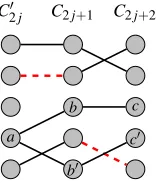
Figure 2: Examples of cheating by the last mix server (left-hand side) and by any mix server (right-hand side).
(ii) For every instanceπofP, the probabilityPr[π(`)7→ ¬γk∧J:accept]is aλ-bounded function in`.
Condition (ii) say that the probability that in a run the goal is not satisfied butJnevertheless accepts the run should be small (bounded byλ). This condition can easily be satisfied by judges that do not accept any run. Condition (i) therefore requires that if all mix servers are honest, then the judge should accept the run, which together with Condition (ii) implies that (with high probability) the goal is satisfied. It follows from results shown in [15] that if an RPC mix net providesλ-accountability with tolerancekand w.r.t. a judgeJ, then the RPC mix net also providesλ-verifiable with tolerancekand w.r.t.J0, whereJ0outputsrejectifJwould blame some party.
We note that for RPC mix nets every party (also external observers) can play the role of the judge, who needs to examine publicly available information only.
4
Analysis of Accountability of the Chaumian RPC Mix
Nets
In this section, we provide formal results for the level of accountability (and hence, verifiability) Chaumian RPC mix nets provide. As already mentioned in the introduction, this is the first rigorous analysis of accountability/verifiability for Chaumian RPC mix nets in the literature. We start, in Section4.1, with a description of some attacks on the accountability/verifiability of Chaumian RPC mix nets. We then present our formal results, which show that these mix nets have a reasonable level of accountability/verifiability. In particular, they show that there are no worse attacks than those described in Section4.1.
4.1
Attacks
The most obvious way in which a mix server can cheat is when it replaces the result of the decryption of an input ciphertext by another ciphertext (or another plaintext in the case that the last mix server cheats in its second mixing step). If the mix server does not lie about the permutation it used, then this kind of cheating is (not) detected with probability12. If the mix server cheats in this way fork+1 input ciphertexts at the same time (and hence, would violate
γk), its probability of not being caught is(12)k+1. Of course, all dishonest mix servers could
cheat in this way.
However, there are more subtle ways of cheating which result in dishonest mix servers being caught less likely.
Cheating by the last mix server. This attack does not seem to have been described before in
that the last mix server outputs the final plaintexts. The idea of the attack is that if after the first mixing step performed by the last mix server for two different positionspandq(marked gray on the left-hand side of Figure2) the ciphertextsC2m−1[p]andC2m−1[q]decrypt to the
same plaintexts (the last mix server knows this), it, instead of committing toπ−2m1−1(p)and
π2−m1−1(q), respectively, commits to, say,π−2m1−1(p), for both pandq. Then, the plaintext at positionqcan be replaced by any other plaintext, and hence, the mix server can replace one plaintext by a plaintext of it’s choice. This way of cheating is detected only if bothp∈/Im−1
andq∈/Im−1, because in this case only it would be visible that the mix server did not commit
to a permutation in its second sequence of commitments. The probability for this is14. Hence, the probability that this way of cheating goes undetected is 34. Of course, the last mix server can apply this attack on different pairs of ciphertexts that decrypt to the same plaintext in order to replace many plaintexts. Applied tok+1 different pairs of ciphertexts results in the violation ofγkand this remains undetected with probability(34)k+1.
This problem could be fixed, for example, as follows: i) require honest senders to add a nonce to their plaintext in order to avoid clashes between plaintexts, or ii) add another level of encryption (where for this last layer of encryption no mixing is performed, only decryption). However, these fixes do not improve the level of accountability RPC mix nets provide, as there are other, equally harmful attacks (like the following one).
Cheating by any mix server. This attack, which seems to have been sketched already in
[13] and is illustrated on the right-hand side of Figure2, can be applied to the first mixing step of any mix server. The idea is that a mix serverMj for two positions pandq in its intermediate sequenceC2j+1of ciphertexts sets bothC2j+1[p]andC2j+1[q]to be the decryption
ofC02j[π2j(p)](an honestMjwould setC2j+1[q]to be the decryption ofC02j[π2j(q)]). Moreover, in its first sequence of commitments, both at positionspandqit commits to the valueπ2j(p) (an honestMjwould at positionqcommit toπ2j(q)).
Now in the duplicate elimination phase, performed by the next mix server after the second mixing step ofMj, ifj<m−1, one of the two copies of the result of the decryption ofC2j+1[p]
will be removed (on the right-hand side of Figure2, one of the gray nodes in the rightmost column). As a result, one of the input ciphertexts fromC20jis dropped (the black node in the example).
Analogously to the previous attack, this attack can be detected with probability14, because detection requires that bothpandqbelong toIj. As before, one mix server can apply this attack for multiple pairs of positions and it can also be performed by many mix servers in order to manipulate (in this case drop) many input ciphertexts. Performing the attack onk+1 different pairs of ciphertexts (by the same mix server or different mix servers) results in the violation ofγkand this remains undetected with probability 34
k+1
.
This seems to be an inherent problem for RPC mix nets, without an obvious fix.
4.2
Formal Analysis of Accountability of the Mix net
We now state and prove the precise level of accountability/verifiability Chaumian RPC mix nets have. While from the above it is clear thatλk, i.e., the probability of more thankmanipulations going unnoticed, may be as high as(34)k+1, we prove that the probability is not higher, and
hence, there are no worse attacks.
Recall from Section2.2.2that we assume that the scheduler, the judge, the auditor, and the bulletin board are honest. However, none of the mix servers nor the senders are assumed to be honest.
Security assumptions. We make the following assumptions about the cryptographic
hiding, with Pedersen commitments being an example [21]. (However, a scheme that is only computationally binding and hiding would do as well.) For the public-key encryption scheme, we assume it to be randomized such that for every plaintext in the domain of the scheme the probability of producing two identical ciphertext when encrypting the plaintext twice under the same public-key is negligible. This property is satisfied, for example, by all IND-CPA secure schemes. (Later, for privacy, Section6, we will require an IND-CCA2 secure public key encryption scheme. But for accountability IND-CCA2 security is not necessary.) For the public key encryption scheme we, as usual, also assume that mix servers can provide proofs of correct decryption. More specifically, we require a non-interactive zero-knowledge (NIZK) proof of correct decryption, i.e., a NIZK proof that, for input of the form(m,c,pk), proves the statement∃sk:(pk,sk)∈K∧Decsk(c) =m, whereKdenotes the set of all public/private key pairs the key generation algorithm of the public key scheme can produce. For this, as already mentioned in Section2.2, all parties are provided with a CRS by the scheduler. Note that an honest mix server knows the secret keyskrelated to its public keypk, and hence, can prove the above statement. Also observe thatmmight be⊥, in which case the statement states failure of decryption. To prove accountability, the zero-knowledge property is actually not needed (only completeness and soundness). But to prove privacy, we need the ZK property as well.
Now, the following theorem holds for Chaumian RPC mix nets as modeled in Section2.2 for both in-phase and post-phase auditing.
Theorem 1. Under the above assumptions concerning the cryptographic primitives, Chaumian
RPC mix nets provideλk-accountability with tolerance k, whereλk= 34k+1
, and they do not provideλ-accountability for anyλ < λk, i.e.,λkis optimal.
This theorem implies that even if all mix servers are dishonest, the probability that more thank inputs of honest voters have been manipulated, but the judge nevertheless does not blame any mix server, is bounded by 34k+1. For example, the probability that more than 5 manipulations go undetected is less than 18% and 10 manipulations go undetected in less than 4.5% of the cases. Moreover, if manipulation is detected, at least one mix server is blamed (and rightly so) for its misbehavior. As explained in Section3, Theorem1also immediately implies that Chaumian RPC mix nets enjoyλk-verifiability with tolerancek.
In the proof of Theorem1(see AppendixBfor a proof sketch), we show that the attack described above (cheating by any mix server) is an optimal strategy. Every other way of cheating does not give a better or more effective way of manipulating the result.
5
Defining Privacy of RPC Mix Nets
In this section, we propose a definition of privacy that is suitable for RPC mix nets in that it allows one to measure the level of privacy a protocol provides. The ability to measure the level of privacy is important in the context of RPC mix nets because such protocols do not achieve perfect privacy: the adversary can learn information from a protocol run and therefore it is essential to be able to precisely tell how much he can learn.
her honest program. While this definition is quite strong (see, e.g., the discussion in [2]), simulation-based definitions [12] are stronger (see also [3] for a related game-based definition). Roughly speaking, simulation-based definitions imply that an adversary should not be able to distinguish between two (different) vectors of honest inputs. However, as explained at the end of Section2.1, in the case of RPC mix nets an adversary obtains partial information about how the input is mapped to the output, and hence, RPC mix nets do not satisfy such simulation-based definitions.2Nevertheless, this does not necessarily mean that RPC mix nets
do not do a reasonably good job in hiding which specific message an individual honest sender sent. This security requirement corresponds to the central property in the context of e-voting, already sketched above, and it is what our privacy notion for RPC mix nets, which we define precisely below, is therefore supposed to capture.3
In the analysis of privacy of RPC mix nets, it turns out that it is useful to distinguish betweenrisk-avoidingandventuresomeadversaries, i.e., between adversaries that try to avoid being caught (i.e., blamed by the judge for misbehavior) and those that do not care. The class of venturesome adversary is simply the class of all probabilistic polynomial-time adversaries. In Section5.3, we introduce and precisely define the concept of risk-avoiding adversaries.
5.1
Definition of Privacy w.r.t. Venturesome Adversaries
As already mentioned in Section2.2, for studying privacy, we consider the protocolPmixj (n,m, µ), where the j-th mix server is assumed to be honest, all other mix servers may be dishonest. Among then senders, we consider one sendersto be under observation. (The task of the adversary is to figure out whether this sender sent plaintextporp0.)
Now, given a sendersand a plaintextp, the protocolPmixj (n,m, µ)induces a set of instances of the form(πˆs(p)kπ∗)where ˆπs(p)is the honest program of the sendersunder observation that takes pas its unencrypted input (as defined in Section2.2) andπ∗is the composition of programs of the remaining parties (scheduler, auditor, judge, senders, mix servers), one programπ∈Πafor each partya. Recall that according to the definition ofPmixj (n,m, µ), ifais
the scheduler, the auditor, the judge, or thej-th mix server, thenΠacontains only the honest program of that party, as they are assumed to be honest. All other parties may run arbitrary (adversarial) probabilistic polynomial-time programs. Since we do not restrict these programs to avoid accusations by the judge, this models venturesome adversaries.
Privacy for Chaumian RPC mix nets (w.r.t. venturesome adversaries) is now defined as follows, where we use the following notation:Pr[(πˆs(p)kπ∗)(`)7→1]denotes the probability that the adversary (i.e., some dishonest agent) writes the output 1 on some dedicated channel in a run of ˆπs(p)kπ∗with security parameter`and some plaintextp. The probability is over the random coins used by the agents in ˆπs(p)kπ∗.
Definition 3. ForPmixj (n,m, µ)as before letsbe the sender under observation,l<n−1, and
δ∈[0,1]. We say thatPmixj (n,m, µ)with l honest senders achievesδ-privacy, if
Pr[(πˆs(p)kπ∗)(`)7→1]−Pr[(πˆs(p0)kπ∗)(`)7→1] (1)
2These security notions imply that the success probability of an adversary trying to distinguish between the two
input vectors is bounded by12up to a negligible value. It is easy to see that for a fixed number of honest mix servers (our results on privacy assume even only one honest mix server), the probability of distinguishing between the two input vectors will exceed12by a non-negligible value. RPC mix nets might satisfy the definition if the number of (honest) mix servers grows in the length of the security parameter, but this is unrealistic. It might be interesting future work to see how many (honest) mix servers are needed to decrease the success probability of the adversary for the stronger notions to a reasonable level. However, this number might be unrealistically big.
3Alternatively to the definition of privacy used here, one could think of a definition where the adversary is asked to
isδ-bounded as a function of the security parameter`, for all valid input plaintexts4 p,p0and all programsπ∗of the remaining parties such that (at least)lsenders are honest inπ∗.
Sinceδtypically depends on the numberlof honest senders, privacy is formulated w.r.t. this number. Note that a smallerδmeans a higher level of privacy. However,δcannot be 0, not even in an ideal protocol, as detailed in the following subsection: there is, for example, a non-negligible chance that all honest senders sent the same message. In this case, the adversary knows the message sendershas sent, and hence, can easily distinguish betweenshaving sent porp0.
5.2
Privacy for the Ideal Mix Net Protocol
Before we introduce the notion of privacy w.r.t. risk-avoiding adversaries, we first study the level of privacy (w.r.t. venturesome adversaries) for the ideal mix net. More specifically, we determine the optimalδlid,µin this case. This is useful because i) this value constitutes a lower bound for all kinds of mix net protocols and ii) the level of privacy for Chaumian RPC mix nets can be expressed in terms of this value.
In the ideal mix net, the senders submit their input plaintexts on a direct channel to the ideal mix net. The ideal mix net then outputs the submitted messages after having applied a random permutation. Honest senders choose their inputs according to the distributionµ.
The level of privacy provided by the ideal mix net, as well as the justification of the result, coincides with the level of privacy provided by the ideal voting protocol, as studied by K¨usters et al. in [16]. It depends on the numberlof honest senders and the probability distributionµ
on valid input plaintexts. To defineδid
l,µ, we need the following terminology. Let{p1, . . . ,pk}be the set of valid plaintexts. Since the adversary knows the input plaintexts of the dishonest senders, he can simply filter out these plaintexts from the final output and obtain what we call thepure output
~r= (r1, . . . ,rk)of the protocol, whereri,i∈ {1, . . . ,k}, is the number of times the plaintext pi occurs in the output after having filtered out the dishonest inputs. Note that, ifl is the number of honest senders, thenr1+· · ·+rk=l+1 (lhonest senders plus the sender under observation).
We denote byOutthe set of all pure outputs. LetA~irdenote the probability that the choices made by the honest senders yield the pure output~r, given that the sender under observation submitspi. Further, letMj,j0={~r∈Out:A
j
~r≤A j0
~r}. Now, the intuition behind the definition of
δid
l,µis as follows: If the observer, given a pure output~r, wants to decide whether the observed sender submittedpjorpj0, the best strategy of the observer is to opt forpj0 if~r∈Mj,j0, i.e.,
the pure output is more likely if the sender submittedpj0.
This leads to the following level of privacy provided by the ideal mix net protocol withl honest senders and the probability distributionµ:
δidl,µ= max j,j0∈{1,...,k}
∑
~r∈Mj,j0
(Aj
0
~r −A j
~r),
with example values depicted in Figure3. (Note thatA~rj0 -A~rjdepend onlandµ.)
The proof of this statement is a straightforward adaption of the proof for the ideal voting protocol [16].
5.3
Definition of Privacy w.r.t. Risk-Avoiding Adversaries
To define the notion of privacy w.r.t. risk-avoiding adversaries, letPmixj (n,m, µ), ˆπs(p), andπ∗ be defined as before.
We say thatπ∗isrisk-avoidingif the probability that the system(πˆs(p)kπ∗)(`)produces a run where the judge states a verdictdis(a)for some dishonest agentais negligible as a function in the security parameter`, for all valid input plaintextsp.
Now, in the definition of privacy w.r.t. risk-avoiding adversaries, we simply restrict the set of programsπ∗to those that are risk-avoiding.
Definition 4. ForPmixj (n,m, µ) let s be the sender under observation, l<n−1, and δ∈
[0,1]. We say thatPmixj (n,m, µ)with l honest senders achievesδ-privacy w.r.t. risk-avoiding adversaries, if
Pr[(πˆs(p)kπ∗)(`)7→1]−Pr[(πˆs(p0)kπ∗)(`)7→1] (2)
isδ-bounded as a function of the security parameter`, for all valid input plaintextsp,p0and all risk-avoiding programsπ∗of the remaining parties such that (at least)lsenders are honest inπ∗.5
6
Analysis of Privacy of Chaumian
RPC Mix Nets
We now state and prove the precise level of privacy Chaumian RPC mix nets have. We consider different cases, depending on whether in-/post-phase auditing is done and depending on whether adversaries are risk-avoiding or venturesome. As we will see, altogether the level of privacy is quite satisfying, only in the case of post-phase auditing and venturesome adversaries privacy is completely broken. The case of venturesome adversaries appears to be quite unlikely in practice, e.g., in the context of e-voting, where malicious behavior might be punished severely. (Recall from Section4that the probability of being caught cheating is high.) In all other cases, the level of privacy is quite close to the ideal case(δlid,µ)given sufficiently many senders. Surprisingly, this is even so for venturesome adversaries in the case of in-phase voting.
We note that in our analysis of privacy, we always make the worst case assumption, namely that only one of the mix servers is honest; clearly, if all mix servers are dishonest there cannot be any privacy.
In what follows, we first shortly discuss the reasons why Chaumian RPC mix nets are not perfect, i.e., why they do not offer exactly the same level of privacy as the ideal mix net. We then state the cryptographic assumptions we use in the privacy proof, followed by the analysis of privacy for all the cases mentioned above.
6.1
Problems with Privacy
As already illustrated in Section2.1, it is in the very nature of the RPC mix nets that some information about the input to a mix server is mapped to its output. Consequently, the adversary obtains some partial information about how the input of the honest mix server is mapped to its output. Hence, privacy cannot be as in the ideal case. Note that for the other (dishonest) mix servers, the adversary has full knowledge about the mapping from the input to the output.
The second reason why the level of privacy for Chaumian RPC mix nets is worse than in the ideal case is that the level of verifiability/accountability is imperfect as well. To attack privacy, an adversary can use his ability to change unnoticeably (with some probability) the input to the honest server. In the extreme case, the adversary could drop all honest entries before the honest mix server is invoked and then, knowing the plaintexts in the dishonest entries, the adversary could easily determine the input of the sender under observation. Note, however, that in the case of in-phase auditing this works only if the misbehavior of the adversary is not detected before the honest server gets to decrypt its input. But from our analysis of verifiability/accountability we know that such a misbehavior would be detected with high probability.
A particularly interesting case from an analysis point of view is hence the case of in-phase auditing and venturesome adversaries. In this case, an adversary is confronted with a trade-off between the risk he takes (of being caught and of the protocol being aborted) and the additional information he obtains by manipulation. Our formal analysis provides the optimal strategy for the adversary to resolve this trade-off.
6.2
Cryptographic Assumptions
We make the same assumptions about the cryptographic primitives used in the protocol as in the case of accountability, plus the assumption that the encryption scheme is IND-CCA2 secure and that the proof of correct decryption is zero-knowledge.
6.3
Privacy for Risk-Avoiding Adversaries
We begin our analysis of privacy with the class of risk-avoiding adversaries. The results presented here hold true both for the case of in-phase and post-phase auditing.
By the results of Section4, we know that whenever dishonest mix servers change some entry, this can be detected with non-negligible probability. Therefore, a risk-avoiding adversary will not change or drop any entry of an honest sender. Consequently, risk-avoiding adversaries can only attack privacy passively, that is, without changing the input to the honest server in any significant way. More specifically, we obtain the following result.
Theorem 2. The protocolPmixj (n,m, µ)with l honest senders achievesδl,µ-privacy w.r.t.
risk-avoiding adversaries, where
δl,µ= 1 2l·
l
∑
i=0l
i
δiid,µ .
Moreover,δl,µ is optimal, i.e., this protocol does not achieveδ-privacy w.r.t. risk-avoiding adversaries for anyδ < δl,µ.
0 0.2 0.4 0.6 0.8 1
1 5 10 20 50 100 200 500
number of honest voters (without the observed voter)
pri
v
ac
y
le
v
el
(
δ
)
2 valid input plaintexts, ideal 2 valid input plaintexts,δl,µ(Th.2) 3 valid input plaintexts, ideal 3 valid input plaintexts,δl,µ(Th.2) 5 valid input plaintexts, ideal 5 valid input plaintexts,δl,µ(Th.2)
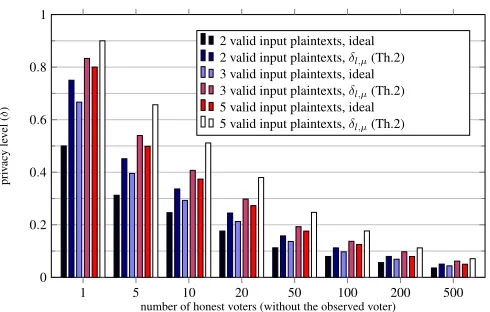
Figure 3: Level of privacy (δl,µ) w.r.t. risk-avoiding adversaries and in the ideal caseδidl,µ, uniform distribution of input plaintexts. These figures have been obtained by straightforward calculations using theδ-formulas as provided in the theorems.
Proof (sketch). We first introduce some notation and terminology. To simplify this notation, let us assume that the sender under observation has index 0 and the honest senders have indices from 1 tol. LetMjdenote the honest mix server.
Because we consider risk-avoiding adversaries, we know that, except with negligible probability, no entry is dropped or changed by the mix server (see Proposition1in AppendixC). In particular, the entryα02jof the sender under observation occurs, as expected, in the input sequenceC2jof the honest mix serverMj(at some position). Similarly, the entriesα12j, . . . αl2j of the honest senders occur inC2j. In a run of the mix net, these entries are divided by the audit procedure into two groupsGLandGR. The groupGL contains those entries amongst
α02j, . . . αl2jfor which the left link is opened during the audit procedure forMj, i.e., the links from the entries inC02j to the corresponding entries inC2j+1 are revealed. The groupGR contains those entries for which the right links are opened. Considering, for example, Figure1, entriesx1andx2belong toGL, whereas entriesx3andx4belong toGR. We callGRandGL audit groups.
Now, the rationale behind the definition ofδl,µis the following:irepresents the number of entries of honest senders that are, in a given run of the system, in the same audit group as the entry of the sender under observation. We consider all the possible cases, fromi=0 (the entry of the sender under observation is alone in its audit group, and hence, the adversary can easily see her choice) toi=l(all the honest entries are in the same group as the entry of the sender under observation; in this case, privacy of the sender under observation is maximally protected). The probability thatihonest senders belong to the same audit group as the sender under observation is li1
2l, as it is decided independently for every honest entry if it belongs
6.4
Privacy for Venturesome Adversaries
We now analyze privacy for the class of venturesome adversaries. Here it makes a big difference whether in-phase or post-phase auditing is performed.
Post-phase auditing.We first study the case of post-phase auditing, for which, as argued next, no privacy can be guaranteed whatsoever, unless the honest server happens to be the first one (if this is the case, all the honest entries are in its input and privacy is as in the case of risk-avoiding adversaries). If the first mix server is not honest, a venturesome adversary can remove all the entries of the honest senders, except for the observed sender, before the honest mix server gets to mix its input. This will be detected with very high probability, but only after the protocol has been finished and after the adversary has obtained the information he wants. As a result of this way of cheating, the only honest entry left is the one of the sender under observation. So, for venturesome adversaries and post-phase auditing privacy is completely broken.
Formally, we obtain the following result.
Theorem 3. The protocolPmix1(n,m, µ)(the first mix server is honest) with post-phase auditing
and with l honest senders achievesδl,µ-privacy w.r.t. venturesome adversaries, whereδl,µis defined as in Theorem2.
For j>1, the protocolPmixj (n,m, µ)(the first mix server may not be honest) with post-phase auditing and with l honest senders does not achieveδ-privacy w.r.t. venturesome adversaries for anyδ <1.6
The fact that for venturesome adversaries privacy is completely broken is quite obvious and has already been pointed out in the original proposal for RPC mix nets [11]. In [13], it was proposed to mitigate this problem by introducing an additional inner-most encryption with distributed decryption, where the private keys are distributed among the mix servers. By this, if one of the mix servers is honest, one can guarantee that the plaintexts are only output if no mix server was caught cheating. (This basically leads to the case of in-phase auditing discussed below.)
As already mentioned in the introduction, it is quite unlikely that adversaries are venture-some, at least in the context of e-voting, given the possibly severe negative consequences such adversaries would have to face. Also, as further discussed in the case of in-phase auditing below, our results show that an adversary who wants to obtain an advantage in breaking privacy would have to drop entries of honest senders before they reach an honest mix server. While the gain in breaking privacy when dropping a few honest entries (sayk) is quite small, the probability of being caught is very high, namely 1−(34)k. Hence, unless an adversary really does not care being caught, cheating does not make much sense in an attempt to break privacy. In-phase auditing. Now we consider RPC mix nets with in-phase auditing. This is the most interesting case from the technical perspective, as the adversary, whenever he is to remove/change an entry, needs to balance out the risk of being caught, and hence, not learning anything useful, and the advantage cheating gives for breaking privacy.
In order to state the following theorem, let us note that, following the optimal strategy of cheating with a minimum risk of being caught (forming left collision groups of size two), as
6We note that in [17] we also considered the case ofα-risk-avoiding adversaries in Theorem3forα∈(0,1). As
described in Section4, one dishonest mix server can dropbl
2cout oflhonest entries. From
this it is easy to calculate how many mix server are needed to drop all honest tries from the initial input to the mix net.
Now, we obtain the following theorem for the level of privacy of Chaumian RPC mix nets in the case of in-phase auditing, venturesome adversaries, and assuming one honest mix server only.
Theorem 4. The protocol Pmixj (n,m, µ)with in-phase auditing and with l honest senders
achievesδl∗,µ-privacy w.r.t. venturesome adversaries, where
δ∗l,µ= max l0∈{0,...,l}
3 4
l−l0
·δl0,µ
!
. (3)
The protocol does not achieveδ-privacy w.r.t. venturesome adversaries for anyδ < δ∗l,µ, as-suming the number of mix servers preceding the honest mix server is sufficiently big in order to drop l honest entries following the optimal strategy, as discussed above.7
The intuition behind the constantδl∗,µis the following (see AppendixC.1for the full proof): If an adversary letsl0 entries of honest senders reach the honest mix serverMj (and hence, l−l0are dropped)andthe adversary is not caught droppingl−l0entries, then his advantage of breaking privacy is (at most)δl0,µ. This is because this case corresponds to the case with
l0honest senders from Theorem2. However, if the adversary is caught, he does not learn anything from the protocol run. The probability that the adversary is not caught if he drops l−l0entries of honest sender is 34l−l0
. We consider all possiblel0as above and pick the one for which the advantage of the adversary is biggest.
We have computed the constantsδ∗l,µ for those parameters we also considered forδl,µ (Figure3). For all those parameters, it has turned out thatδl∗,µ=δl,µ. That is, the optimal
strategy of the (venturesome) adversary is tonotremove/change any of the honest entries (and, therefore, it coincides with the optimal strategy of a risk-avoiding adversary). This, in particular, means that the risk of being caught when manipulating honest entries, and in consequence not learning anything, always outweighs the advantage these manipulations yield for breaking privacy. Indeed, as we can see in Figure3, the advantage in breaking privacy increases only very little, when we decrease the number of honest entries by, say 1, while the probability that the adversary gets caught (and learns nothing) when he drops even only one entry is quite substantial (25%). So, it appears that in the case of in-phase auditing it never makes sense for the adversary to cheat in its attempt to break privacy.
7
Conclusion
In this paper, we provided the first formal security analysis of Chaumian RPC mix nets. These mix nets are appealing not only due to their simplicity and efficiency, but also because they can be used with any IND-CCA2-secure public key encryption scheme (that allows for efficient proofs of correct decryption) and can handle arbitrarily long input messages.
We proved that these mix nets enjoy a high level of accountability/verifiability. The probability for a mix server of being caught cheating if it tries to manipulatekmessages of honest senders is 1−(34)k. Hence, already the manipulation of just one (two) message(s) is
7We note that in [17] we also consideredα-risk-avoiding adversaries. However, for reasons explained before, we
detected with probability 0.25 (0.43). In the context of e-voting, where cheating mix servers might face severe penalties, this might be a strong incentive to behave honestly.
The level of privacy is surprisingly good, namely close to the ideal case (δid
l,µ), already in a settings with a few hundred senders. The only exception is the case of post-phase auditing and venturesome adversaries, which take into account to be caught cheating for sure. In this case, there is no privacy. However, in the context of e-voting, it is quite unlikely that an adversary is venturesome, since an adversary caught cheating might have to face severe consequences. Also, our results show that if an adversary cheats in order to (even only very slightly) increase his advantage of breaking privacy, then the probably that this cheating is detected is quite high: to increase his advantage of breaking privacy an adversary has to drop entries of honest senders, but this is detected with high probability. So, unless an adversary really does not care if he is caught, cheating in an attempt to break privacy does not pay off, and hence, altogether the level of privacy provided to single senders/voters is quite satisfying.
In summary, our results show that Chaumian RPC mix nets offer a reasonable level of privacy and verifiability, and that they are still an interesting option for the use in e-voting systems.
Acknowledgment
This work was partially supported byDeutsche Forschungsgemeinschaft(DFG) under Grant KU 1434/6-2 within the priority programme 1496 “Reliably Secure Software Systems – RS3”.
References
[1] M. Bellare, A. Desai, D. Pointcheval, and P. Rogaway. Relations Among Notions of Security for Public-Key Encryption Schemes. In H. Krawczyk, editor,Advances in Cryptology, 18th Annual International Cryptology Conference (CRYPTO 1998), volume 1462 ofLecture Notes in Computer Science, pages 549–570. Springer, 1998.
[2] David Bernhard, V´eronique Cortier, Olivier Pereira, and Bogdan Warinschi. Measuring vote privacy, revisited. In Ting Yu, George Danezis, and Virgil D. Gligor, editors,ACM Conference on Computer and Communications Security (CCS 2012), pages 941–952. ACM, 2012.
[3] David Bernhard, Olivier Pereira, and Bogdan Warinschi. How not to prove yourself: Pitfalls of the fiat-shamir heuristic and applications to helios. In Xiaoyun Wang and Kazue Sako, editors,Advances in Cryptology - ASIACRYPT 2012 - 18th International Conference on the Theory and Application of Cryptology and Information Security, Pro-ceedings, volume 7658 ofLecture Notes in Computer Science, pages 626–643. Springer, 2012.
[4] R. Carback, D. Chaum, J. Clark, adn J. Conway, E. Essex, P.S. Herrnson, T. Mayberry, S. Popoveniuc, R. L. Rivest, E. Shen, A. T. Sherman, and P.L. Vora. Scantegrity II Municipal Election at Takoma Park: The First E2E Binding governmental Elecion with Ballot Privacy. In USENIX Security Symposium/ACCURATE Electronic Voting Technology (USENIX 2010). USENIX Association, 2010.