Available online: http://edupediapublications.org/journals/index.php/IJR/ P a g e | 4 7 1
SCHEDULED SMS OR MMS TRIGGER
M. Adhilakshmi
1,D. Nehal
2,G. Prudvidhar
3,S. SanjeevaRao
4. 1Assistant Professor ,CSE Dept, TKREC, Hyderabad, TS-India, Email: [email protected]
2B.Tech C.S.E TKREC Hyderabad Email: [email protected] 3B.Tech C.S.E TKREC Hyderabad Email: [email protected]
4B.Tech C.S.E TKREC Hyderabad Email: [email protected]
1.ABSTRACT
We can send any sms or mms from any mobile to any other mobile. This sms / mms will reach the destination at the time of sending only. But I want to send a sms / mms at a specified time to a specified destination. Scheduled SMS / MMS will enable that kind of service. This “Scheduled SMS or MMS” application is being built on Android 2.3.3. This is built by the assistance of Eclipse IDE with ADT plug-in configured with android SDK for windows. This application is being built on Android 2.3.3. This is built by the assistance
of Eclipse IDE with ADT plug-in
configured with android SDK for windows. The android is the platform (mobile os) is now a day is mostly used in the 60% of mobile devices. It is more flexible to develop the application and test it on mobile or on emulator itself before deploying in to the mobile.
2.INTRODUCTION
The short message service (SMS) technology is one of the most stable
and most widely used mobile
communication methods after phone calls. Most students of tertiary institutions carry mobile phones which is capable of receiving short messages as a means of event notification. In principle, text message can be used either as a one-way communication to provide the user information such as reminder, alert, etc, or as a two-way communication that enables the user to send and receive information (such as question and answer). Event notification (through SMS) is a well-known way of notifying users about an event scheduled to take effect
within a particular period in an institution. Moreover, Mobile text messages are an excellent aid for communication when there is a need to submit information also at long
distances or without well working
communication system or infrastructure, or when the people cannot physically meet the staff that is concerned, provided that the cost of the text message is very low and it is available to practically everyone. It has been found useful to employ the text messaging in many routine-like academic environment applications. Typical examples of these application areas are e.g. different kinds of reminders and instructions, reporting of laboratory test results or home assessment
for students, remote controlling and
monitoring etc. By using this kind of communication, it is possible to save resources by e.g. avoiding unnecessary visits and phone calls; the mobile phone messaging in institutions has been a subject of active research work for about a decade. In this paper, the development of a schedule-able SMS-based system which permits multiple vendor gateways for event notification is presented. review SMS is an
acronym used in the world of
Available online: http://edupediapublications.org/journals/index.php/IJR/ P a g e | 4 7 2
now allowed users to broadcast SMS text messages not just from mobile phones but also from computers with the use of SMS software and through public SMS gateways. The link between text messaging to SMS technology now co notates the terminology of "SMS" as the act of texting or sending text messages even with the use of a different communications protocol.
2.1 The Capabilities of SMS
The use of SMS as an effective means of personal communication has expanded the market of text messaging. Businesses, government offices, and even television shows now use this service since SMS is the quickest way to get a message through from one entity to another SMS text messaging is the most widely used data application on the planet, with 2.4 billion active users, or 74% of all mobile phone subscribers sending and receiving text messages on their phones . The SMS technology has facilitated the development and growth of text messaging. SMS has unique advantages that other non-voice services do not have. It provides a very convenient method of exchanging small bits of information between mobile users. The reasons for the enormous popularity of SMS have been the fact that this mechanism of sending and receiving messages not only saves time but costs less as well. In many situations one is relatively much more comfortable sending a message via SMS than talking over phone. With new information services and unique value added services being used by the operators the popularity of SMS is increasing further. SMS is also uniquely positioned as a very
attractive advertisement medium. SMS
should no longer be treated as a value added service in mobile networks. SMS is not only providing a useful mechanism for a host of innovative services over mobile networks but it acting as a point of entry for new data services like WAP in mobile networks. 2.2 Application of SMS services
2.2.1 As a tool to provide SMS car parking technique
The car parking technique is being implemented using the SMS services on cellular phone in Vienna (Austria). It describes how useful these advanced car parking system are in providing drivers with information about the structure of the car park systems and the space available for them to park their cars. The availability of the vacant parking space is calculated by means of sensors installed in the parking areas, which count the number of cars that enter to and exit from the parking areas. Also, the number of parking tickets issued at the tickets counter can be used to calculate the vacant spaces. All this information from the sensors and tickets counters is used to update a central database which stores all the information about the areas of the parking space which is vacant or occupied. The advanced parking system also provides advanced, electronic payment options for the customers. The idea behind this electronic payment option is to prevent the customer for having to wait in long queues to buy a ticket. Queues can cause congestion in areas within and outside of parking facilities.
2.2.2 As administrative tool to support communication in higher institution of learning
According to L. Naismith, (2007) from the University of Birmingham reported that an e-mail to text message service called Study Link is employed to support
Administrative communication in higher
education. Text messaging can be
“effectively integrated into both the student and staff experience”. Administrative staff members were able to integrate the service into their current means of communicating with students while students were able to effectively receive and act on text messages. Message types include notices of changes and cancellations (e.g., class cancellations),
reminders to submit and collect
Available online: http://edupediapublications.org/journals/index.php/IJR/ P a g e | 4 7 3
lectures/activities, individual administration (e.g., warning messages to absentees), instructional messages (e.g., instructions for
submitting assignments), and
greeting/courteous messages. According to S. Pramsane, & R. Sanjaya, (2006) development of education services based on short message services. The education
information such as the enrollment
information, grade release, university
announcement, and internship opportunity can be retrieved and/or sent by the students via SMS through a login system. This research points out that administrative support to students via short message services is ideal.
2.2.3 As a tool to support library administrative work
Library services can be improved through SMS-based administrative support. Libraries can reach out and serve students ubiquitously by sending and receiving SMS-based library information. There are a number of areas in library services for which SMS-based messages can be helpful. Basic information alerts such as notices of book reservations, and renewals and overdue reminders are well tailored with this communication medium. One example is the SMS alert services offered by the Hong Kong Institute of Education. Further library services can also be provided via SMS based systems. For example, extended text messaging reference can send SMS messages to and receive answers from librarians as reported in research at Southeastern Louisiana University as a way to further enhance the quality of services provided by libraries in higher education. 2.2.4 As a tool for Teaching and Learning Support (Classroom interaction and discussion)
A SMS-based classroom interaction system is presented in [65]. They called this the TXT-2-LRN system. The system allows students to send questions or comments to the instructor’s laptop via SMS. The instructor can read the messages on the
screen and decide to respond immediately or wait for later action. The instructor can also provide a quiz to the students and collect results. Students can look at the projector’s screen in real-time graphics showing the results. Short message services encourage interactivity in the classroom, Traxler, J. (2005).
2.3 Related Work
Mobile computing and
communication technology interventions for improving health care and health service outcomes, referred as M-health, Free C et al., Patel V, et al. (2010) are used nowadays on a wide range from data collection and
information transmission to supporting
health behavior change. Wei et al., (2011) presented a literature review including 24 articles on the use of text messaging for clinical and healthy behavior interventions. In paper of Cole-Lewis and Kershaw, (2010) a review on the behavior change interventions for disease management and prevention delivered through text messaging is presented. Krishna et al. (2009) have made an article on the state-of–heart of the use of mobile phones and text messaging interventions in improving health outcomes and processes of care. There has been an increasing interest in academic institutions using mobile devices to support teaching and learning. Different mobile devices can be used in mobile learning. The most ubiquitous and stable mobile technologies namely Short Message Service (SMS) texting (Traxler, 2005) on cellular phones has great potential in education. In Mozambique health workers can support diagnosis & treatment through Bulk SMS and even in Uganda, Malawi and Benin health education messages are sent by text messages (Pankaj, 2011).
3.Proposed work
Available online: http://edupediapublications.org/journals/index.php/IJR/ P a g e | 4 7 4
End user should provide destination phone number and message along with delivery date and time to schedule the sms.End user should provide destination phone number and image along with delivery date and time to schedule the mms.The mms can browse from the sd-card or can capture an image or video at
the time of schedule.Should have
security to schedule sms / mms.
4.System architecture
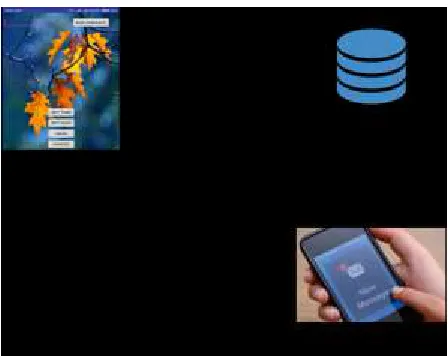
Fig System Architecture
Using APK the sms or mms is scheduled by one of the user. After scheduling the message is saved into the database. At the scheduled time the message is sent to the selected receipent. Before scheduling the sms the user needs to enter the password that has been set during the installation of the app.
5.Algorithm
Step 1: Validate the app entry password if yes, goto step2 else repeat step1
Step 2: Select the type of message to send 1.SMS 2.MMS if option 1 goto step3 else goto step 7
Step 3: add contact Step 4: enter message
Step 5: schedule the message Step 6: save goto step12 Step 7: select default app Step 8: add contact
Step 9: select multimedia below 100KB Step 10: schedule the mms
Step 11: save Step 12: exit
6.Result analysis
Fig: Pie chart showing the participation of modules in the system
7.Conclusion
This application is aimed at problems like One may forget to send a
SMS regarding birthday wishes or
anniversary wishes or any other important information. To overcome such problems an android application this application has been developed wherein a SMS will be automatically sent on the selected date and time to desired recipient. One can schedule a SMS by simply opening the application and schedule where every entry specifies recipient’s number, date and time of your transmission and the text message to be sent.
8.Future Enchancement
Available online: http://edupediapublications.org/journals/index.php/IJR/ P a g e | 4 7 5
sending stickers along with the text message, sending a multimedia message. To provide ease for the user by developing an inbuilt keypad that reduces the effort to type whole word and the chance of spelling mistakes.To provide ease for the user by automatically configuring the MMS settings, which are different for different network provider.
References
Cole-Lewis H, Kershaw T (2010)
Text Messaging as a Tool for
Behavior Change in Disease
Prevention and Management.
Epidemiol Rev 32: 56-69.
free C, Phillips G, Felix L, Galli L,
Patel V, et al. (2010) The
effectiveness of M-health
technologies for improving health and health services: a systematic review protocol. BMC Research
Notes 3: 250.
Infotech.monash.edu/promotion/.../ projects/carparksms/literaturerevie w.doc
Krishna S, Boren SA, Balas EA
(2009) Healthcare via Cell Phones: A Systematic Review. Telemed J E Health 15: 231-240.
L. Naismith, (2007). Using text
messaging to support
administrative communication in
higher education. Active Learning in Higher Education,Vol 8, 155-171.
L. Smith & H. Roth (2003).
“Parking Systems Technologies”. Retrieved on 11 August 2005
Masoud, H., Masoud, A (2012);
The Pedagogical Applications of
Using Short Message System
(SMS) in Language Learning
Classes, International Journal of Academic Research in Progressive Education and Development , Vol. 1, No. 1
Pankaj, K. J.,(2011);SMS Based
Information Systems
S. Pramsane, & R. Sanjaya, (2006).
Mobile education services based on
SMS and their architecture
comparison.
Proceedings of the Third
International Conference on
eLearning for Knowledge-based Society. So, S. (2009). The development of a SMS-based
teaching and learning system.
Journal of Educational Technology Development and Exchange, 2(1), 113-124.
Traxler, J. (2005). Case studies:
Introduction and overview. In A. Kukulska-Hulme and J. Traxler
(Eds), Mobile learning: A
handbook for educators and
trainers (pp 70-75). London:
Routledge Wei J, Hollin I,
Kachnowski S (2011) A review of the use of mobile phone text messaging in clinical and healthy behaviour interventions. J Telemed Telecare 17: 41-48.
www.sicet.org/journals/jetde/jetde0
9/simon.pdf. Block all
www.sicet.org results. In teaching and learning
Traxler, J. (2005). Case studies:
Introduction and overview. In A. Kukulska-Hulme and J. Traxler
(Eds), Mobile learning: A
handbook for educators and
Available online: http://edupediapublications.org/journals/index.php/IJR/ P a g e | 4 7 6
http://www.cs.washington.edu/edu
cation/courses/cse590f/07sp/docs/ Mukhebi.pdf.
http://www.sicet.org/journals/jetde/
jetde09/simon.pdf
http://www.ewh.ieee.org/soc/e/sac/