Privacy and Verifiability in Voting Systems:
Methods, Developments and Trends
Hugo Jonkera,∗, Sjouke Mauwa,b, Jun Panga
aUniversity of Luxembourg, Faculty of Sciences, Technology and Communication 6, rue Coudenhove-Kalergi, L-1359 Luxembourg
bUniversity of Luxembourg, Interdisciplinary Centre for Security, Reliability and Trust 4, rue Alphonse Weicker, L-2721 Luxembourg
Abstract
One of the most challenging aspects in computer-supported voting is to combine the apparently conflicting requirements of privacy and verifiability. On the one hand, privacy requires that a vote cannot be traced back from the result to a voter, while on the other hand, verifiability states that a voter can trace the effect of her vote on the result. This can be addressed using various privacy-enabling cryptographic primitives which also offer verifiability.
As more and more refined voting systems were proposed, understanding of first pri-vacy and later verifiability in voting increased, and notions of pripri-vacy as well as notions of verifiability in voting became increasingly more refined. This has culminated in a variety of verifiable systems that use cryptographic primitives to ensure specific kinds of privacy. However, the corresponding privacy and verifiability claims are not often veri-fied independently. When they are investigated, claims have been invalidated sufficiently often to warrant a cautious approach to them.
The multitude of notions, primitives and proposed solutions that claim to achieve both privacy and verifiability form an interesting but complex landscape. The purpose of this paper is to survey this landscape by providing an overview of the methods, developments and current trends regarding privacy and verifiability in voting systems.
Key words: Privacy, voting systems, receipt-freeness, coercion-resistance, end-to-end verifiability.
1. Evolution of privacy and verifiability requirements in voting systems
In a seminal paper Chaum proposed a technique to enable anonymous communica-tion [Cha81]. In a single paragraph in this paper, he remarked on how such anonymous communications could be leveraged for private electronic voting. This remark triggered academic interest, which led to a plethora of voting system designs. These systems aimed
∗Corresponding author. Tel: +352 466 644 5483, fax: +352 466 644 35483
Cha81
ballot-privacy
indivual verifiability
BT94
receipt-freeness JCJ05 coercion-resistance
SK95 verifiabilityuniversal Cha04 end-to-end verifiability
Figure 1: Evolution of privacy notions (top) and verifiability notions (bottom) in voting systems.
to achieveballot-privacy – keeping the ballot’s contents secret – while allowing voters to verify their vote counted towards the final result.
In order to ensure voter trust, most designs offered traceability of the voter’s vote. Upon voting, the voter acquires a receipt, which she could use to trace her vote to the results. Benaloh and Tuinstra showed in [BT94] that such receipts can be used to nullify vote-privacy, when the voter shows her receipt to another party. They had the insight that vote-privacy is not optional, but must be enforced by the system. None of the classical systems that had been proposed up to then satisfied this requirement. BT94 led to a new direction in voting systems: receipt-free voting systems. These are systems that do not allow the voter to prove how she voted. Later, Juels, Catalano and Jakobsson [JCJ05] further refined the notion of privacy by identifying the need for coercion-resistance. This property extends the notion of receipt-freeness, by requiring protection against forced abstention, against forced randomised voting and against being forced to give up voter credentials. The evolution of these privacy notions is sketched in the top row in Figure 1.
Ensuring correctness of receipt-free and coercion-resistant systems is achieved by com-plex cryptographic operations. These operations also enable systems to satisfyindividual and universal verifiability. Individual verifiability ensures that a voter can verify that her vote counts correctly, while universal verifiability (first recognised explicit by Sako and Kilian [SK95]) ensures that any observer (who may be a voter) can verify that the result is a correct reflection of the set of cast votes. However, the complexity of the cryptographic verification process hindered the adoption of theoretical voting systems in real-world elections. Practical and theoretical developments were not converging. Both Chaum [Cha04] and Neff recognised this as a problem and sought to address this, with the former’s work setting a trend. Chaum’s work [Cha04] (“Cha04” in Figure 1) took inspi-ration from both election practice and theoretical developments and proposed a voting system which offers a far easier approach (visual cryptography) to verify that the en-cryption of a vote does indeed contain that vote. Neff [Nef04] used a challenge/response protocol to achieve the same end. Their works led to a refinement of the notions of ver-ifiability intocast-as-intended (as above),recorded-as-cast (the voter can verify that the encryption of the vote was properly stored), and tallied-as-recorded (anyone can verify that the announced result is correct w.r.t. the set of received votes). Chaum’s and, to a lesser degree, Neff’s works inspired a shift in focus, from systems focused on achieving strong privacy notions while being verifiable, to systems that focus on practical verifia-bility while satisfying strong privacy notions, such as receipt-freeness. Such systems are called end-to-end verifiable [Uni05] voting systems. The evolution of these verifiability notions is sketched in the bottom row in Figure 1.
current overview that describes these trends accurately, that is, that highlights firstly how strong notions of privacy were achieved, and later, how verifiability was made practical, is to the best of our knowledge missing. This survey investigates and clar-ifies the highlights of the above developments to provide such an overview. To that end, we distinguish two classes of systems along the lines of the developments sketched in Figure 1: systems focusing on privacy, and systems focusing on verifiability. We remark that privacy-oriented systems tend towards theoretical results (e.g., satisfying receipt-freeness), whereas verifiability-oriented systems additionally focus on practicality of implementation (e.g., satisfying receipt-freeness without requiring a voter to perform cryptographic computations). We consider a selection of voting systems, namely those proposed in recent years that notably offer an innovative approach to privacy and/or verifiability. We focus on the communication behaviour of each system, that is, which messages are exchanged by the involved parties. The systems are described in order of year of publication. The description of a system not only includes a sketch of how its salient features work and what claims it makes, but also refers to those studies (including non-security studies) we were aware of at the time of writing. Security breaks found by these studies are mentioned explicitly. Finally, we focus on democratic elections (e.g., voting systems to elect the government). Application areas such as boardroom-style voting are thus out of the scope of this survey.
Related surveys. In recent years, there have been few in-depth studies of developments in voting literature. Three notable exceptions are the studies by Sampigethaya et al. [SP05], by Smith [Smi05b], and by Cha et al. [CA12]. Smith’s study focuses on the cryptographic blocks used to achieve privacy and verifiability. Cha et al. provide a brief survey of methods to determine the result of an election given the number of votes per candidate. Finally, the study by Sampigethaya et al. is closest of these three to our aim. They classify systems according to whether they hide voter, vote or both. Their study focuses on the cryptographic computations of the considered system.
In contrast, we set forth to sketch the recent developments and trends in voting literature, focusing on privacy and verifiability requirements. As such, we selected a group of papers that (in our view) have proven to be influential in the field, or added a novel approach towards privacy and/or verifiability. Moreover, in line with the intruder model due to Dolev and Yao [DY83], we focus on how communication flows and abstract away from the cryptographic details. The goal of our study is threefold:
(1) To help the reader understand various approaches to achieving privacy and verifi-ability in voting systems;
(2) To help the reader understand where these approaches originated, and how they developed further;
(3) To help the reader to make a high-level comparison of the discussed voting systems.
claims. This is followed by a survey of verifiability-oriented voting systems in Section 6. We conclude the paper in Section 7 with trends and developments observed in voting.
2. Terminology and notation
2.1. Terminology
As discussed above, this paper focuses on privacy and verifiability requirements. As remarked by Chevallier-Mames et al. [CFS+06], absolute privacy (no information leaked) cannot coexist with verifiability (sufficient information leaked to verify the result). The goal of voting system design is to find a way to enable as much privacy and verifiability simultaneously as possible. To this end, several terms for privacy and verifiability have arisen. In particular, we use the following terms:
Privacy:
• Ballot-privacy (BP): no outside observer can determine for whom a voter voted.
• Receipt-freeness (RF): a voter cannot proveafter the election how she voted.
• Coercion-resistance (CR): a voter cannot interact with a coercerduring the election to prove how she is voting.
Note that if a voter cannot prove how she voted, she must have had ballot-privacy (otherwise the empty proof suffices as such a proof). As such, we will view a claim of RF or CR as a claim of BP as well.
Verifiability:
• Individual verifiability (IV): a voter can verify that the ballot containing her vote is in the published set of “all” (as claimed by the system) votes.
• Universal verifiability (UV): anyone can verify that the result corresponds with the published set of “all” votes.
• End-to-end verifiability: a voter can verify that:
– cast-as-intended (CAI): her choice was correctly denoted on the ballot by the system,
– recorded-as-cast (RAC): her ballot was received the way she cast it,
– tallied-as-recorded (TAR): her ballot counts as received.
Note that Kremer et al. [KRS10] identify another type of verifiability,eligibility verifia-bility: anyone can verify that each vote in the published set of “all” votes was cast by an eligible voter, and anyone can verify that each eligible voter cast at most one vote. Due to a lack of systems proposed in literature that claim to satisfy this requirement, we consider this type of verifiability not in scope for the current study.
applied π by Kremer and Ryan [KR05] and later Kremer, Ryan and Delaune [DKR06, DKR09], and in a specifically designed process algebra by Jonker, Mauw and Pang [JMP09b]. Verification using process algebras culminated in the successful automatic verification of protocols by Backes, Hrit¸cu and Maffei [BHM08]. Secondly, there are works formal-ising privacy in logics, including work by Jonker and De Vink [JdV06] and Br¨aunlich and Grimm [BG11] in first-order logic, and privacy in epistemic logic by Jonker and Pieters [JP06] and later Baskar, Ramanujam and Suresh [BRS07].
In addition to privacy and verifiability claims, there are a plethora of other security requirements for voting systems. For the sake of completeness, we list the claimed security requirements as well. Please be advised: we use the appellations the authors gave these, and, unlike for privacy and verifiability, make no attempt to harmonise terminology.
2.2. Notation
Encryption of a messagem with key k is denoted asenck(m). This ciphertext can
be decrypted using the decryption keyk−1. In the case of symmetric cryptography, the encryption key k is equal to its inverse k−1. For asymmetric cryptography, we denote the public key and private key of an agentA aspk(A) andsk(A), respectively.
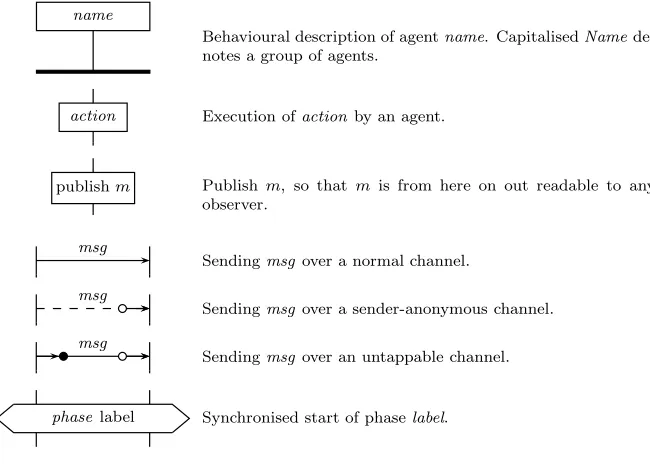
name
Behavioural description of agentname. CapitalisedName de-notes a group of agents.
action Execution ofaction by an agent.
publishm Publish m, so that m is from here on out readable to any observer.
msg
Sendingmsgover a normal channel.
msg
Sendingmsgover a sender-anonymous channel.
msg
Sendingmsgover an untappable channel.
phaselabel Synchronised start of phaselabel.
Figure 2: Legend for the interaction diagrams.
Note that unless otherwise stated, all agents know their own private key and all other public keys (that is, key generation/distribution is not part of the diagrams).
3. Privacy building blocks
Several techniques have been introduced that enable electronic voting systems to provide privacy whilst preserving verifiability. In this and the next section we introduce some of the concepts that are prevalent in current voting systems. While we categorise these as privacy building blocks or verifiability building blocks, we stress that many of them specifically maintain privacy while allowing some form of verification, and can in fact be leveraged for both privacy and verifiability.
This section discusses building blocks for privacy. The building blocks here are homo-morphic encryption, re-encryption, blind signatures, zero knowledge proofs, designated verifier proofs, secret sharing, mixnets, communication channels with privacy properties, and tamper-resistant hardware. Verifiability building blocks are discussed in the next session.
3.1. Homomorphic encryption
In a homomorphic cryptosystem, there is a homomorphism between an algebra based on the plaintext domain and an algebra based on the ciphertext domain. More precisely, using ⊕ to denote an appropriate operation on plain text messages and ⊗ to denote an appropriate operation on ciphertext messages, the following equality is the defining property of homomorphic encryption:
enck(m1)⊗enck(m2) =enck(m1⊕m2).
This property allows two encrypted messages to be combined meaningfully (using
⊗) into one encrypted message without using a key. The actual operations represented by ⊗ and ⊕ depend on the used cryptographic system. Examples of homomorphic cryptographic systems include RSA [RSA78] (where both ⊗ and⊕are multiplication), ElGamal [ElG85] (where⊗is component-wise multiplication, and⊕is multiplication in the underlying group), and Paillier [Pai99] (where⊗is multiplication and⊕is addition). A detailed survey of homomorphic systems is given in [FG07].
Homomorphic encryption can be applied to tally votes using asymmetric cryptog-raphy. In such a setting, every voter v can encrypt her vote votev with the election public key pk(C), which yields encpk(C)(votev). Using the homomorphic property of the encryption system, the authorities can add all votes together without opening the individual votes. This results in the encrypted tally:
encpk(C)(vote1)⊗. . .⊗encpk(C)(voten) =encpk(C)(vote1⊕. . .⊕voten).
Anyone can verify the calculation of the tally and thus verify that her vote contributes to the result. However, no one except for the authorities that possess the decryption key can see for which candidate a particular voter voted. This preserves vote-privacy while offering verifiability.
votes for two candidates, encryptions of a negative number (which translates as a “minus” vote for a candidate), and other such shenanigans. To ensure such fraudulent encryptions can be detected, each voter must also submit a proof of validity – a proof that her encrypted vote contains precisely one valid candidate (see e.g. [CGS97]).
3.2. Re-encryption
Re-encrypting a message means changing the ciphertext, without changing the cor-responding plaintext. Knowledge of the decryption key is not needed for re-encryption, though the encryption key must be known. Recall that in symmetric cryptoschemes these keys are the same, so in any symmetric cryptosystem that allows re-encryption, the agent performing the re-encryption must possess the decryption key.
Re-encryption is related to probabilistic encryption, in which the ciphertext not only depends on the plaintext, but also on some random factor. More precisely, if a cryptosys-tem is not probabilistic, there is no random factor in the ciphertext that can be changed without changing the plaintext. We useenck,r(m) to denote the probabilistic encryption of messagemwith keykand random factorr. A re-encryption of this message results in enck,r′(m), wherer′ is the new random factor (r′6=r). The re-encryption with random
factor r of a given ciphertext c is denoted by renck,r(c). A re-encrypted ciphertext is distinct from the original ciphertext. However, both decrypt to the same plaintext. The most relevant property of re-encryption is
renck,r′(enck,r(m)) =enck,r′′(m),
where r′′ denotes the random factor of the re-encrypted ciphertext, which depends only
on r and r′. When the encryption key k is clear from the context, we will often write
rencr(c) forrenck,r(c).
Examples of cryptographic systems allowing re-encryption include ElGamal [ElG85], Goldwasser-Micali [GM84], and Paillier [Pai99]. In fact, in any homomorphic cryptosys-tem which is probabilistic (that is, there are multiple encryptions c for every plaintext m), one can just homomorphically add encryptions of 0 to any ciphertext to obtain a different ciphertext without changing the plaintext.
In voting, re-encryption is used to break the link between a voter and her cast vote. By re-encrypting a cast vote, the vote remains unchanged, while the encrypted message can no longer be linked to the message sent by the voter while casting her vote.
3.3. Blind signatures
A party can authenticate a message by applying its digital signature to that message. Assuming an agent a’s signing key sk(a) and the corresponding public verification key pk(a), we denote the signing of a message m by signsk(a)(m). This signature can be verified with the operation checksignpk(a), satisfying the following equation:
checksignpk(a)(signsk(a)(m)) =m.
If the keys and message are clear from the context, we will use signature-ok? to denote the verification of a signature by testing the above equality.
a message to be signed. The carbon paper will copy anything written on the envelope to the message, including a signature. Thus, a notary can sign the envelope, while the secret message is not revealed to him. The envelope (the blind) can later be removed, revealing a signed message.
We denote a message m blinded with blinding key b by blindb(m). If a blinded message is signed, the message can be unblinded without removing the signature. For a messagem, signed with agenta’s keysk(a), we have the following:
deblindb(signsk(a)(blindb(m))) =signsk(a)(m).
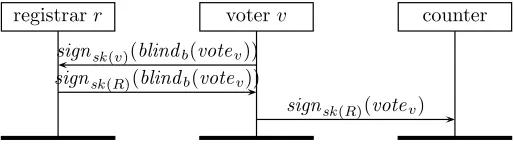
Blind signatures can be used to ensure that only eligible voters can vote (see Figure 3; the used notation is explained in Figure 2). A votervblinds her votevotevusing blinding key b. She signs that and sends her signed, blinded vote to the registrar. The registrar separates the blinded message and the signature, and verifies that the voter is eligible and has not yet voted. If so, the registrar signs the blinded vote and sends it back to the voter. The voter unblinds the received message usingband sends the signed vote to a counter.
registrarr voterv counter
signsk(v)(blindb(votev)) signsk(R)(blindb(votev))
signsk(R)(votev)
Figure 3: An example of the use of blind signatures.
3.4. Zero knowledge proofs
A zero knowledge proof (ZKP) is a proof of a statementswhich reveals nothing about statements, except that it is true. An informal example is the following: the prover sets out to prove to a color-blind friend that two billiard balls have a different color. The friend takes one ball in each hand, showing the prover which ball is in which hand. Then, the friend puts the balls behind his back and may or may not switch them. Finally, the friend shows the balls again, and the prover has to tell whether the balls were switched. In the example, if the balls are truly indistinguishable, the prover only has a 50% chance of guessing correctly. Therefore, by repeating this process a few times, the friend can reduce the chance of the prover guessing correctly as much as he wishes.
Remark that in the example, a zero knowledge proof deals with some public knowledge and some private knowledge. In the example, the order of the balls in the beginning is public knowledge, while the knowledge of whether they switched hand is private. In general, a zero knowledge proof proves a boolean statement over publicly and privately known arguments, without revealing the private knowledge.
interactive. Fiat and Shamir [FS86] proposed a method to transform such interactive proofs intonon-interactivezero knowledge proofs. This relies on the prover generating a (to him) unpredictable challenge based on his commitment and public knowledge, such as the hash of the commitment. Since this is unpredictable, the prover cannot tweak the commitment to give him an advantage.
Zero knowledge proofs are often used in voting to prove to a voter how her vote is being processed by the system. This enables a voter to verify that her vote is being handled correctly, without her being able to prove to an outsider how she voted. An example of this is proving a certain ciphertext is indeed a correct (re-)encryption of a message, without revealing the encryption key. This is done in mixnets (see Section 3.7).
3.5. Designated verifier proofs
Regular non-interactive proofs are transferable, i.e., a voter who possesses a proof of a boolean statement can transfer that proof to anyone. This is not always desirable, for example a voter selling a proof of how she voted. Suppose proverP wants to prove the truth of statement sto verifierV, but doesn’t wantV to be able to prove sto anyone else. What P can do, is prove the following toV:
“I amV ORs.”
As the verifier knows that the prover is notV, the statementsmust be true. As “I am V” holds true for the verifier, the verifier can prove “I amV ORx.” for anyx(by proving that the verifier is V). Hence,V cannot use the above proof to convince anyone else of statement s. Such a non-transferable proof is called a designated verifier proof [JSI96].
3.6. Secret sharing
Secure operation of a system can often only be guaranteed under the assumption that one of the agents is trusted. An authority in a voting system is an example of such a trusted agent. However, access to information is sometimes deemed too sensitive to be left to one agent. Compromising a single agent then would suffice for an attacker to break the system’s security. To avoid this, cryptographic mechanisms have been developed that allow the sharing of a secret by a number of authorities. This is done in such a way that only by putting their shares together, the authorities can recover the secret [Sha79, Bla79].
A simple way to share a secret is to encode the secret into a bitstring, and choose the shares such that theexclusive orof all shares produces the secret. While this works, this requires each agent holding a share to be honest about their share. Failing one share, the secret becomes unrecoverable.
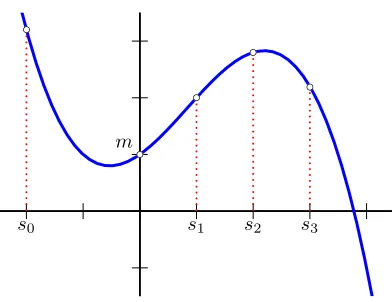
To counter this, more complex secret sharing schemes have been proposed. One method works by interpolation of polynomials (see Figure 4). To share a secret over n parties, the secret is encoded as a numberm. Then, a random polynomial of degreetis chosen that covers the point (0, m) (in Figure 4: −0.2x3+ 0.5x2+ 0.7x+ 1). Each share is then given by a random point on the polynomial. The example shows a polynomial of degree three. There are four shares, since a polynomial of degree three is fully determined by four points.
s0 s1 s2 s3 m
b
C
b
C
b
C
b
C
b
C
Figure 4: Secretmshared overs0, s1, s2ands3using polynomial−0.2x3+ 0.5x2+ 0.7x+ 1.
are needed to recover the secret. This is called threshold cryptography. Often, a secret sharing scheme is referred to as (t, n) meaning thatt (for threshold) shares are needed, and that there arenshares in total.
Secret sharing can be used in voting to distribute a decryption key. Suppose all voters encrypt their votes with the same public key. The corresponding private key is then split over all authorities, to ensure that only the authorities acting in concert can decrypt the votes. In some cryptosystems such as ElGamal, it is even possible to decrypt a ciphertext without reconstructing the key – see e.g. [CGS97].
Example of decryption without reconstructing the key. Encryption in ElGamal works as follows. The public key is given by raising the generator g of a given group to the private key k: gk. Encrypting message m results in (gr,(gk)rm), where ris chosen by the encrypting agent. To decrypt, one raises the first element grto the power k, which results in the term grk. Then, the second element (gk)rm is divided bygrk, resulting inm. Note that the private keykis not needed for decryption. Decryption only requires grk, which is derived fromk.
A joint decryption of (gr,(gk)rm) without reconstructing the key transpires as follows. Assume the private key kis split into nsharess1, . . . , sn, such thatgk =gs1+s2+···+sn. Each shareholderiraisesgrto his share and sends (gr)sito the others. Now, the share-holders can compute Πi(gr)si= (gr)k, which is the term needed to decrypt (gr,(gk)rm). In this fashion, the message can be recovered without constructingk.
3.7. Mixnets
A simple way to achieve privacy of one’s vote is to shuffle it with a number of votes from other voters. This can be achieved by the use of mixes [Cha81]. A mix shuffles its input in such a way that no element of the output can be linked back to an element in the input. To ensure that the link between the input list and the output list is not trivially retrieved, the mix needs to change the appearance of every message without changing the meaning of any message.
Mix 1 Mix 2 Mix 3 ✐ w ✐ x ✐ y ✐ z ❍❍❥ ❳❳③ ✘✘✿ ✟✟✯ ✟✟✯ ✘✘✿ ❳❳③ ❍❍❥ ✐x ✐ w ✐y ✐z ❍❍❥ ❳❳③ ✘✘✿ ✟✟✯ ✟✟✯ ✘✘✿ ❳❳③ ❍❍❥ ✐ y ✐x ✐w ✐ z ❍❍❥ ❳❳③ ✘✘✿ ✟✟✯ ✟✟✯ ✘✘✿ ❳❳③ ❍❍❥ ✐z ✐ w ✐y ✐ x
Figure 5: An example of a mixnet in operation (adapted from [HS00]).
the order in which the elements are output. In order to ensure that no single entity can recover the ordering, multiple mixes can be chained to form a mixnet. The final output elements then can only be linked to their corresponding input elements if all mixes collude.
When using decryption mixes, the initial input consists of several layers of encryption, each layer specifically targeted at one mix. On its way through the mixnet, the original message changes its shape because each mix peels off one layer of encryption. This approach is used in onion routing [SGR97], which provides anonymous routing.
Figure 5 sketches the working of a mixnet. The first mix takes an input list of messages (here, w, x, y, z) and outputs a shuffled list (x, w, y, z) in such a way that the individual messages cannot be linked to its input (denoted in Figure 5 by rotation of the messages). The output of the first mix becomes the input of the second mix, which in turn provides the input to the last mix. The output of the last mix is not linkable to the input of the first mix, nor to any of the intermediate stages.
To prove that the output is indeed a permutation of the input, the mix can use zero-knowledge proofs or designated verifier proofs. A pair of mixes has another option available, called randomised partial checking [JJR02]: they shuffle and publish their results. An independent party then selects for each message in the intermediate set (i.e., the output of the first mix, which is the input of the second mix) whether the link to the input or the link to the final output is revealed. A variant of this is shown in Figure 25. As the mixes do not know in advance which link they must reveal, the likelihood of being caught should they mix fraudulently is substantial. At the same time, input messages cannot be linked to the output messages as only one of the two links necessary for linking is revealed for any message.
3.8. Anonymous and untappable communication channels
To ensure privacy, many voting systems rely on communication channels with special properties: anonymous channels anduntappable channels. Sender-anonymous channels hide the sender of a message, and can be implemented using a mixnet as first suggested by Chaum [Cha81]. An untappable channel is a channel where no party except sender and receiver can learn anything about the communication, including whether communication occurred or not. One approach to achieve this, is to offer multiple channels, where the sender picks one at random. Under the assumption that an adversary cannot tap all channels simultaneously, the adversary cannot be certain that none of the channels was used. Nevertheless, an untappable channel remains a very strong physical assumption. Replacing this with less strict assumptions (such as by a threshold homomorphic deniable encryption scheme as suggested by [CGS97]) remains currently an open problem.
3.9. Tamper-resistant hardware
Another approach to achieving privacy is to rely on special hardware, designed so that it is very difficult to modify or inspect the internal functioning of the hardware (tamper-resistant). An everyday example of this is a smart card. Given the assumption of tamper-resistance, the hardware can be viewed as a trusted computing base whose computations can neither be inspected nor disturbed. Voting systems can leverage this to re-encrypt a vote, ensuring that the voter cannot prove how she voted by decrypting her vote.
3.10. Security implications of cryptographic primitives
The cryptographic primitives discussed above depend on specific assumptions and may introduce their own limitations. For example, homomorphic encryption, re-en-cryption (and thus re-enre-en-cryption mixnets) and blind signatures each allow a ciphertext to be altered in a meaningful way without access to the decryption key. Cryptographic systems with this property are called malleable [DDN00]. Malleability of the crypto-graphic system can be leveraged for privacy, because ciphertext(s) can be meaningfully changed (e.g., adding two ciphertexts together) by someone who does not know the plaintext(s). However, a malleable ciphertext can be changed in a meaningful way by an attacker as well. Therefore, such cryptosystems must be used with care and awareness of their limitations and vulnerabilities.
Moreover, most of the cryptographic primitives are computationally secure. This means that security relies on a mathematical problem (such as factorisation, or dis-crete log) believed to be intractable to solve. In contrast, a primitive that cannot be broken even when the adversary has unlimited computing power is called information-theoretically secure.
4. Building blocks for verifiability
The building blocks for verifiability discussed below are secure bulletin boards, bal-lot auditing (cast-or-audit, continuous auditing, Markpledge-style auditing), plaintext equivalence tests, and commitment schemes.
4.1. Bulletin boards
Many voting systems from literature assume the use of secure bulletin boards. Typ-ically, this is used to provide a verifiable log of communications. To this end, a secure bulletin board provides an append-only, publicly available communication medium with memory. The basic properties (see e.g. [JP11]) are:
• information cannot be removed or modified, only added to the board;
• anyone may read the board,
• the board provides a consistent view to everyone.
Most systems discussed in this survey state that there is a bulletin board, but not how to communicate with it. To avoid suggesting any specific type of interaction, in the inter-action diagrams the act of publishing is denoted by an inter-action “publish ” (cf. Figure 2).
4.2. Ballot auditing and ballot verification
To preserve privacy, many systems opt to record a voter’s choice in an encrypted way. As Chaum [Cha04] pointed out, there should be some mechanism to ensure the voter that the encryption indeed contains the voter’s choice. This can be achieved with cryp-tographic proofs (e.g., visual cryptography as Chaum proposed, zero-knowledge proofs or designated-verifier proofs), but such proofs cannot convince voters who are not cryp-tographic experts. In literature, three alternative approaches have been proposed: veri-fication by means of short strings (Markpledge), continuous auditing (Prˆet `a Voter), and cast-or-audit (Benaloh challenges).
Verification using short strings. Neff [Nef01] proposed the Markpledge system (Sec-tion 6.5), that uses short strings to enable voters to verify that the ballot posted publicly was the one they saw in the voting booth. While full verification relies on helper organi-sations, this approach does put some power in the hands of the voter as follows: the voter makes her choice for candidate A. Next, the voting system prints a ballot that contains encryptions for all candidates. The machine prints a commitment to the encryption of the chosen candidate. The voter inserts her challenge (a short string), and the machine prints the challenge and the answer for the chosen candidate. Finally, the machine prints a cryptographic proof that the printed receipt contains precisely one “yes” vote. (To preserve privacy, the machine also computes fake commitments matching the challenge and prints fake answers for the other candidates.)
Continuous auditing (Prˆet `a Voter). Ryan [Rya05] suggested to have continuous audits of the ballot encryptions in the Prˆet `a Voter (Section 6.6) system. In Prˆet `a Voter , the authorities prepare ballots in which the candidate order is randomised, and encrypted. To be sure that the order that is claimed is indeed the order that is encrypted, voters can submit a blank ballot and have that ballot’s order decrypted, spoiling the ballot. After repeated testing, the voter is convinced that the candidate order shown on the form is the one encrypted. At this point, the voter selects a random blank ballot, marks her choice and casts her vote.
Cast-and-audit (Benaloh challenges). Benolah [Ben06, Ben07] elaborated this auditing approach to a system where the voter marks her choice, the system prepares the ballot, and then the voter is presented with the option to either decrypt the prepared ballot, or to cast the prepared ballot.
The paper coming out of the voting device can now act either as a ballot or as an auditing tool. Since the voting device is irrevocably committed to a particular encryption, and as the device cannot predict whether the voter will choose to cast or choose to audit, any cheating by the voting device has a 50% chance of being audited (and, thus, detected). By repeating the audit as often as desired, the voter can test the machine as often as desired and thus increase her confidence in the correctness of the machine’s operation.
4.3. Plaintext equivalence tests
A plaintext equivalence test (PET) is a test of two ciphertexts, that results in true if the two respective plaintexts are equal, without revealing anything else. In other words,
PET({ma}k,{mb}k) ≡ ma=mb.
Such tests are used in various systems. For example, the JCJ05 system uses such tests to identify and remove duplicate votes from the bulletin board without revealing anything about the duplicated votes.
4.4. Encoding candidates
To ease the tallying process, candidates can be encoded as numbers, while the operator
⊕represents addition. If we assume, for instance, 3 candidates and 9 voters, then a vote for the first candidate is represented by 1, a vote for the second candidate by 10, and a vote for the third candidate by 100. The addition of nine such votes then results in a number with at most 3 digits that represents the outcome of the voting process. For instance, if the sum of the votes equals 315, then there were 5 votes for the first candidate, 1 for the second and 3 for the third. The generalisation of this encoding to more voters requires the numbers to be represented in a different base. Such an encoding is due to Baudron et al. [BFP+01], and can be combined with homomorphic tallying to enable anyone to verify correctness of the result.
4.5. Commitment schemes
In proofs, it is often necessary that the prover first commits to a certain statement m (e.g., the candidate order) and later reveals that commitment. Given a commitment key c, which is normally a random string chosen by the prover, the main property of a commitment scheme is:
decommitc(commitc(m)) =m.
Whenever the commitment keycis not relevant for understanding the protocols, we will leave it out. Another property of commitment schemes is that the prover cannot deny this commitment later, that is, the prover cannot find m′, c′ such that
decommitc′(commitc(m)) =m′.
This property can be achieved using regular encryption to commit, and afterwards reveal-ing the decryption key. However, encryption schemes are by nature only computationally hiding: given enough computational resources, the decryption key will be found. Com-mitment schemes (e.g., [Ped91]) can be “perfectly” hiding: no amount of computation can decide which value was committed to. This can be achieved, for example, because the commitment can be opened in any way:
∀m′ ∃c′ decommit
c′(commitc(m)) =m′,
but to find such a m′, c′ pair is computationally hard. Thus, while the prover cannot
find such an alternative pair in time to lie about his commitment, anyone trying to break the commitment later will find that the commitment could have been to any message. Several voting systems (e.g., [CFSY96, MN06, MN07]) let the voter cast commitments instead of encryptions. For these systems, even if the commitments are made public and linked to the casting voter, no one can ever find out how a voter voted.
Trapdoor commitments. An interesting variety of commitment schemes are trapdoor commitment schemes. In these schemes, knowledge of a trapdoor does allow the com-mitter to open the commit in any way. To assign her vote to a candidate, the voter sends the decommit value c privately to the election authorities. Using this decommit value, the commit will open to the chosen candidate. But for every other candidate m′, the
voter can compute an appropriate c′ such that the commit can be opened as if it is a
vote for m′. In this way, the commits to candidates can be made public, without the
voter being able to prove which candidate she committed to. This approach was used in a.o. [Oka96, Oka97].
5. Survey of voting systems focusing on privacy
JCJ05 Civitas08
SK95 HS00 BFP01
BT94 LK00 LK02 LBD03 ALBD04
Cha81 NR94 CGS97 MN06 MN07
MBC01
FOO92 Oka96 Oka97
Figure 6: Influences between notable voting systems focussed on privacy.
5.1. Overview
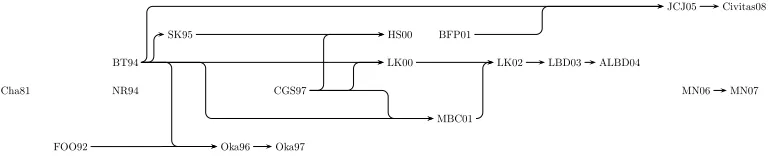
There is a vast body of voting literature concerned with ballot-privacy. Most works published after the seminal work of Benaloh and Tuinstra (BT94) address their stronger privacy requirements. The systems are discussed in order of publication year.
Naturally, design of receipt-free systems is influenced by their (non-receipt-free) prede-cessors. Below we discuss two influential predecessor systems: the FOO92 system [FOO92] and the CGS97 system [CGS97]. The FOO92 system was designed with the intent of actual use. It has been used as the basis for implementation of two voting systems (Sen-sus [CC97] and Evox [Her97]). CGS97 was designed with the intent of being as efficient as possible. As such, CGS97 has been used as a basis by various theoretical systems (including HS00, LK00, MBC01) that aim to incorporate receipt-freeness.
But the main focus is on receipt-free systems. We discuss the seminal work by Benaloh and Tuinstra (BT94) [BT94]. This is followed by an alternative proposal by Niemi and Renvall (NR94) [NR94], which appeared around the same time and addressed the same concerns. From then on, research into voting became quite prolific, and we highlight the influential receipt-free systems that followed their work: Oka96/Oka97, HS00, MBC01, BFP01. In addition, to illustrate a typical development cycle, we highlight the sequence of systems LK00, LK02, LBD03, ALBD04.
After discussing receipt-freeness, we outline JCJ05, the work of Juels, Catalano and Jakobsson [JCJ05]. Their introduction of the notion of coercion-resistance has led to a new direction in voting. Then we examine the MN06 and MN07 systems by Moran and Naor [MN06, MN07] on achieving unconditional privacy – at the cost of having computational (instead of unconditional) verifiability. Finally, we discuss Civitas, an implementation of JCJ05 with some modifications. We end our survey of privacy-focused systems here, as we find that the focus of the community began shifting. The community is steadily moving towards combining existing understanding of privacy with practical verifiability, and away from further refining privacy.
5.2. FOO92: anonymity using blind signatures
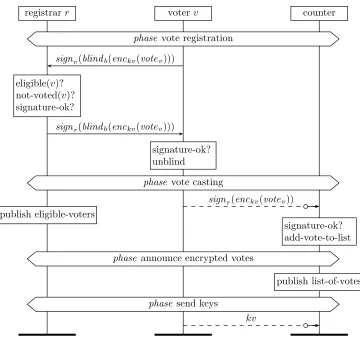
The FOO92 system [FOO92] by Fujioka, Okamoto and Ohta aims to combine privacy with verifiability. To achieve this, it uses blind signatures as follows (see Figure 7). The voter encrypts her vote (using a commitment scheme), blinds that encryption and sends the blinded, encrypted vote to the registrar (the first message of Figure 7). The registrar verifies that the voter is an eligible voter and that she hasn’t voted yet. If so, the registrar signs the blinded, encrypted vote and sends the signed version to the voter (2nd
registrarr voterv counter
phase vote registration signv(blindb(enckv(votev)))
eligible(v)? not-voted(v)? signature-ok?
signr(blindb(enckv(votev)))
signature-ok? unblind
phase vote casting
publish eligible-voters
signr(enckv(votev))
signature-ok? add-vote-to-list phase announce encrypted votes
publish list-of-votes
phase send keys
kv
Figure 7: The FOO92 system.
Then, after the voting period has ended, the counter publishes the list of all signed, encrypted votes that he received. After publication, the voter sends the decryption key for her vote to the counter (the last message in Figure 7). This allows the counter to open the vote and count the votes.
FOO92 serves as the basis for two implemented voting systems: Sensus [CC97] and Evox [Her97]. Evox implements the anonymous channel as a trusted third party; Sensus omits the anonymous channel completely. As such, both implementations deviate from the FOO92 specification in a manner that negatively impacts voter-privacy.
Claims. FOO92 claims ballot-privacy (BP) and an early form of universal verifiability (UV). Moreover, it makes the following additional security claims: completeness (all votes counted correctly), soundness (malformed votes cannot change the result), no double voting, eligibility, and fairness.
Studies. Privacy of the FOO92 system is studied in a.o. [KR05, MVdV07, JdV06, BRS07], fairness in a.o. [KR05, BRS07, TMT+08], eligibility in a.o. [KR05, TMT+08], and veri-fiability of FOO92 is studied in a.o. [BRS07, TMT+08, KRS10].
5.3. BT94: introducing receipt-free voting
In their landmark paper, Benaloh and Tuinstra [BT94] described an attack on vote-privacy, apparently used in Italy. In certain election systems used for multiple parallel elections in Italy, voters could list their votes in any order. Knowing this, and given that the number of possible permutations is far greater than the number of voters, an attacker can assign specific permutations of votes a priori. This permutation then acts as a voter’s “signature”. If a voter’s signature is not in the set of cast votes, the voter deviated from her assigned voting strategy. If the signature is present, then the voter complied with her assigned voting strategy.
The above example illustrates two important things. First, it exemplifies that if the voter can somehow undo the privacy of her vote, she is at risk of being coerced. Secondly, it also shows that any input of the voter may allow her to lift her privacy.
Benaloh and Tuinstra devised a way around this problem. Their solution is con-strained to voting for either 0 or 1. The solution relies on a “doubly” homomorphic randomised cryptosystem, that is, an encryption system that supports two homomor-phic operations: ciphertext operations ⊗and⊘ with plaintext equivalent operations + and −, respectively. Moreover, this cryptosystem must be able to generate proofs of decryption.
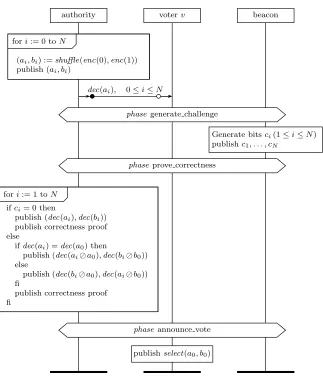
The central idea is to use an interactive challenge-response protocol, where only the voter knows the commitment (in Figure 8, the claimed values of the decryptions ofai). As such, only the voter is convinced. More specifically, the voting authority publishes a series of pairs (ai, bi),0≤i≤N, containing an encrypted 0 and an encrypted 1 in random order. The authority then privately commits to the decryption of the published pairs. Next, an independent and trustworthy random source (“beacon” in the figure) generates the challenge c. The authority responds to the challenge (see below), after which the voter knows which encryption contains her preference. She publicly announces which encryption (either a0 or b0) she prefers. Finally, to determine the result, the authority sums up all encrypted votes using the ⊕ homomorphic encryption, and decrypts the result.
authority voterv beacon
(ai, bi) :=shuffle(enc(0),enc(1))
publish (ai, bi)
fori:= 0 toN
dec(ai), 0≤i≤N
phasegenerate challenge
Generate bitsci(1≤i≤N)
publishc1, . . . , cN
phaseprove correctness
ifci= 0 then
publish (dec(ai),dec(bi))
publish correctness proof else
ifdec(ai) =dec(a0) then
publish (dec(ai⊘a0),dec(bi⊘b0))
else
publish (dec(bi⊘a0),dec(ai⊘b0))
fi
publish correctness proof fi
fori:= 1 toN
phaseannounce vote
publishselect(a0, b0)
Figure 8: Vote casting in BT94
In addition to requiring a cryptographic system with very specific properties, the BT94 system relies on the existence of a voting booth, and a private channel. While cryptographic systems satisfying the particular requirements exist (e.g. [Ben94]), Benaloh and Tuinstra left it unclear how to satisfy these latter two assumptions. In addition, their system can only handle a maximum of two candidates. Schemes following BT94 sought to address these shortcomings, as described below.
Claims. BT94 claims receipt-freeness (RF), and does not explicitly claim a verifiability property. In addition, it claims “correctness of result”.
two different plaintexts are sometimes mapped to the same ciphertext. They proposed a fix which extends to BT94.
5.4. NR94: unlinkable receipts
Around the same time, Niemi and Renvall [NR94] independently identified the threat of vote buying as well. They also noted that all existing systems gave the voter a token, which is made public upon counting. Their solution was to adapt this token, so that the voter cannot prove that it is hers. The (multi-party) computations done for this occur inside a voting booth, which keeps the voter completely private. The token allows a voter to check if her vote is part of the public set of received votes (ensuring individual verifiability). Furthermore, the correctness of the count can be publicly verified (ensuring universal verifiability).
As in the receipt mentioned for FOO92 [JdV06], a voter can predict a random value that will appear on the bulletin board. However, this is not a receipt as the voter may generate fake tokens and thus cast fake votes, which are indistinguishable from real votes. (Note the similarity between this approach to receipt-freeness and the ideas to ensure coercion-resistance in JCJ05.)
The computations needed do not scale well with respect to false votes, something which Niemi and Renvall already noted. Furthermore, the system requires a strict assumption (a voting booth). Although their proposal was influential for its ideas (like [BT94]), the mechanics they proposed have been relegated to the fringes of vot-ing research.
Claims. NR94 claims receipt-freeness (RF), and does not explicitly claim a verifiability property.
5.5. Oka96, Oka97: receipt-free blind signatures
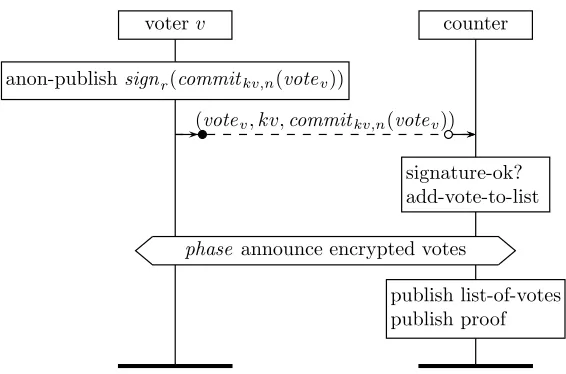
Okamoto proposed an adaption of FOO92 to achieve receipt-freeness [Oka96] (see Figure 9). The main differences with FOO92 (as depicted in Figure 7) are: the direct and anonymous publishing (by voters) on the bulletin board (“anon-publish” in Fig-ure 9), the use of anonymous untappable channels to the authorities, and the use of a trapdoor commitment scheme to encrypt the votes (denoted ascommitkv,nin Figure 9). Knowledge of the trapdoor (rin Figure 9) allows an encryption to be opened in any way (i.e. for any candidate). Due to this, the encrypted vote does not constitute a receipt.
However, Okamoto noted a flaw in the system: the trapdoor is voter-generated (see also [MBC01]). An intruder can force a voter to use an intruder-generated trapdoor. Then, the voter can still encrypt her vote, but she can only open this encryption in one way. In [Oka97], Okamoto proposed three variations to address this flaw. The first uses secret sharing to break up trapdoor r into shares for every counter. The second system generalises the secret sharing to a threshold secret sharing scheme. The third uses a “voting booth” (here, a two-way untappable channel), which the voter can use anonymously. The voter then proves via the voting booth she knowsr, thus preventing the attack on Oka96. We refer to the three systems collectively as Oka97.
voter v counter
anon-publishsignr(commitkv,n(votev))
(votev, kv,commitkv,n(votev))
signature-ok? add-vote-to-list
phase announce encrypted votes
publish list-of-votes publish proof
Figure 9: The Oka96 vote casting phase (improving FOO92).
Studies. Privacy of Oka97 was studied in a.o. [KT09]. Delaune et al. [DKR09] gave a formal analysis of Oka96, finding receipt-freeness satisfied and coercion-resistance violated, confirming Okamoto’s own findings [Oka97]. Dreier et al. have similar re-sults [DLL11, DLL12]. Juels et al. [JCJ05] remarked that Oka97 achieves resistance to forced abstention, by verifying eligibility only in private – which carries its own problems, according to Juels et al.
5.6. CGS97: optimally efficient voting
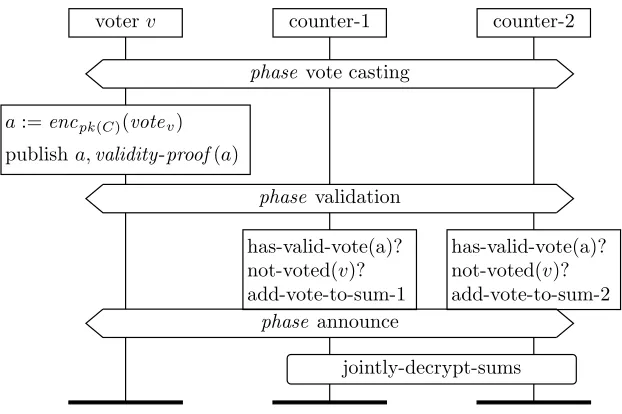
The system proposed by Cramer, Gennaro and Schoenmakers [CGS97] aims to be op-timally efficient for a multi-authority setting. This work builds on efforts by Cramer and others [CFSY96] on improving efficiency in a multi-authority setting. A multi-authority setting is desirable, as it reduces the trust assumption required for each individual au-thority. In their system, a voter publishes a single encrypted vote plus a proof that the published message contains a valid vote. The system is a homomorphic (ElGamal) voting system, it sums all encrypted votes and then uses joint decryption to decrypt the sum. Cramer et al. noted that proofs of validity of ciphertexts (as discussed in Section 3.1) can be made non-interactive using the Fiat-Shamir technique [FS86]. They remark that in this case, care should then be taken to ensure that the constructed challenges are voter-specific (to avoid duplications of challenges). The system is sketched in Figure 10, where pk(C) denotes the public key shared by the counters. Remark that all communication happens via the bulletin board. In particular, the jointly-decrypt-sums action is run via the bulletin board, and leaves any observer able to verify correctness of the announced tally.
voterv counter-1 counter-2
phase vote casting
a:=encpk(C)(votev) publisha,validity-proof(a)
phase validation
has-valid-vote(a)? not-voted(v)? add-vote-to-sum-1
has-valid-vote(a)? not-voted(v)? add-vote-to-sum-2 phase announce
jointly-decrypt-sums
Figure 10: The CGS97 system with two counters.
Hirt and Sako [HS00] pointed out that in the specific multi-party example cited, partic-ipants can prove specific behaviour.
The CGS97 system reduced the communication and computational load for voting significantly, in comparison to previous efforts. In addition, the ideas set forth by this system have been influential, leading to various adaptations to achieve receipt-freeness.
Claims. CGS97 claims universal verifiability (UV) and and ballot-privacy (BP). In ad-dition, it claims the following other security claims: robustness and prevention of vote duplication.
5.7. HS00: homomorphic tallying for randomised candidate lists
Hirt and Sako [HS00] set out to further reduce overhead and enable less strict physical assumptions. They cast a critical eye on previous work, showing a receipt in the multi-authority version of BT94, noting the processing load of SK95 and identifying the use of anonymous, secret communication channels in Oka97 as prohibitive towards adaption.
voterv mixer-1 mixer-2
publish votev
add-vote-to-sum-1 add-vote-to-sum-2
jointly-decrypt-sums
Figure 11: The HS00 vote casting phase (improving upon SK95).
decrypt the result, without reconstructing the decryption key. The vote casting phase is depicted in Figure 11. Note that all communications occur via the bulletin board.
Like [SK95], the used designated verifier proofs require possession of a private key. Hirt and Sako provided a protocol in which a verifier proves she possesses the private key. This ensures non-transferability of the proof.
Hirt and Sako applied their construction to CGS97. The lack of receipt-freeness in CGS97 originates from the fact that the voter creates and posts her vote on a public channel. This derivative consists of the basic construction by Hirt and Sako, and borrows the cryptographic scheme and the encoding of votes from CGS97. Consequently, the resulting system more closely resembles SK95 (as depicted in Figure 15) than CGS97 (as shown in Figure 10).
Claims. HS00 claims receipt-freeness (RF) and a threshold version of ballot privacy (any group with less than t colluding authorities cannot break privacy), and individual and universal verifiability (IV, UV). In addition, it claims correctness of tally. The authors also claim that as long as the voter knows of a non-colluding authority, the voter is even free from coercion.
5.8. LK00: third-party re-encryption of votes
Lee and Kim [LK00] also introduced receipt-freeness in CGS97. Unlike HS00, Lee and Kim did not aim to provide a generic construction for receipt-freeness, but seek to incorporate receipt-freeness into CGS97. Their approach is to ensure that the receipt present in CGS97 (the voter’s vote) can no longer act as a receipt. They introduced a trusted third party, an honest verifier, that cooperates with the voter to construct her encrypted vote. Since neither party is fully aware of the randomness used to encrypt the vote, neither can prove the link between ciphertext and plaintext. For homomorphic tallying, it is necessary to prove that the resulting ciphertext is an encryption of a valid candidate (cf. Section 3.1). To prove validity of the encryption, voter and honest verifier must cooperate.
The vote encryption process, sketched in Figure 12, involves two partly overlapping challenge-response protocols: the first for the voter’s encrypted voteencpk(C),nv(votev),
the second for the verifier’s randomnessnvf. Communication occurs via a public bulletin
verifiervf voter v
noncenv,chalv nonce nvf,chalvf
commit(encpk(C),nv(votev))
chalvf,commit(encpk(C)(nvf))
response(votev,chalvf),chalv
verify response
response(nvf,chalv)
verify response publish validity proof for
rencnvf(encpk(C),nv(votev))
ballot :=rencnvf(encpk(C),nv(votev))
Figure 12: Verifier and voter jointly computing an encrypted ballot in LK00.
First, the voter publicly commits to her encrypted vote. In Figure 12 this concerns the message commit(encpk(C),nv(votev)). The verifier responds with a challengechalvf
to the encrypted vote, and a commitment to her encrypted randomness nvf. The voter
computes the appropriate response response(votev,chalvf) for the received challenge of
her encrypted vote. She then sends the computed response and a challenge of the verifier’s randomness,chalv. If the response is correct, the verifier computes the correct response response(nvf,chalv) to the voter’s challenge, and computes and publishes a proof of validity for the re-encryption of the voter’s encrypted vote. The voter re-encrypts her vote using the encrypted randomnessencpk(C)(nvf) of the verifier, and posts this on the
bulletin board.
Claims. LK00 claims receipt-freeness (RF) and universal verifiability (UV). Additionally, it claims accuracy, eligibility, fairness, and robustness.
Studies. Hirt [Hir01] pointed out that the verifier can help the voter in casting a vote that falsifies the result. Furthermore, the voter can construct a receipt similarly to the receipt in the multi-authority version of BT94.
5.9. BFP01: improving scalability by distributed tallying
Very few systems in literature mention scalability of their approach. Moreover, scal-ability is usually a problem for actual elections. Operations such as mixing all votes together become prohibitively time consuming for constitutions with tens of millions of voters (such as the UK or France).
distributes the computation of the result over several aggregation levels. Their system first computes results at the local level, and then aggregates these at the regional level. Finally, the regional results are aggregated at the national level. The system achieves this by having the voter cast three encrypted votes (one for each aggregation level) along with a proof that the three encrypted votes encrypt the same candidate. To facilitate this, the authors introduced an encoding scheme nowadays known as Baudron counters (cf. Section 4.4).
As these votes are made public, the basic system is inherently not receipt-free. Bau-dron et al. addressed this by suggesting to use a hardware device to re-encrypt the votes (reminiscent of LK00). Correctness of the encryption can be proven using an interactive zero knowledge proof or a non-interactive, designated verifier proof. They claimed that the interactive zero knowledge proof would not harm receipt-freeness as the actual tran-script of the interaction is indistinguishable from a simulated trantran-script (and thus the voter can provide a fake transcript). However, as pointed out by Hirt [Hir01] and later by Juels et al. [JCJ05], the interactivity in a zero knowledge protocol can be abused to construct a receipt. Moreover, the remark in [HS00] concerning designated verifier proofs is also not addressed. As Baudron et al. did not provide further details, we consider the claim of receipt-freeness for their protocol dubious at best.
Claims. BFP01 claims receipt-freeness (RF) and universal verifiability (UV). In addition it claims robustness against faulty authorities.
5.10. MBC01: smart cards re-encrypting votes
Magkos, Burmester and Chrissikopoulis again set out to transform CGS97 into a receipt-free voting system. Independent of Lee and Kim [LK00], they followed the same approach of trying to ensure that the obvious receipt of CGS97 is not a proof of how the voter voted. As in [LK00], randomness from a third party is used to encrypt the voter’s vote. However, instead of relying on an external party, they implemented their system using a tamper-resistant smart card (see Figure 13). The voter sends a random order of the two possible votes (+1 and -1) to the smart card. The smart card then re-encrypts these values (denoted by renc in the figure) and sends them back. Finally, the smart card proves the correctness of the re-encryption using an interactive zero knowledge proof (denoted by the dotted arrow in Figure 13). After this, the voter knows which of a′, b′
is an encryption of her choice. After this, the system mimics the steps of the CGS97 system.
Magkos et al. identified a need for randomness in voting systems, to ensure vote-privacy. They analysed where this randomness could originate from: voter, authorities or an external source. According to their analysis, letting the voter introduce randomness enables her to abuse the randomness as a receipt. Letting the authorities choose the randomness implies a need for an untappable channel, according to this analysis. An external source would also require such a channel. However, Magkos et al. proposed to provide the voter with tamper-resistant smart cards for introducing randomness. This would reduce the assumptions further: as long as the voter can interact with the smart card in an unobserved, untappable way, receipt-freeness can be achieved.
smartcard voterv
(a, b) :=shuffle(enc(0),enc(1))
noncen, n′
(a, b)
a′=rencn(a)
b′=rencn
′(b)
(a′, b′)
correctness proof
Figure 13: MBC01 extensions to ensure receipt-freeness in CGS97.
channels. Furthermore, their relaxation is achieved by introduction of a smart card. They did not answer the question whether this introduction brings new risks.
Claims. MBC01 claims receipt-freeness (RF) if using a tamper-free smart card, and makes no explicit verifiability claims.
Studies. Independent of each other, [LK02] and [JCJ05] identified the same method (using an intruder-supplied challenge) to arrive at a receipt in the MBC01 system, irre-spective of tamper-freeness of the smart card.
5.11. Lee et al. series: Externally re-encrypted votes
In collaboration with others, Lee explored external re-encryption of votes to repair the LK00 system in three closely related systems. The first system uses dedicated hardware in a homomorphic tallying scheme (LK02), the second (LBD03) adopts this to a mixnet setting instead. The third system (ALBD04) tweaks the mixnet setting for the use of an optimistic mixnet system.
LK02: Smart cards re-encrypting votes. Lee and Kim heeded Hirt’s remarks [Hir01] and noted that the approach to constructing a receipt for LK00 is also applicable to MBC01, as both voting systems use interactive proofs, where the voter may abuse her interactivity to construct a receipt. They also claimed that this holds true in general for blind signatures: the used blinding factor can act as a receipt.
Lee and Kim based their system [LK02] on the system proposed in [Hir01], but they replaced the assumption of a trusted third party randomiser therein with an assumption of a tamper-resistant randomiser possessed by the voter. The resulting system greatly resembles the MBC01 system (and is thus not depicted graphically), where the interactive proof is replaced with a designated verifier proof.
that the voter does not possess the decryption key). Furthermore, as Lee and Kim them-selves pointed out, one of the proof-techniques they use may leak more information than intended.
In addition to the above remarks, the conclusions for MBC01 carry over to LK00: the constraints are relaxed by introducing a new object, but the security of this new object is not extensively treated.
LBD03: Mixing instead of homomorphic tallying. Lee et al. took the LK02 system and used mixnets instead of homomorphic tallying [LBD+04]. LBD03 does not propose any particular mixnet. Since LBD03 decrypts the individual votes, a proof of validity of the vote is no longer necessary, and thus dropped. Lee et al. noted that the malleability of the cryptographic system used in LBD03 enables a voter to copy another voter’s encrypted vote. They seemed to imply that this does not pose a security risk, even though the signed and encrypted votes of each voter is cast by making it public.
ALBD04: Optimistic mixing. Aditya joined Lee et al. in [ALBD04], which proposes an optimistic mixnet for LBD03. In addition, the tamper-resistant hardware is removed by letting an authority fulfill the vote re-encryption tasks. The mixnet used is optimistic in that it only proves that the product of the input is the product of the output, not that there exists a strict correspondence between in- and output. Thus, a dishonest mix could mix votes c1,c2 as 12c1 and 2c2, since 12c1 ·2 c2 =c1 ·c2. To deal with such
situations, the system proposes a trace-back protocol which traces a vote back through the mixnet (by having each mix in turn undo its mixing for that vote) to find the faulty mix, in case the decrypted vote was invalid.
As Aditya et al. pointed out, the security of optimistic mixnets is not beyond doubt yet (see e.g. [Wik03]). They introduced several changes to the used optimistic mixing scheme to prevent identified flaws. Most notable of these changes are the use of only one encryption layer, and omitting the hashing. This latter change reintroduces the possibility to change votes as explained above.
Claims.
• LK02: receipt-freeness (RF) and universal verifiability (UV).
Further claims: soundness, completeness, unreusability, eligibility, and fairness.
• LBD03: receipt-freeness (RF) and universal verifiability (UV). Further claims: prevention of double voting and fairness.
• ALBD04: receipt-freeness (RF), individual and universal verifiability (IV, UV). Further claims: eligibility, prevention of double voting, fairness and robustness.
Studies. Privacy of LBD03 is studied in a.o. [KT09, DKR09, DLL11].
5.12. JCJ05: introducing coercion-resistance
is forced to vote for a random candidate). They proposed a new notion of privacy, coercion-resistance, to capture the requirement of being receipt-free and preventing the three attacks, and propose a system to satisfy this requirement. This seminal system has laid the basis for the development of other election systems including the recently proposed Civitas [CCM08] (cf. Section 5.14).
1. L:= “list of all published encrypted votes + credentials + proofs.”
B:= “list of all valid, encrypted credentials published by the registrar.” 2. Remove all rows with invalid proofs fromL.
3. Remove all rows with duplicate credentials fromL. E.g. by keeping the most recently cast row / vote. 4. MixL.
5. Remove fake credentials fromL.
Achieved by plaintext-equivalent-tests betweenB andL. 6. Decrypt remaining ballots onL.
7. PublishL.
Table 1: The counting process in JCJ05.
Juels, Catalano and Jakobsson’s protocol uses zero-knowledge proofs and an anony-mous public channel. Moreover, it assumes the channel between registrar and voters to be untappable. Voters receive a credential from the registrar in the registration phase. This credential constitutes a proof of eligibility and is used in the voting phase. Addition-ally, the registrar publishes the credential encrypted by the tallying authority’s public key. In the voting phase, voters cast their vote on the anonymous channel by sending on the channel their vote, their encrypted credential and a zero-knowledge proof of the credential and of validity of the vote. In the end, the tallying authorities first check the proofs, then eliminate duplicates, next mix the ballots, then check the credentials and finally publish the set of valid votes. A plain-text equivalence test between the encrypted credential received from the voter and the published encrypted credential allows the tal-lying authorities to check the validity of the credentials without decrypting them, thus preserving their secrecy. The main reason why their protocol is coercion-resistant lies in the fact that a voter can derive fake credentials from the real one and use these fake credentials as the attacker pleases. Votes cast using these fake credentials are removed in the tallying phase. Since validity of credentials are only checked after the votes have been mixed (cf. Table 1: mixing precedes removal of fake credentials), the link between a removed vote and a published vote is not retrievable. The computational workload in JCJ05 is heavy, and several works [Smi05a, WAB07, AFT08, SKHS11] have suggested adaptations to address this issue.
Claims. JCJ05 claims receipt-freenesss (RF), coercion-resistance (CR), and universal verifiability (UV). Note that their definition of coercion-resistance implies receipt-freeness.
5.13. MN06, MN07: Achieving unconditional privacy
Moran and Naor [MN06] argued the need for information-theoretic (or unconditional) privacy, as opposed to computational privacy achieved by encrypting votes. Moran and Naor remarked that regular encryption is computationally hiding (a computationally un-bounded adversary can decrypt), but unconditionally binding: there is only one correct decryption. The Pedersen commitment scheme [Ped91] has the converse property: com-mitments are computationally binding, but unconditionally hiding. With this in mind, Moran and Naor proposed to use commitments instead of encryption. This recalls a prior system by Cramer et al. [CFSY96], which also uses commitments. However, this earlier system is not receipt-free.
To ensure privacy and verifiability of the commitments, Moran and Naor adopted the MarkPledge method (cf. Section 6.5). To ensure verifiability of the tally, they employed a cut-and-choose zero knowledge proof: the counter producesknew lists of commitments, each list being a masked permutation of the list of all voters’ commitments (list 0). Then, a public random source outputs bits 1, . . . , k. If biti= 0, list iis opened (proving the result of listiis the announced result). If biti= 1, the permutation is revealed, proving that list iis a reordering of list 0.
This system relies on a trusted authority, who learns how each voter votes. In [MN07], Morat and Naor addressed this by introducing a way to secret-share commitments (adapted from the layered ballots of Punchscan). This removes the need for the Mark-Pledge method. Simply put, the commitment is shared between two authorities. They privately communicate about the randomness each used for the ballot order, thus en-abling them to reconstruct the voter’s choice.
Claims. Both MN06 and MN07 claim receipt-freeness (RF) and universal verifiability (UV). In addition, both claim “everlasting privacy” – the privacy of the link between voter and the choice they input does not depend on any computational assumption.
5.14. Civitas
Clarkson, Chong and Myers designed and implemented a remote voting system called Civitas [CCM08], which is considered as the first implemented system that is coercion-resistant and verifiable. The strong security provided by Civitas comes at the expense of its time-consuming tabulation phase. Civitas is based on JCJ05, but differs in several aspects. For instance, instead of assuming a single registration authority, Civitas has a registrar and a set of mutually distrusting registration tellers and introduces a con-struction of credential shares. The JCJ05 system does not describe how to distribute credentials, while a concrete protocol for this purpose is introduced in Civitas and is proven to be secure. In addition, Civitas provides concrete instantiations of crypto-graphic components which are left unspecified in JCJ05.
Claims. Civitas claims individual and universal verifiability (IV, UV) and coercion-resistance (CR).
Studies. Privacy of Civitas has been studied in a.o. [KT09].
5.15. Summary
The claims made by the various systems with respect to privacy and verifiability are listed in Table 2. Each row lists privacy claims made, verifiability claims made, known attacks, the main cryptographic technique used, and finally, works that investigated the system.
privacy verifiability attacks based on
FOO92 BP UV [KR05]⋆ Blind Sig
CGS97 BP UV Hom Enc
BT94 RF – [HS00] Hom Enc
NR94 RF – Multiparty Comp
SK95 RF UV [MH96] Mixnet
Oka96 RF – [Oka97] Blind Sig, Commit
Oka97 RF IV, UV Blind Sig, Commit
HS00 RF IV, UV Mixnet
LK00 RF UV [LBD+04] Hom Enc
BFP01 RF UV [Hir01, JCJ05] Hom Enc
MBC01 RF – [LK02, JCJ05] Hom Enc
LK02 RF UV Hom Enc
LBD03 RF UV Mixnet
ALBD04 RF IV, UV Mixnet
JCJ05 RF, CR UV Mixnet
MN06 everlasting BP, RF UV Commit
MN07 everlasting BP, RF UV Commit, Hom Enc
⋆ The problems found are due to unclarities, not to a fundamental problem with the system.
Table 2: Claims, subclassification, analyses of voting systems.

![Figure 5: An example of a mixnet in operation (adapted from [HS00]).](https://thumb-us.123doks.com/thumbv2/123dok_us/7900936.1311563/11.612.142.455.88.199/figure-an-example-mixnet-operation-adapted-from-hs.webp)