V. Muralikrishna
1, Dr,B.Rama
2, Dr. Arvind Kumar Sharma
3 1Research Scholar, Department of Computer science, OPJS University, Rajasthan.
2Professor, Computer Science Department, Kakatiya University, Warangal.
3Associate Professor, OPJS University, Rajasthan.
ABSTRACT:Palmprint era is one of the biometric
strategies used toidentify an character. Recognition of palmprints is based on the features likepalm traces, texture, ridges and many others. Several line and texture extraction techniqueshave already been proposed.A biometrictemplate consists of N m-element function vectors, in which N is the overallrange of overlapping subimages, and m is the wide variety of neighborhood Haralick functions per subimage inside the ROI. A stay biometric template and templates fromdatabase are matched in N matching modules. Based on fusion at the matchingscore level, the overall similarity measures among a stay biometric template andtemplates from the database are calculated. By the usage of the most of generalsimilarity measure and the 1-NN category rule, the very last decision (personidentification) is made.
KEYWORDS-Palmprint, local Haralick features,
Open set identification
I. INTRODUCTION
Palmprint is the inner part of a person’s hand. For centuries, the palm line patterns have popularly been believedto be able to predict a person’s future. But its
uniqueness and capacity for distinguishing
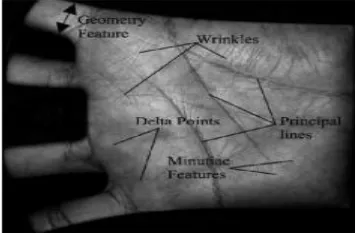
individuals has come to foreonly recently. Palmprint is also one of the reliable modality since it possess more features than that of the other modalitysuch as principal lines, orientation, minutiae, singular points etc. Also palmprint modality is unique for each individual ,moreover it is universal. Palmprint recognition is used in civil applications, law enforcement and many such applicationswhere access control is essential.Palm has features like geometric features, delta point’s features, principal lines features, minutiae, ridges andcreases. Principal lines are namely heart line, head line and life line. Figure 1
shows structure of palmprint. Palmprintcontains three principal lines which divides palm into three regions:
Interdigital, Hypothenar and Thenar. An
Interdigitalregion lies above the Heart line. The Thenar lies below the Life line. And Hypothenar is between Heart and Life line.From palmprint principal lines, minutiae, ridges features can be extracted for identification.
Palmprint recognition techniques have been grouped into two main categories, first approach is based on lowresolution features and second approach is based on high-resolution features. First approach make use of low-resolutionimages (such as 75 or 150 ppi), where only principal lines, wrinkles, and texture are extracted. Second approach useshigh resolution images (such as 450 or 500 ppi) , where in addition to
principal lines and wrinkles, more
discriminantfeatures like ridges, singular points, and minutiae can be extracted.
Fig. 1 Different Features of Palm
Algorithms such as the stack filter [10] are able to extract the principal lines.However, these principal lines are not sufficient to represent the uniqueness of eachindividual’s palmprint because different people may have similar principal lines ontheir palmprints [7].This paper contains some data about the extraction of features like palm lines and texture
present onthe palm. Filiformity [6] technique is used for extracting the line features. Thistechnique can extract the lines even from the low contrast images. Texture featuresare extracted using Gabor filter technique [7]. Two fusion strategies are employed onthe features extracted using filiformity and Gabor filter techniques.
II. BACKGROUND WORKS
A. Gyaourova and A. Ross[1] have proposed an indexing technique that can either employ the biometricmatcher that is already present in the biometric system or use another independent matcher. Index codes are generated foreach modality using the corresponding matcher. During retrieval, the index code of the probe is compared against those in the gallery using a similarity measure to retrieve a list of candidate identities for biometric matching. the
proposedindexing technique on a chimeric
multimodal database resulted in a reduction of the search space by an average of 84%at a 100% hit rate. The main factor for the amount of speedup during identification was the penetration rate of theindexing.
Dai and Zhou [2] introduces high resolution approach
for palmprint recognition with multiple
featuresextraction. Features like minutiae, density, orientation, and principal lines are taken for feature extraction. For orientationestimation the DFT and Radon-Transform-Based Orientation Estimation are used. For minutiae extraction Gabor filter isused for ridges enhancement according to the local ridge direction and density. Density map is calculated by using thecomposite algorithm, Gabor filter, Hough transform. And to extract the principal line features Hough transform isapplied. SVM is used as the fusion method for the verification system and the proposed heuristic rule for theidentification system.
A. Kong and D. Zhang [3] have presented a novel feature extraction method, the Competitive Coding Schemefor palmprint identification. This scheme extracts the orientation information from the palm lines and stores it in theCompetitive Code. An angular match with an effective implementation is developed for comparing Competitive Codes.Total execution time for verification is about 1s, which is fast enough for real-timemapplications. The proposed codingscheme has been evaluated using a database
with 7,752 palmprint images from 386 different palms. For verification, theproposed method can operate at a high genuine acceptance rate of 98.4% and a low false acceptance rate of 3*10-6.
Jiaa, Huanga and Zhang [4] have proposed palmprint verification based on robust line orientation code.Modified finite Radon transform has been used for feature extraction, which extracts orientation feature. For matching oftest image with a training image the line matching technique has been used which is based on pixel-to-area algorithm.
D. Huang, W. Jia, and D. Zhang[5] proposed a novel algorithm for the automatic classification of low-resolutionpalmprints. First the principal lines of the palm are defined using their position and thickness. Principal lines are definedand characterized by their position and thickness. A set of directional line detectors is devised for principal lineextraction. By using these detectors, the potential line initials of the principal lines are extracted and then, based on theextracted potential line initials, the principal lines are extracted in their entirety using a recursive process. The localinformation about the extracted part of the principal line is used to decide a ROI and then a suitable line detector ischosen to extract the next part of the principal line in this ROI. After extracting the principal lines, some rules arepresented for palmprint classification. The palmprints are classified into six categories considering the number of theprincipal lines and their intersections. From the statistical results in the database containing 13,800 palmprints, thedistributions of categories 1–6 are 0.36%, 1.23%, 2.83%, 11.81%, 78.12% and 5.65%, respectively. The proposedalgorithm classified these palmprints with 96.03% accuracy.
J. You, W. Kong, D. Zhang, and K. Cheung[7] proposed a dynamic selection scheme by introducing globaltexture feature measurement and the detection of local interesting points. Our comparative study of palmprint featureextraction shows that palmprint patterns can be well described by textures, and the texture energy measurement possessesa large variance between different classes while retaining high compactness within the class. The coarse-levelclassification by global texture features is e4ective and essential to reduce the number of samples for further processingat fine level. The guided searching for the best matching based on
interesting points improves the system
efficiencyfurther.
W. Li, J. You, and D. Zhang[8], have proposed an effective indexing and searching scheme for an image database to facilitate fast retrieval when the size of a palmprint database is large. There are three key issues to beconsidered: feature extraction, indexing, and matching . In general, in an image database, the extracted features are oftenassociated to the original images as indices. A search for the best matching is conducted in a layered fashion, where onefeature is first selected to lead the search by reducing the set of candidates. Then other features are used to reduce the candidate set further. Such a process will be repeated until the final output is determined based on the given matchingcriteria. The selection of features plays an important role for efficient search. An effective feature selection schemeshould exclude the most impossible candidates, compare easily, require small size of space for storage.
Prasad, Govindan and Sathidevi[9], have proposed Palmprint Authentication Using Fusion of Wavelet BasedRepresentations. Features extracted are Texture feature and line features. In proposed system pre-processing includes lowpass filtering, segmentation, location of invariant points, and alignment and extraction of ROI. OWE used for featureextraction. The match scores are generated for texture and line features individually and in combined modes. Weightedsum rule and product rule is used for score level matching.
In biometrics applications Haralick features [11], [12] are used for fingerprint classification [13], face [14]
and iris recognition [15]. As far as we know, beside our paper[16], there are only four other descriptions of applications of Haralick features forpalmprint recognition. In [16] we have described the basic idea of using localHaralick features and results of the
series of preliminary palmprint recognition
experiments for different parameters of the gray-level co-occurrence matrix (GLCM) for 8x 8 subimages. The experiments were performed on two relatively small databases(550 hand images of 110 people and 1324 hand images of 133 people). It was shownthat the achieved recognition rate (98.91%) was better then the recognition rate for thesame databases for the eigenpalm approach. In [17] the author used the Haralick features obtained from relatively large
subimages (22 x 22) along the palmprint
principallines. Verification experiments were
performed on the small part of the PolyU database (only 50 persons) and have shown a poor performance (EER above 14%). Basedon such performance, it may be concluded that the above described approach is notpromising.
III. PROPOSEDWORK
The investigational palmprint recognition system consists of the following modules:preprocessing module, module for localization and normalization of ROI, localHaralick feature extraction moule, N matching modules, template database, N distance to similarity transform modules, fusion module, 1-NN and decision module. Theshort descriptions of functions of the above modules consequently follow.
A. Preprocessing
In the preprocessing module some standard image preprocessing procedures areapplied on the input hand-images from PolyU database: global threshold, contour andrelevant points extraction. Based on the contour of the hand and the relevant points onit, the palmprint ROI is automatically localized. After that, the ROI is cropped fromthe gray-scale image, rotated to the same position, sized to the fixed dimensions (96 x96 pixels) and then it is light normalized using histogram fitting. The procedures ofpreprocessing are similar to those described in [1]. Light normalization is described indetail in [5]. We would like to stress that preprocessing is not in the focus of the paperand it is only briefly described.
In the feature extraction module, the local Haralick features are extracted from apalmprint ROI as follows. The palmprint ROI represented as a D x D pixels graylevel image (D = 96, G = 256 gray levels) is divided into a set of N overlappingsubimages. In our implementation, we use the square subimages obtained by using asliding-window approach. A sliding-window of the size dxd pixels is positioned inthe upper-left corner of the ROI. The first subimage is composed of all the pixels of apalmprint ROI that fall inside the window. After that, the window is translated by t =d /2 pixels to the right, and so on.
When the sliding-window falls outside of
thepalmprint ROI, it is moved t pixels down and all the way to the left of the ROI. Theprocess is concluded when the bottom-right corner of the sliding-window reaches thebottom-right corner of the palmprint ROI.
we have foundthat:
i) three local Haralick features (energy, contrast, correlation) are sufficiently discriminatory for palmprint recognition purposes,
ii) the size of the window d = 12, the sliding-window translation step t = 6and the distances δ from 1 to 6, give satisfactory recognition accuracy,
iii) the number of gray-levels of the palmprint ROI which is less than G = 128 degrades the recognition accuracy. We have selected G = 256 levels.
iv) the recognition accuracy becomes lower if the resolution of the palmprint ROIis decreasing. The resolution 96 x 96 was selected.
IV. CONCLUSION
The objective of this work is to investigate the performance of the palmprint system by extracting reliable features from the palmprint. We extracted linelike features as well as texture features from the palmprint image. Performance rateslike GAR and FAR are calculated for each technique. In case of filiformity techniquethe FAR rates are better than GAR rates, which implies that a genuine person may bedenied but an impostor is not allowed.
REFERENCES
1. A. Kong, D. Zhang, M. Kamel. A survey of palmprint recognition, Pattern Recognition,42, pp. 1408-1418, 2009.
2. D. Maltoni, D. Maio, A. K. Jain, S. Prabhakar.
Handbook of fingerprint
recognition,Springer-Verlang, New York, 2003.
3. D. Zhang. Palmprint Authentication, Kluwer Academic, Norwell, 2004.
4. G. Lu, D. Zhang, K. Wang. Palmprint recognition using eigenpalms features, Pattern Recognition Letters, 24, (9), pp. 1463-1467, Sept. 2003.
5. S. Ribaric, I. Fratric. A biometric identification system based on eigenpalm and eigenfinger features, IEEE Transactions on Pattern Analysis and Machine Intelligence, vol. 27 no.11, pp. 1698-1709, Nov. 2005.
6. X. Wu, D. Zhang, K. Wang. Fisherpalms based palmprint recognition, Pattern RecognitionLetters, vol. 24, no. 15, pp. 2829-2838, Nov. 2003.
7. D. L. Swets, J. J. Weng. Using discriminant eigenfeatures for image retrieval, IEEETransactions on Pattern Analysis and Machine Intelligence, vol. 18, no. 8, pp. 831-836,Aug. 1996.
8. L. Shang, D.S. Huang, J.X. Du, Z.K. Huang, Palmprint recognition using ICA based onwinner-take-all-network and radial basic probabilistic neural network, in: ser. LectureNotes in Computer Science, 3972, Springer, pp. 216-221, 2006,.
9. D. Zhang, W.K. Kong, J. You. Online Palmprint identification, IEEE Transactions on Pattern Analysis and Machine Intelligence, vol. 28, no. 9, pp. 1041-1050, Sep. 2003.
10. X. Wang, H. Gong, H. Zhang, B. Li, Z. Zhuang. Palmprint identification using boostinglocal binary pattern”, in: Proc. of International Conference on Pattern Recognition, pp.503-506, 2006.
11. R. M. Haralic. Statistical and structural approaches to texture, Proceedings of the IEEE,vol. 76. no. 5, pp. 786-804, May 1979.
12. R. M. Haralic, K. Shanmugam, I. Dinstein.
Textural features for image classification,
13. M. Yazdi, K. Gheysari. A New Approach for the Fingerprint Classification Based onGray-Level
Co-Occurrence Matrix, International Journal of
Computer and InformationScience and Engineering 2;3, pp.171-174, 2008.
14. M. F. Augusteijn, T. L. Skufca. Identification of
Human Faces through Texture-BasedFeature
Recognition and Neural Network Technology, in: Proc. IEEE Int. Conference onNeural Networks, pp. 392-398, Apr. 1993.
15. R. Szewczyk, P. Jablonski, Z. Kulesza, A. Napieralski, J. Cabestany, M. Moreno. Automatic people identification on the basis of iris pattern extraction features and classification,in: Proc. of the MIEL 2002, pp. 691-694, 2002.
16. S. Ribaric, M. Lopar. Palmprint recognition based on local Haralick features, in: Proc.IEEE Melecon 2012, 657-660, March 2012.
17. D. S. Martins, Biometric recognition based on the texture along palmprint principal lines,Faculdade de
Engenharia da Universidade do Porto,
2011.
http://repositorio-aberto.up.pt/bitstream/10216/61287/1/000148639.pdf
, accessed March 8,2013.
18. D. Zhang, Z. Guo, G. Lu, L. Zhang, Y. Liu, W. Zuo. Online joint palmprint and palmveinverification,
Expert System with Applications,