VICTORIA ~ UNIVERSITY
-·
~·.
·· .· ..~
0 . . .• 0·...
=
DEPARTMENT OF COMPUTER AND
MATHEMATICAL SCIENCES
Factors Affecting the Choice of Target for a Process
with 'Top-Up' and 'Give - Away'
Violetta
I.
Misiorek and Neil S. Barnett
(62 EQRM 18)
December,
1995
(AMS
: 62Nl 0)
TECHNICAL REPORT
VICTORIA UNIVERSITY OF TECHNOLOGY
DEPARTMENT OF
CO~UTERAND MATHEMATICAL SCIENCES
P 0BOX14428
MCMC
Factors Affecting the choice of Target for a Process
with 'Top-Up' and 'Give -Away'
Violetta
I.
Misiorek
and
Neil S. Barnett
AMS 62N10
Department of Computer and Mathematical Sciences
Victoria University
ABSTRACT
The purpose of this paper is to develop a model for the optimal selection of a process setting with a view to maximising the expected profit per manufactured item. The main focus is on a situation where product above a certain threshold is sold at a regular price, product below that threshold but above some other dimensional value can be reprocessed at a cost and sold at the regular price. All other items are unsaleable. In addition,
product above the threshold implies 'give-away'. The dependencies between the process parameters and the optimal value of the process setting are graphically displayed and discussed.
Key words: Quality Selection, Optima/Target value, Process Control.
1. INTRODUCTION
This report focuses on an extension of the work of Hunter and Kartha (1977) in which they determine the initial ( and assumed static ) setting of an industrial process with a view to maximising the expected profit per manufactured item. The problem revolves around the situation where product above a certain dimensional threshold attracts a fixed selling price and product below the
threshold attracts a reduced yet fixed selling price. In addition, product above the threshold implies 'give-away' which diminishes the net profit per item. The
essential issue is to find the most suitable process setting (the process mean) so as to effectively trade off diminished profit due to 'give-away' with diminished profit induced by producing below the stipulated threshold. Besides successfully formulating the problem, Hunter and Kartha provide a graphical method of solution. The authors consider the problem under the assumption that once the initial setting is made, no other control actions are subsequently required.
Burr (1962), Springer (1951) and Bettes (1962) all considered related problems; the latter two took economic aspects into account and determined the optimal location of the mean , which minimizes the total costs.
Bisgaard, Hunter and Pallesen (1984) considered a more general problem
by developing a procedure for selecting optimal values for the process mean as
well as the variance. They eliminated the assumption made by Hunter and Kartha
that all underfilled items can be sold for a fixed price. They considered a situation
where the underfilled items are sold for a price that is proportional to the amount
of ingredient in the container. The objective was to maximise profit.
Boucher and Jafari (1991) extended the above work by evaluating the
problem under a sampling plan as opposed to 100% inspection.
They considered a case in which the reject criterion is based on the number of
nonconforming units in a sample. Two profit functions were proposed; one for
destructive testing , the other for nondestructive testing.
This current report considers a similar problem using variations of the
model of Hunter and Kartha. The main focus is on a model where production
between two dimensional values can be reprocessed at a cost but where items
produced below the lower of these is unsaleable. As before, items initially
produced above the upper threshold attract a fixed selling price but involve
'give-away' product. The problem, once again, is to obtain the optimal process setting so
as to maximise the expected profit per item. The problem is formulated, the
solution discussed and the nature of dependencies of the solution on the problem
parameters illustrated. The existence of more sophisticated computational tools,
than those available in 1977, when Hunter and Kartha published their work,
removes the necessity or desirability of relying on graphical methods of solution.
None-the-less, graphical displays are shown to be powerful indicators of
parameter dependencies.
Process operations that involve placing fluid product into containers
typically illustrates the area where problems of this nature most commonly occur.
It is, therefore, in this setting that the model is framed. In this context, a
production item represents an amount of product provided in a particular
2. GENERAL PROBLEM
Consider a process where containers are filled, with quantity requirements q, as close to L as possible. If q ~ L then they are sold at a fixed selling price, with
Profit = A - Production Cost.
where A = Selling Price - Material Cost.
If, however, L 0 :$; q < L the item can be 'topped-up' and sold at the same price
providing
Profit = B - Production Cost,
where B =A -Additional Processing Cost.
When a container needs to be 'topped-up' it is assumed that this can be done exactly. A container such that q <Lo is not 'topped-up', above all, for economic reasons, although the material does not have to be considered lost under such circumstances. The production cost p, which is the cost of filling, is assumed to be constant regardless of the amount placed in the container.
Whenever q > L then there is 'give-away' product and the cost of this excess per unit measure is denoted by e. The aim is to find the mean setting of the process ( assumed to be stable ) so that the profit per container is maximised. Figure 1 illustrates the inter-relationships between L 0 , L and T, the target dimension,
Unless
a
Lo L T
Figure I
Shows the inter-relationships between lower limit of the process ( L ), the "secondary " lower limit ( L 0 ) and the target dimension ( T ).
Jn practical applications, the Target value is ordinarily above L but it is possible for Target to be placed below L.
where
a
is the process standard deviation, then the problem is not significantlydifferent from that considered by Hunter and Kartha. The inequality is thus
assumed to hold.
In the analysis it is assumed that q is normally distributed with mean T and
known variance a 2 • In any practical situation it would be expected that the
optimal value of 8, which is the focus of attention, is greater than 0, however this
depends on a., the ratio between A and B, and/or on the standard deviation of the
process. Again, from practical considerations, B/ A < 1, where A, B > 0. The
Target value, T=L+8 is called optimum if it maximises the expected profit per
container.
3. THEORETICAL
ANALYSIS
The profit from a single item may be written as follows:
=
(A-p) -e ( q -L) , q ~L P(q)=
B-p , Lo ~q ~ L= -p , otherwise.
Thus the expected profit per item, denoted by E[P(q)], is
co co L Lo
E[P(q)] = (A-p)
J
f(q)dq - eJ
f(q)dq + (B-p)J
f(q)dq - pJ
f(q)dq (1)L L Lo --oo
where f( q) is the p.d.f. of q i.e.
f(q)
=
(27tcr2f
112 exp{-(q -T)2 I 2cr2}The objective is to obtain the value of 8 that maximises E[P(q)]; where 8 = T -L.
Let
cj>(x) = (27t 2 )-u2 exp(-x 2 /2)
q
<l>( q) =
J
<j>(x)dxEquation ( I ) can be simplified to
. -8 -8 -8 - a 00
J
E[P(q)]
=
A{l- <l>(-)} + B{<l>(-)- <l>( )}- e (q - L)f(q)dq - p.cr cr cr
L
Differentiating with respect to 8 and using a result of Hunter and Kartha (1977),
E'[P(q)]
=
[(A-B)/ cr]<j>(-8/cr) + (B/cr)<j>[(-8-a)/cr] - e<l>(8/cr). (2)Setting equation (2) to zero, gives:
[<l>(8/cr)r1 {<j>(-8/cr) + (B/(A-B)) <j>[(-8-a)/cr]} = ecr I (A-B) (3)
The second derivative with respect to 8 from (2) gives,
E"[P(q)] = -[(A-B)/ cr](8/cr2 )<j>(8/cr)-(B/cr)[(8+a)/cr2 ]<j>[(8+a)/cr]- (e/cr)<j>(8/cr).
If E"[P(q)] < 0 (with 8 = 80 ) that is if
_ 80 _ B(80 +a)<j>((80 +a) I a)< ea
cr (A-B)<j>(80/cr) A-B (4)
then 8 0 is optimal. The solution to (3) will then give a setting for the target that
will maximise the expected profit.
From practical considerations a > 0 and if 8 < 0 then -8 < a and so
4. DISCUSSION
To investigate the relationships between the variables, as well as to study the effects of various model parameters on the target mean and the expected profit, several data sets were generated using Mathematica. The following graphs were obtained using Mathematica and SPSS.
Unless otherwise stated, each analysis is based on the example given by Hunter & Kartha .Some additional values, believed to be suitable, are also chosen by the authors. For q:;:::: L, A, the price per item is 67 and the "give-away" cost is 5 5. The distance between L 0 and L is 0.1 and L= 1.
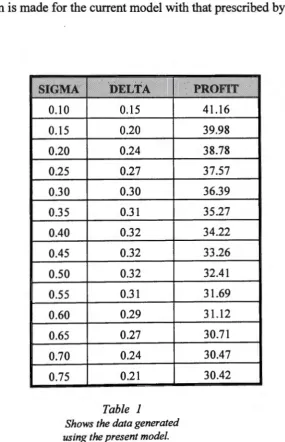
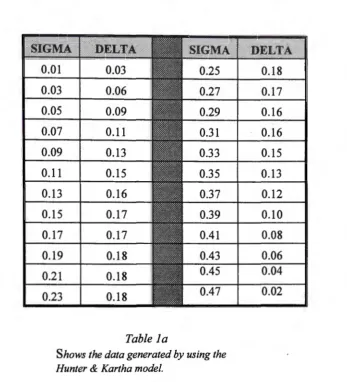
Discussion commences with a study of the relationship between the process standard deviation and the optimal value of 8 0 • The data used is shown in Table 1 (the present model) and la ( Hunter&Kartha model). A graphical comparison is made for the current model with that prescribed by Hunter and Karth a.
SIGMA DELTA
0.10 0.15
0.15 0.20
0.20 0.24
0.25 0.27
0.30 0.30
0.35 0.31
0.40 0.32
0.45 0.32
0.50 0.32
0.55 0.31
0.60 0.29
0.65 0.27
0.70 0.24
0.75 0.21
Table I
Shows the data generated using the present model.
PROFIT ·
41.16
39.98
.. SIG-MA ··· <<DELl.'A SIGMA·
0.01 0.03 0.25
0.03 0.06 0.27
0.05 0.09 0.29
0.07 0.11 0.31
0.09 0.13 0.33
0.11 0.15 0.35
0.13 0.16 0.37
0.15 0.17 0.39
0.17 0.17 0.41
0.19 0.18 0.43
0.21 0.18 0.45
0.23 0.18 0.47
Table la
Shows the data generated by using the
Hunter & Kartha model.
DELTA
0.18
0.17
0.16
0.16
0.15
0.13
0.12
0.10
0.08
0.06 0.04
0.02
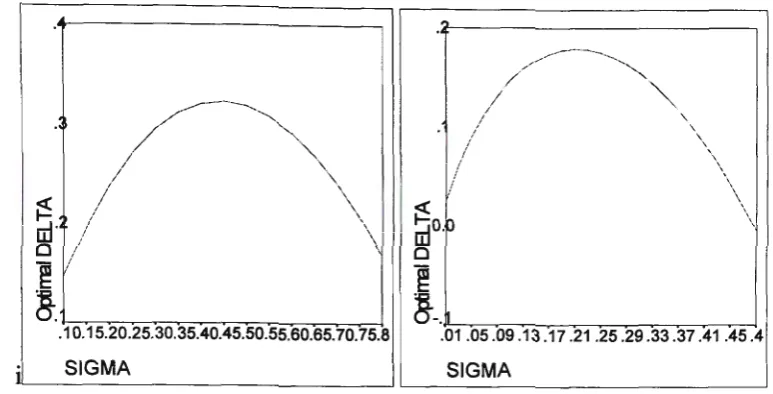
The optimal values of 8 (8 0 ) plotted against different values of cr ( keeping A, B,
a and e constant at A=67, B=O.SA, a=O.l, e=55)) are shown in Figure 2a. Several
observations are worth noting. As is clearly shown, a single optimal 8 value arises
from two distinct cr's. Figure 2b illustrates the same phenomena for the Hunter &
.
.
.
/ _ __.--·-·--·---.. .."
I
/
'"
,
~
I '\
.-
/
\p / \
m·~
/
\
0 / \
~ I ,
~-
_.,..1o~.1-:-::5,....,.2-,.-0.~25~_3,....,o~.3-5.~40~.4-5~.50-.5~5~.6-o.~65~.1-0~. 1--15.aSIGMA
Figure 2a
Shows the optimal delta values for sigma rangingfrom 0.1to0.8.
The results were obtained using present model.
~
cdo.o 0
~
~-.
l'--.~~~~~~~~~--.---l .01 .05.09.13.17.21 .25.29.33.37.41 .45.4SIGMA
Figure 2b Shows the optimal delta values
for sigma ranging from 0.01 to 0.5.
The results were obtained using Hunter&Kartha model.
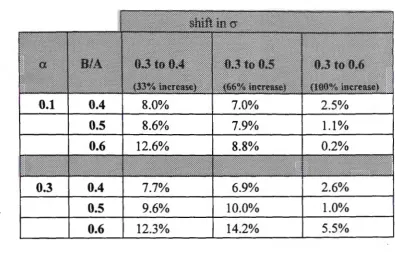
The second observation concerns the effect of various combinations of a,
the ratio between A and B and the percentage increase in cr on the optimal value
of
o.
This is illustrated in Table 2, showing the percentage change in optimal &due to a shift in cr. The chosen values for a are 0.1 and 0.3, and for B/A are 0.4,
0.5 and 0.6. Smaller shifts in cr (33% increase) cause nearly the same change in
optimal
o
as a shift by 66%. If the process standard deviation shifts by 100% the optimal setting of proc~ss target is not significantly affected. The bigger the ratio0.1 0.4 8.0% 7.0% 2.5%
0.5
8.6% 7.9% 1.1%0.6 12.6% 8.8% 0.2%
0.3
0.4 7.7% 6.9% 2.6%0.5
9.6% 10.0% 1.0%0.6 12.3% 14.2% 5.5%
Table 2
Shows the percentage change in optimal delta due to 33%, 66%, and 100% change in er , where the distance between L and L 0
increases from 0. 1 to 0. 3 and the ratio between A and B is equal to 0. 4,
0.5 and0.6.
It should be pointed out that the behaviour of cr in relation to 8 0 in Figure
.
.
.
. 3 Optimal DEL TA
.2
665462 60 58 PROFIT 5654
Figure 3
.4
SIGMA
.8
Shows the relationship between the optimal delta, the process standard deviation (ranging.from 0.1 to 0.8) and the maximum profit.
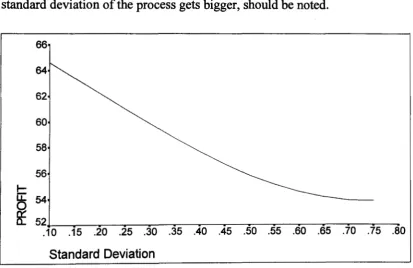
It is to be expected that an increase in sigma leads to a decrease in profit. This is shown clearly in Figure 4. The flatness of the optimal profit curve as the
standard deviation of the process gets bigger, should be noted.
66
64
62
60
58
56
I-~
540...: 52.l---..----~~~~~---=---..-::----=-~:---=----:~~-;;---::-;;:---~~
.10 .15 .20 .25 .30 .35 .40 .45 .50 .55 .60 .65 . 70 . 75 .80
Standard Deviation
Figure 4
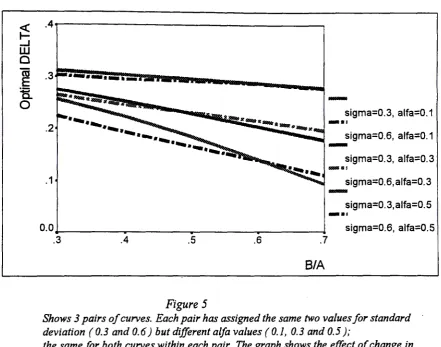
Figure 5 illustrates the effect of change in the ratio BIA on the optimal
process setting. It should be observed that for small
a (
in this case 0.1) theoptimal target setting seems to be approximately constant regardless of changes in
BIA or the standard deviation of the process. Note that the result obtained from
figure 2 is also clearly visible in Figure 5 .
~
_,
w
Q
~
a
0 . 4
.3
-
sigma=0.3, alfa=0.1.2
sigma=0.6, alfa=0.1
-
sigma=0.3, alfa=0.3.1 sigma=O. 6, alfa=O. 3
-
sigma=O. 3, alfa=O. 50.0._~~~~---~~~----~~~~----~~~~~ sigma=0.6, alfa=0.5
.3 .4 .5 .6 .7
8/A
Figure 5
Shows 3 pairs of curves. Each pair has assigned the same two values for standard deviation ( 0.3 and 0. 6) but different a/fa values ( 0.1, 0. 3 and 0. 5);
the same for both curves within each pair. The graph shows the effect of change in the ratio between A and B on the optimal target setting
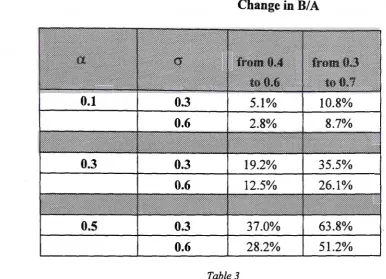
More precise analysis of the relation between the optimal target value of
the process and BIA is shown in Table 3, which illustrates the percentage change in
o
0 due to change in pricing policy. It can be observed is that for relatively small a., if cr increases by I 00% then even a large increase in the ratio between A and B hasChange in B/ A
0.6 51.2%
Table 3
Shows the procentage change in optimal process setting due to change
in the ratio B to A. The distance between L and L 0 varies from 0. 1 to 0. 5, the process standard deviation shifts from 0.3 to 0.6 and BIA changes from 0.4 to 0.6 and from 0.3 to 0. 7.
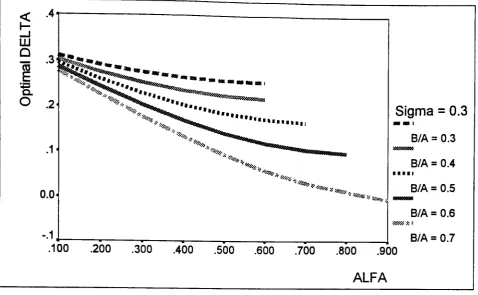
The further L 0 is from L (i.e. the larger the a) the bigger the effect of B/ A on optimal C3. These changes will be larger for smaller
a.
Figure 6 illustrates the result of relaxing or tightening the distance between L and L 0 on the optimal solution. An increase in a reduces the value of the optimal () i.e. brings it closer to L 0 • This effect is more significant for small
<( .4
I-_J
w
0 (ijE ~
c..
0 .2
Sigma= 0.3
--·
B/A=
0.3.1
-B/A = 0.4 I I 111
0.0
BIA= 0.6 -.1 -:-:-~~..--~~..--~~...--~~--~---..--~---...-~--.~~---J B/A
=
0.7.100 .200 .300 .400 .500 .600 .700 .800 .900
ALFA
Figure 6
Shows curves of optimal delta values against values of a/fa for sigma= 0.3 and BIA from 0.3 to 0. 7.
5. CONCLUDING REMARKS
In this report the problem of selecting an optimal process mean in the
presence of'top-up' and 'give-away' has been defined and analysed.
The dependencies between the process parameters and the optimal value have been
described.
The results would seem to indicate that even if the process variance
deteriorates there is little gain in adjusting the mean per se but more appropriate strategy would be to concentrate on reducing variability as this increase will
diminish profit per item. Furthermore, if there is an increase in a., which would
likely be accompanied by a decrease in B (i.e. the ratio BIA will decrease) then
References
Bettes, D. C. (1962), "Finding an Optimum Target Value in Relation to a Fixed
Lower Limit and an Arbitrary Upper Limit," Applied Statistics, Vol.11,
pp.202-210.
Bisgaard, S.; Hunter, W. G. & Pallesen, L. ( 1987 ), "Economic Selection of
Quality of Manufactured Product," Technometrics, Vol. 26, pp.9-18.
Boucher T. 0. & Jafari, M.A. ( 1991 ), "The Optimum Target Value for Single
Filling Operations with Quality Sampling Plans," Journal of Quality Technology,
Vol.23, No.I, pp.44-47.
Burr, I.W. ( 1949 ), "A New Method of Approving a Machine or Process
Setting," Part 1, Industrial Quality Control, Vol.5, No.4, pp.12-18, Part 2,
Industrial Quality Control, Vol.6, pp.13-16.
Gohlar, D. Y. ( 1987 ), "Determining the Best Mean Contents for a Canning
Problem," Journal of Quality Technology, Vol.19, No.2, pp.82-84.
Hunter, W. G. & Kartha, C. P.( 1977 ), "Determining the Most Profitable
Target Value for a Production Process," Journal of Quality Technology, Vol.9,
No. 4, pp.176-181.
Schmidt, R. L. & Pfeifer, P. E. ( 1989 ), "An Economic Evaluation of
Improvements in Process Capability for a Single-Level Canning Problem,"
Journal of Quality Technology, Vol.21, No.I, pp.16-19.
Springer, C.H. ( 1951)," A Method of Determining the Most Economic