Noname manuscript No.
(will be inserted by the editor)
Dynamic Cube Attack on
105
round Grain v1
Subhadeep Banik
Received: date / Accepted: date
Abstract As far as the Differential Cryptanalysis of reduced round Grain v1 is concerned, the best results were those published by Knellwolf et al. in Asiacrypt 2011. In an extended version of the paper, it was shown that it was possible to retrieve (i) 5 expressions in the Secret Key bits for a variant of Grain v1 that employs 97 rounds (in place of 160) in its Key Scheduling pro-cess using 227chosen IVs and(ii)1 expression in Secret Key bits for a variant
that employs 104 rounds in its Key Scheduling using 235chosen IVs. However,
the second attack on 104 rounds, had a success probability of around 50%, which is to say that the attack worked for only around one half of the Secret Keys.
In this paper we propose a dynamic cube attack on 105 round Grain v1, that has a success probability of 100%, and thus we report an improvement of 8 rounds over the previous best attack on Grain v1 that attacks the entire Keyspace. We take the help of the tool ∆GrainKSA, to track the differential
trails induced in the internal state of Grain v1 by any difference in the IV bits, and we prove that a suitably introduced difference in the IV leads to a distinguisher for the output bit produced in the 105th round. This, in turn,
helps determine the values of 6 expressions in the Secret Key bits. Using the
Section 3 of this work has been taken from the paper “Some Insights into the Differential Cryptanalysis of Grain v1 [3]” accepted in ACISP 2014 and published in LNCS 8544, pp. 34-49, 2014.
Subhadeep Banik Applied Statistics Unit
Indian Statistical Institute, Kolkata and
above attack as a subroutine we propose a method that uses a two dimensional differential attack to determine directly 9 Secret Key bits.
Keywords eStream · Differential Cryptanalysis · Dynamic Cube Attack · Grain v1·Stream Cipher
Mathematics Subject Classification (2000) AMS code: 94A60
1 Introduction
The Grain v1 stream cipher, designed by Hell, Johansson and Meier in the year 2005 [18], is in the hardware profile of the eStream portfolio [1]. It is a synchronous bit oriented cipher designed so as to minimize hardware complex-ity. After two attacks [7, 22] on the initial design of the cipher were published, the modified version Grain v1 [18] was proposed. Later, the designers came up with a second version of Grain, i.e., Grain-128 [19] that uses a 128 bit Key. Thereafter, the cipher Grain-128a [2] was designed for the dual purpose of mes-sage authentication alongside mesmes-sage encryption. For detailed cryptanalytic results related to this family, the reader may refer to [4–6,8–10,15,17,20,25,26] and the references therein.
Cube attacks were first introduced by Dinur and Shamir in [13] and have been used extensively to attack reduced round variants of the Grain family. Although the attack paradigm can be used to cryptanalyze any symmetric key cryptosystem with manipulatable public variables, we shall focus on stream ciphers in this paper, in which the IV plays the role of the public variable. A cube attack on a stream cipher proceeds in the following manner (for a detailed description of cube attacks, kindly refer to [13, 14]).
A. The attacker chooses any non-empty subset C of the IV bit variables, commonly called cube variables. All the IV bits outside of C assigned to some constant, usually zeros.
B. The attacker enumerates 2|C| IVs by assigning the cube variables to all possible values. He then obtains a segment of keystream bits produced by some fixed Secret KeyK and each of the 2|C| IVs enumerated above.
C. If the attacker is able to determine that the sum of all the corresponding keystream bits produced by the 2|C| IVs leads to a linear equation on the
Secret Key bits ofK, then he effectively obtains one linear equation on the Secret Key variables. If not, he discards the cube setC, and starts stepA
with another randomly generated cube set.
on the Secret Key variables. This process is usually quite time consuming and can even take weeks to complete [13]. Very recently, a Moebius-transform based approach was adopted in [16], that was able to find 12 such cube sets (that lead to linear equations in Secret Key bits) for a version of Trivium reduced to 799 initialization rounds, in just about 2 hours.
On the other hand, Dynamic Cube Attacks, are a class of cube attacks that aim to establish if by stipulating some algebraic relation between the Secret Key and IV variables, one is able to observe some testable non-random property in the cube sum. In this type of attack, some of the IV variables outside the cube set are chosen as dynamic cube variables. Each dynamic cube variable ν is related to one or more expressions in the Secret Key bits. The attacker first has to guess the values of each of these expressions correctly to compute the value of ν. Thereafter he performs the cube sum, and tests it for some non-random property. The attack parameters should be designed in a manner so that, if the values of the Secret Key expressions are guessed correctly, then the attacker would be able to detect some non-randomness in the cube sum, and not otherwise. This would therefore enable the attacker to determine the values of each of those Secret Key expressions. So, if there are
enumber of expressions to be guessed, the cube sum needs to be computed 2e
times, once for each of the guesses.
In [11, 12], dynamic cube attacks have been used to successfully cryptan-alyze reduced-round variants as well as full Grain 128. In [21], cube distin-guishers were used to distinguish a variant of Grain-128a, that employs 189 out of the 256 rounds in the Key Scheduling process. However, due to the rel-ative complex nature of the component functions used in the design of Grain v1, there have not been many advances in this direction against it. The best published work on Grain v1 is the Conditional Differential Cryptanalysis by Knellwolf et al [24], an extended version of which appeared in [23, Chapter 3.4]. The attack, which can be best described as a dynamic cube attack over a single-dimensional cube (i.e., the cardinality of the cube set is one), achieves the following objectives:
a) It retrieves 5 expressions in the Secret Key bits for a variant of Grain v1 that employs 97 rounds (in place of 160) in its Key Scheduling process using 227 chosen IVs.
b)It retrieves 1 expression in Secret Key bits for a variant that employs 104 rounds in its Key Scheduling using 235 chosen IVs. However, as reported
in [23, Chapter 3.4], this attack has a success probability of around 50%, which is to say that the attack works for only around one half of the Secret Keys.
to track the differential trails introduced in the internal state of Grain v1 by any difference in the IV bits. Using the tool, the theoretical correctness of the work presented in [24] was proven.
1.1 Relation between Dynamic Cube attack and Conditional Differential Cryptanalysis
The Conditional Differential Cryptanalysis strategy described in [24], is struc-turally and thematically very similar to a Dynamic Cube Attack over a single dimensional cube. Both attack strategies use involve constructing a distin-guisher for the underlying cryptosystem, that depends on the values of one or more Secret Key bits used in the system. The distinguisher is constructed in such a manner that the attacker is able to distinguish the output of the cryptosystem from an ideally distributed random variable if and only if he guesses the values of certain Secret Key bits/expressions correctly. The only difference in a Dynamic Cube attack is that the attack can be extended to a higher dimensional differential attack, by increasing the dimension of the cube. Therefore, it can be argued that Conditional Differential Cryptanalysis is a sub-class of Dynamic Cube Attack. Thus, although we use elements of Conditional Differential Cryptanalysis in this paper, we use the much more general term Dynamic Cube Attack to describe our work.
1.2 Contribution and Organization of the paper
In this work, we make use of the tool∆GrainKSA to further improve the work
presented in [24]. We first outline a heuristic algorithm that enables us to determine a suitable single dimensional cube (i.e, the 61st IV bit). We show that a differential introduced via the 61st IV bit in Grain v1, leads to a dis-tinguisher for the keystream bit produced in the 105th round in Grain v1, if certain algebraic conditions involving the Secret Key and the IV bits are satisfied. This, in turn, leads to the deduction of 6 expressions in the Secret Key bits. This amounts to an improvement of 8 rounds over the previous best attack on Grain v1 that works for any Key in the Keyspace.
In Section 2, we give the complete mathematical description of Grain v1. In Section 3, we give a brief description of the tool ∆GrainKSA as reported
2 Description of Grain v1
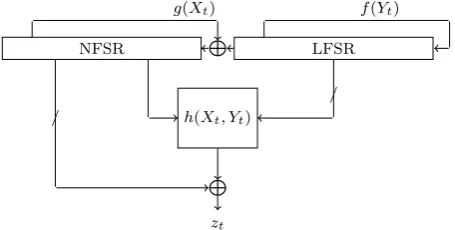
The exact structure of the Grain family is explained in Figure 1. It consists of ann-bit LFSR and ann-bit NFSR. Certain bits of both the shift registers are taken as inputs to a combining Boolean function, whence the key-stream is produced. The update function of the LFSR is given by the equation yt+n=
f(Yt), where Yt = [yt, yt+1, . . . , yt+n−1] is an n-bit vector that denotes the
LFSR state at the tth clock interval and f is a linear function on the LFSR state bits obtained from a primitive polynomial in GF(2) of degree n. The NFSR state is updated asxt+n=yt⊕g(Xt). Here,Xt= [xt, xt+1, . . . , xt+n−1]
is ann-bit vector that denotes the NFSR state at the tth clock interval and
g is a non-linear function of the NFSR state bits. The output key-stream is produced by combining the LFSR and NFSR bits as zt = h0(Xt, Yt) =
L
a∈Axt+a⊕h(Xt, Yt), whereAis some fixed subset of {0,1,2, . . . , n−1}.
Grain v1 uses ann= 80-bit keyK, and anm= 64-bit initialization vector
IV. The key is loaded in the NFSR and the IV is loaded in the 0th to the
(63)rdbits of the LFSR. The remaining bits of the LFSR are loaded with the
all one pad0x ffff. Hence at this stage, the 2nbit initial state is of the form
K||IV||P.
Key Scheduling Algorithm (KSA)For the first 2nclocks, the key-stream bit produced by the cipher is XOR-ed to both the LFSR and NFSR update functions, i.e., during the first 2nclock intervals, the LFSR and the NFSR bits are updated asyt+n=zt⊕f(Yt),xt+n =yt⊕zt⊕g(Xt).
Pseudo-Random key-stream Generation Algorithm (PRGA) After the completion of the KSA,ztis used as the Pseudo-Random key-stream bit.
It is no longer XOR-ed to the LFSR and the NFSR. Therefore during this phase, the LFSR and NFSR are updated asyt+n=f(Yt), xt+n =yt⊕g(Xt).
NFSR LFSR
g(Xt) f(Yt)
h(Xt, Yt) /
/
zt L
L
2.1 Mathematical description of Grain v1
Grain v1 consists of an 80 bit LFSR and an 80 bit NFSR. It uses an 80-bit Key and a 64-bit IV, and a 16-bit padP=0x ffff. Certain bits of both the shift registers are taken as inputs to a combining Boolean function, whence the key-stream is produced. The update function of the LFSR is given by the equation
yt+80=yt+62⊕yt+51⊕yt+38⊕yt+23⊕yt+13⊕yt ∆
=f(Yt).
The NFSR state is updated as follows
xt+80=yt⊕g(xt+63, xt+62, xt+60, xt+52, xt+45, xt+37, xt+33, xt+28, xt+21, xt+15 xt+14, xt+9, xt),
whereg(xt+63, xt+62, . . . , xt) ∆
= g(Xt) =
xt+62⊕xt+60⊕xt+52⊕xt+45⊕xt+37⊕xt+33⊕xt+28⊕xt+21⊕xt+14⊕ xt+9⊕xt⊕xt+63xt+60⊕xt+37xt+33⊕xt+15xt+9⊕xt+60xt+52xt+45⊕
xt+33xt+28xt+21⊕xt+63xt+45xt+28xt+9⊕xt+60xt+52xt+37xt+33⊕ xt+63xt+60xt+21xt+15⊕xt+63xt+60xt+52xt+45xt+37⊕
xt+33xt+28xt+21xt+15xt+9⊕xt+52xt+45xt+37xt+33xt+28xt+21.
The output key-stream is produced by combining the LFSR and NFSR bits as follows
zt=M
a∈A
xt+a⊕h(yt+3, yt+25, yt+46, yt+64, xt+63)=∆M
a∈A
xt+a⊕h(Xt, Yt)
where A = {1,2,4,10,31,43,56} and h(s0, s1, s2, s3, s4) = s1⊕s4⊕s0s3⊕
s2s3⊕s3s4⊕s0s1s2⊕s0s2s3⊕s0s2s4⊕s1s2s4⊕s2s3s4.
3 The tool ∆GrainKSA
3.1 Generalized Grain cipher
For completeness of this paper, we will discuss in brief the tool ∆GrainKSA
which was discussed in [3]. The primary purpose of such a tool is to track the differential trails in the internal state of the cipher during the KSA phase, which is introduced due a difference in the IV bits. First a generalized Grain stream cipher is defined which covers the descriptions of Grain v1, Grain-128 and Grain-Grain-128a as well. Any cipher in the Grain family consists of an
n-bit LFSR and ann-bit NFSR (n= 80,128,128 for Grain v1, Grain-128 and Grain-128a respectively). The update function of the LFSR is given by the equation
where Yt = [yt, yt+1, . . . , yt+n−1] is an n-bit vector that denotes the LFSR
state at thetthclock interval andf is a linear function on the LFSR state bits obtained from a primitive polynomial inGF(2) of degreen. The NFSR state is updated as
xt+n=yt⊕g(Xt) =yt⊕g(xt, xt+g1, xt+g2, . . . , xt+gb) =yt⊕xt⊕xt+g1⊕ · · · ⊕xt+gb0⊕g
0(x
t+gb0 +1, xt+gb0 +2, . . . , xt+gb) Here, Xt = [xt, xt+1, . . . , xt+n−1] is an n-bit vector that denotes the NFSR
state at thetthclock interval andg is a non-linear function of the NFSR state
bits in which the NFSR locations 0, g1, g2, . . . , gb0only contribute linearly. The output key-stream is produced by combining the LFSR and NFSR bits as
zt=xt+l1⊕xt+l2⊕ · · · ⊕xt+lc⊕yt+i1⊕yt+i2⊕ · · · ⊕yt+id⊕
h(yt+h1, yt+h2, . . . , yt+he, xt+j1, xt+j2, . . . , xt+jw).
Herehis another non-linear combining Boolean function. Note that Grain v1, Grain-128 and Grain-128a are particular instances of the generalized Grain cipher.
3.2 ∆GrainKSA
LetS0= [X0||Y0]∈ {0,1}2n be the initial state of the generalized Grain KSA
and S0φ = [X0φ||Y0φ] be the initial state which differs from S0 in some LFSR location φ ∈[0, m−1], where m is the length of the IV (m = 64,96,96 for Grain v1, Grain-128 and Grain-128a respectively).
The tool ascertains how the corresponding internal states in thetthround St and S
φ
t differs from each other, for some integer t > 0. In the original
definition of∆GrainKSAdescribed in [3], the engine takes as input the difference
locationφ∈[0, m−1] and the valuer of the number of rounds, and returns the following (the definition of these arrays will be apparent shortly):
(i) a set ofr integer arraysχt, for 0≤t < r, each of length c+d, (ii) a set ofrinteger arrays Υt, for 0≤t < r, each of lengthe+wand
(iii) an integer array∆Z of lengthr.
(iv) a set ofr integer arraysFt, for 0≤t < r, each of lengtha+ 1, (v) a set ofrinteger arraysGlin,t, for 0≤t < r, each of length b0+ 1 and (vi) a set ofr integer arraysGnlin,t, for 0≤t < r, each of length b−b0
Note that as already defined in the description of generalized Grain, d, c
A generalized differential engine∆φ-GrainKSAwith ann-cell LFSR∆Land
ann-cell NFSR∆N is defined. All the elements of∆Land∆N are integers. Thetthround state of∆Lis denoted as∆Lt= [ut, ut+1, . . . , ut+n−1] and that
of ∆N is denoted as ∆Nt = [vt, vt+1, . . . , vt+n−1]. Initially all the elements
of ∆N, ∆Lare set to 0, with the only exception that – the cell numberedφ
of∆Lis set to 1. The initial states∆N0, ∆L0 are indicative of the difference
betweenS0andS φ
0 and thetthstates∆Nt, ∆Ltare indicative of the difference
betweenStandS φ t.
The update functions of the registers L, N are defined in the following manner. The functionlin:∪∞
i=1Zi+→ {0,1,2}is defined as follows. (whereZ+
is the set of non negative integers)
lin(q1, q2, . . . , qi) =
q1+q2+· · ·+qimod 2 if max(q1, q2, . . . , qi)≤1,
2, otherwise.
Define the vectorsFt,Glin,t,Gnlin,t as follows:
Ft= [ut, ut+f1, . . . , ut+fa], Glin,t= [vt, vt+g1,· · · , vt+gb0], Gnlin,t= [vt+gb0 +1, vt+gb0 +2, . . . , vt+gb]
The intermediate variables`t, rt, Ωtare defined as follows:
`t=lin(Ft), rt=lin(ut,Glin,t), Ωt= 2·OR(Gnlin,t).
HereORis a map from∪∞
i=1Zi+→ {0,1} which roughly represents the logical
‘or’ operation and is defined as
OR(q0, q1, . . . , qi) =
0,ifq0=q1=q2=· · ·=qi = 0,
1, otherwise.
Define the following vectors:
χt= [vt+l1, vt+l2, . . . , vt+lc, ut+i1, ut+i2, . . . , ut+id],
Υt= [ut+h1, ut+h2, . . . , ut+he, vt+j1, vt+j2, . . . , vt+jw].
Note that χt(Υt) is the set of cells in∆φ-GrainKSA which corresponds to the
bits which are linearly added to the output functionh(input to h) in thetth
KSA stage of the actual cipher. Thetth key-stream element π
t produced by
this engine is given as (the termexceptionwill be explained shortly)
πt=
1 ifχt, Υtthrows up anexception lin(lin(χt),2·OR(Υt)) otherwise.
Now ∆Lupdates itself as ut+n =lin(`t, πt). And similarly, ∆N updates itself asvt+n =lin(rt, Ωt, πt). The values in the registersLt, Ntin ∆GrainKSA
represent the differences in the corresponding algebraic systems St and S φ t,
which are thetthround internal states of the Generalized Grain initialized by
two IVs that differ in the φthbit. Similarly the output element πt represents
the difference between the output bitszt and ztφ produced in the tth rounds
→0, the difference between ytandytφ (resp.xt, xφt andzt, ztφ) is always 0. →1, the difference between ytandy
φ
t (resp.xt, x φ
t andzt, z φ
t) is always 1.
→2, the difference betweenytandytφ(resp.xt, xφt andzt, ztφ) is probabilisti-cally either 0 or 1 and the exact value would depend on the exact value of the initial vectorS0 and actual update functions.
For example if some elementut+nis 0 we can assume that the correspond-ing LFSR bitsyt+nandyφt+nare always equal, ifπtis 1 for somet, then we can assume that difference of the keystream bitszt andzφt is always unequal etc.
We will show that this hypotheses is correct as we go along trying to explain the rationale behind the various elements of the engine.
1. The Keystream element πt: We will try to explain that the difference
be-tween ztand z φ
t is indeed captured by by πt. In order to do that we need
to explain the working of several functions used in the engine:
The function lin(∆) computes the modulo 2 sum of the elements of the vector ∆ only if all its elements are 0 or 1, otherwise it returns 2. This captures the notion of difference propagation rules over ordinary GF(2) ad-dition. Letxandxφ be vectors in the original cipher initializationsS0and Sφ0 respectively, whose contents need to be summed for some intermediate cipher operation. Letδ=x⊕xφ, then the difference of sums of the bits of
xandxφis equal to the sum of the contents ofδ. Now if the elements ofδ
are always 0 or 1 (this corresponds to all elements of ∆ being either 0 or 1 in the differential engine), it implies that the corresponding elements of
xandxφare respectively always equal or different. Then, the difference of
sums of the bits ofxandxφwill either be always 0 or 1 and is given by the
sum of elements ofδ. In such an event,lin(∆) computes the modulo 2 sum of the elements of ∆which is either 0 or 1. If, however, some correspond-ing elements x and xφ are only probabilistically equal (this corresponds
to some elements of∆ being equal to 2), then the difference between the sums of their contents is also probabilistically 0 or 1, andlin(∆) returns 2.
The function 2·OR(∆) returns 0 only if all elements of the vector ∆
is 0 and returns 2 otherwise. This captures the notion of difference prop-agation rules over non-linear Boolean functions. Again, let x and xφ be
vectors in the original cipher initializationsS0and S φ
0 respectively, which
are fed to some non-linear functionF during some intermediate cipher op-eration. As above, letδ=x⊕xφ. Then difference betweenF(x) andF(xφ)
is deterministically 0 only if all elements of δ are also deterministically 0 (this corresponds to all elements of ∆ being 0). If even one element of
δ is not deterministically 0 then the difference between F(x) and F(xφ)
becomes probabilistic and depends on the nature of the Boolean Function
Now observe the equation definingπt. Note thatχtconsists of tap locations that add linearly to the output function and Υt consists of the locations that feed the non-linearhfunction in the original generalized Grain cipher. Thus thelin()oflin(χt) and 2·OR(Υt) will effectively capture the difference between actualtthround keystream bitsz
tandz φ
t in the two initializations
of the generalized cipher.
2. Update rule of ∆L: In the original cipher, the update to the LFSR is the GF(2) sum of 2 parts: the keystream bit zt and the linear update functionf over the LFSR bitsyt, yt+f1, yt+f2, . . . , yt+fa. The function`t= lin(ut, ut+f1, . . . , ut+fa) captures the difference propagation over the linear sum. So the definition of ut+n which is lin(`t, πt) captures the difference betweenyt+n andy
φ t+n.
3. Update rule of ∆N: In the original cipher, the update to the NFSR is the GF(2) sum of 4 parts: the keystream bit zt, the LFSR bit yt, the
linear function over the NFSR bitsxt, xt+g1, . . . , xt+gb0 and the non-linear update function g0 over the bits xt+gb
0 +1, . . . , xt+gb. The function rt = lin (ut, vt, vt+g1 ,· · ·, vt+gb
0) captures the difference propagation over the linear parts, and Ωt = 2·OR(vt+gb
0 +1, vt+gb0 +2, . . . , vt+gb) captures the difference over the non-linear function g0. And thus the definition ofvt+n
which islin(rt, Ωt, πt) captures the difference betweenxt+n andxφt+n.
4. Anexception to the rule: Our definition of πt some times fails to capture the exact difference between zt and zφt. We will demonstrate this with
an example: We go back to our original system in Grain v1 where the differential is introduced via the 37th IV bit and therefore we run the engine∆37-GrainKSA. At round 30 the values ofχtandΥtare as follows: t= 30 : χt=0, Υt= [ut+3= 0, ut+25= 0, ut+46= 0, ut+64= 1, vt+63= 0] Here 0 is the all zero vector. This implies that if we introduce an IV differential at location 37 then at KSA round 30 all state bits in S30 and
S37
30involved in the computation of their respective keystream bits are equal
except the bits yt+64 and y37
t+64, which are deterministically unequal, i.e., yt+64= 1⊕y37
t+64always holds. Then, it follows that
z30⊕z3037=h(y33, y55, y76, y94, x93)⊕h(y33, y55, y76,1⊕y94, x93) =y33y76⊕y33⊕y76x93⊕y76⊕x93= 1.
The above follows becausey76is initialized to 1 as it is a part of the0x ffff
padding that is used in Grain v1. Thus, z30 and z3730 are deterministically unequal. But according to the definition of πt, the value of π30 would be computed as 2. To prevent a situation like this one must always check if for some t, the values ofχtand Υt throw up anexception. If it does we must assign the value 1 to πt. Thus the definition of πtcan be rewritten thus:
πt=
Input:φ: An LFSR location∈[0, m−1], an integerr(>0);
Output: An integer array∆Z ofrelements;
Output: Two integer arraysχt, Υt for 0≤t < r;
[u0, u1, . . . , un−1]←0,[v0, v1, . . . , vn−1]←0,t←0,uφ= 1;
whilet < rdo
Υt←[ut+h1, ut+h2, . . . , ut+he, vt+j1, vt+j2, . . . , vt+jw] ;
χt←[vt+l1, vt+l2, . . . , vt+lc, ut+i1, ut+i2, . . . , ut+id];
`t←lin(ut, ut+f1, ut+f2, . . . , ut+fa);
rt←lin(ut, vt, vt+g1,· · ·, vt+gb0);
Ωt←2·OR(vt+gb0 +1, vt+gb0 +2, . . . , vt+gb);
ifχt, Υt throws up anexceptionthen πt←1
end else
πt←lin(lin(χt),2·OR(Υt))
end
ut+n←lin(πt, `t),vt+n←lin(πt, rt, Ωt);
/*Any modification goes here */;
0.1
t=t+ 1;
end
Return [χ0, χ1, . . . , χr−1],[Υ0, Υ1, . . . , Υr−1], ∆Z=
[∆z0, ∆z1, . . . , ∆zr−1],[F0,F1, . . . ,Fr−1]
Return [Glin,0,Glin,1, . . . ,Glin,r−1],[Gnlin,0,Gnlin,1, . . . ,Gnlin,r−1]
Algorithm 1:∆φ-GrainKSA
3.3 Using∆φ-GrainKSA to model Knellwolf’s attack [23, Chapter 3.4]
The basic philosophy of the attack in [23, Chapter 3.4] is as follows. The attacker introduces a difference in the internal states of two initializations of the Grain v1 cipher via the 37th IV bit. Thereafter, by imposing several
algebraic conditions of Type 1 and 5 conditions of Type 2 between the Secret Key and the IV variables the attacker prevents the propagation of this difference into the NFSR at KSA roundst= 12,34,40.
Type 1 conditions are of the formF1(IV) = 0 which involve only the IV bits.
Type 2 conditions are of the formF2(K, IV) = 0 which involve both the Key
and IV bits.
The attacker observes that if all the Type 2conditions are satisfied then Pr[z97⊕z97φ = 0] = 1
2 +, (≈0.0014) (1)
enumerates 32 different sets of IVs Ti, 0 ≤ i ≤ 31, such that all the five
Type 2 conditions are satisfied in exactly one of the sets Ti. The attacker then computes the probabilityPr[z97⊕z97φ = 0] in each of the 32 sets. The Set
Ti in which he obtains a bias reveals the value of the 5 expressions in the Secret Key bits.
Prior to the work in [3], there was no theoretical proof of this attack, i.e. the attack was supported by experimental evidences only. In [3], the author uses a modified form of ∆φ-GrainKSA to model Knellwolf’s system. Note that [23]
imposes specific algebraic conditions to stop the propagation of the differential into the NFSR at KSA roundst= 12,34,40. This was modeled by modifying the definition of ∆φ-GrainKSA at line no 0.1 of Algorithm 1 by including the
following code snippet.
if t ∈ {12,34,40}:vt+n←0
Thereafter the distributions of the differences of several internal variables were computed by utilizing the outputs of∆37-GrainKSA and Equation (1) was
proven.
4 Dynamic Cube attack on 105 round Grain v1
One of the reasons that the authors of [23, 24] had given for choosingφ= 37 (i.e., the IV location where the single bit difference was introduced) was that due to the positioning of the tap locations in the design of Grain v1, a difference placed in this location would be contained in the LFSR for the longest number of KSA rounds. This is a valid approach to look at Differential Cryptanalysis of Grain v1, since as the differences propagate into the NFSR, they become difficult to control and predict. However, given the fact that we have a tool to track the differential trails in Grain v1, one could try to see if any differential introduced at an arbitrary IV bit locationφ, (0≤φ <64) leads to a bias in the distribution ofPr[zt⊕z
φ
t] for any t >104.
Before we outline the process of searching for a suitable difference location
φlet us state the following Lemma.
Lemma 1 Letλ1, λ2, . . . , λn+1 be independent random variables overGF(2).
Letλi∼Ber(12+i). Where eachiis some real number in[−12,12]andBer(·)
denotes the Bernoulli distribution (we will call|i|the bias in the variableλi)
Letγ1=⊕ni=1λiandγ2=⊕n+1i=1λi. Letγ1∼Ber(12+δ1)andγ2∼Ber(12+δ2).
Then we must have|δ1| ≥ |δ2|.
Proof By the Piling-up lemma, it is easy to see thatPr[λ1⊕λ2⊕· · ·⊕λn= 0] = 1
2+ 2 n−1Qn
i=1i and so we have γ1 ∼ Ber(12 + 2n−1Q n
i=1i) and similarly
we haveγ2 ∼Ber(12+ 2nQn+1
i=1 i). Assuming that alli 6= 0, we have
|δ1|
|δ2| =
2n−1Qn
i=1i
2nQn+1
i=1 i
= 1
The above inequality follows since 2|n+1| ≤1. If somei= 0, for 0≤i≤n, thenδ1 =δ2= 0, and ifn+1 = 0 and all otheri are non zero, we will have
δ2= 0, while |δ1| is a positive real number and so the lemma is proven. ut
So if λ1, λ2, . . . , λn are independent variables, each approximately biased
towards zero by some positive quantity || (i.e. each λi ∼ Ber(12 +)), a
corollary of the above result is that the GF(2) sum of any n1 variables λi
is likely to be more biased than the GF(2) sum of any n2 variables λi, if n1< n2. We will use the result of the previous lemma as a heuristic argument to arrive at a suitable difference location φ. Note that the difference in the keystream bits at roundt in Grain v1, given byzt⊕zφt is theGF(2) sum of eight random variables γ1, γ2, . . . , γ8 over GF(2) which are given as follows. Fori= 1,2, . . . ,7, we haveγi=xt+li⊕x
φ
t+li, wherel1= 1, l2= 2, l3= 4, l4= 10, l5= 31, l6= 43, l7= 56. The last variableγ8 is given as
γ8=h(yt+3, yt+25, yt+46, yt+64, xt+63)⊕h(yφt+3, yφt+25, yt+46φ , yφt+64, xφt+63).
Consider the case when for some value of φ, ∆φ-Grain outputs the following values:
χt1 : [vt1+1= 0, vt1+2= 0, vt1+4= 0, vt1+10= 0, vt1+31= 1,
vt1+43= 0, vt1+56= 2]
Υt1 : [ut1+3= 0, ut1+25= 1, ut1+46= 2, ut1+64= 2, vt1+63= 2]
and
χt2 : [vt2+1= 0, vt2+2= 0, vt2+4= 2, vt2+10= 2, vt2+31= 2,
vt2+43= 2, vt2+56= 2]
Υt2 : [ut2+3= 0, ut2+25= 1, ut2+46= 2, ut2+64= 2, vt2+63= 2]
Note that the values ofχt1 andΥt1 indicate that in two instances of Grain v1 initialized by the statesS0andS0φ, (note that these states differ only in the
φthLFSR bit, introduced by a difference in theφthIV bit), the following events
occur: at KSA roundt1,xt1+1=xtφ1+1,xt1+2=x
φ
t1+2,xt1+4=x
φ
t1+4,xt1+10=
xφt
1+10,xt1+10=x
φ
t1+10,xt1+31= 1⊕x
φ
t1+31,yt1+3=y
φ
t1+3,yt1+25= 1⊕y
zt1⊕ztφ1 = M
i∈A
xt1+i⊕xφt1+i
⊕
h
h(yt1+3, yt1+25, . . . , xt1+63)⊕h(ytφ1+3, y
φ
t1+25, . . . , x
φ t1+63)
i
= 1⊕(xt1+56⊕x
φ t1+56)⊕
h
h(yt1+3, yt1+25, . . . , xt1+63)⊕h(ytφ1+3, y
φ
t1+25, . . . , x
φ t1+63)
i
= 1⊕λ11⊕λ12
Here,λ11= (xt1+56⊕xφt1+56) and the variableλ12=h(yt1+3, yt1+25, . . . , xt1+63) ⊕h(yφt
1+3, y
φ
t1+25, . . . , x
φ
t1+63). Similarly at roundt2, we have
zt2⊕ztφ2 =
M
i∈A
xt2+i⊕xφt2+i
⊕
h
h(yt2+3, yt2+25, . . . , xt2+63)⊕h(ytφ2+3, y
φ
t2+25, . . . , x
φ t2+63)
i
= M
i∈{4,10,31,43,56}
(xt2+i⊕x
φ t2+i)⊕
h
h(yt2+3, yt2+25, . . . , xt2+63)⊕h(y
φ t2+3, y
φ
t2+25, . . . , x
φ t2+63)
i
=λ21⊕λ22⊕λ23⊕λ24⊕λ25⊕λ26
where the values of λ2i0s have been assigned as at round t1. Note that the randomness in zt1⊕zφt1 comes from only two random variables λ11 and λ12
whereas the randomness inzt2⊕ztφ2 comes from 6 random variables. Now this is certainly not a conclusive proof (as we still do not know the quantity of the bias of each variable λ1i/λ2i or if they are independent or not), but one can make a heuristic argument that if the biases in theλ1i0s andλ2i0s are not too different, and if one can intuitively/empirically determine that theλ1i0s,λ2i0s are independent, then the bias of the variable zt1⊕z
φ
t1 is likely to be much higher than that of zt2 ⊕z
φ
t2, following the arguments outlined immediately after Lemma 1.
4.1 Search for a suitable candidate forφ
Given two distributions Ber(12 +) and Ber(12) (i.e., the Uniform distribu-tion overGF(2)) and an efficient algorithm to extract multiple samples from these distributions, it usually takes number of samples proportional to 12
from samples generated from a uniformly random distribution by employing at most 228 to 230pairs of chosen IVs differing only at bit locationφ.
One way of searching for such aφ, is by executing the engine∆φ-GrainKSA
for allφ∈[0,63], and examining theχtvector output by the engine for every
t > 104. The vector χt contains 7 elements, if the number of probabilistic
elements (i.e. number of 20s) inχ
t, (for somet >104 and φ∈[0,63]) is less
(say not more than 1 or 2), then as per the arguments outlined in the previous subsection,φandtare likely to be good candidates for performing the attack, as in such a casezt⊕z
φ
t is likely to have some non-negligible bias which can
in all likelihood be detected within 230 pairs of chosen IVs differing at bit
positionφ. However there are several practical difficulties in running such an Algorithm.
1. For t >104, the number of 20s inχt is usually never less than 4, for any value ofφ∈[0,63].
2. This being the case one needs to impose Type 1andType 2 conditions on the Secret Key and IV bits to prevent the propagation of differences to the NFSR whenever possible, much like the ones mentioned in Sec-tion 3.3. Thus, as menSec-tioned in SecSec-tion 3.3, to model this event, one needs to modify the routine ∆φ-GrainKSA by inserting code snippets in Line 0.1
in Algorithm 1.
3. During the state updates of the LFSR, NFSR in the KSA, the keystream bit
zt is summed with the feedback functions of both the LFSR and NFSR.
Thus in the earlier KSA rounds, whenever zt⊕z φ
t is probabilistic (this
occurs when the keystream element πt produced by∆φ-GrainKSA is equal
to 2), the differential is likely to propagate to the NFSR. In this case, we should try to impose the Type 1 andType 2 conditions to prevent the propagation. Thus for an arbitrary φ, the code snippet to be inserted in Line 0.1 in Algorithm 1 is as follows:
if πt= 2 : vt+n←0
4. As a case in point, one can examine the attack presented in [23, 24], in which the attacker stops the propagation of the differential at 3 KSA rounds
t = 12,34,40. To do so, the attacker needed to impose 27 Type 1 condi-tions which set individual bits of the IV to 0/1. This reduced the effective IV space to {0,1}64−27={0,1}37.Thus, this tells us that imposingType 1/2conditions at more than 3 to 4 KSA rounds may well shrink the effec-tive IV space to below{0,1}30, and in such a case we will not have enough
IVs to detect any bias in zt⊕ztφ. Thus preventing the propagation of the difference at more than 4 KSA rounds is not feasible.
5. As we shall see shortly, another fundamental requirement to mount the at-tack, is the ability to enumerate the explicit algebraic expressions ofzt⊕zφt
propagation of a difference to the NFSR is to be prevented. Thereafter our goal would be to express certain internal variables of the cipher in the form
F3(K)⊕F4(V), whereF3, F4are functions on only the Secret Key bits and the IV bits respectively. Using Computer Algebra Systems like SAGE [27], we were able do this for KSA rounds uptot= 45 on a system running on a 3.2 GHz processor and 8 GB of internal memory. Thus we did not attempt to prevent the propagation of the difference at any roundt >45.
6. Finally, we would also like to note that it is not necessary to run the engine
∆φ-GrainKSA with all the modifications and constraints listed above, for all
values of φ∈ [0,63]. For example, due to the state updates in Grain v1, it is easy to see that ∆36-GrainKSA at KSA roundt−1, will give the same
result as∆37-GrainKSA at roundt. Thus it is sufficient to run the engines
at all values of φ just before the tap locations i.e., for values equal to 2,12,22,24,37,45,50,61,63.
By running the engine ∆φ-GrainKSA, under the aforementioned
modifica-tions and restricmodifica-tions, for the values ofφlisted above, we were able to deter-mine that forφ= 61 andt= 105, and after preventing the propagation of the differential at KSA roundst= 15,36,39,42, the value ofχ105 was obtained as
follows.
χ105= [v106= 1, v107= 0, v109= 0, v115= 0, v136= 0, v148= 2, v161= 2]
Since there are only two 20s in this vector, this seemed to be a good choice of the attack parameters and we proceeded to mount the attack from here.
4.2 Algebraic Details of the attack forφ= 61
Algebraically speaking, introducing a difference at the 61st bit position of the
IV is equivalent to analyzing two initializations of the Grain v1 cipher, one with the initial state equal to
X0= [k0, k1, . . . , k79], Y0= [ν0, ν1, . . . , ν61, . . . , ν63,1,1, . . . ,1],
and the other with the initial state equal to
X0φ= [k0, k1, . . . , k79], Y0φ= [ν0, ν1, . . . ,1⊕ν61, . . . , ν63,1,1, . . . ,1].
whereK= [k0, k1, . . . , k79], V = [ν0, ν1, . . . , ν61, . . . , ν63], Vφ= [ν0, ν1, . . . ,1⊕ ν61, . . . , ν63] are the formal notations for the Secret Key and the two IVs that
differ in the 61stbit position. The primary task of cryptanalysis is to monitor
the propagation of the differentials across the internal states in the tth KSA
round, i.e., between St=Xt||Yt and Stφ =Xtφ||Ytφ. During the execution of
1. t=15: At this roundχt =Glin,t =Gnlin,t =0, ut = 0 andΥt = [ut+3=
0, ut+25 = 0, ut+46 = 1, ut+64 = 0, vt+63 = 0]. This implies that of all state bits of St, S
φ
t at t= 15 involved in the computation ofxt, x φ t, only y64 = 1⊕y64φ holds deterministically and all the differences of all other state bits is deterministically 0. So we have
x80+15⊕x φ
80+15= [g(X15)⊕y15⊕z15]⊕[g(X φ 15)⊕y
φ 15⊕z
φ 15]
=h(y18, y40, y61, y79, x78)⊕h(y18, y40,1⊕y61, y79, x78) =ν18(1⊕ν40⊕k78)⊕ν40k78⊕k78⊕1
To prevent the propagation of the differentialx80+15⊕xφ80+15 must be set to 0 by imposingType 1/2conditions. Note that if we setν18= 1, ν40= 0, thenx80+15⊕x
φ
80+15 becomes identically zero. Thus we have imposed two Type1conditions at this round.
2. t=36: At this KSA round we again haveχt=Glin,t=Gnlin,t=0, ut= 0
and Υt = [ut+3 = 0, ut+25 = 1, ut+46 = 0, ut+64 = 0, vt+63 = 0]. This
implies that
x80+36⊕x φ
80+36= [g(X36)⊕y36⊕z36]⊕[g(X φ 36)⊕y
φ 36⊕z
φ 36]
=h(y39, y61, y82, y100, x99)⊕h(y39,1⊕y61, y82, y100, x99) = 1⊕ν39y82⊕y82x99
To halt the differential we need ν39 = 0, y82 = 1, x99 = 1. The first is a simpleType 1condition but the remaining conditions need further inves-tigation. If we setν48= 0, the algebraic expression fory82 becomes:
y82=k3⊕k4⊕k6⊕k12⊕k33⊕k45⊕k58⊕ν2⊕ν5⊕ν15⊕ν25⊕ν27⊕ν53⊕1.
Therefore if we set the followingType 2conditiony82becomes identically 1.
C1: ν15⊕ν2⊕ν5⊕ ⊕ν25⊕ν27⊕ν53⊕K1= 0, (2)
where K1=k3⊕k4⊕k6⊕k12⊕k33⊕k45⊕k58. Now to setx99= 1, we need to impose the following Type 1 conditionsν2 =ν47 =ν49 =ν22=
ν44=ν5=ν27= 0, and the followingType 2condition.
C2: ν3⊕ν1⊕ν4⊕ν6⊕ν16⊕ν19⊕ν28⊕ν41⊕ν54⊕K2= 0, (3)
3. t = 39: At this round we have χt = Glin,t = Gnlin,t = 0, ut = 0 and Υt = [ut+3 = 0, ut+25 = 0, ut+46 = 0, ut+64 = 1, vt+63 = 0]. Therefore we have,
x80+39⊕x φ
80+39= [g(X39)⊕y39⊕z39 ]⊕[g(X φ 39)⊕y
φ 39⊕z
φ 39 ]
=h(y42, y64, y85, y103, x102)⊕h(y42, y64, y85,1⊕y103, x102) =ν42⊕y85⊕x102⊕ν42y85⊕y85x102
To set this to zero we need to impose ν42= 0, y85= 0, x102= 0. Again the first is a simple Type 1 condition. To set the other variables to zero we need to do the following: if we setν51= 0, the expression fory85becomes
y85=k6⊕k7⊕k9⊕k15⊕k36⊕k48⊕k61⊕ν8⊕ν28⊕ν30⊕ν43⊕ν56
Thus if the followingType 2condition is applied theny85becomes
iden-tically zero.
C3: ν43⊕ν8⊕ν28⊕ν30⊕ν56⊕K3= 0, (4)
whereK3=k6⊕k7⊕k9⊕k15⊕k36⊕k48⊕k61. If we now setν8=ν30=
ν25 = ν50 = ν52 = 0, and the followingType 2 conditionC4 then x102
also is nullified.
C4: ν57⊕ν4⊕ν6⊕ν7⊕ν9⊕ν19⊕ν31⊕K4= 0, (5)
K4 is an expression in the Secret Key bits of algebraic degree 15 and 2612 monomials.
4. t=42: At this KSA round we again haveχt=Glin,t=Gnlin,t=0, ut= 0
and Υt = [ut+3 = 0, ut+25 = 0, ut+46 = 0, ut+64 = 1, vt+63 = 0]. This implies that
x80+42⊕x φ
80+42= [g(X42)⊕y42⊕z42 ]⊕[g(X φ 42)⊕y
φ 42⊕z
φ 42 ]
=h(y45, y67, y88, y106, x105)⊕h(y45, y67, y88,1⊕y106, x105) =ν45⊕y88⊕x105⊕ν45y88⊕y88x105
Again we need to set ν45= 0, y88= 0, x105= 0 to nullify this difference. If we set ν54= 0, the expression fory88 becomes
y88=k9⊕k10⊕k12⊕k18⊕k39⊕k51⊕k64⊕ν11⊕ν21⊕ν31⊕ν33⊕ν46⊕ν59⊕1
Therefore to nullify y88we apply the followingType 2condition.
C5: ν46⊕ν11⊕ν21⊕ν31⊕ν33⊕ν59⊕K5= 0, (6)
where K5 = k9⊕k10⊕k12⊕k18⊕k39⊕k51⊕k64⊕1. Now if we set
C6: ν60⊕ν1⊕ν4⊕ν7⊕ν9⊕ν10⊕ν12⊕ν26⊕ν34⊕K6= 0, (7)
whereK6is an expression in the Secret Key bits of algebraic degree 15 and 2620 monomials.
The sixType 2relationsC1, C2, . . . , C6obtained in Equations (2)-(7) are
crucial to the Key recovery attack. We note that due to the several Type 1
relations, a total of 25 of the IV bits are assigned either 0 or 1 and hence the effective IV space is reduced to{0,1}39. In fact, many of the IV bits that
appear in the expressions for theType 2 conditions, are later set to zero in one of the following KSA rounds. So we rewrite the final expressions for the
Type 2conditions.
C1:ν15⊕K1= 0,
C2:ν3⊕ν1⊕ν4⊕ν6⊕ν16⊕ν19⊕ν41⊕K2= 0, C3:ν43⊕ν56⊕K3= 0,
C4:ν57⊕ν4⊕ν6⊕ν7⊕ν9⊕ν19⊕ν31⊕K4= 0, C5:ν46⊕ν21⊕ν31⊕ν59⊕K5= 0,
C6:ν60⊕ν1⊕ν4⊕ν7⊕ν9⊕ν10⊕ν12⊕ν26⊕ν34⊕K6= 0.
Now since the attacker does not know the values of the six expressions
K1, K2, . . . , K6, he will need to guess them in order to satisfy the Type 2
conditions. Let{ν15, ν3, ν43, ν57, ν46, ν60}be the set of dynamic cube variables. We will partition the IV space (which now has 239 elements) into 26 disjoint sets Ti, 0 ≤i < 63 as follows. Let U = [K1, K2, K3, K4, K5, K6]. Then, for eachU∈ {0,1}6the setT
U is generated as follows:
1. Define the Set
TU ← {V ∈ {0,1}64 |ν18= 1, ν40= 0, ν39= 0, ν48= 0, ν2= 0, ν47= 0, ν49= 0, ν22= 0, ν44= 0, ν5= 0, ν27= 0, ν42= 0, ν51= 0, ν8= 0, ν30= 0, ν25= 0, ν50= 0, ν52= 0, ν45= 0, ν54= 0, ν11= 0, ν33= 0, ν53= 0, ν55= 0, ν28= 0}
2. For all V ∈ TU, adjust ν15, ν3, ν43, ν57, ν46, ν60 according to the guessed
value ofU:
ν15 ←K1, ν3 ← ν1⊕ν4⊕ν6⊕ν16⊕ν19⊕ν41⊕K2,
ν43 ←ν56⊕K3, ν57 ← ν4⊕ν6⊕ν7⊕ν9⊕ν19⊕ν31⊕K4,
ν46 ←ν21⊕ν31⊕ν59⊕K5,
Note that if V ∈TU for some V and U, thenVφ ∈ TU. As it turns out, if the conditionsC1to C6 are all satisfied then the distribution ofz105⊕z105φ
exhibits appreciable bias. It was experimentally observed that
Prhz105⊕z105φ = 0|Ci is satisfied∀ i∈[1,6]i≈ 1
2+ 0.0002, (8) where the probability was calculated by the randomness generated over the Key and IV space. For a proof of Equation (8), please refer to Appendix A. Now to mount the attack, the attacker tries to compute the distribution of
z105⊕z105φ in each of the 64 setsTU. Note that all the conditionsC1, C2, . . . , C6
are satisfied in only one of these setsTU0 whereU0is the correct value of U. The attacker will therefore be able to observe the bias in the set TU0, and by standard randomness assumptions, he should not be able to detect any bias in the other sets, thereby determining the values of the six expressions
K1, K2, . . . , K6.
4.3 Further Issues
We have just stated that ideally the attacker should not be able to detect any bias in any set TU0 such thatU0 6=U0. But as it turns out, he will be able
detect some bias in three sets other thanTU0. These sets are those where a)
C5 is not satisfied butC6 is, b)C6 is not satisfied but C5 is andc) Neither
C5 norC6 is satisfied. This points to the fact that even if we had not halted the difference propagation att= 42, we would have obtained some bias in the distribution ofz105⊕z105φ . In fact, if we had run the engine∆61-GrainKSA and
opted to nullify the difference at roundst= 15,36,39 only, we would still have obtained the value ofχ105= [v106= 1, v107= 0, v109 = 0, v115= 0, v136=
0, v148 = 2, v161 = 2]. However, in spite of this, nullifying the difference at t = 42, results in much higher bias in z105⊕zφ105. This is because the bias in the random variableh(y108, y130, . . . , x168)⊕h(yφ108, yφ130, . . . , xφ168) is much higher if the difference is nullified att= 42. As a result although the attacker detects bias in three sets other thanTU0, the bias in these sets is usually much lower than inTU0. So the attacker can compute the distribution ofz105⊕z
φ 105
in all the 64 sets and deduce that the set in which he obtains the highest bias ofz105⊕z
φ
105to be the correct value ofU.
Although each setTi contains 232 pairs of IVs (i.e.,V and Vφ), it has been
observed that one need not use all the IV pairs in each Ti to compute the
distribution of z105⊕z105φ . Instead one can do the following. Out of the 64 IV bits, we know that 25 have been assigned with constants via theType 1
conditions, 6 are dynamic variables attached to the Type 2conditions, and 1 (i.e.ν61) is variable over which we are computing the cube sumz105⊕z105φ . This leaves us with 32 ‘free’ IV variables. The attacker can further set some
Table 1 Experimental results forn1= 5
Results Percentage
AllK1, K2, . . . , K6 determined correctly 92%
K1, K2, . . . , K5determined correctly butK6 determined incorrectly 3%
K1, K2, . . . , K4, K6 determined correctly butK5determined incorrectly 3%
K1, K2, . . . , K4determined correctly butK5, K6determined incorrectly 2%
the cardinality of each set Ti by a factor of 2n1. But for smalln1 (≤5), the attacker should be able to detect maximum bias in the correct setTU0.
4.4 Experimental Results
We experimented with the value ofn1= 5, with around 1000 randomly gen-erated Secret Keys. Thus the complexity of our algorithm was 232−n1+6+1= 239−n1 evaluations of the Grain v1 KSA function reduced to 105 rounds us-ing chosen IVs. The experiments were run on a 3.2 GHz Intel Xeon processor and took around 23 hours to complete for each Secret Key. The results are tabulated in Table 1. It can be seen that all the expressions K1, K2, . . . , K6
are determined correctly for around 92% of the Secret Keys. In the remain-ing cases there may be error in determinremain-ingK5 and/or K6. In any case, the
Algorithm always determines the value ofK1, K2, K3, K4correctly.
5 Higher dimensional differential attack
In this section, we will explain how the attack outlined in the previous sub-section can be utilized to ascertain the values of nine Secret Key bits of 105 round Grain v1. Note that in the attack used in the previous subsection we have employed 25Type 1 conditions in which 24 specific IV bits have been set to 0 and one of them set to 1. We will now see if some other assignment ofType 1conditions can simplify some linear combination of the expressions
K1, K2, . . . , K6. For example, had we set ν48 = 1 in place of 0, during the analysis att= 36, the value ofy82would be equal to
y82=k3⊕k4⊕k6⊕k12⊕k33⊕k45⊕k58⊕k65ν2⊕ν5⊕ν15⊕ν25⊕ν27⊕ν53.
Thus the value of the expressionK1in the Type 2condition given in Equa-tion (2) would be given by
K1|ν48=1 = k3⊕k4⊕k6⊕k12⊕k33⊕k45⊕k58⊕k65⊕1
Now we already know that if ν48 was set to zero then, the value ofK1would be given by the expression:
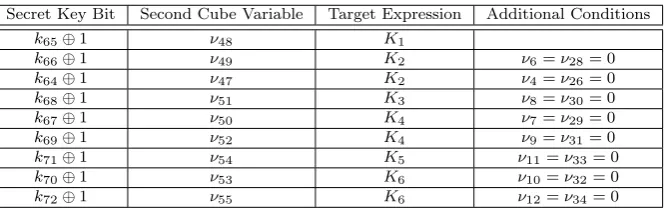
Table 2 List of Secret Key bits that can be recovered
Secret Key Bit Second Cube Variable Target Expression Additional Conditions
k65⊕1 ν48 K1
k66⊕1 ν49 K2 ν6=ν28= 0
k64⊕1 ν47 K2 ν4=ν26= 0
k68⊕1 ν51 K3 ν8=ν30= 0
k67⊕1 ν50 K4 ν7=ν29= 0
k69⊕1 ν52 K4 ν9=ν31= 0
k71⊕1 ν54 K5 ν11=ν33= 0
k70⊕1 ν53 K6 ν10=ν32= 0
k72⊕1 ν55 K6 ν12=ν34= 0
Adding these expressions we obtain K1 |ν48=0 ⊕ K1 |ν48=1 ⊕ 1 =k65. Thus we have ascertained the 65th bit of the Secret Key. Thus the procedure for
determiningk65can be summed up in the following steps:
(a) Determine the values ofK1, K2, . . . , K6by applying the attack described
in Section 4.2. The values of theType 1conditions should be as explicitly outlined in Section 4.2 (in particular ν48= 0).
(b) Now re-execute the attack, but this time set ν48 = 1 instead of 0 and determine the Secret Key expressions K1toK6.
(c) The sum of the values of K1 determined in the above two executions of the algorithm gives the value ofk65⊕1.
Note that the above process is similar to a 2 dimensional dynamic cube attack in which the cube variables areν61andν48. We repeat the above procedure but
this time useν49 as the second cube variable in place ofν48. By performing
similar calculations on the Secret Key expression K2, we will arrive at the following result:
K2|ν49=0⊕K2|ν49=1=k66·(ν6⊕ν28⊕1)⊕ν6ν28⊕ν6⊕1.
So, if we additionally setν6=ν28= 0, along with the otherType 1conditions
we would be able to retrieve the value ofk66⊕1. So we repeat the attack steps (a)-(c), this time takingν49 as the second cube variable (additionally setting ν6 and ν28 to 0) and sum the two values of K2 so obtained to determine the value ofk66⊕1. In Table 2, we give a list of the Secret Key bits that can be retrieved in this manner for different choices of the second cube variable.
As can be seen from Table 2, the nine Secret Key bitsk64, k65, . . . , k72are readily determined by this process.
6 Conclusion and Open Problems
made a primitive attempt to provide some structure to the search for suitable cubes as far as the stream cipher Grain v1 is concerned. Our attack retrieves 6 expressions in the Secret Key bits (of which three are linear and three of higher algebraic degree) for a version of Grain v1 in which the KSA is reduced to 105 (out of 160) initialization rounds. The attack uses 239−n1 evaluations (here
n1≈5) of the 105 round KSA function of Grain v1 with chosen IVs and takes
around 23 CPU hours to complete. This is an improvement of 8 KSA rounds over the previously best attack published against this cipher. Thereafter, we use this attack to propose a 2 dimensional dynamic cube attack against 105 round Grain v1 that retrieves nine Secret Key bits of the cipher.
Traditionally, application of cube attacks against Grain v1, has proven to be difficult due to the complex algebraic structure of the cipher. Although the work presented in this paper presents the best possible attack against the cipher in terms of number of rounds attacked, it is not too unrealistic to attempt to cryptanalyze even higher number of rounds using a cube attack of dimension possibly higher than 2. Until and unless all 160 rounds of the cipher can be attacked, this remains an attractive open research problem in this field.
References
1. The ECRYPT Stream Cipher Project. eSTREAM Portfolio of Stream Ciphers. Revised on September 8, 2008.
2. M. ˚Agren, M. Hell, T. Johansson and W. Meier. A New Version of Grain-128 with Authentication. Symmetric Key Encryption Workshop 2011, DTU, Denmark, February 2011.
3. S. Banik. Some Insights into Differential Cryptanalysis of Grain v1. In ACISP 2014, LNCS, Vol. 8544, pp. 34-49, 2014.
4. S. Banik, S. Maitra and S. Sarkar. A Differential Fault Attack on Grain family under reasonable assumptions. In Indocrypt 2012, LNCS, Vol. 7668, pp. 191-208, 2012. 5. S. Banik, S. Maitra and S. Sarkar. A Differential Fault Attack on the Grain Family of
Stream Ciphers. In CHES 2012, LNCS, Vol. 7428, pp. 122-139, 2012.
6. S. Banik, S. Maitra, S. Sarkar and M. S. Turan. A Chosen IV Related Key Attack on Grain-128a. In ACISP 2013, LNCS, Vol. 7959, pp. 13-26, 2013.
7. C. Berbain, H. Gilbert and A. Maximov. Cryptanalysis of Grain. In FSE 2006, LNCS, Vol. 4047, pp. 15–29, 2006.
8. A. Berzati, C. Canovas, G. Castagnos, B. Debraize, L. Goubin, A. Gouget, P. Paillier, S. Salgado. Fault Analysis of Grain-128. In: IEEE International Workshop on Hardware-Oriented Security and Trust, pp. 7–14, 2009.
9. T. E. Bjørstad. Cryptanalysis of Grain using Time/Memory/Data tradeoffs (v1.0 / 2008-02-25). Available athttp://www.ecrypt.eu.org/stream.
10. C. De Canni`ere, O. K¨u¸c¨uk and B. Preneel. Analysis of Grain’s Initialization Algorithm. In AFRICACRYPT 2008, LNCS, Vol. 5023, pp. 276–289, 2008.
11. I. Dinur, T. G¨uneysu, C. Paar, A. Shamir, R. Zimmermann. An Experimentally Verified Attack on Full Grain-128 Using Dedicated Reconfigurable Hardware. In ASIACRYPT 2011, LNCS Vol. 7073, pp. 327–343, 2011.
12. I. Dinur, A. Shamir. Breaking Grain-128 with Dynamic Cube Attacks. In FSE 2011, LNCS, Vol. 6733, pp. 167–187, 2011.
13. I. Dinur, A. Shamir. Cube Attacks on Tweakable Black Box Polynomials. In EURO-CRYPT 2009, LNCS, Vol. 5479, pp. 278-299, 2009.
15. H. Englund, T. Johansson, and M. S. Turan. A framework for chosen IV statistical analysis of stream ciphers. In INDOCRYPT 2007, LNCS, Vol. 4859, pp. 268–281, 2007. 16. P. Fouque and T. Vannet. Improving Key Recovery to 784 and 799 rounds of Trivium
using Optimized Cube Attacks. To appear in FSE 2013.
17. S. Fischer, S. Khazaei, and W. Meier. Chosen IV statistical analysis for key recovery attacks on stream ciphers. In AFRICACRYPT 2008, LNCS, Vol. 5023, pp. 236–245, 2008.
18. M. Hell, T. Johansson and W. Meier. Grain - A Stream Cipher for Constrained En-vironments. ECRYPT Stream Cipher Project Report 2005/001, 2005. Available at http://www.ecrypt.eu.org/stream.
19. M. Hell, T. Johansson and W. Meier. A Stream Cipher Proposal: Grain-128. In IEEE International Symposium on Information Theory (ISIT 2006), 2006.
20. K. Khoo and C. Tan. New time-memory-data trade-off attack on the estream finalists and modes of operation of block ciphers. In 7th ACM Symposium on Information, Computer and Communications Security, ASIACCS, pp. 20-21, 2012.
21. M. Lehmann, W. Meier: Conditional Differential Cryptanalysis of Grain-128a. In CANS 2012, LNCS, Vol. 7712, pp. 1–11, 2012.
22. S. Khazaei, M. Hassanzadeh and M. Kiaei. Distinguishing Attack on Grain. ECRYPT Stream Cipher Project Report 2005/071, 2005. Available at http://www.ecrypt.eu. org/stream
23. S. Knellwolf. Cryptanalysis of Hardware-Oriented Ciphers, The Knapsack Generator, and SHA-1. PhD Dissertation, 2012. Available athttp://e-collection.library.ethz. ch/eserv/eth:5999/eth-5999-02.pdf
24. S. Knellwolf, W. Meier and M. Naya-Plasencia. Conditional Differential Cryptanalysis of NLFSR-based Cryptosystems. In ASIACRYPT 2010, LNCS, Vol. 6477, pp. 130–145, 2010.
25. M. Rahimi, M. Barmshory, M. H. Mansouri, M. Reza Aref. Dynamic Cube Attack on Grain-v1. In IACR eprint archive. Available athttp://eprint.iacr.org/2013/268. 26. P. Stankovski. Greedy Distinguishers and Nonrandomness Detectors. In INDOCRYPT
2010, LNCS, Vol. 6498, pp. 210–226, 2010.
27. W. Stein. Sage Mathematics Software. Free Software Foundation, Inc., 2009. Available at http://www.sagemath.org. (Open source project initiated by W. Stein and contributed by many).
Appendix A: Computing the distribution of z105⊕z105φ for φ= 61 if allC1, C2, . . . , C6 are satisfied
We will prove the bias in the distribution ofz105⊕z φ
105along similar lines of
the proof of the bias of z97⊕z9737 reported in [3]. The probability values we
calculate are computed over the randomness due to the Key bits and the those IV bits not assigned by theType 1, 2relations. However, these results also hold, even if the Key is fixed, and the randomness comes only from the IV bits. First we state a straightforward lemma without proof.
Lemma 2 Let F be an i-variable Boolean function, with wt(F) = w. If the vectorX is chosen uniformly from{0,1}i then Pr[F(X) = 0] = 1− w
2i. We begin by inspecting the output of ∆61-GrainKSA at round t = 105, in
which the difference is nullified at rounds t = 15,36,39,42. At t = 105, we have
Υ105= [u108= 1, u130= 1, u151= 2, u169= 2, v168= 2]
This implies that of all the bits ofS105, S φ
105involved in the computation of z105andz
φ
105respectively, the relations between only i)x148, x φ
148ii)x161, x φ 161
iii)y151, y φ
151 iv)y169, y φ
169v)x168, x φ
168 are probabilistic. Therefore we have
z105⊕z105φ = 1⊕[x148⊕xφ148]⊕[x161⊕xφ161]⊕ [h(y108, y130, y151, y169, x168)⊕
h(1⊕y108,1⊕y130, yφ151, y169φ , xφ168)]
(9)
We assume that the random variables x148⊕x φ
148,x161⊕x φ
161,y151⊕y φ 151, y169⊕y
φ
169andx168⊕x φ
168are statistically mutually independent of one another.
It is difficult to prove this assumption theoretically but extensive computer simulations have shown that one can make this assumption.
CalculatingPr[x148⊕xφ148= 0]
To find this distribution we need to look at the state of our modified ∆61 -GrainKSA at t = 148−80 = 68. At this we have u68 = 0, Υ68 =0, Glin,68 =
[v68= 0, v82= 0, v130= 1],Gnlin,68=0, and
χ68= [v69= 0, v70= 0, v72= 0, v78= 0, v99= 0, v111= 0, v124= 2]
So we have
x148⊕xφ148= [g(X68)⊕y68⊕z68]⊕[g(X68φ)⊕y68φ ⊕z68φ] = 1⊕(x124⊕xφ124)
So in order to compute the above probability we need to compute the distribu-tion of (x124⊕x
φ
124) first. Att= 124−80 = 44, we haveu44= 0, Υ44= [u47=
0, u69 = 0, u90 = 1, u108 = 1, v107 = 0], χ44 = 0, Glin,44 = [v44 = 0, v58 =
0, v106 = 1],Gnlin,68 = 0. Note that y47 = ν47 = 0 according to one of the Type 1 conditions, andy69= 1 as defined by the padding rule of Grain v1. So we have
x124⊕x φ
124= [g(X44)⊕y44⊕z44]⊕[g(X φ 44)⊕y
φ 44⊕z
φ 44]
= 1⊕h(y47, y69, y90, y108, x107)⊕h(y47, y69,1⊕y90,1⊕y108, x107) =x107⊕y90·x107⊕y90⊕y108·x107⊕y108
Sincex107⊕y90·x107⊕y90⊕y108·x107⊕y108is a Boolean Function of weight 6, assuming independence of the component variables we havePr[x124⊕xφ124= 0] = 1−6
8 = 1
4. This implies that Pr[x148⊕x φ
CalculatingPr[y151⊕y151φ = 0]
To find this distribution we need to look at the state of our modified ∆61 -GrainKSAatt= 151−80 = 71. At this we haveΥ71= [u74= 0, u96= 0, u117=
0, u135= 2, v134= 2],F71=0, χ71=0. So we have
y151⊕yφ151= [f(Y71)⊕z71]⊕[f(Y71φ)⊕zφ71]
=h(y74, y96, y117, y135, x134)⊕h(y74, y96, y117, yφ135, xφ134)
Define the set of functionshij =h(y74, y96, y117, y135, x134) ⊕ h(y74, y96, y117, y135⊕i, x134⊕j), fori, j∈ {0,1}. Now assuming independence or the random
variables involved, we can write,
Pr[y151⊕yφ151= 0] =X
i,j
Pr[hij = 0]·Pr[y135⊕yφ135=i]·Pr[x134⊕xφ134=j]
(10) To compute this probability, we would need to calculate the individual prob-abilitiesPr[y135⊕y
φ
135= 0] andPr[x134⊕x φ
134= 0]. Att= 135−80 = 55, we
have F55 = [u55 = 0, u68 = 0, u78 = 0, u93 = 0, u106 = 1, u117 = 0],χ55 =0, Υ55= [u58= 0, u80= 0, u101= 0, u119= 1, v118= 0]. So we have
y135⊕yφ135= [f(Y55)⊕z55]⊕[f(Y55φ)⊕z55φ]
= 1⊕h(y58, y80, y101, y119, x118)⊕h(y58, y80, y101,1⊕y119, x118) = 1⊕y58y101⊕y58⊕y101x118⊕y101⊕x118
This represents a Boolean Function of weight 2, and hence we havePr[y135⊕
y135φ = 0] = 1−2 8 =
3
4. Now att= 134−80 = 54, we haveχ54=0, Glin,54= 0, u54 = 0, Υ54 = [u57 = 0, u79 = 0, u100 = 0, u118 = 1, v117 = 0] and all elements ofGnlin,54 are zeros exceptv106= 1. So we have
x134⊕x φ
134= [g(X54)⊕y54⊕z54]⊕[g(X φ 54)⊕y
φ 54⊕z
φ 54]
= [g(. . . , x106, . . .)⊕g(. . . ,1⊕x106, . . .)]⊕
[h(y57, y79, y100, y118, x117)⊕h(y57, y79, y100,1⊕y118, x117)]
We have to set x99 = 1, in the above equation since it is one of the con-ditions imposed at t = 36 to nullify a difference. Hence we have Pr[y135⊕
CalculatingPr[y169⊕y169φ = 0],Pr[x168⊕xφ168= 0] and Pr[x161⊕xφ161= 0]
To compute these probabilities, we will need to look at outputs of∆61-GrainKSA
att= 81,88,89. However at these rounds bothχtandΥthave many elements
equal to 2 and hence at this point we have to delve into several lower KSA rounds and compute the distributions of several intermediate variables and work our way up from there. Since this is slightly tedious, we omit extensive analysis of these two distributions and simply state the results.
Pr[y169⊕y169φ = 0] = 0.5015, Pr[x168⊕xφ168= 0] = 0.5,
Pr[x161⊕x φ
161= 0] = 0.495
CalculatingPr[h(y108, y130, y151, y169, x168)⊕h(1⊕y108,1⊕y130, y151φ , yφ169, xφ168) = 0]
For the sake of conciseness, let this expression be denoted by the symbolH, and define the Boolean FunctionsHijk=h(y108, y130, y151, y169, x168)⊕h(1⊕ y108,1⊕y130, i⊕y151, j ⊕y169, k ⊕x168), for all i, j, k ∈ {0,1}. Assuming
independence, it is easy to see thatPr[H = 0] equals
X
i,j,k
Pr[Hijk = 0]·Pr[y151⊕y151φ =i]·Pr[y169⊕y φ
169=j]·Pr[x168⊕x φ 168=k]
As it turns out, all the functionsHijkare balanced exceptH011andPr[H011=
0] = 34. By plugging these values into the above equation we get Pr[H = 0]≈ 0.542.
CalculatingPr[z105⊕z φ 105= 0]
From Equation (9), we can writePr[z105⊕z105φ = 0] equal to the following:
= 1− X
i⊕j⊕k=0
Pr[x148⊕xφ148=i]·Pr[x161⊕xφ161=j]·Pr[H =k]
≈0.5002
This concludes our proof for the distribution ofz105⊕z φ
105= 0. This has also