O R I G I N A L R E S E A R C H
Preoperative high C-reactive protein level is
associated with an increased likelihood for
conversion from laparoscopic to open
appendectomy in patients with acute appendicitis
This article was published in the following Dove Press journal: Clinical and Experimental Gastroenterology
Mitsugi Shimoda Tsunehiko Maruyama Kiyotaka Nishida Kazuomi Suzuki Tomoya Tago Jiro Shimazaki Shuji Suzuki
Department of Gastroenterological Surgery, Tokyo Medical University, Ibaraki Medical Center, Ami, Ibaraki, Japan
Background: Laparoscopic appendectomy (LA) has been increasingly adopted for its
advantages over the open appendectomy, but there are possibilities of conversion from laparoscopic to open appendectomy (CA) if the patients had complicated appendicitis concurrently, or when the extent of inflammation prohibits successful procedure. In this retrospective study, we aimed to clarify the preoperative predictors for CA.
Patients and methods: From January 2010 to April 2016, medical records of 93
con-secutive patients who underwent LA for suspected appendicitis were reviewed retrospec-tively. Factors evaluated were age, gender, body mass index, C-reactive protein (CRP), white cell count, albumin, Neutrophil count, lymphocyte count, Neutrophil/lymphocyte ratio, preoperative CT imaging (abscess formation: yes/no, appendicolith: yes/no), operative fac-tors (time to operation, amount of bleeding), length of hospital stay, period until oral intake after surgery, and period from initial symptoms to surgery.
Results:CA occurred in nine patients (9.7%). The reason for conversion was severe dense
adhesion in two cases, inadequate exposure of appendix in two cases, uncompleted appen-dectomy in two cases, perforated appendicitis in one case, gangrenous appendicitis in one case, and abscess formation in one case. Based on 93 patients evaluated by preoperative CT scan, significant factors in thefinal multivariate analysis associated with CA was CRP [odds ratio=1.13, 95% CI:1.00–1.28,p=0.04].
Conclusion: Identifying the potential factors for conversion preoperatively may assist the
surgeons in making decisions concerning the management of patients with appendicitis and in the judicious use of LA.
Keywords:laparoscopic, conversion, appendectomy, C-reactive protein
Introduction
Laparoscopic surgery is the preferred approach for many abdominal surgeries because of reduced postoperative incisional pain, short hospital stay, and improved cosmetic which follows a successful operation compared with standard open surgery.
Laparoscopic appendectomy (LA) wasfirst published in an article reporting thefirst complete removal of the appendix using the laparoscopic technique in 1983,1 and Schreiber2performed the first LA in a patient with acute appendicitis for women in 1987. The technique of LA has improved during the last decade, and the number of
Correspondence: Mitsugi Shimoda Department of Gastroenterological Surgery, Tokyo Medical University, Ibaraki Medical Center, 3-20-1, Chuo, Ami, Ibaraki 300-0395, Japan
Tel +81 298 871 161 Fax +81 298 402 089
Email [email protected]
Clinical and Experimental Gastroenterology
Dove
press
open access to scientific and medical research
Open Access Full Text Article
Clinical and Experimental Gastroenterology downloaded from https://www.dovepress.com/ by 118.70.13.36 on 20-Aug-2020
patients undergoing LA increased rapidly. LA also has been extended to complicated appendicitis. However, there were several occasions where conversion from laparoscopic to open appendectomy (CA) was necessary.
CA rates were about 0–17% in the previous reports,3–9and some reports described that independent risk factors which lead to CA were age, male sex, diabetes, obesity, high C-reactive protein (CRP), low white cell count (WBC), base necrosis, and acute appendicitis with abscess or peritonitis.7–10 CA increases medical costs and operative times; furthermore, from our experience CA compromises the benefits of the laparoscopic approach and outcomes, such as fewer surgical site infections and shortened hospital stays. Thus, preoperative criteria or risk factors that can be used to decide the ideal operative approach for individual patients are required.
In this retrospective study, we evaluated the preopera-tive risk factors and radiological inflammatoryfindings by computed tomography (CT), to identify parameters that may prove useful in predicting the failure of LA.
Patients and methods
Patient population and selection
From 2010, we started and indicated LA procedure for acute appendicitis cases, and our eligibility criteria for LA were all cases of acute appendicitis. The number of LA cases were increasing year by year from 2010.
From January 2010 to April. 2016, a total of 93 LA were performed in our medical center, and the patients and their operational outcomes were retrospectively analyzed in this study.
Prior to surgery, all patients were subjected to clinical examination, blood and urine screening, and to physical examination of the abdomen. Preoperative CT was routi-nely carried out in all patients. We diagnosed in acute appendicitis from CT findings, elevated WBC and CRP, and with abdominal physical findings. If the patients had free air or ascites and suspected appendiceal carcinoma as a result of the preoperative diagnosis, we selected conven-tional open appendectomy. Some patients’ received inter-val appendectomy, which was defined as appendectomy after 7 days or more since the initial symptoms.
Surgical procedure
All operations were performed by a team of two surgeons, at least one supervisor must be scrubbed in the operation. They were adequately experienced in the open as well as the laparoscopic approach.
LA was performed using a standardized three-trocar approach (umbilical, 12 mm port; suprapubic, 5 mm port; and optional lower-left quadrant, 5 mm port) under general anesthesia. With the patient in the Trendelenburg position and right side up, the small bowel was retracted away from the lower right quadrant. An inflammatory mass or hard adhesions, if present, was dissected gently with blunt instru-ments. The appendix was divided using pretied loops (Endoloops, Ethicon, Johnson and Johnson, Arlington, TX, USA) and removed through 12 mm port, in general with use of a Memo bag (Teleflex, Tokyo, Japan). Generally, intraper-itoneal irrigation was performed in all cases. Particularly in case of an abscess or perforated appendix, the lower-left quadrant, right paracolic gutter, and pelvis were irrigated with 1–2 L of physiological saline and was inserting contin-uous irrigation drain. In conversion appendectomy group (CA G), all of the cases were celiotomy by pararectal inci-sion, stump was close by serosa-muscle interrupted sutures. We performed abdominal lavages with more than 5 L of physiological saline solution to avoid abscess formation, and were inserting continuous irrigation drain in the pelvic cavity. Blood loss was measured by the circulating nurse from suction volume or the weight of the gauze.
Study design
We evaluated clinical and operative factors in all of the 93 patients. We divided the patients into two groups; LA group (LA G) and CA G, and clinical factors were selected and compared between the two groups. Clinical factors included age, gender, body mass index (BMI), albumin (Alb), CRP, neutrophil to lymphocyte ratio (NLR), WBC, and patholo-gical findings. We compared with both group according to the procedure, such as, time to surgery (TS), operative factors (operating time and amount of blood loss), length of hospital stay (LHS), period until start of ingestion (PSI), postoperative complication and interval appendectomy, and also compared both groups with and without an appendico-lith and abscess on preoperative CTfindings.
The study was approved by the research and ethics committee at the Tokyo Medical University, Ibaraki Medical Center (Number: 16–34). The patients who com-pleted follow-ups were also included in the study. As this is a retrospective non-intervention study, the institutional review board waived the need for written informed con-sent from all patients. All procedures performed in studies involving human participants were in accordance with the ethical standards of the institutional research committee and with the 1995 Helsinki Declaration.
Clinical and Experimental Gastroenterology downloaded from https://www.dovepress.com/ by 118.70.13.36 on 20-Aug-2020
Statistics
Statistical analyses were performed with the SPSS statis-tical software package (version 24.0; SPSS Inc., Chicago, IL). Median was used to define laboratory parameters such as age, gender, BMI, Alb, CRP, NLR, WBC, oper-ating time, amount of blood loss, PSI,, and LHS. Univariate and multivariate analyses were performed to clarify the laboratory parameter and clinical factors most significantly associated with LA G and CA G. Univariate and multivariate analyses, Mann–Whitney U-test, and Fisher’s exact test were utilized, and odds ratios with 95% CI were calculated using logistic regression model analyses.P-values of less than 0.05 were considered to be statistically significant.
Results
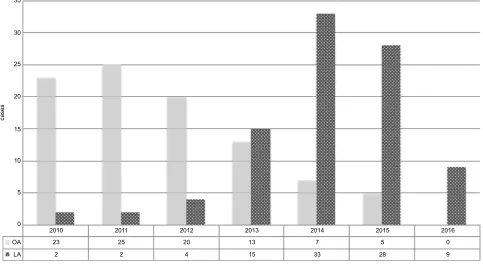
From January 2006 to April 2016, a total of 186 cases were performed appendectomy in our medical center, 93 patients underwent LA and another 93 cases had open appendectomies (OA) under acute appendicitis. The CA occurred in 9 of 93 patients (9.7%) (Figures 1 and 2).
Characteristics of CA G groups
There were one female and eight male, and the median age was 51.4 years old (range: 17–71). Reason of
conversion from LA to CA was severe dense adhesion in two cases, inadequate exposure of appendix in two cases, uncompleted appendectomy in two cases, perfo-rated appendicitis in one case, gangrenous appendicitis in one case, and abscess formation in one case. All of the nine patients received conventional appendectomy, how-ever, one patient needed additional surgery because the patient had appendiceal cancer according to the patholo-gicalfindings.
Comparing LA G and CA G
Bivariate analysis
Preoperative characteristics
BMI and CRP were significantly higher and longer in CA G than in LA G (p=0.01 and 0.001). Preoperative Alb level was significantly lower in CA G than in LA G (p=0.04). Patients with histological gangrenous presented the highest in CA G:p=0.002 and 0.01: Table 1).
Operative and postoperative factors
Operating time, amount of bleeding, LHS and PSI were significantly higher and longer in CA G than in LA G (p=0.0001, 0.0001, 0.002 and 0.002: Table 2). Patients with an abscess in CT image presented the highest in CA G:p=0.002: Table 2).
35
30
25
15
10
5
0 20
cases
2010 2011 2012
20 4
2013 2014 2015 2016
0 9 5
28 7
33 13
15 25
2 23
2 OA
LA
Figure 1Number of laparoscopic appendectomies and open appendectomies during the study period. Abbreviations:OA, open appendectomy; LA, laparoscopic appendectomy.
Clinical and Experimental Gastroenterology downloaded from https://www.dovepress.com/ by 118.70.13.36 on 20-Aug-2020
Multivariate analysis
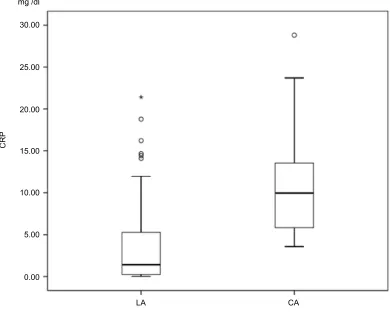
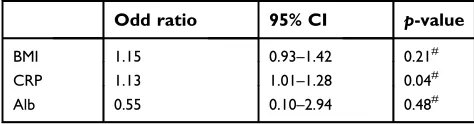
CRP level was an only significant adverse prognostic factor in multivariate analysis (odds ratio 1.13; 95% CI; 1.00–1.28,p=0.04: Figure 3, Table 3).
Discussion
There have been several advancements in laparoscopic surgery during the last decade. These improvements have contributed to some advantages of LA over the OA,
35
30
25
20
15
10
5
0
LA conversion
2010 2011 2012 2013 2014 2015 2016
9 1 1
28 33
4 15
1 4
2 1 1
2
0
cases
Figure 2Number of laparoscopic appendectomies and conversion from laparoscopic to open appendectomies during the study period. Abbreviations:Conversion, conversion from laparoscopic to open appendectomy, LA, laparoscopic appendectomy.
Table 1The characteristics before and after surgery according to the procedure
CA G (n=9) LA G (n=84) p-value
Age (years) 51 (16–71) 29 (19–84) 0.07*
Gender (F/M) 1/8 37/47 0.09†
BMI 23.1 (17.9–35.6) 21.3 (15.3–30.8) 0.01*
CRP (mg/dl) 9.9 (3.6–26.0) 1.4 (0.02–21.4) 0.001*
Alb (g/dL) 4.0 (3.4–4.7) 4.4 (2.8–6.1) 0.04*
WBC (103/μL) 13.2 (8.3–26.5) 12.3 (4.3–22.1) 0.08*
Neutro. (%) 84.1 (77.1–95.5) 79.8 (28.8–94.6) 0.21*
Lymph (%) 6.5 (3.0–15.7) 13.6 (3.3–46.0) 0.11*
NLR 13.5 (4.9–31.8) 5.8 (0.9–27.2) 0.20*
Abscess (Y/N) 3/6 1/83 0.002†
appendicolith (Y/N) 4/5 31/53 0.73†
Histological Gangrenous (Y/N) 6/3 24/60 0.01†
Notes:Showing medians and interquartile ranges. *Tested by Mann–WhitneyU-test.†Tested by Fisher’s exact test.
Abbreviations:BMI, body mass index; CRP, C-reactive protein; Alb, albumin; WBC, white cell count; Neutro, neutrophil; Lymph, lymphocyte; NLR, neutrophil/lymphocyte ratio; CA G, open appendectomy group; LA G, laparoscopic appendectomy group.
Clinical and Experimental Gastroenterology downloaded from https://www.dovepress.com/ by 118.70.13.36 on 20-Aug-2020
including reduced blood loss and improved postoperative morbidity rate. On the other hand, the disadvantages asso-ciated with the increase of LA are the use of disposable instruments which adds to the cost and increases the oper-ating time compared to OA. Furthermore, there were occa-sions where LA cases had to be converted to open
laparotomy. We believe that several factors could have played a role regarding this conversion, such as initial patient selection which can improve with better and more accurate preoperative diagnostic through CT scans, and an improved learning curve of surgical staff. But even so, conversion to laparotomy is unavoidable in some cases, and the conversion rate according to previous reports was about 0–17%.3–9The major reason for conversion to lapar-otomy was inadequate exposure of appendix, bleeding, and iatrogenic bowel injuries according to previous reports.11–14
Some of the retrospective reports identified predictors of where conversion would be necessary from LA to open. The predictors were age, male, symptom duration, WBC over 20,000, surgeon experience, and CT scans
findings.8,12,14 The conclusion from our study, CA was lengthened the operative time, delayed meal intake, increasing blood loss, and leads to a longer hospital stay.
CTfinding is one of the important factors for determi-nation of procedure for an appendectomy. Tuggle et al, defined the CT grading system through acute appendicitis
Table 2The outcomes according to the procedure
CA G (n=9)
LA G (n=84)
p
-value
Operating time (mins)
121 (93–219) 59 (28–176) 0.0001*
Blood loss (g) 125 (1–300) 1 (1–150) 0.0001*
PSI (days) 5 (2–8) 2 (0–11) 0.002*
TS (days) 1 (0–7) 1 (0–41) 0.63†
LHS (days) 10 (5–14) 5 (2–24) 0.002*
Complication (Y/N) 1/8 2/82 0.27†
IA (Y/N) 0/9 12/72 0.59†
Notes: Showing medians and interquartile ranges. *Tested by Mann–Whitney U-test.†Tested by Fisher’s exact test.
Abbreviations:CA G, open appendectomy group; LA G, laparoscopic appendect-omy group; PSI, period until the start of meal intake; TS, time to surgery; LHS, length of hospital stay; IA, interval appendectomy.
LA CA
CRP
30.00
25.00
20.00
15.00
10.00
5.00
0.00 mg /dl
Figure 3CRP level in laparoscopic appendectomies and conversion appendectomies.
Abbreviations:CRP, C-reactive protein; CA, conversion from laparoscopic to open appendectomy; LA, laparoscopic appendectomy.
Clinical and Experimental Gastroenterology downloaded from https://www.dovepress.com/ by 118.70.13.36 on 20-Aug-2020
using 6-point (0–5) scale.15Several authors have evaluated this grading system for CA compared to LA. The patients had a fluid collection and/or abscess formation of the grade of 4 and 5, and those patients had a significantly higher risk of conversion.9,12In the present study, abscess formation is considered as one of the risk factors for CA. OA was also our first choice to those patients who had surgery previously or had an obvious case of abscess formation through CT.
What this study adds is that a significantly elevated CRP of >9.9 mg/dL is also an independent risk factor for conver-sion from LA to CA. Only two studies verify CRP as a marker for conversion from LA.7,9 Those two papers described that preoperative CRP of >100 and >150 mg/L were a statistically significant predictor of CA. CRP is body’s acute phase inflammatory markers. A higher level of CRP is therefore suggestive of a more intense local inflammatory reaction and more severe acute appendicitis. We theorize that this is due to inflammatory and/or infective components, and it may be correlated with perforating appendix or abscess. Patients with high CRP should undergo abdominal CT and suspected gangrenous appendicitis and/or abscess formation. In order to build on this concept, our study shows that not only does a high CRP make the procedure more challenging technically but it also increases the chance of complications arising in the LA group.
Conclusion
Our study has identified that high CRP (more than 9.9 mg/ dL) is associated with an increased likelihood for LA to CA in patients with acute appendicitis. We suggested that if the patients had high CRP level with abscess formation or gangrenous appendicitis on CTfindings, we recommend the first approach to the conventional appendectomy for those patients.
Abbreviations list
LA, laparoscopic appendectomy; OA, open appendectomy; CA, conversion from laparoscopic to open appendectomy.
Disclosure
The authors report no conflicts of interest in this work.
References
1. Semm K. Endoscopic appendectomy.Endoscopy. 1983;15(2):59–64. doi:10.1055/s-2007-1021466
2. Schreiber JH. Early experience with laparoscopic appendectomy in women.Surg Endosc. 1987;1(4):211–216.
3. Schlottmann F, Sadava EE, Pena ME, Rotholtz NA. Laparoscopic appendectomy: risk factors for postoperative intraabdominal abscess. World J Surg. 2017;41(5):1254–1258. doi:10.1007/ s00268-017-3869-y
4. Lee SM, Hwang GS, Lee DS. Single-incision laparoscopic appen-dectomy using homemade glove port at low cost.J Minim Access Surg. 2016;12(2):124–128. doi:10.4103/0972-9941.169979 5. Popa D, Soltes M, Uranues S, Fingerhut A. Are there specific
indica-tions for laparoscopic appendectomy? A review and critical appraisal of the literature. J Laparoendosc Adv Surg Tech A. 2015;25 (11):897–902. doi:10.1089/lap.2014.0624
6. Kucuk GO. Technical and social challenges of laparoscopic appen-dectomy performed in a rural setting. Ann Ital Chir. 2015;86 (4):344–348.
7. Shelton JA, Brown JJ, Young JA. Preoperative C-reactive protein predicts the severity and likelihood of complications following appendicectomy. Ann R Coll Surg Engl. 2014;96(5):369–372. doi:10.1308/003588414X13946184901722
8. Gomes CA, Junior CS, Costa EDF, et al. Lessons learned with laparoscopic management of complicated grades of acute appendicitis. J Clin Med Res. 2014;6(4):261–266. doi:10.14740/ jocmr1837w
9. Abe T, Nagaie T, Miyazaki M, Ochi M, Fukuya T, Kajiyama K. Risk factors of converting to laparotomy in laparoscopic appendectomy for acute appendicitis. Clin Exp Gastroenterol. 2013;6:109–114. doi:10.2147/CEG.S41571
10. Finnerty BM, Wu X, Giambrone GP, et al. Conversion-to-open in laparoscopic appendectomy: a cohort analysis of risk factors and outcomes.Int J Surg. 2017;40:169–175. doi:10.1016/j.ijsu.2017.03.016 11. Fleming CA, Kearney DE, Moriarty P, Redmond HP, Andrews EJ. An evaluation of the relationship between Enterobius vermicularis infestation and acute appendicitis in a paediatric population – a retrospective cohort study. Int J Surg. 2015;18:154–158. doi:10.1016/j.ijsu.2015.02.012
12. Gupta N, Machado-Aranda D, Bennett K, Mittal VK. Identification of preoperative risk factors associated with the conversion of laparo-scopic to open appendectomies. Int Surg. 2013;98(4):334–339. doi:10.9738/INTSURG-D-13-00058.1
13. Nielsen LBJ, Tengberg LT, Bay-Nielsen M. Laparoscopy in major abdominal emergency surgery seems to be a safe procedure.Dan Med J. 2017;64:5.
14. Liu SI, Siewert B, Raptopoulos V, Hodin RA. Factors associated with conversion to laparotomy in patients undergoing laparoscopic appendectomy.J Am Coll Surg. 2002;194(3):298–305.
15. Tuggle KR, Ortega G, Bolorunduro OB, et al. Laparoscopic versus open appendectomy in complicated appendicitis: a review of the NSQIP database.J Surg Res. 2010;163(2):225–228. doi:10.1016/j. jss.2010.03.071
Table 3 Multivariable analysis clinical and operative factors
according to the procedure
Odd ratio 95% CI p-value
BMI 1.15 0.93–1.42 0.21#
CRP 1.13 1.01–1.28 0.04#
Alb 0.55 0.10–2.94 0.48#
Note:#
Tested by logistic regression model analyses.
Abbreviations:BMI, body mass index; CRP, C-reactive protein; Alb, albumin.
Clinical and Experimental Gastroenterology downloaded from https://www.dovepress.com/ by 118.70.13.36 on 20-Aug-2020
Clinical and Experimental Gastroenterology
Dove
press
Publish your work in this journal
Clinical and Experimental Gastroenterology is an international, peer-reviewed, open access, online journal publishing original research, reports, editorials, reviews and commentaries on all aspects of gas-troenterology in the clinic and laboratory. This journal is indexed on American Chemical Society’s Chemical Abstracts Service (CAS).
The manuscript management system is completely online and includes a very quick and fair peer-review system, which is all easy to use. Visit http://www.dovepress.com/testimonials.php to read real quotes from published authors.
Submit your manuscript here:https://www.dovepress.com/clinical-and-experimental-gastroenterology-journal
Clinical and Experimental Gastroenterology downloaded from https://www.dovepress.com/ by 118.70.13.36 on 20-Aug-2020