ISSN (Print) : 2320 – 3765 ISSN (Online): 2278 – 8875
I
nternational
J
ournal of
A
dvanced
R
esearch in
E
lectrical,
E
lectronics and
I
nstrumentation
E
ngineering
(An ISO 3297: 2007 Certified Organization)
Vol. 5, Issue 7, July 2016
An Advanced Web Image Search Reranking
using HRPP and Feature Selection
Silpa Parvathy S1
, Saranya R
2PG Student [Communication Engineering], Dept. of ECE, BC Caarmel Engineering College, Kerala, India1 Assistant Professor, Department of ECE, BC Caarmel Engineering College, Kerala, India2
ABSTRACT:Web Image Search Reranking (ISR) is a technique that aims at refining text-based search results by excavating images visualcontent. Feature extraction and the design of ranking function aretwo key steps in ISR. Current commercial search engines have taken image re-ranking for improving the web based search of images. At first the images are retrieved and displayed. This images are based on textual similarity, select one image fromthe initial result as query image and the residual images are re-ranked based on their visual resemblance with the queryimage. Here, a framework for Advanced Web Image Search Re-ranking is suggested. Relevance Labelling is an exciting procedureto advance the performance of Image Retrievalmethods even when using low-level features alone. It individually and automatically learns the different input keywords instead of manually describing a universal concept dictionary. In this way the semantic space associated to the image to be re-ranked becomes slender, because of the query keyword provided by users. Principal Component Analysis [PCA] helps to optimize the performance speed. The query-specific semantic spaces can more precisely model the images to be re-ranked, since they have omitted other potentially unbounded number of irrelevant concepts, which serves as noise and depreciate the re-ranking enactment on both accuracy and computational cost.
KEYWORDS: Feature Embedding, Image Reranking, Relevance Labelling, Image Retrieval, PCA.
I.INTRODUCTION
Web Image Searching is a technique that uses keywords as queries and surrounding textual similarities are used as source. But this method suffers from vagueness, because it is very difficult for user to describe all visual features in words. For instance, using “apple” as an input keyword, the recovered images belong to different categories. In order to solve the vagueness, content-based image retrieval [2] with relevance feedback [10] is widely used. It requires users to select multiple relevant and irrelevant image instances, from which graphic similarity metrics are cultured through online training. The images are arranged based on the visual similarities. Still, for web-scale commercial systems, user’s feedback has to be limited to the least without online training.
Feature extraction and design of ranking function are two key steps in ISR Initially searched images are distributed intrinsically in a hypersphere [1], [11], where relevant images are inside it while irrelevant images are outside it. This is in accordance with the idea of hypersphere in one-class classification in which the relevant images are target data and the irrelevant ones are outliers, A novel spectral embedding algorithm named Hypersphere-based Relevance Preserving Projection (HRPP) [11] is used. The algorithm learns a linear transformation matrix under the locality constraint on the data and relevance constraints on different relevance degree examples. Thus, HRPP algorithm transforms the original graphical feature space to an intrinsical feature space.
ISSN (Print) : 2320 – 3765 ISSN (Online): 2278 – 8875
I
nternational
J
ournal of
A
dvanced
R
esearch in
E
lectrical,
E
lectronics and
I
nstrumentation
E
ngineering
(An ISO 3297: 2007 Certified Organization)
Vol. 5, Issue 7, July 2016
II. SYSTEM MODEL
The existing methods for Image Search Reranking [ISR] suffer from the unfaithfulness of the assumptions beneath which the text-based images search result. The resulting images contain more irrelevant images. Hence the re ranking thought arises to re rank the recovered images based on the text around the image and data of data of image and visual property of image. A number of approaches are distinguished for this re-ranking. The high ranked images are used as noisy data and an algorithm named k means algorithm is used for classification.Most of the feature extraction methods for ISR treat the initially searched images equally, which is not appropriate since these images usually have two or more than two relevance degrees, e.g., relevant, fair and irrelevant. Generally, image groups with different relevance degree have distinct properties. Ignorance of the difference between different relevance degree groups cannot ensure the appropriate visual representations, and degrades the final ISR performance.
An Advanced Web image Search Reranking Method is proposed, that uses a feature selection technique to reduce the dimensionality of the image feature space. The target of Advanced Web Image Search Reranking is to retrieve images relevant to a query of a user. Here Text Based (Tag Based) Image Retrieval [TBIR] is used along with feature extraction methods. The Framework of the Proposed System is shown in fig.1.
Fig.1 Framework of the Proposed System
ISSN (Print) : 2320 – 3765 ISSN (Online): 2278 – 8875
I
nternational
J
ournal of
A
dvanced
R
esearch in
E
lectrical,
E
lectronics and
I
nstrumentation
E
ngineering
(An ISO 3297: 2007 Certified Organization)
Vol. 5, Issue 7, July 2016
TEXT BASED IMAGE RETRIEVAL [TBIR]
An image retrieval system is a computer system for browsing, searching and retrieving images from a huge database. Most traditional and common means of image retrieval utilize some method of giving metadata like captioning, or descriptions towards the images so that retrieval can be achieved over the annotation words. TBIR is the image retrieval method used in this thesis. In Text Based (Tag Based) Image Retrieval, each image is annotated with a textual description [Tag] and their retrieval is based on matching the user’s textual query to the annotation of the image. Text based means, when the user give an input textual query, it looking for the tag that the user entered as a search query in the database. It looks the similar tag that has been attached with the image and retrieves the image to the operator. It didn't scrutinize the content of the image; it only checks the tag in the image.
THE HRPP AND REVERSED KNN ALGORITHMS
A spectral analysis algorithm, HRPP (Hypersphere-based Relevance Preserving Projection), which finds a low dimensional embedding of the data examples with the idea of one-classification and spectral analysis. And then, a simple but effective ranking algorithm named H-Rank (Hypersphere- Ranking) to order the data examples according to their relevance to the query. Finally, a web Image Search Reranking framework is used with algorithms of HRPP and H-Rank.
The HRPP Algorithm
Given a textual query q, let X = [x1; :::; xn] ε RD x n be the set of initial search result, where D is the original feature
dimensionality, n is the total example number. Let L =[x1; :::; xr; xr+1; :::; ::;xr+h] be the labeled set from X, where r is
the labeled number of the relevant examples, h is the labeled number of irrelevant examples. Using the labeled data, the aim of our proposed HRPP algorithm is to find an embedding matrix W = [w1; :::;wd] ε R D x d that maps X = [x1; :::; xn]
ε R D x n to low-dimensional compact vectors Y = [y1; :::; yn] ε Rd x n (d « D) as well as keeping the intrinsical
hypersphere distribution. The transformation process can be implemented by Y = WTX, whose one-dimensional case is yi= wTxi .
Relevant examples are clustered together from two aspects. One is that the relevant examples should be close to the hypersphere center, which represents the users search intention. We use the mean vector m of the labeled relevant examples as the hypersphere center for simplicity, i.e.:
The objective function can be written as:
The other one is that the relevant examples should be as close as possible and preserve the local information. The widely used Graph Laplacian regularizer can be employed, which is defined as:
where
Sij measures the similarities between xi and xj, and σ is a scaling parameter. To keep the irrelevant examples away, the
objective function is defined as:
ISSN (Print) : 2320 – 3765 ISSN (Online): 2278 – 8875
I
nternational
J
ournal of
A
dvanced
R
esearch in
E
lectrical,
E
lectronics and
I
nstrumentation
E
ngineering
(An ISO 3297: 2007 Certified Organization)
Vol. 5, Issue 7, July 2016
The objective function J can be reduced to:
where
and L = P-Q is a Laplacian matrix.
Therefore, the solution for the HRPP algorithm can be represented as follows:
By introducing the Lagrangian multiplier, HRPP algorithm can be solved by the following generalized eigen-decomposition:
wherewi is the generalized eigenvector of XLXTand λiis the corresponding eigenvalue. Let the column vectors w1……wd
be the solutions of the algorithm can be well-arranged according to the first d largest eigenvalues. The embedding matrix can be expressed as:
whereyi is a d - dimensional vector and W is a D x d embedding matrix.
The main procedure of the HRPP Algorithm:
Step 1: Compute the mean vector m as the hypersphere center.
Step 2: Compute the similarities Sijbetween two examples with the labeled relevant data.
Step 3: Compute the matrices D, P, Q and the resultant Laplacian matrix, L = P-Q. Step 4: Perform the eigenvalue decomposition and construct D x d embedding matrix W.
THE REVERSED KNN ALGORITHM AND ONE-CLICK BASED HRPP (OC-HRPP)
A reversed KNN algorithm is used to obtain adequate pseudo-relevant images by necessitating that the user gives only one click on the initially searched images. The HRPP method combined with reversed KNN algorithm is called One-Click based HRPP (OC-HRPP).The steps of the reversed KNN algorithm are as follows:
1. The user clicks one relevant image that satisfies his/her intent from the initially searched results. This image is then put into a relevant-image pool.
2. The nearest neighbor of the clicked images from the top N initially searched images is chosen as a pseudo-relevant image by the k-Nearest Neighbor (KNN) algorithm, and this image is also plow into the pseudo-relevant images pool. At present, there are two images in the pool.
3. Find the next pseudo-relevant image by calculating the least average distance between the images in that pool and the remained top N initially searched images.
4. Repeat the stage of (3) until the total image number in the pool extents the predefined threshold Tc.
ISSN (Print) : 2320 – 3765 ISSN (Online): 2278 – 8875
I
nternational
J
ournal of
A
dvanced
R
esearch in
E
lectrical,
E
lectronics and
I
nstrumentation
E
ngineering
(An ISO 3297: 2007 Certified Organization)
Vol. 5, Issue 7, July 2016
relevant images are only chosen from the top N initially searched images. In this way, the quality of pseudo-relevant images in the pool can be guaranteed to a large extent. Therefore, enough relevant images can be harvested by only one-click, which makes the OC-HRPP algorithm quite important.
H-RANK ALGORITHM
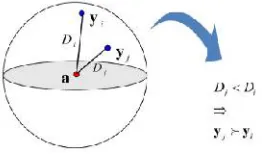
After feature embedding, the transformed features are assumed to be distributed in a hypersphere space, where the relevant examples lie inside the hypersphere while the irrelevant examples lie outside the hypersphere. Thus, it is reasonable to consider that the examples near to the hypersphere center are more relevant to those far from it. Therefore, data can be ranked by their distances to the center, as shown in fig. 2.
Fig. 2 Data ranking by their Distances.
In the H-Rank algorithm, Euclidean distance is adopted. Thus the distance is defined as:
where a is the hypersphere center in the transformed feature space. The smaller Di is, the higher position xi should be
ranked in. In this way, the examples are ranked without the complex training stage or heavy computational burden. Specifically, the hypersphere center a is obtained with the method of Support Vector Data Description (SVDD).
with the constraints 0 ≤ αi ≤ C
FEATURE EXTRACTION USING PRINCIPAL COMPONENT ANALYSIS [PCA]
Feature extraction is a distinguishing method of dimensionality reduction and enfolds more information about the original image. The input query which is to be treated is transformed into a concentrated description set of features. This efficiently represents interesting portions of an image as a solid feature vector. This tactic is useful when image sizes are bulky and a reduced feature illustration is necessary to quickly complete tasks such as image matching and retrieval. Principal Component Analysis is used as a dimensionality reduction technique in which a covariance enquiry between factors takes place. The original data is replotted into a new coordinate system centered on the variance contained by the data. PCA put on a mathematical system for changing a number of correlated variables into a lesser amount of uncorrelated variables called principal Components. As much of the variability in the data is promising with the first PCA, and each succeeding component accounts for as much of the lasting variability as possible. PCA is useful when there is data on a large amount of variables, and if there is some redundancy among those variables. Redundancy means that some of the variables are interconnected with one another. Due to this redundancy, PCA can be used to reduce the observed variables into a concentrated number of principal components for most of the variance in the observed variables.
Steps involved in PCA
ISSN (Print) : 2320 – 3765 ISSN (Online): 2278 – 8875
I
nternational
J
ournal of
A
dvanced
R
esearch in
E
lectrical,
E
lectronics and
I
nstrumentation
E
ngineering
(An ISO 3297: 2007 Certified Organization)
Vol. 5, Issue 7, July 2016
3) Centralize the data [Subtract the mean from the dataset in all the n- dimensions]. From these values a new matrix is obtained
4) Calculate the d x d Covariance matrix of this mean-subtracted dataset
Ci,i (diagonal) - variance of variable i
Ci,j(off - diagonal) - covariance between variables i and j.
5) Eigen values of the dataset is calculated.
6) Using the Eigen values compute the Eigen vectors of the Covariance matrix of the dataset
7) Forming a feature vector by choosing the Eigen vectors having the largest Eigen values. These are the Principal Components of the Dataset
III.RESULT AND DISCUSSION
At first a Database is prepared. NUS-WIDE Dataset is used to prepare the database. The database contains ‘All Images’ and ‘Tag All’. ‘All Images’ consist of the image names and their respective tags are given under ‘Tag All’. When we give a name in that Tag, it will display all those pictures that matches the tag name. Each image is associated with a numerical value, for each value, some textual descriptions are given in the database. The textual descriptions are stored under ‘TagAll’.To search an image from, the web, first give an input text word as the query. Giving an input keyword is shown in fig.5.
Fig.5 Input Query
When an input keyword is given as the query, an initial set of images are displayed as the search result. Initial search result consists of all those images whose tags matches with the input query. The Initial result when we give 'rose' as the input word is shown in the Fig.6.4.When we give an input text word, we get an initial set of images as the search result. Among the initial result, search any one of the image for Reranking purpose. Selection of image is shown in fig.6.
ISSN (Print) : 2320 – 3765 ISSN (Online): 2278 – 8875
I
nternational
J
ournal of
A
dvanced
R
esearch in
E
lectrical,
E
lectronics and
I
nstrumentation
E
ngineering
(An ISO 3297: 2007 Certified Organization)
Vol. 5, Issue 7, July 2016
When we give an input text word, we get an initial set of images as the search result. Among the initial result, search any one of the image for reranking purpose. Selection of image is shown in Fig.7.
Fig.7. Image Selection
Selected image is used for reranking .The image that is more relevant with the input keyword is displayed first. The final result is shown in fig.8
Fig. 8. Final Result
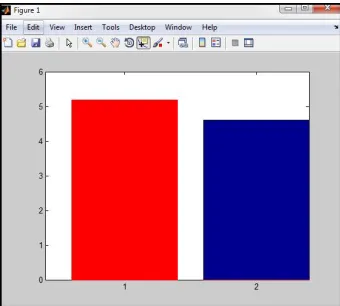
Speed optimization is possible with the present work. It gives better searching and takes only a little time for Reranking of images. Also it helps to reduce the semantic gap in between the input query and the obtained results. A Comparison between the Existing Method and Present Work while taking ‘rose’ as input query is shown in the graph in Fig.9.
ISSN (Print) : 2320 – 3765 ISSN (Online): 2278 – 8875
I
nternational
J
ournal of
A
dvanced
R
esearch in
E
lectrical,
E
lectronics and
I
nstrumentation
E
ngineering
(An ISO 3297: 2007 Certified Organization)
Vol. 5, Issue 7, July 2016
The graph plotted shows that the Present Work have high efficiency and it requires minimum Computational time. This shows the efficiency of the proposed Work. The proposed work needs minimum computational time and the results are more accurate.
IV.CONCLUSION
Based on the hypersphere idea in one-class classification, the feature extraction and ranking function problems in image searchreranking have been addressed in this work. Specifically, the HRPP algorithm transforms the original visual features space into an innately low-dimensional space by conserving the manifold structure and relevance relationship among the images. The H-Rank algorithm sorts the images with their distances to the hypersphere center .Moreover, a novel interactive method is used to capture the user’s intent by demanding that the user provides only one click on the initially searched images, which makes the proposed Web Image Reranking method, a method having strong practical significance. PCA is used to lessen the number of features used to signify data. The benefits of this dimensionality reduction provides a simpler demonstration of the data, reduction in memory, and faster classification .Speed optimization and better efficiency is possible with present work.
REFERENCES
[1] Y. Chen, X. S. Zhou, and T. S. Huang., “One-class SVM for learning in image retrieval”,IEEE Int. Conf. Image Process, pp. 3437, Oct. 2001. [2] X. S. Zhou and T. S. Huang, “Relevance feedback in content-based image retrieval: Some recent advances”, Inf. Sci., vol. 148, nos. 14, pp.
129137, Dec. 2002.
[3] M. Wang, L. Yang, and X.-S. Hua, “MSRA-MM: Bridging research and industrial societies for multimedia information retrieval”, Microsoft, Beijing, Beijing, China, Tech. Rep. MSR- TR-2009-30, 2009.
[4] B. Geng, L. Yang, C. Xu, and X.-S. Hua, “Content-aware ranking for visual search”,IEEE Conf. Comput. Vis. Pattern Recognit., pp. 34003407, Jun. 2010.
[5] X. Tian, L. Yang, J. Wang, X. Wu, and X.-S. Hua, “Bayesian visual Reranking”, IEEE Trans. Multimedia, vol. 13, no. 4, pp. 639652, Aug. 2011.
[6] L. Duan, W. Li, I. W. Tsang, and D. Xu, “Improving Web image search by bag-based reranking”, IEEE Trans. Image Process., vol. 20, no. 11, pp. 32803290, Nov. 2011.
[7] M. Wang, H. Li, D. Tao, K. Lu, and X. Wu, “Multimodal graph-based reranking for Web image search”, IEEE Trans. Image Process., vol. 21, no. 11, pp. 46494661, Nov. 2012.
[8] J. Yu, Y. Rui, and D. Tao, “Click prediction for Web image reranking using multimodal sparse coding”, IEEE Trans. Image Process., vol. 23, no. 5, pp. 20192032, May 2014.
[9] W. Cao, N. Liu, Q. Kong, and H. Feng, “Content-based image retrieval using high- dimensional information geometry”, Sci. China Inf. Sci., vol. 57, no. 7, pp. 111, Jul. 2014.
[10] Y. Zhang, X. Yang, and T. Mei, “Image search reranking with query dependent click-based relevance feedback”, IEEE Trans. Image Process., vol. 23, no. 10, pp. 44484459, Oct. 2014.
[11] Zhong Ji, Yanwei Pang, and Xuelong Li, "Relevance Preserving Projection and Ranking for Web Image Search Reranking", IEEE Trans. Image Process., vol. 24, no. 11, pp. 4137- 4147, Nov.2015.
BIOGRAPHY
Silpa Parvathy S received the B.Tech degree in Electronics and Communication Engineering from MG University, Kottayam, Kerala, India, in 2007 and currently she is doing M.Tech in Electronics and Communication Engineering with Specialization in Communication Engineering from BC Caarmel Engineering College, Perunad,MG University Kottayam, Kerala, India.