CSEIT411853 | Published - 25 April 2018 | March-April-2018 [ (4 ) 1 : 320-325 ]
National Conference on Recent Advances in Computer Science and IT (NCRACIT) International Journal of Scientific Research in Computer Science, Engineering and Information Technology
© 2018IJSRCSEIT | Volume 4 | Issue 1 | ISSN : 2456-3307
320
A Study and Analysis of Machine Learning Algorithms and Its
Applications
Dr. Archana Sharma
1, Prof. Vibhakar Mansotra
21Department of Computer Science, Institute of Management Sciences (IMS), Jammu, Jammu & Kashmir, India 2Department of Computer Sciences and IT, University of Jammu, Jammu, Jammu & Kashmir, India
ABSTRACT
Machine learning is a subfield of artificial intelligence (AI). Deep understanding of data inputs would help in taking output as optimized decisions and also help them to work in more accurate and in efficient manner. Designing and implementing the algorithm and using it in most appropriate way is, the real challenge for the developers and scientists. Machine learning algorithms allow computers to train inputs data and use statistical analysis for optimum decision values. Based on data inputs, machine learning facilitates computers in building models from dataset in order to get automatic decision-making processes. Today, many technical users has benefitted from machine learning. In this paper, we will discuss the machine learning methods, and explore various algorithmic approaches in machine learning providing with some of the positive and negative attributes of each algorithm and most efficient use to make decisions and complete the task in more optimized form.
Keywords: Artificial Intelligence, Machine Learning, Decision-Making Process, Applications.
I.
INTRODUCTION
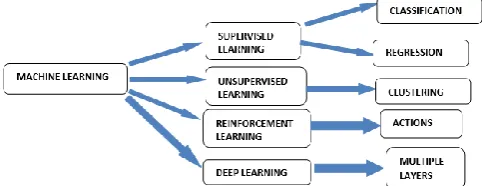
According to a recent study, machine-learning algorithms are expected to replace 25% of the jobs across the world, in the next 10 years. With the rapid growth of big data and availability of programming tools. Machine learning is gaining mainstream presence for data. Machine learning applications are highly automated and self-modifying which continue to improve over time with minimal human intervention as they learn with more data. Machine Learning algorithms are classified as
Figure 1. Machine Learning Techniques
A. Supervised Machine Learning Algorithms
Machine learning algorithms that make predictions on given set of samples. Supervised machine learning algorithm searches for patterns within the value labels assigned to data points.
B. Unsupervised Machine Learning Algorithms There are no labels associated with data points. These machine-learning algorithms organize the data into a group of clusters to describe its structure and make complex data look simple and organized for analysis.
Figure 3. Unsupervised Learning
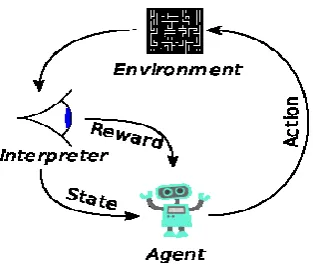
C. Reinforcement Machine Learning Algorithms
These algorithms choose an action, based on each data point and later learn how good the decision was. Over time, the algorithm changes its strategy to learn better and achieve the best reward.
Figure 4. Reinforcement Learning
D. Deep Machine Learning Algorithms
In deep learning, a computer model learns to perform classification tasks directly from images, text, or sound. Deep learning models can achieve state-of-the-art accuracy, sometimes exceeding human-level performance. Models are trained by using a large set of labeled data and neural network architectures that contain many layers.
Figure 5. Deep Learning
II.
Which Machine Learning Algorithm to
Use?
There are dozens of supervised, unsupervised, reinforcement and deep machine learning algorithms, and each takes a different approach to learning.. Finding the right algorithm is partly just trial and error. But algorithm selection also depends on the size and type of data working with, the insights we want to get from the data, and how those insights will be used.
Figure 6. Classification of Machine Learning Algorithms
Some of the machines learning algorithms are explained below:
A. Naïve Bayes Classifier Machine Learning
Algorithm
The Bayesian Classification represents a supervised learning method as well as a statistical method for classification. It is a probabilistic model and it allows us to capture uncertainty about the model in a principled way by determining probabilities of the outcomes. It can solve diagnostic and predictive problems. Bayesian classification provides practical learning algorithms and prior knowledge and
observed data can be combined. Bayesian
B. Support Vector Machine Learning Algorithm Support Vector Machine is a supervised machine-learning algorithm for classification or regression problems where the dataset teaches SVM about the classes so that SVM can classify any new data. It works by classifying the data into different classes by finding a line (hyperplane) which separates the training data set into classes. As there are many such linear hyperplanes, SVM algorithm tries to maximize the distance between the various classes that are involved and this is referred as margin maximization. If the line that maximizes the distance between the classes is identified, the probability to generalize well to unseen data is increased.
SVM‟s are classified into two categories:
Linear SVM‟s – In linear SVM‟s the training data
i.e. classifiers are separated by a hyperplane.
Non-Linear SVM‟s- In non-linear SVM‟s it is not
possible to separate the training data using a
hyperplane.
C. Apriori Machine Learning Algorithm
Apriori algorithm is an unsupervised machine-learning algorithm that generates association rules from a given data set. Association rule implies that if an item A occurs, then item B also occurs with a certain probability. Most of the association rules generated are in the IF_THEN format.
Basic principle on which Apriori Machine Learning Algorithm works:
If an item, set occurs frequently then all the
subsets of the item set also occur frequently.
If an item set occurs infrequently then all the
supersets of the item set have infrequent occurrence.
D. Linear Regression Machine Learning Algorithm
Linear Regression algorithm shows the relationship between two variables and how the change in one variable impacts the other. The algorithm shows the
impact on the dependent variable on changing the independent variable. The independent variables are referred as explanatory variables, as they explain the factors the impact the dependent variable. Dependent variable is often referred to as the factor of interest or predictor.
E. Decision Tree Machine Learning Algorithm
A decision tree is a graphical representation that makes use of branching methodology to exemplify all possible outcomes of a decision, based on certain conditions. In a decision tree, the internal node represents a test on the attribute, each branch of the tree represents the outcome of the test and the leaf node represents a particular class label i.e. the decision made after computing all of the attributes. The classification rules are represented through the path from root to the leaf node.
Types of Decision Trees
Classification Trees- These are considered as the default kind of decision trees used to separate a dataset into different classes, based on the response variable. These are generally used when the response variable is categorical in nature.
Regression Trees-When the response or target variable is continuous or numerical, regression trees are used. These are generally used in predictive type of problems when compared to classification.
Decision trees can also be classified into two types, based on the type of target variable- Continuous Variable Decision Trees and Binary Variable Decision Trees. It is the target variable that helps decide what kind of decision tree would be required for a particular problem.
F. Random Forest Machine Learning Algorithm
from the random forest algorithm.In this ensemble learning method, the output of all the decision trees in the random forest, is combined to make the final prediction. The final prediction of the random forest algorithm is derived by polling the results of each decision tree or just by going with a prediction that appears the most times in the decision trees.
G. Logistic Regression
Logistic Regression machine learning algorithm is for classification tasks and not regression problems. The name „Regression‟ here implies that a linear model is fit into the feature space. This algorithm applies a logistic function to a linear combination of features to predict the outcome of a categorical dependent variable based on predictor variables.
Binary Logistic Regression – The most
commonly used logistic regression when the categorical response has two possible outcomes i.e. either yes or not. Example –Predicting whether a student will pass or fail an exam, predicting whether a student will have low or high blood pressure, predicting whether a tumour is cancerous or not.
Multi-nominal Logistic Regression -
Categorical response has three or more possible outcomes with no ordering. Example- Predicting what kind of search engine (Yahoo, Bing, Google, and MSN) is used by majority of US citizens.
Ordinal Logistic Regression - Categorical
response has three or more possible outcomes with natural ordering. Example- How a customer rates the service and quality of food at a restaurant based on a scale of 1 to 10.
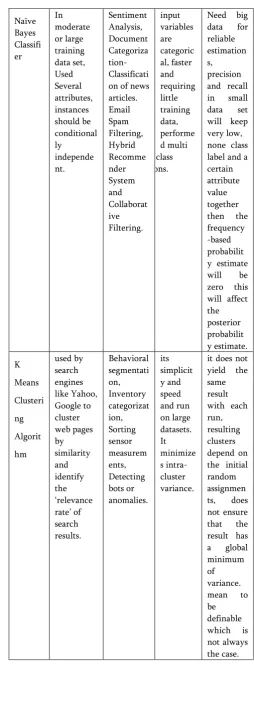
Table 1. shows the uses, applications, advantages and drawbacks of various machine learning algorithms.
Machin
Uses Applicatio ns
Support classes can be used. kernel, the problem selection.
Apriori assess risk in financial services or insurance domain, credit card industry, mining and machine in decision analysis,
use in finance for option
III.
CONCLUSION
Machine learning research spans almost four decades. Much of the research has been to define various types of learning, establishing the relationship among them, and elaborate the algorithms that characterize them. But much less effort has been devoted to bring machine learning to bear on real world applications. Recently researchers have found broader applications of machine to real world problems such as
Classifying DNA sequences
Virtual Personal Assistants
Computer vision, including object recognition
Game playing
handwriting recognition
Speech recognition
Brain-machine interfaces
Adaptive websites
Videos Surveillance
Predictions while Commuting
Social Media Services
Online Customer Support
Online Fraud Detection
Bioinformatics and there are many more fields
where machine learning is used now a days.
IV.REFERENCES
[1] Nahum Shimkin, “Learning in Complex System”, Lecture Notes, Spring 2011.
[2] Thomas G. Dietterich, “Machine-Learning Research”, AI Magazine Volume 18 Number 4 (1997).
[3] Rob Schapire, “Machine Learning Algorithms for Classification”, Princeton University.
[4] S. B. Kotsiantis, “Supervised Machine Learning: A Review of Classification Techniques”, Informatica 31 (2007) 249-268.
[5] Leslie Pack Kaelbling, Michael L. Littman, Andrew W. Moore “Reinforcement Learning: A Survey”, Journal of Artificial Intelligence, Research 4 (1996) 237-285, May 1996.
[6] R. Sathya, Annamma Abraham, “Comparison of Supervised and Unsupervised Learning Algorithms for Pattern Classification”, (IJARAI) International Journal of Advanced Research in Artificial Intelligence, Vol. 2, No. 2, 2013.
[7] R. Sathya and A. Abraham, “Unsupervised Control Paradigm for Performance Evaluation”, International Journal of Computer Application, Vol 44, No. 20, pp. 27-31, 2012.
[8] Taiwo Oladipupo Ayodele, “Types of Machine Learning Algorithms”, University of Portsmouth, United Kingdom.
[9] Alberto Maria Segre, “Applications of Machine Learning”, Cornell University.
[10] J. A. Hartigan and M.A. Wong, “A K-Means Clustering Algorithm”, Journal of the Royal Statistical Society. Series C (Applied Statistics), Vol. 28, No. 1 (1979), pp. 100-108.