© 2018 IJSRCSEIT | Volume 3 | Issue 5 | ISSN : 2456-3307
Implementation of Huffman Algorithm to Improve Quality of
Compressed Image
Er. Sukhdeep1, Er. Smriti Sachdeva2
1M.Tech Scholar, Department of Computer Science JCDMCOE Sirsa, Haryana, India 2Assistant Professor Department of Computer Science JCDMCOE Sirsa, Haryana, India
ABSTRACT
Image processing has been considered as a mechanism to implement any operations on an image or graphics to extract an enhanced Image/Graphics or to capture information from it. This is considered as a type of signal processing in which input is an Image/Graphics & output could be Image/Graphics or characteristics/features associated with that image. An image, digital image, or still Image/Graphics is a binary representation of visual information such as drawings, pictures, graphs, logos, or individual video frames. Digital images could be saved electronically on any storage device.
Keywords : Image Processing, Visual Perception, Graphics Transformations.
I.
INTRODUCTIONUncompressed multimedia data requires considerable storage capacity and transmission bandwidth. Despite rapid progress in mass-storage density, processor speeds, and digital communication system performance, demand for data storage capacity and data-transmission bandwidth continues to outstrip the capabilities of available technologies. The recent growth of data intensive multimedia-based web applications have not only sustained the need for more efficient ways to encode signals and images but have made compression of such signals central to storage and communication technology.
Fig 1 : Steps of Image Compression and Decompression
To enable Modern High Bandwidth required in wireless data services such as mobile multimedia,
email, mobile, internet access, mobile commerce, mobile data sensing in sensor networks, Home and Medical Monitoring Services and Mobile Conferencing, there is a growing demand for rich
Content Cellular Data Communication, including Voice, Text, Image and Video. One of the major challenges in enabling mobile multimedia data services will be the need to process and wirelessly transmit very large volume of this rich content data.
II.
BENEFITS OF COMPRESSIONIn the last decade, there has been a lot of technological transformation in the way we communicate. This transformation includes the ever present, ever growing internet, the explosive development in mobile communication and ever increasing importance of video communication.
with increasing clarity without data compression. Data compression is art and science of representing information in compact form.
Despite rapid progress in mass-storage density, processor speeds, and digital communication system performance, demand for data storage capacity and data-transmission bandwidth continues to outstrip the capabilities of available technologies. In a distributed environment large image files remain a major bottleneck within systems. Image Compression is an important component of the solutions available for creating image file sizes of manageable and transmittable dimensions. Platform portability and performance are important in the selection of the compression/decompression technique to be employed.
III.
MEASUREMENTS FOR COMPRESSION METHODSThere are a variety of ways in which different compression algorithms can be evaluated and compared. For quantifying the error between images, two measures are being commonly used. They are Compression Ratio (CR), Mean Square Error (MSE) and Peak Signal-to-Noise Ratio (PSNR).
Compression Ratio (CR)
CR is the ratio between numbers of bits required to represent original image to the number of bits in the compressed image and is given below
CR =
Where n1 = number of bits in original image And n2 = number of bits in compressed image.
Mean Square Error (MSE)
MSE is one of the error metrics used to compare quality of various image compression technique.
Where, P (I,j) is the original image,Q(I,j) s the approximated image or decompressed image and mxn is the dimension of the image.
Peak Signal-to-Noise Ratio (PSNR)
Another error metric used to compare the subjective fidelity criteria of the uncompressed image is PSNR. PSNR is the quality measure of the compressed image. Since it is a logarithmic measure and our brain seems to respond logarithmically to intensity values [10]. It can define using MSE as.
IV.
IMPLEMENTATIONHere in this paper updated Huffman algorithm to compression an image had been performed. Here jpeg image had been taken and matlab script had been applied on it.
Fig 2 Original images for compression
Fig 3 Size of original File
Fig 4 Huffman code to compress and decompress image
Fig 5 Size of File after applying compression algorithm
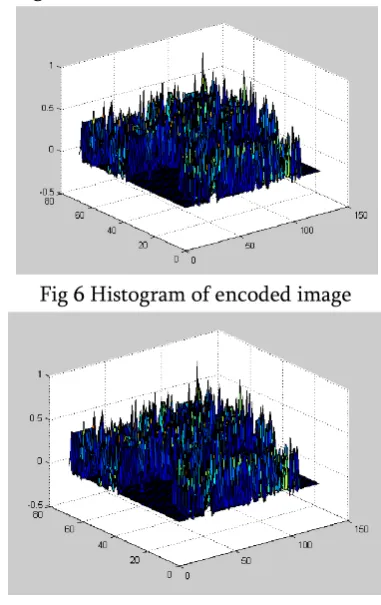
Plotting Histogram Of Encoded And Decoded Images In order to find histogram of images we would apply canny edge detector on encoded and decoded image.
Fig 6 Histogram of encoded image
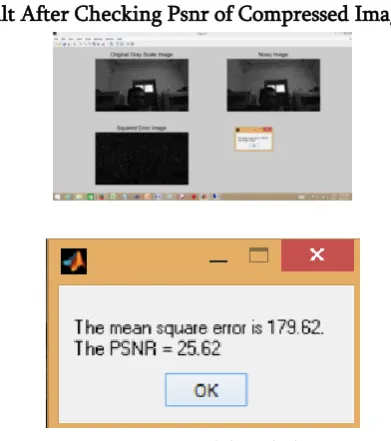
Result After Checking Psnr of Compressed Image
Fig 8 Histogram of decoded image
PSNR Calculation Of Decoded Image
Fig 9 PSNR of Decoded Image
V.
CONCLUSIONWe have studied effective means by which content of image could be automatically structured, indexed and retrieved. This research would be study of various image compression techniques are loosy Image Compression Methods and Lossless Image Compression Methods. design an algorithm based on Huffman Coding to compress image with minimum loss in quality of image is most suitable for image transmission during networking. Implement algorithm in MATLAB to compress an image with minimum loss in quality of image reduces chance of retransmission of file. Calculation of Peak Signal to
Noise Ratio and Mean Square Root Error confirms performance of algorithm.
VI.
REFERENCES1. Dudgeon, D.E. & R.M. Mersereau, Multidimensional Digital Signal Processing. 1984, Englewood Cliffs, New Jersey: Prentice-Hall.
2. Castleman, K.R., Digital Image/graphic Processing. Second ed. 1996, Englewood Cliffs, New Jersey:
3. Oppenheim, A.V., A.S. Willsky, & I.T. Young, Systems & Signals. 1983, Englewood
4. Papoulis, A., Systems & Transforms with Applications in Optics. 1968, New York:
5. Russ, J.C., Image/graphic Processing Handbook. Second ed. 1995, Boca Raton, Florida: CRC 6. Giardina, C.R. & E.R. Dougherty, Morphological
Methods in Image/graphic & Signal Processing. 1988, Englewood Cliffs, New Jersey: Prentice-Hall. 321.
7. Gonzalez, R.C. & R.E. Woods, Digital Image/graphic Processing. 1992, Reading, Massachusetts:
8. Goodman, J.W., Introduction to Fourier Optics. McGraw-Hill Physical & Quantum Electronics Series. 1968, New York: McGraw-Hill. 287. 9. Heijmans, H.J.A.M., Morphological
Image/graphic Operators. Advances in Electronics & Electron Physics. 1994, Boston: Academic Press.
10. Hunt, R.W.G., Reproduction of Colour in Photography, Printing & Television,. Fourth ed. 1987, Tolworth, England: Fountain Press.
11. Freeman, H., Boundary encoding & processing, in Picture Processing & Psychopictorics, B.S. Lipkin & A. Rosenfeld, Editors. 1970, Academic Press: New York. p. 241-266.
12. Stockham, T.G., Image/graphic Processing in Context of a Visual Model. Proc. IEEE, 1972. 60: 13. Murch, G.M., Visual & Auditory Perception.
14. Frisby, J.P., Seeing: Illusion, Brain & Mind. 1980, Oxford, England: Oxford University