Enhancing the Energy Efficiency of Virtual Network Embedding
in Cloud
Devagudi Siva Sankar1, K. Naryana2
1Student, Department of CSE, Seshachala Institute of Technology, Puttur, Andhra Pradesh, India
2Assisstant Professor, Department of CSE, Seshachala Institute of Technology,Puttur, Andhra Pradesh, India
ABSTRACT
Network Virtualization is recognized as a key technology for the future internet. Energy-efficiency is one among the most challenges in future networking environments. Network virtualization has caught the attention of the many researchers in recent years. It facilitates the method of making many virtual networks over one physical network. In existing system, if any one of the machine will get broken means that we are able to simply transfer all the information corresponding to that machine to a different machine. Here we tend to concentrated on only data we don’t take into account network efficiency, cost and power consumption.to overcome this problem we move to proposed model. During this paper, we tend to propose an energy economical virtual network embedding (EEVNE) approach for cloud computing networks, wherever power savings are introduced by consolidating resources within the network and data centers. We model our approach in an imp over WDM network using mixed integer linear programming (MILP). The performance of the EEVNE approach is compared with 2 approaches from the literature: the bandwidth cost approach (CostVNE) and also the energy aware approach (VNE-EA). The CostVNE approach optimizes the utilization of available bandwidth, whereas the VNE-EA approach minimizes the ability consumption by reducing the amount of activated nodes and links while not taking into consideration the granular power consumption of the information centers and also the completely different network devices. The results show that the EEVNE model achieves a most power saving of 60% (average 20%) compared to the CostVNE model below an energy inefficient data center power profile. we tend to develop a heuristic, real-time energy optimized VNE (REOViNE), with power savings approaching those of the EEVNE model. we tend to additionally compare the various approaches adopting an energy efficient data center power profile.
Keywords: Cloud networks, energy efficient networks, IP over WDM networks, MILP, network virtualization, optical OFDM, virtual network embedding.
I.
INTRODUCTIONCloud computing may be a process paradigm that deliver on demand, pay as you use services. These services embody software system as a Service (SaaS) by permitting users to use application over web, Platform as a Service (PaaS) as package, databases and internet servers and Infrastructure as a Service (IaaS), such servers and software system. so as to deliver
a very way that one physical resource will accommodate multiple users’ demands at same time. As a result, sharing resources can facilitate to reduce cost and energy consumption along with increasing resources utilization.Network virtualization has been mentioned as an answer to the perceived ossification of this web. many variants of network virtualization are investigated and it's already wide utilized in current Future internet testbeds . It provides an abstraction from substrate resources, making virtual resources that are expected to be a lot of versatile and easier to manage for users. one amongst the most incentives for deploying virtualization technology within the core network is that the ability to consolidate resources. Rising energy prices cause an augmented target energy-efficiency of ICT equipment. Indeed, energy-efficiency is one amongst the most challenges in future networking environments. Network virtualization are often accustomed tackle this problem by sharing hardware, rather than requiring dedicated hardware for every instance. Thus, so as to save energy, unused equipment can be place into an energy-efficient sleep mode, or perhaps turned off completely. to create use of those energy saving measures it's necessary to determine however the virtual network resources ought to be mapped onto hardware. As a part of virtualization, network virtualization caught attention of the many researchers throughout the past few years. It facilitates the method of making many virtual networks over one physical network known as Substrate Network ―SN‖. It provides resources sharing demand over cloud computing infrastructure. Network Virtualization plays a crucial role as link between virtual and physical infrastructure. Therefore, the method of virtual resources allocation over the corresponding physical ones became a crucial issue. This downside known as Virtual Network Embedding ―VNE‖. The VNE downside are often either Offline or on-line. In offline issues [8] all the virtual network requests (VNRs) square measure glorious and regular ahead
information centers for minimal power consumption in cloud networks.
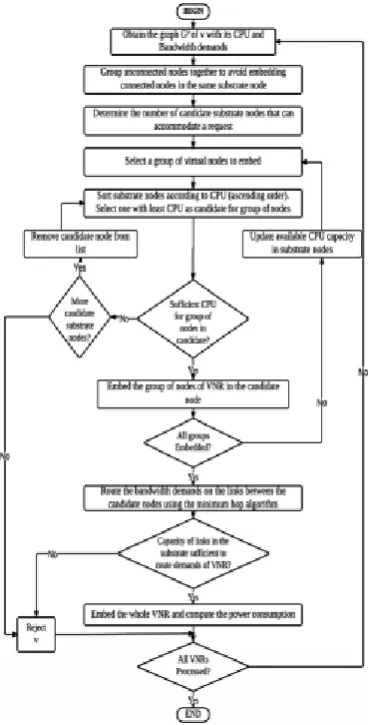
System Flow
Figure 1. REOViNE heuristic flow chart
Figure 2. Virtual Network Embedding problem
II.
ALGORITHMVirtual Networks in IP Over WDM Networks
The VNE problem defines however virtualized resources ought to be complete onto the substrate network. As represented in, VNRs are annotated with node and link demands and within the same means,
the substrate network is annotated with node and link resources. Demands and resources then ought to be matched so as to attain complete embeddings. the VNRs 1, 2 and 3 with node and link demands are to be embedded onto the substrate network that is an information processing over WDM network with data centers. The information processing over WDM network consists of 2 layers, the ip layer and the optical layer. successful embedding of VNRs’ link demands can thus want resources each within the ip layer and therefore the optical layer. ip routers combination traffic from VNRs and in every substrate node ip routers are connected to optical switches that are connected by fibre links. The optical layer provides the large bandwidth needed for communication between ip routers. On every fiber, a combine of multiplexers/demultiplexers is employed to multiplex/demultiplex wavelengths. The transponders give OEO process for full wavelength conversion at every switching node. additionally, for long-distance transmission, erbium-doped fiber amplifiers (EDFAs) ar used to amplify the optical signal in every fiber. every substrate node is taken into account to host a knowledge center additionally to the ip and optical equipment. The node demands of the VNRs are embedded within the knowledge centers. once a virtual node is embedded within the substrate network, its processor demands instantiate virtual servers within the knowledge center and its bandwidth demands instantiate a virtual router within the core router such the requester of the service is granted management of each the virtual servers and virtual router and has the flexibility to configure any protocols and run any applications.
MILP Model for EEVNE
that the set of substrate links. every node or link within the substrate network is related to its own resource attributes. The VNR v is represented by the graph = ( , )wherever is that the set of used are located across the layers.
III.
CONCLUSIONThis paper has investigated the energy potency of virtual network embedding in IP over WDM networks. we developed a MILP model (EEVNE) and a heuristic (REOViNE) to optimize the use of wavelengths within the network additionally to consolidating the utilization of resources in data centers. The results show that the EEVNE model achieves a most power saving of 60 minutes (average 20%) compared to the CostVNE model that minimizes the bandwidth value of embedding a VNR. The EEVNE model has also higher power savings compared to the virtual network embedding energy aware (VNE-EA) model from the literature. we've got demonstrated that once it comes to energy savings within the network, it's not enough to develop models that simply turn off links and nodes within the network however it's necessary to consider all the power consuming devices within the network then Ouda, "Resource allocation in a network-based cloud computing environment: Design
challenges," IEEE Commun. Mag., vol. 51, no. 11, pp. 46–52, 2013.
[2]. United States Environmental Protection Agency. Report to Congress on Server and Data Center Energy Efficiency Public Law 109-431. (2007). Online]. Available: over core networks," IEEE J. Lightw. Technol., vol. 32, no. 7, pp. 1261–1281, Jan. 2014.
[4]. R. Jain and S. Paul, "Network virtualization and software defined networking for cloud computing: A survey," IEEE Commun. Mag., vol. 51, no. 11, pp. 24–31, Nov. 2013.
[5]. A. Belbekkouche, M. M. Hasan, and A. Karmouch, "Resource discovery and allocation in network virtualization," IEEE Commun. Surveys Tuts., vol. 14, no. 4, pp. 1114–1128, Oct.–Dec. 2012.
[6]. N. M. M. K. Chowdhury and R. Boutaba, "Network virtualization: State of the art and research challenges," IEEE Commun. Mag., vol. 47, no. 7, pp. 20–26, Jul. 2009.
[7]. A. Fischer, M. T. Beck, H. De Meer, and X. Hesselbach, "Virtual network embedding: A survey," IEEE Commun. Surveys Tuts., vol. 15, no. 4, pp. 1888–1906, Oct.–Dec. 2013.
[8]. B. Wang, X. Chang, J. Liu, and J. K. Muppala, "Reducing power consumption in embedding virtual infrastructures," in Proc. IEEE Globecom Workshops, Dec. 3–7, 2012, pp. 714– 718.
[9]. M. Yu, Y. Yi, J. Rexford, and M. Chiang, "Rethinking virtual network embedding: Substrate support for path splitting and migration," SIGCOMM Comput. Commun. Rev., vol. 38, no. 2. pp. 17–29, 2008.
network virtualization environments," in Proc. 16th Int Conf.Parallel Distrib. Syst., 2010. [11]. D. G. Anderson, (2002). Theoretical
Approaches to Node Assignment. Online]. Available:
http://repository.cmu.edu/cgi/viewcontent.cgi? article = 1079&context = compsci.
[12]. J.F. Botero, X. Hesselbach, M. Duelli, D. Schlosser, A. Fischer, and H. De Meer, "Energy efficient virtual network embedding," IEEE Commun., vol. 16, no. 5, pp. 756–759, May 2012.
[13]. S. Sen, Z. Zhongbao, C. Xiang, W. Yiwen, L. Yan, and W. Jie, "Energyaware virtual network embedding through consolidation," in Proc. IEEE Comput. Commun. Workshops, 2012, pp. 127–132.
[14]. J. F. Botero and X. Hesselbach, "Greener networking in a network virtualization environment," Comput. Netw., vol. 57, no. 9, pp. 2021–2039, 2013.
[15]. S. Su, Z. Zhang, A.X. Liu, X. Cheng, Y. Wang, and X. Zhao, "Energyaware virtual network embedding," IEEE/ACM Trans. Netw., vol. 22, no. 5, pp. 1607–1620, Oct. 2014.
[16]. I. Houidi, W. Louati, and D. Zeghlache, "A distributed virtual network mapping algorithm," in Proc. EEE Int. Conf. Commun., 2008, pp. 5634–5640.
[17]. M. Chowdhury, M. R. Rahman, and R. Boutaba, "ViNEYard: Virtual network embedding algorithms with coordinated node and link mapping," IEEE/ACM Trans. Netw., vol. 20, 1, pp. 206–219, Feb. 2012.
[18]. L. Nonde, T. E. H. El-Gorashi, and J. M. H. Elmirghani, "Cloud virtual network embedding: Profit, power and acceptance," submitted to IEEE Commun., 2015.
[19]. I. Houidi, W. Louati, W. Ben Ameur, and D. Zeghlache, "Virtual network provisioning across multiple substrate networks," Comp. Netw., vol. 55, no. 4, pp. 1011–1023, 2011.
[20]. A. Fischer, J. F. Botero, M. Duelli, D. Schlosser,