
A Survey of Data Hiding Techniques using Mosaic Images
Sonam Kumari1, Akhilesh Bansiya2
1Computer Science and Engineering, Vedica Institute of Technology, Bhopal, Madhya Pradesh, India 2Asst. Prof, Computer Science and Engineering, Vedica Institute of Technology, Bhopal, Madhya Pradesh, India
ABSTRACT
Although there is various security techniques implemented for the privacy of data from sender to the receiver in the network such as cryptography, watermarking, authentication. Information hiding using mosaic images is new ways of securing the information such the data can be send in a private and in a secure way. Here in this paper a survey of all those techniques that are implemented so far for information hiding using mosaic images is presented.
I.
INTRODUCTIONMOSAIC is a type of artwork created by composing small pieces of materials like stone, glass, tile, etc. made-up in earliest era they are still used in many applications today. Mosaic image is an image produced by arranging many smaller tile images to form a vibrant larger image. At Design a Mosaic, we use the digital images for the tile photos to re-create another one of the images. In essence, your smaller images will make up your larger image [1].
Mosaic Images
MOSAIC is a type of artwork created by composing small pieces of materials (glass, tile, stone, etc.) invented in ancient time they are still used in many applications today. Mosaic image is an image produced by arranging many smaller tile images to form a vibrant larger image. At Design a Mosaic, we use the digital images for the tile photos to re-create another one of the images. In essence, your smaller images will make up your larger image.
Types of Mosaic
There are two kinds of mosaic, depending on how the matching is done.
Simpler Kind: In this, each element of the target image is averaged down to a single colour. Each of the library images is also reduced to a single colon. Each part of the target image is then replaced with one from the library where these colours are as comparable as possible. In upshot, the target image is concentrated in resolution and then each of the resultant pixels is replaced with an image whose average colour matches that pixel.
Advanced Kind: In the more advanced kind of camera-friendly mosaic, the target image is not down sampled, and the harmonizing is done by evaluating each pixel in the rectangle to the corresponding pixel from each store image. The rectangle in the objective is then substituted with the library image that minimizes the total difference. This requires much more computation than the simple kind, but the outcomes can be much enhanced since the pixel-by-pixel matching can preserve the resolution of the target image.
Encryption and Decryption of Mosaic Images
decryption. Many cryptography techniques are used to encrypt the confidential data. A secret key is used to encrypt the data then retrieve the secret data by decryption process using appropriate key. Image capturing, image identification, image segmentation, image improvement, image compression, morphing are some basic operations of image processing. A new type of art image, called secret-fragment-visible mosaic image that encloses minute fragments of a given source image is proposed in this study. Examining such a kind of mosaic image, one can observe all the fragments of the source image, but the fragments are accordingly minute in size and as a result unsystematic in position that the spectator cannot understand what the source image seems appear. Hence, the source image may be believed to be secretly entrenched in the resulting mosaic image, while the fragment pieces are all observable to the witness. And this is the motive why the resulting mosaic image is named secret-fragment-visible. More specifically, as illustrated by Fig. 1, a secret image is first divided into rectangular-shaped fragments, called tile images, which are fitted next into a target image selected from a database to create a mosaic image. The number of usable tile images for this operation is limited by the size of the secret image and that of the tile images. This is not the case in traditional mosaic image creation where available tile images for use essentially are unlimited in number because the tile images are not generated from the secret image and may be used continually. Then, the information of tile-image appropriate is entrenched into some blocks of the mosaic image, which are selected randomly by a secret key. Accordingly, an observer possessing the key can reconstruct the secret image by retrieving the embedded information, while a hacker without the key cannot.
Figure 1. Type of a Mosaic Image
Cryptography technique is used to encrypt the confidential data. A secret key is used to encrypt the data then retrieve the secret data by decryption process using appropriate key. Here Secret images can also be protected using the same encryption and decryption process. Image processing is a wide area which contains many processes. Such processes are involved for image encryption and decryption. Image capturing, image identification, image segmentation, image improvement, image compression, morphing are some basic operations of image processing. In this paper secret image is going to hide on another image and it is called as encrypted image. Normally encrypted image looks like a blurred image. It exposes itself that it has some hidden image. Secret visible mosaic image technique is used to create an encrypted image without blur effect.
segmentation is a process of partitioning an image into multiple segments. This operation is used to simplify the image and to change the representation of image in desired view. It is also used to locate the objects and its boundaries. It helps to monitoring or processing the small parts of image. Segmentation subdivides an image into its constituent regions or objects.
Many methods have been proposed to create different types of mosaic images by computer. Photo-mosaic, Crystallization Photo-mosaic, ancient mosaic and puzzle image mosaic are four types of mosaic images. The first two types are obtained from decomposing a source image into tiles (with different colours, sizes, and rotations) and reconstructing the image by properly painting the tiles, and therefore they both may be entitled tile mosaics. The additional two types of mosaics are acquired by fitting images from a database to cover an assigned source image, and both may be described as multi-picture mosaics. Image compression, the art and science of reducing the amount of data required to represent an image. Compression is performed by removing some redundant data there by size of image can be reduced. In case of compressing encrypted image data loss during extraction cannot be accepted. So lossless predictive coding is used for compression and decompression of encrypted mosaic image.
Mosaic Creature
Mosaic Creator creates a large regular mosaic patterned images made of a lot of tiny cells. Mosaic Creator permits creating standard photo mosaics as other similar photo mosaic software. Also it can provide excellent images using slightest image collections with fine colour enhance. Specific for Mosaic Creator are optional non rectangular pattern cell shapes like triangle, puzzle shape, hexagon, etc.
Mosaic Creator includes pattern shape editor for user defined patterns (only in professional version). We
can start to create mosaics only with one image. We must select cell images, source image, and destination image size and pattern type. Web can enhance the rendering process by fine colour modifying the unit images, and wind up the resultant mosaic image by adding cell boundaries. There are no limit for numerous cell images and output mosaic file volume. The Mosaic Wizard makes straightforward the process of mosaic explanation. Mosaic Creator can arrange thumbnails with clickable image map (Web picture gallery) and render video animations.
Secret-Fragment-Visible Mosaic Image:
The Image Restoration
The quality of the historical photograph [3] is poor, many scratches and dust are clearly visible at several places. An inaccurate camera focus (with large format cameras of that time, it was complicated to accomplish an elevated exactitude of focusing) has caused image fuzziness. The aging effect also has a profound impact on certain areas of the picture which manifest as additional blurring. Most of the components in black and white photography (fine-grained and superficial silver, with gelatine, albumin or collodium as a binding agent) are affected by environmental conditions and the stability of photographic pictures is limited by the properties of each of the substances. The removal of these degradations on the historical mosaic photograph requires an appropriate image restoration technique which would decrease the noise impact and increase the image sharpness.
Before any effort to detect mutual differences can start, the geometrical correspondence of images has to be assured. This process is called image registration [3]. Since the images were taken from different locations of the camera, their geometry is different. After the alignment, all objects which did not change their position in the scene will be at the same part of the images. Then, by means of simple image overlaying, we can easily identify parts where the mosaic was changed with respect to its state in 1879. There are various registration methods that remove geometrical differences of images. The big differences between our images due to the discrepancy of intensity values, blurring, scratches, noise, etc. preclude using of classical correlation like methods. Feature based methods, which use extracted features and their estimated correspondence, or up-to-date multimodal area based techniques are appropriate candidates for the solution of this task [3].
Change Detection
After transforming and [3] overlaying the registered images of the historical and current mosaic state, many differences, not visible before, became apparent. Examples of the identified differences can be seen in Fig. 2, where two test parts of the mosaic are presented. In the Resurrection scene, examples of the differences include the following: the haircut of the figure has an extra wave, the ornamental patterns on the right side are corrupted and have a different shape now and a part of the coffin edge is missing. In the Jesus Christ scene, the rays under Jesus Christ are missing, the shape of Jesus’ beard is changed and the collar of one of the angels is different, to name a few. The task was very difficult due to the low image quality and missing colour information on the historical photograph; however, we were able to identify differences which could bring new ideas to the understanding of the mosaic and which were appreciated by art historians.
II.
RESEARCH WORKStext-type greyscale document images. Specifically, a new colour scale and a new greyscale have been proposed to define a new -feature and a new -feature, which then are used to define appropriate similarity measures for images and blocks for generating secret-fragment-visible mosaic images more effectively. Tile-image fitting information for secret image recovery is embedded into randomly-selected tile images in the resulting mosaic image controlled by a secret key. Good mosaic image creation results are guaranteed only when the database is large in size so that the selected target image can be sufficiently similar to the input secret image [1].
Grayscale Features of Blocks and Mosaic Image Creation and Recovery: It is often encountered that the secret image is a grayscale one. This could happen when the image is obtained, through various ways like scanning, from paper documents mainly with text substances. In this case, the chosen objective image apparently should be of the same type, namely, a grayscale image; and the generated mosaic image is also a grayscale one. First, the color image database should be converted into a grayscale version. For this, the color values (r,g,b) of every pixel in each image in the database is transformed in this study into a 1-D grayscale value by the equation y= 0.177 X r + 0.813 X g + 0.011 X b where the weights for , , and are taken to be the coefficients of the luminance (the component) used in the transformation from the RGB model to the YUV one. The motivation for implementing such weights as an alternative of the conventional value of 1/3 for each color channel is based again on the previously-mentioned human eye’s higher sensitivity to the green color [1].
High-quality mosaic image creation results are guaranteed only when the database is large in size so that the selected target image can be sufficiently similar to the input secret image. Future works may be directed to allowing users to select target images from a smaller-sized database or even freely without
using a database, in addition to developing additional information hiding applications using the proposed secret-fragment-visible mosaic images [1].
M.Karthika and B.Amutha proposed Random-Generated Image Mosaics for Secret Image Hiding [2]. In this scheme, an image mosaic is produced as a reproduction of an original image. The regain image is similar of the input image. When the image mosaic generated in starting of process then original image was divided into many tiles. Before splitting the image it compares with the image for mosaic creation. A search algorithm has also been proposed for searching the tile images in a secret image for the most similar ones to fit the target blocks of a selected target image more proficiently. The final image mosaic is generated by substituting each tile with its best matching image [2].
An image mosaic is generated as a reproduction of an original image. In detail the input and the output is same, because the input image is merged with target image and in other side original image is reconstructed by some algorithm. The retrieve image is same as that of the input image. When the image mosaic generating process starts original image is divided into many tiles. Before split the image, the compare the image for mosaic creation. For each tile, its colour value is matched with target image for best fit of tile. A search algorithm has also been proposed for searching the tile images in a secret image for the most similar ones to fit the target blocks of a selected target image more efficiently [2].
scheme using secret key. Encrypted image should be reduced in size for easier transmission. This compressed image may loss some data during extraction, consequently lossless compression method is used to decrease the size of encrypted image. Error less or lossless compression technique has been used to decrease the size of encrypted image, thus it is quite easy to transmit and receive the data. Compressed encrypted data can be transmitted easily to preferred destination and receive the data without any data loss are assured. Therefore the secret data can be shared in a protected way using secret fragment visible mosaic image method [4].
In this technique image segmentation operation is performed to divide the secret image. Then embed those fragments on to another cover image hence it is said to be secret mosaic image. Image compression operation is performed to compress the encrypted image. Then corresponding image decompression technique is used to extract the encrypted image. Secret image can be reconstructed by retrieving the tiles using key from the encrypted image [4]. Image segmentation is a procedure of division an image into multiple segments. This function is used to simplify the image and to transform the representation of image in preferred view. It is also used to establish the objects and its boundaries. It helps to supervising or processing the small parts of image. Segmentation subdivides an image into its component regions or objects [4].
In proposed system [4], the confidential image is hidden into target image by using mosaic image algorithms. With secret key, efficient LSB replacement algorithm is used to embed the secret image fragments to from mosaic image without blur effect. Size of the encrypted mosaic image is going to reduce by using error free compression technique. Lossless predictive compression method is used to compress the image. The compressed image can be sent to desired destination. Decompression process is
performed by reverse the lossless compression technique. Using the appropriate key secret image fragments are retrieved and reconstructed into its original state without loss using reverse lossless LSB replacement scheme [4].
These processes can be carried out in five modules [4]. They are:
Fragmentation of secret image
Embedding secret image fragments on the target image
Compression and transmission of mosaic image
Reception and decompression of mosaic image
Retrieval and Reconstruction of secret image
In 2011 Patil et al [5] proposed Mosaicing of Torn Document Images. They work on mosaicing torn document images, it has reliable performance, fast document recovery capability and on-screen visual verification. Their architecture for mosaicing of torn document images involves various stages. The first stage comprises the scanning of the two fragments of the ripped up document like non-uniform sides face each other. The fragments consist of both uniform and non-uniform boundaries. The fragments are scanned jointly in a single frame. During the method, the working area is condensed by applying a bounding box around the fragments. In the further stage, boundaries of these fragments are identified. In order to link the two fragments, two different points are plotted on each fragment manually and the fragments are joined based on these orientation points. The re-constructed document image was displayed for visual verification. This method can be applicable for all kinds of document irrespective of its content [5].
manually by creating storage space which consumes more space and also increased cost of maintenance due to various factors like insect attack, ageing and careless manual handling caused harm. In order to repossess the information lost due to the damage, the technique of mosaicing is employed where in much of work done so far in this field involves joining of the fragments using the overlapping method based on scanning each fragment of the ripped document individually [5].
In the present work of Mosaicing Torn Document Images, they [5] have made an effort of stitching two fragments. The fragments here are scanned together in a single frame. Throughout the process, the operational region is reduced by applying a bounding box around the fragments. In the next level, borders of these fragments are detected. In order to join the two fragments, two individual points are conspired on each fragment manually and the fragments are joined based on these reference points [5].
Xi Shao et al [6] presented Image Mosaics Base on Homogeneous Coordinates. As far as vision of human eyes and camera lens is considered it is observed the camera lens lakes the vision as compared to human eyes. So to take larger view picture is difficult. To overcome this problem multiple pictures are combined together to form a large image this is known as panoramic mosaics. An efficient method for panoramic mosaics was presented in [6]. They use homogeneous coordinates to represents image points. RGB channel has overlapped points are interpolated to generate mosaics after projecting the points from different images to the referred image. As computerized video becomes omnipresent with the development of communication, storage, and exploitation capabilities, it will propose a prosperous source of images for computer graphics applications [6].
Sugita et al. [7] present a Visionary Mixture Method for Generating Colored-Paper Mosaic Images that is colored paper mosaic. This method uses dithering technique for generating the colours illusion in original images using limited colored-paper tiles. While other traditional methods uses original colored images. Visionary mixture method generate colored – paper mosaic image instead of image colour from dithering, this will reduce visual artifacts. They [8] define multiresolution spline technique for combining two or more images into a larger image Mosaic. In this spline image was decomposed in band pass filters components then image components are assembled using spatial frequency and corresponding band pass mosaic. The image is joining according to weighted average within a transition zone which is comparative in size to the wave lengths of band. Further this image is added to obtain desired image. During adding of image multiresolution spline method is quite general technique for forming image mosaics [8].
A survey on Mosaic digital framework was proposed by S. Battiato et al [9]. They survey about unified framework based several methods to transform raster input images into good quality mosaics. They surveyed several approaches to NPR of digital images in the field of mosaic generation. Some methods also jointly work to enhance the output of mosaic. As per survey they [9] categorized mosaic as ‘ancient’ mosaics, crystallization’ mosaics, ‘photo’-mosaics and ‘puzzle image’ mosaics. They also suggest merging multiple schemes for betterment.
unusual criterion. The general and special ideas between the methods had been reported and explained. The different methods had been compared also with respect to the overall performances both in terms of achieved visual effects and computational complexity [9].
A novel approach for artificial mosaic generation based on Gradient Vector Flow is proposed in [10]. GVF computation are used together with heuristics to maximize the covered mosaic area are used. The high frequency details are used to manage in a global way allowing for preserving the mosaic-style also for small ones. This scheme is better as compared to traditional method [10]. Yoshinori Dobashi et al [11] propose a non-photorealistic rendering method that creates an artistic effect called mosaicing. This method converts images in to mosaic image using Voronoi diagram. This voronoi diagram is used to optimize error between the original image and the resulting image is as small as possible. The sites and edges of the Voronoi diagram are used to mosaic the image. This technique was useful to stained-glass-style images as a non-photorealistic rendering technique [11].
This method consists of two processes [11]. In the first process, the mosaic image is automatically generated by creating the optimal Voronoi diagram so that the error between the original image and the resulting image becomes as small as possible. The second process allows the user to add various effects to the mosaic image created by the first step. The second process is designed in accordance with our observation of stained glass windows since stained glass is one of the applications that use mosaic images. One important feature is that there are color variations in each region of the blemished glass. In earlier methods, nevertheless, each tile in the mosaic image has a single color. Moreover, contours of pictures depicted in windows are expressed by using boundaries between glass sections. The second
process of our method provides ways to add these two visual effects, that is, edge enhancement and color variations in each tile [11].
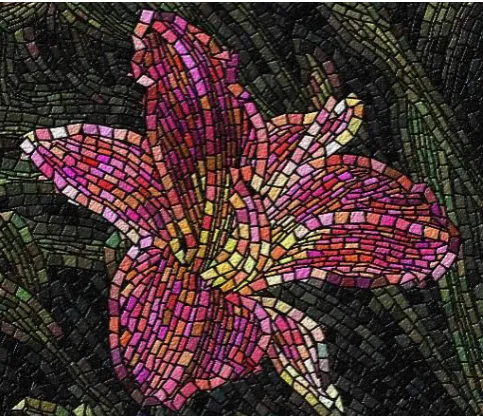
Definition of Voronoi Diagrams: As shown in Figure 2, a Voronoi diagram of a set of "sites" (points) is a collection of regions that divide up the plane. Each region ("Voronoi region") corresponds to one site, and all the points in one constituency are nearer to the corresponding site than to any other site. The boundary (i.e. "Voronoi edge") between two adjacent regions is a line segment, and the line that holds it is the at a 90 degree angle bisector of the segment joining the two sites [11].
Figure 2. Voronoi Diagrams [11].
For efficient computation, the proposed method uses discrete Voronoi diagrams in which the sites are located at pixel centers. They utilize a fast method using graphics hardware for computing the discrete Voronoi diagrams. This method can compute the discrete Voronoi diagrams by drawing cones using graphics hardware [11].
information of each site position with the analytical algorithm for generating Voronoi diagrams. The various methods to generate Voronoi diagrams, including the incremental method used in this method [11].
Ming-Shing Su et al [12] proposed Analysis on Multiresolution Mosaic Images. In their proposed scheme, the to-be-combined images are first predictable into wavelet subspaces. The images expected into the similar wavelet space are then blended. Their blending function is consequent from an energy minimization model which balances the smoothness around the overlapped region and the fidelity of the blended image to the actual images [12]. The two dissimilarity terms are balanced by an additional parameter. By adjusting this parameter, they can improve the subjective quality of the mosaic image.
S. Jayaprakash et al [13] suggested Secret Image Hiding in Target Image of Mosaic Form. A new type of art image, called secret-fragment-visible mosaic image that includes tiny fragments of a specified source image anticipated in this study. Monitoring such a type of mosaic image, one can see all the wreckage of the source image, but the fragments are so insignificant in size and so arbitrary in position that the observer cannot figure out what the source image looks like. Thus, the source image may be supposed to be clandestinely embedded in the resulting mosaic image, nevertheless the fragment portion are all noticeable to the viewer. And because of this reason, why the consequential mosaic image is called secret-fragment-visible? Because of this characteristic of the new mosaic image, it may be used a carrier of a secret source image in the disguise of another − a target image of a different content. This is a new technique of information hiding, not set up in the literature up to now. It is useful for the application of concealed communication or secure keeping of secret images [13].
Database Construction: If a selected target image from the database is dissimilar to a given secret image, the created mosaic image will be distinct from the target one, resulting in a reduction of the information hiding effect. To generate a better result, the database should be as large as possible. Searching a database for a target image with the highest similarity to a given secret image is a problem of content-based image retrieval. In general, the content of an image may be described by features like shape, texture, color, etc. Due to the use of small tile images in the proposed method, which are the fragments of the surreptitious image, it is originate in this study that the mainly efficient characteristic, which affects the largely visual manifestation of the resulting mosaic image, is color. Therefore, they focus on extracting color distributions from images to define an appropriate image similarity measure for use in target image selection in this study [13].
Lisha and Kavitha presented An Efficient Steganography with Mosaic Images for Covert Communication [14]. The new art which can be used for secure keeping or covert communication of undisclosed images. This kind of mosaic image is self-possessed of small fragments of an input secret image and though all the fragments of the secret image can be seen evidently, they are so minute in size and consequently indiscriminate in position that people cannot figure out what the source secret image looks like. A narrative algorithm has also been offered for searching the tile images in a secret image for the most similar ones to fit the target blocks of a selected target image more efficiently [14].
i. Image similarity and target image selection
for comparison is used. Input for image similarity is the images and output of this is a percentage value for both secret and the target image. The assessment returns from the algorithm determine how the resemblance is? The input of image is specified by the user only. If the participation is text image or text file, he painted image is not appropriate. The subsequent step is to divide source image [14].
Split the source image into number of small piece of images described as tiles. The dividend image or tiles are positioned with the target image for mosaic creation. Source splitting is straightforwardly propositional to the output quality. Source splitting dimension is elevated then output excellence is very low, and divide size is low then the superiority of output is high. For instance, split source image into 8x8 matrixes, finding the apt or accurate situation for placing the image in target is difficult. With the intention that the quality is totally dropped in this size and the target image will get disappeared in this case. If divide the image into 20x20 matrixes, quality is high .This will for the other parallel splitting. Splitting of text picture is also identical as that of the colored image. But the output superiority is completely contradictory from the quality of colored image. The image is splitted and prepared for the auxiliary process to create the mosaic [14].
ii. Mosaic generation:
Before generating mosaic procedure, split target image into extremely tiny size. Here use distinct splitting algorithm for divide the target image and the size of the target image and tile is dissimilar. When the target image size is great can’t capable to find the perfect equivalent for tile. If it is little in size competent to discover the perfect match for every tile. The splitting of target image is judgment the best fit for the tiles in the target image. The main problem behind this is there some replication of each image of tile and size of output image is too large compare to input image. Then judge against the tile with all the
splitted target images and get position of perfect match where the particular image is to be located. After the discovery of the best fit procedure, create an empty image with the back colour is black [14].
The output image is made based on the location. Then get situation of target image and situate the tile into the blank black image. Concatenate output image will identical as like that of target image. Here the introduction will not extend beyond another image for that place image in a basis of tile image. Volume of output image is not forecasted previously, output image size is based on the insertion of the tile image. As per the tile images will not go beyond each other. The output image is with slight eminence drop losing but not more. The tile image size is excessively diminutive then the computation time is elevated. The state of correct a tile image is characterized by a vertex of the graph, and the accomplishment of appropriate the tile image into a target block may be represented by an edge of the graph with its weight taken to be the similarity value between the pixels’ colours of the tile image and those of the target block. As supposed before the above process is for the text image, and here the target image is completely crammed with tile images and background image is disappeared fully [14].
the output as input. For this reason use the integration information file. As well thought-out above this restrains where were the tile images are stored and name of the image is stored in particular position are available in this file. Entrenching file consist of assimilation information. This file would be joint or merged with output image and send it to sender without any loss. There is a security transaction is detained between the sender and the receiver. Devoid of a de-embedding algorithm the others can’t read the file or they can’t detach the file. For this security an extremely protected method is used for embedded the both files. Later than the conclusion of the embedding progression the output will ready to send to the receiver [14].
Repetitively select randomly a block in unselected so far other than the first block of using the random number generator with the secret key as the beginning, and insert bits of into all the pixels of by the lossless LSB replacement scheme proposed in until all the bits in are tired, where is computed acquire the final with entrenched as the desired secret-fragment-visible mosaic image for the input secret image and exit. A diverse technology is hiding the fitting series file into created mosaic image. The produced mosaic image is transformed to string for hiding the fitting sequence information file. Followed by receiving the sequence file takes apart the string by an order for information hiding [14].
iii. Reconstruction of secret image:
This is the final step of the project; the output is same as the input in sender area. Before going to reforming first de-embedded the image file and the text file. Afterward do the formation process in overturn process. De-embedded the file initial and then divide the mosaic produced output image with the basis of text file and named the image as represented in text file. The recover method is based on width and height of tile image in mosaic
construction process. Crack the mosaic image with duplicates as belong to size of tile and named it as name in position file [14].
In text file the position are not in the same order (i.e.) here the position file has the name corresponding to the image. Frequently select haphazardly an unselected block other than the first block from using the random number generator with the secret key as the seed, extort bits from all the pixels of using a quash version of the lossless LSB replacement scheme proposed in and concatenate them successively, in anticipation of all the bits of are mined. Alter every bits of into an integer which specifies the index of a tile image in the original secret image (to be collected), resultant in the secret improvement progression. After receiving the tile images from situation file then there is no replication of images because the image is repeated then the name would be same and overwrite the previous image [14].
1. Building of a color image database for use in selecting similar target images for given secret images.
2. Construction of a secret-fragment-visible mosaic image using the tile images of a secret image and the selected similar target image as input.
3. Revitalization of the secret image from the created secret-fragment-visible mosaic image. 4. Searching the database for an objective image
the most similar to the secret image.
5. Appropriate the tile images in the secret image into the blocks of the target image to create a mosaic image;
6. Inserting the tile-image fitting information into the mosaic image for later secret image recovery.
8. Reconstructing the surreptitious image from the mosaic image using the retrieved information.
1. PSNR: PSNR is the most widely used image quality metrics. This ratio (in decibels) is often used as a quality measurement between the original and a compressed image. It is defined as the ratio between the maximum possible power of a signal and the power of corrupting noise that affects the fidelity of its representation. The higher the PSNR, the better the quality of the compressed or reconstructed image. PSNR is calculated using the following equation –
(
)
Where, ‘MAX’ is the highest possible pixel value of the image.
2. MSE: MSE is the error metrics used to compare image firmness eminence. The MSE represents the growing squared error between the compressed and the original image. The inferior the assessment of MSE, the inferior the error. The mean-square error is calculated using the following equation –
∑ [ ( ) ( )]
3. NAE: The Normalized Absolute error of our proposed algorithm is better as compared to the existing algorithm.
4. MAE: The proposed algorithm provides better mean absolute error.
5. BER: Bit error rate (BER) is defined as the ratio of number of incorrect watermark information bits retrieved to the total number of watermark information bits embedded and depends only on the quantity of noise added.
6. Compression ratio = 100(1- compressed size/original size)
Compressed size is the number of bits obtained after compression and original size will be the total number of bits required without using compression algorithm. As shown in the fig 1 that the E-deflate has the higher compression ratio than other compression techniques. 7. Compression/Decompression TimeThe time
taken to compress any file is the compression time and the time taken to decompress any file is the decompression time. The compression/decompression time totally depends on the number of iteration used in the algorithm and as shown in the fig 2 that E-deflate has higher compression/decompression time than other algorithms.
The compression/decompression time is calculated as: Compression/decompression time = Time taken to compress/decompress data.
8. Number of mosaic frames 9. Searching time
III.
CONCLUSION
In this paper we have described about the privacy of data from sender to the receiver in the network such as cryptography, watermarking, authentication. Information hiding using mosaic images is new ways of securing the information such the data can be send in a private and in a secure way. In this paper we have concluded that information hiding using mosaic images is the one of the most important techniques
IV.
REFERENCES
Information Forensics and Security, Vol. 6, No. 3, pp. 936- 945, September 2011.
[2]. M.Karthika, B.Amutha "Random-Generated Image Mosaics For Secret Image Hiding" 2012 International Journal of Communications and Engineering, Volume 05, No. 5, Issue 03, pp. 29-35, March 2012.
[3]. Barbara Zitova, Jan Flusser Filip S, roubek "An application of image processing in the medieval mosaic conservation" 2004 Springer-Verlag London Limited, feb 2004
[4]. Vignesh.K "Mosaic Image Encryption with Error Free Compression and Reconstruction", International Conference on Computing and Control Engineering (ICCCE 2012), April, 2012.
[5]. Nagaraj B. Patil, V. M Viswanatha & Sanjay Pande M. B " Mosaicing of Torn Document Images", IJRRAS, Vol.-1, Issue -7, pp. 25-31, 2011. Online available: www.arpapress.com/Volumes/Vol7Issue1/IJRR AS_7_1_03.pdf
[6]. Xi Shao, Changsheng Xu, Joo Hwee Lim "Image Mosaics Base on Homogeneous Coordinates", Proceeding VIP '02 Selected papers from the 2002 Pan-Sydney workshop on Visualization, Volume -22, pp. 93-96, 2002.
[7]. Junichi Sugita, Tokiichiro Takahashi, Akimichi Tanaka "Visionary Mixture Method for Generating Colored-Paper Mosaic Images" proceedings of ACM SIGGRAPH 2006 Research posters (SIGGRAPH '06), article no. 115, 2006.
[8]. PETER J. BURT and EDWARD H. ADELSON "A Multiresolution Spline With Application to Image Mosaics", journal ACM Transactions on Graphics (TOG), vol. 2, issue- 4, pp. 217-236, 1983.
[9]. S. Battiato, G. Di Blasi, G. M. Farinella and G. Gallo "Digital Mosaic Frameworks - An Overview", Computer Graphics forum, Volume 26, number 4, pp. 794–812, 2007.
[10]. S. Battiato, G. Di Blasi, G. Gallo, G. C. Guarnera and G. Puglisi "Artificial Mosaics by Gradient Vector Flow", EUROGRAPHICS digital library, 2008. Online available: https://diglib.eg.org/EG/DL/conf/EG2008/short/ 053-056.pdf.abstract.pdf
[11]. Yoshinori Dobashi, Toshiyuki Haga, Henry Johan, Tomoyuki Nishita "A Method for Creating Mosaic Images Using Voronoi Diagrams", EUROGRAPHICS digital library, 2002. Online available: nis-ei.eng.hokudai.ac.jp/~doba/papers/egshort02_m osaic.pdf
[12]. Ming-Shing Su, Wen-Liang Hwang, and Kuo-Young Cheng "Analysis on Multiresolution Mosaic Images", IEEE Transactions on Image Processing, Vol. 13, No. 7, pp. 952-959, July 2004.
[13]. S. Jayaprakash, G.Sujitha, G.Manju "Secret Image Hiding In Target Image Of Mosaic Form", International Journal of Research in Engineering & Advanced Technology (IJREAT), ISSN: 2320-8791, Volume 1, Issue 1, March, 2013.
![Figure 2. Voronoi Diagrams [11].](https://thumb-us.123doks.com/thumbv2/123dok_us/1040400.1129686/8.595.326.529.323.504/figure-voronoi-diagrams.webp)
