Integration of Workflow and Pipeline for Language Service Composition
Mai Xuan Trang, Yohei Murakami, Donghui Lin, and Toru Ishida
Department of Social Informatics, Kyoto University Yoshida-Honmachi, Sakyo-Ku, Kyoto, 606-8501, Japan [email protected],{yohei, lindh, ishida}@i.kyoto-u.ac.jp
Abstract
Integrating language resources and language services is a critical part of building natural language processing applications. Service workflow and processing pipeline are two approaches for sharing and combining language resources. Workflow languages focus on expressive power of the languages to describe variety of workflow patterns to meet users’ needs. Users can combine those language services in service workflows to meet their requirements. The workflows can be accessible in distributed manner and can be invoked independently of the platforms. However, workflow languages lack of pipelined execution support to improve performance of workflows. Whereas, the processing pipeline provides a straightforward way to create a sequence of linguistic processing to analyze large amounts of text data. It focuses on using pipelined execution and parallel execution to improve throughput of pipelines. However, the resulting pipelines are standalone applications, i.e., software tools that are accessible only via local machine and that can only be run with the processing pipeline platforms. In this paper we propose an integration framework of the two approaches so that each offests the disad-vantages of the other. We then present a case study wherein two representative frameworks, the Language Grid and UIMA, are integrated.
Keywords:Service Workflow, Processing pipeline, Language Grid, UIMA
1.
Introduction
The creation of language resources (LRs) remains a fun-damental activity in the field of language technology. The number of language resources available on the internet has been increasing year by year (Maegaard et al., 2005). Based on these resources, developers can build advanced Natural Language Processing (NLP) applications such as Watson (Ferrucci et al., 2010) and Siri by combining them. How-ever, it is difficult for developers to collect and combine the most suitable set of language resources in order to achieve the intended goals.
Numerous of platforms have been proposed for creating, coordinating and making language resources available and readily useable for users. There are two approaches to shar-ing and combinshar-ing language resources: framework-based service workflow such as the Language Grid (Ishida, 2006), and PANACEA (Bel, 2010) and Framework-based process-ing pipeline such as UIMA (Ferrucci and Lally, 2004b), and GATE (Cunningham et al., 2002). Interoperability is the main challenge to allow different language resources work together in one framework, as well as in different works. Interoperability between components in one frame-work is dealt by defining common data exchange format be-tween components, or defining standard interface for com-ponents. For example, UIMA defines Common Analysis Structure as data exchange between components, the Lan-guage Grid defines standard interfaces for their lanLan-guage services in a linguistic service ontology (Hayashi et al., 2011). Interoperability among formats of two processing pipeline frameworks UIMA and GATE is explored in (Ide and Suderman, 2009). This paper addresses the issue of how to bridge the gap between two different common da-ta exchange formats used in different processing pipeline frameworks. Thid work focuses on integrating two differ-ent types of frameworks.
The processing pipeline infrastructure provides
platform-s that define language replatform-sourceplatform-s and toolplatform-s aplatform-s annotatorplatform-s and combine these annotators in pipeline manner. With support of pipelined execution and parallel execution, this approach has shown a good performance when process-ing huge amounts of data. After creatprocess-ing applications by combining existing components into pipelines, often user-s need to user-share applicationuser-s that they have developed with other users. To facilitate this, most of processing pipeline platforms offers an import/export mechanism. However, pipelines are normally shareable only within the bound-aries of the specific platform. This makes it difficult to use pipelines independently of the platform in which they were developed and violates the principles of wide soft-ware applicability and usability. On the other hand, the service workflow infrastructure provides platforms to share language resources as web services and compose these ser-vices to define composite serser-vices in workflows. Work-flow languages have expressive power to describe variety of workflow patterns to satisfy users’ requirements. This ap-proach also provides mechanism to share language services of language resources consistent with intellectual property rights. User can access and invoke workflows independent-ly with the platforms. These advantages of service com-position platforms encourage language resource provider-s publiprovider-sh and provider-share their componentprovider-s, increaprovider-sing the ac-cessibility and usability of language resources. However, transferring huge amounts of data between web services in workflows is not efficient (Zhang et al., 2013).
Therefore, this paper realizes integration of those two types of infrastructures to mutually offset their disadvantages. To this end, we address the following issues:
• Mapping between service invocation interface (ser-vice composition) and stand-off annotation (process-ing pipeline).
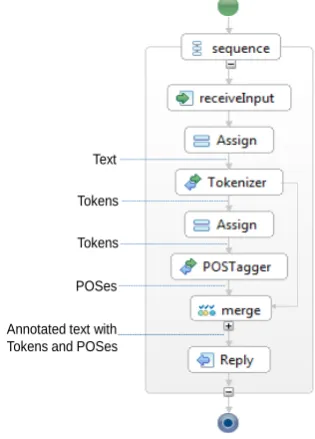
en-Text
Tokens
Tokens
POSes
Annotated text with Tokens and POSes
Figure 1: Service composition approach
gine.
• A concept integration framework that can integrate the two types of frameworks.
• To realize the concept framework, a case study of inte-gration two representative frameworks, the Language Grid and UIMA, is described.
The remainder of this paper is organized as follows: Sec-tion 2 briefly discusses features of the two types of language resource coordination frameworks. The integration of the service workflow and processing pipeline will be presented in section 3. We show a case study on integration between the Language Grid and UIMA in section 4. A discussion is given in section 5. Finally, section 6 concludes this paper.
2.
Language Resource Coordination
Frameworks
In this section we briefly discuss about characteristics of two types of language resource coordination frameworks: service composition with interface invocation and process-ing pipeline with stand-off annotation.
2.1. Service Workflow Approach
This approach takes the Service-Oriented Architecture (SOA) line; language resources are wrapped as web ser-vices that users can combine to create customized ite language services as needed. Figure 1 shows a compos-ite service consisting of two language services: Tokenizer and POSTagger. Each service in the workflow is defined by an interface with input and output. For example, Tokenizer service has plain text inputs and outputs a set of tokens of the plain text. Interoperability between services in a work-flow is ensured by conforming interfaces of the services. Output of a previous service and input of the later service in the workflow must be compatible.
To help users easily create workflow, standard interfaces for language services have been proposed. The Language
Grid designed interfaces of all services based on a language service ontology (Hayashi et al., 2011), with standardiza-tion depending on the types of services. PANACEA also defines common interfaces for different types language ser-vices such as translation service, bilingual dictionary, etc.. Language resources available as language services on these frameworks are provided by wide variety of companies, research organizations with different intellectual property rights. PANACEA currently has more than 160 services provided by 11 service providers. Over 170 services avail-able on the Language Grid, these services are provided by over 140 groups from 17 countries. The service composi-tion approach provides access control funccomposi-tionality to deal with the issues on intellectual rights of language resources providers. The providers can configure the permission pro-cess and monitor the statistics of use of their resources any-time. This advantage of service composition approach en-courages providers to share their language resources, in-creasing number of language services available on these frameworks.
2.2. Processing Pipeline Approach
This approach focuses on providing a setting for creating analysis pipelines, and is oriented towards linguistic analy-sis and stand-off annotation. The purpose of these frame-works is to combine language resources to analyze huge amounts of data in the local environment. Pipelined execu-tion and parallel execuexecu-tion are employed in pipeline engine to improve throughput of the pipelines.
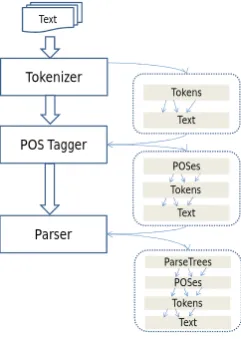
Language resources are combined into a pipeline to ana-lyze documents. Each resource is defined as an annotator that tags document with annotations in stand-off manner. The pipeline outputs the input document enriched with an-notations added by components in the pipeline. The anno-tated document is written in Common Data Exchange For-mat (CDEF). The CDEF document passed along the com-ponents in the pipeline. Figure 2 shows a pipeline of three annotators: Tokenizer, POSTagger, and Parser. Each anno-tator in the pipeline processes input text by annotating it. In this example the input text is given three annotations: To-ken, POS, and ParseTree. The GATE framework provides GATE document as CDEF to represent text and its annota-tions, this data structure is exchanged between GATE com-ponents. UIMA also defines a CDEF called Common Anal-ysis Structure (CAS) to represent text including annotations as a common data exchange between UIMA components.
3.
Integration of Service Composition and
Processing Pipeline
The processing pipeline is based on the stand-off annotation model, while service composition is based on service inter-face invocation model. This section first defines a mapping of the two models, and then uses it to define an integration framework.
3.1. Mapping Service Interface Invocation and
Stand-off Annotation
Tokenizer
POS Tagger
Parser Text
Text Tokens
Text Tokens POSes
Text Tokens
POSes ParseTrees
Figure 2: Processing pipeline approach
standards that are used for encoding machine-readable texts and linguistic corpora, such as CES (Ide et al., 2000), TEI (Vanhoutte, 2004), and thecommon interface formatbeing developed under the context of ISO committee TC 37/SC 4 (Ide and Romary, 2009). CDEF basically consists of t-wo parts: one representing the document text, and the other representing annotations. Figure 3 shows an example of CDEF in XML-based format:
• <doc>: represents the document, the idattribute is used to distinguish documents when a pipeline pro-cessing multiple documents. ThedocStringattribute represents document text or reference link to the doc-ument.
• <annotations>: represents all annotations produced by a pipeline. An annotation is described by<annot>
tag, thetypeattribute indicates type of the annotation, two attributesbeginandenddefine position of the an-notation in the document text and the componentID
indicates the author(annotator) of this annotation.
• Different annotation types may have different struc-tures. The structure of an annotation type is defined by a feature structure (fs) tag. Each feature is defined by a (f) tag and its attributenameindicates the name of the feature, attributevalueis the value of the feature. For example, the feature structure of a Morphem produced by a POSTagger consists of two features: lemma and postag of a word, as shown in the example.
In web service composition workflow, each language ser-vice has its own interface with input and output. This in-terface is defined by standard inin-terfaces of the frameworks. The input and output types are designed according to the type of the language service. For example, for a Tokenize service type, input is plain text and output is set of Tokens. In order to interwork two kinds of systems, first we need to map between stand-off annotation model and interface invocation model. For an annotator in processing pipeline, we can assume that its input and output are CDEF docu-ments. The mapping is defined to so as to map input/output of language services to annotation types in CDEF. We de-fine CDEF Maker and CDEF Extractor to conduct the
map-<?xml version="1.0" encoding="UTF-8"?> <annotatedDoc>
<doc id="1" mimeType="text"
docString="Text of the document"/> <annotations>
<annot type="POS" docID="1" begin="1" end="5" componentID="POSTager"> <fs>
<f name="lemma" value="Text"/> <f name="postag" value="noun"/> ...
</fs> </annot> ...
</annotations> </annotatedDoc>
Figure 3: CDEF Structure
Annotator CDEF
Maker
CDEF CDEF
Extractor CDEF
Service output Service input
(a) Language service wrapper
Language Service CDEF
Extractor
CDEF Maker
CDEF CDEF
Annotation
Service result Annotation’s offset
(b) Annotator wrapper
Figure 4: Wrappers
ping and create two wrappers: Language Service Wrapper and Annotator Wrapper, see Figure 4(a) and Figure 4(b) respectively. The former is used to wrap an annotator as a language service. The latter is used to wrap a language service as an annotator. CDEF Maker and CDEF Extrac-tor have slightly different roles in the different wrappers as follows.
The Language Service Wrapper consists of three parts: A CDEF Maker, an annotator, and a CDEF Extractor:
• CDEF Maker creates CDEF document from service input. It first maps the service input type to an an-notation type and then forms a CDEF document that includes the annotation.
• The Annotator analyses CDEF document and add an-alytics result to the document.
• CDEF Extractor manipulates with the CDEF docu-ment to extract from<fs>node and sub-nodes<f>s
the annotations produced by the annotator. Then it maps each annotation to its corresponding language service type as found in the output of a language ser-vice.
The Annotator Wrapper is defined as three components: CDEF Extractor, language service, and CDEF Maker:
corresponding language service type found in the in-put of the language service. Position information of the annotations is also extracted.
• The Language service is invoked with the input to pro-duce an output with defined type.
• CDEF Maker maps structure of the language service output to the structure of a corresponding annotation type and use annotation’s position information, ex-tracted by CDEF Extractor, to create a CDEF docu-ment. This CDEF document becomes output of the annotator.
With this mapping of stand-off annotation and service in-terface invocation, processing pipeline components can be wrapped as services in service composition frameworks and can be combined with other services to define composite services. Language services can be wrapped as an annota-tor and inserted into a pipeline flow.
3.2. Integrating Workflow and Pipeline Engines
To realize the integration, we propose pipeline service which uses pipelines to create service workflows. A pipeline service is a composite service created from a pipeline flow. This pipeline is comprised by several an-notators, where the annotators can be pipeline approach components or wrapped language services. The pipeline service architecture consists of two components: Service Invoker and Pipeline Executor. When users send requests to a pipeline service, the Service Invoker will start to exe-cute the composite service, it sets binding information for composite service and triggers the Pipeline Executor to ex-ecute the pipeline. Pipeline engine is used to run the input information through the pipeline.
With this pipeline service we can use pipeline engine to create and execute composite services. We argue that by declaring a pipeline as a Web service invocation, the inte-gration between Service workflow approach and Processing pipeline approach becomes practical.
Moreover, pipeline services allow the pipeline engine to support the service composition approach for service work-flow execution. Pipelined and Parallel execution features of pipeline engine may help to improve performance of composite services. Data parallelism can be used to pass large documents, split into smaller data partitions, through a composite service. These data partitions will be processed by multiple instances of the composite services in multiple parallel threads simultaneously. This may helps to improve the throughput of the workflow.
3.3. Integration Framework
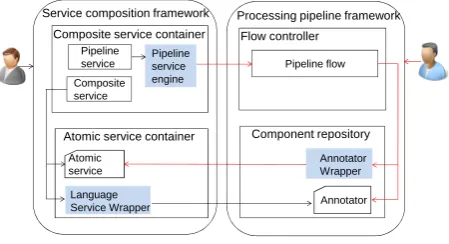
Integration framework enables users easily combine two types of components: language service and annotator. The latter yield composite services and can use language ser-vices in pipeline manner. This increases the interoperability of the two types of framework. It also provides the ability to include the pipeline engine in a composite service. Figure 5 shows that the integration of service composition and processing pipeline uses a wrapper system consisting of Language Service Wrapper and Annotator Wrapper. Anno-tator providers use the Language Service Wrapper to wrap
Processing pipeline framework Service composition framework
Composite service container
Pipeline service engine
Atomic service container Component repository
Language Service Wrapper
Annotator Wrapper Atomic
service
Annotator
Flow controller
Pipeline flow Pipeline
service Composite service
Figure 5: Integration Framework
annotators as language services. A service is then shared with access control in the service composition framework. Users who have access rights to the system can invoke this service or can use this service to compose composite ser-vices. The language service providers use the Annotator Wrapper to wrap a language service into an annotator, this annotator can be executed and combined in a pipeline flow. Language resources are shared as language services with protection of intellectual rights making it easy to create composite services. However, pipeline flow has better per-formance than the comparable composite service when pro-cessing large amounts of data. We wrap the pipeline service engine as a service composition engine to create compos-ite services. The pipeline service with parallel execution inherited from pipeline flow will have better performance when processing huge amounts of data.
Moreover, the integration framework helps users easily switch between workflow engine and pipeline engine to ex-ecute workflows. Users can also define hybrid workflow which uses both engines to execute the workflow, pipeline engine is used to executed a part of the workflow to help improves thoughput of this part and so increase the perfor-mance of the whole workflow.
4.
Case study: Integration of the Language
Grid and UIMA
In this section we realize the integration framework concept by integrating the Language Grid and UIMA.
4.1. Benefits of Integrating Language Grid and
UIMA
Lan-guage Technology Institute has hosted an UIMA Compo-nent Repository website1, where developers can post in-formation about their UIMA analytics. U-Compare (Kano et al., 2011) introduced the world largest repository of ready-to-use type compatible UIMA components. Howev-er, currently there is no platform to share UIMA-compliant language resources while protecting intellectual property rights. This limits the accessibility and usability of the lan-guage resources. Users who want to use lanlan-guage resources have to find and negotiate with the owners to get these lan-guage resources and freely combine them in their applica-tions without considering other stakeholders. Once the lan-guage resources are passed to users, the providers will have no control on their language resources.
Unlike UIMA, the purpose of the Language Grid is to sup-port intercultural collaboration by service workflows. A workflow combines language resources and their attendant complex intellectual property issues, such as machine trans-lators, parallel corpora, and bilingual dictionaries. Lan-guage resource providers retain ownership of their lanLan-guage resources shared on the Language Grid. Providers can monitor statistical usage information of their language sources, and can also establish access control for the re-sources. These functions may encourage providers to share language resources on the Language Grid, increasing the availability and accessibility of language resources. Integration of the Language Grid and UIMA can help NLP communities share their UIMA-compliant language resources via the Language Grid. This increases the num-ber of language services available on the Language Grid. Users can easily find, access and use language resources for their applications. In addition, users can use the UIMA en-gine to define composite services. The UIMA enen-gine with its data parallelism support can increase the performance of composite services by decreasing the execution time of composite services when processing huge amounts of data.
4.2. Implementing the Integration
Using the integration framework concept, we integrated the Language Grid and UIMA. We implemented two wrappers: Language Service Wrapper and Analysis Engine Wrapper. The former is used to wrap an UIMA analysis engine as a language service, while the latter is used to wrap language service into an Analysis Engine.
UIMA is a data-driven architecture which means that single components communicate with each other by exchanging data. The data exchanged includes the original documen-t and documen-the annodocumen-tadocumen-tions produced by each componendocumen-t. This data is structured as per the Common Analysis Structure (CAS). CAS is one of the CDEF formats used in the UIMA framework. UIMA specifies the main interface for the anal-ysis engine. This interface takes CAS-input and delivers CAS-output. As one part of UIMA, an XML specification for CAS has been defined. Figure 6 shows a simple exam-ple of CAS in XML format. It is possible to develop UIMA analysis engines that directly accept and output this XML. However, to support analysis engines that consume or pro-duce complex data structures, UIMA framework provides a
1
http://uima.lti.cs.cum.edu
<?xml version="1.0" encoding="UTF-8"?> <xmi:XMI xmlns:cas="http:///uima/cas.ecore"
xmlns:xmi="http://www.omg.org/XMI"
xmlns:tokenizer="http:///org/apache/uima/examples/tokenizer.ecore" xmlns:tcas="http:///uima/tcas.ecore"
xmlns:examples="http:///org/apache/uima/examples.ecore" xmi:version="2.0"> <cas:Sofa xmi:id=“1” sofaNum=“1” mimeType=“text”
sofaString=“This is a simple example."/>
<tcas:DocumentAnnotation xmi:id="8" sofa="1" begin="0" end="26" language="en"/> <examples:SourceDocumentInformation xmi:id="13" sofa="1" begin="0" end="0"
uri="file:simple example.txt" offsetInSource="0" documentSize="28" lastSegment="false"/> <tokenizer:Sentence xmi:id="21" sofa="1" begin="0" end="26"/> <tokenizer:Token xmi:id="25" sofa="1" begin="0" end="5"/> <tokenizer:Token xmi:id="29" sofa="1" begin="6" end="8"/> <tokenizer:Token xmi:id="33" sofa="1" begin="9" end="10"/> <tokenizer:Token xmi:id="37" sofa="1" begin="11" end="17"/> <tokenizer:Token xmi:id="41" sofa="1" begin="18" end="25"/> <tokenizer:Token xmi:id="45" sofa="1" begin="25" end="26"/> <cas:View sofa="1" members="8 13 21 25 29 33 37 41 45"/> </xmi:XMI>
Figure 6: Example of UIMA CAS
native language interface to the CAS. This has been imple-mented in both C++ and Java (Ferrucci and Lally, 2004a). Based on this interface we implement CAS Maker and CAS Extractor to manipulate with CAS documents and create the wrappers:
• CAS Extractor extracts annotations from CAS docu-ment and maps input/output of language services.
• CAS Maker maps the input/output types of language services with UIMA annotation types and creates CAS documents which serves as input/output of the analy-sis engine.
In order to create Language Service Wrapper we define a new language service interface to represent an analysis engine. The operations of this interface include analyz-ing the CAS input and output. Figure 7 shows class di-agram of this wrapper. There is new web service inter-face in the Language Grid node, which is located in the package jp.go.nict.langrid.wrapper.uima. Developers can wrap their analysis engines by implementing and extending
UIMAAEServiceandAbstractUIMAAEService. The imple-mentation of this wrapper architecture is as follows:
• There are three additional created classes: UIMACom-ponent(defines analysis engine to be wrapped into the language service),UIMAAEService(defines interface for service access), andAbstractUIMAAEService (im-plements this interface).
• The Concrete Service class (e.g. MorphologicalSer-vice) defines a concrete UIMA service which extends
AbstracUIMAService and use UIMAAE to call pro-cess method in an analysis engine.
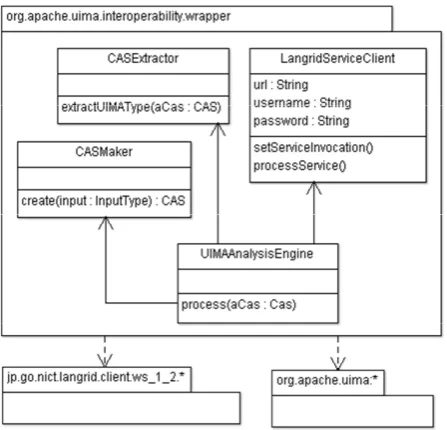
Analysis Engine Wrapper is used to wrap a language ser-vice into an analysis engine. Figure 8 shows the class di-agram used to implement this wrapper. There are several new classes defined as follows:
Figure 7: Class diagram of language service wrapper
Figure 8: Class diagram of analysis engine wrapper
• CASMakeris used to map output of the language ser-vice to a corresponding annotation type and add this annotation to the CAS document.
• LangridServiceClientis used to set language service endpoint and invoke the service with the input extract-ed from the CAS.
• UIMAAnalysisEngineinvokes a language service with the input extracted from CAS document, output of the service is added to the CAS document by using CAS Maker.
We adapt UIMA Engine into the Language Grid Composite Service Container (Murakami et al., 2011), so that users can use this engine to create composite services from UIMA aggregate analysis engines (UIMA AAE). Figure 9 show class diagram used for implementing this composite ser-vice. We use UIMA AAEs to define a pipeline of
sev-Figure 9: Class diagram of UIMA composite service
eral Analysis Engine Wrappers. In the Analysis Engine Wrappers we use ComponentServiceFactory.getServiceto set service type to be invoked. We can then create compos-ite services by calling the UIMA AAEs. These composcompos-ite services are shared on composite service container in the Language Grid. When a request is sent to the UIMA com-posite service, the Java Method Invoker will set invocation information for the composite service, UIMA engine will be used to execute the workflow.
UIMA supports data parallelism to improve pipelines per-formance with CAS Multiplier and UIMA Asynchronous Scale-out (AS) (Epstein et al., 2012). CAS Multiplier sep-arates a big CAS into smaller CASes and put them into a CAS pool. UIMA AS is use to execute multiple CAS-es with multiple instancCAS-es of a flow in parallel. Figure 10 shows data parallelism concept in UIMA framework. Users can define number of concurrent instances of the flow ac-cording to computing resources of their environments. Us-ing UIMA CAS Multiplier and UIMA AS engine to cre-ate and execute composite service will improve compos-ite service performance when processing huge amounts of data. We can use UIMA engine to execute a part of a workflow to improve thoughput of this part and so increase the performance of the workflow. For example, we cre-ated a Language Grid hybrid composite service of trans-lation combines with dictionary for Japanese-German spe-cialized translation as show in figure 11. The translation from Japanese to German is a two-hop translation created from a UIMA Aggregate Analysis Engine (UIMA AAE). This UIMA AAE consists of two translation analysis en-gines wrapped from translation language services. In this example we have realized the integration framework to cre-ate a hybrid composite service, we can employ not only workflow engine but also UIMA pipeline engine as Work-flow Executor for composite services.
U-Parallel Computing in UIMA (3/3)
2014/1/3014
Aggregate
Controller
FC
Delegate 1
Controller MultiplierCAS
Input queue Output queue
CAS Pool Output queue
Delegate 2
Controller AAE
Input queue
Provided by ActiveMQ
Provided by UIMA
Provided by users
Input queue
Figure 10: Data Parallelism in UIMA
remaining terms?
remaining terms?
Intermediate code table
Technical Term Multilingual Dictionary +
Japanese Morphological Analysis
Technical Term Extraction
Intermediate Code Insertion
Translation (ja -> de)
Term Replacement
Yes
No No
Yes
MeCab
Life Science Dictionary
Executed by workflow engine Executed by UIMA pipeline engine
J-Server
Google Translation
Composite service Atomic services
UIMA AE Translator (ja -> en)
UIMA AE Translator (en -> de)
Figure 11: Example of hybrid composite service
Compare (Kano et al., 2011) one of the World’s largest, and still growing, collection of UIMA-compatible resources. This would significantly increase the number of NLP-related language resources available as services in the Lan-guage Grid. NLP communities will benefits from a large number of easy access language services shared on the Lan-guage Grid.
4.3. Evaluation
We performed an evaluation to investigate the performance of composite service when using UIMA CAS Multiplier and UIMA AS. The performance metric is execution time of the composite service when processing a big document. To evaluate composite service performance, we use the pre-vious example in Figure 11, the two-hop translation is im-plemented with two methods: Using service composition engine in the Language Grid, and using UIMA engine with CAS Multiplier and UIMA AS. To execute the two-hop translation with the latter implementation, we first need to separate large document to smaller documents. We im-plement a simple Segmenter to separate large document
Time (ms)
0 20000 40000 60000 80000 100000 120000 140000 160000 180000
Figure 12: Execution time of different types of composite service
to smaller CAS documents each consisting of 500 words. Number of smaller CAS documents, which can be execut-ed concurrently, depends on the configuration of the UIMA composite service.
We conducted an experiment to see how composite ser-vice performance was improved when using UIMA AS and CAS Multiplier. We assume that the number of compos-ite service instances, which can be executed in the same time, may also affect execution time of the composite ser-vice. We designed six UIMA composite services (UIMA AAE) with different parameter specifying number of in-stances that can be executed concurrently. For example, UIMA AAE 1 can run 10 concurrent 10 CASes simultane-ously.
We challenged each type with a data set containing ten text documents with different sizes, ranging from 5000 words to 50000 words. The CAS Multiplier can separate these ten documents into different number of CASes, ranging from 10 CASes to 100 CASes. We compare the execution times of these composite service with execution time of normal two-hop translation service. The resulting execution times are plotted in Figure 12.
From this result we can see that, the CAS Multiplier and UIMA AS engine improve the composite service perfor-mance significantly. For example, when we use UIMA AAE 6 to execute with document 10, the execution time was decreased almost 70 % compared to the execution time of normal two-hop translation service.
5.
Discussion
for the input document. There are other parameters beside the number of concurrent composite service instances that effect performance of the composite services. For exam-ple, computing resources and service loads are important parameters that need to be considered to find an optimal setting for a composite service in a given environment. Trying to optimize the parameters involves several trade-offs. The local computing resource defines the maximum number of threads that can be executed. If the number of concurrent instances exceeds this maximum number, the performance of the composite service would be decreased. If the number of parallel requests exceeds the maximum number of requests that a service can handle, composite ser-vice performance might worsen. It will be more interesting in the future when we have more researches in analysing data parallelism in composite service. Further experiment need to be conducted in order to build a correlation model of parameters for analysing and finding optimal parameters for composite service on a given environment.
6.
Conclusion
In this paper we proposed an integration of two types of language resource frameworks: framework-based service composition and framework-based processing pipeline. The main contributions of this paper are as follows:
• Adapting a pipeline engine to yield a service compo-sition engine for enhancing composite service perfor-mance.
• The integration framework increases the availability of language resources by protecting intellectual property rights.
• A case study that showed a promising increase in the number of language services in the Language Grid af-ter integration with UIMA. This leads to greaaf-ter use of the Language Grid
Adding the UIMA framework to the Language Grid will in-crease the number of language resources shared as lan-guage services on the Lanlan-guage Grid and increase its ro-bustness. It also allows NLP users to easily access and test UIMA-compliant language resources before downloading these language resources and combining them to build their applications.
7.
Acknowledgements
This research was partly supported by a Grant-in-Aid for Scientific Research (S) (24220002, 2012-2016) from Japan Society for Promotion of Science (JSPS) and Service Sci-ence, Solutions and Foundation Integrated Research Pro-gram from JST RISTEX.
8.
References
Bel, N. (2010). Platform for automatic, normalized annotation and cost-effective acquisition of language resources for human language technologies. panacea.
Procesamiento del Lenguaje Natural, 45:327–328.
Cunningham, H., Maynard, D., Bontcheva, K., and Tablan, V. (2002). Gate: an architecture for development of ro-bust human language technology applications. In Pro-ceedings of 40th Annual Meeting of the Association for Computational Linguistics, pages 168–175, Philadelphi-a, PennsylvaniPhiladelphi-a, USA, July. Association for Computa-tional Linguistics.
Epstein, E. A., Schor, M. I., Iyer, B. S., Lally, A., Brown, E. W., and Cwiklik, J. (2012). Making watson fast. IBM Journal of Research and Development, 56(3.4):15–1. Ferrucci, D. and Lally, A. (2004a). Building an
exam-ple application with the unstructured information man-agement architecture. IBM Systems Journal, 43(3):455– 475.
Ferrucci, D. and Lally, A. (2004b). Uima: an architectural approach to unstructured information processing in the corporate research environment. Natural Language En-gineering, 10(3-4):327–348.
Ferrucci, D., Brown, E., Chu-Carroll, J., Fan, J., Gondek, D., Kalyanpur, A. A., Lally, A., Murdock, J. W., Ny-berg, E., Prager, J., et al. (2010). Building watson: An overview of the deepqa project. AI magazine, 31(3):59– 79.
Hayashi, Y., Declerck, T., Calzolari, N., Monachini, M., Soria, C., and Buitelaar, P. (2011). Language service on-tology. InThe Language Grid, pages 85–100. Springer. Ide, N. and Romary, L. (2009). Standards for language
re-sources.arXiv preprint arXiv:0909.2719.
Ide, N. and Suderman, K. (2009). Bridging the gaps: in-teroperability for graf, gate, and uima. InProceedings of the Third Linguistic Annotation Workshop, pages 27–34. Association for Computational Linguistics.
Ide, N., Bonhomme, P., and Romary, L. (2000). An xml-based encoding standard for linguistic corpora. In Pro-ceedings of the Second International Conference on Lan-guage Resources and Evaluation, pages 825–830. Ishida, T. (2006). Language grid: An infrastructure for
intercultural collaboration. In Applications and the In-ternet, 2006. SAINT 2006. International Symposium on, pages 96–100. IEEE.
Kano, Y., Miwa, M., Cohen, K. B., Hunter, L. E., Anani-adou, S., and Tsujii, J. (2011). U-compare: A modular nlp workflow construction and evaluation system. IBM Journal of Research and Development, 55(3):11–1. Maegaard, B., Choukri, K., Calzolari, N., and Odijk, J.
(2005). Elra - european language resources association-background, recent developments and future perspec-tives. Language Resources and Evaluation, 39(1):9–23. Murakami, Y., Lin, D., Tanaka, M., Nakaguchi, T., and
Ishida, T. (2011). Service grid architecture. InThe Lan-guage Grid, pages 19–34. Springer.
Vanhoutte, E. (2004). An introduction to the tei and the tei consortium. Literary and linguistic computing, 19(1):9– 16.