Criteria for Identifying and Annotating Caused Motion Constructions in
Corpus Data
Jena D. Hwang
1, Annie Zaenen
2, Martha Palmer
11Department of Linguistics, University of Colorado at Boulder
2Center for the Study of Language and Information, Stanford University
[email protected], [email protected], [email protected]
Abstract
While natural language processing performance has been improved through the recognition that there is a relationship between the semantics of the verb and the syntactic context in which the verb is realized, sentences where the verb does not conform to the expected syntax-semantic patterning behavior remain problematic. For example, in the sentence“The crowed laughed the clown off the stage”, a verb of non-verbal communicationlaughis used in a caused motion construction and gains a motion entailment that is atypical given its inherent lexical semantics. This paper focuses on our efforts at defining the semantic types and varieties of caused motion constructions (CMCs) through an iterative annotation process and establishing annotation guidelines based on these criteria to aid in the production of a consistent and reliable annotation. The annotation will serve as training and test data for classifiers for CMCs, and the CMC definitions developed throughout this study will be used in extending VerbNet to handle representations of sentences in which a verb is used in a syntactic context that is atypical for its lexical semantics.
Keywords:VerbNet, caused motion constructions, semantic coercion, lexical semantics, sentence representation
1.
Introduction
While natural language processing performance has been improved through the recognition that there is a relation-ship between the semantics of the verb and the syntactic context in which the verb is realized (Guildea and Palmer, 2002), sentences where the verb does not conform to the expected syntax-semantic patterning behavior remain prob-lematic. Consider the following sentences:
1. The goalie kicked the ball into the field.
2. The crowd laughed the clown off the stage.
3. The market tilted the economy into recession.
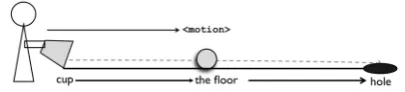
These sentences are semantically related – an entity causes a second entity to go along the path described by the prepo-sitional phrase: in 1, the goalie causes the ball to go into the field, in 2, the crowd causes the clown to go off the stage, and in 3, the market causes the economy to go into recession.
While only the verb in the first sentence is generally identi-fied as a verb of motion that can appear in a caused motion context, all three are examples of caused motion construc-tions (CMCs) (Goldberg, 1995). The verb laugh of sen-tence 2 is normally considered an intransitive manner of speaking verb (e.g.The crowd laughed at the clown), but in this sentence, the verb is coerced into the caused motion in-terpretation and the semantics of the verb gives the manner in which the movement happened (e.g. the crowd caused the clown to move off the stage by means of laughing). The verbtiltis a verb of spatial configuration normally taking, as its object argument, the inclined item (e.g. He tilted the bottle). In 3, the verb is not only coerced into the caused motion reading, the coerced meaning is also abstract rather than physical (e.g. He tilted the liquid into his mouth and swallowed). Whether the motion is physical or abstract,
the semantics parallel one other: all three sentences have a causal argument responsible for the event, an argument in motion, and a path that specifies the initial, middle, or final location, state or condition of the argument in motion.
Thus, if the semantic interpretation is strictly based on the expected semantics of the verb and its arguments, it fails to include the relevant information from the CMC. An accu-rate semantic role labelling for such sentences requires that NLP classifiers to accurately identify these coerced usages in data. Furthermore, once the CMCs identified and the semantic roles are properly assigned, the sentence would require an accurate semantic interpretation with appropri-ate representations that include the semantics of the CMCs. Making a semantic analysis available for both conventional and coerced caused motion instances would be useful in making inferences related to the states or locations pre- and post-event (Zaenen et al., 2008).
In a pilot study, we determined that CMCs can be automat-ically identified with high accuracy (Hwang et al., 2010). The pilot study was conducted in a highly controlled en-vironment over a small portion of Wall Street Journal data. This current effort is aimed at providing a larger set of high-quality annotated data for further training and testing of CMC classifiers. In this study, we develop detailed crite-ria for identifying CMCs that will aid in the production of consistent annotation with high inter-annotator agreement. In turn, successful annotation of the data will be used to establish whether or not the descriptive criteria are indeed useful in characterizing CMCs.
in-cause(Cynthia, E)
motion(E, the snow)
body process(E, Cynthia)
rel to path(start(E), the snow, her eyelashes)
rel to path(end(E), the snow, not(her eyelashes))
Figure 2:“Cynthia blinked snow off her eyelashes.”
One notable difference between the two representations is that theblinksentences that include the CMC carry an ad-ditional semantic component, namely, the act of blinking itself. As we have noted, the semantics of motion and path information would be projected from the semantics of the constructions. What the VerbNet HICCUP-40.1.1 class would provide is then the specialized semantics that is par-ticular to the lexical meaning that instantiates the CMC. In the above example, this lexical information is captured with the body process() predicate which comes from the class HICCUP-40.1.1 to which the verbblinkbelongs. The semantic interaction between caused motion construc-tions and the ROLL-51.3.1 class or other classes of motion such as THROW-17.1 with members likekick, lauch, and
tosswill produce the same results that would have been pro-duced by the classes by themselves, since the CMC frame is inherent in the member verbs (e.g.She carelessly tossed her book on the table). However, when paired with the HICCUP-40.1.1 class, which includes verbs such asblink, andshiver, it produces the correct analysis for sentences likeShe blinked the snow off her eyelashesorThe man shiv-ered the cold off his bones.
3.
Applying Linguistic Theory
We take Goldberg’s (1995) analysis of CMCs as the start-ing point for our definitions. As described above, a CMC requires three roles: the causal argument, the patient argu-ment undergoing motion, and one or more path arguargu-ments; and it roughly means “the causal argument directly causes the patient to move along a path specified by the preposi-tional phrase”. Goldberg’s analysis includes both physical and abstract/metaphorical motion. Its prototypical caused motion instances include those occurring with verbs of mo-tion (e.g.throw,push) and the coerced instances as seen in sentences 2 and 6.
3.1. Entailments of Motion
Goldberg recognizes that depending on the verb that instan-tiates the CMC, the construction can retain a different set of inferences when it comes to motion. Consider the follow-ing examples:
7. Harry locked Joe into the room.
8. Harry allowed Joe into the room.
9. Harry invited Joe into the house.
10. Harry helped Joe into the house.
Sentence 7, Harry prevents Joe’s motion by introducing a barrier – presumably a door – in Joe’s potential path of mo-tion. The verballowin sentence 8 has the opposite effect: Harry makes Joe’s motion possible by removing the prohi-bition that may have kept Joe out of the room. Sentence 9’s semantics is similar to that of 8, but entailment of mo-tion is dependent on the condimo-tion that Joe accepts Harry’s invitation. Finally, sentence 10 is likely the only example here where Joe’s motion is unconditionally entailed: it is not possible to negate Joe’s movement into the house (e.g.
*Harry helped Joe into the house, but Joe never went into it). Goldberg identifies these distinctions as four senses re-lated to the ‘central’ sense CMC. The four examples above are examples of prevented motion, enabled motion, implied motion and assisted motion, respectively.
We take a slightly narrower view of what defines CMCs. Specifically, we focus on a subset of Goldberg’s construc-tions for which the path of motion is strictly entailed. Since the annotation’s goal is to be used for automatic identifi-cation of the CMCs, the annotated label should describe meaningful and coherent phenomena. That is, if the de-scriptive features of a construction are too varied, then au-tomatic identification is less likely. If the label is seman-tically too general, no meaningful inferences can be made from its identification. This decision, effectively, selects for only one of the four related senses as a part of our CMC def-inition. By restricting CMCs to instances in which motion is strictly entailed, we can enable the inference that the ob-ject is in motion (physical or abstract) during the course of the event with a corresponding change of location or state.
3.2. Expanding the Definition
In order to account for the idiosyncratic usages of the struction, Goldberg introduces a series of semantic con-straints for CMCs (c.f. section 7.4 in Goldberg (1995)). However, Goldberg’s central sense, we find, is too general to identify the members of the construction reliably in an annotation setting. Instances expressing clear-cut motion (e.g. He kicked the ball into the binor coerced instances likeThe crowd laughed him off the stage) are easier for hu-man annotators. However, instances that are not specifi-cally discussed in the analysis can only be evaluated given general criteria from Goldberg’s analysis, and the more abstract the meaning, the more difficult is the evaluation. Therefore, we further expand and elaborate on the defini-tions proposed by Goldberg (1995).
We find that there are some natural categories that emerge in the examination of data. Consider the following exam-ples of CMCs:
11. Ron Brierley raised its stake in the company Friday to 15.02% from about 14.6% Thursday.
12. They plan to recycle them into fresh sealing clay.
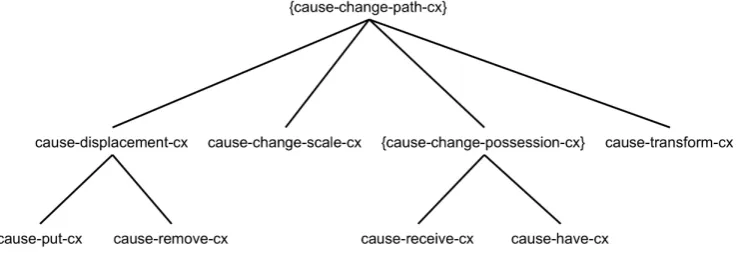
Figure 3: CMC Classification
The path, here, is conceived of as a change of state over which the patient is moved. In particular, the attribute of the patient undergoes a change of state, moving from a cer-tain initial state to a final state (Goldberg and Jackendoff, 2004). These types of elaborations are necessary to pro-vide the annotators with further information that will allow them to make decisions about sentences like this as they are encountered in the data.
The following example of CMC is an instance of change of possession:
13. Vector will sell WordPerfect to someone who [...] will capitalize the product.
Identifying this sentence as CM is based on the interpre-tation that while the thing possessed is not literal motion, change of ownership is well understood as a metaphori-cal extension of physimetaphori-cal transfer (c.f. Jackendoff (1972; Rappaport-Hovav and Levin (2008)). This relation that is also recognized in Goldberg (1995), we make explict in our definitions. In the next section we discuss our CMC clas-sification and the categories created in order to account for such idiosyncrasies in CMC usage.
4.
CMC Classification
Through a series of iterative annotation steps we will discuss in Section 5., we developed a semantically fine-grained sub classification of CMCs based on corpus data. The classification is shown in Figure 3. It includes 4 main categories of CMCs, one of which does not have any in-stances of its own (i.e. cause-change-possession-cx), and 4 semantically finer grained sub-categories. Each of these CMC categories details the particular characteristics and semantic types that they lend to consistent semantic infer-ences.
4.1. cause-displacement-cx
The category cause-displacement-cx (DISPLACE) de-scribes the most prototypical of the CMC types. The la-bels in this category are given to sentences in which the theme undergoes a change of location (physical or abstract) without an attributive or transformational change. Exam-ples 1-6, and 10 seen so far in this paper are examExam-ples of this category. DISPLACE has two finer grained subcate-gories: cause-put-cx(PUT), which includes instances that
syntactically realize only theGOALarguments and cause-remove-cx(REMOVE), which includes instances that syn-tactically realize only theSOURCEarguments. Unlike the two sub-categories, DISPLACE can occur with either path arguments. Following are examples in these categories:
14. (PUT) She put the book *[from the shelf]-SOURCE[on the table]-GOAL.
15. (REMOVE) She removed the book [from the
shelf]-SOURCE*[onto the table]-GOAL.
4.2. cause-change-scale-cx
The category cause-change-scale-cx (SCALE) identifies CMCs in which the path of motion is mapped to a linear scale. It is specifically reserved for instances in which the patient argument moves along a path that is expressed as a linear scale to include sentences like the one seen in exam-ple 11. The movement can be in any direction. Following are further examples of this category:
16. I marked the price down to 2 dollars.
17. The heavy downpour raised the level of the lake to 1000 ft.
4.3. cause-change-possession-cx
The category cause-change-possession-cx (TRANSFER) includes caused motion instances of transfer of possession, where the path of motion (physical or abstract) is defined as the path on which the patient argument moves from the
SOURCEentity’s possession toGOALentity’s possession. There are two sub-categories under TRANSFER: cause-have-cx(GIVE), which includes instances that syntactically realize only theGOAL (or recipient) argument and cause-receive-cx(RECEIVE), which includes instances that syn-tactically realize only theSOURCE(or giver). Instead of the
SOURCEargument for GIVE andGOALargument for RE-CEIVE, the cause argument (in this case anAGENT) takes on the role of the GOAL andSOURCEarguments, respec-tively. Following are some examples:
18. (GIVE) Mary gave my coat [to the salvation
army]-GOAL.
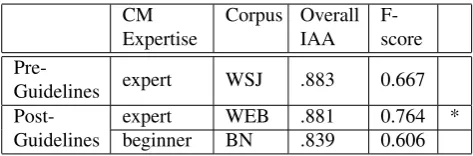
Alexander Yeh. 2000. More accurate tests for the statisti-cal significance of result differences. InProceedings of the 18th Conference on Computational Linguistics, vol-ume 2.