Word Alignment-Based Reordering
of Source Chunks in PB-SMT
Santanu Pal
1, Sudip Kumar Naskar
2, Sivaji Bandyopadhyay
2 1Universit¨at des Saarlandes, Saarbr¨ucken, Germany2Jadavpur University, Kolkata, India
[email protected],{sudip.naskar, sbandyopadhyay}@cse.jdvu.ac.in
Abstract
Reordering poses a big challenge in statistical machine translation between distant language pairs. The paper presents how reordering between distant language pairs can be handled efficiently in phrase-based statistical machine translation. The problem of reordering between distant languages has been approached with prior reordering of the source text at chunk level to simulate the target language ordering. Prior reordering of the source chunks is performed in the present work by following the target word order suggested by word alignment. The testset is reordered using monolingual MT trained on source and reordered source. This approach of prior reordering of the source chunks was compared with pre-ordering of source words based on word alignments and the traditional approach of prior source reordering based on language-pair specific reordering rules. The effects of these reordering approaches were studied on an English–Bengali translation task, a language pair with different word order. From the experimental results it was found that word align-ment based reordering of the source chunks is more effective than the other reordering approaches, and it produces statistically significant improvements over the baseline system on BLEU. On manual inspection we found significant improvements in terms of word alignments.
Keywords:Machine Translation, reordering, prior reordering, chunk-level reordering, word alignment based
1.
Introduction
Reordering is the one of the most difficult problems in sta-tistical machine translation (SMT); it presents itself dif-ferently for different language-pairs. For some language pairs (English–French, Chinese–English, etc.) only lo-cal movements are sufficient for translation, while some language-pairs have significant syntactic divergences. Par-ticularly, SMT between SVO–SOV (e.g., English–Hindi) or SVO–VSO (e.g., English–Arabic) language pairs suffer from long-distance reordering phenomena. Most of the In-dian languages are relatively free phrase-order languages; they are generally verb-final, i.e., verb phrases are posi-tioned at the end of the sentence and local movement of words within phrases also takes place.
In SMT, language models play a crucial role in positioning the target words in an acceptable order. But language mod-els also have their limitations; it typically considers up to 5-grams, which is not sufficient enough to make decision about a good translation. If we increase the n-gram value then the reordering cost involved is much higher in terms of computational effort and requirement; besides longer n-grams in language models suffer from data sparsity. In the phrase-based SMT (PB-SMT) framework, reorder-ing is typically handled by two models: distortion model and lexicalized reordering model (Koehn et al., 2005; Gal-ley and Manning, 2008). Distortion model was proposed by the IBM Models (Brown et al., 1993). IBM models 1 and 2 define the distortion parameters in accordance with the word positions in the sentence pair instead of actual words at those positions. The distortion probability also depends on the source and target sentence lengths. Models 4 and 5 limit this by replacing absolute word positions with rel-ative word positions. However, all these models are lim-ited to only word movements; they do not consider phrasal movement. Koehn et al. (2003) proposed relative distor-tion model in PB-SMT. The model works in terms of the
difference between current phrase position and the previ-ous phrase position in the source sentence. Basic PB-SMT model considers word movements up to 6 tokens which could be increased to consider long distance reordering; however, higher distortion limits usually result in degraded performance (Koehn et al., 2007).
Lexicalized reordering model conditions reordering on the PB-SMT phrases. It consists of three types of reordering – monotone (M), swap (S), and discontinuous (D) – by con-sidering the orientation of previous and next phrases. The orientation is called monotone if the previous source phrase is aligned with the previous target phrase. The orientation of the swap occurs when the next source phrase is aligned with the previous phrase in the target; and the orientation is termed as discontinuous if neither of the two above men-tioned cases are true, i.e. neither monotone or swap. The reordering model is built by calculating the probabilities of the phrase pairs being associated with the given orientation. Notwithstanding the reordering models used in the state-of-the-art PB-SMT, the differences in word ordering between distant languages result in poor translation quality. The remainder of this paper is organized as follows. Section 2 briefly discusses previous research relevant to the context. Section 3 focuses on the traditional approach of tree based reordering. Section 4 describes word alignment-based ap-proach to reordering of source chunks. Section 5 reports the tools and algorithms used along with a description of the datasets used. Section 6 presents the experiments and re-sults together with some analysis, followed by conclusions and future work.
2.
Related Work
etc.
4.
Word Alignment-based Reordering
In this section we discuss a simple yet effective language-independent approach to reordering based on word align-ment following Holmqvist et al. (2012). This method has the advantage that it does not necessitate any reorder-ing rules, handcrafted or automatically acquired. It also avoids any language dependent preprocessing of the target language; it only requires chunking of the source language. In this reordering approach we first run the GIZA++ word alignment tool on the original parallel corpus bidirection-ally which produces 1-to-n alignments for both directions. Then a symmetrization matrix is built on these two uni-directional word alignments and the ‘grow-diagonal-final-and’ (gdfa) heuristic is applied which produces m-to-n alignments. The gdfa heuristic is believed to be the most favourable word alignment heuristic for PB-SMT, and is used in the MOSES vanilla settings. This word alignment serves as the basis for this source reordering approach. Once the word alignment has been obtained, chunks are identified in the source (i.e., English) side of the training set which are then reordered following the word alignment. The chunk reordering process is outlined in algorithm 1. For reordering a source sentence, the algorithm starts with the chunked source sentence and the word alignment for that sentence pair. Let us consider the following chunked source sentence, the target sentence and the word align-ment:
S= (s1, s2, s3, . . . , sp) = (C1, C2, C3, . . . , Cm)
where
Ci= (sj, . . . , sj+n)
and
T = (t1, t2, t3, . . . , tq)
whereS is a source sentence,T is the corresponding tar-get sentence, and s, t and C represent source word, tar-get word and source chunks repectively. The alignment be-tween words inSandT is given by:
A={a1, a2, . . . , ar}, whereak = [sj, tl]
For the sake of simplicity the algorithm assumes 1-based index while 0-based indexing is used for the actual align-ments.
The algorithm uses a list of indices, list pos, for each source chunk. list posi stores indices of target words
which are linked to the component words of theithsource
chunk (Ci) via word alignment, i.e.,
list posi={j:tj∈T∧ ∃k:sk∈Ci∧[sk−tj]∈A}
In an ideal scenario, all tokens in a source sentence, or at least some tokens in every source chunk should be aligned to some tokens in the corresponding target sentence; but that is not always the case. If no correspondence can be found with the target via word alignment for any of the to-kens belonging to Ci, the source chunk position of Ci is
added tolist posi. Finally, the entries in each list pos are
sorted in ascending order, and the chunks are arranged ac-cording to the first entry in the correspondinglist pos. The pseudo-code of the algorithm used to reorder source chunks according to word alignment information is illus-trated in Algorithm 1.
fori= 1 to m chunks in the sourcedo new posi= NULL;
forj = 1 to n source words inchunkido
fork = 1 to r alignments in Ado ifak=[sj, tl]then
add l to listnew posi;
end end end
ifnew posiis NULLthen
add i tonew posi;
end end
fori = 1 to m new pos listsdo
Sort the items innew posiin ascending order;
end
reordered sen = NULL;
whilenot(all new pos lists are empty)do
i = index of the first new pos list containing the smallest first entry;
j = first entry innew posi;
Appendchunkjto reordered sen; new posi= NULL;
end
Algorithm 1:Word alignment-based source chunk reorder-ing
5.
Tools and Resources Used
The English–Bengali parallel dataset used for the exper-iments presented in this paper are from the tourism and travel domain and were taken from the EILMT1 project.
For identification of chunks, English training set and testset sentences are first POS-tagged using Stanford POS tagger2.
Chunks are then identified from the POS-tagged sentences using a CRF chunker3. The source side of the datasets were
parsed using Stanford Parser4.
The MT experiments were carried out using the standard log-linear phrase-based SMT toolkit MOSES (Koehn et al., 2007). GIZA++ (Och and Ney, 2003) implementation of IBM word alignment model 4 with the grow-diagonal-final-and heuristic was used for performing word align-ment. Phrase extraction was performed following Koehn et al. (2003). The feature weights were tuned using minimum error rate training (Och, 2003) on a held-out development set in terms of BLEU. For language modelling purpose we
1The EILMT project is funded by the Department of Informa-tion Technology (DIT), Ministry of CommunicaInforma-tions and Infor-mation Technology (MCIT), Government of India.
2
http://nlp.stanford.edu/software/tagger.shtml 3
http://crfchunker.sourceforge.net/ 4
Table 1: Evaluation results obtained on the reordering experiments.
Experiments Prior reordering Level TR Exp BLEU NIST METEOR TER
Word-based SMT
none (baseline) no 1 8.87 3.61 0.3028 86.95
alignment-based word yes 2 8.97 3.54 0.2985 88.86 chunk yes 3 9.94∗ 3.71 0.3107 86.64
Phrase-based SMT
none (baseline) no 4 10.68 4.13 0.3035 73.37 tree-based yes 5 11.53∗ 4.22 0.3126 72.75
alignment-based word yes 6 11.11 4.08 0.3073 75.34 chunk yes 7 12.65∗ 4.29 0.3144 73.00 alignment-based word
reordering, 1-pass
no 8 11.25 4.09 0.3129 75.25
alignment-based word reordering, 2-pass
no 9 11.47 4.12 0.3141 75.14
alignment-based chunk reordering, 2-pass
yes 10 13.17∗ 4.28 0.3161 72.66
FIGURE1.a – Initial word alignment Source:
Target:
FIGURE1.c – Final word alignment CR Source:
Target:
WR Source:
FIGURE1.b – Correct word alignment
[he] [of his life] [the last thirty years] [devoted] [to his experimental research] [.] [he] [devoted] [the last thirty years] [of his life] [to his experimental research] [.]
িতিন তাঁর জীবেনর েশষ ি
t
শ বছর
u
ত্সগর্ কেরন তাঁর পরী
k
ামূলক গেবষনায় ।
he his life the last devoted thirty years of his experimental to research . [he] [devoted] [the last thirty years] [of his life] [to his experimental research] [.]
িতিন তাঁর জীবেনর েশষ ি
t
শ বছর
u
ত্সগর্ কেরন তাঁর পরী
k
ামূলক গেবষনায় ।
িতিন তাঁর জীবেনর েশষ ি
t
শ বছর
u
ত্সগর্ কেরন তাঁর পরী
k
ামূলক গেবষনায় ।
Source:Target:
CR Source: [he] [of his life] [the last thirty years] [devoted] [to his experimental research] [.]
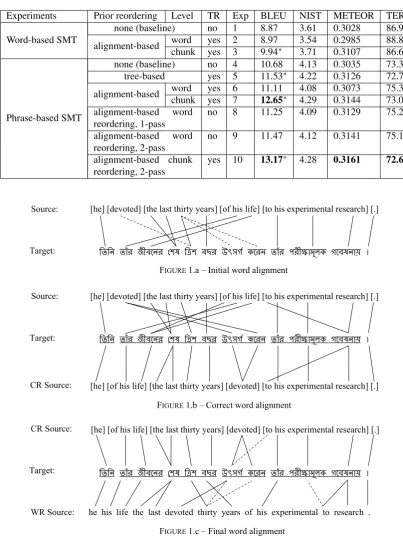
Figure 1: Word alignments with unordered and reordered source.
proves both world alignment precision and recall. This example illustrates two important improvements: firstly, word-alignment based chunk reordering of the source re-sults in less cross-chunk alignments, in this case zero (cf. figure 1.c), and secondly and more importantly, it improves the accuracy of the word alignment. From this example it is also evident that word-alignment based chunk reordering is more effective than word-alignment based word reordering in PB-SMT which is quite intuitive. This approach to
preserves some source language syntax and is less affected by noisy word alignments.
Due to the unavailability of the gold-standard word align-ment, improvement in terms of word alignment quality could not be measured empirically; however this exam-ple clearly demonstrates the usefulness of word-alignment based source chunk reordering in improving word align-ment quality. Although this approach calls for the testset to be reordered (as opposed to Holmqvist et al. (2012)) and is sensitive to errors in chunking, it was still able to produce significant improvements over the baseline systems. We in-spected the lexfile and phrase table sizes for the PB-SMT experiments and found that lexfile and phrase table sizes were inversely proportional to the BLEU scores obtained on them, which essentially suggests that prior reordering also reduces the data sparsity problem.
7.
Conclusions
In this paper we have presented a method of source chunk pre-ordering based on word alignment. Source chunks are reordered based on their associations with the target words and the target word order. The testset is reordered using monolingual PB-SMT built on the original source train-ing data and the reordered source traintrain-ing data. Our ex-periments showed that word alignment based source chunk pre-ordering is more effective than word alignment based source word pre-ordering and tree-based reordering; and it produced statistically significant improvements on both. On manual inspection we found significant improvements in terms of word alignments. This method also reduces the data sparsity problem. The method presented in the paper has the advantage that it does not require any language spe-cific tools like parsers excepting a chunker for the source language.
8.
Acknowledgements
The research leading to these results has received funding from the EU project EXPERT – the People Programme (Marie Curie Actions) of the European Union’s Seventh Framework Programme FP7/2007-2013 under REA grant agreement no. [317471] and from Science Foundation Ire-land as part of the CNGL (grant 07/CE/I1142).
9.
References
Andreas, J., Habash, N., and Rambow, O. (2011). Fuzzy syntactic reordering for phrase-based statistical machine translation. InProceedings of the Sixth Workshop on Sta-tistical Machine Translation, WMT ’11, pages 227–236, Stroudsburg, PA, USA. Association for Computational Linguistics.
Avinesh, P. V. S. (2010). A data mining approach to learn reorder rules for smt. In Proceedings of the NAACL HLT 2010 Student Research Workshop, HLT-SRWS ’10, pages 52–57, Stroudsburg, PA, USA. Association for Computational Linguistics.
Badr, I., Zbib, R., and Glass, J. (2009). Syntactic phrase reordering for english-to-arabic statistical machine trans-lation. InProceedings of the 12th Conference of the Eu-ropean Chapter of the Association for Computational
Linguistics, EACL ’09, pages 86–93, Stroudsburg, PA, USA. Association for Computational Linguistics. Banerjee, S. and Lavie, A. (2005). Meteor: An automatic
metric for mt evaluation with improved correlation with human judgments. InProceedings of the ACL Workshop on Intrinsic and Extrinsic Evaluation Measures for Ma-chine Translation and/or Summarization, pages 65–72. Bisazza, A. and Federico, M. (2010). Chunk-based verb
reordering in vso sentences for arabic-english statistical machine translation. In Proceedings of the Joint Fifth Workshop on Statistical Machine Translation and Met-ricsMATR, WMT ’10, pages 235–243, Stroudsburg, PA, USA. Association for Computational Linguistics. Brown, P. F., Pietra, V. J. D., Pietra, S. A. D., and
Mer-cer, R. L. (1993). The mathematics of statistical ma-chine translation: Parameter estimation. Computational Linguistics, 19(2):263–311, June.
Carpuat, M., Marton, Y., and Habash, N. (2010). Improv-ing arabic-to-english statistical machine translation by reordering post-verbal subjects for alignment. In Pro-ceedings of the ACL 2010 Conference Short Papers, ACLShort ’10, pages 178–183, Stroudsburg, PA, USA. Association for Computational Linguistics.
Collins, M., Koehn, P., and Kuˇcerov´a, I. (2005). Clause restructuring for statistical machine translation. In Pro-ceedings of the 43rd Annual Meeting on Association for Computational Linguistics, ACL ’05, pages 531–540, Stroudsburg, PA, USA. Association for Computational Linguistics.
Dan, H., Sudoh, K., Wu, X., Duh, K., Tsukada, H., and Nagata, M. (2012). Head finalization reordering for chinese-to-japanese machine translation. InProceedings of the Sixth Workshop on Syntax, Semantics and Struc-ture in Statistical Translation, SSST-6 ’12, pages 57–66, Stroudsburg, PA, USA. Association for Computational Linguistics.
Doddington, G. (2002). Automatic evaluation of machine translation quality using n-gram co-occurrence statistics. In Proceedings of the Second International Conference on Human Language Technology Research, HLT ’02, pages 138–145, San Francisco, CA, USA. Morgan Kauf-mann Publishers Inc.
Galley, M. and Manning, C. D. (2008). A simple and effec-tive hierarchical phrase reordering model. In Proceed-ings of the Conference on Empirical Methods in Natu-ral Language Processing, EMNLP ’08, pages 848–856, Stroudsburg, PA, USA. Association for Computational Linguistics.
Genzel, D. (2010). Automatically learning source-side re-ordering rules for large scale machine translation. In
Proceedings of the 23rd International Conference on Computational Linguistics, COLING ’10, pages 376– 384, Stroudsburg, PA, USA. Association for Computa-tional Linguistics.
Gupta, D., Cettolo, M., and Federico, M. (2007). Pos-based reordering models for statistical machine transla-tion. InProceedings of the MT Summit XI, pages 207– 213.
machine translation. InProceedings of the MT Summit XI, pages 215–222.
Holmqvist, M., Stymne, S., Ahrenberg, L., and Merkel, M. (2012). Alignment-based reordering for smt. In Chair), N. C. C., Choukri, K., Declerck, T., Doan, M. U., Mae-gaard, B., Mariani, J., Odijk, J., and Piperidis, S., edi-tors,Proceedings of the Eight International Conference on Language Resources and Evaluation (LREC’12), Is-tanbul, Turkey, may. European Language Resources As-sociation (ELRA).
Kneser, R. and Ney., H. (1995). Improved backing-off for m-gram language modeling. InProceedings of the IEEE International Conference on Acoustics, Speech and Sig-nal Processing. Volume I., pages 181–184.
Koehn, P., Och, F. J., and Marcu, D. (2003). Statisti-cal phrase-based translation. InProceedings of the 2003 Conference of the North American Chapter of the As-sociation for Computational Linguistics on Human Lan-guage Technology - Volume 1, NAACL ’03, pages 48–54, Stroudsburg, PA, USA. Association for Computational Linguistics.
Koehn, P., Axelrod, A., Mayne, R. B., Callison-burch, C., Osborne, M., and Talbot, D. (2005). Edinburgh system description for the 2005 iwslt speech translation evalua-tion. InIn Proc. International Workshop on Spoken Lan-guage Translation (IWSLT.
Koehn, P., Hoang, H., Birch, A., Callison-Burch, C., Fed-erico, M., Bertoldi, N., Cowan, B., Shen, W., Moran, C., Zens, R., Dyer, C., Bojar, O., Constantin, A., and Herbst, E. (2007). Moses: Open source toolkit for statistical machine translation. InProceedings of the 45th Annual Meeting of the ACL on Interactive Poster and Demon-stration Sessions, ACL ’07, pages 177–180, Strouds-burg, PA, USA. Association for Computational Linguis-tics.
Niehues, J. and Kolss, M. (2009). A pos-based model for long-range reorderings in smt. In Proceedings of the Fourth Workshop on Statistical Machine Translation, StatMT ’09, pages 206–214, Stroudsburg, PA, USA. As-sociation for Computational Linguistics.
Och, F. J. and Ney, H. (2003). A systematic comparison of various statistical alignment models. Computational Linguistics, 29(1):19–51, March.
Och, F. J. (2003). Minimum error rate training in statistical machine translation. InProceedings of the 41st Annual Meeting on Association for Computational Linguistics -Volume 1, ACL ’03, pages 160–167, Stroudsburg, PA, USA. Association for Computational Linguistics. Papineni, K., Roukos, S., Ward, T., and Zhu, W.-J. (2002).
Bleu: A method for automatic evaluation of machine translation. InProceedings of the 40th Annual Meeting on Association for Computational Linguistics, ACL ’02, pages 311–318, Stroudsburg, PA, USA. Association for Computational Linguistics.
Popovi´c, M. and Ney, H. (2006). Pos-based reorderings for statistical machine translation. InProceedings of the Fifth International Conference on Language Resources and Evaluation, LREC-2006, pages 1278–1283. Snover, M., Dorr, B., Schwartz, R., Micciulla, L., and
Makhoul, J. (2006). A study of translation edit rate with targeted human annotation. InIn Proceedings of Asso-ciation for Machine Translation in the Americas, pages 223–231.
Stolcke, A. (2002). Srilm - an extensible language model-ing toolkit. pages 901–904.