A flexible language learning platform based on language resources and web
services
Elena Volodina*, Ildikó Pilán*, Lars Borin*, Therese Lindström Tiedemann†
*Språkbanken, University of Gothenburg, Sweden
Språkbanken, Institutionen för svenska språket, Göteborgs universitet, Box 200, 405 30 Göteborg, Sweden
†Department of Linguistics and Philology, Uppsala University, Sweden
Department of Linguistics and Philology, Uppsala University, Box 256, 751 05 Uppsala, Sweden
[email protected], [email protected], [email protected], [email protected]
Abstract
We present Lärka, the language learning platform of Språkbanken (the Swedish Language Bank). It consists of an exercise generator which reuses resources available through Språkbanken: mainly Korp, the corpus infrastructure, and Karp, the lexical infrastructure. Through Lärka we reach new user groups – students and teachers of Linguistics as well as second language learners and their teachers – and this way bring Språkbanken's resources in a relevant format to them. Lärka can therefore be viewed as an case of real-life language resource evaluation with end users. In this article we describe Lärka's architecture, its user interface, and the five exercise types that have been released for users so far. The first user evaluation following in-class usage w ith students of linguistics, speech therapy and teacher candidates are presented. The outline of future work concludes the paper.
Keywords: exercise generator; ICALL; Lärka
1 Introduction
Lärka1 is the ICALL platform of Språkbanken (the Swedish
Language Bank). ICALL – Intelligent Computer-Assisted Language Learning – has as its main aim to draw on the opportunities offered by language resources, such as corpora, lexicons and natural language processing (NLP) components including lemmatizers, parsers, etc., to build more sophisticated and flexible applications for language learners and students of grammatical theory (Meurers, 2012; Amaral and Meurers, 2011; Heift and Schulze, 2007). ICALL is an active area of research with such examples of end-user applications as E-tutor (Heift, 2010), Criterion and E-rater (Burstein et al., 2013), Werti (Meurers et al., 2010), TAGARELA (Amaral and Meurers, 2001). Research within ICALL is advancing along multiple dimensions, such as text and sentence readability (Pilán and Volodina, 2013; Shen et al., 2013), text simplification (Vajjala and Meurers, 2014), mother tongue identification (Li, 2013), learner error detection (Cahill et al., 2013), essay scoring (Östling et al., 2013), exercise generation (Dickinson and Herring, 2008), semantic analysis of learner production (King and Dickinson, 2013), etc. Functionality and appropriateness of ICALL applications depend linearly upon advances in these and other related areas.
Språkbanken has a long history of ICALL R&D, and Lärka combines and extends the capabilities of two earlier
1 <spraakbanken.gu.se/larka/>. Lärka is an acronym for LÄR språket via KorpusAnalys ‘Learn language via corpus analysis’. The word itself also means ‘lark’, and it corresponds in English to Language Acquisition Reusing Korp.
applications, ITG (Saxena and Borin, 2002; Borin and Saxena, 2004) and SCORVEX (Volodina, 2010). The ITG platform was developed in the early 2000s and explicitly targeted students of linguistics. Its aim was to offer grammar – part-of-speech (POS) and syntactic-relation – exercises based on authentic language examples from annotated corpora. ITG was used on linguistics courses at several Swedish universities during the years 2005–2012 (Saxena and Lind, 2008), and sporadically alongside Lärka in 2013. SCORVEX was built as an ICALL application for students of Swedish as a foreign or second language, offering a variety of vocabulary exercises. In a rapidly evolving digital world, the technologies used in these applications have been superseded, and the development of Lärka was a natural consequence of a general restructuring of Språkbanken’s language resource and technology infrastructure into one based on distributed (REST) web service components and web applications. At present, in addition to Lärka, this infrastructure comprises Korp2 (Borin et al., 2012b) for
text corpora, and Karp3 (Borin et al., 2012a) for lexical
resources.
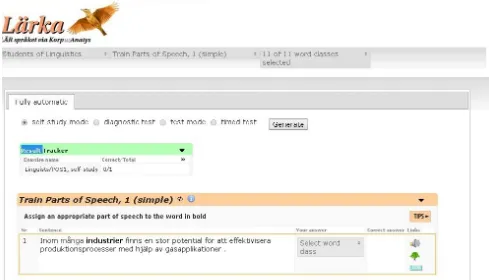
Figure 1. Lärka – user interface
The work on Lärka started in the project Systems
Architecture for ICALL financed by NordPlus Sprog (2011–
2013). Specified as a modular web-based exercise generator that reuses available annotated corpora and lexical resources, Lärka is freely available, targeting primarily learners of Swedish as a second/foreign language and students of (Swedish) linguistics. Being web-based, Lärka has advantages of accessibility and ease of use compared to its predecessors. With the release of Lärka 1.0 (October, 2013) ITG and SCORVEX have been “retired”.
Below, we give an overview of Lärka (section 2), summarize feedback from the first in-class uses (section 3) and conclude the paper outlining future plans (section 4).
2 Lärka in a nutshell
Lärka is designed as a Service Oriented Architecture based on web services. The platform comprises two main components – user interface and web services – where the web services can be reused by other applications (Volodina et al., 2012). Web services take care of exercise generation whereas the user interface collects user input, formats the web service output and assigns behavior to buttons and menus.
At the moment Lärka offers exercises for two target groups: students of linguistics and learners of Swedish. All available exercises share some common features, namely:
• Training context: sentence. The objective with the
Lärka-based exercise generator has, from the onset, been to use real-life language examples from corpora. Possible
copyright issues are avoided by using only a single-sentence context.
• Format: multiple-choice. The target item (one
word or phrase) is marked in the sentence. An accompanying drop-down menu contains several answer alternatives, only one of which is correct.
• Reference materials. Relevant articles are
looked up in Wikipedia, Wiktionary and Karp, while a text-to-speech module provided by SitePal4 offers
pronunciation of relevant words and sentences. Reference materials are shown in a separate field that can be hidden when not wanted.
• Training modes: self-study, test and timed. The
self-study mode reveals all clues (e.g. reference articles, syntactic tree structure, pronunciation, etc.) and also provides a possibility to try several answer options. In the test and timed test modes, the clues are not revealed until the answer is provided; and users cannot change their answer. In the timed test there is also an additional pressure of time set on the user.
• Feedback is offered in the form of immediate
correct/incorrect symbols and a result tracker where information on correct/total number of answers is shown.
• A new item is generated as soon as the previous
one is answered.
• To avoid sentence duplicates, the same sentence is never selected more than once during the
same exercise session. • Finally, an i-icon provides information about each exercise type.
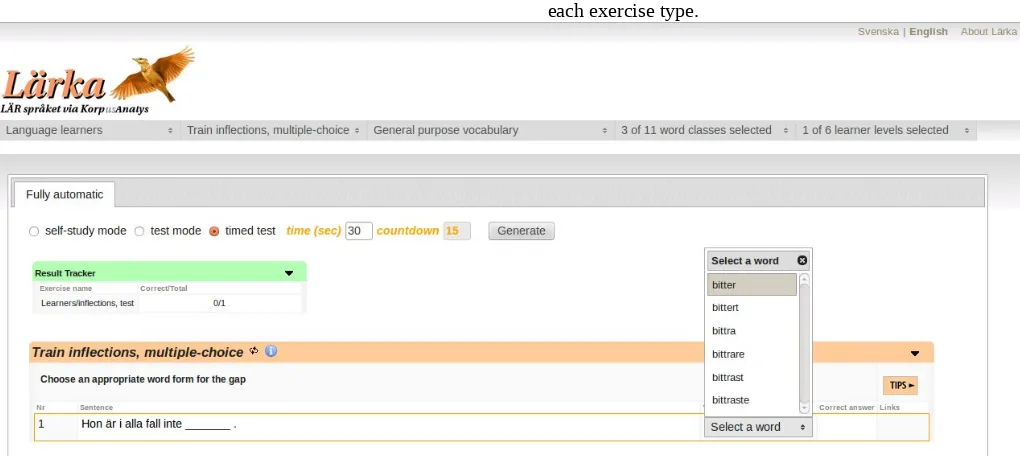
Figure 2. Lärka - exercise with inflectional paradigms
The exercise repertoire for students of linguistics comprises exercises for training POS, syntactic relations and semantic roles. Common features for all the three exercise types include sentence filtering consisting in allowing only sentences of 5–20 tokens in length that are non-elliptic, i.e. contain a subject and a finite verb and which do not contain subordinate clauses, except when looking for sentences with subjunctions.
Users have an option of selecting one or a set of categories (e.g. POS) from a menu for training. Other features include statistics over the answers, diagnostic test and adaptivity which ensures that the categories that cause more difficulties return more often. A diagnostic test option gives the student a number of questions to test their knowledge of parts of speech, syntactic relations or semantic roles. After the test the student is given automatic feedback and recommendations what to focus on. From the result tracker the student can also choose to view more explicit feedback where the test sentences are listed, as well as the right and wrong answers.
The POS exercise (Figure 1) aims at students who want to practice differentiating between POS. The following POS and sub-categories are used in the exercise: adjective, adverb, conjunction, subjunction, determiner, nouns (incl. proper names), numerals, participles, prepositions (incl. particles), pronouns and verbs. All sentences are selected from SUC3.0 (Stockholm-Umeå Corpus – Ejerhed et al., 1992; Källgren, 2006), a corpus manually annotated for POS.
The syntactic-relation exercise is aimed at students who need to train and revise clause-level syntactic roles. The following 7 relations and sub-categories are used in the exercise: adverbial, finite and non-finite verbs, predicative,
direct and indirect objects, and subject. The sentences are selected from Talbanken (Teleman, 1974; Einarsson, 1976), a corpus manually annotated for syntactic relations.
The semantic-role exercise provides training for understanding the semantic relations in a sentence. There are 12 general roles, each of which encompasses a group of semantically related sub-roles coming from the role set used in the Swedish FrameNet (SweFN; Borin et al., 2010): Agent, Experiencer, Theme, Instrument, Location, Goal, Recipient, Origin, Time, Manner, Purpose, Cause (see Pilán and Volodina, 2014). All of the sentences come from SweFN, where they have been carefully selected from corpora and manually annotated for semantic roles.
Learners of Swedish are offered two exercise types:
training vocabulary knowledge and training inflectional
paradigms. Figure 2 shows an example of the latter.
Both exercise types offer the option of selecting a domain for target vocabulary as well as learner proficiency levels. The selection of target vocabulary comes from three main sources:
Reference (CEFR; COE, 2012), which also makes it possible to select vocabulary from a certain proficiency level/frequency band. Words from AO always correspond to advanced proficiency (C2).
• From 30 LEXIN (Gellerstam, 1999) domain lists. In this case we do not offer an option of filtering target vocabulary items for POSs as domain vocabulary in Lexin Picture Series contains mainly nouns, and in certain domains some verbs, adjectives and adverbs.
In both exercise types sentences are selected according to the proficiency level specified by the user. For that, a special Lärka-based sentence readability module, HitEx “Hit Examples”, currently available for ntermediate level [B1] and above (Pilán et al., 2013; Pilán, 2013). The module selects and ranks corpus hits either based on heuristic rules only or using a combination of rules and classification with machine learning. To assess the readability of sentences, a number of morpho-syntactic (e.g. average dependency length) and lexical-sematic features (e.g. CEFR level and frequency of words) are taken into consideration. The rules offer the possibility also to filter sentences containing certain linguistic elements including, among others, abbreviations, negative formulations and participles. Sentences are selected from three different corpora to cater for a combination of different genres, namely SUC3.0 (a balanced corpus with texts from various genres), GP2012 (newspaper texts) and ROM99 (novels). Sentences for training vocabulary coming from AO are selected from specialized corpora comprising academic texts in the areas of the humanities and social sciences (Sköldberg and Johansson Kokkinakis, 2012).
The two exercise types differ in how the distractors
(incorrect alternatives) are selected. For vocabulary training, words of the same morphosyntactic tag are selected, whereas in the inflectional paradigm exercise a morphology web service provides different word forms.
3 Lärka in use – initial user experiences
Lärka has been used by Uppsala University for the past three terms (2013-2014) and by the University of Gothenburg during Spring Term 2014, to teach first-year students of linguistics, speech therapy and language technology, as well as trainee teachers of upper-secondary Swedish and Swedish as a Second Language.
Figure 3. Evaluation results 1
The aim of the general introductory course to Linguistics5 was to enable students to identify, among
others, POS, syntactic relations, main/embedded clauses and semantic roles. During three laboratory sessions, one for POSs, the other for syntactic relations, and the last for semantic roles, students have been working individually and in small groups with the exercises. Although lab sessions were optional, student attendance was very high. Students were also encouraged to continue training with Lärka at home.
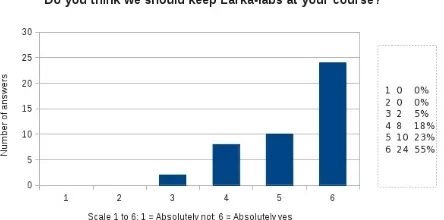
The labs have been very positively accepted by students (Figure 3). Out of 45 answers, 34 students (78%) have commented in favour of using Lärka as part of the courses (scores 5–6 on the scale of 1 to 6), while 10 students (22%) have been reserved about it (scores 3– 4). Similarly to written evaluations of ITG (Saxena and Lind, 2008), students found the labs fun and instructive, and they appreciated the opportunity to get individual help from the teacher as well as receiving instantaneous feedback from the program. They trained primarily in self-study mode, with initial and final diagnostic tests, and appreciated the real-life challenge presented by the sentences coming from authentic texts and the possibility to consult various sources of reference. Students as well as teachers, who were initially skeptical, found Wikipedia articles useful. The existence of contradictory views on certain aspects of linguistics sparked some lively discussions which proved to lead to a better understanding of the complexity of language (and linguistics).
Figure 4. Evaluation results 2
Lärka was generally perceived by students as a very useful and instructive complimentary tool. 80% of the students would recommend the tool for others to use, followed by 18% of those who might recommend it, compared to 2% who were uncertain (Figure 4). In a number of written (optional) comments students wrote that they would definitely continue practicing with Lärka outside the classroom, that it was a very easy-to-use tool and that they appreciated an opportunity to step away from paper-bound training to a more fun way of