A Quality-based Active Sample Selection Strategy for
Statistical Machine Translation
Varvara Logacheva, Lucia Specia
Department of Computer Science, University of SheffieldSheffield, United Kingdom
{v.logacheva,l.specia}@sheffield.ac.uk
Abstract
This paper presents a new active learning technique for machine translation based on quality estimation of automatically translated sentences. It uses an error-driven strategy, i.e., it assumes that the more errors an automatically translated sentence contains, the more informative it is for the translation system. Our approach is based on a quality estimation technique which involves a wider range of features of the source text, automatic translation, and machine translation system compared to previous work. In addition, we enhance the machine translation system training data with post-edited machine translations of the sentences selected, instead of simulating this using previously created reference translations. We found that re-training systems with additional post-edited data yields higher quality translations regardless of the selection strategy used. We relate this to the fact that post-editions tend to be closer to source sentences as compared to references, making the rule extraction process more reliable.
Keywords:machine translation, active learning, human feedback
1.
Introduction
One of the most efficient ways to improve the quality of a machine translation (MT) system is to enhance it with new training data. In many scenarios, monolingual data on either source or target languages (or both) tends to be abundant. However, parallel data has to be created by hav-ing humans translathav-ing monolhav-ingual content, which is an expensive process. Clever selection techniques to choose a subset with only the most useful sentences to translate from monolingual data can result in systems with higher quality using less training data. These techniques are usually re-ferred to as active learning (AL) (Settles, 2010). Active learning has been extensively used in various Natural Lan-guage Processing (NLP) tasks, such as POS tagging (Ring-ger et al., 2007), parsing (Reichart and Rappoport, 2007), and sentiment analysis (Xiao and Guo, 2013).
Previous work has used active learning for MT. However, the majority of Active learning methods used in MT used mainly properties from source sentences. One of the most common criteria used in active sample selection for MT is the dissimilarity of a candidate sample to the existing data. Along those lines, Eck et al. (2005) suggest a TF-IDF-based metric, while Ambati et al. (2010) propose a metric of informativeness relying on unseen n-grams.
Bloodgood and Callison-Burch (2010) present a simple and yet effective method. The only criterion for sentence selec-tion is the frequency of their n-grams in the training data. Their technique requests translations for phrases instead of complete sentences, which saves user effort and leads to marked improvement of quality even if the size of the ini-tial training dataset is already substanini-tial.
A recent trend is to use the estimated translation quality of a sentence as a criterion for active selection. Sentences which are likely to be translated well by the existing MT system will not be useful for its training. Conversely, sentences that
are translated badly could contain words or phrases which are absent in the current translation model. One of the first methods of this type is presented in (Haffari et al., 2009). Haffari et al. (2009) define the most useful sentences with a classifier which uses a number of features such as the num-ber of unseen phrases/n-grams, the similarity to the exist-ing trainexist-ing data, and the confidence of translations. Anan-thakrishnan et al. (2010) propose an error-driven method to define the most useful sentences. The idea is that the most useful sentences are those that lead to the largest number of translation errors. They learn a classifier that induces n-grams which are translated incorrectly. The classifier is then used to pick the source sentences that are likely to cause errors, i.e., likely to contain the largest number of erroneous n-grams.
We propose a new sentence selection strategy. Similarly to (Ananthakrishnan et al., 2010), the core idea of our method is to select sentences that are likely to be trans-lated incorrectly by the MT system. However, we estimate the correctness of automatic translation of a sentence us-ing a richer quality estimation metric, which benefits from a wider range of features. Another concern in our work was to analyse the potential of using human post-editions of machine-translated sentences as training data for the MT system. The use of post-editions in our research is two-fold. Firstly, the post-editions are used to train a quality estima-tion system which then generates the quality scores for new sentences. The translations of the new sentences selected for having low predicted quality are then post-edited, and those post-editions are added to the MT training data. We compare the improvements obtained by a system enhanced by post-editions with the improvements obtained by a sys-tem with additional reference translations.
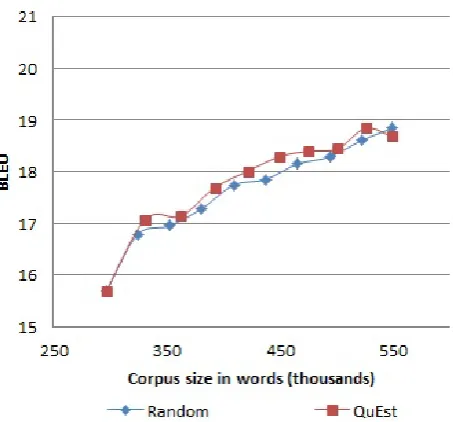
Figure 1: Performance (BLEU) improvements on the test set for MT systems re-trained based on additional data se-lected via active selection ofpost-editedtranslations
.
3.3.
Results
We conducted a set of experiments to show the improve-ment rate of our selection strategy compared to random data selection.
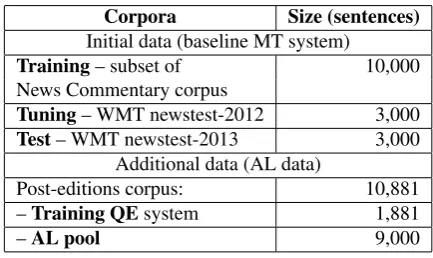
At every iteration, based on quality predictions for transla-tions of the active learning pool produced by the baseline MT system, batches of 1,000 sentences from the pool with the lowest predicted score were selected. These were added to the training data of the MT system, which was then re-trained. The selected sentences were removed from the ac-tive learning pool. The new MT system was applied to the test set, with performance (BLEU) measured. The process was repeated until the pool was empty.
Figure 1 plots the results of the experiments with added reference translations, while Figure 2, with added post-editions. Our selection strategy implies choosing com-plete sentences. However, the scores predicted byQuEst have a strong bias towards sentence length, i.e., longer sen-tences tend to be rated as requiring higher post-edition ef-fort. Therefore, we show improvements in BLEU scores of the MT systems with respect to the corpus length in words, although the batches were chosen disregarding sen-tences length. All figures are reported based on the test set. As we can see, our error-based selection strategy re-sults in consistent improvements in performance, and out-performs random selection when both post-editions and ref-erence translations are added to the MT data. The improve-ments obtained by adding post-editions as opposed to ref-erence translations are however substantially higher.
To highlight the difference between systems trained on added post-editions and those trained on reference trans-lations, Figure 3 shows that adding post-editions results in higher BLEU scores than adding references for any num-ber of added sentences. The improvement obtained for the
Figure 2: Performance (BLEU) improvements on the test set for MT systems re-trained based on additional data se-lected via active selection ofreferencetranslations.
Figure 3: Comparison of the impact of post-editions and reference translations on improvements in translation qual-ity.
entire set of 9,000 sentences was of1.5 BLEUpoints. The results for random selection (as opposed to QuEst-based selection) follow the same trend.
3.4.
Analysis
To sum up, our experiments demonstrate two main phe-nomena:
• MT systems trained on data selected by our error-driven active learning method yield larger improve-ments in translation quality than those trained on ran-domly selected sentences; and
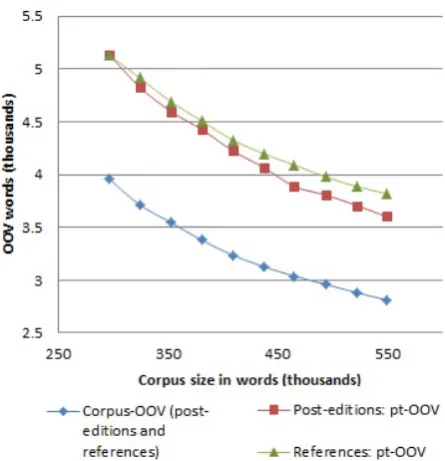
Figure 4: Comparison of reduction of OOV words for dif-ferent active selection techniques.
in translation quality than the use of independently created reference translations.
In order to further understand these phenomena, we ex-amine the number of out-of-vocabulary (OOV) words in the test set when it is translated by the different systems. Namely, we considered two parameters:
• Number of words in the test set which do not occur in training data (referred to ascorpus-OOV);
• Number of words in the test set which do not occur in phrase table (pt-OOV).
These two parameters often differ as unaligned words might be omitted when extracting phrases.
Figure 4 shows how the number of OOV words in the test set naturally decreases as more data is added to MT system. This reduction is faster for both corpus-OOV and pt-OOV when our error-driven strategy is used as opposed to random selection. Therefore, QuEst seems to predict higher HTER scores for sentences that contain more uncovered words and thus we implicitly attempt to increase vocabulary variety, which is widely used in other active learning work, e.g. (Eck et al., 2005).
The comparison of OOV word rate for systems trained on post-edited translations and those trained on reference translations has also led to interesting results. Figure 5 shows that whilecorpus-OOVis almost identical for cor-pora containing references and post-editions, the pt-OOV rate for systems built from post-editions is consistently lower than that of systems built from references.
Similar corpus-OOV rates are expected, since the source sides of both corpora are the same (slight differences may appear because different sentences can be filtered out dur-ing the corpus cleandur-ing step before systems are re-trained).
Figure 5: Comparison of the impact of post-editions and references on the OOV rate.
On the other hand, faster reduction ofpt-OOVrate means that more phrases are extracted from the newly acquired corpus.
Overall, we can assume that post-editions contain more literal word-to-word translations and less reformulations, than reference translations. This argument is supported by research in (Potet et al., 2011). The authors report that post-editions are often closer to source sentences than their ref-erence translations. This result means that a parallel corpus can be better for MT purposes if the target sentences are as close as possible to the literal translation of their cor-responding source sentences. While this conclusion looks pretty evident as such, our experiments suggest that a sim-ple and natural way of generating such literal translations is through the post-editing of translations produced by the underlying MT system.
We note that the post-editions used in our experiments were produced by editing an output of a third-party MT system (the LIG system (Potet et al., 2010)). Although it is built on the same type of data as our baseline system, we have only used a small fraction of the corpora, and therefore the two systems are substantially different. Nevertheless, the use of these post-editions improved the quality of our MT systems. Hence we can suggest that the actual system used to generate the translations to be post-edited is less relevant.
4.
Discussion and future work
met-Computational Linguistics, Demo session, August 2013, Sofia, Bulgaria.