© 2018 IJSRCSEIT | Volume 3 | Issue 3 | ISSN : 2456-3307
Prepackaging Sorting of Guava Fruits using Machine Vision based
Fruit Sorter System based on K-Nearest Neighbor Algorithm
Ashok Kanade*1, Arvind Shaligram2
1Department of Electronic Science, P.V.P. College, Pravaranagar, Maharashtra, India
2Professor and Head, Department of Electronic-Science, Savitribai Phule Pune University, Pune, Maharashtra,
India
ABSTRACT
In the present work, a general approach is developed to estimate the ripeness level of Guava fruit without touching it. The fruits can be classified according to different conditions as pre-harvest, postharvest harvest, storage conditions in controlled environment or harsh environment. In this study the fruit under test were classified at the time of harvest in four different classes as green, ripe, overripe and spoiled using a web camera based computer vision system. This paper presents a simple method that uses a combination of digital web camera, computer and indigenously developed graphics software to measure and analyze the surface color of fruits for ripening state recognition. The recognition was done by the nearest neighbor classifier engine uses the HSI color distribution in selected ROI of fruits. Experimental results on a database of 200 guava fruits from 4 different ripening states confirm the effectiveness of the proposed approach.
Keywords: HSI Color space, fruit ripeness, computer vision, nearest neighbor, Machine vision, Guava fruit sorting.
I.
INTRODUCTION
Now days machine vision based techniques have been found increasingly useful in the fruit industry for quality inspection, detection of ripening stage and defect sorting applications. The harvested fruits are sorted according to quality and maturity level and then transported to different standard markets at different distances based on the quality and maturity level [1].Sorting of fruits on the basis of their ripening stage has been an issue faced by producers as well as sellers due to the sheer volumes handled and the delicate nature of the fruit [2].
Conventionally fruit sorting is done by trained human graders according to maturity level as they percept by their experience. This manual sorting by visual inspection is labor intensive, time consuming and suffers from the problem of inconsistency and inaccuracy in judgment by different human as they
have different experience and vision level. Also this method has disadvantage in term of objectivity and repeatability. So to decrease this failure rate there is huge potential to invent new methods for fruit sorting. The exponential reduction in the price of camera and computational facility adds an opportunity to apply machine vision based system to assess this problem [3-4].The human sensory panel based sorting of fruits replaced by machine vision with the advantages of non-contact detection, high accuracy, uniformity and high processing speed is an inevitable trend of the development of automatic sorting and grading systems [5].
[10], sorting of bell [11]. Intelligent system for packing 2-D irregular shapes [12], online visual inspections [13-14].
Color is the fundamental property of natural images, and plays an important role in visual perception. Color has been a great help in identifying objects for many years. Color classification process involves extraction of useful information related the spectral properties of object surfaces and discovering the best match from a set of known descriptions or class models to implement the recognition task [3]. Color features have been extensively applied for guava fruit quality evaluation mostly for defect detection and grading. For instance, color features of each pixel in images obtained in three components of HSI spaces could be successfully used for grading of guava fruits on the basis of their ripening stage.
This paper explains the use of a low cost machine vision based fruit sorter system with appropriate pattern recognition algorithm for sorting guava fruits with specific ripening category as green, ripe, overripe and spoiled. The system is having ability of automated sorting. The system is integrated with image acquisition, image processing and decision making algorithm. The system used low-cost webcams that required no frame grabber hardware, thus making the overall system cheaper and flexible from the design point of view. The Color images were acquired in computer by indigenously developed image acquisition software programmed using LabVIEW2012 with Vision development suit. The mean HSI values were evaluated from ROI of the image. The developed system was used to collect the color data, which is then processed using nearest neighbor pattern recognition methods. The system is programmed for classification of guava fruit in four ripening states as green, ripe, overripe and spoiled. The system hardware, software development and results obtained are discussed in the paper.
II.
METHODOLOGY
A. Fruit sorter system design
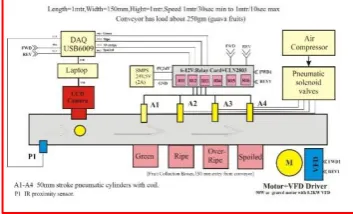
Figure 1 shows the design of computer vision based automatic fruit sorter system for automatic sorting of guava fruits. Conveyor movement is controlled by the ac gear motor with VFD. Fruit presence on the conveyor is detected by IR proximity sensors. The application specific software is programmed using LabVIEW for handling the overall process of fruit sorter system and fruit classification. Fruits are pushed into bins in accordance with the classification, by pneumatic cylinder controlled through a solenoid control valve. The appropriate hardware and software developed for the fruit sorter machine.
Figure 1. Fruit sorter system design
The automated system collects video image from the CCD web camera placed on the top of a conveyer belt carrying Guava fruits, then it processes the images in order to collect several relevant features which are sensitive to the maturity level of the guava fruit. The ROI of the collected image is used to estimate the parameters of the individual classes for prediction of maturity. The recognition is achieved by the nearest neighbor classifier engine uses the HSI color distribution in selected ROI of fruits. Figure 2 shows the actual photograph of the system.
B. Experimental procedure:
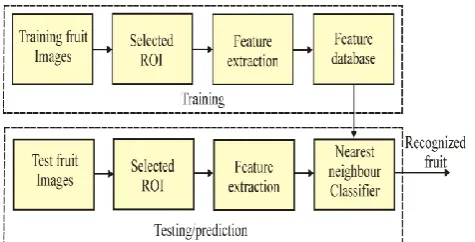
There are two sections involved in the proposed work are training and classification. The block diagram of proposed method is shown in figure 3 of electronic machine vision based system for automatic guava fruit sorting into four different classes as green, ripe, overripe and spoiled. The images were acquired using iball made 12 megapixel webcam in the indigenously developed GUI software developed in LabVIEW12 with vision development suit. The camera was interfaced with a computer through USB port. This software is capable to segment the specific ROI location of image into equivalent HSI values. Some fruit images were used for training purpose and remaining for recognition. The decision making was done using nearest neighbor classifier based algorithm.
Figure 3. Block diagram of Machine Vision System
C. Image acquisition and illumination:
Images were captured using image acquisition software developed in LabVIEW with Iball made webcam connected to USB. Fruit Samples were illuminated by using two fluorescent lamps with a color temperature of 65000K (Philips, Natural Daylight, and 18W) and a color rendering index (Ra) near to 95% [15]. This illumination system gave a uniform light intensity over the fruit sample plane. A digital web camera was located vertically at a distance of 10 cm from the sample. The angle between the camera lens axis and the lighting sources was around 450. Images were captured at resolution 640x480 pixels.
D. Pre-processing of images
The performance of the classifier system depends on the quality of the captured images by the web-camera,
since various features to be evaluated from it. The still frames were extracted using indigenously developed software GUI from the video images having frame rate 30 frames /second. The proposed algorithm was implemented in LabVIEW12 Real Time Environment with vision development suit. Video signal capture from web camera found to be contaminated with motion blur artifact and noise, thus proper extraction of images from video frames and then filtering is needed. The extracted images have background color hence needed feature was extracted from only selected region of interest (ROI).
E. Color image segmentation:
The goal of segmentation is to simplify or change the representation of an image into something that is more meaningful and easier to analyze. The HSI representation is selected due to its invariant properties [16]. The Fruit recognition system shown in Figure 2, need a change in the color space of the images, in order to obtain one channel containing the luminance information and two other channels containing chrominance information. The hue is invariant under the orientation of an object with respect to the illumination and camera direction and hence more suited for object retrieval [17]. The HSI color space is very important and attractive color model for image processing applications because it represents colors similarly how the human eye senses colors. The HSI color model represents each color with three components: hue (H), saturation (S), intensity (I).
F. Training of classifier
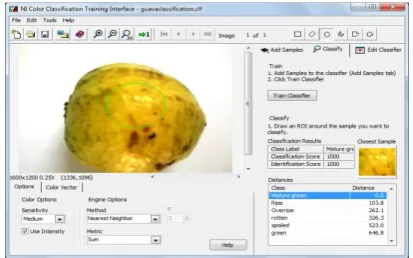
Figure 4. NI color classification training interface
Color Classification Training Interface was used to train a color classifier by manually classifying color samples into new or existing color classes. Based on those samples, the color classifier can classify unknown samples into a known class.
There are various color classification algorithms available in NI color classifier such as k-Nearest Neighbor, Nearest Neighbor and Minimum Mean distance but nearest Neighbor is preferred for this application as per our experimental experience. Nearest Neighbor based classification is most direct approach to classification. In nearest neighbor classification, the distance of an unknown color sample from another class is defined as the distance from the closest samples in the neighbor class. The figure 5 shows complete steps of training the ANN using NI color classification training interface.
Figure 5. Flowchart for use of NI color classification training interface
The classification score is the degree of certainty that a sample is assigned to one class instead of another class.
The identification score is the degree of similarity between a sample and samples in the class to which the sample is assigned. The closest sample image is the learned sample that most closely matches the sample in the ROI. The proper option from the metric list was selected to configure how the classification engine calculates the distance between samples. Sum—Metric used in the classification applications. Sum is also known as the Manhattan metric or Taxicab metric. This is the default Metric value [18].
III.
RESULTS AND DISCUSSION
For the experimental work Lucknow49 type guava fruits of four ripening states as green, ripe, overripe and spoiled (50 samples each state) were collected from orchard located in the Rahata tahsil of Ahmednagar district from Maharashtra state, India at altitude 520 m, latitude 19.72° North, longitude 74.28° East. Three independent human sensory panel experts having more than 10 years of experience of fruit sorting were selected for manual classification of guava fruits in four different ripening states as discussed earlier. From human sorted fruits 50 % fruits from each group were used to train the Ni color classifier and the remaining images serves as the testing or prediction set.
Figure 6. Representative images of fruit samples
process of labeling a color based on previously learned colors was used as a machine vision tool to deciding ripening state of guava fruits
Figure 7. Software front panel
Front panel of the software is the screen, which indicates the ripening stages of fruit. The panel consists of gauge which indicates the acquire image and selected ROI for classification. HSI values calculated from acquired image. The software uses trained classifier file previously prepared using NI color classification training interface as described earlier. The software identifies an unknown color sample of a ROI in image by comparing the region’s color feature to a set of features that conceptually represent classes of known samples (trained classes).The developed intelligent grader software was used practically to discriminate the guava fruit ripening state in four classes. In operational the software acquires the fruit images automatically. As soon as the image of the guava fruit under test is acquired, it automatically displays its ripening state. The conveyor carry the fruit in appropriate bin. The classification accuracy obtained using developed system for guava fruit is presented in Table 1.
Table 1. Performance analysis Sample No. of samples Classification
% Training Testing Expert System
Green 25 25 25 25 100
Ripe 25 25 25 20 80
Overrip e
25 25 25 22 88
Spoiled 25 25 25 23 92
The average efficiency achieved using developed classifier system is 90%, if human grading taken as reference level is assumed to be 100% accurate. However, 10% variation is also due to individual judgment of human-graders in perceiving the ripening level of fruit during manual grading, which of course is inevitable. The repeatability of the developed system is found to be 100% from rigorous experimental work.
IV.
CONCLUSION
The developed system can be used effectively to classify guava fruits. It has been found experimentally that Nearest Neighbor Classifier employing Sum Metric showing good results for said application. It is found that efficiency increases as increasing number of training samples. By analyzing percentage accuracy getting with this system, it is concluded that system is capable to translate effectively human visual perception about guava fruit classification in to machine vision. The system predicts the right class of guava fruit successfully when checked for complete set of fruits used for training as well as in classifying phases. The proposed system has a good future in the field of machine vision based classification and grading of fruits. The study reveals that, the developed system performance is near to the human sensory panel experts, where they judge the ripeness level not only by the skin color but also with firmness and smell.
V.
REFERENCES
[1]. C. S. Nandi,B. Tudu,and C. Koley,"Machine Vision Based Techniques for Automatic Mango Fruit Sorting and Grading Based on Maturity Level and Size," in Sensing Technology: Current Status and Future Trends II,Springer,2014,pp. 27-46.
[3]. M. Dadwal and V. K. Banga,"Estimate ripeness level of fruits using rgb color space and fuzzy logic technique," Int. J. Eng. Adv. Technol.,vol. 2,no. 1,pp. 225-229,2012.
[4]. S. Arivazhagan,R. N. Shebiah,S. S. Nidhyanandhan,and L. Ganesan,"Fruit recognition using color and texture features," J. Emerg. Trends Comput. Inf. Sci.,vol. 1,no. 2,pp. 90-94,2010.
[5]. B. Jarimopas and N. Jaisin,"An experimental machine vision system for sorting sweet tamarind," J. Food Eng.,vol. 89,no. 3,pp. 291-297,2008.
[6]. D.-J. Lee,J. K. Archibald,and G. Xiong,"Rapid color grading for fruit quality evaluation using direct color mapping," Autom. Sci. Eng. IEEE Trans.,vol. 8,no. 2,pp. 292-302,2011.
[7]. Z.Varghese,C.T. Morrow,P.H. Heinemann,H.J. Sommer,Y.Tao,R.W. Crassweller,Automated inspection of golden delicious apples using color computer vision,Am. Soc. Agric. Eng. 16,1682-1689 (1991)
[8]. B. K. Miller and M. J. Delwiche,"A color vision system for peach grading," Trans. ASAE,vol. 32,no. 4,pp. 1484-1490,1989.
[9]. A. A. Al-Janobi,"Color line scan system for grading date fruits," in ASAE Annual International Meeting,1998.
[10]. Y. Tao,P. H. Heinemann,Z. Varghese,C. T. Morrow,and H. J. Sommer Iii,"Machine vision for color inspection of potatoes and apples," Trans. ASAE,vol. 38,no. 5,pp. 1555-1561,1995. [11]. S. A. Shearer and F. A. Payne,"Color and defect
sorting of bell peppers using machine vision," Trans. ASAE,vol. 33,no. 6,pp. 1245-1250,1990. [12]. A. Bouganis and M. Shanahan,"A vision-based
intelligent system for packing 2-D irregular shapes," Autom. Sci. Eng. IEEE Trans.,vol. 4,no. 3,pp. 382-394,2007.
[13]. H. C. Garcia and J. R. Villalobos,"Automated refinement of automated visual inspection algorithms," Autom. Sci. Eng. IEEE Trans.,vol. 6,no. 3,pp. 514-524,2009.
[14]. H. C. Garcia,J. R. Villalobos,and G. C. Runger,"An automated feature selection method for visual inspection systems," Autom. Sci. Eng. IEEE Trans.,vol. 3,no. 4,pp. 394-406,2006.
[15]. Kanade,A.; Shaligram,A.,"Development of machine vision based system for classification of Guava fruits on the basis of CIE1931 chromaticity coordinates," in Physics and Technology of Sensors (ISPTS),2015 2nd International Symposium on ,vol.,no.,pp.177-180,7-10 March 2015
[16]. A. Pal andS. Chauhan,"Development of an Intelligent Virtual Grader for Estimation of Fruit Quality," vol. 62,no. 17,pp. 25-29,2013. [17]. S. Arivazhagan,R. N. Shebiah,S. S.
Nidhyanandhan,and L. Ganesan,"Fruit recognition using color and texture features," J. Emerg. Trends Comput. Inf. Sci.,vol. 1,no. 2,pp. 90-94,2010.