
© 2018 IJSRCSEIT | Volume 3 | Issue 3 | ISSN : 2456-3307
Monetization of IoT Systems by deploying Block chain
Technology to perk up financial transactions using
edge-based analytics
Rajesh Harikrishna
Sr. Assistant Professor, Department of Computer Science and Applications, New Horizon College, Marathalli, Bangalore, India
ABSTRACT
The IoT is generating a fresh era of modernized world, an irrefutable and computable world, where global citizens and all businesses can handle their chattels in efficient well-versed ways. The New form of IoT eco system will bring upgraded hardware, services, protocols and software too. So the Future of IoT in India is giving strong desire of hope which provides the foremost business platform to enrich our knowledge sharing, networking and move towards future. Edge-based analytics is a model which will be deployed by 2018, 50% of IoT data will be stored, processed, analyzed and acted upon at the edge of the network where it is created. In this paper, the upcoming block chain technology how it can be able to monetize with the emerging IoT edge devices analyzed. Then the scope and benefits of edge-based analytics in future of IoT also discussed.
Keywords: IoT, Block Chain, Edge-based analytics
I.
INTRODUCTION
There will be an expected 21 billion connected things by 2020, placing an extreme pressure on network systems. The vast amount of data generated by these smart sensors and devices is currently for the most part being processed in the cloud or data centres, which will not be adequate for long. The essential is arising for another way to handle the quantities of data, and that is edge computing.
The edge computing model comprises sensors and connected devices to communicate with a gateway device, instead of the cloud or server, which processes the information. This technology is better suited for gathering and processing IoT generated data as it can deliver almost immediate analysis. That is important for industrial applications that involve making process changes based on recorded values. It is also has economic implications, as it is less
expensive regarding data management, and by utilizing a gateway device, it negates the cloud network and results in less constricted networks. Another benefit is because of its standalone architecture, the network will remain operational even if there is a problem with one of the device.
II.
INTERNET OF THINGS
new ways. IoT have become ecosystem including hardware, services, software and governing bodies. Under Government of India “Digital India” , “Make in India” & “Smart Cities” plan headed into implementation stage, IoT implementation will evolve all sectors to take the next leap to make these initiatives come true
The IoT will become a new component of asset establishments and its formation. To achieve this success of IoT, the edge devices should be able to cope with block chain technology. The entire IoT platforms have to adopt with block chain technology which can provide a reliable and flexible financial services in future of all life transactions. Thus become the the scale of productivity and efficiency will get increased in revenue transactions and customer satisfaction
III.
BLOCK CHAIN
A. The Concept of BlockChain
Blockchain, also known as a distributed ledger technology, was originally created as a tracking database for Bitcoin transactions. It was developed in 2009 to enable individuals and organizations to process transactions without the need for a central bank or other intermediary, using complex algorithms and consensus to verify transactions. Blockchain is emerging as a potentially disruptive force capable of transforming the financial services industry by making transactions faster, cheaper, more secure and transparent. [7]
The blockchain network lives in a state of accord, one that automatically checks in with itself every ten minutes. A kind of self-auditing ecosystem of a digital value, the network reconciles every transaction that happens in ten-minute intervals. Each group of these transactions is referred to as a “block”. Two important properties result from this:
1) Transparency data is embedded within the network as a whole, by definition, it is public.
2) It cannot be corrupted altering any unit of information on the blockchain would mean using a huge amount of computing power to override the entire network. [8]
B.How Block Chain Works
Step 1: The Sender X wants to send money to receiver Y.
Step 2: The First Block is created online and represents the transaction
Step 3: The block is broadcast to every party in the Network
Step4: Those in the Network approve the transaction and validate it
Step 5: The Block is added to the Chain which provides permanent, non repudiate and transparent record of the transaction.
Step 6: The Receiver receives money from the Sender.
C. The Convergence of IoT and Block Chain
Figure 1. Block Chain Technology [7]
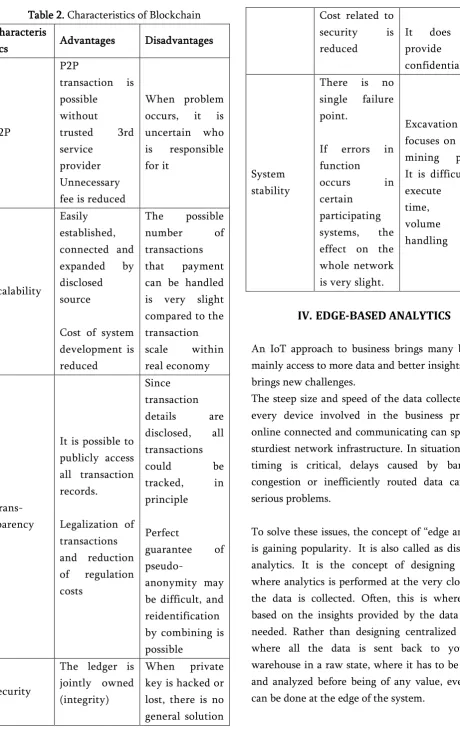
The following two tables illustrate the types of the block chain. [7]
Table 1. Types of Block Chain
Types of
Table 2. Characteristics of Blockchain Characteris
tics Advantages Disadvantages
P2P
P2P
transaction is possible fee is reduced
When problem occurs, it is uncertain who is responsible for it
Scalability
Easily established, connected and expanded by disclosed source
Cost of system development is reduced compared to the transaction publicly access all transaction records.
Legalization of transactions and reduction of regulation costs
Since transaction details are disclosed, all transactions
anonymity may be difficult, and jointly owned (integrity)
When private key is hacked or lost, there is no general solution
Cost related to single failure point. whole network is very slight.
Excavation
IV.
EDGE-BASED ANALYTICS
An IoT approach to business brings many benefits, mainly access to more data and better insights. It also brings new challenges.
The steep size and speed of the data collected when every device involved in the business process is online connected and communicating can sprain the sturdiest network infrastructure. In situations where timing is critical, delays caused by bandwidth congestion or inefficiently routed data can cause serious problems.
Figure 2. IoT edge Analytics [1]
For example, Massive scale CCTV security system, Hours and hours of still footage is likely to be captured for every second of useful video with thousands of cameras covering a large area is been used to detect intruders. It’s likely that 99.9% of the footage captured by the cameras will be of no use. When so much of footage data is being streamed in real-time across the network, It generates huge expense and potential compliance burdens. To avoid this, a model of edge based analytics is used in which the 99% of footages of images could be analyzed within the cameras at the moment it is captured. In this analysis, if anything is identified as useless, that will be discarded or market as low priority, liberating centralized resources to work on data of concrete value. [4]
Companies like Cisco, Intel and others were early proponents of Edge Computing by positioning their Gateways as Edge devices. Historically, gateways performed the function of traffic aggregation and routing. In the Edge computing model, the core gateway functionality has evolved. Gateways do not just route data but also store data and to perform computations on the data as well. Edge analytics allows us to do some pre-processing or filtering of the data closer to where the data is being created. Thus, data that falls within normal parameters can be ignored or stored in a low cost storage and abnormal readings may be sent to the Lake or the in-memory database. [2]
Figure 3. Edge Computing [6]
A. Factors for using Edge Computing
1). Privacy preservation: Data captured by IoT devices can contain sensitive or private information, e.g., GPS data, streams from cameras, or microphones. With Edge Computing, an application can make sure that sensitive data is pre-processed on-site, and only data that is privacy compliant is sent to the Cloud for further analysis, after having passed through a first layer of anonymizing aggregation.
2) Latency Reduction: Network delays happen due to data being shipped to the Cloud and results computed and sent back to the edge. When low-latency results are needed, Edge Computing applications can implement machine-learning algorithms that run directly on IoT devices, and only interact with the Cloud off the critical path, for example, to continuously train machine learning models using captured data.
V.
FINDINGS
1. As a result of examining domestic and foreign cases, it can be understood that the areas where blockchains are most keenly applied in the financial sector are expanding into settlement, remittance, securities and smart contracts.
2. Also, in Domestic, Many of the authentication procedures based on the equipment possessed by the consumers are used so that introduction of the blockchain in the authentication part is major.
3. The shift to introduce a closed private distributed ledger that does not go through the central bank is accelerating in payments between banks.
4. Domestic financial institutions also need joint action by financial institutions through a blockchain consortium to apply blockchain technology to the financial sector.
5. Consumer needs and technological developments are changing. At the same time, as the opportunity to breach on the information held by individuals has expanded, the need for blockchain technology is strongly emerging because of the efforts of the organizations to defend it. 6. Blockchain truly is a mechanism to bring
everyone to the highest degree of accountability. No more missed transactions, human or machine errors, or even an exchange that was not done with the consent of the parties involved. [6]
7. Above all, the most critical area where Blockchain helps is to guarantee the validity of a transaction by recording it not only on a main register but a connected distributed system of registers, all of which are connected through a secure validation mechanism. The internet itself has proven to be durable for almost 30 years. It’s a track record that bodes
well for blockchain technology as it continues to be developed
VI.
CONCLUSION
The massive amount of data generated by IoT devices will put strains on the network, requiring edge devices to get much smarter IoT edge devices. With the increase in computation, storage and networking capabilities edge-based analytics become a critical element to the success of IoT.
Edge devices need to be complemented with Cloud resources to help with coordination and also to off-load computing when the edge is over off-loaded, draining battery, or needs access to large datasets. An edge-only solution, such as Peer-to-Peer (P2P) computing, poses unnecessary complexity given the ready availability of Cloud resources. Fog computing, where accelerated servers or mini-clusters are available close to the edge, will also become feasible within city infrastructure deployments.
The most significant benefit of the blockchain is that it can eliminate inefficiencies in existing financial markets and drive faster, lower-cost transactions that are more efficient and provide increased liquidity, transparency and security. Thus, The blockchain offers trust for the user, eliminating the need for the intermediary and mitigating the risk of human error with complete automation.
VII.
REFERENCES
[1].Edge-centric Computing: Vision and Challenges, Pedro Garcia Lopez, et al, ACM SIGCOMM Computer Communication Review, Volume 45 Issue 5, October 2015.
[2].Demystifying Fog Computing: Characterizing Architectures, Applications and Abstractions, Prateeksha Varshney, Yogesh Simmhan, in IEEE International Conference on Fog and Edge Computing, 2017
[4].https://www.forbes.com/sites/bernardmarr/2016/ 08/23/will-analytics-on-the-edge-be-the-future-of-big-data/#69a204aa3644
[5]. https://www.ibm.com/blogs/internet-of-things/edge-iot-analytics/
[6].https://www.emeraldinsight.com/doi/full/10.110 8/APJIE-12-2017-036
[7].Olleros, X., Zhegu, M. and Elgar, E. (2016), "Blockchain technology: principles and applications", Research Handbook on Digital Transformations, p. 39. Google Scholar]
![Figure 1. Block Chain Technology [7]](https://thumb-us.123doks.com/thumbv2/123dok_us/1035545.1128971/3.595.42.551.44.741/figure-block-chain-technology.webp)
![Figure 2. IoT edge Analytics [1]](https://thumb-us.123doks.com/thumbv2/123dok_us/1035545.1128971/5.595.42.279.62.204/figure-iot-edge-analytics.webp)
