CSEIT172592 | Received : 12 Sep 2017 | Accepted : 24 Sep 2017 | September-October-2017 [(2)5: 414-419]
International Journal of Scientific Research in Computer Science, Engineering and Information Technology © 2017 IJSRCSEIT | Volume 2 | Issue 5 | ISSN : 2456-3307
414
Different QOS Based Comparative Simulation Evaluation of AODV
and OLSR Based on EXTENDED Rate PHY_802.11g for 54 Mbps
Ruchita1, Mamta Sachdeva2, Jonish3
¹M-Tech Department of CSE, SITM, Sonepat, Haryana, India ²Department of CSE, SITM, Sonepat, Haryana, India
³Department of CSE, Sonepat, Haryana, India
ABSTRACT
In this paper analysis of Comparative performance of OLSR and AODV is done for Extended Rate PHY (802.11g) on 54mbps data rate. We used OPNET Simulation tool we created a network containing 25 mobile nodes with data rate 54 Mbps with transmission power 0.005 watts and buffer size 256000 bits each node moves randomly in the network and simulation time was 1500 sec. OLSR And AODV on Extended Rate PHY (802.11g) WLAN are compared in terms of 54 Mbps for different QOS’s. According to the resulted performance we can say that OLSR performed better in our QOS with Extended Rate PHY (802.11g). The simulation result of the research has practical reference value for further study.
Keywords : MANET, QOS, OPNET, IEEE, OLSR, AODV
I.
INTRODUCTION
Mobile Ad hoc network (MANET) is a dynamic network formed without the use of any existing infrastructure or centralized administration. Each device in a MANET is free to move independently in strengths of reactive routing and proactive routing protocols. In this method communication in MANET is possible when nodes are near to each other and the supposition that changes in topology are only important if they happen in the vicinity of a node. Wireless LAN is the major issue in data communication’s performance of MANET other than Routing Protocols. Hence, Wireless LAN required is to be effective and accurate so as to handle mobility of nodes and to give best utilization to technology. Routing protocol is a
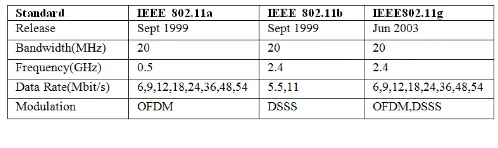
standard that determines how nodes find the way to forward packets between devices in the network. IEEE 802.11a/b/g WLAN Standard. [2]
Table I. IEEE 802.11 Classifications
II.
RELATED WORK
Jonish [1] analyzed the performance of TORA and GRP routing protocol with the use of OPNET simulation tool, they created a 50 mobile nodes network on data rate 1 and 2 Mbps and transmission power 0.005 watts with buffer size 256000 bits the time of simulation was 1500 sec. TORA and GRP routing protocols were compared in terms of Download Response Time, Upload Response Time, Delay, Load and Media Access Delay in scenario for the simulation analysis and performances.
application traffic on IEEE 802.11 WLAN Standard and 48 Mbps data rate. The network performance is evaluated by using OPNET simulator based on various quantitative metrics- Network Load, Throughput, Retransmission Attempts and Media Access Delay by varying physical characteristics and number of nodes. A comparative performance analysis of these protocols have been carried out in this paper and in the last conclusion will be presented which demonstrate that performance of routing protocols differs by varying the network and selection of accurate routing protocol according to the network ultimately influences the efficiency of the network in a magnificent way.
Kuldeep vats [5] analyzed the performance of DSR, OLSR and GRP routing protocols. They used OPNET simulation tool. They created a network containing 150 mobile nodes with the data rate of 18 mbps and transmit power of 0.11 watts. Each node moves randomly within the network range 10,000 sq m and Simulation time was 1000 sec. According to their simulation result OLSR presented the best performance and GRP presented low to OLSR and high to DSR or finally DSR presented the low performance (DSR<GRP<OLSR) is analyzed.
III.
WIRELESS LAN
A wireless local area network (WLAN) is a wireless computer network that links two or more devices using a wireless distribution method (often spread-spectrum or OFDM radio) within a limited area such as a home, school, computer laboratory, office building or campus. This gives users the ability to move around radio waves for transferring information wirelessly over a network.
Few people realize, however, that the 802.11 standard also includes the 802.11 Infrared (IR) Physical Layer 802.11 IR defines 1Mbps and 2Mbps operation by bouncing light off ceilings and walls to provide connectivity within a room or small office. The reason that 802.11 IR is unheard of is that there are no known vendors that sell products compliant with 802.11 IR.
The primary difference between infrared and radio wireless LANs is the frequency of the transmitted signal. Don't become complacent with radio frequency (RF) technologies, such as 802.11a and 802.11b, as the only option for wireless LANs. An infrared wireless LAN might do a better job of satisfying requirements for mobile applications.
IV.
SIMLATION SETUP
OPNET Modeler is commercial network simulation environment for network modeling and simulation the version named OPNET Modeler 14.5 has been adopted in our study. It allows the users to design and study communication networks, devices, protocols, and applications with flexibility and scalability [12]. It is easy to work with GUI interface and the OPNET provides us the GUI interface to work. And it is easy to built model of working in GUI Virtual environment. It simulates the network graphically and gives the graphical structure of actual networks and network components.
TABLE II
SIMULATION PARAMETERS
Simulation Parameter Value
Simulator OPNET Modular 14.5
Area 1500*1500
Network Size 25 Nodes
Data Rate 54 Mbps
Mobility Model Random waypoint Simulation Time 1500 sec
Address Mode IPV6 Neighbor Hold Time(Sec) 6.0 Topology Hold Time(Sec) 15.0 Duplicate Message Hold
Time(Sec)
30.0
TABLE IV
WIRELESS LAN PARAMETERS
Attribute Value
Physical Characteristics Extended Rate (802.11g)
Data Rate 54 Mbps
Short Retry Limit 9 Long Retry Limit 7 Max Receive Lifetime (sec)
0.5
Buffer Size(bits) 1024000 Roaming Capability Enabled
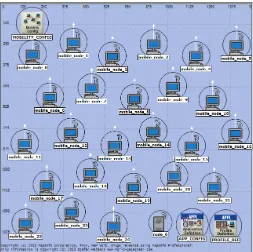
Fig. 1 shows the simulation environment of scenario containing 25 WLAN mobile nodes, one fixed WLAN Server, Application definition, Profile definition and Mobility config. We configure the nodes in the scenario to work with 54 Mbps data rate. Figure 2 Shows Process Model.
Fig. 1 Network Model for 25 Nodes scenario
Fig. 2 Process Model of TCP Manager
V.
PERFORMANCE MERICS
A. Wireless LAN Delay B. Wireless LAN Load C. Media Access Delay D. Network Load E. Throughput
VI.
SIMULATION RESULTS AND ANALYSIS
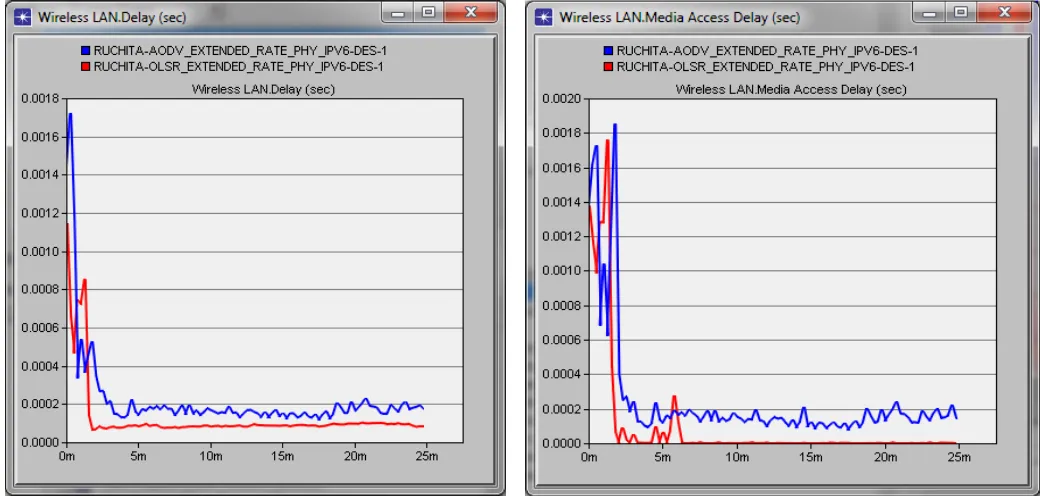
A. Wireless LAN Delay
Fig. 3 Sample Sum for Wireless LAN Delay in 54 Mbps for Extended Rate 802.11g
B. Wireless LAN Load
Fig. 4 Sample Sum for Wireless LAN Load in 54 Mbps for Extended Rate 802.11g
C. Media Access Delay
Fig. 5 Sample Sum for Media Access Delay in 54 Mbps for Extended Rate 802.11g
D. Network Load
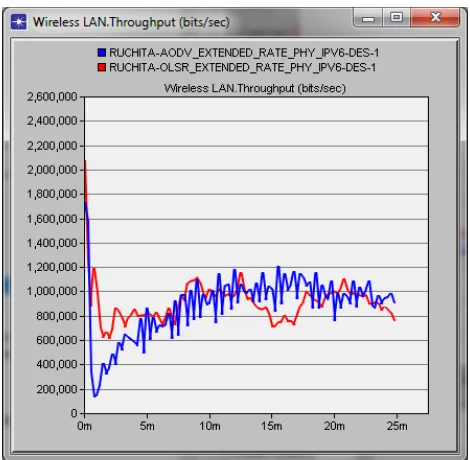
E. Throughput
Fig. 7 Sample Sum for Throughput in 54 Mbps for Extended Rate 802.11g
VII.
CONCLUSION
In this paper performance of Extended Rate 802.11g is evaluated with the use of AODV and OLSR Protocol for metrics as shown in table below by using 25 nodes scenario with IEEE 802.11g Extended Rate in 54 Mbps. From the above discussion we find out that.
TABLE 5. RESULTING VALUES possibilities to be worked on. After seeing these results I wonder why these are not widely used. An IEEE 802.11g Extended Rate might do a better job of satisfying requirements for mobile applications with OLSR routing protocol. The simulation result of the research has practical reference value for further study.
VIII.
REFERENCES
[1]. R Jonish, Kapil Chawla, "Different QOS Based Simulation Evaluation of TORA and GRP Routing Protocol Based on Frequency Hopping", IJCSMC, Vol. 3, Issue. 11, November 2014, pg. 523 – 531.
[2]. Anjali, Maninder Singh, "Performance Analysis of Proactive, Reactive and Hybrid MANET Routing Protocols on IEEE 802.11 Standard", International Journal of Computer
Applications,pp.1-8,Volume
54-No.12,September 2012.
[3]. Anjali, Maninder Singh, "Simulation and Performance Analysis of AODV, OLSR, GRP Routing Protocol by considering IEEE 802.11Standard", IJARCSSE, Volume2, issue 6, pp-171-178,June 2012.
[4]. Ravinder Ahuja, "Simulation based Performance Evaluation and Comparison of Reactive, Proactive and Hybrid Routing Protocols based on Random Waypoint Mobility Model", International Journal of Computer Applications, Vol. 7, No.11, pp. 20-24, Oct. 2010.
[5]. Kuldeep Vats, Monika Sachdeva and Dr. Krishan Saluja, "Simulation and performance Analysis of OLSR, GRP, DSR Routing Protocol using OPNET", International Journal of Emerging trends in Engineering and Development, Vol.2 ,Issue 2, pp 390-404, March-2012.
[6]. Pravin GhoseKar, Girish Katkar and Dr. Pradip Ghorpade, "Mobile Ad Hoc Networking: Imperatives and Challenges",IJCA, pp. 153-158, 2010.
[7]. Xiaoyan Hong, Kaixin Xu and Mario Gerla, "Scalable Routing Protocols for Mobile Ad Hoc Networks", IEEE Network, vol. 16, issue 4, pp 11-21, Aug.2002.
[8]. Mostafa Fazeli, "Assessment Of Throughput Performance Under OPNET Modeler Simulation Tools In Mobile Ad Hoc Networks (MANETs)" 3rd ICCI,CSN , IEEE 2011.
[10]. Guo, L, and Peng, Y. (2010) "Performance evaluation for on-demand routing protocol based on OPNET modules in wireless mesh network" Computer and Electrical Engineering (Elsevier), vol. 37(2011), pp. 106-114.
[11]. T.H. Clausen, "The optimized link state routing protocol evaluating through experiments and simulation" mind pass centre for distributed system, Aalborg university ,Denmark.
[12]. Wikipedia Internet :
http://en.wikipedia.org/wiki/IEEE_802.11g-2003 [13]. Opnet Technologies, Inc. "Opnet Simulator,"